EPS Sandwich Panel Safety: Fire, Moisture & Durability

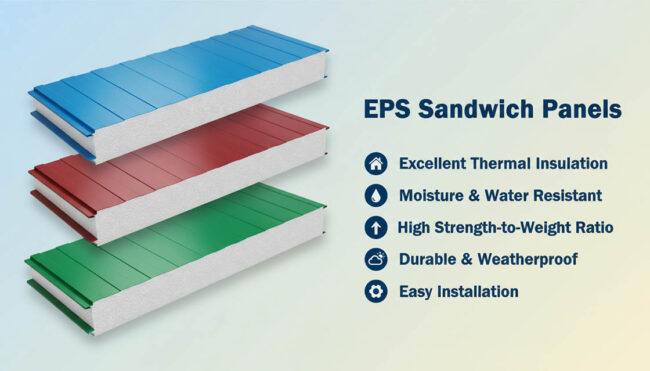
When you’re specifying an EPS sandwich panel for a cold storage warehouse or clean room, fire resistance, moisture protection, and long-term durability aren’t nice-to-have features — they’re the difference between passing inspection and tearing out walls two years early. Too many procurement officers learn this the hard way after a panel fails a fire test…


Modular Home 8 Key Things to Research Before Buying a Modular Home

8 Key Things to Research Before Buying a Modular Home

Most modular home buyers discover too late that factory specs don’t always match field performance. We’ve seen projects where insulation claimed at R-21 delivered closer to R-14 after installation — thermal bridging through steel framing eats into the rating before modules even leave the plant. That gap doesn’t show up on a spec sheet. At…

EPS vs XPS How EPS and XPS Perform Under Real-World Conditions

EPS vs XPS: R-Value, Moisture, Strength & Cost Compared

Most specifiers reach for XPS when they need below-grade moisture resistance. It’s the default choice on many drawings. But here’s what the trade literature doesn’t always emphasize: EPS retains its R-value longer over the service life of a building. That difference matters. A cold storage facility runs for 20 years, and every point of R-value…

EPS vs Polyurethane SIPs EPS vs Polyurethane SIPs: How to Choose the Right Insulation

EPS vs Polyurethane SIPs: How to Choose the Right Insulation

The upfront price tag on Expanded Polystyrene (EPS) panels looks tempting until you calculate the refrigeration load for a clean room or cold storage facility. When you are speccing industrial modular structures, choosing between EPS vs Polyurethane SIPs is not just a material selection—it is a decision that dictates your operational energy costs for the…

Container Houses Container Houses: Expandable vs Folding

Container Houses: Expandable vs Folding

The container housing sector has moved past the days of simply cutting a hole in a shipping box and calling it a home. The real engineering challenge now sits in how the structure deploys — and two competing mechanisms dominate: expandable and folding. Both claim speed, efficiency, and cost savings, but they solve opposite problems.…

PUF Panels What Thermal Ratings Matter Most

Why PUF Panels Lead in Energy Efficient Thermal Insulation

Rising energy costs are gutting margins in modern cold storage, and conventional insulation often fails to meet stricter thermal codes without inflating wall thickness. Specifying PUF panels is not just about checking an R-value box on a spec sheet; it is about guaranteeing the building envelope performs a decade down the line without thermal bridging…

Prefabricated Construction What Is Prefabricated Construction?

What Is Prefabricated Construction? A Complete Overview

Prefabricated construction shifts building from a field craft to a manufacturing discipline by producing structural components in a controlled off-site facility. The market reflects this urgency, valued at USD 175.9 billion in 2025 and projected to nearly double by 2035. Procurement officers are moving past the old “temporary building” stigma to secure the speed and…

Dry vs Cold Rooms Quick Comparison Framework

Dry vs Cold Rooms: Key Differences & Industry Applications

Most people assume dry rooms and cold rooms are interchangeable — they both control temperature, right? Wrong. One manages humidity; the other manages cold. Get the distinction wrong, and you’re looking at product spoilage, failed compliance inspections, or a HVAC system running at 110% capacity for no reason. We’ve seen it across food processing, pharma,…

Cold Storage How to Calculate the Volume of Cold Storage

How to Calculate the Volume of Cold Storage

Underestimating cold storage volume eats into profit margins faster than refrigeration costs. Most facility planners assume the external dimensions translate directly to pallet capacity, but that math ignores the physical reality of the building envelope. At RaxPanel, we factor in that a standard high-efficiency insulated panel system reduces internal clearances by roughly 200mm per wall,…

EPS R-Value EPS R-Value: Thickness, Density & ASTM C578

EPS R-Value: Thickness, Density & ASTM C578

Most spec sheets rank EPS as the weakest rigid foam per inch. That assumption costs you money. At RaxPanel, we watch buyers reach for XPS on cold storage projects without running the full cost-per-R-value calculation. The EPS R-Value lands between R-3.6 and R-4.4 per inch, and it holds that number for decades. The foam is…