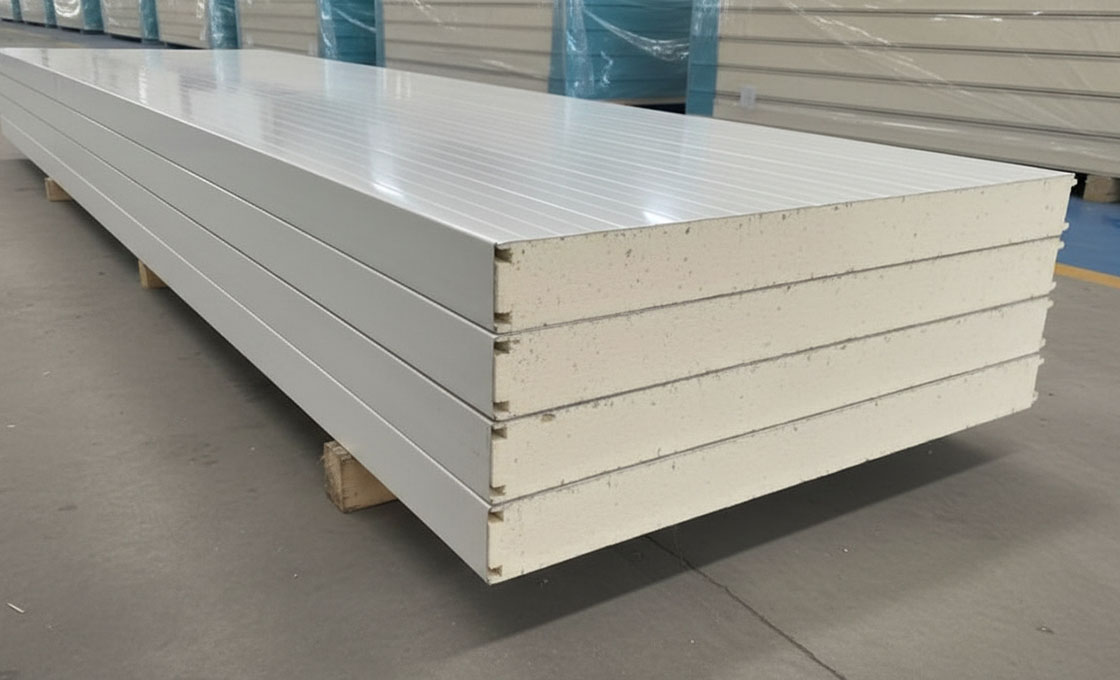
Most spec sheets rank EPS as the weakest rigid foam per inch. That assumption costs you money. At RaxPanel, we watch buyers reach for XPS on cold storage projects without running the full cost-per-R-value calculation. The EPS R-Value lands between R-3.6 and R-4.4 per inch, and it holds that number for decades. The foam is air-blown, so there are no blowing agents to escape and no thermal drift to budget around. ASTM C578 governs every density grade, and it’s the standard most specifiers skip when they’re racing a deadline.
We walk through how EPS thickness maps to target R-value, decode the ASTM C578 Type system so you select the right density for your structural load, and show where the density-to-performance trade-offs actually cost you money. You’ll get a clear specification framework that locks in code compliance without padding your budget.

How R-Value Scales with Board Thickness
Thermal resistance in EPS (Expanded Polystyrene) increases predictably and linearly with board thickness. To determine the necessary dimensions, divide the target total R-value by the material’s steady-state R-value per inch, typically ~3.85 for standard densities.
The Linear Correlation Between Thickness and Resistance
Unlike some insulation materials that suffer from thermal drift or aging complications, EPS maintains a consistent R-value per inch over its service life. This linear correlation means that doubling the thickness of the board effectively doubles its thermal resistance. For specifiers, this removes complexity from the equation: you are essentially stacking identical thermal barriers. Whether you are utilizing a 0.90 lb/ft³ density or a higher 1.80 lb/ft³ grade as found in our ASTM C578 compliant manufacturing, the scaling factor remains consistent. It is critical, however, to remember that while R-value scales up, the physical footprint of the panel scales with it, impacting dimensional planning for refrigerated trucks and cold storage rooms.
Calculating Required EPS Thickness for Target R-Values
To achieve specific energy efficiency goals, you must work backward from the required thermal resistance of the assembly. The calculation is straightforward: Required Thickness (inches) = Target R-Value ÷ R-Value per Inch. While we manufacture a broad spectrum of densities to suit diverse load-bearing needs, the industry-standard approximation for EPS is roughly R-3.85 per inch. Below is a reference table for estimating core thickness based on standard thermal targets, excluding the facings.
| Target R-Value | Approx. Thickness (Inches) | Approx. Thickness (mm) | Typical Application |
|---|---|---|---|
| R-10 | 2.6″ | 65 mm | Seasonal Storage, Garage Doors |
| R-15 | 3.9″ | 100 mm | Coolers (+4°C), Partition Walls |
| R-20 | 5.2″ | 130 mm | Freezers (-18°C), Exterior Walls |
| R-30 | 7.8″ | 200 mm | Deep Freeze (-25°C), Low-Energy Buildings |
📋 Specification Calculation Steps
- Step 1: Define the interior/exterior temperature delta and required energy efficiency code.
- Step 2: Determine the total assembly R-value required, subtracting the R-value contribution of facings (GRP, Metal, etc.).
- Step 3: Divide the remaining required R-value by 3.85 (or specific grade R-value) to find the exact EPS core thickness needed.
Impact of Increased Thickness on Panel Weight and Cost
While thicker insulation provides better thermal performance, it introduces two critical constraints: weight escalation and logistical volume. EPS is inherently lightweight—approximately 1.5 to 2.2 lbs per cubic foot depending on the density grade—but moving from a 50mm core to a 150mm core triples the material volume and weight. For truck body applications, this additional dead weight directly reduces payload capacity. In construction, thicker panels demand deeper window and door reveals, increasing structural complexity.
We have found that many procurement teams underestimate the shipping costs associated with thicker panels. Because EPS is bulky, increasing thickness drastically reduces the number of panels that fit into a standard 40-foot container. At Rax Panel, our engineering team routinely runs “freight-to-performance” calculations for our global clients. We often recommend optimizing density rather than just adding thickness, ensuring you meet the R-value target without blowing your budget on overseas shipping or sacrificing payload capacity in refrigerated fleets.

Understanding the ASTM C578 Type System
ASTM C578 is the definitive standard for rigid cellular polystyrene, classifying EPS by density and compressive strength to ensure specifiers match the material grade precisely to structural demands.
Decoding Density and Compressive Strength Categories by Type
The ASTM C578 classification system serves as a universal language for specifiers, removing ambiguity about what “high-quality” foam actually means. Rather than relying on vague marketing terms, this standard categorizes EPS based on two critical physical properties: density and compressive strength. Density, expressed as pounds per cubic foot (lb/ft³), acts as a proxy for the material’s cellular structure. Higher density indicates a tighter configuration of polymer beads, which directly correlates with improved durability and resistance to moisture absorption over the service life of the panel.
Compressive strength measures the foam’s ability to resist deformation under load, typically calculated at 10% deformation or yield. In the context of sandwich panels, this metric is non-negotiable. A low-density foam might provide adequate thermal resistance, but it lacks the mechanical rigidity required to support heavy facings or withstand impact loads. We strictly monitor these parameters in our production lines because even minor deviations in density can significantly alter the bond line integrity between the EPS core and the GRP or metal facings.
- Density Consistency: Ensures uniform thermal performance and prevents weak spots in the insulation envelope.
- Deformation Resistance: Higher compressive ratings are essential for panels that must support suspended equipment or withstand heavy traffic.
- Cell Structure Integrity: Denser grades exhibit superior dimensional stability when exposed to temperature cycling.
Selecting the Correct ASTM Type for Structural Load Needs
Choosing the right ASTM type is a decision driven by mechanics, not just thermal efficiency. For standard cold storage wall panels where the primary load is wind pressure and the weight of the panel itself, mid-density types often provide the most economical balance. However, the application context shifts dramatically when considering flooring or roofing. In refrigerated truck bodies, for example, the floor is subjected to concentrated point loads from forklifts and pallet jacks. Using a standard grade EPS in this scenario invites creep—permanent deformation that compromises the flatness of the floor and the structural bond to the substrate.
In our R&D lab, we frequently test panels under load to verify that the specified foam type meets the real-world stress distribution of the application. High-density types are engineered specifically for these punishing environments, offering a rigid substrate that prevents denting and crushing. When specifying for industrial flooring or foundational applications, overspecifying is often cheaper than the cost of retrofitting a failed floor. The engineering significance here is clear: the compressive strength rating must always exceed the maximum expected live and dead loads of the installed system.
Ensuring Compliance: Specifying EPS per ASTM C578 Standards
For B2B buyers and procurement officers, compliance is the ultimate safeguard against project failure. Specifying “white foam” is an invitation for suppliers to substitute lower-grade materials. To ensure compliance, purchase orders and technical submittals must explicitly reference the ASTM C578 type designation (e.g., “Type IX” rather than just “1.35 lb/ft³ EPS”). This legal notation binds the manufacturer to deliver material that has been tested and verified to meet the minimum density and compressive strength requirements of that specific classification.
Transparency in the supply chain is critical. We provide full compliance documentation for every batch, allowing our clients to trace the material properties back to independent lab tests. Without this verification, you risk installing “grey market” insulation that may initially look correct but will degrade rapidly under stress or moisture exposure. Strict adherence to ASTM C578 not only ensures engineering performance but also satisfies the rigorous demands of building inspectors and insurance auditors who require proof that materials meet the specified fire and structural safety codes.
- Specification Language: Always include the ASTM C578 type number in contracts to prevent material substitution.
- Documentation: Request mill certificates verifying density and compressive strength for every shipment.
- Verification: Conduct random field density checks using core samples to confirm compliance with the submitted data.
| ASTM Type | Density Range (lb/ft³) | Compressive Strength | Rax Application | Key Benefit |
|---|---|---|---|---|
| Type II (Standard) | 0.90–1.00 | 10–15 psi | Cold Storage Wall Panels | Type II EPS (Standard) at 0.90–1.00 lb/ft³ delivers 10–15 psi compressive strength and is the baseline choice for cold storage wall panels. Economical thermal efficiency for standard insulation needs |
| Type VIII EPS (High-Density) at 1.50–1.80 lb/ft³ delivers 40–50+ psi compressive strength for industrial flooring and foundation applications. |
| Density: 1.50–1.80 lb/ft³ |
| Compressive Strength: 40–50+ psi |
| Application: Industrial Flooring & Foundations |
| Key Feature: High load-bearing capacity with superior moisture resistance |
How Density Affects R-Value in Each EPS Type
Higher-density EPS delivers a marginal thermal gain per inch, but provides a dramatic increase in compressive strength. Selecting the right density balance is critical for cold storage and below-grade applications.
Many buyers operate under the assumption that higher-density EPS always means better insulation. The reality is more nuanced. Thermal resistance in EPS is primarily driven by the gas trapped within the closed-cell structure, not by the polymer mass itself. Density influences how much polymer surrounds each cell, which subtly affects the R-value per inch, but the relationship is far from linear.
ASTM C578 Density Types and Their R-Value Performance
ASTM C578 classifies EPS into Types I through IX based on density and compressive strength. The standard thermal resistance values per inch for common types are well established:
- Type I (Packaging Foam): Approximately 1.0 lb/ft³ density with an R-value of roughly R-3.6 to R-3.8 per inch. This type is not suitable for construction-grade insulation due to low structural capacity and higher moisture absorption risk.
- Type II: Typically 1.5 lb/ft³ density, delivering an R-value of approximately R-3.8 to R-4.0 per inch. This is the minimum type commonly specified for below-grade and cold storage wall panel applications.
- Type IV: Around 2.0 lb/ft³ density, providing an R-value of approximately R-4.0 to R-4.2 per inch alongside significantly improved compressive strength, often exceeding 20 psi.
- Type V and above: Densities from 2.5 to 3.0+ lb/ft³ yield R-values of approximately R-4.2 to R-4.4 per inch, with compressive strengths reaching 30 to 50+ psi for heavy-load flooring and roofing scenarios.
The thermal jump from Type II to Type IV is roughly 0.2 to 0.4 R-value per inch. While that may appear meaningful on paper, the real performance driver at higher densities is structural reliability, not thermal superiority. A Type IV panel at 2.0 lb/ft³ will not insulate dramatically better than a Type II panel at 1.5 lb/ft³, but it will resist far greater compressive loads and maintain dimensional stability under heavier snow or equipment loads.
Why the Density-to-R-Value Relationship Is Not Linear
The R-value of EPS comes from the insulating gas (typically pentane or air, depending on formulation) sealed inside each closed cell. As density increases, the cell walls become thicker and the overall polymer content rises, but the gas fill ratio does not decrease proportionally. This means the thermal resistance per inch improves only slightly with each density step-up.
Conversely, compressive strength scales much more aggressively with density. A doubling of density from 1.0 lb/ft³ to 2.0 lb/ft³ may only add 0.2 to 0.4 R-value per inch, but it can triple or quadruple the compressive strength. For cold storage wall panels, this means specifying a higher density than strictly necessary for thermal performance is almost always a structural decision, not an insulation decision.
Cost Implications of Density Selection
Density directly impacts material cost. Higher-density EPS contains more polymer per cubic foot, which raises the unit cost of the core material. For a project specifying R-20 wall panels, selecting Type IV over Type II may increase the core material cost by approximately 20 to 30 percent, while delivering only a marginal thermal improvement that could be offset by a slight thickness adjustment instead.
The smart procurement approach is to first determine the minimum compressive strength required for the application, then select the lowest-density ASTM C578 type that meets that structural threshold. This ensures you are not overpaying for density you do not need, while still achieving the target R-value through proper thickness specification rather than unnecessary density inflation.
Graphite-Enhanced EPS: A Density Alternative for Higher R-Values
For projects that require higher R-values without increasing density or thickness, graphite-enhanced EPS offers a compelling alternative. Graphite particles dispersed within the EPS beads improve infrared radiation reflection, effectively boosting the R-value per inch by approximately 10 to 15 percent compared to standard white EPS at the same density.
This means a Type II graphite-enhanced EPS panel can achieve an R-value comparable to a standard Type IV panel, while maintaining the lower density, lighter weight, and reduced material cost of the Type II grade. For cold storage wall panels where weight constraints and budget sensitivity are both critical, graphite-enhanced EPS at a moderate density often represents the optimal balance of thermal performance, structural capacity, and cost efficiency.
Picking the Right Thickness and Density for Your Project
Selecting the correct EPS panel configuration is one of the most consequential decisions in cold storage design. A panel that is too thin for its operating zone creates thermal bridges and compressor overload, while an over-specified panel inflates capital costs without proportional energy return. The challenge is not finding the highest R-value on paper, but matching density and thickness to the actual thermal load, structural demands, and lifecycle economics of each zone.
The right panel isn’t the thickest or densest—it’s the one engineered to the specific thermal, structural, and economic profile of your project’s coldest zone.
Matching Panel Thickness to Thermal Zone Requirements
The most common and costly error in cold chain construction is applying a single panel thickness across all temperature zones. A facility housing both a chiller room and a deep freezer demands fundamentally different insulation strategies, yet many specifications default to uniform thickness for simplicity. This approach guarantees thermal bridging at the freezer boundary, condensation on interior surfaces, and compressor runtime that can exceed design estimates by 30% or more.
The decision framework starts with the coldest zone. Every other compartment in the facility must meet or exceed that zone’s thermal resistance, but no panel should be undersized for its designated temperature band. For above-grade wall applications requiring a minimum R13, industry practice establishes a baseline of at least 3 inches of EPS. Achieving R20 in the same application typically requires 4 inches or greater, with the exact thickness contingent on the density selected. These thresholds shift significantly for below-grade or ultra-low freezer environments where thermal loads are substantially higher.
Thickness selection also interacts with structural performance. Thicker panels provide greater bending resistance, which matters for long-span wall installations and roof applications where deflection limits are strict. However, increased thickness adds weight, raises material cost, and can complicate handling and installation logistics. The optimal point sits where thermal performance, structural capacity, and installability converge—not at the maximum thickness available.
Density Selection Across Multi-Temperature Facilities
Multi-temperature cold storage facilities require a zone-by-zone density strategy, not a one-size-fits-all approach. Interior partition walls between conditioned spaces face far lower thermal loads than exterior walls exposed to ambient temperature swings. Deploying high-density panels on interior dividers wastes material budget, while under-specifying exterior walls in freezer zones creates chronic performance gaps.
The engineering logic follows a simple hierarchy: exterior envelope panels demand higher density and greater thickness to resist both conductive heat transfer and structural loads from wind, seismic activity, and stacking. Interior partition panels can often operate effectively at lower densities, provided they meet the minimum compressive strength required for their application. This tiered approach can reduce total material costs by 15–25% without compromising any zone’s thermal performance.
Density selection also influences moisture management. Higher-density EPS contains a greater proportion of closed cells per unit volume, which reduces water vapor transmission and improves dimensional stability in high-humidity environments. For freezer applications where condensation and ice formation are constant threats, the moisture resistance advantage of denser panels justifies the incremental cost in virtually all commercial installations.
Evaluating Cost versus Performance Trade-offs
The persistent question among project owners is whether upgrading from standard EPS to higher-performance alternatives like PIR or edge-sealed polyurethane panels delivers sufficient lifecycle value to warrant the premium. The answer depends entirely on the application’s thermal severity, energy costs, and projected facility lifespan.
For above-grade wall applications in moderate cold storage ranges, standard EPS typically delivers the strongest return on investment. Its R-value per inch, while lower than PIR or PU, is stable over time and unaffected by long-term gas diffusion—the very mechanism that causes PIR and PU panels to lose 5–15% of their initial thermal resistance within the first decade. When energy costs are factored over a 20-year facility life, the upfront savings from EPS frequently offset its slightly lower thermal efficiency.
PIR and edge-sealed PU panels become justifiable when space is at a premium or when ultra-low freezer temperatures demand maximum thermal resistance in minimal thickness. In these scenarios, the higher initial panel cost is offset by reduced building footprint, lower structural support requirements, and faster payback through energy savings. The decision matrix should weigh three variables: required thermal resistance, available installation space, and total lifecycle energy cost.
- Standard EPS (above-grade, moderate cold storage): Lowest upfront cost, excellent long-term R-value stability, best lifecycle ROI when space is not constrained
- Graphite-enhanced EPS: Bridges the gap between standard EPS and PIR, offering higher R-value per inch while maintaining EPS’s moisture resistance and cost advantage
- PIR panels: Highest initial R-value per inch, but subject to thermal drift over time; best suited for space-constrained or ultra-low temperature applications
- Edge-sealed PU panels: Combines PU’s thermal performance with reduced air leakage at panel joints; justifiable where energy efficiency targets are paramount
Structural and Installation Considerations
Panel selection extends beyond thermal performance into structural and installation realities. Thicker, higher-density panels are heavier and require more robust handling equipment during installation. In retrofit scenarios or facilities with limited access, the weight penalty of over-specification can become a practical constraint that outweighs marginal thermal gains.
Joint design and installation quality also determine whether the theoretical R-value translates into real-world performance. Even the best-specified panel underperforms if thermal bridges form at joints, corners, or penetrations. Edge-sealed panel configurations, interlocking tongue-and-groove joints, and properly specified gasket materials all contribute to maintaining the designed thermal envelope. These installation details should be evaluated alongside density and thickness during the specification phase, not addressed as afterthoughts.
The material’s service temperature, age, and installation quality all influence the actual thermal performance achieved in the field. Panels specified for extreme cold environments should be evaluated not only for their rated R-value but also for their ability to maintain structural integrity and dimensional stability under repeated thermal cycling. EPS panels, when specified at the correct density and thickness for their designated zone, have demonstrated consistent performance across decades of cold chain operations worldwide.
📋 Decision Framework: Selecting Panel Thickness and Density
- Step 1: Identify the coldest operating
Density (lb/ft³) R-Value per Inch Ideal Thickness Temperature Range Best Application 0.90 – 1.00 ~3.6 – 3.8 2 – 3 inches +4°C to +10°C (Chiller Zones) Light commercial cold storage, above-grade walls 1.05 – 1.20 ~3.8 – 4.0 3 – 4 inches -10°C to +4°C (Cooler Zones) Refrigerated truck bodies, standard cold rooms 1.25 – 1.50 ~4.0 – 4.2 4 – 6 inches -20°C to -10°C (Freezer Zones) Deep-freeze cold storage, below-grade foundations 1.55 – 1.80 ~4.2 – 4.5 6 – 8+ inches -30°C and below (Ultra-Low Freezer) Industrial freezer warehouses, extreme cold logistics Custom (0.90 – 1.80) 3.6 – 4.5 (density-dependent) Engineered per project specs Full cold-chain spectrum ASTM C578-compliant custom sandwich panels with GRP, Aluminum, or Steel facings Explore Our Cold Room Panel Solutions.Find wall and ceiling panel options with detailed specifications for refrigeration and cold storage applications on this product page.
Common EPS Specification Mistakes to Avoid
Most EPS specification failures stem from five recurring errors: misreading density versus R-value, confusing panel types, ignoring ASTM C578 compliance, applying identical specs to exterior and interior walls, and underestimating below-grade moisture dynamics.
1. Density Misconception: Higher Density Does Not Equal Proportionally Better Insulation
A widespread assumption in cold storage procurement is that higher-density EPS automatically delivers proportionally higher thermal resistance. This is incorrect. EPS thermal performance increases only marginally with density because the R-value is primarily determined by the closed-cell structure and gas fill, not by mass alone.
Type II EPS (1.0–1.25 lb/ft³) typically achieves an R-value of approximately 3.8 per inch, while Type IV EPS (1.5–1.75 lb/ft³) reaches roughly R-4.2 per inch. The 0.4 difference in thermal resistance comes with a 25–40% increase in material weight and cost. For many cold storage wall panel applications, Type II is the more economical and functionally sufficient choice, provided compressive strength requirements are met.
is often negligible compared to the substantial performance gaps between different insulation materials. Beyond simple density, the selection of the correct panel chemistry becomes the most critical decision in cold storage design.
Understanding these EPS density differences is essential, but it is only one piece of a broader selection challenge that extends well beyond EPS alone.
2. Panel Type Confusion: Mixing Up EPS, XPS, PIR, and PU for Cold Storage
Cold storage projects frequently involve a decision between EPS, XPS, PIR, and PU edge-sealed panels. Each material carries distinct thermal, moisture, and cost profiles that are not interchangeable. PIR offers the highest R-value per inch (approximately R-6 to R-7) but at a significantly higher price point and with different fire-rating characteristics. XPS delivers strong moisture resistance and an R-value around 5.0 per inch but is substantially more expensive than EPS and not recommended for all below-grade applications without careful evaluation.
EPS remains the most cost-effective option for large-volume cold storage wall panels when thermal performance requirements fall within its operational envelope. The mistake occurs when buyers either default to PIR or XPS without evaluating whether EPS meets their specific temperature zone, or conversely, specify EPS for applications requiring higher thermal resistance without adjusting panel thickness accordingly.
Such selection errors are frequently rooted in a failure to consult the specific standards defining material performance.
Understanding these distinctions is essential, but equally critical is ensuring that the EPS panels selected meet the appropriate performance standards. This brings us to a frequent specification error that undermines even the most cost-effective material choice.
Choosing the right panel type is only the first step; ensuring it meets the correct performance standards is equally critical.
Understanding the differences between panel materials is only the first step; equally critical is ensuring that the chosen material meets the correct performance standards. This brings us to a frequent specification error that can undermine even the best material selection.
3. ASTM C578 Compliance Gaps: Specifying by Trade Name Instead of Type Classification
Construction-grade EPS is manufactured to ASTM C578, which defines eight types (Type I through Type VIII) based on density, compressive strength, and thermal resistance. A common specification error is referencing EPS by brand name or vague descriptors such as “high-density foam board” rather than citing the exact ASTM C578 Type. This leaves the door open for suppliers to deliver material that meets only a subset of the required performance criteria.
For cold storage wall panels, Type II and Type IV are the most commonly specified grades. Type II is suitable for most wall applications where compressive loads are moderate. Type IV is preferred for flooring, roofing, and high-load applications where compressive strength above 25 psi is required. Specifiers must explicitly state the required ASTM C578 Type, the minimum compressive strength in psi, and the expected R-value at the specified thickness to ensure compliance and avoid inspection failures.
⚠️ Critical Pitfall: Do not confuse ASTM C578 Type I packaging foam with Type II or higher construction-grade EPS. Type I lacks the compressive strength and thermal consistency required for structural panel applications and will fail under typical cold storage loading conditions.4. Exterior Versus Interior Panel Specification: Using Identical Panels for Different Thermal Environments
Exterior cold storage panels and interior partition panels operate in fundamentally different thermal environments. Exterior panels must withstand ambient temperature swings, solar radiation, UV exposure, and direct weather contact. Interior partition panels only manage temperature differentials between two conditioned spaces, resulting in lower thermal stress and no exposure to moisture or UV degradation.
Specifying the same EPS panel type for both exterior and interior applications is a frequent error. Using an exterior-rated panel with reinforced facings and weather-resistant coatings for interior partitions wastes budget on unnecessary specifications. Conversely, using an interior-rated panel on exterior walls exposes the insulation to moisture ingress and thermal bridging that can compromise R-value retention and panel integrity over time.
While interior applications require distinct panel types, the risks of improper specification increase significantly when insulation is exposed to below-grade moisture.
While distinguishing between interior and exterior applications is vital, the challenges become even more complex below grade. These subterranean environments present unique moisture hazards that require specialized material performance.
5. Below-Grade Moisture Failure: Assuming All Foam Boards Perform Equally in Wet Conditions
Rigid foam insulation installed below grade is in constant contact with soil moisture. A persistent industry misconception is that all rigid foam boards resist water equally. This is not true. Standard water absorption tests measure how much water a material absorbs over a fixed period, but they do not measure how quickly water is expelled or how the material recovers its R-value after wetting and drying cycles.
EPS water absorption is less than 1% by volume, making it suitable for saturated below-grade and cold storage floor applications without significant thermal performance degradation. However, when EPS is exposed to sustained below-grade hydrostatic pressure, moisture can accumulate at panel joints and seams if the installation detail is not properly sealed. Over time, retained moisture reduces thermal resistance and can lead to long-term dimensional instability. Proper joint sealing and drainage details are essential to preserving EPS’s long-term below-grade performance.
This resistance to water absorption is precisely what allows EPS to maintain its insulating properties indefinitely, even in damp below-grade environments.
This inherent moisture resistance is precisely what allows EPS to maintain its insulating value over time, even in demanding below-grade applications.
This resistance to water absorption is precisely what allows EPS to maintain its thermal integrity over time, even in challenging below-grade environments.
💡 Expert Pro-Tip: When specifying EPS for below-grade cold storage applications, request the full ASTM C578 test report including water absorption data, compressive strength retention after moisture exposure, and long-term thermal resistance (LTTR) certification. These three data points together provide a reliable indicator of real-world below-grade performance.How EPS Holds Up Over Time and Against Moisture
Expanded Polystyrene (EPS) delivers stable thermal performance over decades because its cellular structure contains only ambient air, eliminating the “thermal drift” common in gas-blown insulations. Even when exposed to moisture, EPS maintains its integrity and recovers its R-value effectively as it dries.
Long-Term Thermal Resistance (LTTR) Retention Rates
Unlike gas-blown rigid foams that experience thermal drift as blowing agents diffuse out of their cells, EPS is manufactured using steam expansion with cells filled with stable atmospheric air from production. This fundamental difference means EPS does not suffer the same degree of thermal drift as XPS, PIR, or PU insulations, which rely on high-performance blowing agents that gradually escape and are replaced by ambient air. However, LTTR testing demonstrates that EPS does experience some measurable long-term R-value change over decades rather than perfect permanence. Studies such as the Connor research indicate EPS retains an average of R-2.2 per inch after 21 years below grade, confirming that while EPS maintains far more stable thermal performance than gas-blown alternatives, its R-value is not entirely static over the full service life of a building.
Because EPS cells contain only ambient air rather than high-value blowing agents, its thermal resistance is far more stable over time than gas-blown alternatives, though LTTR testing confirms measurable long-term retention rather than absolute permanence. According to the Connor study, EPS retains an average of R-2.2 per inch after 21 years of below-grade exposure, demonstrating that while the material avoids the aggressive thermal drift characteristic of gas-blown foams, long-term thermal resistance should be specified using LTTR-certified values rather than initial R-value assumptions. This approach ensures that energy models remain accurate and that insulation continues to meet specified thermal barriers without relying on optimistic short-term performance data.
Evaluating Moisture Absorption Impact on Insulation Efficiency
Moisture ingress is the primary threat to thermal efficiency in below-grade and roofing applications, as water conducts heat approximately 25 times faster than air. However, EPS possesses a unique closed-cell structure that provides exceptional resistance to bulk water absorption. In empirical testing where EPS insulation was directly exposed to high-moisture soil conditions, the moisture content was found to be less than 0.5% by volume at the end of the exposure period.
The industry distinction lies not just in absorption rates, but in retention. While some foam plastics resist initial water uptake but subsequently trap that moisture within the cellular structure—permanently degrading the R-value—EPS demonstrates a high degree of breathability. It allows any incidental moisture that does penetrate to evaporate and exit the assembly once conditions dry. This “drying potential” ensures that the thermal resistance recovers fully after wetting cycles, rather than suffering a permanent penalty that compromises the building envelope’s efficiency.
💡 Expert Pro-Tip:When evaluating moisture data, look beyond the initial “water absorption” percentage. Focus on long-term retention data. EPS may absorb slight moisture initially, but its ability to release that moisture ensures it often outperforms “water-resistant” foams that remain permanently waterlogged in below-grade applications.
Dimensional Stability Performance Over Extended Service Life
Dimensional stability refers to the material’s ability to retain its shape and size under the influence of temperature changes and moisture over time. If an insulation board shrinks, warps, or expands, gaps form at the joints, creating thermal bridges that bypass the insulation entirely. EPS exhibits excellent dimensional stability with minimal coefficient of thermal expansion, meaning it does not expand or shrink significantly with temperature fluctuations.
Furthermore, EPS resists the “compression set” that plagues softer insulations under heavy loads. When subjected to the compressive forces of concrete slabs or soil backfill, EPS maintains its thickness and elastic recovery better than many competing materials. This resistance to permanent deformation ensures that the physical thickness—and therefore the specified R-value—remains consistent across the entire service life of the assembly, preventing the thinning of insulation layers that often leads to cold spots and structural issues in frost-protected shallow foundations.
Choosing EPS for Below-Grade and Cold Storage
EPS can perform reliably in below-grade and cold storage applications when moisture exposure, compressive loads, and thermal demands are matched to the correct density and installation details. Selecting the right material requires understanding where EPS stands against alternatives like XPS, PIR, and PU for each specific use case.
Moisture Resistance Requirements for Below-Grade Applications
Below-grade installations place rigid foam insulation in constant contact with soil moisture, hydrostatic pressure, and potential standing water. A common mistake among contractors is assuming all rigid foam boards share the same moisture tolerance. They do not. Standard water absorption tests measure how much water a material takes in, but they do not capture how quickly that water is expelled or how the R-value recovers after wetting. This gap in testing can lead to insulation that retains moisture, loses thermal resistance, and contributes to long-term foundation issues.
EPS has a closed-cell structure that resists water uptake, and field exposure data shows that EPS insulation directly exposed to high-moisture soil conditions retained moisture content below 0.5% by volume on average. That is a strong result, but it comes with an important caveat: EPS performs best below grade when proper drainage and waterproofing details are in place. Without adequate drainage, any insulation material faces prolonged saturation risk.
When comparing EPS to XPS for below-grade use, the industry generally positions XPS as the higher-moisture-resistance option, particularly for applications without drainage or directly under slabs. EPS remains a competitive choice for budget-conscious projects, above-grade continuous insulation, SIPs, and ICFs, where long-term R-value stability and environmental factors weigh heavily. Graphite-enhanced EPS (GPS) has narrowed the performance gap in several areas while maintaining the cost and environmental advantages of standard EPS.
The practical takeaway is that EPS is viable below grade, but the specification must account for drainage conditions, backfill quality, and the expected hydrostatic environment. Specifying EPS without these considerations risks moisture retention and thermal degradation that no material can fully withstand under prolonged saturation.
Thermal Efficiency Specifications for Refrigerated Transport Panels
Cold storage and refrigerated transport panels demand insulation that maintains thermal performance across a wide temperature range, from chillers around +4°C to freezers at -25°C or lower. A frequent error in facility design is applying uniform panel thickness across all temperature zones. This approach ignores the fundamental relationship between temperature differential and heat gain, leading to thermal bridging, condensation risk, and excessive compressor runtime that drives up operational costs.
The choice of core material for cold storage panels is equally critical. PIR, PU edge-sealed rock wool, EPS, and XPS each offer different thermal resistance, moisture tolerance, and cost profiles. PIR and PU generally deliver higher R-values per inch, making them efficient for space-constrained applications. XPS provides strong moisture resistance and stable thermal performance in wet environments. EPS offers a lower-cost alternative with stable thermal behavior across the temperature ranges encountered in most cold storage and transport applications, though it requires greater thickness to achieve equivalent R-value compared to PIR or PU.
EPS thermal resistance remains relatively stable as service temperatures change, which is a significant advantage for refrigerated transport where ambient and internal temperatures fluctuate during transit and loading. However, the required panel thickness must scale with the temperature setpoint. A freezer compartment at -25°C requires substantially more insulation thickness than a distribution chiller at +4°C. Using the same panel specification across both zones is a costly oversimplification that results in either under-insulation in the freezer or unnecessary expense in the chiller zone.
Panel selection should therefore be driven by the specific temperature zone, the expected duty cycle, and the total cost of ownership including energy consumption. EPS panels are a practical choice for many cold storage applications where budget constraints exist and the thermal demand does not require the highest R-value per inch. For ultra-low-temperature applications or where space is at a premium, PIR or PU cores may be more appropriate.
Compressive Strength Selection for High-Load Flooring and Roofing
EPS used in flooring and roofing applications must withstand significant compressive loads without permanent deformation or loss of structural integrity. The ASTM C578 standard defines EPS types primarily by their compressive strength, which is directly correlated to density. Selecting the wrong type for the intended load application is a common specification error that leads to panel failure, surface deflection, and premature insulation replacement.
For below-grade flooring and slab-on-grade applications, EPS must resist the combined load of concrete, equipment, and traffic. Type IV EPS, which offers higher compressive strength, is typically specified for these high-load scenarios. Type II EPS, with lower compressive strength, is more commonly used for above-grade wall applications where structural load is minimal. The density of the EPS directly determines its ability to maintain shape and R-value under sustained compression.
Roofing applications present a different set of compressive challenges. Roof EPS must support maintenance traffic, snow loads, and potentially heavy HVAC equipment. The specification must account for both the static load of the roof assembly and the dynamic load of foot traffic during installation and future maintenance. Insufficient compressive strength in roofing EPS leads to compression set, reduced thickness, and diminished R-value over the life of the roof.
The key is matching the ASTM C578 type to the actual load requirements of the application. Engineering specifications should define the expected compressive stress and select the EPS type accordingly, rather than defaulting to the lowest-cost option. Under-specifying compressive strength to save on material costs often results in higher long-term expenses due to premature failure and replacement.
💡 Expert Pro-Tip:When specifying EPS for below-grade or cold storage, always verify that the installer follows proper drainage and waterproofing details. No insulation material compensates for poor site-level moisture management, and the R-value stability of EPS depends heavily on keeping it dry throughout its service life.⚠️ Critical Pitfall:Do not assume that a higher R-value per inch always means the better choice for cold storage. A thicker EPS panel may cost less upfront and deliver comparable total R-value at a lower material cost, but it requires more interior space. The total cost of ownership—including energy, space utilization, and installation—should drive the panel selection, not the R-value per inch alone.Conclusion
Selecting the right EPS board requires matching ASTM C578 density to your structural load, not just targeting a specific R-value. While XPS offers higher initial R-values, standard EPS maintains its thermal resistance better over time when saturated, particularly in below-grade applications. Stick to Type II for basic walls or Type VIII for heavy roof loads to avoid crushing the board under foot traffic. High-density graphite-enhanced options provide R-values of R-4.2 to R-4.5 per inch, but standard white EPS offers strong value for cold storage panels where long-term dimensional stability matters more than incremental R-value gains.
- Our engineering team at RaxPanel provides technical calculations for manufactured PIR and EPS sandwich panels to ensure your cold storage specifications are structurally sound.
To accurately balance these thermal performance factors with your specific structural requirements, precise engineering calculations are essential.
Ultimately, translating these material characteristics into a safe and efficient design requires precise analysis. Therefore, validating your insulation choices against specific structural loads is the critical next step.
Frequently Asked Questions
What is the typical R-value per inch of EPS?
EPS typically provides an R-value of approximately R-3.6 to R-4.2 per inch, depending on density and manufacturing specifications. Higher-density boards tend toward the upper end of this range. Always verify the tested R-value per inch on the manufacturer’s ASTM C578 compliance documentation rather than relying on generic estimates.
Does EPS R-value change with temperature?
EPS maintains stable thermal performance across a wide temperature range, typically from -180°F to 180°F. Unlike some foams that degrade in extreme cold, EPS actually performs reliably in freezer and refrigeration environments. This stability makes it a preferred choice for cold storage facilities and refrigerated transport applications where temperatures fluctuate.
What factors beyond thickness affect EPS R-value?
Density, manufacturing process, blowing agent retention, and long-term aging all influence actual in-service R-value. The blowing agent used during production affects initial thermal resistance, while gas diffusion over time causes gradual R-value reduction. Proper installation that prevents compression and moisture intrusion also preserves rated performance throughout the product lifecycle.
How does EPS compare to XPS and PIR?
EPS offers the lowest cost per R-value among rigid foams, making it ideal for budget-conscious projects. XPS provides higher moisture resistance and compressive strength but at a premium price. PIR delivers the best thermal performance per inch but is significantly more expensive. For most cold storage and below-grade applications, EPS delivers the best value when specified correctly per ASTM C578.
What ASTM C578 type should I specify for roofing?
Roofing applications typically require Type IV or higher, which provides compressive strengths of 20 psi or greater to support foot traffic, ballast, and structural loads. Type V and Type IX offer even higher strength for heavy-duty roofing systems. Always confirm the specified type meets both the thermal resistance requirements and the structural load demands of your roof assembly design.