
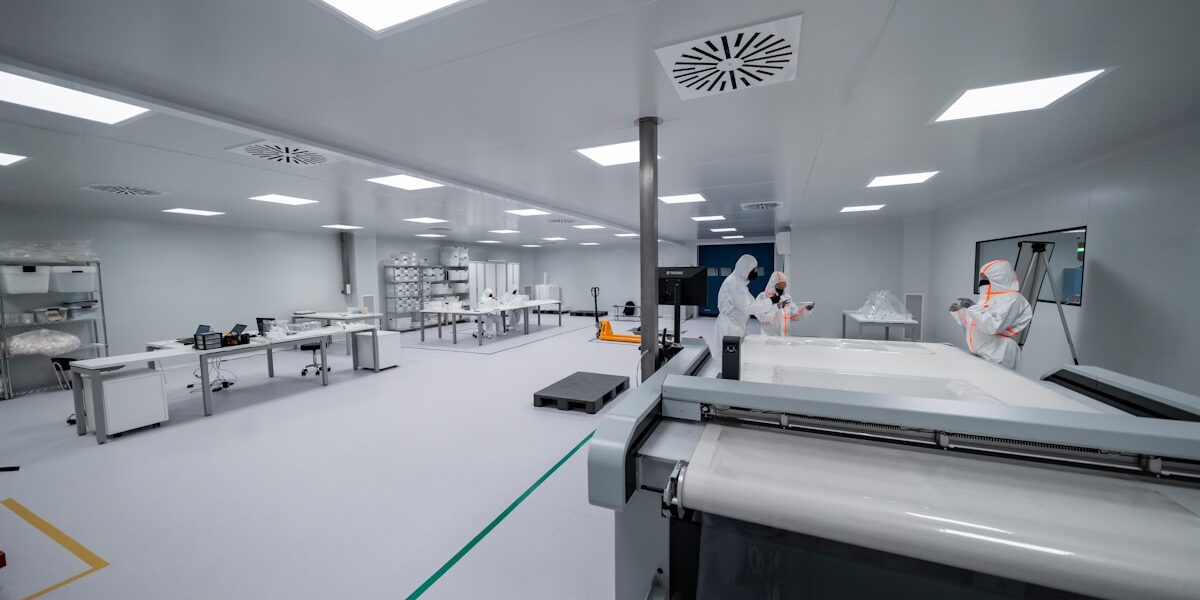
Two companies set out to build the same ISO 8 production space in the same quarter. The one that framed walls with studs and drywall finished in twenty-two weeks. The one that installed factory-built panels finished in fourteen, and spent the difference making product instead of managing a construction site. For a full walkthrough of this topic, see this guide to large-scale clean room project delivery.
Schedule is only the first divergence. Build approach shapes airtightness, long-term maintenance, depreciation treatment, and how easily the room grows next year. This comparison walks through performance, timeline, ownership cost, and the decision matrix, so the path you pick matches how your facility actually operates. For a full walkthrough of this topic, see this guide to clean room cost breakdown by ISO class.
Why Your Build Approach Shapes ISO 8 Performance
ISO 8 is the workhorse class of the classification ladder, and the ISO 14644-1 classification standard caps it at 3,520,000 particles per cubic meter at 0.5 microns and larger. Unlike ISO 5 zones that run laminar flow, ISO 8 clean rooms use dilution ventilation. Air change rate, filter coverage, and envelope tightness do the certification work together, which is why modular ISO 8 clean rooms certify so predictably.
That is why construction method matters more at ISO 8 than buyers expect. A porous drywall joint or an unsealed conduit penetration leaks filtered air and imports dust at every pressure boundary. The 2022 revision of ISO 14644-4 even moved toward performance-based ventilation, using airflow effectiveness indices, which rewards envelopes that hold their geometry and seals over time.
The ownership divergence compounds across the room’s life. A modular wall run damaged by a forklift gets a new panel bolted in before the next shift. A framed drywall wall gets patched, repainted, recleaned, and recertified, and the patch rarely matches the surrounding finish under cleanroom lighting. Buyers who model ten years of operation, not just the invoice, consistently land on the same conclusion about which path holds its value.
Understanding ISO 8 Clean Room Requirements
Certification at ISO 8 rests on four pillars. First, dilution airflow sized to the contamination load. Second, HEPA filtration with at least 99.97 percent efficiency on particles 0.3 microns and larger. Third, a pressure cascade holding 10 to 15 Pascals against adjacent, less clean spaces so leakage always flows outward. Fourth, surfaces that are smooth, non-shedding, and cleanable to the site’s disinfection routine.

Both build paths can satisfy every pillar. The difference is how directly each one gets there, and how much of the certification burden lands on site labor versus factory quality control.
Pressure behavior shows the same contrast. Every classified boundary needs a controlled differential, and guidance holds 10 to 15 Pascals between adjacent rooms of different class. Factory-built panels arrive with continuous skins, machined edges, and matched sealing profiles, so the cascade behaves the way the drawing promises. Field-built partitions vary crew by crew, and each penetration for conduit or ducting becomes a small engineering negotiation with the pressure budget.
None of this makes modular magic. It makes quality repeatable, because the critical work happens once, on a line, under inspection, instead of nightly, on scaffolding, under schedule pressure. That difference shows up in commissioning punch lists, which modular projects tend to shorten dramatically.
How Modular Construction Delivers ISO 8 Faster
Prefabricated envelope systems compress schedules through parallelism. While the factory laminates wall panels to specified dimensions, the site crew prepares utilities and floor slabs at the same time. On a documented 5,000 square foot fit-out, the closest published like-for-like and an ISO 7 build, the modular route completed in 14 weeks against 22 weeks for traditional construction. The parallelism advantage carries directly to ISO 8 scopes, where envelope work follows the same sequence and returns production revenue weeks earlier.

Factory control also removes the dirtiest part of conventional building. There is no drywall sanding inside your future clean space, no wet trades curing against the schedule, and no weather window to negotiate. Certified crews assemble cam-lock panels at 20 to 30 square meters per day, with flush joints and factory-molded coved corners already part of the product. When the layout must change or the room must move, panels unbolt and re-install, which framed drywall never offers.
Where Traditional Stick-Built Construction Still Wins
Honest comparison requires the other side of the ledger. Stick-built construction still earns its place when the space is very large, the ceiling is very high, or the services are heavy. A 12-meter-tall clean bay with structural steel loads and wide clear spans integrates better with conventional construction. Heavy process stacks and utility trunks route through conventional shafts more naturally. Local crews also remain on site for years of general maintenance.

Traditional walls also suit owners who treat the cleanroom as permanent building stock and want the envelope to share the building’s structure and insurance treatment. And the performance-based direction of ISO 14644-4 gives engineered stick-built rooms a defensible qualification route when the design justifies its airflow with data.
Concrete examples sharpen the choice. An electronics assembler adding a second line inside a leased unit chose modular panels and moved the entire room eighteen months later when the lease ended. A food processor converting a corner of a plant into an ISO 8 packaging zone chose panels for the same reason. The local alternative meant months of wet trades running beside live production. In both cases the envelope decision followed the facility’s real constraints rather than a generic preference.
Comparing Long-Term Maintenance and Ownership Costs
The ownership picture diverges after commissioning. ISO 8 clean rooms need requalification on a fixed cadence. Classification testing runs every 12 months for ISO 6 through 9, and every 6 months for ISO 5 and cleaner. Surfaces and seals that survive washdowns and panel swaps therefore cut lifetime cost directly. Modular walls let a damaged panel be replaced in an afternoon without rebuilding a wall run.
Tax and accounting treatment can tilt the decision too. In many jurisdictions modular assemblies qualify for shorter equipment-style depreciation around 7 years.
Permanent construction follows multi-decade building schedules instead. The difference moves real cash flow forward for growing operations.
Envelope pricing follows the same factory-versus-field logic. Published 2026 panel pricing shows tier-1 factory FOB between $48 and $58 per square meter. That sits well below regional field-fabricated equivalents in Europe or North America. On either path, HVAC typically holds a 30 to 40 percent share of the total project budget.
The table below converges those ownership dimensions so the trade-offs sit on one page instead of across ten quotations.
| Ownership Dimension | Modular Envelope | Traditional Envelope |
|---|---|---|
| Requalification support | Flush panels and gaskets swap fast before tests | Patch and repaint cycles precede retests |
| Damage repair | Single panel replaced in hours | Wall run patched, finished, and recertified |
| Depreciation treatment | Often equipment-style, around 7 years | Building schedule over decades |
| Relocation value | Envelope unbolts and moves with the line | Envelope stays with the structure |
| Layout change cost | Partial reconfiguration without demolition | Demo and rebuild with full recleaning |
Model Both Build Paths for Your Floor Plan
Send your dimensions, target class, and ceiling height, and our engineers will return a modular panel takeoff with schedule, requalification, and relocation scenarios side by side.
Ownership economics extend past the walls. Modular envelopes often qualify for shorter equipment-style depreciation schedules, and they carry real relocation value when a lease ends or a line moves. Requalification cadence also favors surfaces that survive cleaning chemistry. ISO 6 through 9 rooms requalify every 12 months, and ISO 5 and cleaner every 6. Finish durability therefore compounds into real money across a decade of certificates.
Which Build Should You Choose
Let the project’s constraints pick the path. The matrix below maps the situations we see most often onto the route that usually serves them best.
| Your Situation | Deciding Factor | Recommended Path | Reasoning |
|---|---|---|---|
| Rented or shared factory floor | Relocation value | Modular | Panels unbolt and move with the production line |
| Fixed launch date this year | Schedule | Modular | 14 versus 22 documented weeks, factory parallelism |
| Tall clean bay with heavy services | Structure | Traditional or hybrid | Stick-built handles spans and utility mass naturally |
| Layout changes every product cycle | Flexibility | Modular | Single panels swap without demolition dust |
| Permanent plant, decade-plus horizon | Building equity | Traditional or hybrid | Envelope shares building structure and insurance |
The strongest answer is often a hybrid. Keep the building shell traditional, then install a modular envelope inside it, so the certified boundary keeps factory quality while the structure keeps its conventional role. When comparing envelope suppliers for that hybrid, our guide to local versus international clean room manufacturers covers the sourcing math. For processes that involve solvents, the guide to clean rooms for chemical laboratories covers surface chemistry selection.
Whichever path wins, hold bidders to the same discipline. Ask each one for the classification acceptance criteria in writing, the operational-state test plan, and the contingency for schedule slip. Suppliers confident in their build path answer with documents. The pattern holds for both construction philosophies, and it filters out the weak bids before they cost you a quarter. Projects pairing disciplined specifications with clean room manufacturers consistently commission faster than either path averages alone.
Avoiding Costly Errors in Either Build Path
Each path has its own failure library. The four below account for most of the certification pain we are asked to rescue.
Certifying only the at-rest state
A room that passes with no people and no machines can fail the moment production starts. Specify, measure, and accept in the operational condition, with equipment running and staff working, so the certificate describes the room you actually own.
Treating the pressure cascade as a detail
The 10 to 15 Pascal gradient between zones is the cleanroom’s immune system. Design it room by room, instrument every boundary, and test door-open transients, because a weak cascade imports contamination faster than any filter removes it.
Letting construction dust define the envelope
On stick-built projects, drywall sanding and site trade debris embed in porous finishes long before certification. Sequence dirty trades out before finish work, or contain them, so the envelope never inherits a particle reservoir it cannot clean.
Underestimating the accessory supply chain

On modular projects the envelope arrives fast, and then the project waits on trim profiles, coving, door hardware, and seals. Order accessories with the panels, negotiate their lead times explicitly, and stage spares at handover so a damaged panel never idles the line while a replacement crosses an ocean.
One decision deserves special care. Where process chemistry includes solvents or aggressive vapors, surface selection matters more than construction method, and our guide to clean rooms for chemical laboratories walks that specification. The envelope decision also interacts with where you buy it, which the comparison of local versus international clean room manufacturers covers with landed-cost math. For anti-static and chemical-resistant duty, see our article on anti-static chemical resistant cleanroom panels and the applications that require them. Buyers mapping their facility against industries that require Class 100 environments can use that article to position ISO 8 inside the wider classification ladder.
Frequently Asked Questions About ISO 8 Clean Rooms
Is modular or traditional better for ISO 8 clean rooms?
For most ISO 8 projects under 10-meter ceilings, modular wins on schedule, cleanliness of construction, and relocation value. Traditional construction still suits tall clean bays, heavy process services, and owners who want the envelope as permanent building stock.
How long does an ISO 8 clean room take to build?
A documented 5,000 square foot build finished in 14 weeks modular against 22 weeks traditional. Your schedule shifts with size, ceiling height, and utility scope, so ask bidders to quote the same bill of materials.
What particle limit defines ISO 8?
ISO 14644-1 caps ISO 8 at 3,520,000 particles per cubic meter at 0.5 microns and larger, with a 29,300 limit at 5 microns. Rooms dilute contamination with turbulent filtered airflow rather than laminar flow.
How often must an ISO 8 room be requalified?
Industry practice under ISO 14644-2 requalifies ISO 6 through 9 every 12 months, while ISO 5 and cleaner run every 6 months. Continuous monitoring of pressure and particles sits between tests.
Can a modular clean room be depreciated as equipment?
In many jurisdictions modular assemblies qualify for shorter equipment-style depreciation, commonly cited around 7 years against multi-decade building schedules. Treatment varies by country, so confirm with your tax advisor before committing.