

Two buyers request quotes for the same 500 square meter room and receive numbers a factor of two apart. Neither quote is wrong. One bundles air handling, validation, and accessories into a turnkey figure near $200 per square meter. The other prices bare panels from $20 to $25 and leaves everything else to your scope.
Clean room cost only becomes comparable when you decompose it. This guide walks the full stack. First, how ISO class moves each line. Then what percentage of budget each discipline takes, what panels cost per square meter by region, and which hidden fees separate the quotation from the invoice. By the end you can normalize any two quotes onto the same page.
What Drives the Price of a Clean Room
Four variables dominate every estimate. Classification sets the air handling burden, because tighter classes demand more filtration capacity and more air changes per hour. Area multiplies everything linearly. Mechanical scope decides whether you are buying an envelope or a building system. Validation depth adds documentation work that scales with regulatory exposure rather than with square meters.
Everything else follows from those four. A buyer who fixes them in writing before requesting quotes eliminates most of the spread between bidders. A buyer who leaves them open invites each bidder to assume a different room.
Classification sits upstream of every other decision, which is why estimators price it first. Air change rates, filter grids, monitoring density, and even the door schedule inherit their requirements from the class number. Getting the class wrong in either direction distorts the whole stack. Treat the classification choice as a budget decision with technical consequences, not the reverse.
Understanding ISO Classes and Cost Impact
The ISO 14644-1 classification standard caps particle concentrations by class, and each step tighter multiplies the airside investment. ISO 8 allows 3,520,000 particles per cubic meter at 0.5 microns. ISO 7 allows 352,000. ISO 6 allows 35,200, and ISO 5 allows 3,520, which demands laminar airflow at 0.36 to 0.54 meters per second over the critical zone.
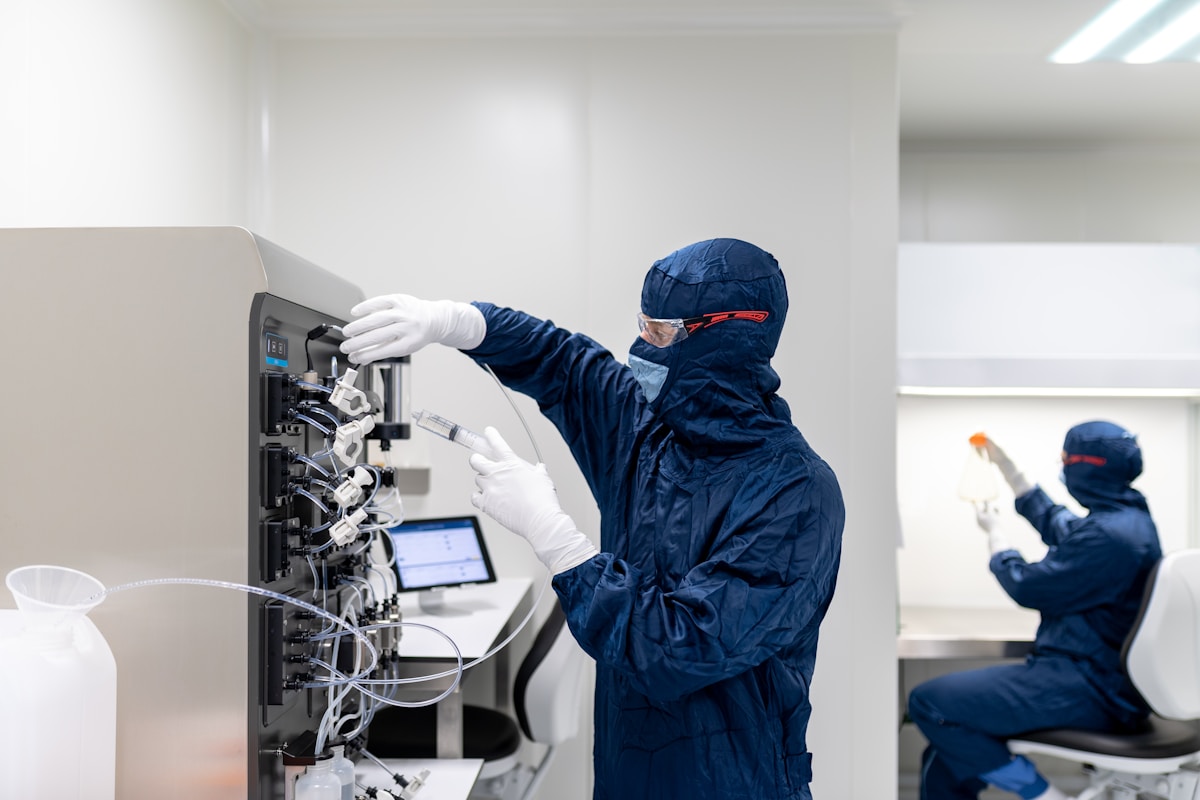
Cost climbs non-linearly with each class because three systems tighten together. Filter coverage density rises, air change rates rise, and energy consumption rises with the pressure the fans must sustain. Between ISO 8 and ISO 7 the delta is mostly fan energy and filter count. Between ISO 7 and ISO 5 the delta includes architectural upgrades, tighter door systems, and a monitoring regime that never sleeps.
Perception also plays a role in how budgets fail. Teams that price the envelope first tend to underestimate everything that connects to it, because walls look simple and air handling does not. A disciplined estimate starts from the airside and works outward, since that is where both the capital and the operating money concentrate. The clean room cost conversation should therefore begin with the HVAC engineer, not with the panel catalog.
Breaking Down the Clean Room Cost Stack
Industry planning guides break the budget into five layers. Design and engineering take 5 to 8 percent. Civil work and interior fit-out take 20 to 30 percent. Air conditioning and clean systems take the largest share at 30 to 40 percent. Mechanical and electrical services take 15 to 25 percent, and validation with documentation takes 3 to 5 percent.
The stack explains most quotation confusion. A bare-panel price covers part of the 20 to 30 percent civil layer and nothing else. A turnkey bundle near $200 per square meter on marketplace listings includes the airside, access, and controls layers, so comparing it against panel-only pricing without stripping scope is meaningless. Ask every bidder to price the same five layers separately, and the numbers finally line up.
Volume and region interact as well. Directory listings show bare wall systems from $20 to $25 per square meter at 100 square meter minimums, and full GMP turnkey bundles near $200 per square meter. The spread inside one marketplace exceeds the spread between continents, which proves the point that scope normalization matters more than geography.
How Much Does an ISO 8 Clean Room Cost
ISO 8 is the most quoted class because it fits food packaging, electronics assembly, and general pharmaceutical support zones. Honest pricing starts with the envelope, and current cleanroom panel pricing and specifications are the fastest way to anchor it. Published 2026 benchmarks place tier-1 factory panels at $48 to $58 per square meter FOB. Field-fabricated equivalents run higher, at $85 to $125 in Europe and $95 to $140 in North America.
One worked example shows how the envelope line matures into a landed figure. One 800 square meter order shipped at $50 per square meter FOB. Freight added $16.25 per square meter, a 7.5 percent duty added $3.75, and brokerage with inland haulage took $5. The panels landed at $75 per square meter against a $114 domestic benchmark, a 34 percent saving achieved entirely below the wall finish.
Above the envelope, apply the stack. On a typical project the airside doubles or triples the envelope line once filtration, ductwork, and controls join. That is why the HVAC share of the total budget dwarfs the panels that contain it.
Certificate levels also move the number. An ISO 8 room certified for electronics assembly prices differently from the same geometry specified for a GMP support zone. Documentation depth, material traceability, and validation effort all scale with regulatory exposure. Buyers who state their audit regime during quotation avoid the most expensive discovery in the industry, which is a rebuilt document package after the room is standing.
Comparing Modular Panel Pricing by Region
Region changes both price and clock. Chinese tier-1 factories quote $48 to $58 per square meter with 25 to 35 day lead times. Regional Chinese factories quote $38 to $48 at 30 to 45 days, with more variable quality control. European mills run $85 to $125 over 40 to 60 days, and North American plants $95 to $140 over 35 to 50 days.
Beware directory pricing at the extremes. Bare wall systems listed from $20 to $25 per square meter at 100 square meter minimums strip out skins, hardware, and finish. Bundled turnkey packages near $200 per square meter fold in air handling and controls. Both numbers are real, and neither is comparable to the mid-market band until you normalize the bill of materials. Our comparison of local versus international clean room manufacturers works through that normalization in detail.
Get Your Cost Stack Priced Layer by Layer
Send your classification, dimensions, and destination port, and our engineers will return an itemized quotation with every layer of the stack priced separately.
Energy belongs in the same conversation even without a fixed price tag. Fan power scales with filter count and hours of operation. An ISO 7 room therefore spends meaningfully more electricity per year than the same footprint at ISO 8, and an ISO 5 zone more again. Estimators who ignore energy compare envelopes while the airside quietly compounds. Request the fan power estimate alongside the mechanical quote so the operating delta is visible before the class is locked.
Hidden Costs Between Quotation and Operation
The gap between quote and invoice fills with predictable items. Accessories add 12 to 18 percent to panel value. Aluminum trim runs $12 to $25 per linear meter, and hygienic coving $18 to $35. Pre-finished door frames cost $180 to $450 each. Ceiling hardware adds $8 to $15 per square meter, and sealants $2 to $4.
A 500 square meter room typically carries $8,000 to $14,000 of accessory value that first quotes omit.
Installation is the second gap. Certified crews bill $45 to $75 per hour and install 20 to 30 square meters per day on cam-lock systems. General contractors work at 8 to 12 square meters per day with 15 to 25 percent rework. Their lower hourly rate lands at $35 to $60 per square meter installed plus contingency, which erases the saving.
Operating costs come third and last the longest. Requalification follows a fixed cadence. ISO 6 through 9 rooms test every 12 months, while ISO 5 and cleaner run every 6. Monitoring contracts and certification visits therefore become permanent budget lines.
Fan energy scales with class tightness, and spare panels, gaskets, and filters belong in inventory from day one. Viewing the project through a total cost of ownership framework keeps those lines visible from the first quotation.

Timeline carries a price tag too. Faster programs pay for parallelism, whether that means factory-capacity reservation or premium freight on the critical path. Slower programs trade calendar for cash but accumulate their own costs in extended project management. Decide early which resource your organization is shorter on, and let that answer shape the delivery schedule you ask bidders to price.
Which Cost Class Fits Your Budget
Match the class to the process, not to the aspiration. Over-classifying burns capital and energy forever, and under-classifying fails audits that cost more than the upgrade. The table maps common processes to their sensible class band and the cost consequence.
| Process | Sensible Class | Cost Behavior | Budget Note |
|---|---|---|---|
| General assembly, packaging | ISO 8 | Lowest airside burden | Envelope and airflow dominate spend |
| Precision electronics assembly | ISO 7 | Filter count and ACH step up | Energy line becomes visible |
| Laboratory support, metrology | ISO 7 to 6 | Tighter monitoring regime | Validation share grows |
| Sterile compounding background | ISO 7 to 5 | Laminar zones appear | Requalification cadence doubles |
| Aseptic filling core | ISO 5 / Grade A | Highest airside and monitoring cost | Specialist validation required |
Two habits keep the budget honest. Price each class option as a variant of the same layout, so the deltas are visible instead of buried. And separate construction cost from the first three years of operation, because the cheaper envelope often costs more once energy, requalification, and repairs are counted. Clean room cost discipline is mostly scope discipline applied early.
Buyers who pair these habits with structured sourcing routinely land inside their first budget. The build-path trade-offs appear in our guide to modular and traditional ISO 8 clean rooms, and the delivery mechanics appear in large-scale clean room project delivery.
One more discipline protects the number you negotiated. Changes priced after approval always cost more than changes priced during design, and cleanroom programs generate plenty of both. Freeze the classification, the room schedule, and the accessory list before the purchase order, and route every later change through a priced change log. Programs run this way treat clean room cost as a managed variable rather than a rolling surprise, which is exactly what a finance review wants to see.
Frequently Asked Questions About Clean Room Costs
How much does an ISO 8 clean room cost per square meter?
The envelope alone runs $48-58 per square meter FOB from tier-1 factories, landing near $75 after freight and duty. Full projects add the airside, electrical, and validation layers that typically double or triple the envelope line.
Air conditioning and clean systems take 30 to 40 percent of the budget, the largest single layer. Civil fit-out follows at 20 to 30 percent, then mechanical and electrical at 15 to 25 percent.
Why do clean room quotations differ so much?
Scope differs more than price. A $200 per square meter turnkey bundle includes air handling and controls, while a $20-25 panel listing excludes skins and hardware. Normalize every bid to the same five-layer scope before comparing.
Accessories at 12 to 18 percent of panel value, certified installation, duty and freight, spare parts, and recurring requalification. A 500 square meter room can carry $8,000-14,000 of accessory value missing from first quotes.
Does a higher ISO class always cost more to run?
Yes, because tighter classes raise filter count, air change rates, and fan energy, and they shorten requalification intervals from 12 months to 6 at ISO 5 and cleaner. Match the class to the process, not to ambition.