
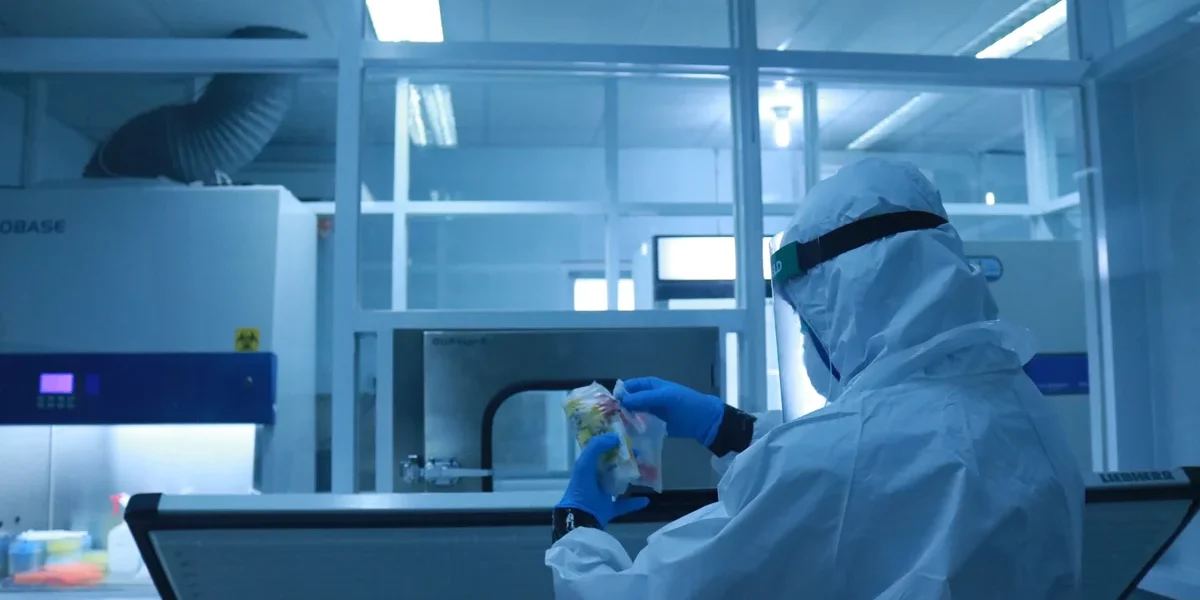
A chemistry laboratory has to protect two different things at the same time, and the two demands pull in opposite directions. Sensitive instruments need air scrubbed of fine particles. Open reagent work needs solvents and acids swept out of the room as fast as they evaporate. Clean rooms for chemical laboratories exist to resolve exactly this conflict, pairing particle control with aggressive exhaust in a single engineered space. For a full walkthrough of this topic, see this guide to clean room manufacturers compared.
Getting the combination wrong is expensive. A room that only filters particles can let solvent vapor accumulate to unsafe levels. A room that only extracts air can pull dusty corridor air across an open balance or a wafer rinse bath. This guide explains how classification, pressure design, panel selection, and molecular contamination control fit together, so your next laboratory build passes certification on the first attempt.
Why Chemical Laboratories Need Clean Rooms
Modern analytical work sits at the intersection of chemistry and precision manufacturing. Battery electrolyte research, nanomaterial synthesis, and pharmaceutical QC labs all run wet chemistry beside instruments that measure particles at the sub-micron scale. A single 0.5 micron dust particle landing on an ICP-MS sampling cone or inside a Langmuir-Blodgett trough can distort an entire measurement campaign.
Ordinary lab ventilation removes vapors but does nothing about particles. HEPA filtration removes particles but does nothing about solvent vapor. Clean rooms for chemical laboratories combine both functions, layering HEPA-filtered supply air on top of once-through exhaust so that neither contamination type reaches the work surface.
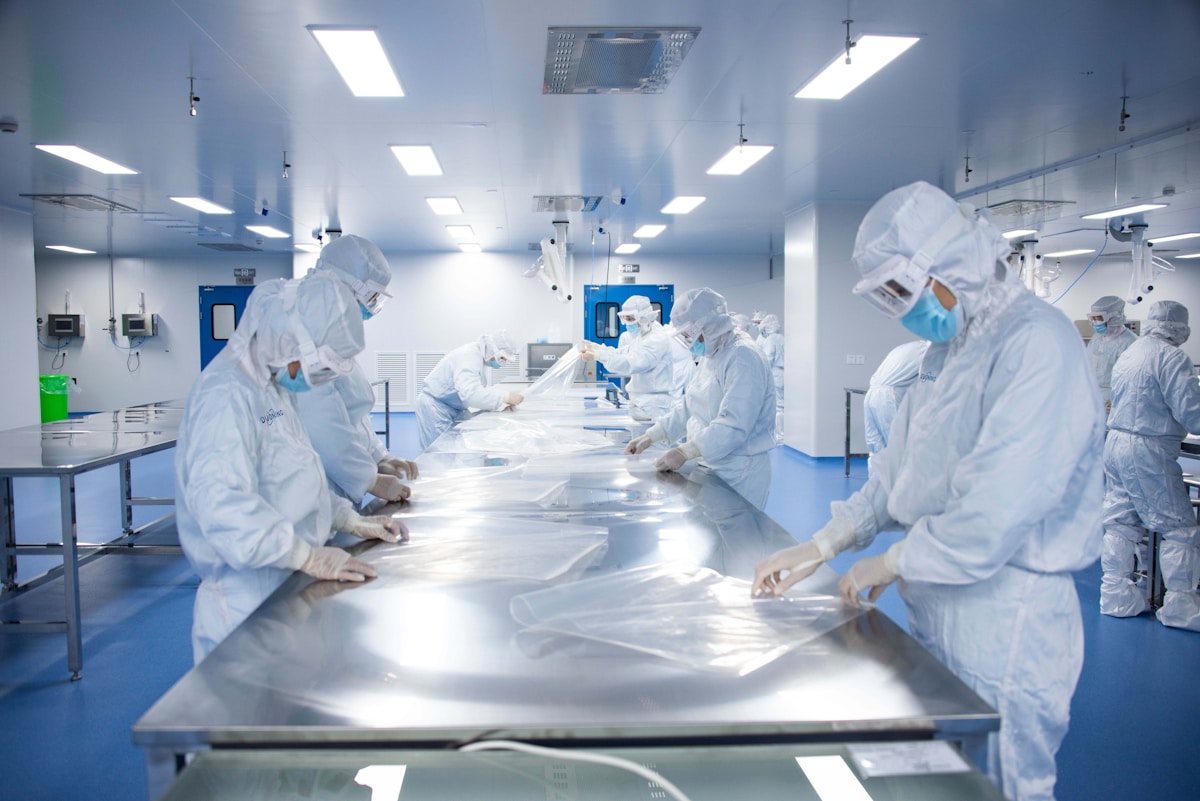
The business case is straightforward. Rework caused by contaminated samples or corroded finishes costs far more than the modest premium of a purpose-built envelope. Laboratories that pair proper classification with chemical-resistant surfaces routinely pass certification on the first attempt and avoid the schedule slippage that follows a failed commissioning test.
Understanding ISO and GMP Grades for Labs
Classification starts with the ISO 14644-1 classification standard, which caps airborne particle concentrations by size. The limits most chemistry labs work with sit at 0.5 microns and larger. ISO Class 5 allows 3,520 particles per cubic meter, ISO Class 6 allows 35,200, ISO Class 7 allows 352,000, and ISO Class 8 allows 3,520,000.
General chemical analysis and sample preparation typically sit at ISO Class 7 or 8. Instrument rooms housing electron microscopes or PCR systems often justify ISO Class 6. Sterile compounding that overlaps with chemistry brings EU GMP grades into play. Grade A matches ISO 5 in operation. Grade B is its ISO 7 background, and Grades C and D cover the less critical steps.
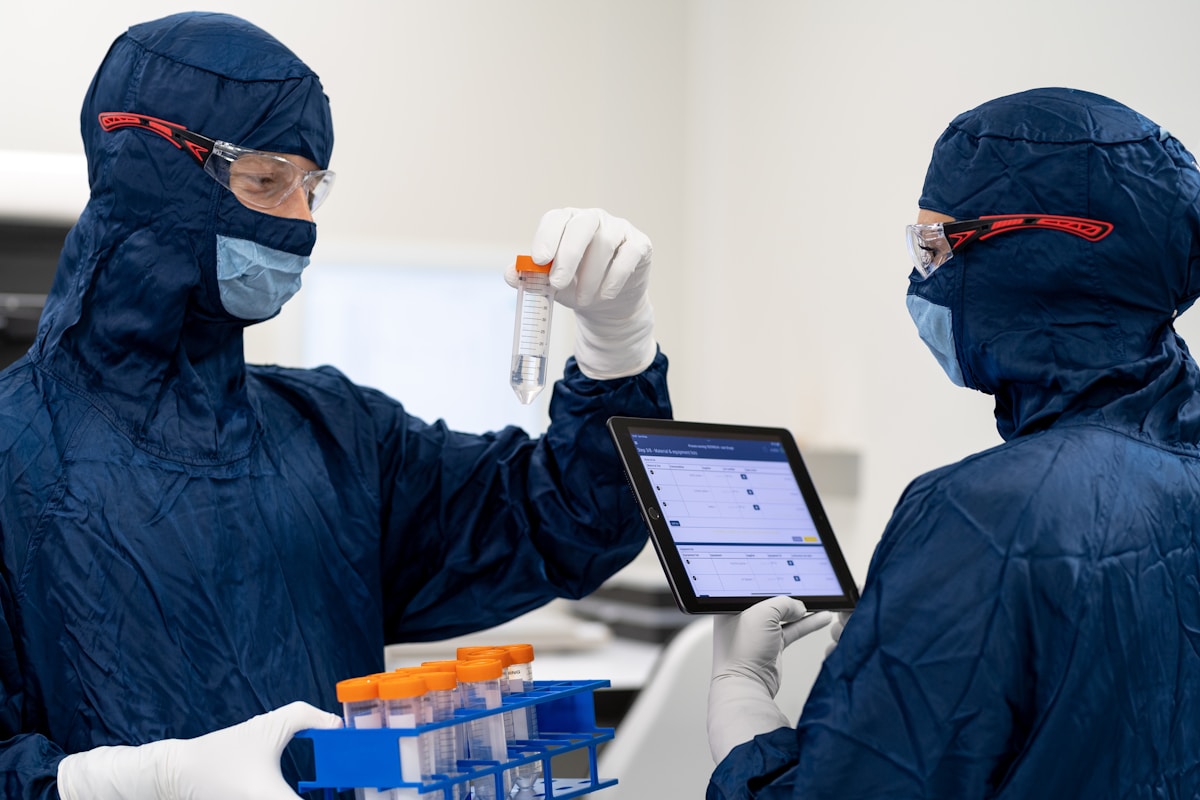
Resist the temptation to over-classify. Pushing an entire laboratory to ISO Class 5 multiplies filter count, fan energy, and requalification burden, and the operating cost follows the air volume rather than the floor area. Zone the room instead: high class where the open product sits, and ISO 7 or 8 around it, with the gradient doing the protection work.
Balancing Positive Pressure Against Fume Extraction
Here is the design problem most competitors never address. A standard cleanroom holds 10 to 15 Pascals of positive pressure against adjacent spaces, so leaked air always flows outward and dust never drifts in. A chemistry lab does the opposite: it runs slightly negative and exhausts 100 percent of its air outdoors so toxic vapor never escapes the room. For a full walkthrough of this topic, see this guide to modular and traditional ISO 8 clean rooms compared.
Occupational guidance is blunt about the exhaust side. Laboratory spaces handling hazardous chemicals stay negative to public corridors, and air that has touched the room never recirculates. Fume hoods capture vapor at the source with a face velocity near 0.5 meters per second at the sash. The room itself turns over at 10 to 12 air changes per hour, which is the working baseline for clean rooms for chemical laboratories.
The resolution is zoning rather than compromise. Keep the clean corridor and gowning sequence positive. Hold the general chemistry zone at a mild negative offset of roughly 5 to 10 Pascals relative to the corridor. Local exhaust at hoods and snorkels captures vapor inside the zone, while HEPA-filtered supply still dominates the instrument alcove, which can remain positive to the wet area it protects.
Instrument alcoves, balance enclosures, and storage of finished samples each get their own small positive cells inside the larger negative room. Differential pressure sensors with alarms watch every boundary. Variable air volume valves rebalance the cascade whenever a sash moves. Done well, the arrangement protects the sample and the scientist without either system fighting the other.
Budget for the energy penalty too. One hundred percent once-through air means conditioning outdoor air from scratch, so heating and cooling loads run far above a recirculating cleanroom of the same size. Heat recovery wheels, glycol run-around loops, and demand-based sash controls claw a meaningful share back without touching safety.
Fire protection shapes the same airside design. NFPA 45 fire protection for laboratories using chemicals drives exhaust redundancy, flammable storage limits, and interlock behavior, so bring the fire marshal into the layout review before panels are ordered.
Select Wall Panels That Resist Chemical Attack
Airborne acid and solvent vapor attacks ordinary building finishes, and a painted drywall or powder-coated steel surface will show corrosion within a couple of years of solvent-heavy work. Panel selection therefore matters as much as HVAC design in this application.
Match the surface to the reagent list. The chemical-resistant cleanroom wall panel systems built on galvanized steel with a high-resin PVDF fluoropolymer finish shrug off repeated wipe-downs with solvents and oxidizing disinfectants. Where strong acids or alkalis dominate, FRP-faced panels and stainless steel carry the duty, and PVC or polypropylene linings protect ductwork and fume hood interiors in the most aggressive streams.
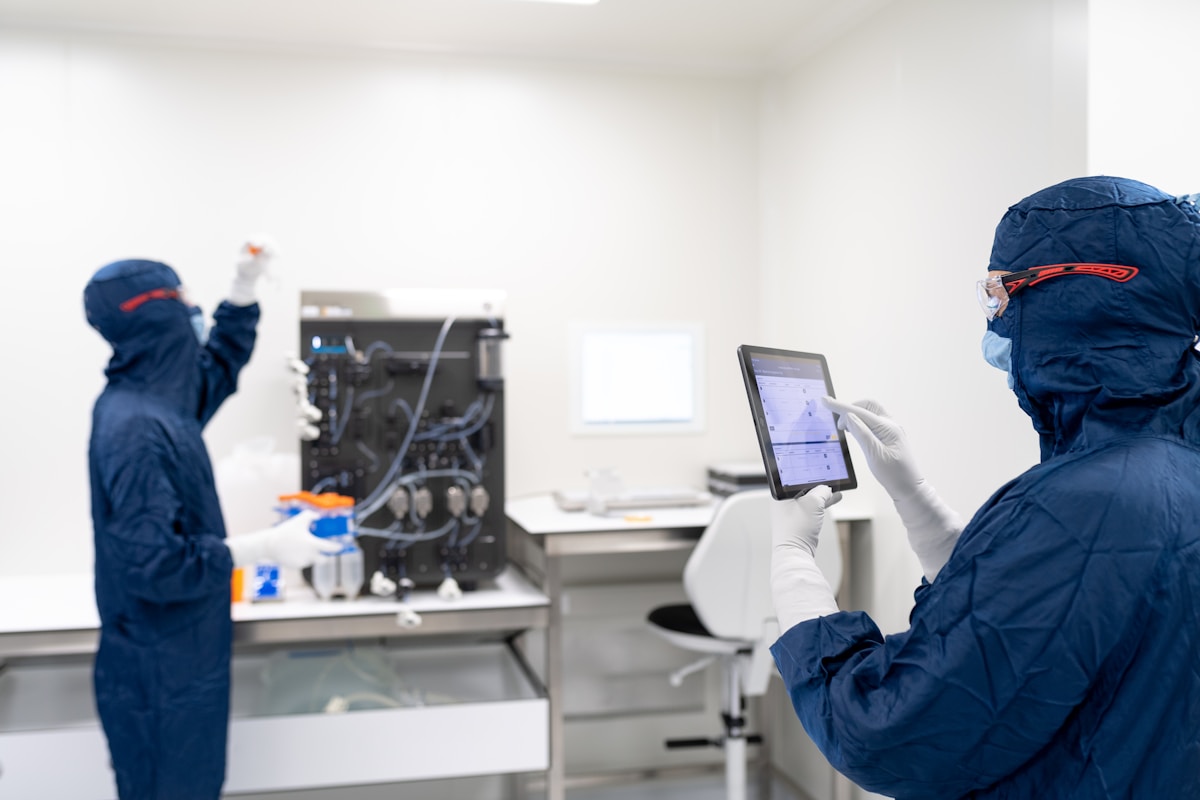
Details decide the outcome as much as the sheet material. Flush-glazed joints, sealed utility penetrations, and coved floor junctions following the 50 millimeter hygienic design convention remove the crevices where vapor condenses and corrosion starts. Prefabricated sandwich panels with continuous skins deliver those details by default, which is why modular construction dominates new laboratory builds. Our own line laminates cleanroom wall, ceiling, partition, and door panels with PVDF and FRP skins, and the joint system is the part we engineer hardest for chemistry duty. Buyers comparing envelopes can read how anti-static chemical resistant cleanroom panels handle combined electrostatic and solvent duty.
Controlling Airborne Molecular Contamination in Labs
Particles are only half the contamination story. Airborne molecular contamination, or AMC, covers acids, bases, condensables, and dopants in vapor form, and it settles on surfaces that particle counts alone would call clean. Photoresist poisoning, sensor drift, and corrosion of silver interconnects all trace back to molecular contamination that HEPA filtration cannot touch. In clean rooms for chemical laboratories this vapor load is generated inside the room every working day, so the design has to plan for it from the start.
The ISO framework handles this through ISO 14644-8, which classifies air by airborne chemical concentration using the ACC scheme. The standard lets you set a budget for each contaminant family, then verify the room holds it. For chemistry laboratories the practical translation is simple: solvent-rich zones need dedicated exhaust and, where recirculation is unavoidable, activated carbon or chemical adsorber stages in the air path.
Surface choice interacts with AMC as well. Non-porous, low-outgassing finishes release little of their own vapor load, which keeps the room inside its ACC budget. That is one more reason flushed, gel-coat-smooth panel skins outperform painted blockwork in any laboratory where molecular cleanliness affects the data. For labs pushing into ISO 5 territory, the classification logic behind which industries require Class 100 environments applies directly to the instrument zone.
Plan a Chemistry Laboratory That Passes First Time
Send us your reagent list, target ISO class, and room dimensions, and our engineers will return a panel and pressure-cascade specification matched to your chemistry.
Which Clean Room Design Fits Your Laboratory
Classification, airflow, and surface chemistry come together differently in every application. The table below condenses the specification choices into a starting point you can bring to your HVAC engineer and panel supplier.
| Laboratory Application | Suggested ISO Class | Typical ACH (Design Starting Point) | Pressure Strategy | Recommended Wall Surface |
|---|---|---|---|---|
| General chemical analysis | ISO 7 | 10 to 12 | Mild negative to corridor, hoods exhaust outdoors | PVDF-coated steel sandwich panel |
| Instrument and metrology room | ISO 6 | 15 to 25 | Positive to wet lab, filtered supply | PVDF steel or FRP-faced panel |
| Battery electrolyte research | ISO 7 | 12 to 15 | Negative with dedicated solvent exhaust | Stainless steel or PVC-lined surfaces |
| Nanomaterial synthesis suite | ISO 6 to 7 | 15 to 20 | Dual gradient with positive alcoves | FRP or PVDF panel with coved joints |
| Sterile compounding overlap | GMP A to B | Per Annex 1 | Positive cascade, sealed airlocks | PVDF steel, flush glazing, 50 mm coves |
Treat the values as design starting points rather than fixed law. Your reagent inventory, occupancy density, and local codes move the numbers, and a commissioning agent should verify every boundary before handover. Door selection follows the same logic, and our aluminum frame cleanroom door selection guide covers the pressure and washdown ratings to match. Well-planned clean rooms for chemical laboratories also leave spare wall runs and ceiling grid capacity for the instrument that arrives two years from now.
Avoiding Costly Chemical Cleanroom Design Mistakes
Most failed laboratory certifications trace back to a handful of repeat errors. Each one is cheap to fix on paper and punishing to fix after installation.
Placing fume hoods inside the laminar field
A hood sits in a room to capture vapor, but its inflow distorts the surrounding airflow pattern. Put one beneath a HEPA ceiling grid and the hood steals the clean air directed at the bench downstream of it. Locate hoods along exhaust-oriented walls, keep capture hoods out of supply streams, and verify the pattern with smoke studies during qualification.
Specifying finishes against the wrong reagent list
A panel that survives daily bleach wipe-downs can still fail under chronic acetic acid vapor. Collect the actual reagent inventory before ordering, including trace concentrations and dwell times, and demand wipe-test data for the specific chemicals on it. The extra week of specification work prevents a mid-life reline.
Certifying the room only at rest
ISO 14644-1 defines both at-rest and in-operation states, and a chemical lab generates its worst particle and vapor load exactly when it is running. Specify, measure, and accept in the operational state, with personnel working and hoods exhausting, or the certificate will not describe the room you actually own.
Ignoring molecular contamination until instruments drift
Unexplained calibration drift and corroded contacts are AMC symptoms, not filter failures. Build an ACC budget into the design brief. Place adsorber stages where recirculated air is unavoidable. Monitor corrosivity with witness coupons so drift is caught before it corrupts a quarter of data.
Frequently Asked Questions About Chemical Cleanrooms
Should a chemical laboratory cleanroom be positive or negative pressure?
It uses both. The clean corridor and instrument alcoves run positive at 10 to 15 Pascals to keep dust out. The wet chemistry zone sits mildly negative with once-through exhaust, so solvent vapor never escapes the room.
What does ISO 14644-8 cover in a laboratory?
ISO 14644-8 classifies airborne molecular contamination using the ACC scheme. It sets concentration budgets for acids, bases, and condensable vapors that HEPA filtration cannot remove, which matters wherever solvent vapor corrodes instruments or skews results.
Which wall panel surface best resists solvents and acids?
PVDF-coated steel handles routine solvent and disinfectant washdowns. FRP faces and stainless steel suit stronger acid or alkali exposure, and PVC or polypropylene linings protect ductwork in the most aggressive streams.
Can a fume hood operate inside a cleanroom?
Yes, with placement care. The hood must duct outdoors and stay out of the laminar supply field. It holds a 0.5 meter-per-second face velocity, so the exhaust and filtration systems complement rather than disturb each other.
How many air changes per hour does a chemistry cleanroom need?
Chemistry laboratories typically run 10 to 12 air changes per hour for general work. Higher particle classes and heavier solvent loads push the rate toward 15 to 25, and the final figure comes from your hazard review.