
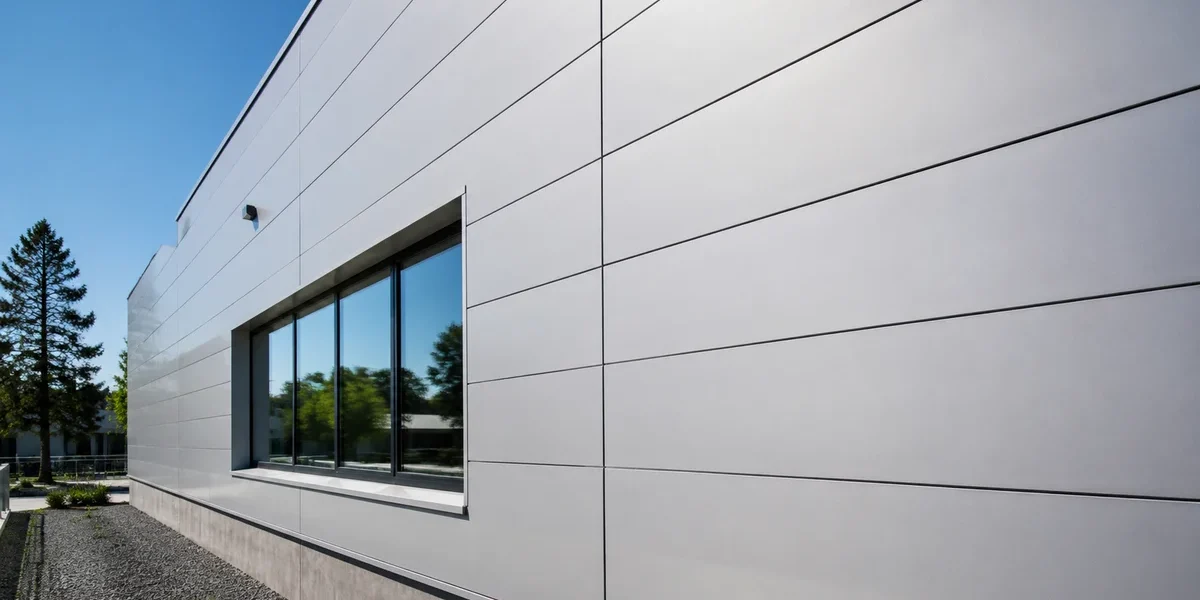
Most facade failures blamed on the aluminium trace back to three cheaper decisions: a skin thinned below 0.21 mm, polyester paint sold as exterior grade, an untested bond. An aluminium composite panel is a sandwich board — two thin aluminium skins bonded to a thermoplastic core, coil-coated for weather and laminated continuously into a flat, rigid sheet. That definition sounds simple. The failure pattern above lives inside those layers, in decisions buyers rarely see on a quotation.
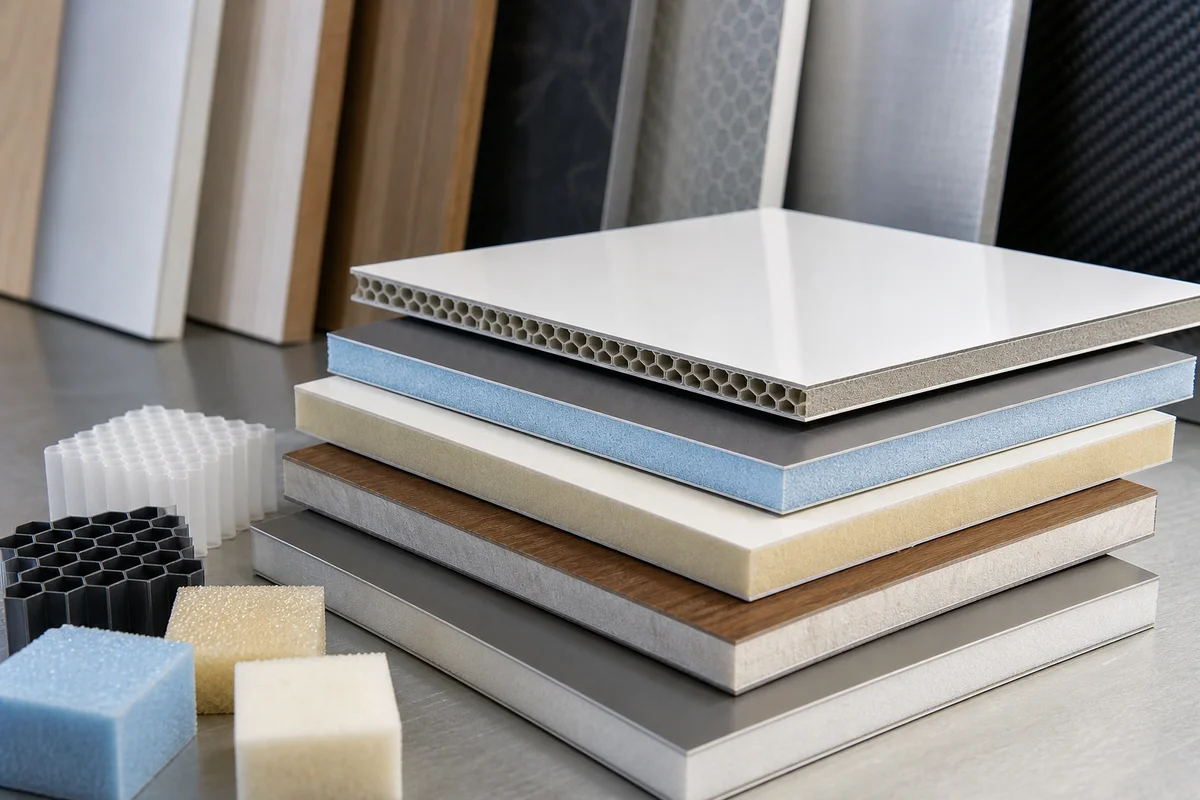
The mechanics are simple: two skins carry the bending load while the core keeps them apart. That is why a 4 mm panel handles loads like a much heavier metal sheet. Every layer hides a procurement decision with a number attached — skin in millimetres, coating in microns, bond in N·mm/mm. None of that is opinion: every figure traces to a published standard you can demand in writing. RaxPanel laminates ACP and its honeycomb-core and foam-core variants on its own line, and the layers below are the decisions that separate those builds.
What Is an ACP Aluminium Composite Panel
An aluminium composite panel is the trade name for that sandwich in building form: a flat sheet engineered for walls, facades, canopy linings and signage. Continuous lamination bonds the three into one sheet, with polymer adhesive films doing the joining under heat and pressure. The skins bring weather resistance and a coating-ready surface; the core brings lightness and easy workability. Cut it, route it, fold it — few cladding materials install this easily at this weight.
- ACP — aluminium composite panel
- Two aluminium skins bonded to a thermoplastic core; the standard name on construction and signage quotations.
- ACM — aluminium composite material
- The same product under its second name; we unpack the ACP vs ACM wording in a dedicated guide.
- Sandwich panel
- Any panel that gains stiffness by separating two thin faces with a light core; ACP is the aluminium version of that idea.
RaxPanel builds ACP alongside honeycomb and foam-core sandwich panels on the same platform, so the definitions here hold across that whole family. For applications, selection and market context, our definitive ACP guide takes the broader view.
The Four Layers of an ACP Panel
Suppliers argue about brands, but the load-bearing logic of every ACP sheet is the same four-layer stack. Each layer exists to prevent a specific failure, and each has a spec you can check on paper before the panels ship.
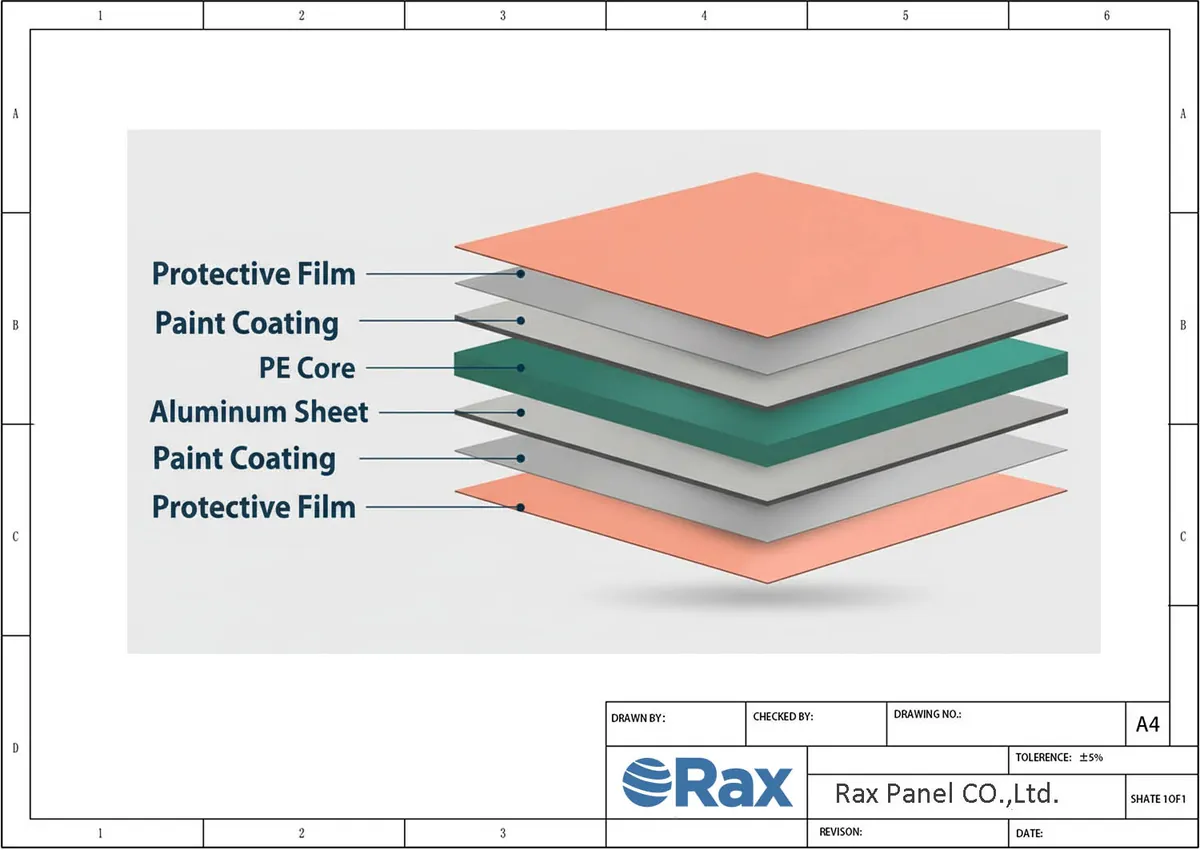
Top aluminium skin — the weather face
The outer skin carries the PVDF or polyester coating and takes the weather: UV, rain, daily thermal swings. It also provides the flatness you see from the street. When facades ripple, the complaint usually starts here.
The core — where fire behaviour lives
Standard cores are low-density polyethylene (LDPE), chosen because it processes well and keeps weight down. Mineral-filled FR cores and A2 cores change the fire story completely, which is why curtain-wall specifications name the core grade explicitly. The core also sets how the sheet routes, folds and holds a fastener.
Bottom liner and adhesive films
The back skin balances the stack so the panel stays flat after coating and cutting. Between each skin and the core sits a polymer adhesive film, melted into the bond by heat and pressure. Skins are chemically treated before laminating so the adhesive grips the treated surface instead of sitting on bare metal. Skip either step and moisture eventually finds the interface — delamination traces directly to poor adhesive films and lamination defects.
Protective film
The fourth layer is disposable: a matte film that guards the finish during transport, handling and installation. It peels off after the panels are fixed. Check its condition on arrival, because the film is also your first evidence of how the batch was stored and shipped.
Aluminium Skin Thickness and Alloy Grades
Skin thickness is where any aluminium composite panel quote hides its biggest differences. The full market runs from 0.06 mm signage stock up to 0.50 mm facade skins, but architectural-grade panels start at 0.21 mm. Total thickness spans 2-6 mm, with 4 mm the default for facade work, cut from standard 1220 × 2440 mm sheets. Below 0.21 mm you are buying signage or interior grade, whatever the sales sheet calls it. The grade split below is the first thing to confirm on any quotation.
| Grade | Skin thickness | Common alloys (ASTM B209) | Typical role |
|---|---|---|---|
| Signage / interior | 0.15 mm | 1100 | ACP signage sheets, interior wall panels |
| Architectural standard | 0.21 mm | 1100 or 3003 | Standard 4 mm facade cladding |
| Architectural premium | 0.30-0.50 mm | 3003 or 5005 | High-rise facades, curtain wall cladding |
Choice of alloy matters as much as gauge. The 1100 grade is at least 99.00% pure aluminium, with the formability and corrosion resistance that folding and routing demand. Moving to 3003 adds manganese and roughly 20% higher strength, while 5005 is the usual pick where facades will be anodized. Skin stock for all of them is produced to ASTM B209/B209M, the standard specification for aluminium sheet and plate.
Buyer warning: when a facade quote undercuts the market, skin gauge is the first place the saving comes from. Micrometer a sample edge before signing — oil-canning on the finished wall is a skin problem, not a luck problem.
Core Chemistry from PE to A2
The core decides whether a panel is a signage product or a facade product. Standard PE cores are low-density polyethylene: cheap, consistent, easy to rout, entirely rational for interior wall panels and ACP signage sheets. Put that same core on a high-rise facade and the fire assessment changes completely.
Fire-retardant cores load the polyethylene with mineral filler and typically reach EN 13501-1 class B-s1,d0. A2 cores push mineral content to roughly 90% and reach A2-s1,d0, where s1 flags limited smoke development and d0 confirms no flaming droplets. An A2 fire rated aluminium composite panel is the default answer when regulations name a class instead of a test report. For how buyers weigh these grades against the rest of a quote, see our eight essential points on ACP and ACM panels.
Compliance warning: fire certificates are checked against the core grade, not the brand name. Get the core classification in writing before submitting facade documentation, because a PE-core sample failing review after delivery is a re-cladding conversation, not a discount.
PVDF Coating Systems Explained Layer by Layer
The coating is the skin’s armour, and “PVDF” on a datasheet is not automatically enough. Genuine architectural PVDF is a fluoropolymer system with 70% PVDF resin in the topcoat, formulated to AAMA 2605. That standard exists because of South Florida: ten years of severe sun exposure with fade held to 5 ΔE or less. The system is applied to flat coil before lamination, on a coil coating line that runs like this:
- Clean and degrease the aluminium coil so nothing interferes with adhesion.
- Apply the primer, 5-7 µm dry film, and heat cure it.
- Apply the color coat, 18-20 µm — this layer carries the pigment and the PVDF resin share.
- Apply the clear coat, another 5-7 µm, and cure; total dry film thickness lands at 25-35 µm.
The arithmetic matters: a total film under 25 µm, or a resin share nobody will state in writing, is polyester paint in disguise. PE paint looks identical to PVDF when the sheets are new, then chalks, fades and cracks within a few years outdoors. Signage interiors can run polyester happily; exterior grade ACP does not get that option. Ask for the coating specification sheet by name, and file it with the contract.
How the Layers Bond During Continuous Lamination
Bonding is a continuous industrial process, not a glue gun. Aluminium coil unrolls, passes chemical conversion treatment, meets the adhesive films and the core, then goes through heat and pressure in one line before being cut to size. The output is a panel whose skins cannot be pulled off by hand — the bond has to be measured, not assumed.
The industry measures it with the climbing-drum peel test, ASTM D1781, which peels the skin around a 102 mm drum and reports the result in N·mm/mm. China’s GB/T 17748-2016, the curtain-wall ACP standard, requires an average peel strength of at least 180 N·mm/mm with no single value below 150 N·mm/mm. Decorative-grade GB/T 22412-2016 uses a 180-degree peel and only asks for 4 N/mm — a different test entirely, so never let one certificate stand in for the other.
“We have test reports” is not an answer. A batch number next to a peel value is.
So the buyer action is narrow and cheap: ask for the climbing-drum peel report for your production batch, with values, not just a statement of compliance. A line that runs to that discipline produces the report as a matter of routine. Hesitation is data too.
Why Sandwich Structure Sets Stiffness and Weight
The sandwich principle explains why composite panels behave the way they do. Bending stress rides on the skins; the core’s only structural job is holding those skins apart. Stiffness grows with the cube of the distance between skins, which is why 4 mm of composite out-handles 1 mm of solid aluminium many times over.
Now the weight, on a back-of-envelope calculation: a 4 mm ACP with 0.5 mm skins and a 3 mm LDPE core works out to roughly 5.5 kg/m². A solid 4 mm aluminium sheet comes to 10.8 kg/m². Half the weight, and the panel is stiffer in use than the thin solid sheet it replaces.
This is also where oil-canning gets properly attributed. Visible waviness comes from a skin too light for its span, combined with heat-driven thermal movement — the sheet expands daily and the flat face buckles at weak points. It is not an inherent property of sandwich panels; it is a skin-and-span decision made at quoting stage. A properly gauged skin on reasonable support spacing stays flat where thinner stock would ripple.
That math is why ACP cladding for high-rise facades replaced solid sheet: lighter panels mean lighter subframes and less dead load into the structure.
ACP Panels Built to the Spec, Not Around It
RaxPanel laminates ACP, ACP honeycomb and ACP foam-core panels on its own line, outputting more than 1,700 m² per day. Engineers run project-specific testing to agreed data standards, and the team answers within 24 hours, one-to-one.
How to Inspect Panel Structure Before Buying
Structure is verifiable with three tools: a micrometer, a document request and ten minutes. Run the checklist below before any deposit leaves your account.
- Micrometer the skin on a sample edge and hold it against the contract tolerance — architectural work starts at 0.21 mm per skin.
- Request the climbing-drum peel report for your batch: GB/T 17748-2016 averages 180 N·mm/mm or better with no single value under 150, or whatever spec you agreed in writing.
- Check the coating datasheet for a stated PVDF resin share — 70% for AAMA 2605 systems — and a total dry film thickness in the 25-35 µm band.
- Confirm the protective film is intact, with no early signs of adhesive aging on the surface.
- Match batch numbers across the whole order, because color drift between production batches shows up as stripes on the finished wall.
- For FR or A2 cores, collect the fire classification certificate itself, not a brochure mention of the class.
A useful benchmark: our aluminium composite panel range publishes skin gauges, core options and coating systems with numbers attached. Compare every quotation against that level of detail, not against a brochure. When a drawing names a brand instead, the ALPOLIC panel guide shows how to translate that name into the same checkable numbers. Core choice belongs on that checklist too – the ACP core durability guide ranks PE, FR and A2 by how they age. Facade systems add weight, weather and fire grades to that list – the aluminum curtain wall guide ranks them.
None of these checks needs a laboratory. They need a supplier who expects the questions, and the answers in writing.
Final Word on ACP Panel Structure
A composite panel is not a commodity defined by its layer names; it is a bundle of numbers that either match your application or do not. Run the pattern across any quote: the coating decides how the panel weathers, the skin decides whether it stays flat, and the bond decides whether it stays a panel. Panels age exactly as those three decisions predict.
- 0.21 mm is the skin floor that separates facade stock from signage stock.
- 70% PVDF resin to AAMA 2605 is the exterior coating line; polyester is not.
- Peel strength is a per-batch number: at least 180 N·mm/mm average under GB/T 17748-2016.
- Fire class is a certificate, not an adjective: B-s1,d0, A2-s1,d0 or ASTM E84 Class A.
If a quotation is missing two of these numbers, the questions write themselves. Ask them before the deposit, not after the containers land.
Frequently Asked Questions About ACP Structure
How long does an ACP panel last outdoors?
PVDF-coated ACP typically serves 15 to 20 years outdoors, and premium coating systems carry manufacturer warranties of up to 25 years. Polyester-coated sheet is an interior product and will not reach those numbers on a facade.
Is an ACP panel recyclable?
Yes. The aluminium skins are fully recyclable metal, and processes exist to separate them from the polyethylene core. Talk to local metal recyclers before demolition, because clean offcuts carry better value than mixed construction waste.
Is an ACP panel waterproof?
The panel itself does not absorb water, but a facade stays dry through joint design, sealants and the substructure behind the cladding. Specify the drainage and joints, not just the sheet.
Is ACP the same as ACM?
Yes. ACP means aluminium composite panel and ACM means aluminium composite material; the two names describe the same product and are used interchangeably across suppliers and markets.
Can you bend or fold an ACP sheet?
Yes. Panels are routed on the back and folded into trays, columns and corner details. Formability follows the alloy: 1100 skins form easily, while very thin signage skins need gentler tooling and tighter process control.