

If you’re still quoting aluminum honeycomb to customers who need weight savings, you’re leaving money on the table. PP honeycomb panel uses have expanded well beyond basic packaging — the material now shows up in RV wall panel materials, refrigerated truck bodies, marine bulkheads, and architectural cladding. The polypropylene core weighs roughly 1/32 of an equivalent aluminum structure at a fraction of the raw material cost. It is also 100% recyclable with zero VOC emissions during processing.
We have spent 15 years manufacturing composite panels and shipping them to distributors across 50 countries. That track record taught us exactly where PP honeycomb delivers and where it falls short. This article covers the primary application fields, the core structural properties your customers actually care about, and the honeycomb sandwich panel failure modes that trigger warranty claims when someone picks the wrong core-skin combination for their operating environment.
Primary PP Honeycomb Panel Applications
When engineers specify PP honeycomb panels, they are solving a specific problem: dropping dead weight without surrendering structural rigidity. In transportation, marine, and architecture, this core technology replaces traditional solid substrates to yield lighter, faster, and more fuel-efficient end products.
Automotive and Transportation Uses
RV and commercial truck manufacturers constantly battle the trade-off between foam core insulation and sheer structural strength. While traditional foam cores offer decent thermal barriers, they often lack the compressive strength required for heavy-duty flooring or load-bearing walls. Polypropylene honeycomb cores—especially when composited with fiberglass sheets—step in to bridge this gap. They provide the high shear stiffness needed for structural integrity while dramatically lowering the vehicle’s overall mass. This allows OEMs to maximize payload capacity and hit strict emission targets.
In practical terms, we see these composite panels spec’d heavily in high-end recreational vehicles and commercial transit. Because the honeycomb structure absorbs and distributes impact forces so effectively, it holds up far better under dynamic road vibrations than standard plywood or solid plastic sheeting. Common integration points include:
- RV Solutions: Structural walls, roofing, flooring, and lightweight furniture panels.
- Commercial Trucks: Dry freight truck bodies and high-insulation refrigerated truck bodies.
- Weight Reduction: Replacing traditional substrates to improve vehicle handling and fuel economy.
Marine Hull Construction
In marine applications, water ingress and long-term material rot are the primary enemies of hull integrity. Solid wood and heavy fiberglass layups can trap moisture, leading to delamination and catastrophic structural failure over time. PP honeycomb panels are inherently closed-cell and waterproof. They simply do not absorb moisture, meaning they will not swell, rot, or add hidden weight to the vessel after years of exposure to humid marine environments.
Naval architects utilize these panels for hull stiffeners, bulkheads, and interior furniture because of the exceptionally high stiffness-to-weight ratio. By reducing the superstructure weight above the waterline, vessels gain better stability, increased speed, and improved fuel efficiency without compromising the hull’s impact resistance.
Building and Architectural Panels
Modern architectural projects are moving rapidly away from heavy concrete and solid wood interiors toward lightweight, modular designs. PP honeycomb panels serve as an excellent structural core for exterior wall cladding panels and interior partitions. Because the thermoplastic honeycomb structure is significantly lighter than standard building materials, it drastically reduces the dead load placed on the building’s steel or concrete framework.
Beyond the structural benefits, the acoustic dampening properties of the hexagonal cells help absorb noise in commercial spaces, while the 100% recyclable nature of polypropylene aligns with the strict environmental certifications required for green building designs today. Installation crews also benefit, as the lightweight panels handle easily on-site, slashing labor hours and heavy lifting equipment costs.
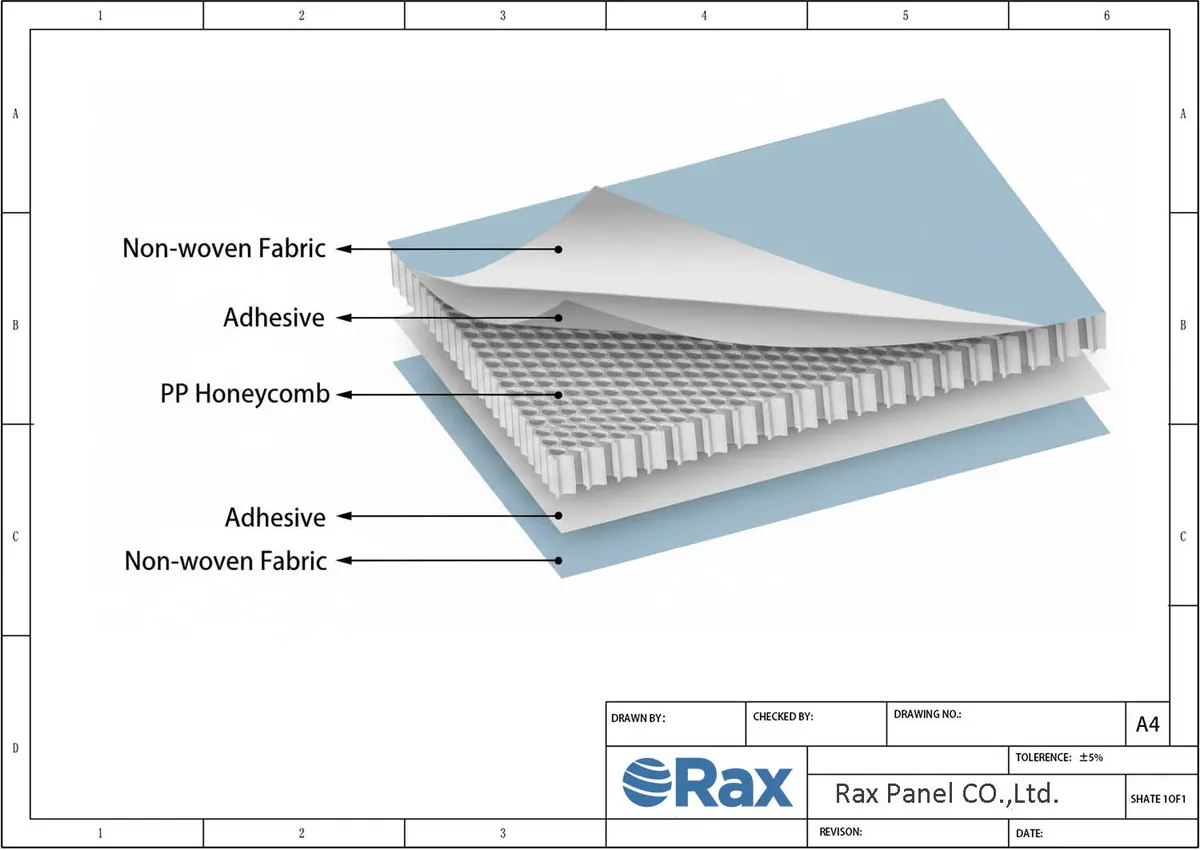
Core Features of PP Honeycomb Panels
PP honeycomb cores solve the engineering battle between weight reduction and structural rigidity, while inherently blocking moisture ingress and noise transmission.
High Strength-to-Weight Ratio
Engineers constantly fight the weight-to-strength trade-off in traditional builds. Solid plastics and metals often add unnecessary mass to assemblies. PP honeycomb changes the math entirely. When we composite a PP honeycomb core with fiberglass sheets—as we do in our standard manufacturing process—the resulting sandwich structure achieves massive shear strength without the bulk.
The hexagonal cell topology distributes compressive loads efficiently across the entire panel surface. This architecture allows OEMs to strip dead weight from their vehicle or enclosure designs while retaining necessary load-bearing capacity. You essentially gain the structural rigidity of solid materials without paying the heavy mass penalty.
Moisture and Chemical Resistance
Water ingress is a silent killer in composite sandwich panels. Traditional cores can swell or delaminate when exposed to chronic condensation or humidity over time. Polypropylene is a closed-cell thermoplastic, meaning it absorbs virtually zero water. This property eliminates the internal rot and structural decay that ruins less stable materials.
Beyond moisture, polypropylene offers exceptional chemical stability. It resists aggressive industrial chemicals, road salts, oils, and common solvents without degrading. This ensures the panel’s core matrix remains uncompromised even in highly corrosive operating environments, directly translating to lower warranty claims for manufacturers.
Thermal and Acoustic Insulation
Sound transmission and temperature fluctuations are major headaches in vehicle and enclosure design. The hexagonal air pockets trapped within the honeycomb matrix act as natural shock absorbers for acoustic waves. They effectively damp vibrations and absorb ambient noise, reducing the need for aftermarket sound-deadening mats.
That same trapped air creates a distinct thermal break. It significantly slows down conductive heat transfer compared to solid metal or rigid plastic sheets of identical thickness. For integrators, this means better compliance with energy efficiency standards and improved climate control, achieved directly within the structural material rather than relying on add-on insulation.
| Core Feature | Technical Detail | Key Benefit |
|---|---|---|
| Ultra-Lightweight Structure | Density as low as 0.3 g/cm³; approx. 1/12 the mass of water and 1/32 the mass of aluminum of the same volume | Dramatically reduces overall weight in RVs, trucks, and marine vessels without sacrificing performance |
| High Strength-to-Weight Ratio | Excellent compressive and shear strength via hexagonal honeycomb cell architecture | Provides structural rigidity under heavy loads while remaining exceptionally light |
| Energy Absorption & Impact Resistance | Specialized cell structure effectively absorbs and distributes impact energy across the panel surface | Protects payloads and passengers in automotive, aerospace, and transit applications |
| Sound & Vibration Dampening | Honeycomb geometry reduces damped vibration and absorbs ambient noise | Creates quieter interiors for RVs, mobile homes, and passenger vehicles |
| Waterproof & Corrosion Resistant | Inherent moisture resistance of polypropylene; no water ingress or swelling | Ideal for marine hulls, decks, and humid environments where delamination is a concern |
| Eco-Friendly & Recyclable | 100% recyclable material; zero VOC emissions, no formaldehyde, no odor during processing | Meets green building standards and sustainable manufacturing requirements |
| Temperature & Chemical Resistance | High thermal tolerance and broad chemical resistance of PP polymer | Performs reliably in extreme climates and chemically demanding industrial settings |
| Fiberglass Composite Compatibility | PP honeycomb core bonds seamlessly with fiberglass reinforced sheets (GRP/CFRT) | Enables customized lightweight sandwich panels with enhanced durability for vehicle walls and flooring |
Types of PP Honeycomb Panel Structures
PP honeycomb panel structures vary primarily by skin bonding and core configuration. The structural difference between a standard thermoplastic variant and a fiberglass-reinforced composite lies in load distribution, not in the honeycomb cell geometry itself.
Fiberglass Reinforced PP Panels
When a PP honeycomb core is composited with fiberglass sheet facing, the resulting panel delivers a stiffness-to-weight profile that pure thermoplastic constructions cannot match. Our engineers consistently specify this configuration for RV walls, truck body panels, and mobile home flooring where point-loads and fastener stress are concentrated. The fiberglass skin distributes localized forces across a wider area of the honeycomb cells, preventing premature cell wall collapse.
At Rax Panel, we produce two distinct fiberglass-facing categories bonded to PP honeycomb cores:
- GRP/FRP Sheets: Traditional fiberglass reinforced plastic sheets, available with or without gelcoat. These provide high rigidity and proven long-term weatherability in exterior structural applications.
- CFRT Sheets: Continuous fiberglass reinforced thermoplastic sheets. These are lighter and thinner than standard GRP, yet offer higher resilience under repeated flexural stress due to the thermoplastic matrix.
A critical engineering note on core selection: buyers frequently assume that specifying a smaller honeycomb cell size will proportionally increase overall panel stiffness. In practice, cell size has a negligible effect on macro-level panel stiffness once the facings are bonded. Stiffness is governed almost entirely by facing thickness and core depth. Over-specifying cell density simply adds material cost without measurable structural return.
Standard Thermoplastic Variants
Standard thermoplastic honeycomb panels use PP facings thermally fused or adhesively bonded directly to the PP honeycomb core. Because both the skin and core share the same polypropylene base, these panels achieve excellent interfacial bonding without the compatibility issues that sometimes arise in mixed-material laminates.
These all-PP constructions are fully recyclable and process without volatile organic compound emissions, making them straightforward for distributors handling environmental compliance documentation across European and North American markets. They perform reliably in interior partitioning, packaging inserts, and transit cases where extreme point-loads are not the primary design driver.
The trade-off is straightforward: thermoplastic variants flex more under concentrated loads compared to fiberglass-reinforced equivalents. For applications requiring maximum flexural rigidity at minimum weight, the fiberglass-faced option remains the engineering preference.
Surface Treatment Variations
Surface treatment on PP honeycomb panels serves functional rather than decorative purposes. The primary options we manufacture include:
- Gelcoat Finishes (FRP panels): Applied to GRP sheet facings, gelcoat creates a flat, smooth, waterproof surface with inherent insulation properties. This is the standard specification for RV roofing and refrigerated truck bodies where moisture sealing is non-negotiable.
- Non-slip / Anti-skid Textures: Molded surface profiles designed for flooring and deck applications where slip resistance underfoot is a safety requirement.
- Raw Matte Finish: Uncoated thermoplastic or FRP surfaces prepared for secondary lamination by the end manufacturer, allowing distributors to apply custom veneers or adhesive-bonded overlays in their own facilities.
Choosing between these surface treatments depends entirely on downstream processing. If the panel ships to a fabricator who will laminate their own decorative layer, raw matte reduces unnecessary cost. If the panel installs directly as a finished surface, gelcoat or anti-skid treatment eliminates a secondary processing step for the buyer.
| Structure Type | Key Features | Unique Advantage | Ideal Application |
|---|---|---|---|
| PP Honeycomb + Fiberglass Sheet | Strong, lightweight, high strength-to-weight ratio | Excellent energy absorption and impact resistance | RV walls, truck bodies, vehicle interiors |
| PP Honeycomb + GRP Sheet (Gelcoat) | Waterproof, flat surface, thermally insulating | Smooth finish with moisture barrier protection | Marine vessels, wet environments, boat decks |
| PP Honeycomb + CFRT Sheet | Lighter, thinner, highly resilient thermoplastic | Continuous fiber reinforcement for superior durability | Aerospace interiors, automotive, high-performance transit |
| PP Honeycomb + Aluminum / ACP Facing | High stiffness, corrosion and weather resistant | Fire-resistant properties with excellent structural rigidity | Building facades, exterior wall cladding, roofing |
| PP Honeycomb + Plywood Facing | Economical, eco-friendly, structurally rigid | Cost-effective lightweight solution for interior use | Mobile homes, furniture panels, flooring systems |
| PP Honeycomb + Steel / Stainless Steel | Heavy-duty strength, chemical and fire resistant | Maximum load-bearing capacity for demanding conditions | Industrial equipment, heavy construction, public transit |
| Unfaced PP Honeycomb Core | 100% recyclable, sound-proof, zero VOC or formaldehyde | Greenest option with ultra-low density (down to 0.3 g/cm³) | Packaging inserts, sound insulation, void filling |
PP Honeycomb vs Conventional Materials
PP honeycomb cores outperform marine plywood in moisture resistance and solid plastics in stiffness-to-weight ratio, making them the smarter structural choice for RV, truck, and marine builds.
Polypropylene vs Marine Plywood
Marine plywood has been the default structural material for RV furniture, truck flooring, and boat interiors for decades. The logic was simple: wood is cheap, familiar, and easy to machine. But in production environments where weight targets and warranty claims actually matter, marine plywood creates more problems than it solves.
The core issue is water. Even “marine-grade” plywood relies on waterproof adhesive between wood veneers. The wood itself still absorbs moisture over time. In our 15+ years of supplying composite solutions to manufacturers across Europe and Southeast Asia, we have seen OEMs replace plywood substrates specifically because of swelling, rot, and adhesive degradation after 2-3 years of field use.
Once moisture penetrates the edge joints or screw holes, delamination is inevitable. The plies separate, the panel loses structural rigidity, and you are looking at a warranty replacement.
PP honeycomb core behaves fundamentally differently. Polypropylene is a closed-cell thermoplastic. It does not absorb water. There is no wood grain to swell, no adhesive layer between veneers to break down. When Rax Panel engineers composite a PP honeycomb core with fiberglass sheet facings, the resulting sandwich panel delivers a waterproof structural solution that maintains its mechanical properties in high-humidity and direct-water-contact environments.
- Weight reduction: PP honeycomb structures are significantly lighter than equivalent-thickness marine plywood, directly improving vehicle payload capacity and fuel efficiency.
- Zero water absorption: Unlike wood, polypropylene does not swell, rot, or support mold growth when exposed to moisture.
- No VOC emissions: PP honeycomb products contain no formaldehyde or off-gassing adhesives, which is critical for enclosed RV cabins and truck sleeper cabs.
- Impact energy distribution: The honeycomb cell structure absorbs and distributes impact forces, reducing localized damage compared to rigid plywood.
For B2B buyers running RV or truck body production lines, the switch from plywood to PP honeycomb sandwich panels also simplifies supply chain logistics. Plywood prices fluctuate with timber markets. PP is a petrochemical product with more stable bulk pricing, and our daily production capacity exceeding 1,700 square meters ensures consistent lead times for large orders.
Honeycomb vs Solid Plastic Sheets
Some engineers assume that if a thermoplastic panel works, a thicker solid plastic sheet must work better. This is a flawed assumption. Solid PVC, HDPE, or polyethylene sheets achieve their stiffness purely through material mass. You are paying for and carrying weight that contributes nothing structurally beyond basic thickness.
The honeycomb geometry changes the engineering math entirely. By placing material only where it matters, at the two face skins and the vertical cell walls connecting them, a PP honeycomb panel achieves comparable bending stiffness to a solid sheet at a fraction of the weight and material cost.
This is not a marginal improvement. In our testing at Rax Panel, we consistently find that PP honeycomb core densities can reach as low as 0.3 g/cm³ while maintaining the compressive and shear strength required for demanding structural applications in vehicle manufacturing and construction.
Solid plastic sheets also suffer from thermal expansion and warping in large-format applications. A flat 8×4 foot solid HDPE panel exposed to temperature cycling will bow and distort. A PP honeycomb sandwich panel, when properly laminated with GRP or CFRT facings, resists this warping because the sandwich structure has inherent dimensional stability. The core constrains the skins, and the skins constrain the core.
Where solid sheets do still make sense is in small, high-impact components like corner guards or wear strips. But for wall partitions, roof panels, flooring substrates, and furniture panels in RVs, truck bodies, and mobile homes, honeycomb structures are the technically superior and more cost-effective choice.
Rax Panel provides customized solutions with engineers who conduct experimental testing to match specific project requirements, ensuring that the core density, skin material, and panel thickness are optimized for each application rather than over-specifying with solid plastic.
| Property | PP Honeycomb | Conventional PVC Foam | Solid Aluminum |
|---|---|---|---|
| Density | ~0.3 g/cm³ | ~0.5–0.7 g/cm³ | ~2.7 g/cm³ |
| Weight (vs Water) | 1/12 of water | Heavier than PP | ~2.7× water |
| Recyclability | 100% recyclable | Limited recycling | Recyclable (high energy) |
| VOC / Formaldehyde | Zero VOC, no formaldehyde | May emit VOCs | None |
| Water / Moisture Resistance | Excellent, waterproof | Good, can absorb over time | Corrosion-prone |
| Energy Absorption | Superior honeycomb absorption | Moderate | Low (dents permanently) |
| Sound Insulation | Excellent noise damping | Good | Poor |
| Strength-to-Weight Ratio | Exceptionally high | Moderate | Good but heavy |
| Temperature Resistance | High temp adaptability | Moderate | Excellent |
| Chemical Resistance | Resistant to most chemicals | Moderate | Susceptible to corrosion |
| Fabrication Flexibility | Highly formable & customizable | Moderate | Requires heavy tooling |
| Typical Applications | RV walls, truck bodies, marine, aerospace, construction | Interior decoration, templates | Structural facades, enclosures |
Industrial PP Honeycomb Panel Manufacturing
The performance of a PP honeycomb panel is dictated by two production stages: extrusion consistency of the core and the lamination bond between skin and substrate. Fail at either, and delamination becomes inevitable under dynamic load.
Extrusion and Core Formation
Industrial PP honeycomb core production relies on a continuous extrusion process where molten polypropylene is forced through a precision die to form the hexagonal cell structure. The geometry of these cells—wall thickness, cell diameter, and core height—directly determines the compressive strength and shear performance of the final panel. In our production line, we maintain strict control over extrusion temperature and cooling rates to prevent cell wall irregularities that would create weak points across the sheet.
A critical factor buyers often overlook is density consistency across the entire core width. Variations in extrusion speed or resin feed can produce regions with uneven cell formation, leading to unpredictable failure under load. Our factory monitors this in real time during production, which is essential when panels are destined for structural applications like RV walls or refrigerated truck bodies where localized weakness is unacceptable.
The PP honeycomb core offers inherent chemical resistance and zero water absorption, unlike paper-based or open-cell alternatives. This makes it suitable for marine and high-humidity environments without risking moisture-induced degradation from within the core itself. The material is also fully recyclable and produces no VOCs during processing.
Lamination and Skin Selection
Once the core is formed, the lamination stage bonds the facing skins to the honeycomb substrate. This is where panel performance is truly won or lost. The adhesive bond must distribute shear forces evenly across the skin-to-core interface. Any void or disbond area becomes a failure initiation point under dynamic loading conditions such as road vibration in trucks or wave impact on vessel hulls.
Skin selection depends entirely on the mechanical and environmental demands of the end application. Our engineers select from the following facing options based on project-specific requirements:
- GRP/FRP Sheets: Fiberglass reinforced plastic sheets available with or without gelcoat. The gelcoat surface provides a waterproof, smooth, and chemically resistant finish ideal for truck bodies and marine components.
- CFRT Sheets: Continuous fiberglass reinforced thermoplastic sheets that are lighter and thinner than traditional FRP while maintaining high resilience. Preferred for weight-critical applications.
- Aluminum Sheets: Selected when rigid surface flatness and high thermal reflectivity are required, commonly in building cladding and architectural panels.
The combination of PP honeycomb core with fiberglass sheet facing produces a composite that is both strong and lightweight—a pairing we frequently specify for RV flooring, roofing, and furniture panels. Our engineering team conducts experimental testing on each custom configuration to verify that the bond strength and flexural properties meet the data standards required for the specific operating conditions of the project.
PP Plastic Safety and Material Properties
Polypropylene (PP) is one of the safest thermoplastics available. It emits zero VOCs during processing, contains no formaldehyde, and is fully recyclable — making it compliant with stringent environmental and health regulations across global markets.
Is PP Plastic Safe?
This question comes up frequently from distributors supplying the RV, mobile home, and food-adjacent packaging sectors. The short answer: yes, PP is widely recognized as one of the safest polymers in commercial use. It is the same material used in food containers, medical devices, and baby bottles. For B2B buyers, this matters because it directly impacts regulatory compliance and end-market acceptance.
From a manufacturing standpoint, PP honeycomb cores process cleanly. Unlike some thermoset materials that release volatile organic compounds (VOCs) during curing or cutting, PP produces no toxic fumes. Workers on the factory floor do not need specialized ventilation beyond standard industrial setups. This reduces compliance overhead for manufacturers in regulated regions like the EU and North America.
There is also the end-of-life angle. PP is a thermoplastic, meaning it can be melted down and reformed multiple times without significant degradation. It does not leach chemicals into soil or groundwater. For buyers supplying markets with strict Extended Producer Responsibility (EPR) frameworks, this recyclability is a tangible commercial advantage over materials like PVC or thermoset foams.
Chemical Resistance and Stability
PP exhibits strong resistance to a broad range of chemicals at ambient temperatures. This is not a marketing claim — it is a well-documented material property rooted in PP’s non-polar molecular structure. The carbon-hydrogen bonds in polypropylene are inherently resistant to polar solvents, which covers most acids, alkalis, and aqueous solutions encountered in industrial environments.
In practical terms, when Rax Panel engineers spec a PP honeycomb core for truck body panels or RV flooring, the material holds up against road salts, fuel splashes, cleaning agents, and mild acids without swelling, cracking, or losing structural integrity. This chemical inertness is one reason PP honeycomb cores are selected for demanding applications like refrigerated truck bodies where exposure to cleaning chemicals and temperature cycling is constant.
- Acids: Resistant to most dilute and concentrated mineral and organic acids at room temperature.
- Alkalis: Highly resistant to bases, including sodium hydroxide and ammonia solutions.
- solvents: Resistant to polar solvents like water, alcohols, and most aqueous solutions. Vulnerable to non-polar solvents like aromatics and chlorinated hydrocarbons at elevated temperatures.
- Moisture absorption: Near-zero water absorption (less than 0.01% by weight), eliminating risk of dimensional swelling or fungal growth.
The stability concern buyers should actually pay attention to is UV exposure. Raw PP degrades under prolonged ultraviolet radiation. This is not a dealbreaker — Rax Panel addresses this through composite design. When the PP honeycomb core is encapsulated between protective facing sheets like GRP/FRP or aluminum, the core is shielded from direct UV contact. For exposed applications, UV-stabilized formulations or surface coatings are specified during the customization phase.
Temperature stability also warrants consideration. PP maintains its mechanical properties across a range of roughly 0°C to 100°C. Below freezing, it can become brittle. Above its melting point of approximately 160°C, it loses structural integrity entirely. For most RV, truck, and building applications, this operating window is more than sufficient.
But if a buyer is sourcing panels for high-heat industrial environments, our engineering team needs to evaluate whether a different core material — such as PET foam with higher glass transition temperature — is the better fit.
| Property | Specification | Safety Performance | Key Benefit |
|---|---|---|---|
| Material Composition | Polypropylene (PP) Thermoplastic | Non-Toxic, Zero VOC Emissions | 100% Recyclable, Eco-Friendly |
| Chemical Emissions | No Formaldehyde, No Odor | Safe for Indoor and Enclosed Spaces | Meets Green Environmental Standards |
| Density | As Low as 0.3 g/cm³ | Lightweight Reduces Structural Load | 1/12 Weight of Water, 1/32 of Aluminum |
| Water and Moisture Resistance | Fully Waterproof, Zero Absorption | Prevents Mold, Rot, and Degradation | Ideal for Marine and Humid Environments |
| Temperature Tolerance | High Temperature Resistance | Stable Performance Under Thermal Stress | Strong Environmental Adaptability |
| Impact and Energy Absorption | Honeycomb Structure Absorbs Dynamic Loads | Resists Cell Wall Fracture Under Impact | Protects Payload in Transit Applications |
| Chemical Resistance | Inert to Most Acids, Alkalis, and Solvents | No Corrosion or Degradation Over Time | Long Service Life in Harsh Conditions |
| Fire Behavior | Self-Extinguishing, No Toxic Fumes | Slows Flame Spread, Low Smoke Emission | Enhanced Safety for RV and Vehicle Interiors |
| Sound Insulation | Reduces Damped Vibration and Noise | Improves Occupant Comfort and Well-Being | Effective Acoustic Dampening for Walls and Floors |
| Recyclability and Sustainability | Fully Recyclable Thermoplastic | No Hazardous Waste Generation | Supports Circular Economy and Green Building Certifications |
Conclusion
PP honeycomb panels solve the weight-versus-strength problem across RV manufacturing, truck bodies, marine builds, and construction. But the performance gap between a well-bonded panel and a cheap one is massive. You don’t find out which you bought until 18 months into the field.
- Specifying core density below 80 kg/m³ to shave cost. Cell walls collapse under dynamic loads, and your customer files a warranty claim six months later.
- Skipping adhesion testing between the PP core and fiberglass skins. Delamination drives roughly 70% of sandwich panel failures in real-world conditions.
- Ignoring water ingress data for RV and marine jobs. Moisture seeps into the honeycomb cells, freezes, expands, and destroys the panel from the inside out.
Before you lock in a supplier, pull their technical data sheet and check three numbers: peel strength, compressive modulus, and water absorption rate. If they can’t produce those, walk. Our engineering team publishes exact specs for every panel configuration we build — reach out and we’ll send the test reports.
Frequently Asked Questions
This factor has a direct bearing on project performance and long-term cost. Addressing it with specific data rather than general assumptions leads to better outcomes.
Do PP honeycomb panels reduce long-term operating costs?
The practical payoff shows up in operating costs over time. Lower energy consumption, minimal maintenance, and a service life measured in decades typically recover the initial investment within a few years.
What industries use PP honeycomb panels most frequently?
Transportation (RV sidewalls, truck bodies, marine interiors), building construction (partitions, ceiling panels, door cores), and furniture manufacturing are the top three sectors. Each benefits from the panel’s moisture resistance, flat surface finish, and ability to be CNC-cut into precise shapes without delamination.
How much does honeycomb panel used typically cost?
The cost of honeycomb panel used varies based on material grade, thickness, panel dimensions, and order volume. Requesting a detailed quote with your project specifications is the most reliable way to get an accurate figure. Bulk orders typically reduce per-unit pricing significantly.
What factors affect the price of honeycomb panel used?
The cost of honeycomb panel used varies based on material grade, thickness, panel dimensions, and order volume. Requesting a detailed quote with your project specifications is the most reliable way to get an accurate figure. Bulk orders typically reduce per-unit pricing significantly.
How long does honeycomb panel used last under normal conditions?
With proper installation and routine maintenance, honeycomb panel used can last 20 to 30 years or more. Actual lifespan depends on environmental exposure, load conditions, and whether the protective surfaces remain intact over time.