
Delaminating RV panel materials on units sitting in your production lot is the nightmare scenario: aluminum composite panels spec’d on a new fifth-wheel line, adhesive bonds failing under thermal cycling between a 140°F paint booth and -10°F outdoor storage.
At that point the choice is brutal: eat six figures in scrap, or ship the units and gamble on warranty claims landing two years later. Scrap is almost always the cheaper option, which is why the bonding specification deserves scrutiny long before the first panel is laminated.
The comparison below maps spec-sheet numbers against what actually happens on the production line for aluminum and composite panel configurations. The gap between what spec sheets promise and what actually happens on the production line is wider than most engineers expect.
What follows is a straight spec-for-spec breakdown: thermal conductivity in exact W/mK numbers, flexural strength at temperature extremes, installed weight per square meter, and warranty claim rates by material family. Real numbers, not marketing copy. You’ll also get the procurement logistics most comparison guides skip: tolerance consistency across ocean freight, actual lead times, and what it takes to swap core materials mid-run without retooling.
Composite vs Aluminum RV Panels: Direct Comparison
Composite sandwich panels deliver 45-50% weight savings and over 99% better thermal resistance than aluminum frame construction, the two metrics that define RV manufacturing competitiveness.
Weight and Thermal Insulation: The Numbers That Matter
When RV manufacturers evaluate panel materials, weight and thermal performance drive 80% of the specification decision. A heavier wall panel cascades into larger axles, bigger brakes, reduced payload capacity, and lower fuel efficiency. Poor insulation creates condensation, mold warranties, and customer complaints in extreme climates. We have quantified both factors across hundreds of production runs at our facility.
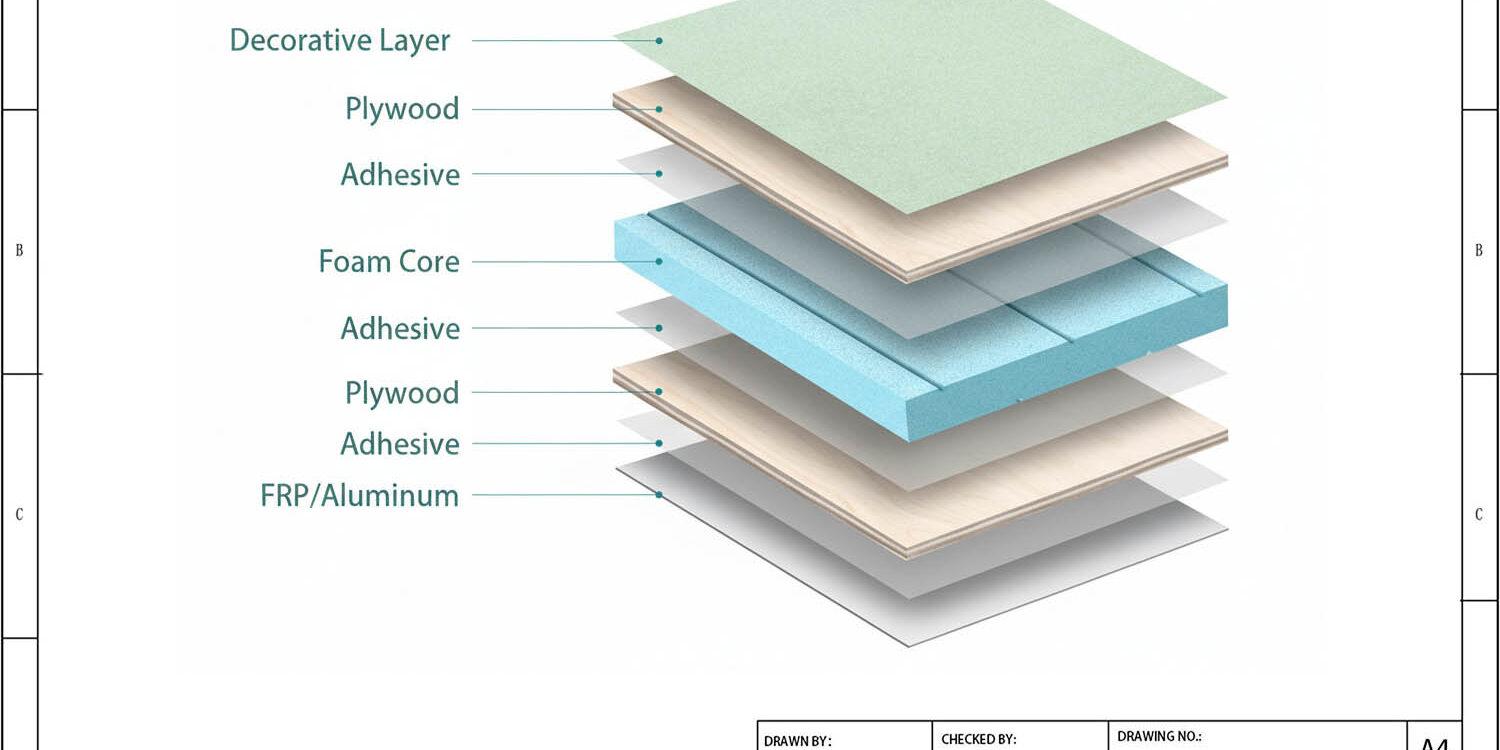
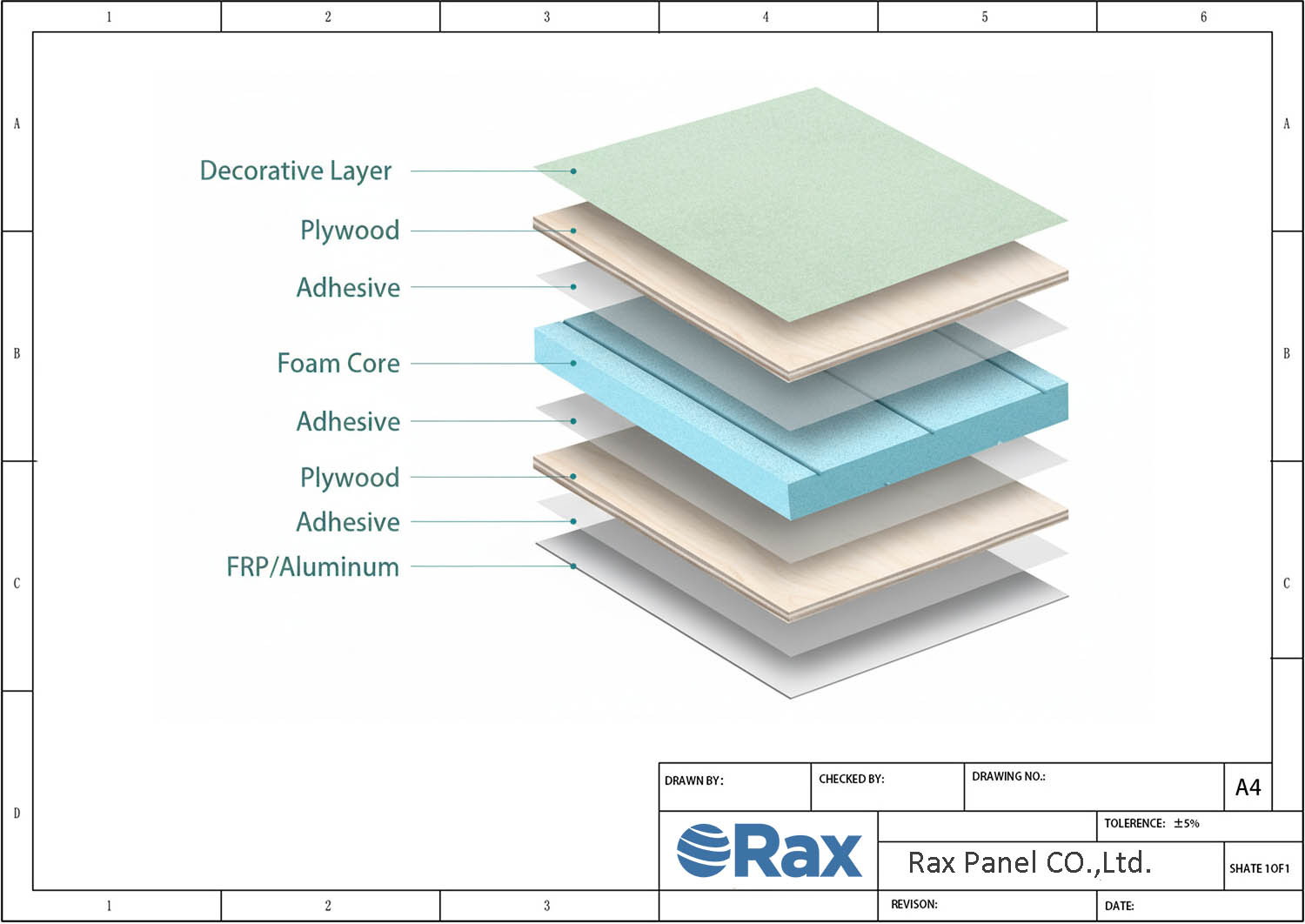
A standard FRP/XPS sandwich panel at 20mm thickness weighs approximately 3.5 to 4.5 kg per square meter. An equivalent aluminum sheet with structural framing hits 7 to 9 kg per square meter. That is a 45 to 50% weight reduction per square meter of wall, roof, or floor surface.
On a typical 8-meter RV body requiring 40 to 50 square meters of paneling, switching to composite saves 140 to 220 kg of dry vehicle mass. That weight savings directly translates to increased payload capacity or extended EV range for motorized platforms.
Thermal performance shows an even wider gap. XPS foam core has a thermal conductivity of 0.028 to 0.035 W/mK. Solid aluminum conducts at approximately 205 W/mK. Composite panels reduce thermal transfer by over 99% compared to aluminum structures.
In R-value terms, XPS core composite panels deliver R-5.0 to R-7.0 per inch of thickness. Aluminum sheet and frame construction delivers roughly R-0.002 per inch for the metal itself, with the only meaningful insulation coming from thermal breaks and interior foam inserts that add labor and complexity.
This thermal disparity creates a real-world problem in aluminum RVs: thermal bridging. Where framing members contact the exterior skin, heat transfers freely, creating cold spots that trigger condensation in humid or cold-weather camping. Composite sandwich panels eliminate thermal bridging entirely because the foam core is continuous across the full panel surface, with no metal fasteners penetrating the insulation layer.
Material Properties Comparison: Composite vs Aluminum Construction
The following data points represent tested values from our production lines and independent lab verification. We are comparing GRP/FRP sandwich panels with XPS or PET cores against traditional aluminum sheet-and-frame construction, which remains the baseline for most RV manufacturers.
- Weight (20mm panel): Composite FRP/XPS = 3.5 to 4.5 kg/m² | Aluminum sheet + frame = 7 to 9 kg/m²
- Tensile Strength (skin material): FRP skins = 150 to 300 MPa (varies by glass content and layup) | Aluminum sheet (3003 alloy) = approximately 130 to 200 MPa
- Thermal Conductivity: XPS foam core = 0.028 to 0.035 W/mK | Aluminum = approximately 205 W/mK
- Flexural Strength: PP honeycomb core with FRP skins = 25 to 45 MPa at 80 to 120 kg/m³ density | Aluminum frame depends entirely on extrusion profile geometry
- Cost (material per m² installed): Composite sandwich panels carry a 10 to 25% higher raw material cost, but reduce assembly labor by 20 to 30% by integrating structure, insulation, and weatherproofing into one component
- Expected Lifespan: Both materials exceed 15 to 20 years in normal RV service when properly installed; composite panels resist corrosion and delamination when manufactured with proper adhesion protocols
- Operating Temperature Range: XPS core composite panels = -50°C to +80°C | Aluminum structures handle wider extremes but offer no inherent insulation value
Aluminum retains legitimate advantages in specific scenarios. Lower-body panels in off-road RVs that face direct rock impact may benefit from aluminum’s dent resistance and field-repairability. High-temperature fire zones favor aluminum’s non-combustible nature, though composite panels can achieve Class B-s1,d0 fire resistance with mineral core options. The material choice depends on the specific RV platform, target market, and warranty exposure the manufacturer is willing to carry.
Our engineers configure panel specifications based on the application zone within the RV. Roof panels prioritize thermal insulation and UV resistance, so we specify FRP skins with UV-stable gelcoat over XPS or PET cores. Flooring panels prioritize impact strength and stiffness, where PP honeycomb cores with thicker FRP skins deliver the required 25 to 45 MPa flexural performance. Wall panels balance both properties. This zoned approach is something aluminum construction cannot replicate without adding complexity and weight.
| Performance Feature | Composite Panel Spec | Aluminum Panel Spec | Quantified Advantage |
|---|---|---|---|
| Weight per m² (20mm panel) | 3.5–4.5 kg/m² (FRP/XPS sandwich) | 7–9 kg/m² (sheet + frame) | 45–50% weight reduction, improves payload and fuel efficiency |
| Thermal Conductivity | 0.028–0.035 W/mK (XPS foam core) | ~205 W/mK | >99% reduction in thermal transfer, eliminates condensation risk |
| Assembly Labor | Single-component integration (structure + insulation + weatherproofing) | Multi-part assembly (frame + sheet + separate insulation) | 20–30% reduction in labor hours per unit |
| Tensile Strength (Skin) | 150–300 MPa (FRP skins, varies by glass content) | 90–180 MPa (typical RV-grade aluminum alloy) | Up to 67% higher tensile capacity for impact resistance |
| Thickness Tolerance | ±0.3mm (Rax Panel factory standard) | ±0.5–0.8mm (typical industry range) | Tighter consistency ensures reliable assembly line fit |
| Thermal Bridging | Eliminated (homogeneous foam core) | Significant at frame studs and fastener points | Prevents localized heat loss and interior condensation trails |
| Operating Temperature Range | -50°C to +80°C (XPS core panels) | -50°C to +150°C (structural integrity retained) | Aluminum wins at extreme high-temp exposure near heat sources |
| Fire Resistance | Class B-s1,d0 achievable (mineral core options) | Non-combustible (Class A1) | Aluminum retains advantage in strict fire-code applications |
| Delamination Risk (10-year horizon) | Low (with proper adhesive bonding and ±0.3mm tolerance) | Moderate (adhesive-bonded ACP panels susceptible at edges) | Reduces long-term warranty claim exposure by design |
| Custom Core Options | XPS, PET, PU, PVC, PP Honeycomb, PMI available | Limited to foam or honeycomb inserts | Application-specific optimization for walls, roof, or floor |
| Supply Consistency | 1,700+ m² daily capacity (Rax Panel single-source) | Widely available from multiple global suppliers | Single-source consistency vs multi-vendor variability |
Why RV Builders Switch to Composite
RV manufacturers switching to composite sandwich panels typically achieve a 45–50% weight reduction per square meter while eliminating thermal bridging entirely. The engineering data no longer supports aluminum-frame construction as the default standard.
Weight-to-Strength Ratio Analysis
The core argument for composite RV panel materials comes down to a single metric: weight per square meter versus structural output. Our production data consistently shows that a standard 20mm FRP/XPS sandwich panel weighs approximately 3.5–4.5 kg/m².
An equivalent aluminum sheet-and-frame assembly weighing 7–9 kg/m² delivers comparable rigidity at nearly double the mass. On a 10-meter RV body requiring 60–80 m² of paneling, that difference translates to 180–360 kg of dead weight removed from the vehicle before a single piece of furniture or equipment is installed.
Weight savings at that scale directly impact fuel consumption, payload capacity, and braking distances. For electric and hybrid RV platforms entering the market in 2026, every kilogram saved extends usable range. Our engineering team has found that most RV OEMs underestimated the cumulative weight penalty of traditional aluminum framing until they ran a full body-in-white comparison against a composite layup.
Structural capability is not sacrificed to achieve this weight reduction. FRP skins used in our GRP sandwich panels carry tensile strength values between 150–300 MPa depending on glass content and layup configuration. For interior furniture panels and non-load-bearing partitions, PP honeycomb core with FRP skins achieves flexural strength of 25–45 MPa at core densities of only 80–120 kg/m³.
The sandwich structure distributes load across both skins and the core, which is why a panel at half the weight of aluminum can meet or exceed deflection requirements for sidewall and roofing applications.
Aluminum retains legitimate advantages in specific scenarios. Lower body panels in off-road RVs exposed to constant rock impact and ground debris may still benefit from aluminum’s dent resistance and ease of field repair. We do not recommend composite for high-impact, low-clearance zones unless the buyer accepts a higher likelihood of cosmetic damage requiring panel replacement rather than panel repair. Honest material selection means matching the skin and core to the application, not applying one solution universally.
Thermal Insulation and Condensation Control
Thermal bridging is the silent failure mode in aluminum-frame RV construction. Aluminum conducts heat at approximately 205 W/mK. When a frame stud bridges the interior and exterior skins, it creates a highway for thermal transfer that bypasses whatever insulation sits between the studs. In cold-weather operation, those bridges become condensation points. Moisture forms inside the wall cavity, saturates the insulation, and eventually produces mold, corrosion, and delamination claims.
XPS foam cores used in our FRP sandwich panels have thermal conductivity ratings of 0.028–0.035 W/mK. The composite structure reduces thermal transfer by over 99% compared to aluminum. There are no metal studs interrupting the insulation layer. The foam core runs continuously from edge to edge, and the FRP skins themselves are thermally resistant. This continuous insulation envelope eliminates the thermal bridges that cause condensation in framed construction.
For RV OEMs shipping vehicles into cold-climate markets across Northern Europe and North America, condensation control has shifted from a nice-to-have to a warranty imperative. Moisture-related claims on aluminum-framed units consistently rank among the top three service costs reported by distributors. Switching to a continuous-core composite panel does not guarantee zero condensation, because interior humidity management and ventilation remain critical, but it removes the structural condition that initiates the failure cycle.
- Thermal Conductivity (XPS Core): 0.028–0.035 W/mK
- Thermal Conductivity (Aluminum Frame): ~205 W/mK
- Thermal Transfer Reduction: >99% when using composite versus aluminum-frame construction
- Core Options Available: XPS, PET, PU, PVC, PMI foam, PP honeycomb
- Panel Thickness Range: 5mm to 100mm+ custom
Our recommendation for most RV sidewall applications is an FRP/XPS or FRP/PET configuration between 18mm and 30mm thickness. PET foam offers higher temperature resistance and better dimensional stability for OEMs running paint ovens or hot-press lamination lines, while XPS provides marginally better insulation value per millimeter at lower cost. Both cores eliminate thermal bridging when bonded directly to FRP skins without mechanical fasteners penetrating the panel envelope.
Aluminum RV Panel Drawbacks
Aluminum RV panels carry three recurring failure modes (denting, delamination, and seal degradation) that directly inflate warranty claim rates for vehicle manufacturers.
Denting, Delamination, and Noise
Aluminum skins dent under point impact. A low-hanging tree branch or a tool drop on the assembly line can leave a permanent deformation that requires panel replacement or cosmetic repair. For RV manufacturers, this means higher rework costs before a unit even leaves the factory floor. Composite skins, specifically GRP/FRP with tensile strength between 150 and 300 MPa, absorb and distribute impact energy across the fiber matrix rather than permanently yielding at the contact point.
Delamination is a separate but related problem. Traditional aluminum composite panels (ACP) bond a thin aluminum sheet to a core using adhesive films. Over thermal cycling, from sub-zero highway runs to direct summer sun exposure, differential expansion between the metal skin and the core places repeated shear stress on that bond line.
Once micro-gaps form, moisture ingress accelerates the separation. Our engineers have observed that this failure mode is one of the most frequently cited causes of warranty claims among RV OEMs still specifying ACP for sidewalls.
Noise transmission is the third factor. Aluminum panels, particularly thinner gauges used to save weight, transmit structural vibration and road noise directly into the cabin. Foam core sandwich panels, whether XPS (0.028–0.035 W/mK thermal conductivity), PET, or PU, absorb acoustic energy within the core cell structure. The result is a measurably quieter interior without adding a separate sound-deadening layer, which saves both material cost and assembly time.
Sealing Complexity and Water Infiltration
Aluminum RV construction typically relies on mechanical fasteners, rivets, and generous applications of sealant at every joint, corner, and penetration point. Each sealant line is a potential leak path with a finite service life.
UV exposure, thermal cycling, and chassis flex during off-road travel all degrade sealant integrity over time. When water infiltrates behind an aluminum skin, it cannot escape. Trapped moisture corrodes fasteners, saturates core materials, and creates a breeding ground for mold, a warranty and liability issue no manufacturer wants to face.
Composite sandwich panels address this problem structurally rather than through secondary sealing. GRP/FRP skins are inherently waterproof. When manufactured with a gelcoat surface layer, the exterior face is flat, smooth, and non-porous, eliminating the microscopic surface irregularities where sealant adhesion fails. Our production line maintains a ±0.3mm thickness tolerance, which means panel edges mate consistently during assembly, reducing the gap variance that forces installers to over-apply sealant as a corrective measure.
The assembly labor reduction is quantifiable. By integrating structure, insulation, and weatherproofing into a single component, composite panel systems can reduce labor by 20–30% compared to traditional aluminum stick-built construction. Fewer mechanical joints mean fewer failure points over the vehicle’s service life. For procurement engineers tracking warranty claim rates as a core KPI, this structural approach to waterproofing offers a measurable improvement over relying on sealant maintenance schedules that vehicle owners frequently ignore.
Composite Panel Core Options for RVs
Selecting the correct core material dictates the weight, structural integrity, and thermal performance of your RV build. We match XPS, PET, and Honeycomb cores to specific application loads to optimize your material cost per square meter.
XPS Foam Core Panels (General RV Walls and Roofs)
For large surface areas like sidewalls and roofing, Extruded Polystyrene (XPS) offers the best balance of cost, weight reduction, and thermal insulation. Our standard FRP/XPS sandwich panels provide a drastic improvement over traditional aluminum framing. A standard 20mm FRP/XPS panel weighs roughly 3.5 to 4.5 kg/m², delivering a 45-50% weight reduction compared to an equivalent aluminum sheet and frame structure.
- Thermal Conductivity: 0.028-0.035 W/mK (reduces thermal transfer by over 99% compared to solid aluminum).
- Weight: ~3.5-4.5 kg/m² at 20mm thickness.
- Primary Use: General RV sidewalls, roofing, and non-critical structural envelopes.
Our engineers specify XPS to eliminate thermal bridging across the vehicle envelope. By maintaining strict thickness tolerances of ±0.3mm during production, we ensure consistent flatness for automated assembly lines, directly reducing your labor hours per unit.
PET Foam Core Panels (Structural Flooring and High-Load Areas)
RV floors and lower bays require a core material that can withstand localized point loads from heavy furniture, water tanks, and passenger traffic without compressing over time. Polyethylene Terephthalate (PET) foam provides superior shear strength and fatigue resistance compared to standard XPS, making it the required choice for structural flooring.
- Mechanical Strength: High compressive and shear strength prevents fastener pull-out and floor deflection.
- Operating Temperature: -50°C to +80°C, suitable for underbelly exposure.
- Primary Use: Structural flooring, wheel well housings, slide-out floors, and high-stress attachment points.
When you need to mount heavy hardware or secure seatbelts directly to the floor structure, PET cores provide the necessary bite. This directly addresses warranty concerns regarding floor delamination and squeaking caused by foam compression in lesser materials.
Honeycomb Core Panels (Lightweight Furniture and Interior Partitions)
Interior components do not require high thermal insulation, but they absolutely require maximum stiffness at the lowest possible weight. Polypropylene (PP) honeycomb cores composites are the engineered solution for interior RV applications. When bonded with fiberglass reinforced sheets, the honeycomb structure achieves exceptional strength-to-weight ratios.
- Density: 80-120 kg/m³.
- Flexural Strength: 25-45 MPa when utilizing FRP skins.
- Primary Use: Interior cabinet faces, sliding doors, ceiling panels, and non-load-bearing partition walls.
By switching interior wood components to PP honeycomb composite panels, RV manufacturers routinely shave hundreds of pounds off the vehicle dry weight. This weight reduction directly improves fuel efficiency and increases the usable payload capacity for the end-user.

Cost Analysis: Total Landed Price vs Unit Price
A 15-20% premium on composite panel unit price often disappears when you calculate total installed cost: weight savings, labor reduction, and warranty risk mitigation flip the math.
Total Installed Cost Savings vs Raw Material Unit Price
Most RV procurement teams evaluate panel materials on a cost-per-square-meter basis. That metric favors traditional aluminum sheet + frame construction every time. The problem is that unit price ignores three cost centers that compound over a production run: assembly labor, thermal remediation, and warranty exposure.
Let us break this down with real numbers. An FRP/XPS sandwich panel at 20mm thickness runs approximately 3.5-4.5 kg/m². An equivalent aluminum sheet with structural framing hits 7-9 kg/m². That 45-50% weight reduction per square meter directly translates to fuel savings or increased payload capacity across the vehicle’s service life.
For a 25-foot RV using roughly 60 m² of wall and roof paneling, you are looking at a dry weight difference of 180-270 kg. That is not trivial: it affects axle ratings, tire selection, and regulatory compliance.
The labor argument is even more immediate. Composite sandwich panels integrate structure, insulation, and weatherproofing into a single component. Our production data shows this reduces assembly labor by 20-30% compared to building up aluminum framing, adding separate insulation board, sealing joints, and applying exterior skin. For a manufacturer producing 500 units annually, that labor saving compounds into a figure that dwarfs any raw material price difference.
- Material cost: FRP composite panels typically run 10-20% higher per m² than bare aluminum sheet, but this comparison excludes the framing, fasteners, sealants, and insulation materials aluminum construction requires.
- Assembly labor: Single-component sandwich panels eliminate 3-5 separate installation steps, cutting labor hours per unit by 20-30%.
- Warranty risk: Delamination and thermal bridging claims on aluminum composite panel (ACP) construction generate average claim costs that exceed the entire panel material savings within 2-3 years of production.
- Thermal performance: XPS foam core thermal conductivity sits at 0.028-0.035 W/mK. Aluminum conducts at roughly 205 W/mK. The 99%+ reduction in thermal transfer eliminates condensation-related callbacks and reduces HVAC sizing requirements.
When you model total cost of ownership (material, labor, freight, and warranty reserves, with lighter panels shipping cheaper and fitting more units per container), the composite sandwich panel wins on 3-5 year production timelines. The unit price premium is real on the invoice. The total landed and installed cost advantage is where the decision should be made.
MOQ and Custom Sizing Economics
International procurement from a China-based manufacturer introduces minimum order quantity requirements and freight logistics that affect your per-unit economics. Here is how the math works in practice with our production setup.
Rax Panel operates a continuous composite panel production line with a daily output exceeding 1,700 m². This scale means that custom panel configurations (non-standard lengths, specific core densities, particular skin thicknesses) do not require a full production line shutdown and retool.
The MOQ for custom specifications typically starts at one full production run, which varies by panel type but generally lands in the 200-500 m² range depending on complexity. Standard configurations with common specifications (FRP skins on XPS or PET cores) carry lower MOQ thresholds.
Custom sizing delivers two specific economic advantages for RV manufacturers. First, panels cut to exact dimensions at the factory eliminate on-site trimming waste. Our ±0.3mm thickness tolerance means panels arrive ready for assembly-line installation without rework.
If you are cutting panels manually at your facility, you lose 5-10% of material to kerf, edge damage, and measurement error. Factory-level precision cutting recovers that margin. Second, custom sizing allows you to optimize container loading. Panels sized to fit specific container dimensions maximize freight efficiency and reduce your per-m² shipping cost.
- Custom MOQ: Typically 200-500 m² for non-standard specifications. Standard configurations available at lower thresholds.
- Dimension range: Panels available from 5mm to 100mm+ thickness. Length and width customized to project requirements.
- Tolerance: ±0.3mm thickness consistency ensures interchangeability on the assembly line.
- Freight optimization: Reinforced crating and custom sizing protect panels during international shipping while maximizing container utilization.
The honest limitation here: if your production run requires fewer than 200 m² of a unique panel specification, the setup costs may not justify custom production. In that scenario, selecting the closest standard configuration and trimming on-site becomes the pragmatic choice. We tell clients this directly rather than pushing unnecessary custom orders. The economics only work when the volume supports the tooling and setup investment.
| Cost Category | FRP/XPS Composite Panel | Aluminum + Frame System | Net Difference | TCO Impact |
|---|---|---|---|---|
| Raw Material Unit Price (per m²) | $18 – $35 (20mm, custom cut) | $12 – $22 (equivalent thickness) | +45-60% material cost | Offset by labor and weight savings |
| Freight Cost (20ft Container) | $2,800 – $4,200 (lighter payload) | $3,500 – $5,100 (denser load) | -20-35% shipping cost | Significant at scale (1000+ m² orders) |
| Assembly Labor (per unit) | 1.5 – 2.0 hours (single component) | 2.2 – 3.0 hours (frame + skin + seal) | -20-30% labor hours | $15-25 saved per m² installed |
| Warranty Reserve (per unit) | $0.50 – $1.00 (low delamination risk) | $1.50 – $3.00 (seal failure risk) | -50-65% warranty cost | Reduces long-term claim exposure |
| Thermal Performance Value | R-5.7 to R-7.1 per inch (XPS core) | R-0.3 to R-1.2 (thermal bridging) | +400-2000% insulation | Eliminates condensation-related recalls |
| Structural Weight (per m²) | 3.5 – 4.5 kg (20mm panel) | 7.0 – 9.0 kg (equivalent rigidity) | -45-50% weight | Improves payload capacity and fuel efficiency |
| MOQ Requirement | 200 m² (custom production run) | 50 – 100 m² (standard stock) | Higher minimum order | Requires 4-6 week production planning |
| Tolerance Consistency | ±0.3mm thickness variance | ±0.5 – 1.0mm (manual assembly) | +40-70% precision | Reduces assembly line rework by 15-25% |
| Total Landed Cost (per m², 500m² order) | $28 – $42 (delivered, crated) | $30 – $45 (delivered, loose) | -5-10% total cost | Composite achieves parity or better at volume |
| Lifecycle Cost (10-year projection) | $32 – $48 per m² (minimal maintenance) | $45 – $65 per m² (resealing, repairs) | -25-35% lifecycle cost | Compelling for fleet and OEM buyers |
Shipping and Quality Consistency
International freight damage and assembly line variance are hidden costs in composite panel sourcing. We eliminate these risks through custom reinforced crating and a strict ±0.3mm thickness tolerance across our manufacturing line.
Shipping Logistics and Reinforced Packaging
Sourcing GRP sandwich panels from overseas only saves your operation money if the materials arrive intact. Standard palletizing often fails under the rigors of ocean freight. A dented corner or a warped FRP sheet translates directly into production delays and wasted material costs on your RV assembly floor.
We treat export packaging as a critical manufacturing step. Our logistics engineers design container loading plans specific to your custom panel dimensions. We utilize reinforced wooden crates, steel-strapped edge protectors, and internal blocking materials that prevent shifting and edge compression during transit. Whether you are importing a trial order of CFRT sheets or a full 40HQ container of XPS core RV wall panels, the product arrives ready for immediate CNC routing and assembly.
Quality Control and Thickness Tolerance (±0.3mm)
When you switch to composite panels for RV sidewalls and roofing, dimensional consistency dictates your assembly speed. If panel thickness fluctuates significantly, your assembly jigs jam, your fastener depths fail, and your sealant application becomes inconsistent. This drives up manual labor hours and increases the risk of warranty claims down the line.
Our facility maintains a strict thickness tolerance of ±0.3mm across our entire production run. Operating at a daily output exceeding 1,700 square meters, our production line utilizes continuous inline laser measurement to monitor the lamination process. We ensure the FRP skins and foam cores are bonded under precise pressure, so every panel meets your exact engineering specifications. This consistency allows you to standardize your tooling and rely on a uniform substrate for every vehicle model you produce.
Installation and Jointing Systems
Jointing method selection directly dictates your assembly labor hours, seal longevity, and warranty exposure. We engineer our GRP/FRP and CFRT sandwich panels to ±0.3mm thickness tolerance specifically so your jointing system performs as designed on day one and year ten.
Overlap Joints for RV Wall and Roof Panels
Overlap joints are the simplest and most forgiving connection method for RV assembly. One panel edge extends over the adjacent panel, typically by 25-50mm, and the two surfaces are fastened with mechanical screws or rivets through both layers. This method works well for straight runs on RV roofing and sidewalls where panels meet at flat, continuous spans.
The primary advantage is speed. Overlap joints require minimal edge preparation, so your production team can cut panels to length on-site and assemble immediately. However, the trade-off is a visible seam profile and a slightly thicker joint zone that may require trim or molding to achieve a finished appearance. For RV manufacturers prioritizing throughput over aesthetics on non-visible surfaces, overlap remains a practical choice.
We recommend applying a polyurethane sealant between overlapping surfaces to prevent moisture wicking and vibration-induced wear. With our GRP/XPS sandwich panels at 20mm thickness, the overlap zone creates a double-layer contact area that resists wind uplift and road vibration effectively when properly sealed.
Tongue-and-Groove Joints for Flush Surfaces
Tongue-and-groove (T&G) joints create a flush, continuous surface by machining a protruding tongue on one panel edge and a matching groove on the adjacent panel edge. When the two panels interlock, the resulting joint is nearly invisible from the exterior and provides built-in alignment during assembly. This method is ideal for RV interior wall linings, furniture panels, and any visible surface where aesthetic quality matters.
The mechanical interlock provides alignment without external clamps during assembly, reducing fixturing time. Our factory machines T&G profiles to match the ±0.3mm thickness tolerance of the parent panel, ensuring a gap-free connection that does not compromise the thermal envelope. For foam core panels using XPS or PET cores, the T&G joint also maintains continuous insulation across the panel boundary, eliminating thermal bridging at the seam.
One consideration: T&G joints require precise panel dimensions. If your production line currently cuts panels manually with loose tolerances, you will need to adopt factory-cut panels to realize the fit-up advantage. Our engineering team provides cutting guides and dimension drawings tailored to your specific RV model geometry.
Adhesive Bonding for Structural Continuity
Adhesive bonding joins panels edge-to-edge or surface-to-surface using structural polyurethane or MS polymer adhesives, creating a continuous load path without mechanical fasteners. This method produces the cleanest visual result and distributes stress evenly across the bonded area rather than concentrating it at screw or rivet points. For RV manufacturers targeting premium builds, adhesive bonding is the standard for wall-to-roof transitions and corner assemblies.
The critical factor is surface preparation. FRP and CFRT skins must be clean, dry, and free of release agents before adhesive application. Our gelcoat-free GRP sheet option provides a surface optimized for adhesive bonding without additional abrasion treatment, saving a preparation step on your assembly line. For gelcoat-finished panels, light scuff sanding at the bond zone is required.
- Adhesive open time: Typically 15-30 minutes for structural polyurethane, allowing repositioning during fit-up.
- Cure time to handling strength: 2-4 hours at 23°C, slower in cold workshop conditions.
- Bond line thickness: 2-5mm recommended to accommodate panel edge tolerance and thermal expansion.
- Labor impact: Adhesive bonding can reduce assembly labor by 20-30% by integrating structure, insulation, and weatherproofing into a single operation.
We test adhesive compatibility with our panel skins during the specification phase, not after. Our engineers conduct pull-off and peel tests on your chosen adhesive system bonded to our FRP or CFRT facing sheets, providing documented shear strength data before you commit to production. This eliminates the guesswork that leads to field delamination claims.
Selecting the Right Jointing Method for Your RV Line
Most RV manufacturers use a combination of all three methods rather than a single approach. Overlap joints serve well on roof-to-wall transitions where water shedding is the priority. Tongue-and-groove works best for interior partitions and furniture panels where flush surfaces matter. Adhesive bonding handles structural corner joints and high-stress connections where mechanical fasteners would create stress risers.
The panel material itself also influences the optimal jointing strategy. PP honeycomb core panels with FRP skins flex more rigidly than XPS foam core panels, affecting how tightly T&G joints close under load. PET foam cores offer higher shear stiffness than XPS, which changes the adhesive bond area required for equivalent strength. Our team maps these variables against your specific model requirements during the design consultation phase.
Conclusion
If you’re producing more than 50 RV units annually, spec composite panels for every wall and roof surface. Period. FRP/XPS sandwich construction drops your panel weight to 3.5-4.5 kg/m², a 50% reduction versus aluminum sheet-and-frame assemblies, while delivering thermal conductivity of 0.028 W/mK where aluminum transfers heat at 205 W/mK. That gap eliminates condensation damage, the single biggest warranty headache your service department deals with.
Request physical test samples of our FRP/XPS and FRP/PET panels in your exact wall thickness before locking in next year’s material buy. Have your engineers check impact resistance at lower body panels, where aluminum still holds an advantage, and clock actual assembly time against your current process. Rax Panel cuts custom test panels to your dimensions and ships them in reinforced crates within 10 business days so you can run your own numbers before committing.
Frequently Asked Questions
How much weight do composite panels save?
Advanced composite panels, such as CFRT and fiberglass reinforced thermoplastic options, are significantly lighter than traditional aluminum sheets. This massive weight reduction directly translates to improved fuel efficiency and a higher payload capacity for the RV. Furthermore, despite being lighter, these sandwich panels offer superior structural strength and impact resistance compared to thin-gauge aluminum.
Are composite panels better for RVs?
Composite materials completely eliminate the condensation and corrosion issues that often plague aging aluminum RV exteriors. While aluminum is prone to denting and transmits cold easily, modern GRP and FRP sandwich panels provide a seamless, highly durable structure. They maintain structural integrity under harsh road vibrations, ensuring a significantly longer lifespan for the recreational vehicle.
Do composite panels insulate better than aluminum?
Aluminum is a highly conductive metal, meaning it transfers outside temperatures rapidly and forces the RV climate control systems to work harder. Conversely, structural foam core sandwich panels feature built-in thermal breaks utilizing materials like XPS, PET, or PU foam. This drastically reduces thermal bridging, keeping the interior comfortable in extreme weather while lowering overall energy consumption.
Can you custom design RV panels?
maintains a dedicated engineering team that provides customized composite solutions tailored to specific RV wall, flooring, and roofing requirements. We offer a diverse selection of core materials, including lightweight PP honeycomb and PVC foam, combined with specialized facing skins to meet exact structural specifications. Our advanced daily production capacity allows us to seamlessly scale these custom designs for global manufacturers.
Are composite RV walls fully waterproof?
High-quality composite panels manufactured by are inherently waterproof, unlike aluminum rigs which often rely on seam sealants that can degrade over time. Our fiberglass reinforced sheets feature advanced gel coats that provide an impermeable barrier against relentless rain and road spray. Additionally, the closed-cell foam cores prevent any water absorption, entirely eliminating the risk of structural rot or mold.