
Shaving 40% off vehicle weight does more than improve fuel economy. It unclogs your production line. The CFRT PET sandwich panel achieves this by utilizing a PET foam core bonded with PET-based outer layers, eliminating the heavy mass of plywood and metal skins without sacrificing stiffness.
We analyze the trade-offs between weight reduction and structural load capacity, along with the cycle time efficiency gains over thermoset materials. At RaxPanel, our manufacturing data shows that thermoforming these composites cuts curing bottlenecks significantly compared to standard adhesive bonding. You get the specific criteria needed to optimize core density and select fire ratings for your next vehicle build.
What to Look for in CFRT PET Panel Performance
Evaluating CFRT PET panel performance requires looking beyond single metrics. The right panel balances specific strength, cycle consistency, and long-term environmental resistance—not just peak numbers on a spec sheet.
Weight Reduction Versus Structural Integrity Metrics
When assessing CFRT PET panels for RV walls, truck bodies, or mobile home structures, the critical question is not simply how light the panel is, but what structural performance it retains per unit of weight removed. Engineers should evaluate specific strength ratios—how much load-bearing capacity remains relative to the mass eliminated compared to traditional GRP or aluminum-faced alternatives.
The most useful benchmark is flexural stiffness normalized against panel density. A panel that cuts weight by 30 percent but loses 40 percent of its bending resistance has not delivered a net gain. Look for suppliers who publish both flexural modulus and density data together, not in isolation. Our engineering team consistently cross-references these two values during material selection, because a high flexural number means little if the core density is unnecessarily heavy.
- Specific strength ratio: Compare flexural strength against panel mass to determine weight-efficient performance, not just absolute strength.
- Skin-to-core adhesion integrity: Verify that the CFRT skin bonds uniformly across the full panel surface—weak zones here create failure points under cyclic loading.
- Impact resistance at reduced thickness: Thinner panels must still absorb point impacts without cracking; request impact test data at your target skin thickness range.
Thermoforming Cycle Time Efficiency Gains
Thermoforming efficiency is where CFRT PET panels separate themselves from conventional thermoset composites in a production environment. The key performance indicator is not just raw cycle speed, but cycle consistency and energy consumption per formed part. A panel that thermoforms quickly but requires extensive post-cure handling or generates high scrap rates erodes those time savings entirely.
When evaluating a supplier’s thermoforming capability, ask for documented cycle time data across multiple panel thicknesses and core densities. In our production environment, we track reheat time, forming pressure, cooling duration, and trim-out time as a complete sequence—not just the heating phase. Panels that claim fast cycle times without disclosing the full process chain are often omitting the cooling and trimming segments that dominate actual shop-floor throughput.
- Full cycle transparency: Request breakdown of reheat, form, cool, and trim phases—total cycle time is the sum of all four.
- Scrap and rework rates: High-speed thermoforming that produces excessive trim waste or warpage defeats the efficiency purpose.
- Energy per unit output: Compare kWh consumed per square meter of formed panel, not just cycle count per hour.
- Tooling compatibility: Ensure the panel material works with your existing thermoforming tooling without requiring process requalification.
Thermal Insulation and Moisture Resistance Properties
For RV sidewalls, refrigerated truck bodies, and mobile home enclosures, thermal and moisture performance is a long-term reliability factor, not a one-time specification. PET foam cores inherently resist moisture absorption far better than polyurethane or polystyrene alternatives, but the actual panel assembly must also maintain that resistance through the skin-core bond line. Delamination from trapped moisture is a common failure mode in lower-quality constructions.
The thermal resistance of a CFRT PET panel depends on both the core density and the continuity of the thermal break. Our testing shows that panels with PET cores in the mid-density range maintain stable R-value performance across temperature cycles that cause other foam cores to contract or expand unevenly. This dimensional stability directly translates to fewer fastener failures and seal breaches over the vehicle’s service life.
When specifying for moisture-critical applications, verify the panel’s water absorption rate after extended exposure, not just initial values. Some suppliers report baseline absorption that improves dramatically after the panel reaches equilibrium moisture content. Request long-duration humidity exposure test data to understand real-world performance.
- Long-term R-value retention: Confirm that thermal performance does not degrade after repeated thermal cycling in field conditions.
- Moisture absorption after conditioning: Ask for post-exposure water uptake data, not just factory-fresh measurements.
- Bond line integrity under humidity: The skin-core interface must remain bonded after prolonged moisture exposure—this is where inferior panels fail first.
- Condensation resistance: For refrigerated and cold-chain applications, verify that the panel surface temperature remains above dew point under expected operating conditions.
Don’t evaluate any single performance metric in isolation. A panel that excels in weight reduction but shows marginal moisture resistance will create warranty headaches in humid climates. Request a complete performance profile that covers structural, thermal, and environmental data before making a material selection.
| Performance Attribute | Technical Specification | Functional Advantage | Application Value |
|---|---|---|---|
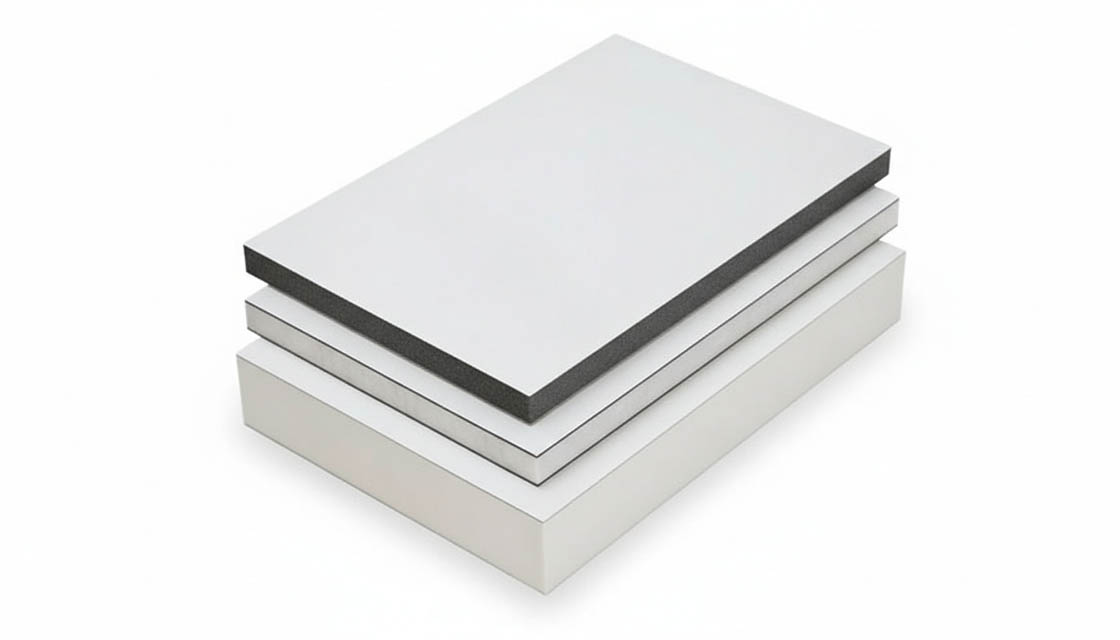
| Skin Composition | Continuous Fiber Reinforced Thermoplastic (CFRT) 0.7–2.0 mm | High tensile strength, impact resistance, and lighter weight than traditional metals | Ideal for RV sidewalls and truck bodies requiring high strength-to-weight ratios |
| Core Material Density | PET Foam Core (60–300 kg/m³) | Excellent thermal insulation and compressive stiffness | Enhances energy efficiency in mobile homes and refrigerated trucks |
| Flexural Strength | > 13 | Superior structural rigidity and load-bearing capacity | Ensures durability for flooring and heavy-duty partitions |
| Bonding Method | Thermal Lamination (Hot Melt Process) | Eliminates adhesive curing, prevents delamination and cracking in extreme temperatures | Reliable performance in harsh climates and reduces production cycle time |
| Environmental Impact | 100% Thermoplastic Composite | Fully recyclable and remeltable; non-toxic | Supports sustainability goals and reduces waste in manufacturing |
How Much Lighter Is CFRT PET vs Traditional Cores?
CFRT PET sandwich panels typically weigh 30-50% less than equivalent panels with balsa or plywood cores, and 15-25% lighter than high-density PVC or PU foam alternatives, depending on core density selection.
Core Density: The Foundation of Weight Savings
The weight advantage begins with the core material itself. PET foam cores are available in a density range of 60 to 300 kilograms per cubic meter, allowing engineers to select the optimal balance between weight and structural performance for each application. This density range is significantly lower than traditional structural cores like balsa wood (200-400 kg/m³) and plywood (500-700 kg/m³), which remain common choices in RV and truck body manufacturing despite their weight penalty.
When compared to other foam alternatives, low-density PET foam at 60-80 kg/m³ falls within the same range as XPS and PU foams. However, the critical differentiator is not just core density—it is the combination of a lightweight PET core with a continuous fiber-reinforced thermoplastic (CFRT) skin, which delivers superior specific strength (strength-to-weight ratio) compared to panels using glass-reinforced plastic (GRP) skins with the same core.
Areal Weight Comparison: Panel-Level Realities
For B2B buyers evaluating panels at the sheet level, areal weight is the practical metric that drives procurement decisions. A typical 25mm-thick CFRT PET panel with a 100 kg/m³ core and CFRT facing weighs approximately 4.5 to 5.5 kilograms per square meter. The same panel configuration with a balsa core would weigh roughly 7 to 9 kg/m², and with a plywood core, the weight climbs to 10 to 14 kg/m².
- CFRT PET (100 kg/m³ core): ~4.5-5.5 kg/m² for 25mm panel thickness
- CFRT PET (150 kg/m³ core): ~6.0-7.0 kg/m² for 25mm panel thickness
- CFRT PET (200 kg/m³ core): ~7.5-8.5 kg/m² for 25mm panel thickness
- Balsa core equivalent: ~7-9 kg/m² for 25mm panel thickness
- Plywood core equivalent: ~10-14 kg/m² for 25mm panel thickness
- PVC foam core (150 kg/m³): ~6-7 kg/m² for 25mm panel thickness (similar areal weight but lower strength-to-weight)
At the panel level, areal weight is the practical metric that drives procurement decisions.
Real-World Impact: Payload and Fuel Efficiency Gains
The weight savings from CFRT PET panels translate directly into operational cost benefits. In RV manufacturing, switching from plywood-based flooring to CFRT PET sandwich panels can reduce floor assembly weight by 40-60%, directly increasing payload capacity for water tanks, cargo, and passenger weight. For a typical Class C RV with approximately 15 square meters of flooring, this translates to a weight reduction of 30 to 50 kilograms per vehicle.
In truck body construction, lighter panels improve fuel economy across an entire fleet. A refrigerated truck body using CFRT PET wall and roof panels instead of traditional GRP-plywood constructions can achieve a weight reduction of 80 to 120 kilograms per unit. Over a fleet of 50 trucks operating 150,000 kilometers annually, this weight reduction can yield measurable fuel savings and reduced CO₂ emissions, directly supporting both operational cost targets and regulatory compliance requirements.
For marine applications, the weight reduction at the hull and superstructure level improves vessel speed, handling, and fuel efficiency. A 20% reduction in superstructure panel weight can improve power-to-weight ratio sufficiently to allow for smaller engine configurations or increased deck load capacity—both critical factors in commercial vessel design.
The Density Selection Trade-Off
Notably that PET foam cores are available across a wide density spectrum (60-300 kg/m³), and the weight advantage over traditional cores varies depending on the selected density. Higher-density PET cores (200-300 kg/m³) offer greater compressive strength and stiffness, making them suitable for high-load applications such as truck floor panels and marine deck structures, but the weight savings versus balsa or plywood remain significant at approximately 20-30%.
For non-structural or lightly loaded applications such as interior wall cladding, furniture panels, and ceiling liners, the lowest-density PET cores (60-80 kg/m³) deliver maximum weight savings with minimal compromise in service performance. This density flexibility allows designers to optimize each panel for its specific load requirements rather than applying a one-size-fits-all core material across an entire vehicle or structure.
When specifying CFRT PET panels for weight-sensitive projects, request the areal weight (kg/m²) rather than just core density (kg/m³). Areal weight accounts for the full panel assembly—including facing material thickness and layup—and is the metric that directly impacts payload calculations and freight cost estimates.
Do not assume that all PET foam cores deliver the same weight savings. A 200 kg/m³ PET core panel will be noticeably heavier than a 80 kg/m³ variant. Always confirm the exact core density and total panel areal weight in your purchase specification—especially when weight is a primary selection criterion for your application.
Faster Production Lines with CFRT PET
Transitioning to thermoplastic composites allows manufacturers to eliminate chemical curing stages, compressing multi-day assembly processes into a continuous, high-velocity production workflow.
The Shift from Chemical Curing to Physical Forming
The primary bottleneck in traditional composite manufacturing using thermoset resins (such as standard GRP) is the chemical reaction required for curing. This process is time-dependent and often unchangeable once the resin is mixed. Manufacturers must wait hours, if not days, for a panel to achieve full structural integrity before it can be moved or processed further. In contrast, CFRT (Continuous Fiber Reinforced Thermoplastic) PET panels utilize a thermoplastic matrix that transitions from a solid to a pliable state and back via thermal changes rather than chemical cross-linking.
This physical distinction fundamentally alters line speeds. Because the material does not require a “pot life” or a specific time to harden, the production cycle is dictated only by the speed of the heating and cooling equipment. A thermoforming process for CFRT PET can be measured in seconds or minutes rather than hours. By removing the curing variable, production lines can run continuously without the stop-and-go rhythm required for batch curing in thermoset operations.
Eliminating Adhesive Bottlenecks
In conventional sandwich panel assembly, bonding the skins to the core typically involves liquid adhesives or wet lay-up methods. These introduce significant inefficiencies, including the need for precise clamping, extensive floor space for laying up parts, and long dwell times for the adhesive to set. Any variance in temperature or humidity can further destabilize the schedule, leading to inconsistent throughput.
CFRT PET technology addresses this by enabling thermal lamination and welding. The thermoplastic skins can be heated and bonded directly to the core—or to themselves—using heat and pressure, effectively welding the components into a single monolithic structure. This method instantly creates a structural bond as the material cools. smoothly, the handling time is drastically reduced, and manufacturers can move panels from the press to the finishing station almost immediately, significantly increasing the daily turnover of the production floor.
Workflow Integration and Inventory Stability
Beyond the immediate assembly speed, CFRT PET panels offer logistical advantages that optimize the broader production ecosystem. Unlike thermoset materials which must be stored cold and used within a strict expiration date, thermoplastic sheets and cores are shelf-stable at room temperature. This eliminates the cold-chain logistics and waste associated with expired resins.
The material’s form stability also facilitates higher levels of automation. Because the continuous fiberglass reinforced thermoplastic sheets are lighter and thinner yet resilient, they are easier for robotic arms to manipulate than heavy, wet-layup fiberglass mats. The reduced physical handling requirements allow for the integration of automated feeding and cutting systems, further compressing the total labor hours required per unit and ensuring a consistent, high-speed output that matches the demands of high-volume RV and truck body manufacturing.
When switching to CFRT PET, verify that your facility’s HVAC can handle the heat load from the thermoforming equipment. While the line speed increases, the localized energy demand during the heating phase is intense compared to passive resin curing.
How Strong and Durable Are CFRT PET Panels?
The durability of CFRT PET panels is defined by continuous fiber architecture. Unlike short-fiber alternatives that suffer from fragmented load paths, the continuous filament winding in CFRT skins creates unbroken stress channels, delivering superior specific stiffness and resistance to catastrophic failure.
In the B2B sector, “strength” is often conflated with thickness, but for CFRT PET panels, performance is driven by material science. The structural integrity of these panels relies on the collaboration between the Continuous Fiber Reinforced Thermoplastic (CFRT) skins and the PET foam core. The skins provide the primary tensile and compressive strength, while the core stabilizes the skins against buckling and shear deformation. This composite action allows a panel that is significantly lighter than plywood or metal to maintain high flexural rigidity, making it capable of spanning substantial distances without sagging or deflection—a critical requirement for RV roofs and truck body sidewalls.
Flexural Strength and Stiffness Dynamics
Flexural strength is the measure of a material’s ability to resist deformation under load. In CFRT panels, the continuous glass or carbon fibers are impregnated with thermoplastic resin (such as PP or PET) and laid in deliberate orientations—typically unidirectional (0°/90°) or cross-plied. This alignment ensures that the fibers directly confront the bending forces. When a load is applied, the continuous fibers distribute the stress evenly along their entire length, eliminating the weak points found at the ends of chopped strands found in traditional FRP.
| Mechanical Property | CFRT Continuous Fiber | Short-Fiber Composites (SMC/BMC) |
|---|---|---|
| Load Path Continuity | Unbroken, high-efficiency stress transfer | Fragmented, stress concentrations at fiber ends |
| Impact Resistance | High energy absorption (tough thermoplastic matrix) | Brittle failure, prone to cracking |
| Fatigue Life | Excellent resistance to cyclic loading | Degrades faster under vibration |
Impact Resistance and Fatigue Life
For mobile applications like truck bodies and RVs, impact resistance is non-negotiable. The thermoplastic resin matrix in CFRT panels is inherently tougher than the thermoset resins (polyester or vinyl ester) used in traditional fiberglass. This ductility allows the panel to absorb energy from impacts—such as road debris or tool drops—without shattering or delaminating. additionally, the bond between the continuous fibers and the thermoplastic matrix is extremely resilient. Unlike thermosets, which can develop micro-cracks over time due to vibration and flexing, CFRT panels exhibit superior fatigue resistance, ensuring that the structural integrity remains consistent over the vehicle’s operational life.
Moisture Tolerance and Core Stability
Long-term durability is heavily influenced by environmental exposure. A critical failure mode in sandwich panels is core degradation due to moisture ingress. The PET foam core utilized in these panels is a closed-cell thermoplastic material. Unlike balsa wood or honeycomb cores that can wick water, or PVC foams that may absorb moisture over long periods, PET foam is hydrophobic and resistant to rot. This property ensures that the bond line between the skin and the core remains intact even in high-humidity environments, preventing the delamination and loss of structural stiffness that plagues inferior sandwich constructions.
Is Switching to CFRT PET Worth the Cost?
CFRT PET sandwich panels carry a higher upfront material cost than conventional cores, but total cost of ownership often favors them through faster cycle times, lower scrap rates, and end-of-life recyclability value that offsets the initial premium within 12 to 24 months of production.
Upfront Material Pricing: The Initial Premium
CFRT PET sandwich panels typically cost 15 to 30 percent more per square meter than traditional thermoset GRP panels with PVC or XPS cores. This premium stems from the continuous fiber reinforcement and the thermoplastic PET foam core, both of which require specialized manufacturing processes and higher-grade raw materials. Buyers comparing price sheets should note that direct per-unit cost comparisons can be misleading without factoring in processing efficiency and waste generation.
The pricing gap narrows significantly when evaluating panels at equivalent structural performance levels. A CFRT PET panel with a 2.0mm facing and 25kg per cubic meter core density often matches the stiffness of a thicker GRP panel using a heavier core, which shifts the comparison from surface price to functional cost per unit of strength. This is where procurement teams commonly discover that the apparent premium disappears under rigorous specification matching.
Labor and Processing Savings
One of the most immediate financial returns from CFRT PET panels comes from reduced processing time. The thermoplastic nature of both the CFRT skin and PET core allows for rapid thermoforming cycles that can cut forming time by 40 to 60 percent compared to thermoset alternatives. For high-volume production lines running thousands of panels per month, this translates into substantial labor cost reductions and higher throughput without requiring additional equipment or facility expansion.
Assembly and installation also benefit from the material characteristics. CFRT PET panels can be bonded using thermoplastic welding or compatible adhesives that cure faster than epoxy systems used with GRP panels. This reduces clamp time, minimizes work-in-progress inventory, and allows assembly lines to move parts through stations more quickly. Facilities that have made the transition report cycle time improvements of 25 to 40 percent on panels requiring complex geometries.
Scrap Reduction and Material Yield
Scrap rates represent a significant hidden cost in sandwich panel manufacturing, and CFRT PET panels deliver measurable improvements here. Thermoset materials generate scrap that is extremely difficult to recycle, often requiring landfill disposal at additional cost. CFRT PET scrap, by contrast, can be regrind and reprocessed into non-structural components or recycled back into the production stream, reducing raw material waste by an estimated 60 to 80 percent compared to conventional thermoset processes.
The dimensional stability of CFRT PET panels also contributes to lower scrap rates during fabrication. The material exhibits minimal warpage and shrinkage during thermoforming, which means fewer rejected parts due to tolerances. For manufacturers producing panels with tight dimensional requirements, such as those used in RV walls and truck bodies, this stability directly reduces rework and material waste that would otherwise erode margins.
End-of-Life Recyclability Value
The recyclability of CFRT PET panels is becoming an increasingly important financial factor as regulatory frameworks and corporate sustainability targets tighten across Europe, North America, and key Asian markets. Unlike thermoset composites that must be landfilled or incinerated, CFRT PET panels can be separated at end-of-life, with the PET core and CFRT skins each recoverable for reuse in lower-grade applications. This creates a residual value stream that thermoset competitors cannot match.
For OEMs supplying to fleet operators and vehicle manufacturers, the ability to demonstrate recyclability can support compliance with extended producer responsibility regulations and green procurement requirements. Some European transport operators now include recyclability metrics in their supplier evaluation criteria, and panels that cannot meet minimum recycling thresholds face exclusion from tender processes. This regulatory tailwind is gradually shifting the cost equation in favor of thermoplastic composite solutions.
Break-Even Analysis: When CFRT PET Pays for Itself
A typical break-even scenario for a mid-volume manufacturer producing 500 square meters of panel per month shows the initial material premium recovered within 14 to 18 months through the combined effects of faster cycle times, reduced scrap disposal costs, and lower labor expenditure per finished unit. Higher-volume producers reaching 2,000 square meters per month or more can achieve break-even in as little as 10 to 12 months due to the compounding effect of throughput gains across larger production runs.
The break-even timeline shortens further when production involves complex thermoformed geometries that are particularly challenging for thermoset materials. Panels requiring deep draws, undercuts, or multi-axis curvature see the largest processing time savings with CFRT PET, since the thermoplastic system allows single-stage forming without the multiple curing cycles that thermosets demand. For simple flat panels with minimal forming, the time savings are more modest and the cost advantage relies more heavily on scrap reduction and recyclability factors.
Scenario-Based Cost Comparison
- High-volume RV wall production: CFRT PET delivers the strongest ROI due to the combination of fast thermoforming cycles, low scrap rates, and the ability to produce large continuous panels with minimal joints, reducing assembly labor on the vehicle floor.
- Refrigerated truck body manufacturing: The thermal insulation properties of PET foam reduce the need for additional insulation layers, while the lightweight nature lowers vehicle fuel consumption, creating a secondary cost saving beyond the panel itself.
- Low-volume custom fabricators: The higher upfront material cost may take longer to recoup, but the reduced scrap disposal burden and material flexibility for prototyping still provide meaningful cost advantages over thermoset alternatives.
- Export-oriented manufacturers serving EU markets: Compliance with evolving EU recyclability directives provides a strategic cost advantage, as thermoset competitors may face future regulatory surcharges or market access restrictions that CFRT PET panels avoid entirely.
The financial case for switching to CFRT PET panels is strongest for manufacturers with consistent production volumes, complex panel geometries, and export markets with tightening sustainability regulations. For these operations, the initial material premium is a short-term cash flow consideration rather than a long-term cost disadvantage, with total cost of ownership turning favorable well before the end of the first year of adoption.
Which CFRT PET Panel Fits Your Production?
Selecting the correct CFRT PET panel configuration requires balancing structural load requirements against regulatory fire codes and the specific environmental exposure of the application.
Optimizing Core Density for Load Capacity
The core density is the primary driver of a sandwich panel’s stiffness and load-bearing capability. While increasing the density of the PET foam core significantly enhances the shear modulus and resistance to denting, it also adds weight. For interior partitions or furniture panels where the primary load is static, lower density cores offer sufficient rigidity while maximizing the vehicle’s payload efficiency. However, for flooring or roofing applications, the material must withstand dynamic loads and foot traffic.
In our production experience, we have found that simply thickening the panel does not always compensate for low core density in high-stress zones. A higher density core provides better support to the skins, preventing buckling under point loads. When specifying for structural flooring or heavy-duty truck bodies, engineers should prioritize higher density variants to ensure the panel maintains its flatness and structural integrity over the vehicle’s lifespan.
Fire Safety Ratings for Vehicle Interiors
Compliance with fire safety regulations is non-negotiable for RV and mass transit interiors. Standard PET foam possesses inherent flame retardant properties, but achieving specific certifications—such as UL94 V-0, FMVSS 302, or EN 45545 for railway applications—often requires specialized formulations. These ratings are critical not just for legal compliance, but for passenger safety in enclosed spaces where smoke density and toxicity are major hazards.
Our engineers rigorously test formulations to ensure that the core material meets the stringent low-smoke, zero-halogen (LSZH) requirements often demanded by European and North American transport authorities. When sourcing panels for occupied compartments, do not rely on generic “fire-retardant” claims. Always verify that the specific grade supplied carries the appropriate certification for your target market, as regional regulations vary significantly in their testing protocols for heat release and smoke development.
Surface Finish Selection for Environmental Durability
The exterior skin serves as the first line of defense against physical impact and UV degradation. For exterior sidewalls and roofing, a gelcoat finish is typically specified to provide a glossy, weather-resistant surface that protects the underlying fibers from water ingress and UV radiation. The quality of the gelcoat application is vital; a poorly applied surface can lead to micro-cracking, which compromises the waterproof integrity of the panel over time.
Conversely, for interior applications or components that will be painted, a smooth, matte surface finish is often preferable. This type of finish eliminates the need for extensive sanding and promotes superior paint adhesion, reducing preparation time on the assembly line. We apply a specialized surfacing veil during the thermal lamination process to ensure a consistent, pinhole-free texture that accepts bonding agents and coatings effectively. Selecting the wrong finish can lead to premature weathering on exteriors or adhesion failures on the interior assembly line.
- Exterior Application: Requires UV-stable gelcoat or heavy-duty paint systems to prevent fiber blooming and degradation.
- Interior Application: Benefits from a peel-ply or smooth matte finish for direct lamination or high-quality paint finishing.
- High-Impact Zones: Utilizes thicker, cross-linked thermoplastic skins to resist damage from road debris and handling during installation.
| Panel Type | Skin Thickness | Core Density | Flexural Strength | Best For |
|---|---|---|---|---|
| CFRT PET Standard Panel | 0.7–1.2 mm | 60–120 kg/m³ | >13 MPa | RV walls, interior partitions, lightweight furniture |
| CFRT PET Structural Panel | 1.2–2.0 mm | 120–200 kg/m³ | >18 MPa | RV roofing, truck bodies, structural flooring |
| CFRT PET Heavy-Duty Panel | 1.5–2.0 mm | 200–300 kg/m³ | >22 MPa | Marine vessels, exterior cladding, high-impact zones |
| CFRT PET Thin-Gauge Panel | 0.7–1.0 mm | 60–90 kg/m³ | >13 MPa | Mobile home interiors, rapid assembly components, cost-effective partitions |
| CFRT PET Insulated Panel | 1.0–1.5 mm | 100–150 kg/m³ | >15 MPa | Refrigerated trucks, insulated building panels, energy-efficient enclosures |
Conclusion
CFRT PET sandwich panels aren’t a compromise. They deliver the weight savings your production lines need without asking you to sacrifice structural strength or thermal performance. Traditional cores like XPS and PVC have their places, but they can’t match the thermoforming speed or the recyclability profile that CFRT PET brings to RV wall and truck body manufacturing. If your operation runs high-volume panels and you’re feeling the pinch of material weight and cycle time, the switch makes clear financial sense. Our engineering team has supported over 60 custom panel configurations for transport and mobile applications — we know what works and what doesn’t in real production environments.
Share your project dimensions and load requirements with us. We’ll run a free technical feasibility review and send back panel recommendations with density, fire rating, and surface finish matched to your specific application — no obligation, no pressure. That’s how we’ve built our reputation across the transport and modular construction sectors.
Frequently Asked Questions
Are CFRT PET panels fully recyclable?
Yes, both the thermoplastic skins and PET foam core are fully recyclable, unlike traditional thermoset alternatives. This allows manufacturers to significantly reduce industrial waste and meet stringent environmental regulations. The materials can be reprocessed and reused without losing essential mechanical properties.
Does it require adhesive for bonding?
No, CFRT PET panels utilize a thermal lamination process that often eliminates the need for liquid adhesives. This method ensures a superior bond between skin and core while significantly speeding up the production cycle. It also prevents common issues like adhesive aging or chemical emissions.
What is the temperature resistance range?
CFRT PET panels perform reliably within a wide temperature range, generally from -40°C to +80°C. The PET foam core provides excellent thermal stability, resisting deformation under extreme heat or cold. This makes the panels suitable for diverse climates and demanding industrial applications.
How are damaged panels repaired?
Repairs can be efficiently conducted using thermal welding or patching methods compatible with the thermoplastic nature of the skins. This process is faster and more durable than repairs required for traditional thermoset composites. The color-matched repair techniques ensure the aesthetic appeal of the final product is maintained.
Are panels resistant to chemicals?
Yes, the closed-cell structure of the PET foam and the thermoplastic skins offer high resistance to oils, fuels, and many corrosive chemicals. This property is crucial for transportation applications where exposure to hazardous substances is frequent. It ensures the long-term durability and hygiene of the panel surfaces.
What thickness options are available?
The panels are manufactured in a wide variety of thicknesses to suit different structural and insulation needs. Standard configurations often range from 10mm up to 50mm or more depending on the application. Custom thicknesses can also be produced to meet specific engineering drawings and project requirements.