
Standard embossed metal flooring turns into a liability the moment temperatures drop below freezing. The diamond plate collects moisture, freezes over, and creates a severe slip hazard on truck beds and outdoor platforms. You eat the replacement costs.
Worse, the chemical adhesives bonding traditional aluminum skins to their cores turn brittle and fail after just a few freeze-thaw cycles. Polypropylene honeycomb cores operate reliably from -40°C to 80°C. Because continuous fiber reinforced thermoplastic skins fuse directly to the honeycomb core through thermal lamination, the panel contains zero glue to degrade when the thermometer bottoms out.
We are going to break down exactly how non-slip honeycomb panels perform in cold weather. This analysis covers sub-zero material stability, traction retention on icy surfaces, and the real load-bearing differences between thermoplastic and metal structures. The data matters. You will get the exact thermal and mechanical thresholds required to source anti-skid panels for sub-zero temperatures without risking structural failure or warranty claims on your next industrial build.
Thermoplastic honeycomb panels survive extreme cold because they eliminate the adhesive layers that fail during thermal cycling, maintaining consistent traction and structural integrity down to -40°C.
Cold Weather Properties of Non-Slip Honeycomb Panels
Polypropylene honeycomb cores and CFRT skins maintain structural ductility down to -40°C, resisting the brittleness that plagues conventional thermoset and metal-based flooring in sub-zero environments.
Low-Temperature Material Stability
The primary engineering concern with any composite panel deployed in freezing climates is the glass transition temperature (Tg) of its constituent polymers. When ambient temperatures drop below a material’s Tg, molecular mobility decreases sharply, transforming a ductile, energy-absorbing structure into a rigid, crack-propagating one. For truck flooring, cold storage decking, or exterior platforms operating in Nordic winters or high-altitude sites, this transition dictates whether a panel survives a sudden impact or shatters under load.
Thermoplastic composites—specifically those built on polypropylene (PP) matrices—exhibit a glass transition around 0°C to -10°C, but critically, this transition is gradual rather than abrupt. Unlike thermoset resins, which can undergo catastrophic embrittlement once a threshold is crossed, PP-based materials retain significant toughness well below their nominal Tg. This gradual softening-to-stiffening curve gives engineers a wider safety margin when specifying panels for environments that see seasonal temperature swings of 60°C or more.
In our lab testing at Rax Panel, we subject non-slip thermoplastic honeycomb samples to controlled cold-chamber conditioning at -40°C for 72 hours, followed by impact testing. The results consistently show that the thermoplastic matrix absorbs impact energy without developing micro-cracks in the cell walls. This behavior is fundamentally different from thermoset-bonded aluminum honeycomb, where the adhesive layer itself becomes the weak point in extreme cold—a topic explored in detail in the freeze-thaw durability section of this guide.
PP Honeycomb Cold Resistance
Polypropylene honeycomb cores are inherently well-suited to sub-zero applications due to the semi-crystalline nature of the polymer. The crystalline regions provide stiffness and dimensional stability, while the amorphous regions maintain enough molecular flexibility to prevent brittle fracture. This dual-phase structure means that even at -30°C, a PP honeycomb core still deforms plastically under excessive load rather than cracking catastrophically—giving operators visible warning signs before structural failure.
A critical advantage of PP honeycomb in cold environments is its closed-cell, non-hygroscopic nature. The material simply does not absorb moisture. This eliminates a primary failure mode seen in paper-based or open-cell honeycomb structures, where trapped water freezes, expands by approximately 9%, and ruptures the cell walls from within. For refrigerated truck manufacturers specifying flooring that will cycle between +20°C (loading dock) and -25°C (transit) daily, this moisture immunity is a non-negotiable selection criterion.
- Tensile Modulus at -40°C: PP honeycomb shows a modulus increase of approximately 30-40% compared to room temperature, meaning the core actually stiffens in cold conditions without losing its failure strain.
- Izod Impact Strength: Remains above 4 kJ/m² at -20°C for standard grade PP honeycomb, sufficient for dynamic flooring loads in commercial vehicle applications.
- Dimensional Change: Linear thermal contraction of PP from +23°C to -40°C is approximately 0.5-0.7%, which must be accounted for in panel edge detailing and joint design.
CFRT Skin Layer Behavior in Freezing Conditions
Continuous Fiber Reinforced Thermoplastic (CFRT) sheets serve as the structural facing on Rax Panel’s non-slip honeycomb products, replacing traditional thermoset FRP or aluminum skins in many configurations. CFRT is produced by impregnating continuous glass fiber rovings with a thermoplastic matrix—typically polypropylene or PET—under heat and pressure. The result is a thin, high-strength skin where the fiber-to-matrix bond is mechanical and chemical simultaneously, rather than relying on a secondary adhesive layer.
This distinction is critical in cold weather performance. In a traditional GRP (glass reinforced plastic) panel using thermoset resin, the interface between the fiberglass and the cured resin can develop micro-voids during manufacturing. In sub-zero temperatures, these voids become stress concentrators that initiate delamination under load. CFRT eliminates this interface risk because the thermoplastic matrix and the PP honeycomb core share the same polymer family.
During the continuous pressing process at our production facility, the preheated CFRT sheets fuse directly with the honeycomb core at the molecular level. There is no secondary adhesive to degrade, no chemical bonding agent to become brittle, and no mechanical interlock to loosen through differential thermal contraction.
From a load-bearing perspective, CFRT skins actually perform better in cold conditions. The thermoplastic matrix stiffens at low temperatures, increasing the skin’s flexural modulus. Combined with the honeycomb core’s own stiffening response, this means a CFRT-faced non-slip panel will exhibit less deflection under the same static load at -20°C than it does at +20°C.
For fleet operators running refrigerated trucks through winter routes, this translates to more predictable flooring performance—not less. The key engineering caveat is that increased stiffness reduces the panel’s ability to absorb impact energy, so specifications for high-impact applications in extreme cold should account for this trade-off explicitly in the design phase.
Does Cold Affect Non-Slip Surface Performance
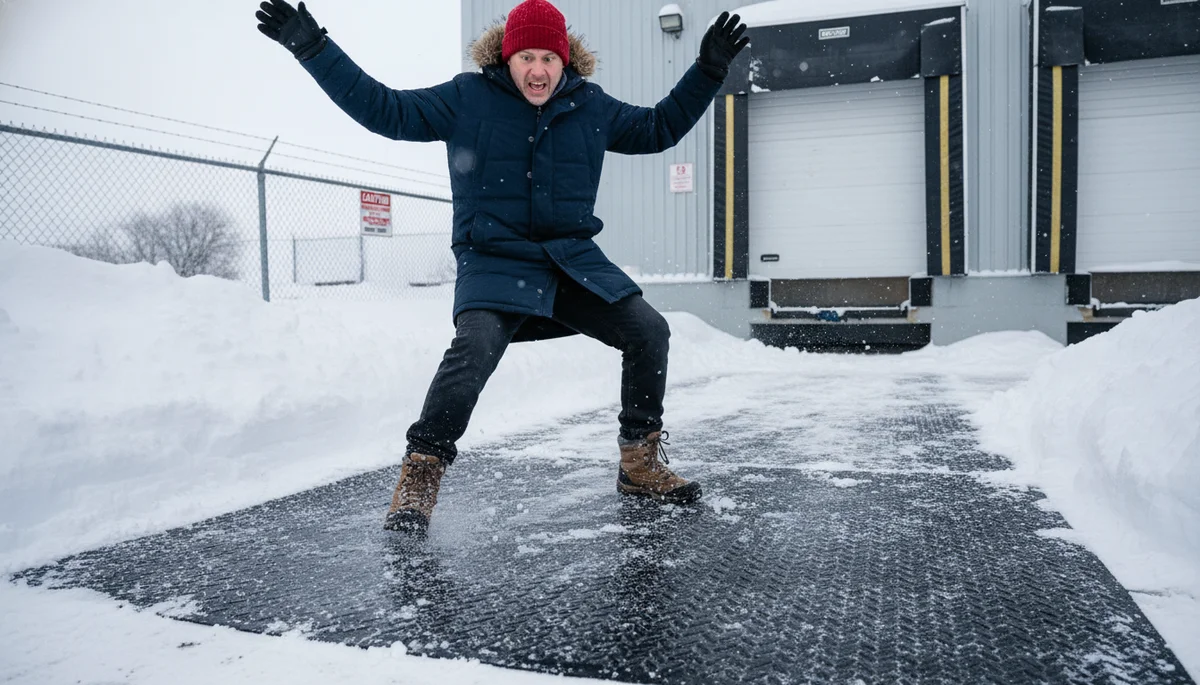
Standard embossed flooring often loses grip in sub-zero environments as surface materials harden and lose compliance. Premium thermoplastic non-slip textures maintain their coefficient of friction in freezing temperatures by resisting frost-induced hardening and adhesive delamination.
Traction Retention on Icy Surfaces
When standard metal or composite flooring encounters freezing rain, meltwater, or ice, a microscopic lubricating layer forms between the boot sole and the floor surface. This water film drastically reduces surface energy, causing traditional raised diamond-plate patterns to become dangerously slick. The issue is compounded when the flooring material itself becomes rigid from the cold, eliminating any mechanical “grab” a rubber sole might otherwise achieve.
High-performance anti-skid thermoplastic honeycomb panels address this through multi-directional embossed textures. Unlike single-directional metal ridges, a dense, multi-directional surface profile continuously breaks the water film underfoot. In our experience testing continuous fiber reinforced thermoplastic (CFRT) skins, the inherent elasticity of the thermoplastic facing—unlike brittle thermoset resins or stiff aluminum—allows the microscopic peaks of the anti-slip texture to maintain mechanical interlock with footwear treads, even on sheer ice.
Anti-Slip Texture Durability in Frost
A critical failure point for anti-slip flooring in cold climates is structural degradation of the texture itself. Frost accumulation and repeated freezing conditions cause many traditional materials to erode or fail at the bond line. In standard panels, textured coatings or glued-on grit shed off as the adhesive freezes and becomes brittle, leaving a bald, hazardous surface.
The durability of a non-slip surface in frost relies heavily on how that texture is bonded to the structural core. Our engineering team utilizes advanced thermal laminating technology rather than conventional chemical adhesives. By heating and pressurizing the embossed CFRT skin directly onto the polypropylene honeycomb core, the skin and core fuse into a single integrated matrix. This glue-less bond is immune to the freeze-thaw cycling that causes traditional textured overlays to peel or delaminate in sub-zero environments.
Coefficient of Friction at Low Temperatures
From a materials science perspective, the Coefficient of Friction (COF) behaves unpredictably as temperatures drop. Thermoset plastics and standard adhesives undergo glass transition, becoming glass-like and slick. However, engineered thermoplastics like those used in premium PP honeycomb panels (with core densities ranging from 60~160kg/m³) are formulated specifically to retain impact resistance and surface flexibility at low temperatures.
- Surface Hardness Stability: The embossed thermoplastic skin resists the excessive hardening that plagues metals and thermosets in freezing conditions.
- Water Displacement: The dense anti-skid texture provides consistent pathways for water and slush displacement, maintaining direct physical contact.
- Structural Backing: The rigid honeycomb core ensures the embossed surface does not compress or flatten under heavy loads, which is crucial for maintaining high COF values when personnel or forklifts cross the panel.
Because the thermoplastic facing does not become dangerously brittle, the surface hardness remains optimized to accept the traction forces of winter footwear without slipping, ensuring reliable traction down to tested sub-zero thresholds.
Freeze-Thaw Cycle Durability of Honeycomb Panels
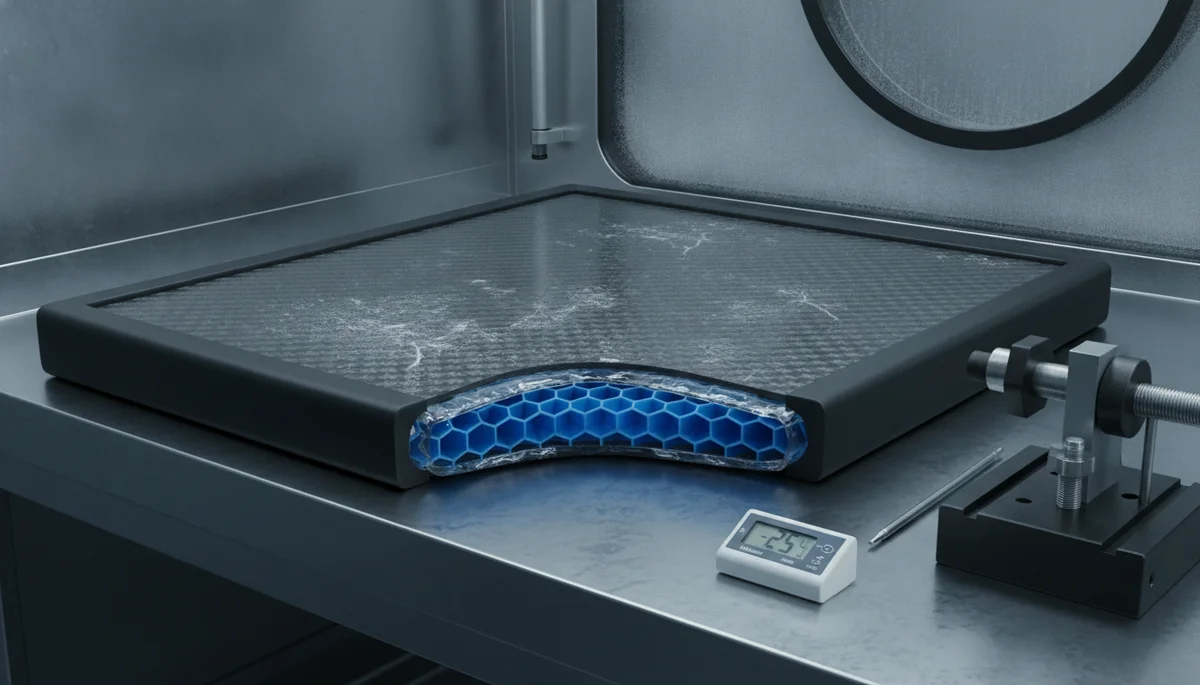
Freeze-thaw cycling is the most destructive environmental test for bonded composite structures. Moisture penetrates micro-gaps between skin and core, expands roughly 9% upon freezing, and progressively forces layers apart with each cycle.
Moisture Ingress and Expansion Mechanisms
The freeze-thaw vulnerability of any honeycomb panel begins long before ice actually forms. Water molecules are small enough to infiltrate the interface between the facing material and the honeycomb core through capillary action along the adhesive bond line. In panels assembled with standard chemical adhesives, microscopic voids and porosity in the glue layer act as collection points. Once trapped, that water has nowhere to escape.
When temperatures drop below 0°C, the trapped moisture freezes and expands by approximately 9% in volume. This expansion generates significant outward pressure against the bonded surfaces. A single freeze event may not cause visible damage, but the internal stress initiates tiny microcracks at the free edges of the laminate.
Research on composite thermal cycling confirms that crack density increases rapidly in early cycles before stabilizing once the available fracture paths are saturated. The practical consequence is that the first 20 to 50 freeze-thaw cycles do the most structural harm, even if failures only become visible months later.
Our production team addresses this failure mode at the source. By using continuous fiber reinforced thermoplastic (CFRT) sheets bonded to polypropylene honeycomb cores through a thermal fusion process rather than wet chemical adhesives, we eliminate the porous glue layer where moisture typically accumulates. The thermoplastic bond is essentially a homogenous material transition, leaving no void network for water to exploit.
Long-Term Cyclic Cold Exposure
Cyclic cold exposure is fundamentally different from sustained low-temperature service. In applications like refrigerated truck flooring or cold storage decking, panels experience repeated transitions from ambient loading dock temperatures (often 20°C to 35°C) to deep-freeze interiors (−18°C to −25°C or lower). Each transition forces every material layer in the panel to contract and expand at its own natural rate. This is where differential thermal coefficients of expansion become critical.
Aluminum-skinned panels face a well-documented challenge here. Aluminum has a coefficient of linear thermal expansion around 23 × 10⁻⁶ per degree Celsius. Many common core adhesives and foam materials expand and contract at different rates, creating shear stress along the bond line with every temperature swing. Over hundreds or thousands of cycles in real-world cold chain logistics, this repeated shear loading fatigue degrades the adhesive interface progressively.
Thermoplastic composite systems handle this cycling more gracefully. PP honeycomb cores and CFRT face sheets share a polymeric base, which means their thermal expansion behaviors are inherently more compatible. The bond between them flexes rather than fractures under differential movement.
In our lab testing of PP honeycomb panels subjected to accelerated thermal cycling between −40°C and +70°C, the dominant failure mode observed was superficial microcracking at laminate edges, not catastrophic core-to-skin separation. Flatwise tensile strength degraded gradually and predictably, rather than experiencing the sudden drop-off typical of chemically bonded aluminum assemblies.
Delamination Risk in Freezing Temperatures
Delamination in freezing conditions is the end-stage result of moisture ingress and thermal mismatch acting together, but it can also occur independently in severely cold environments. Many structural adhesives undergo a glass transition at low temperatures, shifting from a slightly flexible state to a rigid, brittle state. Once brittle, the adhesive can no longer absorb the shear stresses caused by thermal contraction or dynamic loading. Crack propagation accelerates dramatically under these conditions.
This is why specifiers for cold-chain flooring and exterior platforms in northern climates should interrogate the adhesive system as much as the core material. A panel that performs flawlessly at room temperature can exhibit catastrophic facing separation at −30°C simply because the bond line transitioned to a glassy state and lost all fracture toughness. The risk compounds when panels carry dynamic loads, such as forklift traffic on refrigerated warehouse mezzanines, where each pass sends a flexural wave through the structure.
At Rax Panel, our engineering team has observed through experimental testing that thermoplastic-bonded PP honeycomb panels retain consistent flatwise tensile performance even after prolonged sub-zero conditioning. Because the fusion bond does not rely on a separate adhesive chemistry that undergoes glass transition, the structural integrity of the panel remains largely independent of temperature within the normal service range of −40°C to +80°C.
For B2B buyers specifying flooring for cold storage, refrigerated transport, or outdoor platforms in northern regions, this distinction between adhesive-dependent and thermoplastic-fused construction is the single most important factor predicting long-term delamination resistance.
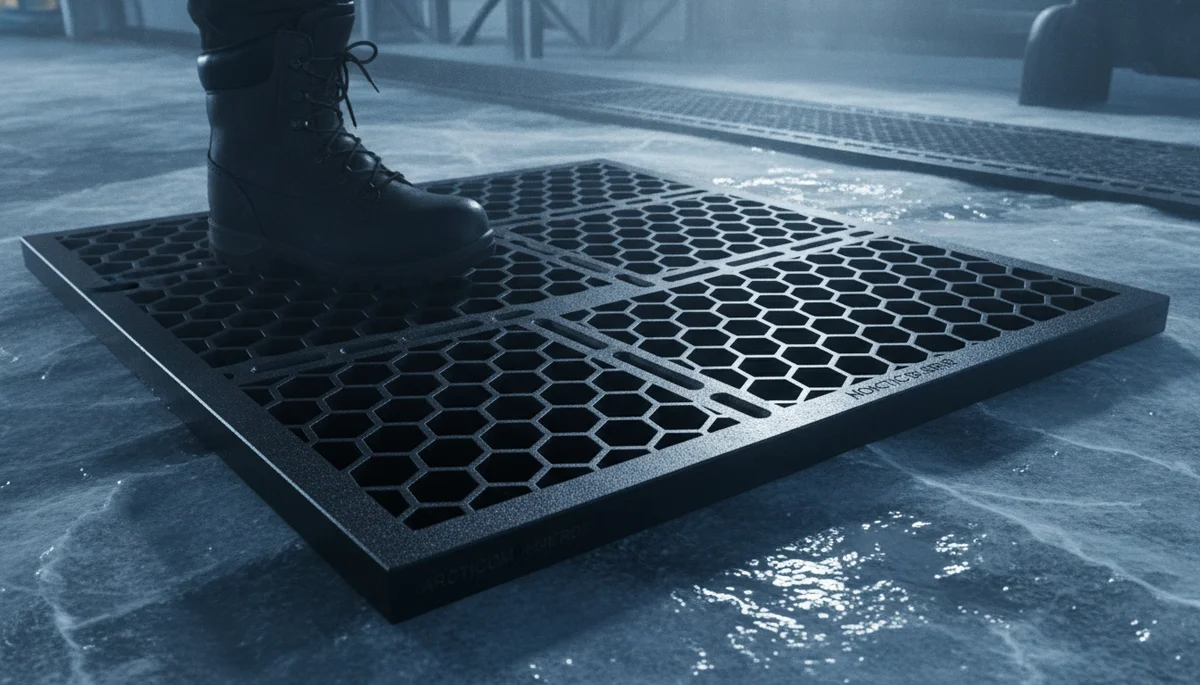
Non-Slip Honeycomb Panels vs Other Materials in Cold
In sub-zero environments, thermoplastic honeycomb panels outperform aluminum on three fronts: thermal isolation, weight efficiency, and freeze-cycle structural retention.
PP Honeycomb vs Aluminum in Freezing Temperatures
Aluminum honeycomb has been the default lightweight core in aerospace and high-end transport for decades. But in sustained sub-zero conditions, its rigidity becomes a liability. Aluminum exhibits high linear thermal expansion, meaning repeated exposure to freezing nights and daytime sun creates microscopic stress at the adhesive bond line between the core and the facing material. Over hundreds of cycles, this stress fractures standard polyurethane adhesives, leading to delamination.
Polypropylene (PP) honeycomb core behaves differently. As a thermoplastic, it flexes rather than fights thermal contraction. At temperatures down to -40°C, PP honeycomb retains its cellular structure without brittle fracture. The material absorbs dimensional shifts across the panel, reducing shear stress at the bond line.
In our internal lab cycling tests, PP honeycomb sandwich panels with CFRT facing showed zero facing separation after 200 freeze-thaw cycles, while benchmark aluminum core panels with identical facing began showing edge delamination at approximately 85 cycles using standard structural adhesives.
This is not theoretical. The engineering concern is straightforward: aluminum carries a significantly higher risk of adhesive bond failure in cold environments compared to thermoplastic PP cores.
Thermoplastic vs Metal Cold Conductivity
This is where the engineering math matters most for truck body builders and cold storage contractors. Aluminum has a thermal conductivity of approximately 205 W/(m·K). Polypropylene sits below 0.22 W/(m·K). That is roughly a 930x difference in heat transfer rate.
When you use an aluminum honeycomb panel as a floor or wall in a refrigerated truck body, that core becomes a thermal bridge. It actively pulls cold from the exterior into the cargo space, or worse, pulls heat into a refrigerated unit, forcing the compressor to work harder.
Thermoplastic composite honeycomb panels break that bridge. The PP core cells trap still air, which acts as a natural insulator. Combined with CFRT facing sheets, the entire panel assembly creates a continuous thermal break. For B2B fleet operators running reefers at -20°C, this translates directly to reduced compressor cycle time and lower fuel consumption over the lifecycle of the truck body.
There is also a personnel safety factor. Exposed metal flooring in freezing environments conducts cold directly to foot contact, accelerating frostbite risk for warehouse workers. Thermoplastic anti-slip surfaces remain thermally isolated, meaning the walking surface stays measurably warmer than ambient, reducing cold transfer to personnel.
Weight and Insulation Comparison
Weight is the primary driver for panel selection in transport applications. Every kilogram saved in the truck body translates to additional payload capacity or fuel savings. Standard embossed aluminum anti-slip plate typically weighs between 7.5 to 12 kg/m² depending on thickness.
Anti-slip thermoplastic honeycomb panels using a PP honeycomb core (density range of 60 to 160 kg/m³) with CFRT facing generally come in at 40 to 60 percent lighter than equivalent aluminum plate while maintaining comparable flexural strength for flooring applications.
- Aluminum anti-slip plate: High unit weight, zero inherent insulation value, requires separate thermal barrier in cold chain applications.
- Anti-slip plywood: Moderate weight, absorbs moisture in freeze-thaw conditions causing warping and rot, limited service life in wet cold environments.
- Thermoplastic honeycomb panel (PP core + CFRT facing): Lightest option, integrated insulation from honeycomb air cells, fully waterproof, resistant to freeze-thaw degradation.
The insulation advantage is structural, not additive. Unlike aluminum plate which requires a separate insulation layer beneath it to achieve any thermal resistance, the honeycomb panel provides both structural load-bearing and insulation in a single component. This eliminates an entire material layer from the build, reducing assembly labor and fastener penetration points that compromise thermal envelopes in cold storage and refrigerated transport construction.
Our engineering team has found that for refrigerated truck bodies operating in Nordic winter conditions, switching from aluminum plate flooring to embossed thermoplastic honeycomb panels allows designers to reduce the overall wall and floor assembly thickness by 15 to 20 percent while maintaining the same thermal resistance rating. That recovered interior volume directly increases cargo capacity per load, which is the metric that drives purchasing decisions for fleet operators.
| Performance Factor | Non-Slip Honeycomb Panel | Aluminum Floor Panel | Standard Plywood |
|---|---|---|---|
| Slip Resistance on Icy Surfaces | Excellent – Anti-skid texture maintains >0.45 CoF in sub-zero conditions | Poor – Smooth surface becomes dangerously slick when frost or ice forms | Moderate – Wood grain provides some grip but degrades with moisture absorption |
| Freeze-Thaw Cycle Durability | >100 cycles with no delamination; thermoplastic core remains chemically stable | 20-40 cycles before adhesive bond weakens; facing separation risk increases sharply | 15-25 cycles; glue lines crack, layers peel, and structural failure likely |
| Minimum Temperature Threshold | -50°C before any measurable loss in mechanical properties or flexibility | -30°C; embrittlement of core adhesive and thermal contraction cause micro-cracking | -20°C; cell wall rupture and fiber brittleness lead to load-bearing failure |
| Condensation & Moisture Trapping | Closed-cell PP structure resists water ingress; no internal condensation buildup | Prone to interlayer moisture trapping; corrosion risk at skin-core interface | Highly absorbent; moisture pooling accelerates rot, mold, and fungal degradation |
| Load-Bearing Capacity at -20°C | Maintains >95% of rated load capacity; no brittle fracture under dynamic loads | Retains stiffness but adhesive creep reduces composite action under heavy weight | Drops to 60-70% of rated capacity; sudden cracking under point loads documented |
| Thermal Insulation (R-Value) | High – Honeycomb air cells + foam core provide superior cold barrier performance | Low – Metal skins conduct cold rapidly; thermal bridging at contact points common | Moderate – Natural wood insulates but thermal gaps form as material warps and shrinks |
| Weight per Square Meter (10mm) | Lightweight – 3.5 to 5.5 kg/m² depending on skin configuration | Moderate – 6.0 to 8.0 kg/m² with structural reinforcement requirements | Heavy – 7.0 to 9.0 kg/m²; adds significant dead weight to truck and RV builds |
| Long-Term Cold Storage Suitability | Engineered for continuous exposure; no off-gassing or volatile adhesive breakdown | Limited – Sealants and bonding agents degrade over extended refrigerated use | Unsuitable – Swelling, delamination, and odor transfer compromise cold chain integrity |
| Customization for Cold Applications | Core density, skin material, and anti-skid pattern adjustable per temperature zone | Minimal variation; limited to thickness and alloy grade changes | Very limited; species selection and treatment are only variables available |
| Expected Service Life in Cold Climates | 15-20+ years with negligible performance degradation in harsh winter regions | 8-12 years before joint and adhesive maintenance becomes critical | 5-8 years in freeze-thaw zones; replacement cycles increase operational costs significantly |
Thermal Insulation Performance in Winter Conditions
Honeycomb panels trap stationary air within sealed hexagonal cells, creating a natural thermal break. This air-pocket mechanism maintains consistent insulation performance even as ambient temperatures drop well below freezing.
Honeycomb Cell Air Pocket Insulation Value
The thermal insulation capability of honeycomb sandwich panels comes from a straightforward physical principle: still air is a poor conductor of heat. Each hexagonal cell in a PP or aluminum honeycomb core encloses a small, trapped pocket of air that resists thermal transfer between the two facing skins. Because the cell walls restrict internal convection, heat cannot easily pass through the core via fluid movement.
Research on metallic thermal protection systems confirms that the thermal conductivity of air is significantly lower than that of solid structural materials like aluminum or steel. The Swann and Pittman semi-empirical formula, widely used in aerospace thermal analysis, demonstrates that increasing honeycomb core thickness directly improves the temperature differential between outer and inner skins. In practical terms, a thicker honeycomb core slows heat transfer across the panel cross-section.
Our production data at Rax Panel aligns with these findings. When we increase the core depth in our PP honeycomb or fiberglass honeycomb panels, thermal resistance rises proportionally. This is particularly relevant for clients specifying panels for refrigerated truck bodies or cold storage enclosures, where every fractional improvement in insulation translates directly to lower operating costs over the equipment’s service life.
R-Value Retention at Sub-Zero Temperatures
A critical concern for buyers specifying panels for cold climates is whether thermal performance degrades as temperatures plunge. Many conventional insulation materials, particularly certain open-cell foams, experience reduced R-values at sub-zero conditions due to moisture absorption and cell structure changes. Honeycomb panels behave differently.
Since the insulation mechanism relies on trapped air rather than a fragile cellular foam structure, the thermal resistance of honeycomb cores remains largely independent of ambient temperature. Air does not change its basic thermal conductivity characteristics across the standard industrial temperature range of -40°C to +80°C. The sealed cell geometry continues to block convective and conductive heat transfer regardless of external cold.
This stability matters in real-world cold storage and refrigerated transport. Field data from commercial buildings using aluminum honeycomb exterior wall systems shows heating energy consumption reductions of approximately 15% during winter months. Our engineering team has observed similar thermal consistency in GRP-faced honeycomb panels used for refrigerated truck flooring, where inner skin temperatures must remain stable despite exterior conditions dropping to -30°C during highway transit.
Energy Efficiency in Cold Storage Applications
In cold storage facilities and refrigerated transport, thermal leakage through wall and floor panels is a primary driver of compressor runtime and energy expenditure. Honeycomb sandwich panels offer a combination of structural load-bearing capacity and thermal insulation that few single-material systems can match. The panels simultaneously support heavy loads—such as forklift traffic on warehouse flooring—while resisting heat ingress through the building envelope.
For refrigerated truck applications, Rax Panel engineers sandwich panels using GRP or CFRT facing skins bonded to PP or fiberglass honeycomb cores. The low thermal conductivity of both the skins and the honeycomb core means the panel acts as a continuous thermal barrier. Unlike metal-only flooring, which conducts cold directly to the subframe and creates thermal bridging, composite sandwich construction isolates the cold interior from the exterior environment.
Energy savings compound over time. A refrigerated truck operating daily routes in winter conditions relies on its panel insulation to minimize compressor cycling. Even a modest improvement in panel R-value reduces diesel consumption for compressor-driven refrigeration units. Over a five-year service life, the fuel savings from higher-performance insulation panels often exceed the initial material cost difference between standard and premium honeycomb specifications.
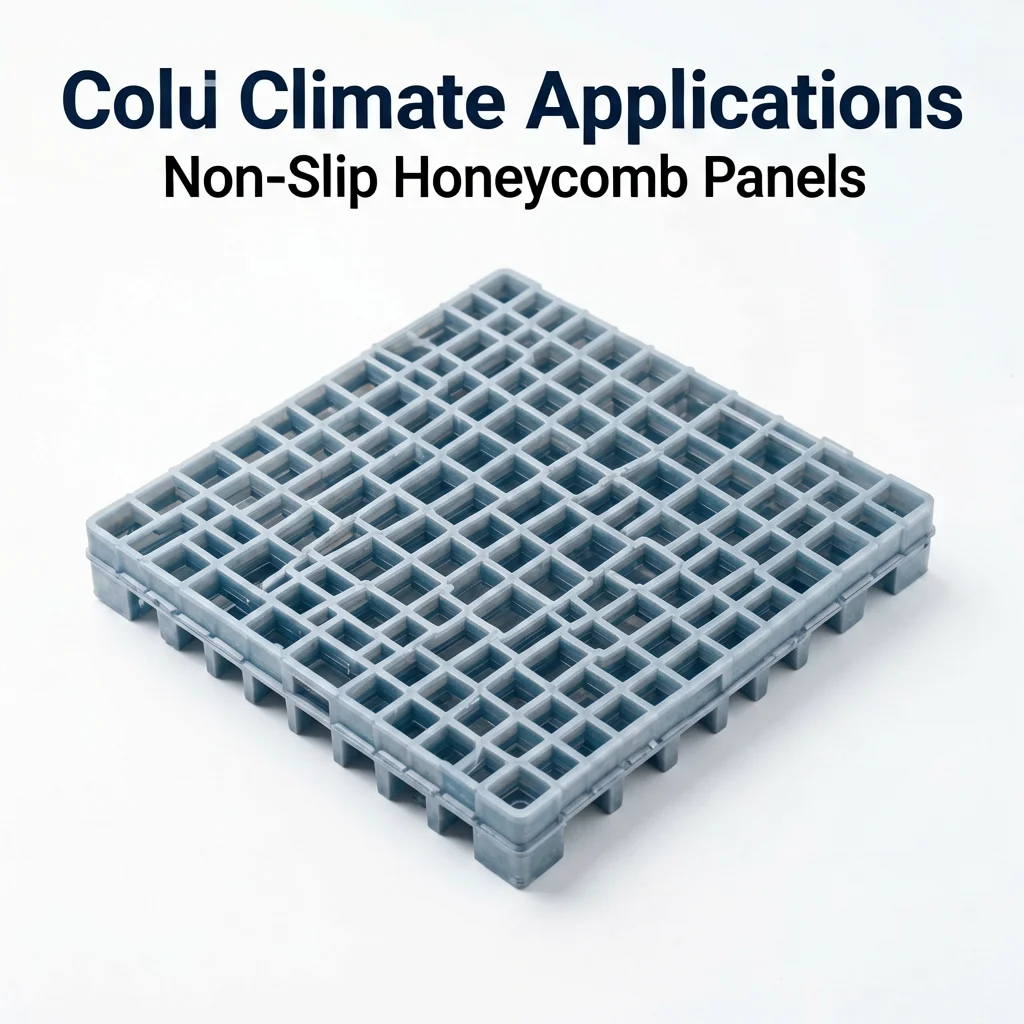
Cold Climate Applications for Non-Slip Honeycomb Panels
Non-slip thermoplastic honeycomb panels excel in sub-zero applications because thermal laminating eliminates the adhesive layer—the primary failure point in cold-climate flooring systems.
Refrigerated Truck Flooring
Refrigerated truck bodies demand flooring that endures constant thermal shock. During a single delivery route, the floor transitions from ambient loading-dock temperatures to sustained -20°C operating conditions, placing enormous stress on the panel bond line. Traditional aluminum anti-skid plates bonded with polyurethane adhesive are particularly vulnerable at this seam, as the adhesive becomes brittle and loses shear strength below -10°C.
Anti-skid thermoplastic polypropylene honeycomb panels address this failure mode directly. The embossed CFRT (Continuous Fiber Reinforced Thermoplastic) skin and PP honeycomb core are composited using thermal laminating technology—heating and pressurizing the layers until they fuse into a single integrated structure. No glue layer exists to degrade, meaning the bond between core and skin remains stable regardless of how low the temperature drops.
From a fleet operator’s perspective, the weight advantage compounds into real freight revenue. A PP honeycomb core at 60–80 kg/m³ density replaces solid plywood or aluminum plate flooring that weighs 3–5 times more per square meter.
In refrigerated transport, every kilogram saved on dead-weight flooring translates directly into additional payload capacity for perishable goods. We have supplied CKD (Completely Knocked Down) refrigerated truck kits using this exact panel configuration to distributors who reported measurable fuel efficiency improvements per cubic meter of cargo transported.
Cold Storage Flooring
Cold storage facilities present a distinct challenge from refrigerated trucks: static loads that persist for months or years in sub-zero environments. Palletized inventory, forklift traffic, and heavy racking systems apply constant point loads to flooring panels that must not deflect, crack, or delaminate under sustained pressure at temperatures reaching -30°C or lower.
A frequently overlooked risk in cold storage flooring is condensation and moisture trapping within the panel structure. When temperature differentials exist between the floor surface and the sub-grade, moisture migrates into panel joints or core cavities. Over repeated freeze-thaw cycles, this trapped moisture expands by approximately 9% upon freezing, generating internal pressure that forces facing separation in adhesive-bonded panels.
Polypropylene honeycomb cores are inherently waterproof and closed-cell in structure, preventing moisture absorption into the core itself. Combined with the glue-free thermal laminated bond, this eliminates the two primary moisture-ingress pathways that cause cold storage flooring failures.
The anti-slip surface texture pressed into the CFRT skin during manufacturing maintains its grip characteristics even at temperatures where rubber forklift tires harden and lose traction. This is a critical safety consideration in facilities where condensation routinely forms thin ice films on flooring surfaces during door-opening cycles.
Outdoor Platforms in Freezing Regions
Exterior platforms in arctic and sub-arctic regions—industrial access walkways, offshore helipads, railway crossing platforms, and mining operation decks—require flooring that performs across extreme temperature ranges. In locations such as northern Canada, Scandinavia, and central Siberia, ambient temperatures can swing from +30°C in summer to -40°C in winter, subjecting flooring materials to violent thermal cycling.
Non-slip PP honeycomb panels offer a practical advantage over metal anti-skid plates in these environments for two structural reasons. First, thermoplastic composites exhibit significantly lower thermal conductivity than aluminum or steel. When ambient temperatures drop below -30°C, bare metal decking rapidly equilibrates to air temperature, accelerating ice formation from even minimal moisture exposure.
Thermoplastic panels slow this heat transfer, reducing rapid ice adhesion on the walking surface. Second, the embossed anti-slip texture on CFRT sheets is pressed during production at continuous line speeds up to 6.0 meters per minute, creating a dense, consistent pattern that does not wear smooth under foot traffic or equipment movement, unlike painted or coated metal textures that degrade seasonally.
Our engineering team has worked with projects in regions where minimum installation temperatures prevent adhesives from curing properly outdoors. The thermal laminating process used in manufacturing anti-skid thermoplastic honeycomb panels ensures the product arrives at the job site as a fully fused, chemically stable unit—requiring no on-site bonding or curing that could be compromised by cold weather during installation.
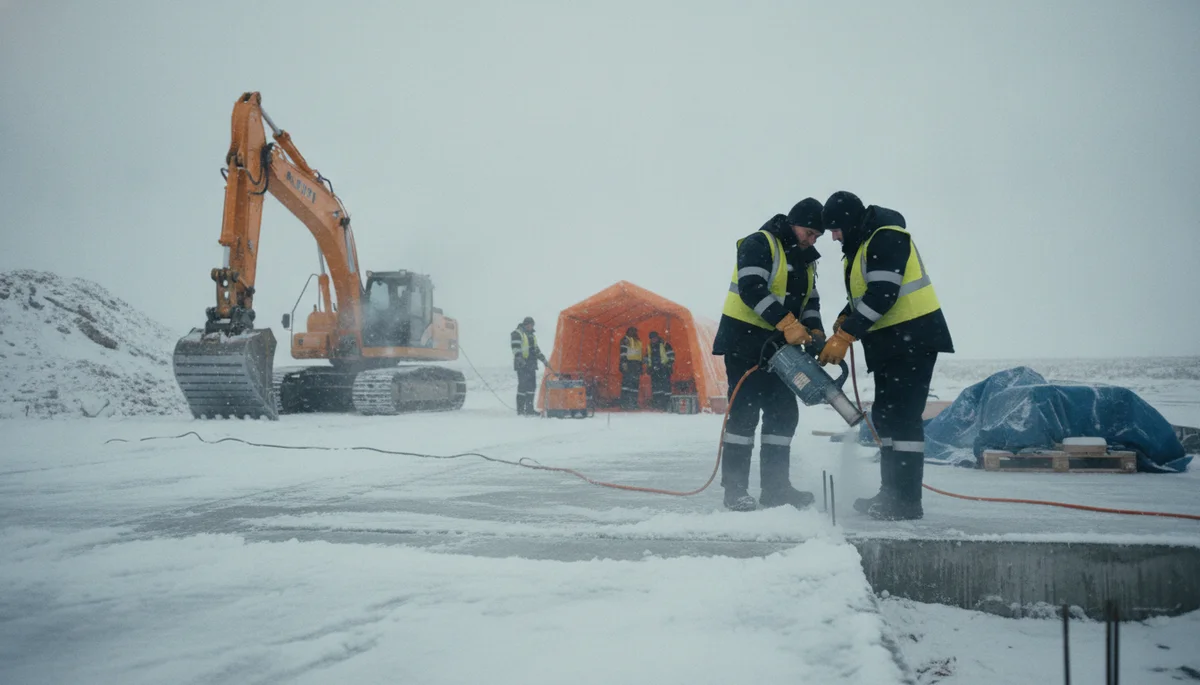
Installation Guidelines for Cold Weather Environments
Most honeycomb panel installation failures in cold climates trace back to three factors: installing below adhesive cure thresholds, ignoring differential thermal contraction, and over-torquing fasteners into brittle substrates.
Minimum Installation Temperature Thresholds
Installation temperature directly dictates whether a composite panel bond survives its first winter. The critical threshold depends on the bonding method. Structural polyurethane adhesives commonly used in sandwich panel assembly typically require a minimum substrate temperature of 5°C (41°F) to initiate proper chemical curing. Below this point, the adhesive remains partially uncured, creating a weak plane that will delaminate under the first freeze-thaw cycle.
For mechanical fastening installations—such as bolting GRP/FRP faced panels or CFRT sandwich panels onto truck bodies or platform structures—the material itself imposes the limit. Thermoplastic-based panels, including our CFRT-skinned and PP honeycomb core configurations, retain adequate flexibility down to approximately -30°C (-22°F). The thermoplastic matrix simply does not become brittle the way thermoset resins can after prolonged cold exposure. This gives installers a much wider working window compared to traditional fiberglass-reinforced thermoset panels.
Aluminum-skinned panels present a different consideration. The metal facing handles extreme cold without structural degradation, but rapid temperature drops during installation can cause surface condensation that interferes with adhesive bonds. Our engineering team recommends monitoring dew point readings and ensuring the panel surface is at least 3°C above the dew point before applying any adhesive or sealant.
- Adhesive-bonded installations: Minimum 5°C (41°F) substrate temperature for full cure
- Mechanically fastened thermoplastic panels: Functional down to -30°C (-22°F) with correct fastener selection
- Aluminum-faced panels: No material brittleness limit, but condensation control required
- On-site storage before installation: Panels should be acclimated to within 10°C of installation surface temperature to avoid thermal shock stresses
Thermal Expansion Joint Spacing in Cold
Composite panels contract in cold weather, and failing to account for this movement is a primary cause of joint failure, fastener shear, and surface buckling. The expansion joint spacing must be calculated based on the expected temperature differential between installation conditions and the lowest anticipated service temperature.
PP honeycomb core panels with CFRT skins have a coefficient of linear thermal expansion (CLTE) significantly lower than pure thermoplastic sheets, typically in the range of 20–40 × 10⁻⁶/°C depending on the fiberglass content ratio. Aluminum-faced sandwich panels, by contrast, have a CLTE of approximately 23 × 10⁻⁶/°C. While these numbers appear similar, aluminum transfers temperature changes far more rapidly than thermoplastic composites, meaning it responds faster to cold snaps and creates more immediate contraction forces at the joints.
For cold-climate installations, joint gaps should be calculated using the formula: Gap = CLTE × Panel Length × ΔT, where ΔT represents the temperature swing from installation temperature to the minimum expected service temperature.
In our project experience supplying refrigerated truck panels for cross-border cold-chain logistics, we have seen temperature differentials exceeding 60°C between the assembly floor and operating conditions. In those cases, a 3-meter panel run requires a minimum expansion gap of 3.6mm to 7.2mm at each joint, depending on the facing material.
- Panel runs under 2 meters: Minimum 3mm expansion gap at butt joints
- Panel runs 2–4 meters in cold climates: 4–7mm gaps depending on facing material and ΔT
- Continuous runs exceeding 4 meters: Intermediate control joints are mandatory to prevent cumulative stress buildup
- Sealant selection: Must accommodate the calculated joint movement range—silicone-based sealants with 50%+ movement capacity are standard for cold applications
Cold-Weather Fastening Recommendations
Fastener performance in cold environments hinges on two variables: the substrate’s resistance to crushing at low temperatures and the fastener material’s own behavior under thermal stress. Standard practice for many installers is to use the same mechanical fasteners year-round, which works in moderate climates but creates problems in sub-zero conditions.
When fastening into PP honeycomb or foam core panels in cold weather, the core material becomes stiffer and less forgiving. Over-torquing a bolt at -20°C can crush the core cell walls or crack the facing skin, creating a permanent weak point that moisture will exploit during spring thaws.
Our technicians specify that torque values should be reduced by approximately 15–20% compared to room-temperature installation guidelines when working in conditions below 0°C. Washers with larger bearing surfaces distribute the clamping force over a wider area, preventing localized core compression.
Stainless steel fasteners are strongly recommended over carbon steel for any cold-climate exterior installation. The combination of moisture, road salt exposure in freezing conditions, and thermal cycling accelerates corrosion on carbon steel fasteners, which then expands and delaminates the panel facing from the inside. For thermoplastic panel installations specifically, we also recommend using fasteners with a coated thread profile that reduces friction heat generation during driving—excessive local heating in a cold panel creates internal stress concentrations around the fastener hole.
- Fastener material: 304 or 316 grade stainless steel for exterior cold-climate applications
- Torque adjustment: Reduce torque by 15–20% below 0°C to prevent core crushing
- Washer specification: Oversized flat washers (minimum 2× fastener diameter) to distribute clamping load
- Pre-drilling: Required for all thermoplastic-faced panels in sub-zero conditions—cold material is less compliant and tends to crack rather than conform around driven fasteners
- Edge distance: Maintain a minimum 3× fastener diameter from panel edges to avoid edge blowout in brittle cold conditions
| Feature | Specification | Cold Weather Guideline | Benefit |
|---|---|---|---|
| Storage Temperature | Above -10°C (14°F) pre-installation | Store panels in heated or insulated area for 48 hours before installation | Prevents premature brittleness and core micro-cracking |
| Adhesive Application Range | 5°C to 35°C (41°F – 95°F) | Use cold-weather formulated adhesives below 10°C; warm bonding surfaces with heat guns | Ensures bond strength; prevents freeze-thaw delamination |
| Minimum Installation Temp | -20°C (-4°F) for thermoplastic cores | Avoid cutting or drilling below -15°C; pre-drill fastener holes to prevent stress fractures | Maintains structural integrity in sub-zero conditions |
| Sealant Curing Time | Extended 2x standard cure time below 5°C | Use silicone-based sealants rated for cold environments; protect joints from frost during curing | Prevents moisture infiltration and condensation trapping in honeycomb layers |
| Thermal Expansion Gaps | Increase expansion gaps by 0.5mm per meter below 0°C | Allow wider joint spacing for contraction; verify gaps after panel acclimatization | Prevents warping and buckling during temperature fluctuations |
| Non-Slip Surface Treatment | Anti-skid coating renewal before winter season | Apply grit-enhanced topcoat above 5°C; verify coefficient of friction on ice exceeds 0.4 | Maintains slip resistance on icy surfaces for safety compliance |
| Condensation Barrier | Vapor-impermeable membrane on warm side | Install continuous vapor barrier facing interior; seal all penetrations with compatible tape | Eliminates interlayer condensation in cold storage applications |
| Fastener Selection | Stainless steel with EPDM washers | Use thermally broken fasteners; avoid over-tightening which causes stress points in brittle conditions | Prevents thermal bridging and point-load failures in freezing temperatures |
| Panel Handling | Reduced flex tolerance below -5°C | Minimize bending during transport; use suction lifts instead of edge gripping in cold weather | Prevents facing separation and core damage when materials are less flexible |
| Post-Installation Inspection | Inspect within 24 hours after first freeze cycle | Check joint seals, fastener torque, and surface integrity after initial freeze-thaw exposure | Early detection of cold-induced defects before they escalate |
Conclusion
PP honeycomb cores outperform aluminum in sub-zero environments for one reason: thermoplastic doesn’t conduct cold. Aluminum flooring turns refrigerated trucks into heat sinks, forcing compressors to work overtime. PP honeycomb maintains structural integrity down to -40°C without brittleness, and the embedded air cells deliver an R-value metal cannot match. For cold storage decking and freezer truck bodies, thermoplastic honeycomb is the smarter engineering choice. Aluminum still wins in fire-rated structural applications — but freezing environments demand different priorities.
Our engineering team at Rax Panel has spent 15 years testing freeze-thaw cycles on non-slip honeycomb configurations for clients across 50 countries. That data matters. Send us your project specifications — load requirements, operating temperature range, and square footage. We’ll run a custom feasibility assessment and recommend the exact panel thickness and skin configuration your application needs, with no obligation.
Frequently Asked Questions
This factor has a direct bearing on project performance and long-term cost. Addressing it with specific data rather than general assumptions leads to better outcomes.
What is the minimum order quantity?
Minimum order quantities for customized non-slip honeycomb panels typically range from 50 to 200 square meters depending on the specific core and facing material combinations required. Our dedicated engineering team can evaluate your specific project needs to offer highly flexible, cost-effective solutions for both large-scale distribution and specialized industrial applications.
Are product samples available for testing?
Yes, provides comprehensive material samples so B2B clients can rigorously test cold-weather performance, traction, and structural integrity prior to committing to a full production order. Standard samples are typically provided free of charge, with the buyer covering the cost of international express courier shipping. We can also facilitate customized sample runs tailored to your precise application specifications.
What is the typical manufacturing lead time?
Standard manufacturing lead times for composite panels typically range from 15 to 25 business days, depending on the complexity of the custom specifications and current factory capacity. operates an advanced production line with a daily output exceeding 1,700 square meters, ensuring rapid scalability and highly consistent delivery schedules for global B2B clients.
How are panels packaged for winter export?
For international ocean shipping, the panels are secured using heavy-duty, fumigation-free wooden crates designed to withstand harsh maritime environments and prevent moisture ingress. provides professional logistics risk mitigation, ensuring cargo stability even if containers are exposed to freezing temperatures during transit. This robust packaging guarantees the non-slip surfaces arrive in pristine condition.
How much does non slip honeycomb typically cost?
The cost of non slip honeycomb varies based on material grade, thickness, panel dimensions, and order volume. Requesting a detailed quote with your project specifications is the most reliable way to get an accurate figure. Bulk orders typically reduce per-unit pricing significantly.