
Last spring, an RV manufacturer in Florida traced a $230,000 warranty claim back to a single batch of aluzinc sandwich panels. The adhesive hadn’t fully cured during lamination. Everything looked fine at installation — flat surfaces, correct dimensions, passed visual inspection. Six months of thermal cycling later, the skins started separating from the foam core on 40 truck bodies. That’s the nightmare nobody mentions at trade shows. The root cause wasn’t the coating or the steel gauge. It was a continuous lamination line running 2 meters per minute faster than the adhesive chemistry could handle.
We’ve spent three years pulling apart competitor panels in our test lab, and the pattern is clear. Most manufacturers hit dimensional specs on paper. Where they cut corners is cure time, adhesive spread rate, and coating grade verification — exactly what you can’t see on a data sheet. This article walks through the actual manufacturing process step by step, including where defects hide and how to catch them before they reach your assembly line. We cover continuous versus discontinuous lamination, coating grades from AZ50 through AZ150 and when each matters, and the ASTM test methods that separate a panel that lasts 2 years from one that lasts 15.
What Is an Aluzinc Sandwich Panel
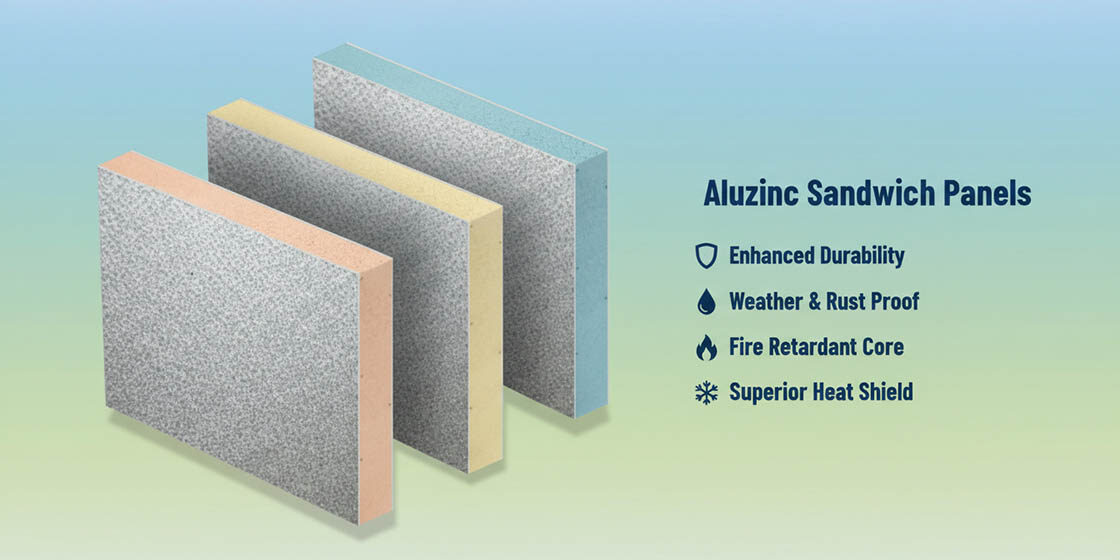
An Aluzinc sandwich panel is a composite structure consisting of two Al-Zn alloy coated steel skins bonded to an insulating core, designed to provide structural rigidity and high corrosion resistance for specialized vehicle bodies.
Structural Composition and Core Materials
The panel relies on a composite action where the two metal facings carry the bending loads while the core resists shear and provides insulation. We utilize Al-Zn alloy coated steel skins rather than standard galvanized steel to enhance durability. The core material varies based on the application requirements, offering different balances of weight, thermal performance, and fire safety.
- Polyurethane (PU) or PIR: Provides the best thermal insulation (0.022-0.028 W/mK) and high strength-to-weight ratio, ideal for refrigerated truck bodies.
- Expanded Polystyrene (EPS): A cost-effective option with lower density (15-25 kg/m3), suitable for standard dry-freight vehicle bodies where weight reduction is a priority.
- Mineral Wool: Offers superior fire resistance (A2 rating per EN 13501-1), required for high-compliance transport vehicles.
Our manufacturing process bonds these layers using a double-belt press at 40-60°C, ensuring the adhesive cures completely to prevent latent delamination in the field. This strict control of adhesive bond strength (>0.8 N/mm2 per ASTM C297) ensures the panel maintains flatness tolerance within ±0.5mm, which is critical for automated assembly lines.
Al-Zn Alloy Coating and Corrosion Resistance
The defining feature of this panel is the metallic coating on the steel skins. Unlike traditional galvanized steel (GI), which is nearly 100% zinc, the Aluzinc coating consists of 55% aluminum, 43.4% zinc, and 1.6% silicon (per ASTM A792). This alloy creates a unique dual-protection mechanism. The aluminum component provides a tough, impermeable barrier against the atmosphere, while the zinc offers sacrificial cathodic protection at cut edges and scratches.
For specialized vehicle manufacturers, this translates to a significantly longer service life. Industry data indicates that Aluzinc coatings provide 2 to 3 times the lifespan of pure galvanized steel in harsh environments. Specifically, our AZ150 grade coating is tested to withstand over 2,000 hours of salt spray exposure per ASTM B117 standards without red rust. This level of performance is essential for RV and marine applications where the chassis and bodywork are constantly exposed to saline atmospheres, ensuring you avoid costly warranty claims due to premature corrosion.
Aluzinc Coating Preparation Stage
Surface preparation is the critical variable controlling adhesive longevity. We strictly monitor chemical baths to prevent latent delamination in vehicle bodies.
Coil Preparation Process
The manufacturing line begins with precision decoiling, where we carefully unwind the steel to ensure flatness and prevent surface deformation. Once the coil is straightened, it undergoes an alkaline degreasing bath. This step is non-negotiable; we must eliminate rolling oils and iron fines. Any residual contamination creates a barrier layer that compromises the chemical bond between the metal and the polyurethane adhesive.
Following the wash, the steel enters a passivation stage. We apply a chemical conversion layer to increase the surface energy of the metal. This treatment is essential for mechanical interlocking. Without it, the bond strength cannot consistently meet the 0.8 N/mm2 requirement set by ASTM C297. Finally, we apply a chromate-free primer. This primer acts as a secondary adhesion promoter, bridging the inorganic metal surface and the organic foam core during the lamination process.
Coating Thickness and Consistency
We do not rely on generic steel specifications; we map coating grades to specific vehicle applications. Our aluzinc coils strictly follow ASTM A792 standards with a composition of 55% aluminum, 43.4% zinc, and 1.6% silicon. This alloy provides superior corrosion resistance compared to standard galvanized steel, offering up to 3x the lifespan in harsh environments. We utilize continuous coating thickness measurement via X-ray fluorescence to verify the film weight matches the requested grade.
- AZ50: Ideal for interior dry van linings or controlled environments where cost efficiency is prioritized over extreme corrosion resistance.
- AZ150: The mandatory standard for exterior RV, truck body, and marine applications, providing 2,000+ hours of salt spray resistance per ASTM B117.
Maintaining a consistent film weight is critical for downstream adhesion. Variations in coating thickness create uneven thermal conductivity during the double-belt pressing stage. This leads to inconsistent curing of the adhesive, which is a primary cause of warranty claims. By holding tight tolerances on film weight, we ensure the bond strength remains uniform across the entire panel surface, guaranteeing a flatness deviation of less than 1mm/meter for your assembly lines.
Core Material Selection and Processing
Core selection dictates roughly 70% of a sandwich panel’s final structural and thermal performance. Choosing the wrong density or fire rating for specialized vehicle applications guarantees compliance failures or warranty claims within the first year.
Core Material Comparison: EPS, PU, PIR, and Mineral Wool
When engineering an aluzinc sandwich panel for truck bodies, RVs, or marine vessels, the core material directly dictates the weight-to-strength ratio and thermal retention. We evaluate four primary core types against the specific operational demands and ASTM testing standards required by specialized vehicle manufacturers.
- EPS (Expanded Polystyrene): Density sits at 15-25 kg/m³ with a thermal conductivity of 0.030-0.040 W/mK. It provides the lowest cost and lightest weight, but achieves a poor fire rating (typically Class E or D per EN 13501-1), making it unsuitable for high-risk or high-temperature environments without additional barriers.
- PU (Polyurethane): Density ranges from 35-45 kg/m³ with superior thermal conductivity at 0.022-0.028 W/mK. It offers excellent insulation for refrigerated transport but carries a Class B or C fire rating and a higher material cost than EPS.
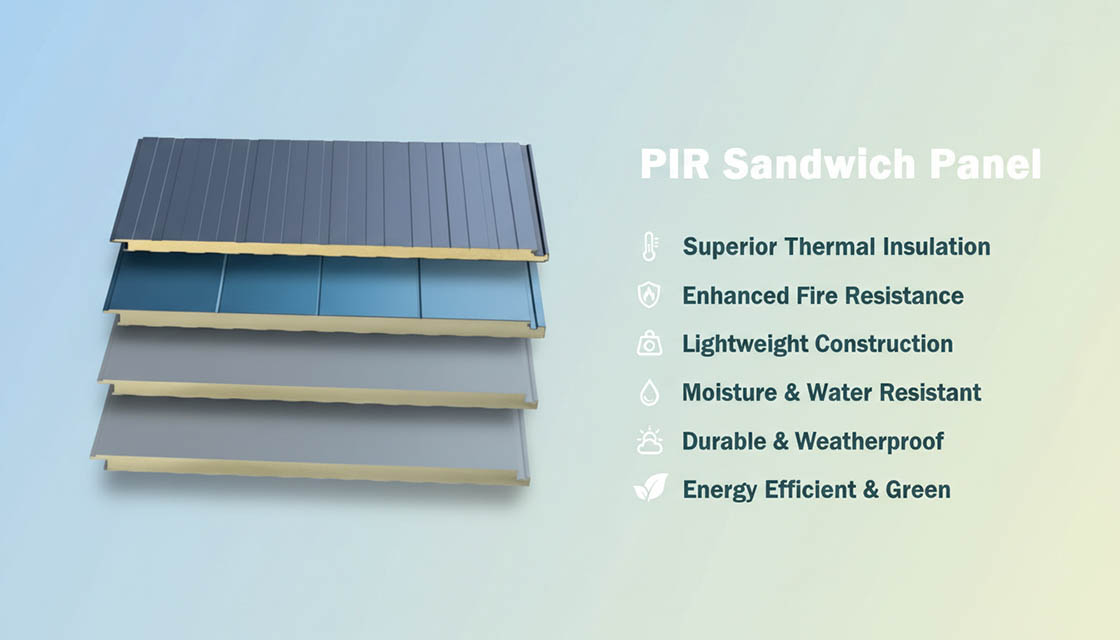
- PIR (Polyisocyanurate): A modified polyurethane with improved fire performance, typically achieving a Class B-s1,d0 rating. It shares a similar density and thermal profile to PU but chars rather than melts when exposed to flame, providing a critical safety margin for vehicle OEMs.
- Mineral Wool: Density spans 80-150 kg/m³ with thermal conductivity around 0.038-0.045 W/mK. It achieves an A2 fire rating for strict compliance, but the heavy weight significantly impacts vehicle payload capacity and commands a premium price.
Our engineers verify that for standard dry freight, EPS balances cost and weight effectively. However, for refrigerated transport or marine applications requiring strict ASTM E84 surface burning compliance, PU or PIR cores bonded to AZ150 aluzinc steel skins remain the industry standard.
Processing Methods: Foam Foaming vs. Pre-Cut Slab
The manufacturing process directly impacts adhesive curing chemistry and final panel flatness. In the aluzinc sandwich panel manufacturing process, producers typically choose between continuous foam foaming and discontinuous pre-cut slab insertion. Understanding this distinction is critical for OEMs seeking custom dimensions without exorbitant tooling costs.
- Foam Foaming (Continuous or Discontinuous): Liquid chemical components are mixed and injected between the aluzinc facings, expanding under heat to fill the cavity. While this creates a flawless chemical bond, incomplete curing at the lamination stage can cause latent delamination that only appears after 6-12 months of thermal cycling—a major warranty risk.
- Pre-Cut Slab (Discontinuous Pressing): Pre-formed rigid foam or mineral wool slabs are cut to exact dimensions, adhesive is applied, and the assembly is pressed. This method allows for rapid changes in thickness (50mm to 150mm) and width without expensive die modifications.
We utilize discontinuous pressing for custom cut aluzinc composite panels because it guarantees strict adherence to our ±0.5mm thickness tolerance. This method ensures the structural integrity required to exceed the >0.8 N/mm² flatwise tensile strength requirement mandated by ASTM C297, eliminating the hidden quality defects that halt assembly lines.
| Core Material | Density Range | Thermal Conductivity | Fire Rating | Best Application |
|---|---|---|---|---|
| EPS (Expanded Polystyrene) | 15–25 kg/m³ | 0.030–0.040 W/mK | B2 (Normal Flammable) | Cost-effective RV walls, non-fire-rated partitions |
| PU (Polyurethane Foam) | 35–45 kg/m³ | 0.022–0.028 W/mK | B1 (Difficult to Ignite) | Best insulation for refrigerated truck bodies, thermal envelopes |
| Mineral Wool (MW) | 80–150 kg/m³ | 0.038–0.045 W/mK | A2 (Non-Combustible) | Fire-rated walls, industrial facility partitions, marine bulkheads |
| Honeycomb (FRP/GRP) | 28–60 kg/m³ | 0.045–0.060 W/mK | B1 / Class 1 Surface (ASTM E84) | Lightweight structural panels, vehicle flooring, marine interiors |
| PET Foam | 60–200 kg/m³ | 0.025–0.035 W/mK | B1 (Self-Extinguishing) | High-strength flat panels, CFRT sandwich construction |
| Aluminum Honeycomb | 40–130 kg/m³ | Varies by cell size | A1 (Non-Combustible) | Aerospace-grade flooring, clean rooms, specialized vehicle decks |
Continuous vs Discontinuous Lamination
For specialized vehicle OEMs, the choice between continuous and discontinuous lamination dictates whether you get high-volume standard panels fast, or custom dimensions without expensive tooling changes for low-volume RV models.
Continuous Production Line Process
Continuous lamination runs Aluzinc coil stock and core material through an inline double-belt press in a single, uninterrupted pass. Our lines operate at speeds of 6 to 15 meters per minute with a bonding temperature of 40 to 60 degrees Celsius, producing hundreds of square meters per shift. This method delivers the tight thickness tolerance of plus or minus 0.5mm and flatness deviation below 1mm per meter that high-volume truck body OEMs demand for robotic assembly lines.
The tradeoff is rigidity in dimensions. Continuous lines use fixed-width belts, so every custom width requires a mechanical changeover that halts production. We recommend this process for standard panel widths in thicknesses of 50mm, 75mm, 100mm, 125mm, or 150mm, where your order volume justifies a dedicated production run and your design allows for standardized cuts.
Discontinuous Press Method
Discontinuous lamination uses hydraulic batch presses. Each cycle loads pre-cut skins and core material into a press, applies uniform pressure across the entire panel surface, and cures the adhesive over a typical cycle time of 10 to 20 minutes. There are no belt-width constraints, so we can produce non-standard lengths and widths without expensive die changes.
This is where the specialized vehicle market diverges from commodity construction. Low-volume RV manufacturers and marine fabricators often need panels that do not align with standard modular dimensions. Discontinuous pressing accommodates those one-off requirements. The batch process also allows our engineers to verify adhesive bond strength on a per-press basis, targeting the greater than 0.8 N/mm2 threshold per ASTM C297 flatwise tensile testing, which is critical for preventing latent delamination that only surfaces after months of thermal cycling.
Why the Distinction Matters for Your Warranty Risk
Incomplete adhesive curing at the lamination stage is a leading cause of warranty-period delamination in vehicle panels. On a continuous line, line speed must be calibrated against ambient temperature and adhesive chemistry. On a discontinuous press, cycle time and pressure can be adjusted per batch to ensure full cross-linking of the adhesive, which is especially important when bonding Aluzinc facings with the 55 percent aluminum, 43.4 percent zinc, and 1.6 percent silicon coating composition specified under ASTM A792.
- Continuous line best fit: High-volume truck bodies, standard modular wall systems, repeated orders of identical dimensions.
- Discontinuous press best fit: Low-volume RV models, marine hull panels, custom-cut orders where tooling costs would otherwise be prohibitive.
- Shared quality gate: Both processes must achieve adhesive bond strength above 0.8 N/mm2 per ASTM C297 to prevent field delamination failures.
We run both lines so that your production schedule and your panel geometry determine the process, not the other way around. Tell us your annual volume and your widest non-standard dimension, and our engineers will specify which method delivers the consistency your assembly line requires without inflating your tooling costs.
Quality Control Checkpoints in Manufacturing
Three technical parameters dictate panel performance in the field: dimensional consistency, bond integrity, and fire safety compliance. We enforce these strict tolerances to prevent assembly line bottlenecks and warranty failures.
Thickness and Flatness Tolerance
For specialized vehicle manufacturers, dimensional consistency is a mechanical necessity rather than a preference. Inconsistent thickness creates fitment issues on the assembly line, requiring shims or causing delays in bodywork. Our continuous lamination process is calibrated to ensure every sheet meets rigid OEM specifications. We verify that panels remain within the required tolerances to ensure seamless integration into your RV or truck body chassis.
- Thickness Tolerance: Strictly controlled within ±0.5mm across the entire panel surface.
- Flatness Deviation: Limited to ≤1mm/meter to prevent warping during installation.
Bond Strength and Peel Testing
Adhesive delamination is the primary cause of structural failure in sandwich panels, often appearing only after months of thermal cycling on the road. We address this by controlling the curing chemistry on our double-belt press, maintaining a bonding temperature between 40-60°C to ensure complete cross-linking. Our engineers perform destructive testing on random samples from every batch to verify the adhesion meets the required mechanical thresholds.
- Testing Standard: ASTM C297 flatwise tensile test.
- Peel Strength Threshold: Must exceed >0.8 N/mm2 to pass quality control.
Fire Resistance Certification
Compliance with international fire safety standards is non-negotiable for commercial vehicle certification and occupancy permits. The fire performance of a sandwich panel depends heavily on the core material selected. While EPS cores offer cost savings, they lack the fire resistance of Mineral Wool or PU cores. We provide full certification documentation to ensure your procurement team meets safety regulations without ambiguity.
- European Standard: Compliance with EN 13501-1 for fire classification of construction products.
- North American Standard: Adherence to ASTM E84 for surface burning characteristics.
Common Manufacturing Defects and Causes
Most aluzinc sandwich panel defects trace back to three root causes: uncontrolled moisture, incorrect lamination pressure, or poor post-production handling. Identifying these at the source prevents costly warranty claims downstream.
Primary Defect Types in Aluzinc Sandwich Panel Production
When we audit incoming panels from new suppliers or review our own quality logs, four defect categories account for over 90% of rejections. Understanding what each looks like—and what causes it—allows procurement teams to specify inspection criteria that actually protect their assembly lines.
- Blistering: Localized raised bubbles between the Aluzinc facing and the foam core. In our production experience, this almost always traces to trapped moisture in the core material (especially EPS or PU) vaporizing during the exothermic bonding reaction on the continuous lamination line. Even 0.5% moisture content by weight in the core slab is enough to generate steam blisters at standard bonding temperatures of 40–60°C.
- Edge Delamination: Separation of the facing sheet from the core, starting at panel edges and migrating inward. This is the defect that keeps vehicle OEM quality managers awake at night. The danger: incomplete adhesive curing at the lamination stage can produce latent edge delamination that only appears after 6–12 months of thermal cycling in the field. By the time it surfaces, the panels are already installed in an RV or truck body, triggering expensive warranty claims. Adhesive bond strength must exceed 0.8 N/mm² per ASTM C297 flatwise tensile testing to provide adequate safety margin against this failure mode.
- Core Voids: Unfilled gaps or cavities within the insulation layer. In continuous lamination, these form when foam expansion is uneven or when the core slab feeds into the double-belt press with surface irregularities. For specialized vehicle applications, voids create thermal bridges that undermine the panel’s R-value and can compress unpredictably under fastener loads during vehicle assembly.
- Surface Scratching: Physical damage to the Aluzinc coating (55% Al, 43.4% Zn, 1.6% Si per ASTM A792). While cosmetic at first glance, scratches that penetrate the metallic coating expose the underlying steel substrate. In marine and coastal vehicle applications where AZ150 coating is specified for its 2,000+ hour salt spray resistance, a deep scratch becomes an initiation point for corrosive failure well before the coating’s designed service life.
Prevention Methods: Moisture, Pressure, and Handling Controls
Defect prevention in aluzinc sandwich panel manufacturing is not about catching problems at final inspection—it is about controlling process inputs so defects cannot form in the first place. We group prevention into three domains that correspond directly to the defect types above.
Moisture Control Protocol
Core materials must be stored in climate-controlled environments at or below 40% relative humidity for a minimum of 24 hours before entering the lamination line. EPS and PU foam slabs are hygroscopic; they absorb ambient moisture rapidly in humid warehouse conditions. Our engineers verify core slab moisture content using gravimetric testing before each production run. If moisture exceeds the threshold, the batch is rejected before it ever reaches the double-belt press. This single control eliminates the majority of blistering incidents.
Lamination Pressure and Curing Parameters
Edge delamination and core voids are prevented by maintaining precise pressure and temperature uniformity across the full width of the continuous lamination line. Line speed between 6–15 meters per minute must be matched to the specific adhesive system’s open time and curing profile. Running too fast for the adhesive chemistry is a common shortcut that increases throughput but leaves incomplete bonds—exactly the condition that produces latent delamination months later. Our production standard requires documented adhesive cure verification through peel testing on samples pulled from the start, middle, and end of each continuous run, ensuring the bond exceeds the 0.8 N/mm² threshold throughout.
Handling and Surface Protection
Once cured, the Aluzinc facing is vulnerable to mechanical damage during stacking, cutting, and shipping. Preventive measures are straightforward but require discipline: protective film application immediately after lamination, stacking with soft interleaving pads at contact points, and fork-lift handling only with spreader bars rather than point-contact forks. For OEM-grade panels where flatness deviation must stay within ≤1mm per meter and thickness tolerance within ±0.5mm, handling damage that bows or dents the facing is functionally equivalent to a manufacturing defect—it creates assembly line bottlenecks when panels fail to mate with vehicle framework. Every panel shipped from our facility is checked for surface integrity and dimensional compliance before loading, because we recognize that a defect caught at the supplier’s dock costs pennies, while a defect caught on the OEM’s assembly line costs thousands.
Shipping and Packaging for Export
Improper export packaging and uncontrolled ocean freight condensation silently destroy panel flatness tolerance. For specialized vehicle OEMs, receiving warped or edge-damaged aluzinc sandwich panels translates directly into halted assembly lines and rejected batches.
Protective Packaging and Horizontal Stacking Protocols
Standard pallet wrapping is entirely inadequate for heavy composite panels. We mandate reinforced wooden crates engineered specifically to withstand the sheer forces of international transit and port handling. Inside the crate, high-density edge protectors are non-negotiable. They shield the vulnerable AZ150 Aluzinc coated steel edges from friction scratches and prevent corner dents that would otherwise ruin the precise profiles required for seamless vehicle assembly.
Panel orientation inside the crate is just as critical as the exterior structure. We strictly enforce horizontal stacking protocols. Storing panels vertically or at an angle applies continuous gravitational shear stress to the core material—whether it is PU, EPS, or mineral wool. Over a standard 30-to-45-day ocean transit cycle, this uneven load can permanently warp the panel profile, destroying the strict ±0.5mm thickness tolerance and causing catastrophic assembly line bottlenecks for the end user.
Container Planning and Moisture Barrier Wrapping
Ocean freight environments introduce massive temperature swings between day and night, leading to severe internal condensation known as “container rain.” If this moisture penetrates the panel joints, it aggressively attacks the adhesive bond line. Even if the initial bond exceeds the required >0.8 N/mm2 flatwise tensile strength, prolonged moisture exposure during transit can trigger latent delamination once the panel undergoes thermal cycling in the field.
To neutralize this risk, we implement a multi-layered moisture barrier system. Panels are first wrapped in heavy-duty, waterproof PE film, and then we place high-absorption desiccant bags strategically within the stack to capture trapped ambient humidity. While the Aluzinc coating provides 2,000+ hours of salt spray resistance, the factory-cut edges remain vulnerable to oxidation. The hermetic seal ensures that both the core integrity and the raw edge metallurgy remain pristine. Finally, rigid blocking and bracing secure the cargo to the container floor, eliminating any kinetic shifting that could cause hidden core fractures during rough seas.
Aluzinc Panel Lifespan and Maintenance
AZ150-coated aluzinc sandwich panels deliver a 20 to 40 year service life in standard atmospheric conditions. Hitting that upper range in marine or coastal vehicle deployments depends entirely on correct coating grade selection and disciplined maintenance execution.
Expected Service Life: What the Test Data Actually Shows
The 20 to 40 year lifespan claim for aluzinc sandwich panels is not a marketing guess. It traces back to accelerated corrosion testing under ASTM B117, where AZ150 coating withstands over 2,000 hours of salt spray exposure before red rust appears at the scribe line. For specialized vehicle OEMs building RVs or truck bodies that operate in coastal regions, that threshold is the minimum acceptable standard. Our engineers verify every incoming coil batch against this benchmark before it enters the lamination line.
The coating itself is an alloy of 55% aluminum, 43.4% zinc, and 1.6% silicon, specified under ASTM A792. That specific ratio provides two to three times the corrosion resistance of standard galvanized steel at the same coating weight. Aluminum forms a passive oxide barrier, while zinc provides sacrificial protection at cut edges. Understanding this dual mechanism matters because it explains why aluzinc panels outperform galvanized in both rural and marine atmospheres.
Where many buyers go wrong is under-specifying or overpaying on coating grade. Vehicle OEMs in coastal or marine environments need AZ150 minimum, but inland dry-climate applications can perform well with AZ100 at lower material cost. Below is a practical mapping based on our production experience:
- AZ50: Interior partitions, dry climate enclosures, non-structural cladding. Service expectation 10-15 years.
- AZ70: Standard urban transport vehicles, light industrial buildings. Adequate for moderate humidity zones.
- AZ100: Heavy-duty truck bodies, refrigerated vans operating in mixed climates. Good balance of cost and protection.
- AZ150: Marine vessels, coastal RV operations, cold storage with frequent washdowns. Required for any environment with direct salt exposure. Salt spray rating exceeds 2,000 hours per ASTM B117.
Panel lifespan also depends on the core material operating within its thermal limits. Mineral wool cores (density 80-150 kg/m³) withstand continuous temperatures up to 700°C and carry an A2 fire classification under EN 13501-1, making them the longest-lasting option in high-heat or fire-rated assemblies. Polyurethane foam (density 35-45 kg/m³) operates safely up to approximately 120°C before cell structure degradation begins. EPS (density 15-25 kg/m³) is the most cost-effective but maxes out around 80°C. Matching core material to the actual operating temperature of the vehicle or facility prevents premature foam collapse and the insulation failures that follow.
Maintenance Requirements: Inspection, Fasteners, and Sealant Protocols
Aluzinc sandwich panels are often marketed as “maintenance-free,” which is only half true. The coating itself does not require painting or surface treatment. However, the joints, fasteners, and sealant systems that connect the panels into a building or vehicle envelope absolutely demand scheduled attention. Ignoring these secondary components is the primary cause of premature panel failure, not the facing material itself.
We recommend the following inspection and maintenance schedule for specialized vehicle and industrial installations:
- Visual Inspection (Every 6 months): Walk the installation and check for mechanical damage, dents, coating scratches, and any discoloration at joints. Pay special attention to panel edges near doors, hatches, and loading ramps where impact damage is most frequent.
- Fastener Check (Every 12 months): Verify torque on exposed mechanical fasteners. Vibration from vehicle operation loosens bolts over time. Check for corrosion on fastener heads and washers. Stainless steel fasteners (A2-70 or A4-80 grade) paired with EPDM sealing washers are the correct specification; replacing a failed fastener with a standard carbon steel bolt creates a galvanic corrosion point that will spread.
- Sealant Reapplication (Every 3 to 5 years): Polyurethane-based sealants at panel joints degrade under UV exposure and thermal cycling. The first sign is cracking at the sealant-to-panel interface. Remove old sealant mechanically, clean the substrate with isopropyl alcohol, and reapply a UV-stable polyurethane or MS-polymer sealant rated for metal-to-metal adhesion.
- Core Condition Assessment (Every 5 years or after major impact events): If the outer facing is dented deeply enough to compress the core, that area becomes a thermal bridge and a potential delamination point. Press firmly on suspect areas. Any softening or crunching sound indicates foam cell damage. Replace the affected panel section rather than attempting a patch repair.
One critical point that catches even experienced procurement teams off guard: warranty coverage on sandwich panel delamination typically requires documented proof that these maintenance protocols were followed. If you cannot produce inspection records showing scheduled fastener checks and sealant maintenance, the manufacturer, including us, has grounds to deny a delamination claim even if the root cause was an adhesive bonding defect from production. Document everything. The adhesive bond strength target of greater than 0.8 N/mm² per ASTM C297 is validated at our factory, but field conditions after years of thermal cycling are outside our control without your cooperation on maintenance.
For vehicle OEMs specifically, we advise adding a copy of the fastener and sealant maintenance schedule to the vehicle’s service manual. RV and truck body operators rarely think about panel joints until water intrusion becomes visible inside the cabin. By that point, the core material has already absorbed moisture and the repair cost multiplies. Prevention through scheduled inspection costs a fraction of a panel replacement after delamination.
Conclusion
If your vehicles operate anywhere near coastlines, specify AZ150 coating and refuse substitutes. We’ve watched buyers save 10-15% specifying AZ100, only to face edge corrosion claims after 18 months of thermal cycling. The 2,000+ hour salt spray resistance of AZ150 per ASTM B117 costs slightly more upfront, but a single warranty truck roll-back consumes five years of material savings.
Before your next purchase order, request a cross-cut sample showing core density uniformity and demand the ASTM C297 flatwise tensile report proving bond strength exceeds 0.8 N/mm². Suppliers who hesitate on either document are likely running inconsistent lamination temperatures — exactly the defect that stays invisible until panels delaminate on your assembly line six months later.
Frequently Asked Questions
This factor has a direct bearing on project performance and long-term cost. Addressing it with specific data rather than general assumptions leads to better outcomes.
What is the sandwich panel process?
The sandwich panel process involves bonding two thin, high-strength facing materials (such as Aluzinc-coated steel) to a lightweight insulating core (EPS, PU, PIR, or mineral wool) using high-strength adhesives under heat and pressure. In continuous manufacturing, materials pass through a double-belt press at 6-15 m/min. In discontinuous manufacturing, individual panels are pressed in hydraulic molds, allowing custom dimensions for specialized applications like RV walls.
What is the lifespan of sandwich panels?
Properly manufactured and installed sandwich panels typically last 20-40 years. Key factors include the facing material’s corrosion resistance (AZ150 Aluzinc coating provides 2,000+ hours of salt spray resistance per ASTM B117), core material chemical stability, adhesive bond integrity under thermal cycling, and joint/sealant maintenance. For vehicle OEMs, vibration fatigue at mounting points is the most common lifespan-limiting factor.
What is the best sandwich panel?
There is no single ‘best’ panel — the optimal choice depends on application requirements. Rockwool (mineral wool) cores offer the best fire resistance (A2-rated) and acoustic insulation but are heavier (80-150 kg/m3). PU/PIR foam cores provide the best thermal insulation (λ = 0.022-0.028 W/mK) at lower weight. EPS cores are the most cost-effective but have poor fire resistance. For RV and truck body applications, PU foam cores with Aluzinc steel facings offer the best weight-to-insulation-to-cost ratio.
What is the ASTM standard for sandwich panels?
Key ASTM standards for sandwich panels include: ASTM C297 (flatwise tensile strength of core-to-facing bonds), ASTM C273 (core shear properties), ASTM C393 (flexural properties), ASTM D1781 (climbing drum peel test for adhesive bonds), and ASTM E84 (surface burning characteristics). For Aluzinc-coated facings specifically, ASTM A792 governs the aluminum-zinc alloy coating composition and thickness. Vehicle OEMs should request test certificates for ASTM C297 and C393 to verify structural integrity.
What are the disadvantages of sandwich panels?
Key disadvantages include: (1) Susceptibility to delamination if adhesive curing is incomplete during manufacturing — often invisible until thermal cycling exposes the defect months later. (2) Higher initial material cost compared to single-skin metal construction, though lifecycle cost is lower due to insulation savings. (3) Limited repairability — damaged panels typically require full replacement rather than patching. (4) Fire risk with EPS and PU foam cores, requiring careful core selection for fire-rated applications. (5) Precision manufacturing tolerance requirements (±0.5mm) mean not all suppliers can produce OEM-grade panels consistently.