

Sourcing composite panels for RV production lines usually turns into a guessing game with overseas vendors, and the classic failure mode is a supplier quietly swapping in low-density foam under 1.8 lb/ft³. The material compresses during transit, panel thickness drifts by two millimeters or more, and automated clamps suddenly cannot grip the walls. That single shortcut can idle a line for weeks and blow a quarter’s defect-rate targets.
Here is how to prevent that scenario by specifying the right core density, thickness window, and CNC tolerance. This guide breaks down the hard numbers behind structural sandwich panels, comparing XPS foam cores against standard plywood and aluminum. You will see exactly why specifying a 2.37 lb/ft³ density and demanding a strict ±0.5mm CNC tolerance protects your cycle time. We will also look at how integrated cutting during the quoting phase eliminates the surprise per-cut programming fees some vendors tack on later. Stop settling for cosmetic cladding. Here is how you spec structural materials that actually fit your robots.
RV Panel Weight vs Plywood
Structural FRP/XPS composite panels weigh just 3.2–5.4 kg/m², shedding 40–60% of the dead weight of marine plywood to directly increase RV payload capacity and fuel economy.
The 3.2–5.4 kg/m² Sweet Spot
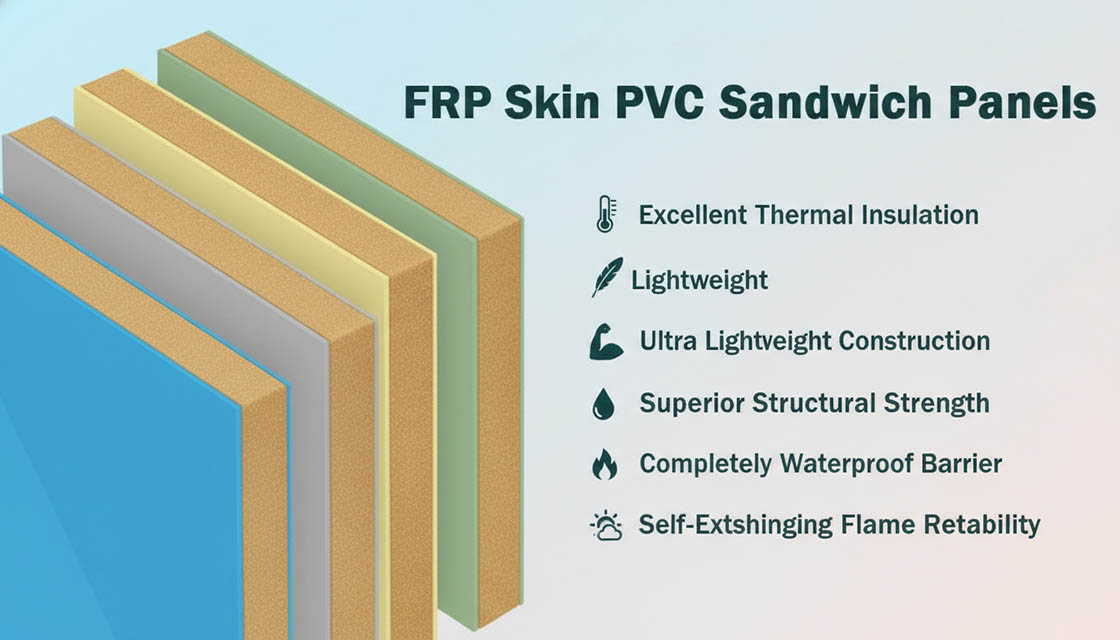
When you are engineering a modern RV, every kilogram dictates both compliance and performance. We manufacture our structural sandwich panels to hit a strict weight range of 3.2 to 5.4 kg/m². This precision comes from matching a 2.37 lb/ft³ density XPS foam core with 1.5–2mm FRP woven roving skins. You get a rigid, load-bearing structure without the severe mass penalty of traditional wood builds.
40–60% Lighter Than Marine Plywood
Novice OEM buyers sometimes conflate cosmetic FRP sheets with structural sandwich panels, but the engineering reality is stark. Standard marine plywood typically weighs between 10 to 15 kg/m² and is highly susceptible to moisture retention and rot over time. By switching to lightweight RV sandwich panels with CNC cutting, you immediately drop 40% to 60% of that material mass.
- Marine Plywood Mass: 10–15 kg/m², depending on thickness and moisture absorption.
- FRP/XPS Composite Mass: 3.2–5.4 kg/m², completely moisture-resistant and dimensionally stable.
- Net Weight Savings: Approximately 6 to 10 kilograms saved per square meter of wall or ceiling surface.
Fuel Economy and Payload Capacity Gains
For specialized vehicle manufacturers, weight reduction is a direct path to increased revenue. Shedding dead weight from the body structure allows you to increase the payload capacity of the motorhome. This gives your customers the ability to carry more water, gear, or aftermarket modifications without dangerously approaching GVWR limits.
Beyond payload, lighter custom size composite panels for RV walls create a measurable improvement in fuel economy. Dropping hundreds of kilograms from the overall vehicle profile reduces engine strain. Over the lifecycle of an RV, this mass reduction translates into lower operational costs for the end-user and fewer physical handling issues on your factory assembly line.
Standard & Custom Thickness Options
Selecting the correct sandwich panel thickness dictates your vehicle’s weight profile and your assembly line efficiency. We maintain strict ±0.5mm CNC tolerances to prevent production line stoppages.
Dimensional Range: From 6mm Interior Cabinetry to 50mm Structural Roofs
In specialized vehicle manufacturing, thickness is not just a structural specification; it is a critical variable that determines your fastening methods and final curb weight. Our custom-size RV panels span from 1/4″ (6mm) up to 2″ (50mm), allowing you to source the exact profile needed for every specific zone of the vehicle without material compromise.
We manufacture 6mm panels primarily for interior partitions, cabinet backing, and ceiling liners where minimizing interior space loss is critical. Conversely, roof and floor assemblies demand the maximum 50mm profile to handle dynamic loads and provide necessary insulation values without requiring heavy secondary framing.
The Engineering Sweet Spot: 1.5″–1.78″ XPS Foam Cores
For the main structural walls of an RV or motorhome, the industry’s engineering sweet spot lies between 1.5″ and 1.78″ thickness. At this profile, CNC-cut sandwich panels hit the optimal rigidity-to-weight balance required for highway speeds and overall structural integrity.
- Core Density: 2.37 lb/ft³ XPS foam resists deformation during shipping and clamp pressure.
- Skin Composition: 1.5–2mm FRP woven roving skins with a weather-resistant gelcoat finish.
- Weight Target: Finished panels weigh strictly between 3.2–5.4 kg/m², depending on the exact core specified.
Many suppliers use vague core density ratings, which leads to hidden problems. Low-density foams compress under clamp pressure, causing thickness variances that ultimately jam automated assembly lines and ruin fastener alignment. By utilizing a verified 2.37 lb/ft³ XPS core, the panel maintains its shape, ensuring your panel thickness and weight specs remain consistent across the entire batch. This dimensional stability directly lowers your defect rate and keeps your production cycle predictable.

One-Piece Panel Advantages
One-piece structural sandwich panels eliminate the mechanical joints that cause water ingress and factory bottlenecks, dropping assembly time by up to 50%.
Seamless Construction Eliminates Leak Points and Joint Failure
Standard RV and specialized vehicle assembly relies on bonding multiple smaller sheets to cover large spans. Every overlap creates a flexing joint susceptible to thermal expansion, road vibration, and eventual water ingress. By utilizing one-piece manufacturing, we produce continuous panels up to 12 meters by 3.2 meters. This single-span approach removes the seams entirely, preventing the chronic leaking and structural delamination that plagues multi-piece configurations.
Factory-Integrated Framing and Precision CNC Openings
Secondary framing on the assembly floor is a massive labor sink. We bypass this by embedding structural frames directly into the FRP or CFRT panels during the manufacturing process. This integration provides immediate load-bearing points for windows, doors, and roof mounts without requiring your technicians to manually build out the underlying structure.
We execute all necessary cutouts using CNC equipment calibrated to a strict ±0.5mm tolerance. Your line workers receive a panel with pre-milled openings that perfectly match your CAD files, meaning hardware drops in cleanly without the manual adjustments that stall production cycles.
Slashing Production Cycle Times by 30–50%
When panels arrive fully formed, pre-framed, and CNC-cut, the downstream labor requirements plummet. Eliminating on-site cutting, edge sealing, and structural reinforcement allows OEMs to reduce their total assembly time by 30 to 50 percent. Your production line shifts from a fabrication environment to a straightforward installation process. This rapid throughput directly lowers per-unit labor costs and ensures strict adherence to your manufacturing KPIs.

CNC Cutting Precision
Holding strict ±0.5mm CNC tolerances on custom size composite panels for RV walls eliminates field trimming bottlenecks, ensuring seamless integration into high-volume automated assembly lines.
Strict ±0.5mm Tolerances for Dimensional Stability
In specialized vehicle manufacturing, inconsistent thickness causes immediate assembly line stoppages. We program our CNC routers to hold a strict ±0.5mm tolerance across the entire panel surface. This level of precision is achievable because our FRP foam core panels utilize a 2.37 lb/ft³ density XPS core, which resists the tool compression and deformation that often plagues low-density foams during the cutting process.
Engineered for High-Volume Automated Assembly
When you are producing motorhome bodies at scale, every minute of manual adjustment eats into your profit margin. By maintaining precise RV composite panel thickness and weight specs, our panels drop directly into automated jigs and robotic welding fixtures without forcing operators to shim gaps or force alignments. We supply one-piece panels up to 12m x 3.2m, allowing OEMs to construct entire wall sections without secondary seaming.
Zero Field Trimming Required
We integrate CNC programming directly into the quoting phase, meaning your lightweight RV sandwich panels arrive on the factory floor cut to exact net shape. Unlike some suppliers who treat custom programming as an afterthought, sometimes charging upwards of $150 per cut. Our approach treats precision machining as a baseline standard to reduce your labor costs.
- Labor Reduction: Eliminates secondary framing and trimming labor by up to 20%.
- Joint Integrity: Prevents the structural weakness and dust contamination caused by on-site trimming.
- Budget Predictability: Locks in machining costs prior to production, avoiding surprise manufacturing fees.
Fire & Structural Certifications
Non-compliant material will halt your assembly line. We mitigate this risk by ensuring our FRP structural panels consistently achieve ASTM E84 Class B fire ratings and tensile strengths exceeding 80 MPa.
Fire Compliance and ASTM E84 Class B Ratings
Procurement engineers often conflate cosmetic FRP cladding with load-bearing structural sandwich panels. For specialized vehicle manufacturing, this distinction is critical. Our custom-size RV wall panels use 1.5–2mm FRP woven roving skins with a premium gelcoat finish, selected to meet an ASTM E84 Class B fire rating, with test documentation available on request. This rating controls the surface burning characteristics, ensuring you meet DOT requirements and internal QA standards without relying on heavier, traditional materials like plywood or solid aluminum.
Structural Integrity: Exceeding 80 MPa Tensile Strength
A panel’s strength-to-weight ratio directly dictates your vehicle’s final payload capacity and fuel efficiency. Our lightweight RV sandwich panels are engineered for tensile strength exceeding 80 MPa in the FRP skin, with mechanical test reports available on request. We accomplish this by bonding high-performance FRP skins to a 2.37 lb/ft³ density XPS foam core. Maintaining this specific core density is non-negotiable; lower-density foams compress during transit or lamination, creating thickness variances that jam automated production lines and drive up your defect rate.
Third-Party Validation and Dimensional Stability
We do not rely on internal estimates for critical metrics. The mechanical properties, thermal conductivity (~0.028 W/m·K), and fire resistance of our FRP foam core panels for motorhome bodies are documented through third-party test reports available on request. This rigorous validation keeps panel thickness and weight specs consistent across your entire production run, saving you from costly assembly line stoppages.
- Dimensional Tolerance: CNC machined to ±0.5mm accuracy.
- Weight Benchmark: Panels range from 3.2 to 5.4 kg/m², optimizing vehicle MPG.
- Manufacturing Scale: One-piece construction up to 12m x 3.2m eliminates secondary framing labor.
Conclusion
If you are running a new RV production line, insist on one-piece FRP/XPS panels with a 2.37 lb/ft³ core density. Cheap, low-density foam compresses during shipping and jams your assembly jigs. Our strict ±0.5mm CNC tolerance prevents those line stoppages entirely, and embedding the frames saves 20% on secondary labor costs.
Before you finalize your next order, send your CAD files over for a custom quote. We program the CNC tooling paths upfront. This shows you the exact cutting costs immediately, helping you avoid surprise per-cut fees that other vendors tack on later.
Frequently Asked Questions
How much do composite panels weigh?
The weight of a composite panel varies significantly based on its specific material composition, typically ranging from 2 to 10 kilograms per square meter. For instance, our lightweight Foam Core Panels and CFRT Sandwich Panels are engineered specifically to reduce overall vehicle mass without compromising structural integrity. Alternatively, our specialized Aluminum Sandwich Panels and GRP/FRP Honeycomb Panels offer slightly higher densities tailored for high-impact resistance and heavy-duty applications. Ultimately, these advanced composite solutions provide an exceptional strength-to-weight ratio that drastically improves fuel efficiency and payload capacity in RV manufacturing.
What are the different types of composite panels?
In the modern RV manufacturing sector, composite panels are primarily categorized by their core structures and facing materials to meet specific structural and thermal requirements. Our diverse product range includes CFRT (Continuous Fiber Reinforced Thermoplastic) Sandwich Panels, which offer exceptional toughness, alongside GRP/FRP Honeycomb Panels that provide superior stiffness and impact resistance. Additionally, we manufacture high-insulation Foam Core Panels for extreme temperature regulation, as well as specialized Aluminum Sandwich Panels designed for maximum structural strength and fire resistance. Each type is custom-engineered to deliver optimal performance, weight reduction, and longevity for diverse recreational vehicle applications.
How thick are composite panels?
For RV applications, our panels are manufactured from 6mm for interior cabinetry up to 50mm for structural roofs and floors. Standard RV wall applications typically utilize panels between 25mm and 45mm, where Foam Core or CFRT panels balance structural integrity with thermal insulation. Wider thickness ranges remain available across our broader product lines for non-RV structural applications. Furthermore, we offer highly flexible custom sizing capabilities, ensuring that every panel meets the precise engineering specifications and spatial constraints of your specific RV build.
How thick is RV paneling?
Standard RV paneling typically ranges from 6mm to 50mm in thickness, depending on whether it is used for interior walls, exterior siding, roofs, or flooring. Exterior walls and roofs often require thicker dimensions around 25mm to 40mm, where our CFRT Sandwich Panels or GRP/FRP Honeycomb Panels excel in providing necessary thermal insulation and structural rigidity. Interior partition walls may utilize thinner Foam Core Panels, often between 6mm and 20mm, to maximize interior living space while maintaining durability. By leveraging our customizable manufacturing processes, RV builders can order exact thicknesses that perfectly integrate with their specific frame designs.
What is the best RV siding material?
The best RV siding material is one that offers an optimal balance of lightweight properties, weather resistance, and structural durability, making advanced composites the industry standard. For unparalleled impact resistance and longevity, our GRP/FRP Honeycomb Panels are an exceptional choice for rugged exteriors, while CFRT Sandwich Panels offer superior flexural strength and weight savings. For high-end thermal insulation and a sleek aesthetic, specialized Aluminum Sandwich Panels provide outstanding weatherproofing and structural stability. Ultimately, the ideal selection depends on the specific RV class and budget, but all of our composite solutions guarantee vastly superior performance compared to traditional materials.