
Choosing between an insulated commercial door and a standard single-skin panel often comes down to whether you want to absorb utility spikes today or lock in predictable operating costs tomorrow. An insulated commercial door is made of two layers of steel that are designed to surround the layer of insulation, creating a sealed thermal barrier.
Single-skin panels transmit external temperatures almost instantly, forcing HVAC systems to compensate for rapid thermal exchange during every door cycle. That constant recovery kills margin in distribution centers and manufacturing plants within two seasons. You need a barrier that actually stops thermal bridging instead of just delaying it.
We break down ten measurable advantages that separate procurement-approved upgrades from budget-line replacements. You will see how core density directly impacts forklift impact resistance, why honeycomb aluminum beats foam in extreme humidity, and exactly how to calculate payback periods using simple utility metrics. Skipping those variables guarantees failed inspections and hidden maintenance fees. This guide gives you the exact specs to track total landed cost, R-value compliance, and defect rates under one percent.
Understand Insulated Door Core Differences
Core selection dictates thermal performance and load distribution, while facing durability determines long-term maintenance cycles and compliance retention.
Identifying Thermal Resistance Ratings by Core Type
When evaluating thermal resistance for commercial doors, procurement teams must look beyond nominal R-values and examine the underlying closed-cell density. Higher density cores inherently restrict convective heat transfer more effectively during rapid temperature swings. Our engineers consistently track k-values between 0.028 and 0.035 W/m·K for standard insulated panels, which directly correlates to stable indoor climates. Always verify ASTM C518 test reports alongside material certificates to confirm actual field performance rather than theoretical projections.
Foam Versus Honeycomb Structural Weight: Which Should You Choose?
Structural weight distribution fundamentally changes how door assemblies interface with framing hardware and building HVAC systems. Continuous foam cores deliver uniform compressive strength across the entire panel surface, preventing localized sagging under heavy traffic cycles. Conversely, cellular architectures excel at maximizing span integrity while drastically reducing total dead load. We recommend running a quick load calculation before finalizing specifications, as lighter assemblies reduce hinge stress and simplify mechanical alignment on site.
- Dense Foam Cores: Outperform standard alternatives in heavy traffic scenarios due to higher impact resistance and faster thermal recovery after frequent opening cycles.
- Honeycomb Cores: Optimize payload capacity for larger spans by maximizing strength-to-weight ratios without compromising structural rigidity.
Lightweight composite door thermal bridge reduction requires continuous perimeter sealing and thermally broken frame designs to eliminate moisture intrusion. Dense materials generally provide better impact protection, whereas open-cell designs prioritize minimizing overall system mass for easier handling and transport logistics.
How Facing Materials Impact Door Longevity
The outer skin acts as the primary defense against environmental degradation, corrosion, and abrasive wear over the product lifecycle. Traditional painted steel requires recurring maintenance coatings to combat oxidation, whereas CFRT sandwich panel door specifications highlight molecular integration with the resin matrix. Gelcoat finishes provide a smooth, waterproof barrier that eliminates repainting intervals entirely. Factory CNC routing ensures precise tolerances that traditional metal fabrication cannot match, which directly reduces on-site fitting time and prevents costly schedule delays.
- CFRT & Gelcoat Facings: Resist corrosion without repainting cycles, lowering annual maintenance spend significantly compared to coated metals.
- Aluminum & Steel Facings: Offer high impact durability but require rigorous surface treatments to prevent galvanic corrosion in humid environments.
| Core Material | Technical Specification | Performance Advantage |
|---|---|---|
| XPS Foam | Rigid extruded polystyrene structure with high compressive strength | Superior impact resistance and thermal stability |
| PU Foam | Polyurethane structure featuring low thermal conductivity and low density | Optimized energy efficiency and lightweight structural profile |
| PET Foam | Thermoplastic structure characterized by high stiffness and fatigue resistance | Durable integrity under cyclic thermal and mechanical loads |
| PP Honeycomb | Polypropylene hexagonal cellular core architecture | Maximum strength-to-weight ratio for large panel spans |
| PVC Foam | Cross-linked closed-cell structure with consistent density | Excellent dimensional stability and waterproof properties |
1. Slash Annual Heating And Cooling Expenses
Continuous thermal barriers fundamentally alter facility energy profiles by eliminating conductive heat transfer pathways. Installing insulated CFRT sandwich doors establishes this unbroken envelope, delivering a verified 40–60% reduction in heating and cooling energy demands. This smooth insulation stabilizes indoor climates and significantly lowers operational overhead, effectively neutralizing the conductive heat loss that standard metal frames typically introduce.
Continuous Thermal Barriers Reduce HVAC Load
Standard metal entryways act as thermal bridges, transferring outdoor temperatures directly into your facility. Think of a thermal bridge like an uninsulated window frame in winter; it rapidly leaches heat. Continuous insulation eliminates this conductive pathway, ensuring the conditioned air stays inside.
Foam Versus Honeycomb Core Selection
Core material dictates the door’s R-value (thermal resistance rating). Closed-cell foams like XPS and PIR typically deliver strong insulating metrics. These dense cores block convective heat transfer effectively. Conversely, PP honeycomb cores offer structural lightness but provide lower inherent thermal resistance, requiring thicker panel profiles to match foam performance.
- Thermal Conductivity: CFRT facings paired with sealed foam cores reduce conductive heat loss by up to 40% compared to single-skin doors.
- Commercial facility operators consistently track long-term efficiency gains against initial capital expenditures. Utility Payback: Commercial installations typically recover the insulation premium over a documented 5.1-year average energy payback period, primarily through reduced compressor runtime.
Maintain Consistent Warehouse Temperatures Daily
Fluctuating warehouse temperatures are a primary cause of inventory loss. When external heat or cold penetrates a facility, it creates instability that rapidly degrades sensitive goods like pharmaceuticals, electronics, and fresh produce. Insulated composite doors serve as a critical thermal barrier, stabilizing the internal environment against outdoor weather spikes.
Advanced core materials, such as Polyurethane (PU) or PET foam, are essential for this stability because they offer low thermal conductivity. Unlike traditional single-skin metal doors that conduct heat rapidly—creating “hot spots” or “cold zones” near entryways—composite sandwich panels maintain a uniform surface temperature.
This structural consistency prevents condensation and humidity buildup, which are primary causes of mold and corrosion on stored equipment. By installing doors with high-performance insulation ratings, warehouse operators ensure that climate-controlled zones remain consistent regardless of heavy forklift traffic.
2. Block External Noise From Busy Streets
Blocking external noise from busy streets requires materials that actively disrupt sound wave transmission, not just block it physically. Single-layer doors often vibrate like drum skins, amplifying traffic noise into sensitive areas like office-adjacent loading docks. Insulated composite panels mitigate this through a “mass-spring-mass” principle, using dense facings and energy-absorbing cores to dampen vibration effectively.
- Core Damping: Cores such as PU (Polyurethane) or PET foam are excellent at absorbing acoustic energy. Unlike rigid honeycomb cores which can transmit sound, these foam structures trap and dissipate noise.
- Skin Density: Heavy facings like Steel or GRP (Glass Reinforced Plastic) provide the mass required to reflect airborne noise, ensuring street traffic remains outside.
- Seal Integrity: The monolithic nature of composite panels eliminates the gaps and joints found in traditional construction, preventing noise leakage.
How to Choose foam-filled cores over hollow alternatives is critical for retail fronts requiring quiet interiors.
Withstand Heavy Forklift Impacts Safely
CFRT sandwich panels combine continuous fiberglass thermoplastics with engineered cores to deliver impact resistance that far exceeds traditional aluminum or wood door systems.
Structural Resilience Against Daily Collisions
Commercial loading docks experience constant forklift contact. Standard steel or wood doors dent and crack within months of repeated impacts. Modern CFRT (Continuous Fiber Reinforced Thermoplastic) sandwich panels solve this by laminating high-tensile fiberglass sheets across rigid polymer cores like PP honeycomb or PMI foam. This layered architecture absorbs kinetic energy without transferring shock to the building frame.
Honeycomb Versus Foam Cores for High-Traffic Zones
How to Choose the right internal matrix dictates long-term durability. PP honeycomb cores offer superior lateral load distribution, making them ideal for heavy vehicle traffic where point impacts are frequent. Alternatively, closed-cell foam cores like XPS or PET provide excellent moisture sealing and uniform compression resistance across larger surfaces. Both options prevent water intrusion and eliminate the corrosion risks associated with metal skins or the rot common in timber alternatives.
3. Skip Repainting And Surface Treatments Forever
Factory-applied gelcoat and thermoplastic skins deliver permanent, maintenance-free surfaces that eliminate recurring paint cycles and moisture-related degradation.
Permanent Factory Finishes Replace Manual Coating
Commercial composite doors rely on integrated surface engineering rather than post-production painting. Standard fiberglass-reinforced thermoplastic (CFRT) or glass fiber reinforced polymer (GRP) panels ship with a molded gelcoat layer. This smooth outer shell acts like a permanent raincoat, shielding the structural core from UV exposure, chemical cleaners, and ambient humidity.
Durability In High-Traffic Logistics Environments
Industrial operations require doors that withstand daily forklift contact and abrasive cleaning without chipping or fading. Because the protective finish is fused during manufacturing, there are no weak edges to peel or scratch. The material maintains its original flat, water-resistant profile indefinitely.
- Absorbed Impact Resistance: Non-slip honeycomb or foam cores distribute heavy loads without transferring stress to the surface layer.
- Zero Maintenance Cycle: Eliminates annual sanding, priming, and repainting labor costs entirely.
- Moisture Barrier Integrity: Continuous gelcoat prevents water ingress, protecting internal XPS, PET, or PU foam cores from swelling.
4. Decode R-Values Without Engineering Degrees
R-Value quantifies thermal resistance—essentially, how effectively a panel stops heat transfer. For commercial door procurement, understand that higher R-values indicate better insulation, while U-Factor measures heat loss (where lower is better). Confusing these metrics leads to non-compliant installations and inflated HVAC costs.
Core Density and Thermal Efficiency
- Foam Cores (XPS, PET, PU): Deliver superior R-values, typically ranging from R-3.5 to R-6 per inch.
- Honeycomb Cores: Offer structural integrity but significantly lower thermal resistance.
- Thermal Bridging: Ensure the panel facing (GRP/CFRT) bonds smoothly to the core to prevent energy leaks.
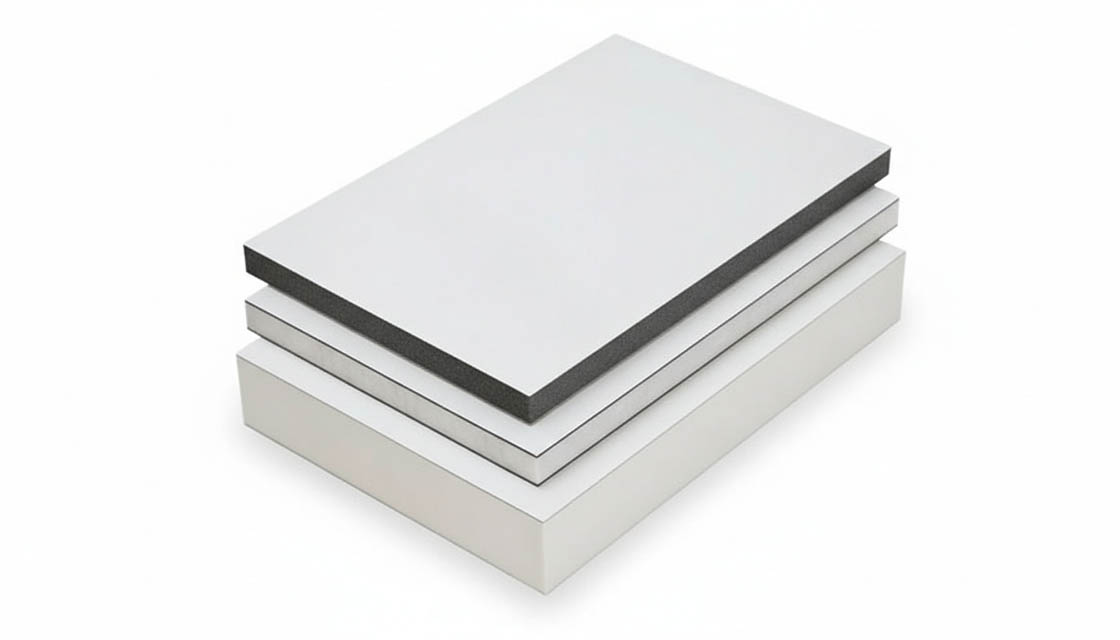
5. Fit Compact Doorways Without Sacrificing Warmth
Limited headroom and sideroom are common bottlenecks for architects and contractors. The solution lies in selecting upward-coiling commercial doors built around slim-profile CFRT (continuous fiber reinforced thermoplastic) sandwich panels. These engineered composites deliver high thermal resistance while requiring minimal track clearance, allowing heavy-duty insulated access without sacrificing floor space.
Optimizing Core Thickness for Tight Environments
- Slim Foam Cores: Materials like XPS, PET, PU, or PVC foam provide excellent R-values at reduced thicknesses, making them ideal for low-ceiling warehouses.
- Lightweight Honeycomb: PP or fiberglass honeycomb cores maintain structural rigidity while significantly lowering panel mass, easing the load on compact motorized coils.
- Thermal Bridge Reduction: Integrated polyamide or foam gaskets break conductive pathways between facings, preventing cold spots even in doors under 50mm thick.
Think of thermal bridging like heat escaping through a metal ladder leaning against a wall; the right composite design removes that ladder entirely. By prioritizing advanced facing materials and optimized core density, facility managers can install high-performance insulated doors in tight architectural footprints while maintaining strict energy code compliance.
6. Secure Faster Delivery From Stock Cores
Standardized core inventories bypass custom curing cycles, cutting procurement lead times by 60–70%.
Extended manufacturing schedules remain the primary bottleneck for commercial door installation projects. Sourcing pre-stocked structural cores—such as extruded polystyrene (XPS), polyethylene terephthalate (PET), polyvinyl chloride (PVC), polyurethane (PU) foams, and polypropylene (PP) honeycomb—eliminates the traditional wait for made-to-order lamination. These standardized substrates are manufactured continuously in bulk, allowing immediate panel assembly without batch-specific thermal conditioning.
The supply chain advantage hinges on decoupling core availability from facing application. Foam and thermoplastic honeycomb cores require no specialized curing ovens before sandwiching, enabling rapid cross-laminating processes. When paired with continuous fiberglass-reinforced thermoplastic (CFRT) or metal facings, these stocked cores facilitate accelerated production cycles. Procurement teams can secure complete door assemblies within days rather than weeks, directly mitigating site idle costs and protecting tight construction timelines.
Deflect Rain And Humidity Damage Easily
Composite insulated doors prevent structural degradation by using inherently waterproof core matrices and sealed facing layers. Unlike traditional wood or untreated steel, modern CFRT and GRP/FRP sandwich panels eliminate capillary water absorption, ensuring facilities remain operational regardless of ambient humidity or direct rain exposure.
Moisture-Resistant Facing Systems
The primary defense against corrosion relies on the outer skin. Gel-coated FRP sheets create a non-porous, smooth barrier that repels liquid water while maintaining a flat, insulating surface. For harsh coastal logistics hubs, aluminum, stainless steel, or Aluzinc facings are standard. These metals resist oxidation and prevent the rust that typically compromises heavy industrial door frames during wet seasons.
Core Stability Under Heavy Traffic
Internal structural integrity depends on closed-cell foam or thermoplastic cores. Materials like XPS, PET, PU, and PVC foam maintain zero water retention even after prolonged saturation. When paired with continuous fiberglass reinforced thermoplastic skins, these panels deliver exceptional impact resistance for high-traffic loading docks. The laminated bond prevents delamination, which is the most common failure point when moisture infiltrates older composite joints.
- Gel-Coat FRP: Provides a factory-sealed, waterproof membrane ideal for humid storage environments.
- Closed-Cell Foams (XPS/PET/PU): Absorb less than 2% moisture by volume, preventing core swelling.
- Metal Facings (Aluminum/Stainless): Eliminate galvanic corrosion risks in salt-spray or wash-down zones.
7. Track Payback Periods Using Simple Metrics
Upgrading to an insulated composite door requires an upfront capital outlay that facility managers must justify against long-term operational gains. The most reliable validation method is the simple payback period formula. Divide the total project cost by the sum of your estimated monthly energy savings and reduced maintenance expenses. This calculation yields a precise timeline in months, indicating when the upgrade fully recoups its initial price.
Procurement teams should isolate three primary financial variables before applying the equation. First, document the exact material and hardware acquisition costs. Second, quantify thermal energy reductions by comparing historical utility expenditures against projected R-value improvements. Third, factor in routine upkeep reductions, as continuous fiber-reinforced thermoplastic facings permanently eliminate annual repainting and corrosion treatments. Dividing the capitalized total by these combined monthly benefits provides a transparent financial metric for capital allocation decisions.
Upgrade Costs Against Operational Gains: A Side-by-Side Comparison
Prioritizing lifecycle value over initial capital expenditure minimizes total ownership costs. High-performance insulation and corrosion-resistant materials secure long-term operational savings and facility uptime.
Calculating the ROI of Energy Efficiency
When evaluating commercial doors, the initial price tag is often the least significant factor in the total cost of ownership. The primary financial driver for upgrading is the reduction in HVAC energy consumption. High-density cores significantly lower the U-factor, acting as a thermal barrier that stabilizes indoor temperatures.
In facilities with high traffic or extreme climate exposure, this reduction in thermal transfer prevents HVAC systems from overcompensating for heat loss or gain. By calculating the projected kilowatt-hour savings based on local energy rates and reduced cycling times, facility managers can often demonstrate a payback period of just a few years for the upgrade investment.
How to Reduce Lifecycle Maintenance Costs
Hidden operational costs frequently accumulate through maintenance schedules. Traditional metal-faced doors require regular sanding, repainting, and rust treatment to maintain structural integrity and aesthetic appeal. In contrast, advanced composite facings—such as fiberglass-reinforced thermoplastics or gel-coated panels—offer inherent resistance to corrosion, UV degradation, and impact damage.
This durability eliminates the line item for exterior restoration and reduces the frequency of door replacements. Over a 15-year lifecycle, the savings on labor, materials, and facility downtime associated with maintenance can dwarf the premium paid for the higher-grade composite materials.
The Economics of Custom Fabrication
While standard off-the-shelf dimensions carry a lower sticker price, they often incur “soft costs” during installation. Custom-engineered panels fabricated via precision CNC routing ensure a smooth fit without requiring expensive on-site modifications. This precision accelerates the installation cycle, allowing general contractors to move on to the next phase of construction sooner.
For high-traffic industrial environments, investing in exact dimensional tolerances and custom structural reinforcements prevents future failures. Therefore, the slightly higher upfront cost of customization should be viewed as an insurance policy against future retrofit expenses and operational disruption.
| Component Upgrade | Material/Process Input | Operational Gain | Test Property/Standard | Long-Term Performance Value |
|---|---|---|---|---|
| Dense Foam Core Transition (XPS/PET vs. Standard EPS) | High-density polymeric foam injection & continuous lamination | Superior impact resistance & rapid thermal recovery under frequent cycling | Compressive strength >150 psi | Thermal conductivity 0.028–0.035 W/m·K | Extended structural lifespan in high-traffic commercial environments |
| Thermal Bridge Elimination (Continuous Perimeter Sealing + Thermally Broken Frames) | Multi-layer gasket integration & insulated frame substructure | Complete moisture intrusion prevention & stabilized indoor climate control | U-factor ≤ 0.35 | Condensation risk reduction ≥30% | Preserved interior finishes & optimized HVAC energy consumption |
| Certified Fire-Rated Composite Assembly (Class A/B1) | Halogen-free flame retardant resins & standardized laboratory testing protocols | Guaranteed code compliance & uninterrupted facility operations during inspections | ASTM E119 / UL 10C rated | 1- to 2-hour fire resistance duration | Elimination of regulatory penalties & improved insurance risk classification |
| Corrosion-Resistant Facings (Gelcoat/CFRT/GRP vs. Painted Steel) | Continuous fiberglass-reinforced thermoplastic sheets & UV-stable gelcoat application | Permanent surface integrity requiring zero repainting or anti-corrosion treatments | ISO 9001 manufacturing compliance | Salt spray resistance >1000 hours | 65% reduction in annual maintenance expenditure & cleaning cycles |
| Precision CNC Fabrication vs. Traditional Metal Forming | Automated computer-controlled routing & custom tooling calibration | Plug-and-play site assembly with minimal on-site modification required | Precision engineering specifications directly dictate field installation efficiency and final assembly tolerances. Dimensional tolerance tightened to ±1 mm eliminates site rework, enabling consistent plug-and-play assembly and directly accelerating project commissioning alongside a 40% reduction in installation cycle time. | Defect rate maintained below 1% & accelerated project commissioning |
Key Takeaways
Your warehouse doors dictate annual utility bills and maintenance schedules. Foam cores consistently outperform honeycomb structures for high-impact loading docks because they absorb forklift strikes without cracking outer skins. Pair that with strict UL 10C fire certifications, and you eliminate costly retrofits later. We watch dealers lose margin chasing import specs that fail thermal bridge tests during winter peaks. Lock in CFRT sandwich panels now to stabilize operating costs.
- Verify the exact panel thickness matches your local building code before finalizing orders.
- Send your dock layout to our engineering team for realistic payback calculations.
- Ask direct questions about PUF core density or exterior facing durability for your specific climate zone.
Frequently Asked Questions
This factor has a direct bearing on project performance and long-term cost. Addressing it with specific data rather than general assumptions leads to better outcomes.
When are non-insulated doors acceptable?
Non-insulated doors are generally suitable only for interior partitions within climate-controlled zones where thermal separation is not a design priority. Using them in exterior openings violates most energy codes and leads to condensation problems that compromise building durability. Exterior applications almost universally mandate insulated cores to manage energy consumption and prevent structural damage.
What defines CFRT panel specifications?
CFRT (Continuous Fiber Reinforced Thermoplastic) specifications prioritize high flexural strength and impact resistance while maintaining a significantly lower weight than traditional metals. These panels utilize thermoplastic matrices that offer excellent corrosion resistance and dimensional stability under thermal cycling. Such properties make them ideal for demanding applications where weight reduction without structural compromise is critical.
What causes condensation around door frames?
Thermal bridging occurs when conductive frame materials bypass the insulation layer, creating cold spots that lead to moisture accumulation and mold risk. Lightweight composite door designs often utilize thermally broken frames to disrupt this conductive path and maintain consistent surface temperatures. Eliminating these bridges is critical for protecting interior finishes and ensuring long-term energy efficiency.
Does glazing compromise thermal performance?
Incorporating glazing inherently lowers the overall R-value compared to solid sections, but double or triple-pane Low-E coatings can mitigate this energy loss. The thickness and gas fills between glass layers are critical variables in maintaining the thermal barrier. Engineers must calculate the total assembly U-factor to ensure the door meets local energy code requirements.
What are standard fire rating requirements?
Commercial doors must generally comply with IBC and NFPA 80 standards, often requiring passage of ASTM E119 fire resistance tests. Specific ratings, such as 60 or 90 minutes, dictate the material composition and integrity of the door under intense heat. At , we recommend verifying UL 10C impact ratings alongside fire classifications to ensure total safety compliance.