
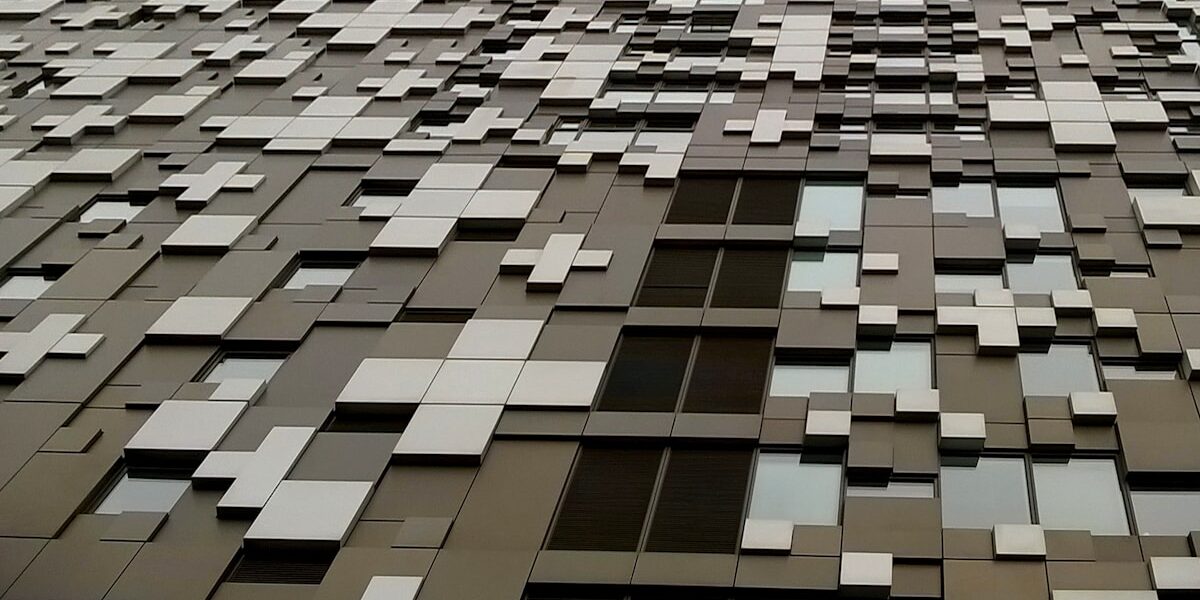
An ACP aluminium composite panel is a sandwich material: two thin aluminium skins bonded to a core of polyethylene, fire-rated mineral, or a blend of the two. Walk down any commercial street and you’re looking at it — façade cladding, fascia bands, shopfront signage, column covers. The panel earns that job on physics. Two skins spaced by a light core resist bending far better than a solid metal sheet of equal weight, so you get flat, rigid cladding without the dead load or the cost of solid plate.
Skin gauge is where quotes get won and facades get lost. Exterior work needs at least 0.3mm of aluminium per skin — drop below that and wind-load cycles gradually work the skin-to-core bond loose, and the delamination shows up as waviness, edge lifting, or a full re-clad. We hold that 0.3mm floor on every exterior-grade sheet we bond at RaxPanel; I’d rather lose a quote than shave the gauge. Core chemistry gets the headlines, and it matters — PE keeps a panel light and easy to route, mineral fill buys fire performance — but no core rescues a panel built on foil-thin skins.
Core chemistry is also where most spec sheets go quiet, so the breakdown below starts with the sandwich itself — skin coatings, core fill, the bonding line — then weighs PE against FR and mineral cores against the fire classifications your inspector enforces. It closes with the at-a-glance checks that tell you whether a panel will pass code, survive transit, and stay flat for the life of the warranty. That last part is where the money is.
What Is an Aluminium Composite Panel (ACP)?
ACP stands for Aluminium Composite Panel (spelled “aluminum composite panel” in American English). It is a flat, factory-manufactured sheet made of two thin aluminium layers bonded to a central core — most commonly polyethylene plastic or a mineral-filled blend. The three layers are pressed into one board that looks and handles like solid metal but weighs a fraction of it. Developed in Europe in the late 1960s, ACP has since become one of the most widely used cladding and signage materials in the world.
Key takeaway: An ACP is not a solid metal sheet. Two thin aluminium skins provide the surface and weather protection, while the core between them provides thickness, stiffness, and light weight — a sandwich construction, engineered on the same principle as an aircraft wing panel.
The Full Name, Word by Word
Every word in “aluminium composite panel” describes a physical part of the product, which is why the name survives unchanged across dozens of languages:
- Aluminium: The two outer metal skins. They carry the color and finish you see and touch, and they shield the panel from sun, rain, and pollution.
- Composite: The panel is not one material but several bonded into one — the skins and the core each contribute a property the other lacks.
- Panel: The product format: a flat, rigid sheet produced in large standard sizes, ready to be cut, shaped, and fixed in place.
What “Composite” Actually Means in Panel Materials
A composite is any material made by combining two or more distinct materials so that each does the job it is best at. The everyday example is reinforced concrete: concrete handles compression, steel rebar handles tension, and together they outperform either one alone.
ACP applies the same logic in flat form. Think of a sandwich: two thin, stiff slices of bread with a light filling in between. The aluminium skins give the panel its finished surface and stand up to the weather; the core keeps the skins apart and adds thickness without adding meaningful weight. That separation is the whole trick — it lets a panel stay flat and rigid across large areas while remaining far lighter than a solid aluminium sheet of the same size.
After more than 15 years manufacturing composite panels, we still consider this the most elegant idea in the category: you pay for metal only where it earns its keep — at the surface.
Where You Have Already Walked Past ACP
Chances are you saw several ACP panels today without registering them, because the material is designed to read as clean metal or a solid color surface:
Storefront fascias and signage, fuel-station canopies, corporate lobbies, transit interiors — each of these relies on the panel’s knack for passing as plain, polished metal. In every case, the material does its job best precisely when it goes unnoticed.
That unassuming appearance is precisely what makes ACP so widely adopted across industries. Beyond signage and interiors, its versatility extends to large-scale applications where aesthetics and performance must coexist.
That unassuming appearance is no accident — it’s what makes ACP so versatile across so many applications.
That unassuming appearance is precisely what makes ACP so versatile: it blends in while delivering performance that stands out.
Picture the fascia above a shopfront, the sign panel at a petrol station, the check-in counters at an airport, or the wall lining in an office lift lobby — odds are good that at least one of them was ACP. In each case, the panel is doing quiet, everyday work: staying flat, shrugging off grime, and weighing almost nothing while it does it.
The common thread is simple: wherever a smooth, durable, metal-look surface is needed at low weight, ACP is usually the default answer. Building exteriors are a major application too, and they deserve their own deeper look later in this article.
Key Features That Define a Typical ACP Panel
Across brands and price points, nearly every genuine ACP shares this core feature set:
These shared traits are what make ACP a dependable choice for everything from signage to full building façades. But sharing a feature set is not the same as performing identically in every application—and that distinction matters more than it might first appear.
However, not every detail in that list carries equal weight across all product tiers.
But listing those shared features isn’t the same as saying they perform identically.
But that shared baseline doesn’t mean all ACP panels perform the same way under real-world conditions.
Taken together, these shared traits are what make ACP one of the most predictable cladding materials on the market, regardless of brand or budget. But predictability in features doesn’t mean uniformity in performance. That distinction matters enough to warrant an honest caveat.
That shared checklist, however, describes the floor rather than the ceiling. Two panels that tick every box above can still behave very differently the moment fire, structural load, or decades of weather enter the picture.
One honest boundary: the word “typical” is doing real work in that heading. Fire behavior, structural performance, and long-term durability all depend on the core material and the aluminium skin gauge — precisely where ACP products differ from one another. Those differences are unpacked step by step in the sections that follow.
How an ACP Panel Is Built, Layer by Layer
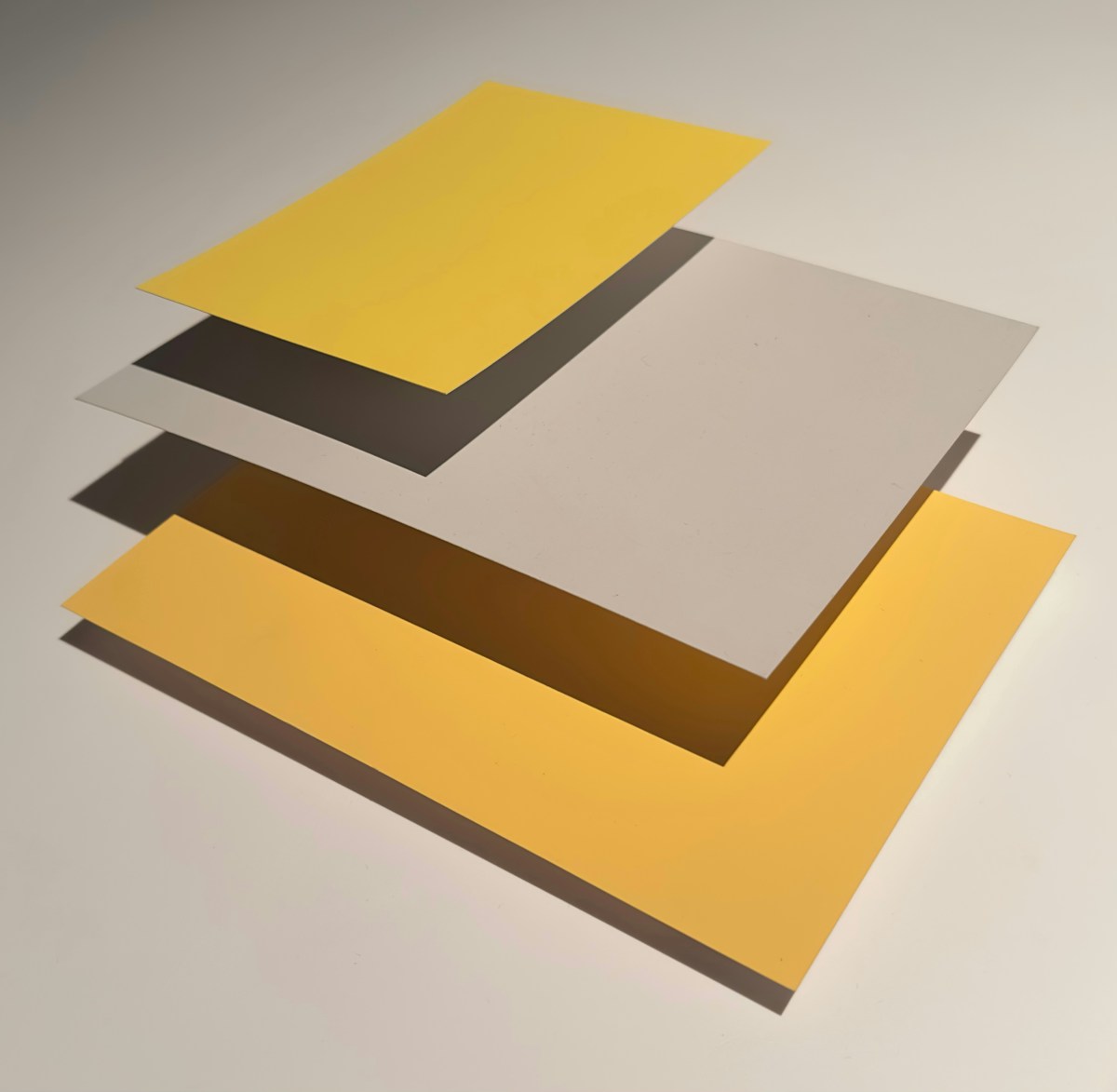
An ACP panel is a sandwich-structured material consisting of two thin aluminium skins bonded to a central core layer. The performance, durability, and fire rating of the final panel are determined by the composition and quality of each individual layer.
The Front Aluminium Skin: Coating and Finish
The front skin is the visible face of the panel and the first line of defence against weather, UV exposure, and mechanical damage. It is typically made from alloyed aluminium sheets, most commonly 3003 or 5005 grade, chosen for their balance of formability and strength. The aluminium layer itself usually ranges from 0.2 mm to 0.5 mm in thickness, with exterior-grade panels requiring a minimum of 0.3 mm to resist denting and wind-induced flexing.
Before lamination, the aluminium surface undergoes a pre-treatment process—typically a chromate or chrome-free conversion coating—that promotes adhesive bonding and corrosion resistance. After pretreatment, the finish is applied through a coil-coating line where primer and topcoat layers are rolled onto the metal and cured in an oven. For exterior facades, a PVDF (polyvinylidene fluoride) resin-based coating is the industry standard, offering superior chalk resistance and colour retention over 20 to 30 years of exposure. Interior-grade panels often use polyester coatings, which are cost-effective but less UV-stable. The finish also determines the panel’s reflectivity, texture, and colour consistency across batches—a critical factor for large facade projects.
The Core Layer Between the Two Aluminium Skins
The core is what transforms a simple aluminium sheet into a composite panel. It sits between the front and back skins and provides rigidity, thickness, and—most critically—fire performance. The core material determines the panel’s fire classification, thermal behaviour, and weight. There are three primary core types used in the industry.
- Polyethylene (PE) core: The most common and cost-effective option. PE core provides excellent stiffness-to-weight ratio and is easy to fabricate. However, it is combustible and typically carries a B-s1,d0 or lower fire classification under EN 13501-1, restricting its use in high-rise or regulated buildings.
- Fire-retardant (FR) core: A polyethylene core modified with mineral additives—usually magnesium hydroxide—to reduce flammability. FR cores achieve a B-s2,d0 or B-s1,d0 classification depending on formulation, making them suitable for mid-rise applications where PE is prohibited but a full mineral core is not required.
- Mineral-filled (A2) core: Composed primarily of non-combustible mineral materials, often with a small amount of organic binder. Mineral-core panels achieve the highest fire rating—Euroclass A2-s1,d0 or A1 under EN 13501-1—and are mandated for high-rise buildings, hospitals, schools, and other occupancy-sensitive projects in most jurisdictions.
The core thickness directly determines the overall panel thickness, which in turn affects the subframe spacing and wind load capacity. Common core thicknesses range from 2 mm to 4 mm, producing overall panel thicknesses of 3 mm, 4 mm, and 6 mm. A thicker core increases stiffness but also adds weight and material cost.
The Back Skin and Protective Film
The back skin mirrors the front skin in composition—same alloy, same thickness range—but often receives a simpler finish since it is not exposed to direct weathering. A polyester coating or primer-only layer is typically sufficient for the rear surface. In some cases, the back skin may be left uncoated (mill finish) for interior applications where cost reduction is a priority, though this is rare in exterior cladding where corrosion resistance on both sides is essential.
Applied to the coated surfaces before shipment is a removable protective film, usually made of polyethylene. This film prevents scratches, abrasion, and contamination during fabrication, transport, and installation. The film should be removed within 6 to 12 months of manufacture; leaving it on beyond that window—especially under UV exposure—can cause the adhesive to bond permanently to the coating, making removal difficult and potentially damaging the finish. Quality manufacturers use low-adhesion films that peel cleanly even after extended storage.
How the Layers Are Bonded Together
The bond between the aluminium skins and the core is the single most important factor in panel durability. A weak bond leads to delamination—separation of the layers—which compromises structural integrity, allows moisture ingress, and ultimately causes panel failure. The industry standard manufacturing process is continuous lamination, where the aluminium coils and core material are fed through a heated roller-bonding line. An adhesive—typically a polymer-based or epoxy system—is applied to the aluminium surfaces before they meet the core, and heat and pressure activate the bond.
For mineral-core panels, the bonding process is more demanding because mineral materials are porous and do not absorb organic adhesives in the same way as polyethylene. Manufacturers often use specialized high-bond adhesives and precisely controlled temperature profiles to ensure a consistent peel strength across the entire panel surface. The minimum peel strength specified by EN 13501-1 and ASTM B814 is 1.0 N/mm for exterior-grade panels, though reputable manufacturers consistently achieve 1.5 N/mm or higher. Shear strength—the resistance of the bond to forces acting parallel to the panel surface—is equally critical and is tested according to EN 15478.
After lamination, the panel sheet is cured in a temperature-controlled oven to complete the adhesive cross-linking process. It is then cooled, trimmed to standard dimensions (typically 1220 × 2440 mm), and inspected for surface defects, bond uniformity, and dimensional tolerance before protective film is applied and the panels are stacked for shipment.
PE, FR, and Mineral-Filled: ACP Core Types Explained
The core material inside an aluminium composite panel dictates its fire behaviour, structural limits, and allowable applications. Choosing the wrong core for a given building height or fire code is a costly mistake that cannot be corrected after fabrication.
Aluminium composite panels are defined by what sits between their two thin aluminium skins. That core layer is not a single material but a spectrum of formulations, each engineered for a different balance of cost, weight, and fire performance. The three most common types are polyethylene (PE), fire-retardant (FR), and mineral-filled (A2) cores. Understanding the fundamental difference between them is essential for any specifier working on exterior cladding, interior fit-out, or transportation applications.
Polyethylene (PE) Core: The Economy Standard
PE core is the baseline material used in the vast majority of ACP panels worldwide. It is a solid plastic core composed entirely of polyethylene, which gives the panel its characteristic lightweight and highly formable nature. Fabricators can route, bend, and thermoform PE-core panels with standard woodworking tools, making it the default choice for signage, interior wall cladding, and low-rise projects where fire risk is minimal.
The trade-off is fire performance. Polyethylene is inherently combustible, and a PE-core panel will feed a fire rather than resist it. In practice, this means PE-core ACP is generally unsuitable for exterior facades above a certain height threshold where building codes require tested fire assemblies. Specifiers working on projects above approximately 40 feet must look beyond PE core, as the panel alone will not satisfy the performance expectations of modern fire codes.
Fire-Retardant (FR) Core: A Middle-Ground Solution
FR core was developed to close the gap between the low cost of polyethylene and the high fire performance of mineral-filled cores. The formulation replaces a significant portion of the polymer with mineral fillers, typically around 70 percent mineral content such as aluminium hydroxide, with the remaining 30 percent being a polymer binder. This composition fundamentally changes how the core behaves when exposed to flame.
When exposed to heat, the mineral fillers release bound water vapour, which dilutes surrounding oxygen and slows the combustion process. The result is a core that does not self-sustain a flame the way pure polyethylene does. FR-core panels are commonly specified for commercial facades and mid-rise buildings where the local code permits a combustible core with enhanced fire retardancy, typically achieving a B-s1,d0 classification under EN 13501-1 when properly tested and certified.
Do not assume every panel labelled FR meets the same fire standard. Fire-retardant core formulations vary by manufacturer, and only panels backed by independent third-party test reports for the specific EN 13501-1 or ASTM E84 rating should be trusted for code-compliant specification. Always request the test certificate before finalising a procurement order.
Mineral-Filled (A2) Core: The Highest Fire Rating
Mineral-filled core represents the top tier of fire performance available in standard aluminium composite panels. The core composition is dominated by inorganic minerals, typically at 90 percent or higher, with a small percentage of polymer binder holding the structure together. Because the material is overwhelmingly non-combustible, it does not contribute fuel to a fire and is classified under the Euroclass A2-s1,d0 rating, which is the highest classification achievable for ACP products.
This classification is not a marketing claim but a test result. A2-rated panels must pass the same rigorous fire tests required for other construction materials, and they are the standard requirement for high-rise facades, curtain walls, and rainscreen systems in jurisdictions with strict fire regulations. The mineral core does carry a weight premium and is slightly less formable than PE or FR cores, but for projects where life safety and code compliance are non-negotiable, mineral core is the only acceptable choice.
How to Choose the Right Core for Your Project
The decision between PE, FR, and mineral core should be driven by three factors: building height, local fire code, and intended application. PE core is appropriate for interior partitions, ceiling panels, signage, and single-storey exterior applications in regions with lenient fire regulations. FR core bridges the gap for low-to-mid-rise commercial facades where a full A2 rating is not mandated but enhanced fire performance is desired. Mineral core is the mandatory specification for high-rise buildings, public assembly spaces, and any project requiring A2-rated assemblies under Euroclass or equivalent standards.
- Building height and code requirement: Panels for facades above 40 feet typically require A2 or NFPA 285-tested assemblies, which rules out standard PE core.
- Interior vs. exterior application: Interior wall and ceiling panels in low-risk environments can safely use PE core, while exterior cladding demands a higher fire tier.
- Formability needs: PE and FR cores are more forgiving during on-site fabrication and thermoforming; mineral cores are stiffer and better suited for flat-sheet installations.
- Certification verification: Always confirm the core type against an independent test report before ordering, as labelling alone is not sufficient evidence for code compliance.
Never specify a core type based solely on price. The cost difference between PE and mineral core is marginal compared to the expense of replacing an entire facade after a failed inspection or fire incident. Always prioritise the core specification that matches your project code requirements from the start.
| Core Type | Composition | Combustibility | Fire Rating (EN 13501-1) | Typical Application |
|---|---|---|---|---|
| PE (Polyethylene) | 100% polyethylene (LDPE) | Combustible; higher heat release potential | Typically D or lower (panel-specific testing required) | Interior decoration, signage, low-risk applications, temporary uses |
| FR (Fire-Retardant) | ≈70% mineral fillers (e.g., aluminium hydroxide) + ≈30% polymer | Reduced combustibility; slows flame spread and minimises debris | B-s1,d0 (when certified) | Commercial facades, multistory buildings, projects requiring improved fire performance |
| Mineral (A2) | ≥90% inorganic minerals + ≤10% polymer binder; total heat value PCS ≤3.0 MJ/kg | Limited combustibility; lowest among common ACP cores | A2-s1,d0 (limited combustibility classification) | High-rise facades, curtain walls, rainscreen systems, fire-regulated exterior applications |
What Makes ACP Perform the Way It Does
Every performance claim attached to ACP — high rigidity at low weight, dead-flat surfaces, dependable resistance to wind — traces back to a single engineering principle: the sandwich structure. Two thin aluminium skins bonded to a lighter core behave, mechanically, like one thick sheet of metal at a fraction of the weight. Once you understand how the layers divide the work, the panel’s behaviour under load, heat, and wind becomes predictable rather than mysterious.
The skins carry bending stress, the core holds them apart and transfers shear, and the adhesive bond makes all three act as one. Weaken any of those three roles and the panel loses most of its rigidity.
The Sandwich Effect: Why Two Thin Skins Beat One Solid Sheet
The easiest way to picture an ACP panel is an I-beam rolled flat. In a steel I-beam, the two horizontal flanges take the bending stress while the vertical web keeps them separated and handles shear. An ACP does the same job: the two aluminium skins act as flanges, and the core acts as a continuous web holding them at a fixed distance.
This geometry is the source of ACP’s high stiffness-to-weight ratio. In sandwich construction, bending stiffness scales roughly with the square of the distance between the skins — double that distance and rigidity can multiply fourfold, while the added material weighs almost nothing. The core contributes very little bending strength of its own, but its spacing function is what amplifies the skins’ strength into something far greater than either layer could deliver alone.
Corrugated cardboard proves the point in everyday life. Two thin paper liners and a fluted middle are floppy on their own, yet nearly rigid once bonded together. The liners supply the strength; the flute supplies the geometry.
Bending Strength and Flexural Modulus: A Joint Effort
Flexural modulus sounds technical, but it simply describes how much a panel resists bending when a load presses on it — the higher the value, the less it deflects. In a composite panel, this value is “apparent”: it emerges from two components working together rather than from any single material.
The division of labour inside the panel is precise:
- Aluminium skins: carry the tensile and compressive stresses created when the panel bends. Thicker or higher-grade skins raise the panel’s load-bearing ceiling.
- Core: stops the two skins from sliding past each other (shear) and holds them at their designed distance. A denser, stiffer core keeps the sandwich acting as one unit.
This is why skin thickness and core type must always be judged together. Pair a stiff skin with a weak core, and the skins shear relative to one another under load, so the panel buckles anyway. Pair a strong core with skins that are too thin, and the faces crush locally under point loads. Load-bearing capacity is a team result — neither component can compensate for the other indefinitely.
Thermal Expansion and Dimensional Stability
Aluminium expands when it heats up — roughly 23 microns per metre for every degree Celsius of temperature rise. On a sunlit facade, the front face of a cladding panel can run tens of degrees hotter than the shaded back. In a single monolithic metal sheet, that uneven expansion has nowhere to go except outward: the sheet bows, and thin sheets develop the rippling defect known as oil-canning.
The composite construction suppresses this. Because the two skins are mechanically tied together through the core, neither face can stretch freely past the other; the panel grows slightly and evenly as a whole instead of one face racing ahead. The result is dimensional stability — the panel stays flat through daily and seasonal temperature swings, which is exactly what a flush, modern facade demands. Panels that do warp usually suffer from unbalanced skins or a bond line too weak to enforce this restraint.
Wind Load Resistance and Panel Rigidity
On a facade, an ACP panel behaves as a small structural element: it spans between subframe rails and must resist wind pressing in and sucking out, cycle after cycle. How well it copes comes down to the same levers described above:
- Skin gauge: sets bending capacity — the panel’s resistance to the out-of-plane pressure that wind applies.
- Core density and quality: governs shear stiffness. A uniform, dense core stops the skins from sliding, which keeps deflection low across a given span.
- Skin separation: delivers the squared-distance stiffness bonus, which is why added core thickness raises rigidity far faster than added skin thickness alone.
When these levers are balanced, a panel deflects under a gust and returns dead flat. When they are not, the telltale signs appear over time: visible flexing between fixings, fluttering in high wind, and surface waviness that breaks the facade’s clean lines. Rigidity is not a single specification — it is the output of the whole sandwich working as designed.
Peeling Strength and Shear Resistance: The Bond That Holds It All
Every property above depends on one quiet component: the adhesive line between skin and core. Peeling strength measures the force needed to pull a skin away from the core, expressed in newtons per millimetre (N/mm). Shear resistance describes the bond’s ability to transfer load between the two skins without letting them slide. Together they are what turn “composite” from a noun into a verb — the layers only behave as one panel for as long as the bond holds.
That bond works hard for decades. Facade panels endure thousands of thermal cycles, vibration from wind, and moisture migrating behind open joints — all of which stress the adhesive line. If the bond degrades, the composite effect collapses: the skins stop sharing load, bending stiffness falls back toward that of the individual thin sheets, and delamination, rattling, and surface distortion follow. This is why engineers treat peeling-strength data as one of the most revealing numbers on a specification sheet — it does not merely describe adhesion; it predicts whether the panel’s stiffness, flatness, and wind resistance will still be there in twenty years.
Standard Sizes and Thickness Options for ACP
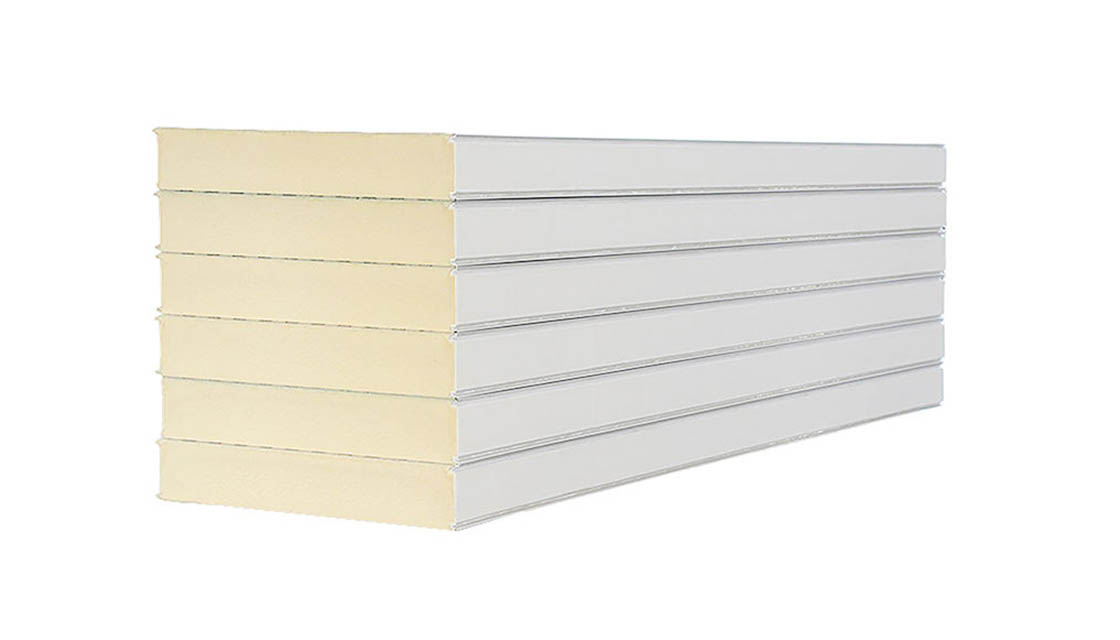
Aluminium composite panels (ACP) are supplied in one of the most standardized dimensional systems in the cladding industry. The global baseline sheet measures 1220 × 2440 mm (48 × 96 in), and total thickness typically runs from 3 mm for interior work up to 6 mm for exterior façades and high-wind locations. Size governs how a project is planned, shipped, and cut; thickness governs how far a panel can bridge between supports without visibly deflecting. Understanding both levers — and how they interact — is what separates a clean installation from an expensive one.
Choose the panel module to fit the sheet and the thickness to fit the span. Every deviation from that order of operations shows up later as offcut waste or visible panel distortion.
Why 1220 × 2440 mm Became the Global Default
The 4 × 8 ft footprint was not invented for composite panels — it is the module the entire construction supply chain was already built around, from drywall to plywood. ACP production lines are engineered so the coated coil width produces a finished 1220 mm sheet, and every downstream step — shipping crates, container loading, fabricator CNC tables, even warehouse racking — is optimized around that footprint.
A useful analogy is A4 office paper. You could print a letter on any sheet size you like, but printers, folders, and envelopes are all designed around A4, so choosing another size costs you money at every step. The same logic applies to panel sizing: deviating from the baseline is possible, but it gives up the cost efficiencies that come with volume production.
One practical consequence for buyers: quotations may be given per sheet or per square meter, and the two are not directly comparable unless the sheet size is identical. Extended and oversize formats — summarized in the table above — exist mainly to reduce the number of horizontal joint lines on tall elevations, which is an aesthetic and weather-tightness decision rather than a structural one.
What the Thickness Number Actually Tells You
The stated thickness is the total measurement across both aluminium skins and the core sandwiched between them. Within the standard range, stiffness rises far faster than the number itself suggests, because increasing thickness pushes the two skins further apart — the same principle that makes an I-beam vastly stiffer than a flat steel bar of equal weight. That single fact drives nearly every selection decision that follows.
- Interior panels: supports are closely spaced and there is no wind load, so the thinner end of the range handles the job comfortably and is easier to fold on site.
- General exterior cladding: the mid-range is the international default because it balances stiffness, weight, and cost for typical story-height spans.
- High-wind and demanding façades: the thicker end is specified where spans widen or wind exposure intensifies, accepting extra weight and material cost in exchange for a flatter, more stable wall.
Matching Thickness to Span and Subframe Spacing
“Span” is the distance a panel must bridge between adjacent fixing rails in the subframe — the grid of aluminium or galvanized steel battens anchored to the building structure that the panels are mechanically fixed to. This is the single most important variable in thickness selection, and unlike wind exposure, it is entirely within the designer’s control.
Think of a bookshelf. A thin shelf sags between widely spaced brackets; you can fix that either by thickening the shelf or by adding another bracket. Cladding works the same way: a thicker panel tolerates wider rail centers, while a thinner panel needs the subframe tightened up. Neither approach is wrong — one spends more on panel, the other on rails, fixings, and installation labor.
Outdoors, wind is what makes this trade-off unavoidable. Gusts load the panel thousands of times over the building’s life, pushing and pulling it between the rails, and a panel undersized for its span eventually telegraphs that stress as visible waviness across the façade. This is why experienced specifiers work from the fabricator’s span tables — published rail-spacing recommendations for each thickness — rather than choosing gauge on unit price alone. In practice, a modest step up in thickness that allows wider rail spacing can partially or fully offset its own premium through a lighter subframe and faster installation.
Custom Sizing and the Hidden Economics of Waste
Because ACP is manufactured from continuous coil rather than fixed moulds, panels can be produced in lengths cut directly to the elevation drawings instead of trimmed from standard sheets. Done well, this delivers two benefits at once: horizontal joint lines nearly disappear on tall façades, and offcut waste shrinks toward zero because every panel arrives at its finished dimension.
Custom sizing is not free, however. It typically involves longer lead times, minimum order quantities, and a unit price premium over stock sheets. There is also a risk asymmetry worth understanding: leftover standard sheets can be re-cut or resold, while offcuts from custom panels are essentially worthless — and if the design changes after production, the entire batch can be lost.
Even with standard sheets, the real cost driver is yield — how efficiently the panel modules nest onto each sheet. A façade module that divides cleanly into the baseline format can push usable yield above 90 percent, while an awkward module can drag it below 70 percent, meaning you are paying for material destined for the skip. One frequently overlooked constraint: directional finishes such as brushed or anodized-look surfaces have a grain that must run consistently across all panels, so sheets cannot simply be rotated to squeeze out a better nest. Fabricators who ignore this during estimating routinely undercut their own margin — and sometimes their client’s patience.
In short, size is a logistics and cost-planning decision, thickness is a structural one, and the two should be settled together — with span tables and a nesting drawing in hand — before the first sheet is ordered.
| Parameter | Standard Options | Technical Detail | Typical Application |
|---|---|---|---|
| Standard Sheet Size (Imperial) | 4 × 8 ft (1,220 × 2,440 mm) | The globally dominant modular format; matches common stud/joist layouts and minimizes cutting waste | Exterior cladding, interior wall panels, signage |
| Extended & Oversize Formats | 4 × 10 ft (1,220 × 3,050 mm); 1,220 × 3,200 mm; 5 × 10 ft (1,525 × 3,050 mm) | Reduced joint lines on tall elevations; maximum panel width available up to 1,600 mm | High-visibility façades, column covers, long fascia runs |
| Custom Length Capability | No fixed length limitation; practical supply up to ~6,000 mm | Continuous coil-coating and lamination lines allow panel lengths cut to project elevation drawings | Rout-and-return tray panels, full-height cladding bands |
| Total Panel Thickness | 2 mm; 3 mm; 4 mm; 5 mm; 6 mm | 4 mm is the international default for building exteriors; thicker cores increase stiffness and wind-load capacity | 2–3 mm: interiors & signage; 4 mm: general exterior cladding; 5–6 mm: curtain wall & spandrel zones |
| Skin Thickness Grades | 0.10–0.18 mm (signage grade); 0.20–0.30 mm (architectural grade); 0.40–0.50 mm (curtain-wall grade) | Skin thickness — not total thickness — governs rigidity, flatness, and foldability; bending/V-groove fabrication requires ≥ 0.30 mm skins to avoid cracking | 0.10–0.18 mm: signage & display; 0.20–0.30 mm: exterior cladding & folded tray panels; 0.40–0.50 mm: curtain wall & high-wind-load façades |
| Core Type & Fire Classification | PE core (100% polyethylene); FR mineral core (≈ 70% mineral / 30% polymer); A2 core (≥ 90% mineral, PCS ≤ 3.0 MJ/kg) | Core chemistry — not panel size — determines fire classification per EN 13501-1: PE → Class E; FR → B-s1,d0; A2 → A2-s1,d0; A2 panels are heavier and less foldable than PE | PE: low-rise & signage; FR: mid/high-rise façades; A2: regulated high-occupancy buildings |
| Aluminium Alloy & Temper | AA3003-H24 (standard); AA1100; AA5005 | 3003-H24 balances formability with torsional strength; alloy grade affects corrosion resistance and anodizing quality | AA3003-H24: PVDF-coated exterior & interior panels; AA1100: signage-grade panels; AA5005: anodized & premium finishes |
| Coating System on Skins | Front: multi-coat PVDF system (pre-treatment + primer + topcoat); Back: polyester primer/backing coat | Multi-layer roller coating with protective film secures 25-year outdoor color retention; PE/polyester coating systems are reserved for interior-grade panels | PVDF fronts: weather-exposed exterior faces; polyester backs & interior systems: interior-grade panels |
Where ACP Is Used Across Industries
Aluminium Composite Panels span multiple industries because their sandwich structure delivers a unique combination of light weight, formability, and surface finish — each application demanding a specific core type and thickness selection.
Architectural Facades and Exterior Cladding: The Dominant Application
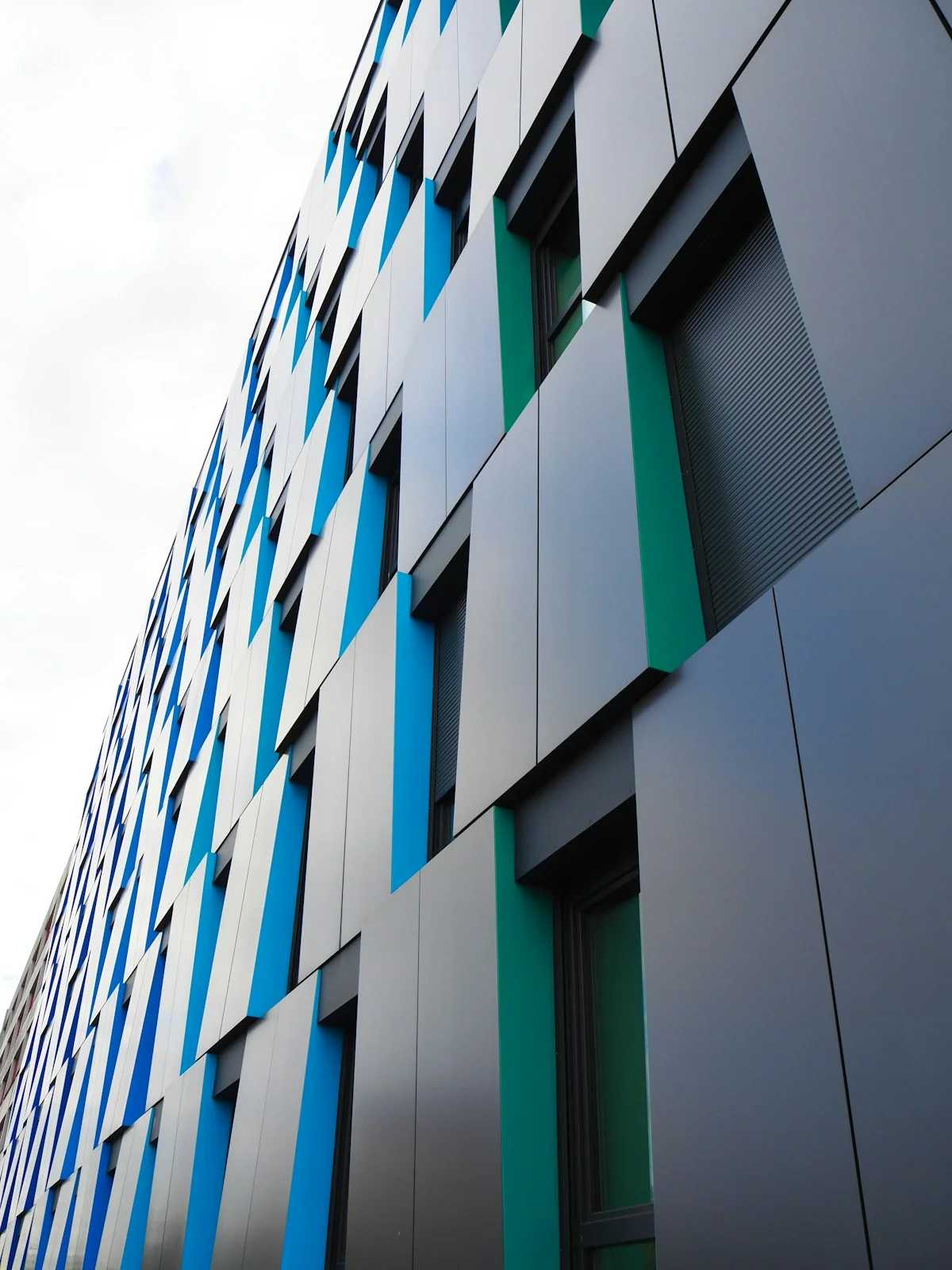
Architectural facades represent the single largest application segment for ACP globally. The material is specified extensively on commercial buildings, mixed-use developments, and high-rise structures where a modern, seamless exterior is a design priority. The sandwich construction — two aluminium skins bonded to a core — delivers a high stiffness-to-weight ratio that solid aluminium sheet cannot match at equivalent thickness. This means thinner, lighter panels can span the same distances without excessive deflection, reducing the load on the building’s structural frame.
For exterior cladding, the core type is the critical specification. Polyethylene (PE) core panels are common on low-rise residential projects but are increasingly restricted on commercial and high-rise buildings due to fire safety regulations. Mineral-filled or fire-retardant (FR) cores are now the default specification for most facade applications above a certain building height, as they provide significantly improved fire performance under Euroclass B-s1,d0 or A2-s1,d0 classifications depending on core formulation and skin gauge. Fire-rated ACP panels for facades typically require 4 mm or 6 mm total thickness to meet wind load and structural rigidity demands in high-rise contexts.
Surface finish selection for facades is equally important. PVDF (polyvinylidene fluoride) coatings, commonly referred to by trade names such as Kynar 500 or Hylar 5000, are the industry standard for exterior durability. These coatings resist UV degradation, colour fading, and chemical exposure far better than polyester finishes, which are generally limited to interior use. A minimum aluminium skin thickness of 0.30 mm is widely recommended for exterior cladding to ensure the panel maintains structural integrity under wind load cycling and thermal movement over its service life.
Interior Wall and Ceiling Panels: Where PE-Core ACP Is Commonly Specified
Interior applications represent the second-largest ACP market segment and are where polyethylene-core panels remain the dominant choice. Because interior environments do not carry the same fire-safety regulatory burden as exteriors, PE-core ACP offers a cost-effective solution for wall cladding, ceiling systems, and partition walls in offices, retail interiors, hospitality venues, and residential fit-outs.
The key advantages in interior settings are formability and surface aesthetics. PE-core panels are softer and more easily formed than mineral-core variants, making them suitable for curved walls, coving, and custom geometries. They accept a wide range of finishes including matte, gloss, metallic, wood-grain, and stone-effect coatings. Thicknesses in the 3 mm to 4 mm range are typical for interior wall and ceiling applications, where wind load and structural rigidity demands are far lower than for facades.
Installation speed is a major driver for interior ACP specification. Large-format sheets reduce the number of joints compared to traditional plasterboard or timber panel systems, creating cleaner visual lines and faster on-site completion. The lightweight nature of ACP also means less structural reinforcement is needed for ceiling suspensions and wall framing compared to solid metal or stone cladding alternatives.
Signage, Branding, and Retail Display: Surface Finish and Formability as Key Drivers
Signage and retail display is one of the most visible applications of ACP and has been a primary growth driver for the product category since its adoption in the 1990s. Shop fronts, corporate logos, illuminated signage boxes, and point-of-sale displays all rely on ACP’s combination of flat surface quality, ease of fabrication, and design flexibility.
The surface finish is the defining specification for signage applications. ACP panels used for signage must deliver a consistently smooth, defect-free surface that accepts printing, painting, and laminated vinyl graphics without showing underlying texture or imperfections. Bright metallic finishes, colour-matched PVDF coatings, and mirror-finish variants allow brands to achieve precise visual identities. The flatness of the panel — maintained by the composite sandwich structure — is critical for large-format printed graphics where warping would distort the image.
Formability is equally important. ACP signage components are routinely cut, routed, bent, and folded into three-dimensional letters, display stands, and facade-mounted brand elements. PE-core panels in the 3 mm thickness are particularly popular for signage because they are easy to machine with standard woodworking and metalworking tools. The material can be cold-formed around tight radii without cracking the aluminium skin, provided the bend direction is aligned with the panel’s manufacturing grain.
- Thickness range: 3 mm is standard for indoor signage; 4 mm is used for large exterior channel letters and freestanding sign panels that require additional rigidity.
- Surface options: PVDF-coated panels in solid colours, metallic finishes, and printed graphics are the most common; polyester-coated variants are used for short-life indoor displays where cost is the primary driver.
- Fabrication compatibility: ACP can be cut with CNC routers, saws, and shears; routed edges produce clean, finished profiles without requiring additional trimming or edge banding.
Modular and Prefabricated Construction: Lightweight Advantage in Fast-Track Builds
Modular and prefabricated construction is an expanding application area for ACP, driven by the global shift toward off-site manufacturing and accelerated project delivery. In this context, the lightweight nature of ACP is not merely a convenience — it is a structural and logistical advantage. A 4 mm ACP panel weighs approximately 4.5 kg/m², compared to roughly 11 kg/m² for a 3 mm solid aluminium sheet of the same dimensions. This weight reduction translates directly into smaller structural frames, lighter lifting equipment requirements, and faster on-site assembly.
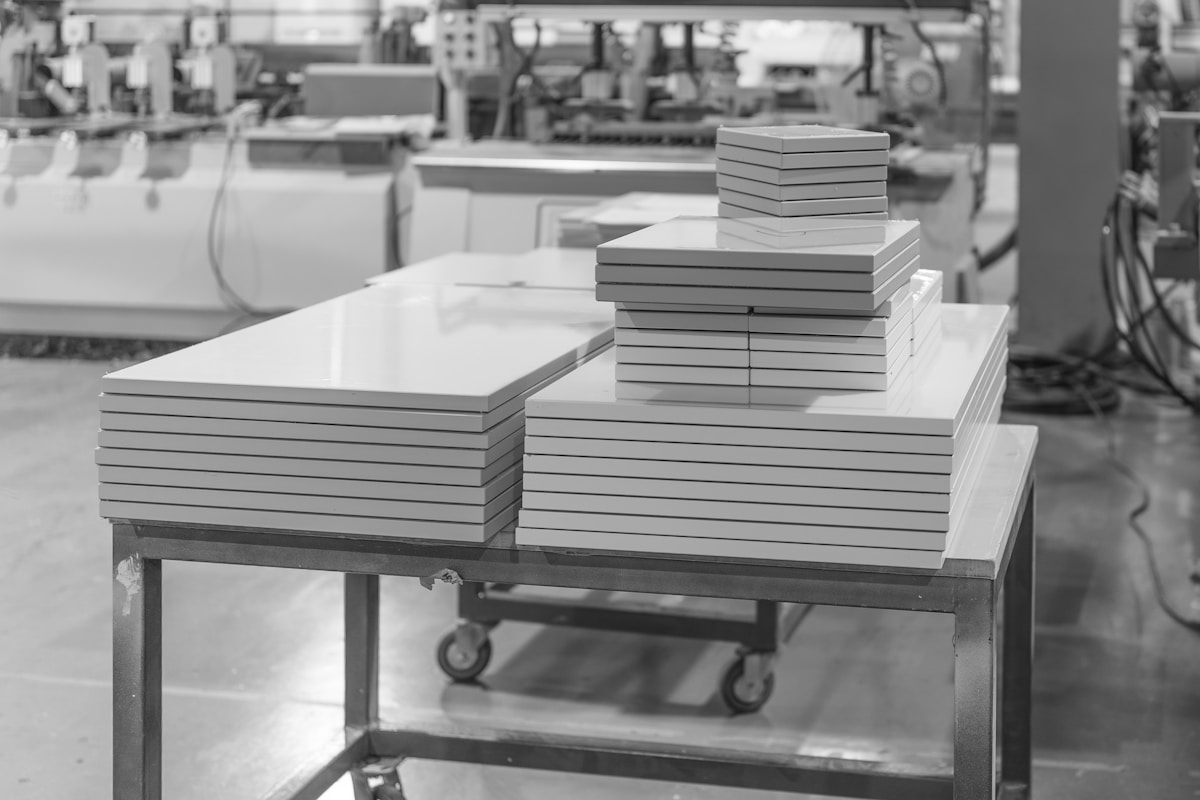
Prefabricated ACP panels are manufactured in controlled factory environments, where quality consistency, coating integrity, and dimensional accuracy are easier to maintain than on exposed construction sites. Panels are produced to exact dimensions with pre-finished surfaces, pre-drilled fixing holes, and integrated joint details. This approach reduces on-site labour, minimises material waste, and allows building envelopes to be installed in a fraction of the time required for traditional cladding systems.
The dimensional stability of ACP — its resistance to warping and thermal movement compared to monolithic metal — is particularly valuable in modular construction. Large prefabricated panels maintain their flatness during transport and handling, and the composite structure absorbs thermal expansion differences between the aluminium skins and the core, reducing the risk of buckling or distortion during temperature fluctuations.
Specialised Environments: Cold Storage and Clean Room Applications Using Foam-Core Variants
Specialised industrial environments represent a niche but technically demanding application segment for ACP. Cold storage facilities, food processing plants, pharmaceutical clean rooms, and chemical processing areas require cladding materials that can withstand extreme temperature cycles, high humidity, and strict hygiene standards. In these applications, ACP panels with foam-filled cores — typically polyurethane (PU) or polyisocyanurate (PIR) — are specified because they provide both structural cladding and thermal insulation in a single integrated component.
The foam core in these panels serves a dual function. Mechanically, it maintains the sandwich panel’s rigidity and load-bearing capacity. Thermally, it provides insulation values that meet the energy efficiency requirements of refrigerated and conditioned spaces. These panels are available in thicknesses ranging from 30 mm to 200 mm or more, depending on the required thermal resistance (R-value) and structural span requirements.
Clean room applications place additional demands on ACP surface properties. The panel surface must be non-porous, chemically resistant, and capable of withstanding repeated cleaning with aggressive disinfectants without degradation. PVDF-coated aluminium skins are commonly specified for clean room environments because of their excellent chemical resistance and smooth, non-shedding surface. Joints between panels are sealed with approved gaskets and sealants to maintain the room’s pressurisation and particulate control standards.
- Cold storage: Foam-core ACP sandwich panels with PU or PIR cores provide thermal insulation values typically between 0.2 and 0.5 W/(m²·K), depending on panel thickness. These panels eliminate the need for separate insulation layers, simplifying construction and reducing thermal bridging.
- Clean rooms: Smooth, non-porous PVDF-coated surfaces resist bacterial growth and withstand frequent cleaning with harsh disinfectants. Panel joints are sealed to maintain air-tightness and pressure differentials critical to clean room classification.
- Chemical processing: ACP panels with chemically resistant coatings are specified in environments where acidic or alkaline atmospheric exposure would degrade traditional cladding materials such as steel or timber.
How to Spot Quality ACP at a Glance
Quality ACP panels can be identified through five critical visual and mechanical indicators: skin thickness, core uniformity, bond strength, coating type, and protective film integrity.
Identifying quality Aluminium Composite Panels does not require laboratory equipment. A trained eye can catch red flags during a site visit or procurement review. The five indicators below form a practical checklist that separates well-engineered panels from cost-cut alternatives.
1. Aluminium Skin Thickness
The aluminium skin is the first line of defence against weather, impact, and wind pressure. For exterior facades, the skin must be at least 0.3 mm thick. Anything thinner risks premature delamination when the panel is subjected to cyclic wind loads over time.
A simple verification method is to request the mill certificate or conduct a non-destructive thickness measurement using an ultrasonic gauge at multiple points across the panel surface. Consistency across readings indicates proper rolling and coating processes during manufacturing.
- Exterior facades: Minimum 0.3 mm aluminium skin per side
- Interior applications: 0.2 mm to 0.3 mm may suffice
- High-wind zones: Consider 0.4 mm or thicker for added rigidity
2. Core Density and Uniformity
The core material sits between the two aluminium skins and determines the panel’s stiffness, fire performance, and overall durability. A quality core is uniformly dense from edge to edge with no voids, soft spots, or visible gaps.
Uneven core density creates weak points where the panel can flex, buckle, or delaminate under load. Press your thumb firmly against the panel surface — a quality panel should not feel spongy or give way. If it does, the core fill was likely inadequate during lamination.
3. Peeling Strength and Shear Test Data
The bond between the aluminium skin and the core is what makes a composite panel composite. Peeling strength measures how well the skin resists being pulled away from the core, while shear strength measures resistance to sliding forces parallel to the panel surface.
Reputable manufacturers provide test reports from accredited laboratories. Key reference standards include EN 13501-1 for fire classification and ISO 11339 for peeling strength testing. Minimum acceptable peeling strength for exterior-grade ACP is typically 1 N/mm or higher, though exact thresholds depend on the core type and intended application.
- Peeling strength: Minimum 1 N/mm for exterior applications
- Shear strength: Varies by core type; mineral-core panels generally exceed PE-core panels
- Certification: Request test reports from ISO 17025-accredited labs
4. Surface Coating Quality
The surface coating protects the aluminium skin from UV radiation, moisture, and chemical exposure. The two most common coating types are PVDF (polyvinylidene fluoride) and polyester, each suited to different environments.
PVDF coatings are the industry standard for exterior facades. They offer superior colour retention, chalk resistance, and weathering performance, typically maintaining appearance for 20 to 30 years. Polyester coatings are adequate for interior applications but degrade faster under direct sunlight and should not be specified for exposed exterior use.
- PVDF coating: Recommended for all exterior facades; 20–30 year colour retention
- Polyester coating: Suitable for interior walls and ceilings only
- Coating thickness: Exterior-grade panels typically carry 25–35 µm of PVDF
5. Protective Film Integrity
A quality ACP panel arrives with a removable protective film on both sides. This film shields the coating during transportation, fabrication, and installation. Its presence signals that the manufacturer takes surface protection seriously.
The film should adhere evenly without bubbles, wrinkles, or premature peeling. It must be removable after installation without leaving adhesive residue. Panels shipped without protective film, or with a film that has already been partially peeled back, are at higher risk of surface scratches and coating damage before they reach the facade.
- Both sides covered: Protective film should be present on front and back surfaces
- Easy removal: Film should peel off cleanly without residue
- No premature peeling: Check edges for lifted or damaged film before accepting delivery
📋 Quick Quality Checklist
- Step 1: Verify aluminium skin thickness is at least 0.3 mm per side for exterior use.
- Step 2: Inspect core density by pressing the panel surface — it should feel solid, not spongy.
- Step 3: Request peeling strength and shear test reports from accredited laboratories.
- Step 4: Confirm PVDF coating for exterior applications; reject polyester for facades.
- Step 5: Check that both sides have intact, removable protective film.
Conclusion
ACP isn’t a single product — it’s a sandwich system where the core decides everything. PE core panels will fail fire inspections on exterior facades above a certain height. Mineral core panels cost more upfront but pass A2 ratings and hold up in high-wind zones. Your thickness call matters just as much: 4mm panels flex between subframe rails, while 6mm panels stay rigid. The aluminium skin thickness and PVDF coating quality determine whether your facade looks sharp at year five or chalked out at year two. Our engineering team is available to walk through any specification questions — no order required.
- Confirm the fire rating certificate matches your project’s local building code before ordering
- Request peeling strength and shear test data from the manufacturer
- Verify the front skin is at least 0.3 mm for exterior applications
- Check that PVDF coating is specified for exterior facades, not polyester
Frequently Asked Questions
What is the difference between ACP and ACM?
ACP stands for Aluminium Composite Panel, while ACM refers to Aluminium Composite Material. Both terms describe the same sandwich-structured product with aluminium skins and a core layer. The difference is purely terminological — ACP is more commonly used in architectural and cladding contexts, whereas ACM appears in technical and industrial specifications.
How does ACP compare to solid aluminium sheets?
ACP offers a significantly higher stiffness-to-weight ratio than solid aluminium of equivalent thickness, making it easier to handle and install. It is also more cost-effective per square metre and provides better thermal and acoustic insulation due to its core layer. Solid aluminium, however, remains preferable where maximum impact resistance or non-combustible requirements are critical.
What fire ratings apply to ACP panels?
ACP panels are classified by fire resistance standards such as B1 (flame retardant) for PE-core variants and A2 (non-combustible) for mineral-filled cores. FR-core panels meet stricter fire safety requirements and are often mandated for high-rise buildings. Buyers should always request tested fire classification data from the manufacturer before specifying ACP for exterior facades.
How do you choose between PE and FR core ACP?
PE-core ACP is cost-effective and suitable for interior applications, signage, and low-rise exterior cladding in moderate climates. FR-core ACP is required for high-rise buildings, fire-sensitive environments, and regions with strict building codes. The choice depends on local fire regulations, building height, and the specific performance requirements of the project.
What are common causes of ACP panel failure?
The most frequent failure modes include delamination caused by poor adhesive quality or excessive thermal cycling, surface coating degradation from low-quality PVDF formulations, and core compression under heavy wind loads when panel thickness is insufficient. Selecting panels with verified peeling strength and appropriate core density for the application prevents most of these issues.
How should ACP panels be maintained over time?
Regular cleaning with mild detergent and water is sufficient to preserve the appearance of ACP panels. Abrasive cleaners or high-pressure washing should be avoided, as they can damage the surface coating. Inspect protective films and sealant joints periodically, especially after extreme weather events, to ensure long-term performance.
Can ACP panels be recycled at end of life?
Yes, the aluminium skins of ACP panels are fully recyclable. The core material determines the ease of separation — mineral-filled cores are simpler to process, while polymer cores require specialized recycling streams. Many manufacturers now offer take-back or recycling programmes to support sustainable construction practices.