
Three years ago, a European distributor I’ve worked with shipped 3,000 square meters of refrigerated truck panels to a client in the Middle East. They went with PUR foam cores instead of PIR to save 12% on unit cost. Six months later, every panel failed local fire compliance testing during a municipal audit.
The client ripped out the entire installation. That distributor ate $220,000 in replacement costs and lost the account for good. Choosing sandwich panel core materials based on price per square meter is how procurement careers end. The foam type you specify determines whether your client passes their next fire inspection or calls you at midnight demanding answers.
We pulled our production test records from the past three years and benchmarked eight core materials, from PIR, PUR, XPS, PET, PVC, and PMI foams to polypropylene and aramid honeycomb structures, against the criteria that actually determine whether a project succeeds or fails. Thermal conductivity. Fire certification compliance under EN 13501 and ASTM E84.
Weight-to-strength ratios for vehicle and building applications. Real aging data, not lab-condition projections. The gap between what material data sheets claim and what happens after three years of temperature cycling is wider than most distributors expect. This article lays out those numbers so you can stop guessing and start quoting projects with hard data.
Understanding Sandwich Panel Core Materials
The core material dictates up to 80% of a sandwich panel’s structural and thermal performance. Selecting the wrong filler doesn’t just hurt insulation: it compromises the entire build.
The Role of Core Filling in Panel Performance
In a sandwich panel, the core is not just filler. It is the structural backbone. The face sheets handle bending and impact, but the core material determines stiffness, thermal resistance, fire behavior, and weight. If you spec the wrong core, you either overpay for performance you don’t need or fail to meet project requirements entirely.
Our engineers at Rax Panel evaluate core materials against four primary performance vectors before recommending a configuration. Here is what each one controls:
- Thermal insulation: Measured by thermal conductivity (λ-value). Lower values mean better insulation. XPS and PU foams are standard for refrigerated trucks and cold chain applications, while PET and PVC foams balance insulation with structural rigidity for marine and RV builds.
- Shear strength and stiffness: The core transfers shear loads between the face sheets. PP honeycomb and fiberglass honeycomb cores deliver high shear performance at minimal weight, making them ideal for vehicle flooring and structural walls.
- Fire resistance: PIR and mineral wool cores provide higher fire ratings compared to standard PU foam. This is critical for building cladding and commercial construction projects subject to EN 13501 or ASTM E84 compliance.
- Weight reduction: PMI foam and aramid honeycomb offer the best strength-to-weight ratios, but at a premium. For cost-sensitive builds, PET foam and PP honeycomb deliver adequate performance at a fraction of the price.
The mistake we see most often from buyers is selecting core materials based on unit price alone. A cheaper PU foam core might save 10% upfront, but if thermal conductivity degrades faster over time, operational energy costs will erase those savings within two years. Total cost of ownership depends on understanding how each core material ages under actual operating conditions.
Core vs. Face Sheet Materials Explained
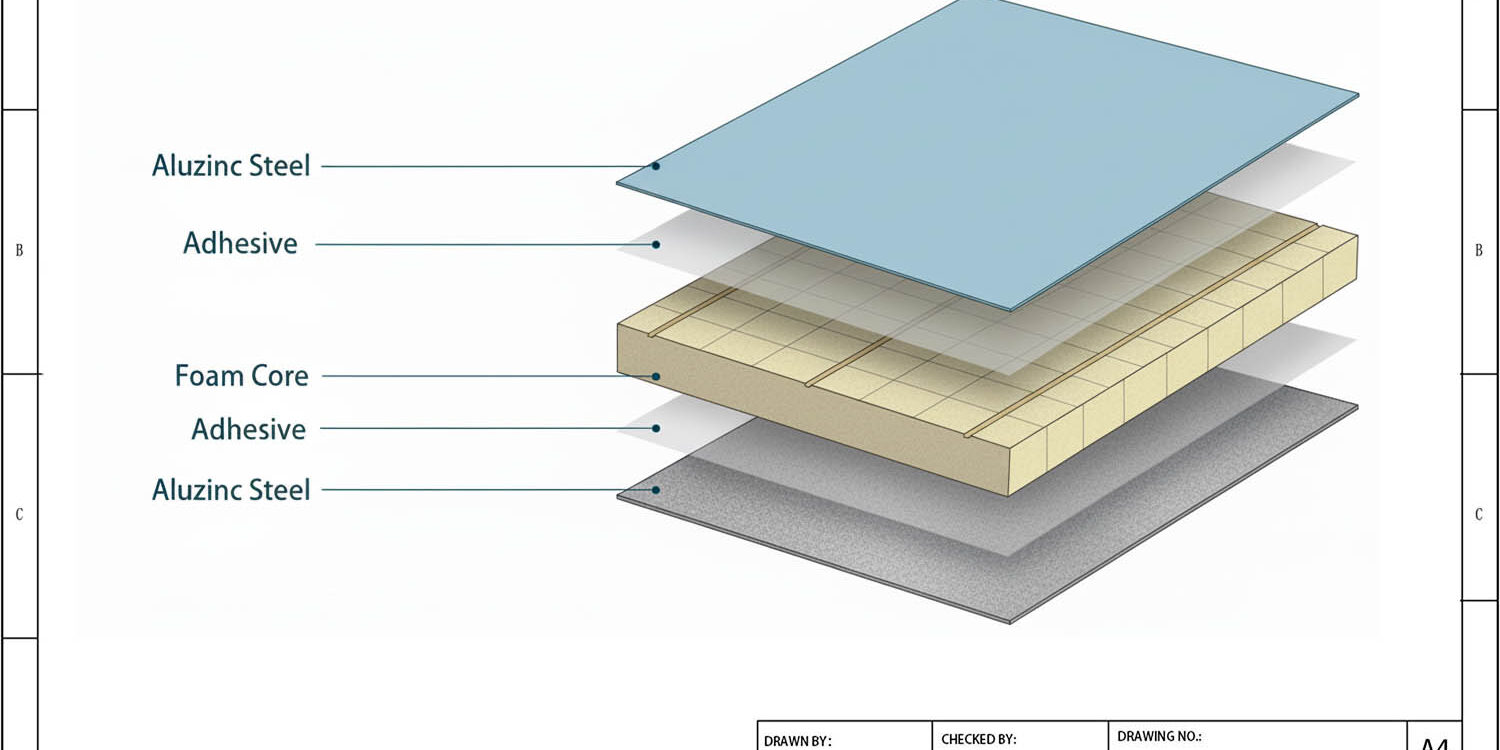
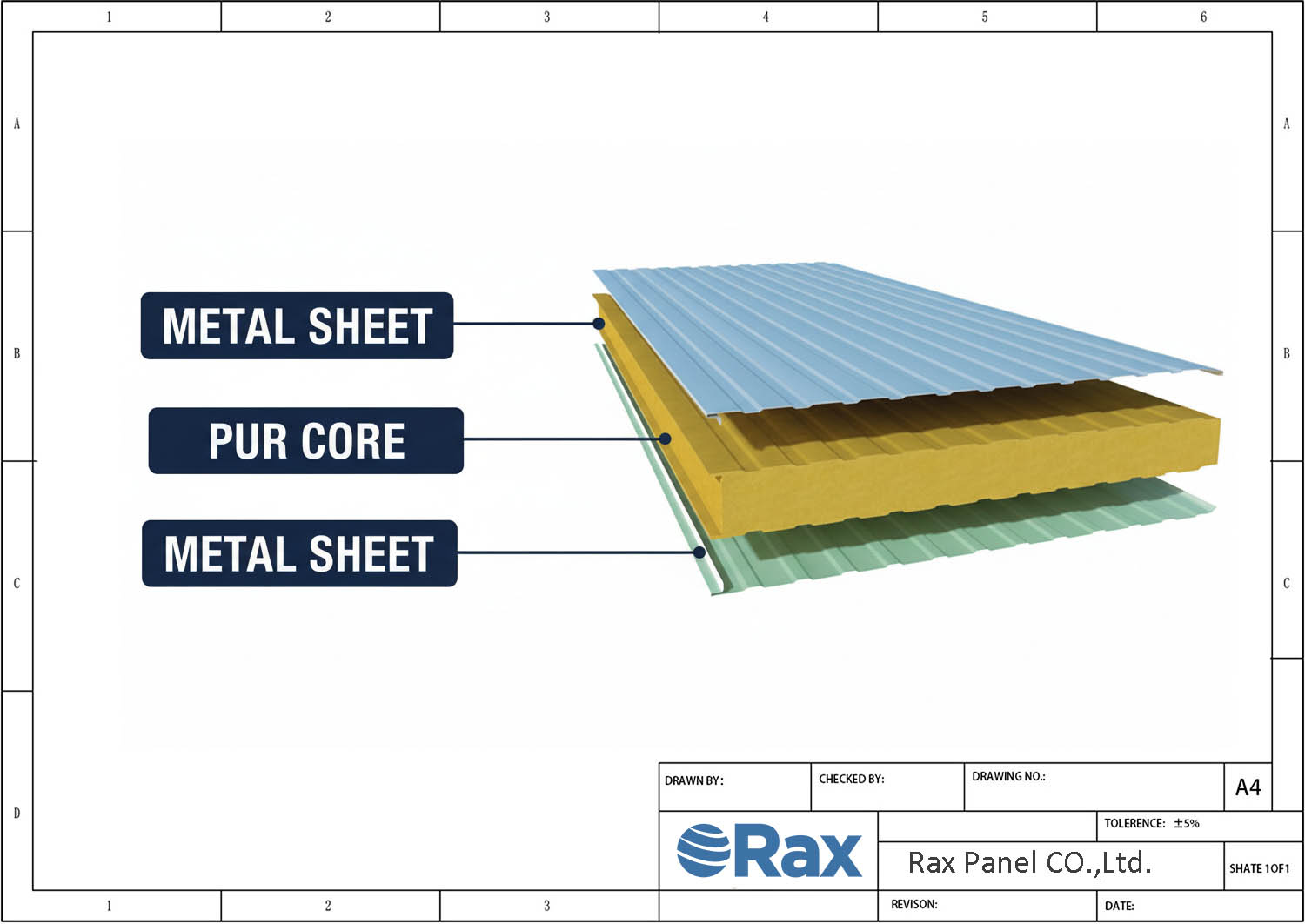
A sandwich panel works like an I-beam. The face sheets (also called skins or facings) act as the flanges, resisting bending stresses. The core acts as the web, holding the skins apart and transferring shear forces between them. Neither component works effectively on its own. The performance multiplier comes from the bond between them.
Face sheet selection determines surface durability, weather resistance, and aesthetic finish. Core selection determines structural and thermal behavior. Matching them correctly is where most specification errors occur. A high-modulus carbon fiber facing bonded to a low-density XPS foam core wastes the facing’s potential: the foam will crush or delaminate under load long before the carbon fiber reaches its limit.
At Rax Panel, we manufacture panels with the following facing and core combinations. This is not theoretical. These are configurations we produce daily on our 1,700+ square meter per day production line:
- GRP/FRP facings: Paired with XPS, PET, PU, or PVC foam cores, or with PP honeycomb. Standard for RV walls, refrigerated truck bodies, and marine applications. Gelcoat options provide waterproof, UV-resistant surfaces.
- CFRT facings: Continuous fiber reinforced thermoplastic sheets bonded to XPS, PET, PU, or PVC cores. Lighter and thinner than traditional FRP while maintaining impact resilience.
- Aluminum and Aluzinc facings: Combined with foam cores or aluminum honeycomb for building cladding, clean rooms, and architectural panels. Fire performance and flatness are key advantages.
- Stainless steel facings: Used with foam cores in hygiene-critical environments: food processing, pharmaceutical facilities, and medical applications where corrosion resistance is non-negotiable.
- Plywood facings: Bonded to foam cores for furniture panels, flooring substrates, and mobile home interiors where screw holding capacity matters.
The critical engineering decision is matching core density to facing stiffness. Our team runs experimental testing on custom configurations to verify that the adhesive bond, core shear strength, and facing tensile strength are balanced for the intended load case. This is not a catalog selection process. It requires actual test data under your specific conditions, which is why we invest in application-specific validation rather than offering generic material recommendations.
| Core Material | Category | Key Properties | Best Applications |
|---|---|---|---|
| XPS Foam | Foam Core | Waterproof, thermally insulated, lightweight | RV walls/roofing, truck bodies, building cladding |
| PET Foam | Foam Core | High strength-to-weight, eco-friendly, recyclable | Vessel panels, industrial equipment, public transit |
| PU (Polyurethane) Foam | Foam Core | Excellent thermal insulation, lightweight, versatile | Refrigerated truck bodies, cold storage, mobile homes |
| PVC Foam | Foam Core | Waterproof, corrosion resistant, thermally insulated | Marine applications, wet environments, vessel interiors |
| PMI Foam | Foam Core | Ultra-lightweight, high mechanical strength, heat resistant | Aviation, new energy, high-performance sports goods |
| PIR Foam | Foam Core | Superior fire resistance, low thermal conductivity | Commercial construction, fire-rated exterior walls |
| PUR Foam | Foam Core | Good thermal retention, seamless fill, cost-effective | Industrial facilities, temperature-sensitive structures |
| EPP Foam | Foam Core | Impact resistant, energy absorbing, recyclable | Automotive, sports products, packaging protection |
| PP Honeycomb | Honeycomb Core | Strong, lightweight, excellent compression resistance | Truck flooring, RV furniture, structural panels |
| Aramid Honeycomb | Honeycomb Core | Extreme strength-to-weight ratio, fire resistant | Aviation, defense, high-end transportation |
| PC Honeycomb | Honeycomb Core | Transparent options, impact resistant, lightweight | Architectural design, decorative panels, skylights |
| Fiberglass Honeycomb | Honeycomb Core | High stiffness, corrosion resistant, durable | Vessel solutions, chemical plants, outdoor structures |
Polystyrene Foam Fillings: EPS and XPS
EPS and XPS share a polystyrene chemistry but diverge sharply in moisture resistance, density, and thermal stability. Rax Panel supplies XPS as one of seven foam core options in its sandwich panel line alongside PET, PU, PVC, PMI, EPP, and MPP. EPS is covered here as an industry baseline for comparison.
Expanded Polystyrene (EPS) Properties
EPS is manufactured by expanding polystyrene beads with steam and fusing them inside a mold. The result is a closed-cell structure with tiny voids between the fused beads. This inter-bead space is what gives EPS its lower cost but also its Achilles’ heel: moisture ingress. Water can migrate through those bead boundaries over time, degrading thermal performance in high-humidity or below-grade installations.
Typical EPS density ranges from 15 to 30 kg/m³ for sandwich panel applications. Thermal conductivity sits between 0.033 and 0.038 W/(m·K), which is respectable but noticeably higher than denser foam alternatives. Compressive strength at 10% deformation generally falls in the 100 to 250 kPa range depending on grade.
For buyers evaluating total cost of ownership, EPS delivers adequate insulation for dry, temperature-controlled environments, but it is not the right choice where prolonged moisture exposure or heavy point loads are expected.
- Density range: 15–30 kg/m³
- Thermal conductivity: 0.033–0.038 W/(m·K)
- Compressive strength: 100–250 kPa at 10% deformation
- Water absorption: 2.0–4.0% by volume (significantly higher than XPS)
Extruded Polystyrene (XPS) Advantages
XPS is produced by extruding molten polystyrene through a die with a blowing agent, creating a fully continuous closed-cell structure with no inter-bead gaps. That single difference in manufacturing is what makes XPS a fundamentally tougher core material.
Water absorption drops to roughly 0.3% by volume, an order of magnitude lower than EPS. For refrigerated truck bodies, marine vessel panels, or exterior wall cladding systems exposed to weather, this moisture resistance translates directly into longer service life and more predictable R-values year over year.
Rax Panel engineers routinely specify XPS cores for GRP/FRP sandwich panels and CFRT sandwich panels because the material holds up under demanding conditions: cyclic temperature swings, sustained compressive loads from cargo or structural dead weight, and exposure to condensation inside wall assemblies. XPS density typically runs from 30 to 45 kg/m³, delivering compressive strength between 300 and 500 kPa, roughly double what standard EPS grades achieve.
- Density range: 30–45 kg/m³
- Thermal conductivity: 0.028–0.034 W/(m·K)
- Compressive strength: 300–500 kPa at 10% deformation
- Water absorption: ~0.3% by volume
EPS vs XPS: Cost and Performance Trade-offs
Raw material cost per cubic meter for EPS is typically 40–60% lower than XPS. That upfront gap looks attractive on a bill of materials, but procurement teams evaluating total cost of ownership need to factor in two things: thermal drift and replacement cycles.
EPS panels in moisture-prone installations can lose 15–30% of their initial R-value within five years as water penetrates the bead boundaries. XPS panels, by contrast, maintain over 90% of their original thermal performance over the same period in equivalent conditions.
For RV flooring and truck body panels where weight budgets are tight, the higher density of XPS actually works in your favor: a thinner XPS core can match or exceed the insulation value of a thicker EPS layer, recovering some of that raw material cost premium through reduced panel thickness and lower overall vehicle weight. Rax Panel’s engineering team works with buyers on a project-by-project basis to model exactly this kind of trade-off, pairing XPS cores with appropriate facing materials like GRP, aluminum, or CFRT skins to hit the target strength-to-weight and thermal specifications without over-engineering the laminate stack.
The practical recommendation is straightforward: if your application is interior-only, climate-controlled, and dry, EPS can serve adequately at lower cost. If your panels will face moisture, mechanical stress, or temperature cycling, XPS pays for itself across the product lifecycle. Rax Panel’s production line processes both core types with daily output exceeding 1,700 square meters, so lead times are not a differentiating factor between the two options.
Polyurethane and PIR Foam Core Fillings
While PUR remains the baseline for maximum thermal insulation in standard vehicle builds, PIR is the mandatory upgrade when strict fire safety compliance dictates material selection.
PUR Foam Filling Characteristics
Polyurethane (PUR) foam is a closed-cell thermoset polymer that serves as a highly effective core material for thermal insulation. In our production line, we frequently pair PUR cores with GRP/FRP or aluminum skins to manufacture sandwich panels for refrigerated truck bodies and RV solutions.
The primary advantage of PUR lies in its exceptionally low thermal conductivity, which directly minimizes energy loss during temperature-controlled transport. For international distributors, the high stiffness-to-weight ratio of PUR panels translates into lower shipping costs and easier on-site handling.
However, PUR does have limitations regarding high-temperature exposure. It performs optimally in standard insulation applications where extreme fire resistance is not the primary compliance metric. When evaluating PUR for mobile homes or truck bodies, buyers must weigh its superior insulation value against regional fire codes.
- Thermal Conductivity: Typically ranges between 0.022 and 0.028 W/m·K, offering excellent temperature retention.
- Dimensional Stability: High resistance to moisture absorption prevents structural warping in humid environments.
- Adhesion: Bonds aggressively to rigid facings like Aluzinc, stainless steel, and fiberglass sheets during the continuous lamination process.
PIR Foam Fire Resistance Benefits
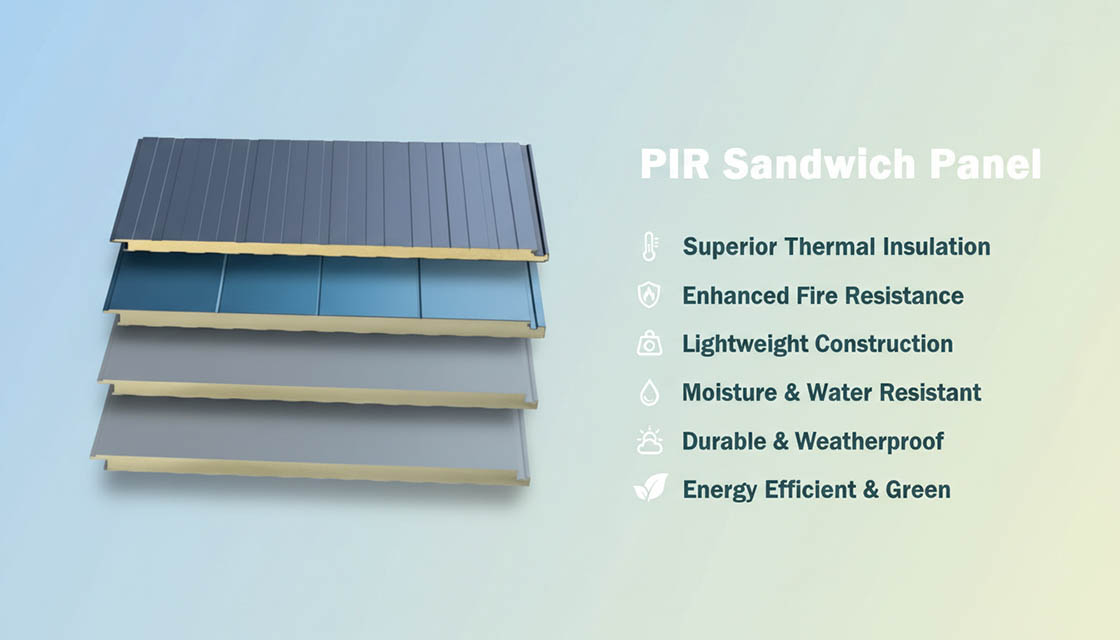
Polyisocyanurate (PIR) is an advanced structural modification of PUR foam, formulated specifically to withstand higher temperatures and resist combustion. When specifying sandwich panels for commercial construction or public transit, fire compliance is a non-negotiable hurdle. PIR cores achieve a higher Limiting Oxygen Index (LOI) and consistently meet stringent fire safety benchmarks, such as ASTM E84 Class 1 ratings and European EN 13501 standards.
Unlike standard PUR, which can melt and rapidly spread flame, PIR foam forms a protective carbonaceous char layer when exposed to fire. This char acts as a physical barrier that drastically slows heat penetration and limits the release of toxic smoke.
Our engineering team uses PIR cores for exterior wall cladding panels and specialized vehicle builds where rigorous fire ratings are strictly enforced. For procurement officers, specifying PIR foam sandwich panels ensures project compliance without sacrificing the lightweight structural properties required for modern modular construction.
Mineral Wool and Phenolic Foam Fillings
Rock wool and phenolic foam sit at opposite ends of the thermal-to-fire-performance spectrum. Selecting the wrong one forces costly re-engineering mid-project.
Rock Wool Core for Fire-Rated Panels
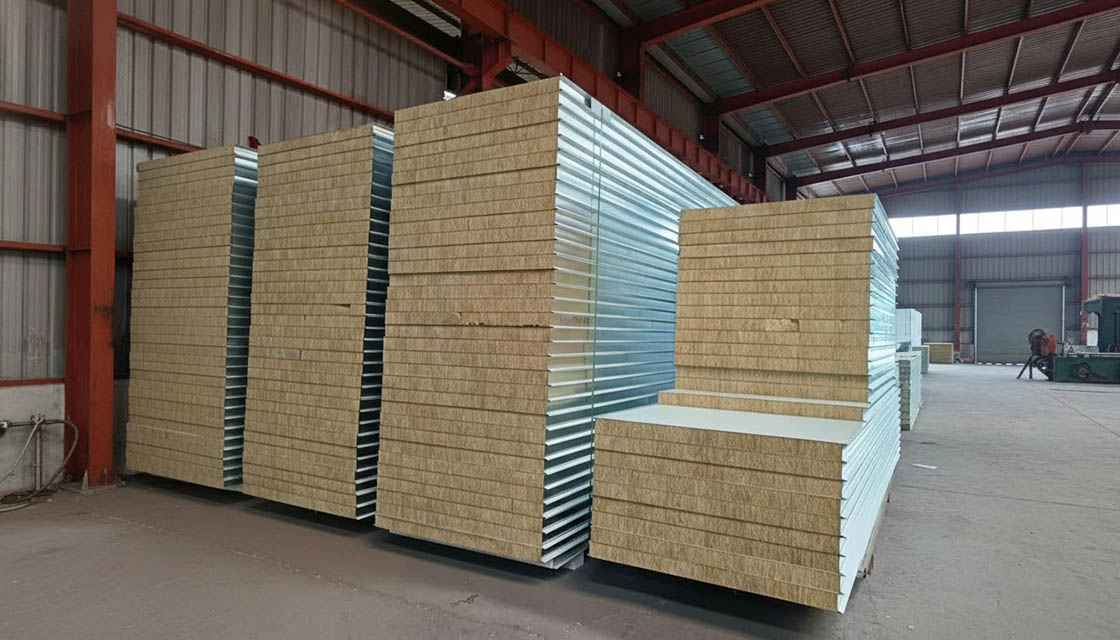
Rock wool, also called stone wool or mineral wool, is the only mainstream sandwich panel core material that achieves a true non-combustible classification. When your project specs demand a minimum A2-s1,d0 rating under EN 13501-1 or a Class 1/Class A designation under ASTM E84, rock wool is the core that gets you there without additional fire-retardant chemical treatments. It is spun from basalt rock at temperatures above 1,600°C, giving it an inherent melting point that no polymer foam can match.
For commercial construction procurement teams, the critical advantage is regulatory predictability. Rock wool sandwich panels consistently achieve fire resistance ratings of 60 to 120 minutes depending on panel thickness and joint design. This performance holds steady across density ranges of 80 to 200 kg/m³. Unlike some foam cores that degrade in fire resistance as the material ages or absorbs moisture, rock wool maintains its structural and fire properties throughout the building lifecycle.
The trade-off is weight. Rock wool panels carry a significantly higher density than foam or honeycomb alternatives, which impacts structural load calculations, handling labor, and freight costs. At Rax Panel, we manufacture Rockwool Sandwich Panels primarily for exterior wall cladding and building applications where fire compliance is non-negotiable and weight constraints are secondary. Our engineers customize the density and panel thickness to match the exact fire rating required, so buyers are not over-spending on unnecessary mass.
Phenolic Foam Thermal Insulation Properties
Phenolic foam occupies a unique position in the sandwich panel insulation hierarchy. It delivers thermal conductivity values between 0.018 and 0.025 W/m·K, placing it among the most thermally efficient rigid foam cores commercially available. For context, that performance matches or exceeds PUR and PIR foams while generating significantly less smoke and toxic gas when exposed to fire.
From a compliance standpoint, phenolic foam achieves a Class B fire rating under EN 13501-1 without the addition of halogenated flame retardants. This characteristic matters increasingly in European and North American markets where building codes are tightening restrictions on halogenated chemicals in occupied spaces.
Procurement teams evaluating phenolic foam for wall and roofing systems should verify that the facing materials, whether aluminum, steel, or GRP, are specified to match the core’s fire performance, as the weakest layer in the assembly determines the panel’s overall fire rating.
The primary limitation with phenolic foam is its mechanical brittleness compared to PUR, PIR, or PVC foam. It does not tolerate high dynamic loads or repeated impact well, making it unsuitable for truck body flooring or high-traffic industrial flooring without additional facing reinforcement. It performs best in static building envelope applications such as exterior walls, roofing systems, and cold storage facilities, where maximum thermal resistance and low smoke emission are the priority over structural load-bearing capacity.
Distributors sourcing sandwich panels for energy-efficient building projects should note that phenolic foam panels command a premium over standard PUR panels, typically 15 to 25 percent higher per square meter.
However, the superior thermal performance often allows specifiers to achieve the same insulation value with a thinner panel profile, which can offset material cost through reduced structural steel requirements, smaller foundation footprints, and lower shipping volume. The total cost of ownership calculation must account for these downstream savings rather than comparing raw material pricing alone.

Honeycomb and Structural Core Materials
Honeycomb and structural core materials dictate the mechanical ceiling of any sandwich panel. Selecting the wrong core inflates weight, drains margins, and guarantees field failures.
Aluminum Honeycomb Core Applications
Aluminum honeycomb delivers one of the highest strength-to-weight ratios available in structural composites. The hexagonal cell structure compresses and distributes load across a wide surface area, allowing panels to absorb significant impact energy without permanent deformation. This makes it the default core choice whenever structural rigidity is non-negotiable but weight budgets are tight.
At Rax Panel, we manufacture aluminum honeycomb panels and ACP honeycomb panels that serve demanding sectors. The primary applications fall into clear categories based on what the material physically does well:
- Transportation: RV wall systems, truck body panels, and public transit interiors where every kilogram saved translates to fuel efficiency over the vehicle lifecycle.
- Architectural Cladding: Exterior wall cladding panels and decorative facades requiring large flat spans that resist wind loads without bowing.
- Marine Vessels: Bulkheads and decking structures where corrosion resistance and weight reduction directly impact payload capacity.
- Industrial Equipment: Machine enclosures and platforms needing rigid, flat surfaces that withstand vibration.
Engineers often ask whether aluminum honeycomb or foam core is the better investment. The honest answer depends on what load profile the panel faces. Aluminum honeycomb excels under sheer and compressive forces. If thermal insulation is the primary requirement, foam cores such as PET or PUR outperform honeycomb. We supply both at Rax Panel, and our engineers run application-specific testing to determine which core geometry and density actually meets the performance data your project demands, rather than guessing.
Aramid Nomex Honeycomb Cores
Aramid honeycomb, widely recognized under the Nomex trade name, is a meta-aramid paper impregnated with phenolic resin and expanded into a honeycomb matrix. It exists for applications where aluminum cannot survive. The core offers exceptional fire resistance, low smoke emission, and strong dielectric properties. It does not conduct electricity, and it maintains structural integrity at elevated temperatures that would cause aluminum cells to creep and deform.
Rax Panel supplies aramid honeycomb as a standalone core material and as part of engineered sandwich panel assemblies. The critical use cases include:
- Aviation and Aerospace: Interior panels, floor assemblies, and control surfaces where fire certification compliance under standards like FAR 25.853 is mandatory.
- High-Speed Rail and Public Transit: Interior wall and ceiling panels requiring low smoke and toxic gas emission ratings.
- Racing and Performance Vehicles: Structural load floors and impact attenuators where every gram matters and crash energy absorption must be predictable.
Aramid honeycomb is not the cheapest core on the market. It commands a premium over both aluminum honeycomb and polymer foams. The justification is straightforward: when fire codes or weight limits eliminate every other option, aramid is what remains. Procurement teams evaluating this material should focus on total installed cost rather than raw material price per square meter. Lighter substructures, fewer mechanical fasteners, and compliance testing that passes on the first attempt often offset the initial premium.
Balsa Wood Core Use Cases
End-grain balsa remains one of the most effective structural core materials in composite manufacturing. The key is its construction: balsa blocks are cut across the grain direction, so the fibers run perpendicular to the panel faces. This orientation gives balsa exceptional compressive strength and shear properties that rival synthetic cores at a significantly lower material cost. It is a natural, renewable resource, which matters increasingly for projects tracking environmental sustainability metrics.
Rax Panel integrates balsa core options into our GRP panel line, including fiberglass balsa sandwich panels and balsa-cored solutions for marine and industrial applications. The material performs particularly well in these scenarios:
- Marine Hull and Deck Construction: Balsa bonds exceptionally well to polyester and vinyl ester resins, creating stiff, durable laminate structures. It handles dynamic loads from wave impact better than many foam alternatives.
- Wind Energy Blades: Shear webs and root sections of turbine blades rely on balsa for its proven fatigue resistance under cyclic loading.
- Industrial Flooring and Platforms: High foot-traffic and equipment-load areas benefit from balsa’s high compressive strength and screw retention.
- Bridge and Civil Infrastructure Repair: Lightweight decking panels for bridge rehabilitation where reducing dead load on aging structures is critical.
There is one limitation procurement teams must understand clearly. Balsa is a porous, natural material. If the panel facing is breached and water infiltrates the core, balsa can absorb moisture and eventually rot. This is why resin infusion quality and facing material selection matter as much as the core itself.
Our engineers at Rax Panel specify facing systems, whether GRP with gelcoat, aluminum, or stainless steel, based on the actual moisture and chemical exposure the panel will face in service. Specifying balsa without analyzing the full environmental profile of the installation is a mistake we actively help buyers avoid.
For distributors evaluating which core materials to stock, balsa offers a compelling margin position. It undercuts aramid and high-density PVC foams on price while delivering comparable or superior mechanical performance in dry-service conditions. The key is qualifying the right end-use applications and ensuring your customers understand the moisture management requirements before they specify it.
| Core Material | Type | Key Properties | Compatible Skins | Best For |
|---|---|---|---|---|
| PP Honeycomb | Honeycomb | Strong, lightweight, high strength-to-weight ratio | Fiberglass sheet, GRP/FRP, CFRT | RV walls, truck bodies, mobile homes, structural panels |
| Fiberglass Honeycomb | Honeycomb | High dimensional stability, structural rigidity | GRP/FRP, Aluminum, CFRT | Marine vessels, industrial equipment, aviation |
| Aramid Honeycomb | Honeycomb | Exceptional impact resistance, high-temperature tolerance | Carbon fiber, GRP/FRP, Aluminum | Aerospace, defense, high-performance sports equipment |
| PC Honeycomb | Honeycomb | Light transmission capability, lightweight | GRP/FRP, Thermoplastic sheets | Architectural daylighting, decorative panels |
| Thermoplastic Honeycomb | Honeycomb | Recyclable, thermoformable, consistent cell structure | CFRT, Thermoplastic UD tapes, GRP | Automotive, public transit, eco-friendly construction |
| Carbon Fiber Honeycomb | Honeycomb | Ultra-lightweight, maximum stiffness, premium performance | Carbon fiber sheets, GRP/FRP | Aviation, new energy vehicles, high-end sports goods |
| PMI Foam | Foam | Lowest density, high-temperature resistance, shear strength | GRP/FRP, CFRT, Carbon fiber | Aerospace, wind energy, precision industrial applications |
| PET Foam | Foam | Recyclable, good mechanical strength, waterproof | GRP/FRP, Aluminum, Steel, Plywood | Building construction, RV, truck bodies, marine |
| XPS Foam | Foam | Excellent thermal insulation, moisture resistant, waterproof | GRP/FRP, Aluminum, ACP, Plywood | Refrigerated trucks, cold storage, exterior wall cladding |
| PU Foam | Foam | Superior thermal insulation, lightweight, gap-filling capability | GRP/FRP, Steel, Stainless Steel, Aluzinc | PUR/PIR sandwich panels, building insulation, temperature-sensitive applications |
| PVC Foam | Foam | Fire resistant, waterproof, excellent chemical resistance | GRP/FRP, Aluminum, CFRT, PVC | Marine vessels, chemical plants, humid environments |
| Aluminum Honeycomb | Honeycomb | Fireproof, high compressive strength, flat surface support | Aluminum, ACP, Stainless Steel | Exterior wall cladding, clean rooms, high-fire-rating applications |
Filling Material Properties Comparison
Choosing between PET, PU, PVC, XPS, or honeycomb cores comes down to three hard numbers: thermal conductivity, fire classification, and compressive yield strength. Everything else is sales noise.
Thermal Insulation R-Value Benchmarks
Thermal performance in sandwich panel filling materials is measured by lambda value (λ), where lower means better insulation. At Rax Panel, our engineering team has run extensive internal testing across the core materials we produce in-house, covering PU, PIR, XPS, PET, PVC, PMI, and EPP foams, to give procurement teams data they can actually spec against.
The critical point that specifiers miss: thermal conductivity shifts with density, temperature, and long-term moisture exposure. A PU foam core rated at λ = 0.022 W/(m·K) in lab conditions at 10°C will not hold that number after five years in a humid coastal installation if the panel seal is compromised. This is precisely why we emphasize closed-cell foam structures for our RV and refrigerated truck solutions.
- PU Foam Core: λ ≈ 0.022–0.028 W/(m·K). Best overall thermal performer. Standard choice for refrigerated truck bodies and cold chain applications.
- PIR Foam Core: λ ≈ 0.020–0.026 W/(m·K). Slightly better than PU, with superior fire performance. Preferred for building cladding panels.
- XPS Foam Core: λ ≈ 0.028–0.035 W/(m·K). Excellent moisture resistance, making it reliable for below-grade or high-humidity environments.
- PET Foam Core: λ ≈ 0.030–0.040 W/(m·K). Moderate insulation, but offers high recyclability and consistent performance over time.
- PVC Foam Core: λ ≈ 0.030–0.038 W/(m·K). Balanced thermal and mechanical properties. Widely used in marine vessel applications.
- PMI Foam Core: λ ≈ 0.035–0.042 W/(m·K). Lower insulation value, but unmatched strength-to-weight for aerospace and high-load structural panels.
- PP Honeycomb Core: λ ≈ 0.050–0.080 W/(m·K). Not a primary insulator. Selected for structural lightweighting in flooring and truck body panels where insulation is handled separately.
For distributors quoting projects in Europe, note that compliance with EN 13163 for foam thermal performance is non-negotiable. Our production line consistently outputs panels tested against these standards before shipment.
Fire Resistance and Reaction Ratings
Fire compliance is where material selection gets expensive, and where getting it wrong gets dangerous. The core material you choose directly determines whether your panel assembly achieves the fire classification your client’s building code demands. At Rax Panel, we produce PIR panels, Rockwool-cored panels, and foam-core panels with specific fire-tested assemblies, and the performance gap between them is significant.
Let us be direct about the tradeoff. PU and PUR foams are thermoset materials that char but can emit smoke. PIR foam is the improved alternative: it forms a stable carbonaceous char layer when exposed to flame, significantly slowing fire spread. If the project requires EN 13501-1 B-s1,d0 classification or ASTM E84 Class A, you are looking at PIR, mineral wool (Rockwool), or specialized fire-retardant-treated foam cores, not standard PU.
- Rockwool Core: A1 non-combustible. The only option for strict fire-rated walls in hospitals, high-rises, and industrial facilities requiring zero combustion risk.
- PIR Foam Core: Typically achieves B-s1,d0 or C-s1,d0 under EN 13501-1. The go-to for commercial building cladding where fire performance matters but weight is also a concern.
- PUR/PU Foam Core: Typically achieves B or C classification with fire-retardant additives. Suitable for cold storage and refrigerated transport where codes permit.
- PET Foam Core: Inherently moderate fire reaction. Can achieve B classification with surface treatments. Often specified in transportation applications.
- PVC Foam Core: Self-extinguishing due to chlorine content. Achieves reasonable fire ratings but smoke density can be a concern in enclosed spaces.
- XPS Foam Core: Requires fire-retardant grades for most building applications. Standard grades are not suitable where fire compliance is mandated.
- PP Honeycomb Core: Thermoplastic. Will melt and ignite without fire-retardant treatment. Not suitable as a standalone fire barrier.
A critical note for international distributors: fire certification is region-specific. A panel that passes EN 13501 in Europe will not automatically satisfy ASTM E84 in North America or GB standards in China. Our engineering team configures each panel assembly’s core, facing material, and adhesive system to match the target market’s specific fire test protocol.
Compressive Strength and Load Capacity
Compressive strength determines whether your sandwich panel survives point loads, static weight, and long-term creep without delaminating or permanently deforming. For vehicle manufacturers building RV flooring or truck bodies, this metric is the deciding factor between a panel that lasts ten years and one that sags after two.
The facing material contributes to bending stiffness, but the core carries the shear and compressive loads. Our engineers at Rax Panel select core materials based on the application’s specific load profile. A refrigerated truck wall panel faces different mechanical demands than a marine vessel hull panel or a building facade panel.
- PMI Foam: Compressive strength up to 15 MPa depending on density. The premium structural foam. Used in aerospace and high-performance applications where weight must be minimized without sacrificing load capacity.
- PVC Foam (cross-linked): Compressive strength 2–8 MPa. The marine industry standard. Excellent fatigue resistance for hull and deck sandwich structures.
- PET Foam: Compressive strength 1.5–5 MPa. Good mechanical performance with the added benefit of being fully recyclable. Growing rapidly in European markets due to sustainability mandates.
- PU/PIR Foam: Compressive strength 0.10–0.30 MPa (standard densities). Sufficient for wall and roof panels in building and cold chain applications where loads are distributed.
- XPS Foam: Compressive strength 0.20–0.70 MPa. Better load capacity than PU at equivalent density, making it suitable for flooring sub-layers and flat roof applications.
- PP Honeycomb: Compressive strength 0.5–3.0 MPa depending on cell size and density. Exceptionally lightweight. When composited with fiberglass sheet as we produce at Rax Panel, the resulting panel delivers high strength-to-weight ratios for truck bodies and mobile home flooring.
- Aramid Honeycomb: Compressive strength up to 8 MPa. Extremely high shear strength. Reserved for defense, aerospace, and high-impact applications where cost is secondary to performance.
Here is the practical takeaway: do not overspec. If your application is a standard building wall panel, PIR or PU foam at 40 kg/m³ density handles the compressive loads at a fraction of the cost of PMI foam. Reserve premium cores like PMI and aramid honeycomb for applications where every kilogram of weight savings translates to measurable operational value: aviation, defense, high-performance marine, and competitive sports equipment.
Our recommendation for buyers evaluating sandwich panel filling materials: request the full test report, not just the datasheet highlights. We provide compressive strength data, thermal conductivity at multiple temperatures, and fire classification certificates for every core configuration we ship. That transparency is what separates a reliable long-term panel supplier from a commodity trader.
| Core Material | Density Range | Thermal Conductivity | Key Properties | Best Applications |
|---|---|---|---|---|
| XPS Foam | 30-45 kg/m³ | 0.028-0.035 W/mK | Waterproof, cost-effective, good insulation | RV walls, truck bodies, cold storage |
| PET Foam | 60-200 kg/m³ | 0.030-0.040 W/mK | Recyclable, high mechanical strength, eco-friendly | Marine, wind energy, public transit |
| PU/PUR Foam | 30-60 kg/m³ | 0.022-0.028 W/mK | Excellent insulation, lightweight, budget-friendly | Refrigerated trucks, mobile homes, building panels |
| PIR Foam | 30-50 kg/m³ | 0.020-0.026 W/mK | Superior fire resistance, low smoke emission | Commercial construction, industrial facilities |
| PVC Foam | 60-250 kg/m³ | 0.030-0.045 W/mK | High strength-to-weight, closed-cell, durable | Marine vessels, aerospace, sports equipment |
| PMI Foam | 32-300 kg/m³ | 0.020-0.035 W/mK | Ultra-light, highest specific strength, heat-resistant | Aviation, high-performance sports, medical |
| PP Honeycomb | 28-120 kg/m³ | 0.050-0.080 W/mK | Lightweight, high compression strength, recyclable | Truck flooring, RV furniture, packaging |
| Aramid Honeycomb | 29-130 kg/m³ | 0.045-0.070 W/mK | Exceptional fire resistance, high shear strength | Aviation interiors, rail transit, defense |
| Rockwool/Mineral Wool | 80-200 kg/m³ | 0.034-0.040 W/mK | Non-combustible A1 fire rating, sound absorption | Exterior wall cladding, fire-rated partitions |
| Aluminum Honeycomb | 30-130 kg/m³ | Variable by design | Rigid, flat surface support, corrosion-resistant | Architectural facades, clean rooms, elevators |
| EPP Foam | 20-80 kg/m³ | 0.030-0.040 W/mK | Energy-absorbing, reusable, impact-resistant | Automotive bumpers, packaging, sports gear |
| Balsa Wood | 100-250 kg/m³ | 0.040-0.055 W/mK | Natural, high compressive strength, sustainable | Marine hulls, wind turbine blades |
How to Choose the Right Core Material
There is no universal “best” core material. There is only the correct one for your specific load, thermal, fire, and budget requirements. Most selection failures happen when buyers treat core choice as a commodity tick-box rather than an engineering decision.
Application-Based Selection Framework
Selecting a sandwich panel core material starts with one question: what is the panel actually doing in service? A refrigerated truck body demands completely different thermal and structural performance than a marine vessel bulkhead or an exterior wall cladding system. When our engineering team evaluates a new project, we categorize the selection into four primary performance buckets: structural load, thermal insulation, moisture exposure, and weight constraints.
For specialized vehicle manufacturers, particularly in RV and truck body construction, the priority is almost always weight reduction without sacrificing stiffness. In these cases, we typically recommend XPS or PET foam cores paired with GRP/FRP facings. PU foam cores also perform well here, especially in refrigerated truck bodies where thermal conductivity below 0.025 W/(m·K) is non-negotiable. PP honeycomb cores paired with fiberglass sheet facings offer an excellent strength-to-weight ratio for dry freight truck bodies where insulation is less critical than structural rigidity.
For marine and vessel applications, moisture resistance and long-term durability take priority. PVC and PET foam cores paired with GRP facings are the standard choice. PVC foam in particular offers closed-cell structure that resists water absorption over years of service. In our experience producing vessel solutions, we have seen customers who initially opted for cheaper XPS cores face delamination issues within 3-5 years in high-humidity marine environments, making PVC or PET the pragmatic long-term choice despite the higher upfront cost.
- RV Walls and Roofing: XPS, PET, or PU foam cores with GRP/FRP or CFRT facings for lightweight insulation
- Refrigerated Truck Bodies: PU or PIR foam cores for superior thermal performance; XPS as a cost-sensitive alternative
- Marine Vessels: PVC or PET foam cores with GRP facings for moisture resistance and structural integrity
- Exterior Wall Cladding: Rockwool or PIR cores for fire compliance; aluminum honeycomb for architectural projects prioritizing aesthetics and flatness
- Industrial Equipment: PMI foam or aramid honeycomb for high-stiffness, low-weight structural panels
For commercial construction procurement teams, the decision matrix shifts heavily toward fire ratings, R-values, and compliance documentation. We cover that in the fire compliance section below. The key point here: do not select a core material in isolation. The facing material, whether GRP, aluminum, steel, ACP, or CFRT, interacts directly with the core to determine overall panel performance. Our engineers conduct experimental testing on each custom configuration to verify that the combined assembly meets the required data standards before mass production begins.
Cost and Availability Considerations
Cost discussions around core materials are often misleading because they focus on price per square meter rather than total cost of ownership. A PET foam core may cost 20-40% more than XPS upfront, but its superior dimensional stability and resistance to thermal degradation mean lower replacement and warranty costs over a 15-year service life. For international distributors managing margin across broad product catalogs, this distinction matters significantly.
From a supply chain perspective, availability varies widely by core type and region. XPS and PU foams are commodity products with stable global supply chains and short lead times. PMI foam and aramid honeycomb, by contrast, have narrower supplier bases and longer procurement cycles, often 4-8 weeks depending on specification.
At Rax Panel, we mitigate this for customers by maintaining a diverse core material inventory that includes PMI foam, XPS foam, PET foam, PU foam, PVC foam, PP honeycomb, aramid honeycomb, and PC honeycomb. Our daily production capacity exceeds 1,700 square meters, which gives us the throughput to handle bulk orders without the 6-8 week delays smaller fabricators often face.
- XPS Foam: Low-cost, widely available; best for budget-sensitive projects where thermal performance requirements are moderate
- PET Foam: Mid-range pricing; excellent recyclability and dimensional stability; growing availability globally
- PU Foam: Mid-range pricing; superior thermal insulation; standard choice for cold chain and refrigerated transport
- PIR Foam: Higher cost than PU; significantly better fire performance; increasingly required in commercial building applications
- PVC Foam: Premium pricing; best-in-class moisture resistance; standard for marine applications
- PP Honeycomb: Cost-effective structural core; minimal insulation value; ideal where stiffness-to-weight is the primary driver
- PMI Foam: Premium pricing; highest mechanical performance among foam cores; aerospace and high-performance applications
For distributors and wholesalers evaluating cost-effectiveness across a product range, we recommend building a tiered offering: XPS-based panels as an entry-level option, PET or PU panels as the mid-range workhorse, and PVC or PMI panels for premium applications. This approach covers the widest customer base while keeping inventory complexity manageable. Our engineering team works directly with wholesale partners to define these product tiers based on their specific regional market demands.
Building Code and Fire Compliance
Fire compliance is the area where we see the most costly specification errors. A panel that performs perfectly in thermal and structural testing becomes a liability if it fails to meet the fire rating required by the building code of its destination market. Fire standards are not interchangeable: EN 13501-1 in Europe, ASTM E84 in North America, and GB standards in China each have different test methods, classifications, and acceptable thresholds for the same material.
The core material is the single largest factor in fire performance. PIR foam achieves a B-s1,d0 classification under EN 13501-1 and a Class 1 rating under BS 476 Part 7 in typical sandwich panel configurations.
PUR foam, by contrast, typically achieves C-s2,d0 at best and often requires additional fire retardant additives to reach that level. This distinction is critical for commercial construction procurement teams specifying panels for buildings requiring fire-rated construction. The PIR vs PUR decision is not just about marginal cost difference. It determines whether your project passes inspection.
For applications demanding the highest fire resistance, such as industrial facility partitions, public transit enclosures, or exterior wall cladding in dense urban areas, Rockwool (mineral wool) cores are the definitive choice. Rockwool is non-combustible, achieving A1 or A2 classification under EN 13501-1 without any additional treatment. The trade-off is weight: Rockwool core panels are significantly heavier than foam-core alternatives, which increases structural load and installation labor costs.
Our recommendation for procurement teams: define the fire classification requirement before selecting any other material property. This is a hard constraint, not an optimization variable. Once the fire rating is fixed, the viable core materials narrow significantly, and the cost-weight-insulation trade-offs become much easier to evaluate.
At Rax Panel, we provide fire test data and certification documentation for all panel configurations we produce, including PIR sandwich panels, Rockwool sandwich panels, and PUR sandwich panels, so that our customers have verifiable compliance records for their projects across European, North American, and Asian markets.
| Core Material | Category | Key Properties | Best Applications | Selection Tip |
|---|---|---|---|---|
| XPS Foam | Thermoplastic Foam | Lightweight, waterproof, excellent thermal insulation, cost-effective | Building walls, truck bodies, RV flooring & roofing | Ideal for budget-conscious projects needing reliable insulation |
| PET Foam | Thermoplastic Foam | High strength-to-weight ratio, recyclable, good thermal stability | Marine vessels, RV panels, aerospace, wind energy | Best eco-friendly choice for sustainability-focused buyers |
| PU / PUR Foam | Thermoset Foam | Superior thermal insulation, fills gaps evenly, moderate fire resistance | Refrigerated truck bodies, cold storage, mobile homes | Optimal for temperature-sensitive transport and storage |
| PIR Foam | Thermoset Foam | Enhanced fire resistance vs PUR, low thermal conductivity, dimensionally stable | Fire-rated commercial buildings, industrial facilities, exterior cladding | Choose for stricter fire safety compliance (EN 13501, ASTM E84) |
| PVC Foam | Thermoplastic Foam | Closed-cell structure, waterproof, rot-proof, excellent chemical resistance | Marine hulls, vessel interiors, chemical-resistant environments | Preferred for harsh moisture and corrosion-prone conditions |
| PMI Foam | High-Performance Foam | Highest specific strength among foams, heat-resistant, ultra-lightweight | Aerospace, high-performance sports equipment, precision industrial | Premium option when weight reduction is mission-critical |
| PP Honeycomb | Honeycomb Core | Extremely lightweight, high compressive strength, excellent strength-to-weight | Truck bodies, mobile homes, RV furniture panels, public transit | Best strength-to-weight ratio for vehicle weight reduction |
| Aramid Honeycomb | Honeycomb Core | Exceptional shear strength, fire-resistant, fatigue-resistant | Aerospace interiors, defense, high-end marine applications | For demanding applications requiring peak mechanical performance |
| Rockwool / Mineral Wool | Inorganic Fiber | Non-combustible (A1 fire rating), superior sound absorption, fireproof | Fire-rated walls, industrial facilities, exterior cladding systems | Essential where maximum fire protection and acoustic control are required |
| Balsa Wood | Natural Core | High compressive strength, renewable resource, excellent fatigue resistance | Marine composites, wind turbine blades, structural panels | Sustainable bio-based option with proven structural performance |
| EPP Foam | Thermoplastic Foam | Energy-absorbing, reusable, recyclable, impact-resistant | Automotive components, packaging, sports equipment protection | Ideal when repeated impact absorption and energy recovery matter |
| PC Honeycomb | Honeycomb Core | Transparent options available, UV-stable, high impact resistance | Architectural daylighting, protective barriers, decorative panels | Unique choice for projects requiring light transmission with structural support |
Conclusion
If you’re stocking panels for general construction and transport applications, lead with PET foam cores. They hit the sweet spot between compression strength, thermal performance, and cost. And unlike PU, PET resists thermal degradation after years of hot-cold cycling. PP honeycomb cores shave 15-20% off panel weight, but that premium only makes sense in marine and RV builds where every kilogram determines your fuel bill.
Before committing to a bulk order, request thermal conductivity test reports and fire certification documents for your exact core and skin combination. Any manufacturer worth partnering with ships that data within 48 hours. If they hedge, move on. Get two 300mm sample panels with different cores and run your own side-by-side fire test; your eyes will tell you more than any spec sheet ever will.
Frequently Asked Questions
What materials are used for sandwich panel face sheets?
The outer face sheets are typically manufactured using strong and lightweight materials such as fiberglass, carbon fiber, or aluminum.
What adhesives bond the core and face sheets together?
Common adhesives used to bond sandwich panels include epoxy resin, polyurethane adhesive, and structural adhesives designed for high durability.
What are common industrial applications for sandwich panels?
Sandwich panels are widely utilized in building construction, transportation (aerospace, automotive, marine), and furniture manufacturing due to their structural and insulating properties.
How much does materials used filling typically cost?
The cost of materials used filling varies based on material grade, thickness, panel dimensions, and order volume. Requesting a detailed quote with your project specifications is the most reliable way to get an accurate figure. Bulk orders typically reduce per-unit pricing significantly.
What factors affect the price of materials used filling?
The cost of materials used filling varies based on material grade, thickness, panel dimensions, and order volume. Requesting a detailed quote with your project specifications is the most reliable way to get an accurate figure. Bulk orders typically reduce per-unit pricing significantly.