
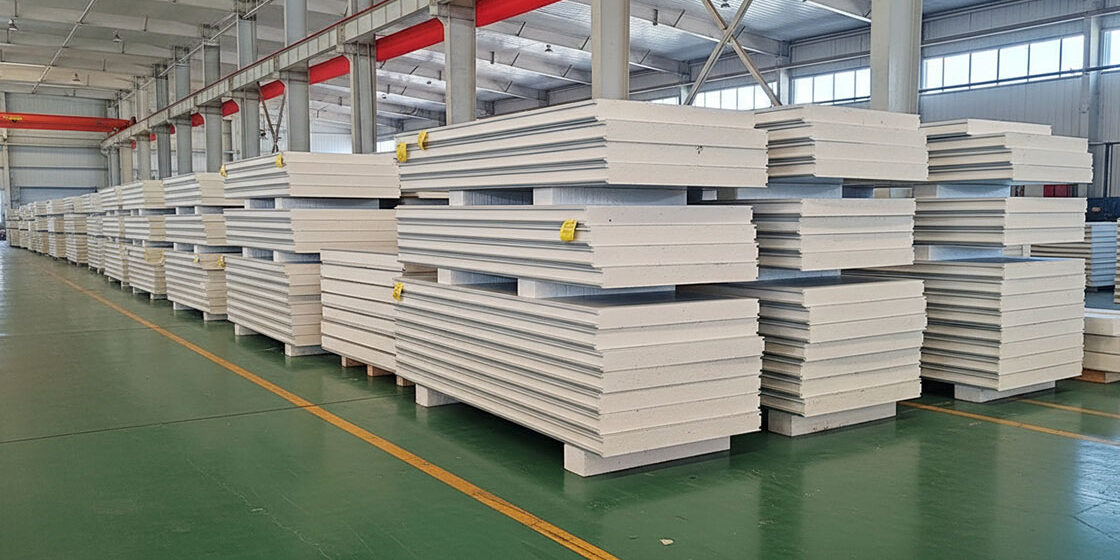
Operational margins in cold chain logistics are being eroded by the hidden costs of thermal bridging and uncontrolled condensation, turning standard building envelopes into liabilities. A custom insulated metal panel manufacturer like Rax Panel addresses this by engineering continuous insulation systems that eliminate the structural gaps inherent in traditional stick-built walls. The difference is not just theoretical; it is measured in the stability of your inventory and the predictability of your energy spend.
You will learn to quantify the return on investment for high-performance panel systems, understanding how initial capital expenditure translates into lower operational overhead and extended facility longevity. This is not a sales pitch for generic cladding, but a technical breakdown for planners who need to justify capital allocation based on measurable efficiency gains.
Why IMPs Outperform Traditional Cold Chain Envelopes
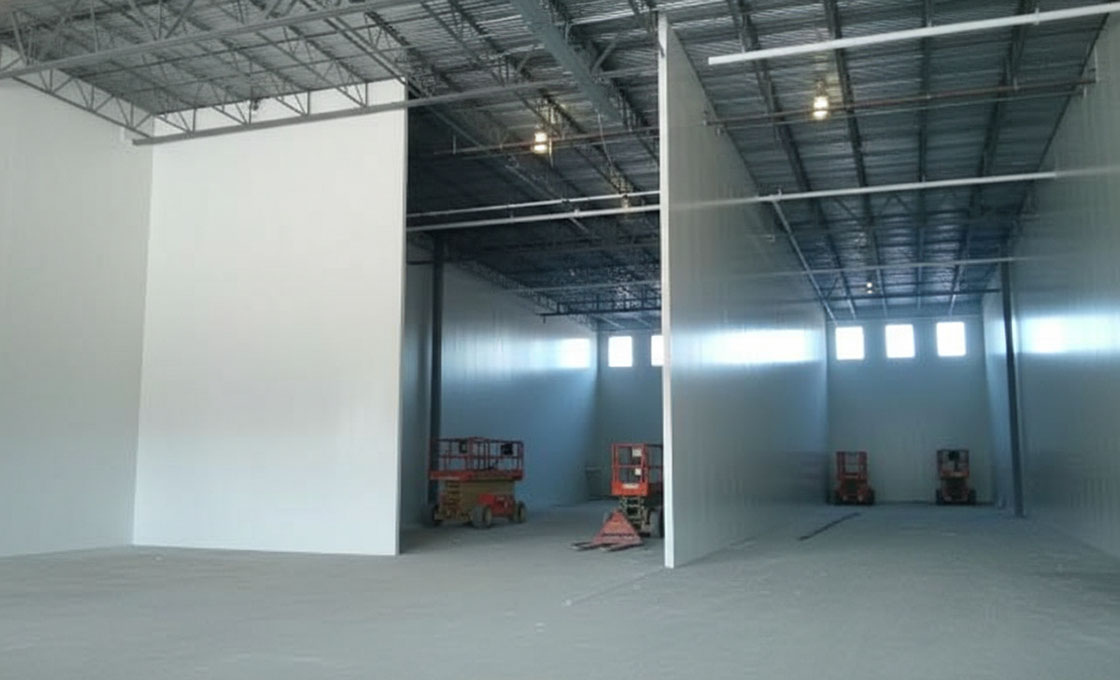
Continuous IMP systems remove structural heat leaks, tighten air barriers, and integrate vapor control, allowing for smaller, more efficient refrigeration equipment.
Eliminating Thermal Bridging in Continuous vs. Stick-Built Systems
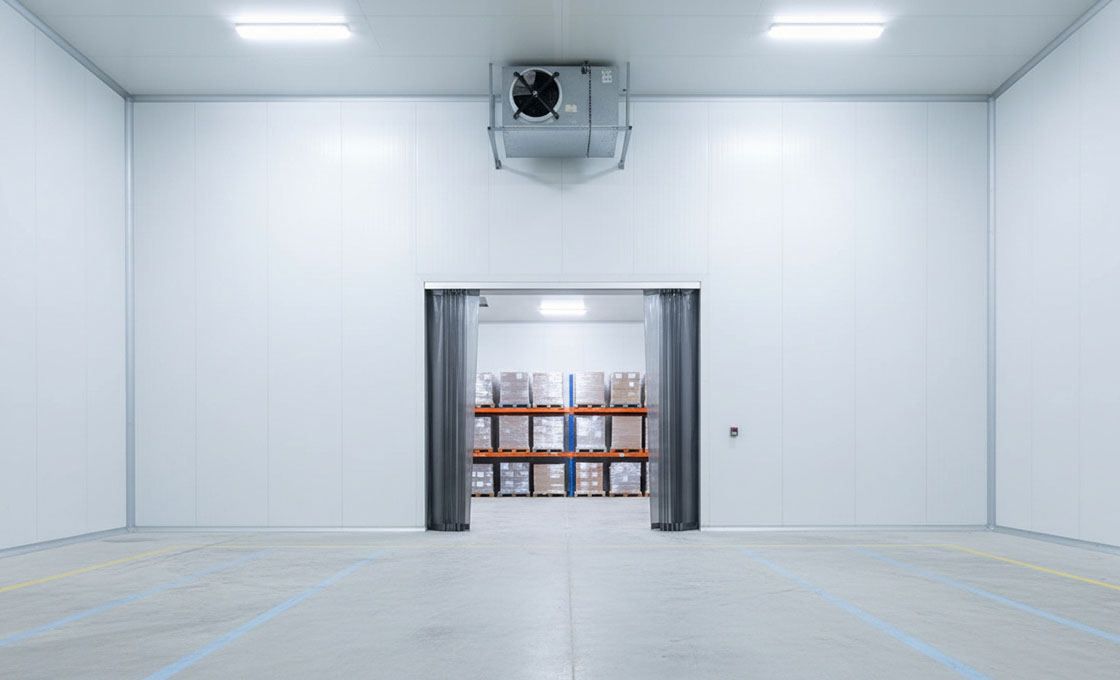
Stick-built cold storage relies on vertical steel studs spaced 24 inches apart. These studs act as thermal bridges, conducting outside heat directly into the frozen core and creating localized spots where ice forms. This structural weakness forces operators to over-insulate to compensate for the dead zones created by the framing.
In contrast, our continuous Insulated Metal Panel (IMP) systems integrate the structural facing, insulation, and vapor barrier into a single monolithic unit. We utilize tongue-and-groove connections on our panels to achieve perfect alignment. This design eliminates the gaps that allow air and heat to bypass the insulation layer.
By removing the need for separate sub-framing, we ensure there are no metallic pathways for heat transfer. This results in a truly continuous thermal envelope that maintains consistent temperatures across the entire wall surface.
Impact of Airtight Sealing on Refrigeration Equipment Sizing
Air leakage is the primary driver of excess load in cold chain facilities. When unconditioned outdoor air infiltrates the cold room, the refrigeration system must work overtime to remove the latent heat and moisture. This unnecessary strain inflates energy consumption and accelerates wear on compressors.
A tightly sealed IMP envelope drastically reduces this infiltration. Because our panels provide a unified air barrier, the refrigeration load drops significantly. This allows facility planners to downsize the mechanical equipment. Instead of installing massive, expensive units to handle unpredictable leaks, you can deploy smaller, highly efficient compressors tailored to the exact thermal load.
This optimization reduces both the upfront capital expenditure on machinery and the ongoing operational costs associated with running oversized equipment.
Reducing Condensation Risks with Integrated Vapor Barriers
Condensation occurs when warm, humid air penetrates the building envelope and freezes upon contact with cold surfaces. In traditional construction, separating the vapor barrier from the insulation creates vulnerable seams where moisture can sneak in. Once inside the wall cavity, this moisture degrades the insulation and causes structural rot.
Our engineered solutions address this by integrating the vapor barrier directly into the panel assembly. We position the vapor control layer on the warm side of the insulation to block moisture ingress at the source. This continuous protection prevents frost accumulation and maintains the integrity of the insulation’s R-value over decades of operation.
Core Material Selection: PIR vs. EPS for Cold Storage
How to Choose PIR over EPS for cold storage comes down to thermodynamic stability at sub-zero levels, permanent moisture rejection, and strict fire compliance. EPS simply degrades under these exact operational conditions.
Thermal Conductivity Differences at Sub-Zero Temperatures
When temperatures drop below freezing, the physical chemistry of your insulation core dictates facility performance. EPS relies on expanded polystyrene beads fused together. In deep freeze scenarios, these bead boundaries create micro-gaps that allow subtle air infiltration and convective looping, which drives down the effective thermal resistance. PIR utilizes an advanced polymer chemistry that creates a continuous, rigid cellular matrix. This thermoset structure remains entirely stable even at extreme negative temperatures, locking the insulating gases permanently in place.
Through 15 years of manufacturing and testing insulated panels, our engineering team consistently observes that PIR formulations maintain their exact engineered thermal resistance over decades of deep-cold cycling. This stability allows developers to specify thinner panel profiles while achieving the same thermal envelope as much thicker EPS alternatives, directly maximizing the usable internal cubic volume of a freezer room.
Moisture Resistance and Long-Term R-Value Retention
The long-term success of a cold storage facility relies entirely on the core’s ability to battle vapor drive. Warm, humid air constantly pushes toward the cold interior. Because EPS beads feature interstitial voids, the material acts like a slow sponge over time. Once moisture penetrates an EPS core, it freezes, expands, and physically tears the insulation apart. This thermal degradation forces compressors to work harder to maintain temperature setpoints, silently inflating energy bills.
Fire Safety Ratings and Compliance for Food-Grade Environments
Commercial cold storage and food processing plants face strict regulatory scrutiny and high property insurance premiums due to the high concentration of electrical and refrigeration equipment. EPS is fundamentally a combustible thermoplastic.
When exposed to a fire event, it melts, drips, and can rapidly contribute to flame spread, often leading to failed commercial inspections or denied insurance coverage. PIR is a thermoset material. When exposed to high heat, it chars rather than melts, forming a protective carbonaceous layer that actively resists flame propagation and structural compromise.
Our engineering team routinely custom-manufactures PIR panels specifically to pass rigorous international fire safety protocols for global export. By upgrading to a PIR core, architects and procurement managers immediately satisfy the stringent building codes required for modern food-grade facilities, effectively eliminating the liability and compliance roadblocks associated with combustible foam plastics.
Lifecycle Cost Analysis: Energy Savings Over 20 Years
Final numbers depend on material grade, panel thickness, order volume, and freight distance. A line-item quotation that separates material, fabrication, and logistics makes comparison straightforward.
Quantifying Reduced HVAC Runtime and Peak Demand Charges
Refrigeration systems account for the majority of operating expenses in cold chain logistics. The continuous thermal envelope provided by Insulated Metal Panels (IMPs) eliminates the thermal bridging inherent in traditional stick-built construction. This structural difference significantly reduces the heat load transferred into the facility.
Reduced heat load allows compressors to cycle off more frequently. This directly lowers the annual kilowatt-hours consumed. Furthermore, minimizing compressor run-time helps avoid peak demand charges levied by utility providers during high-load periods.
Initial Premium Against Operational Expenditure (OpEx): Which Should You Choose?
IMP systems typically carry a 10-20% higher upfront material cost compared to traditional stick-built assemblies with batt insulation. However, this premium is recovered through dramatically lower operational expenses. The continuous thermal envelope reduces refrigeration energy consumption by 25-40% annually, depending on climate zone and temperature setpoint.
Over a 20-year facility life, the cumulative energy savings far exceed the initial material premium. Facility planners who evaluate only first cost miss the larger financial picture: the true expense of a cold storage building is dominated by decades of compressor runtime, not the one-time envelope investment.
Impact of Insulation Thickness on Facility Footprint and Rentable Space
Maximizing rentable square footage is critical for logistics operators paying for storage capacity. Thicker insulation panels provide higher thermal resistance in a smaller physical profile compared to traditional multi-layer wall systems. This efficiency translates directly into more usable interior space.
By using high-performance cores like PIR or PMI, engineers can achieve required U-values with thinner walls. This preserves valuable cubic footage for pallet storage. In large-scale facilities, even a marginal increase in interior dimensions can represent millions of dollars in additional revenue potential.
Maintenance Reduction and Facility Longevity
High-grade facings and hygienic surfaces minimize routine cleaning needs and prevent structural degradation, extending facility lifespan.
Corrosion Resistance of Coated Metal Facings
Humid environments and frequent washdowns accelerate the degradation of standard construction materials. Without proper protection, unprotected steel or inferior coatings succumb to rust, compromising the structural integrity of the cold storage facility. This corrosion leads to unsightly staining, potential contamination risks, and eventual panel failure.
To mitigate this, we utilize high-performance aluminum, galvanized steel, or stainless steel facings. Aluminum naturally resists oxidation, while coated steels feature strong polymer finishes that repel moisture and corrosive agents. In our factory, these materials undergo rigorous testing to ensure they withstand high-humidity conditions without peeling or blistering.
How to Reduce Repair Costs from Frost Heave
Frost heave occurs when water in the soil beneath a facility freezes and expands, lifting the floor unevenly. This structural shift can crack rigid concrete slabs and displace wall panels, leading to costly repairs and dangerous gaps in the thermal envelope. For cold storage operators, even minor structural misalignment can compromise the airtight seal, forcing refrigeration units to work overtime.
Composite panels, particularly those with foam cores like XPS or PET, offer superior dimensional stability compared to traditional materials. These cores are closed-cell structures that resist water absorption, meaning they do not swell or degrade when exposed to ground moisture. This resistance prevents the panel itself from contributing to structural instability, even if the underlying foundation experiences minor shifts.
Ease of Cleaning and Sanitation for FDA Compliance
In food-grade cold storage and pharmaceutical facilities, sanitation is not just a requirement; it is a daily operational reality. Rough or porous surfaces harbor bacteria and biofilm, making them impossible to clean effectively. This leads to frequent regulatory violations, product recalls, and extensive downtime for deep-cleaning procedures.
Our composite panels provide a non-porous, smooth surface that is ideal for hygiene-critical environments. The gel-coated finishes and smooth metal facings allow for rapid wiping and effective sanitization with harsh chemicals without damaging the panel. This ease of maintenance reduces the labor hours required for cleaning and ensures consistent compliance with FDA and HACCP standards.
Construction Speed and Operational Continuity
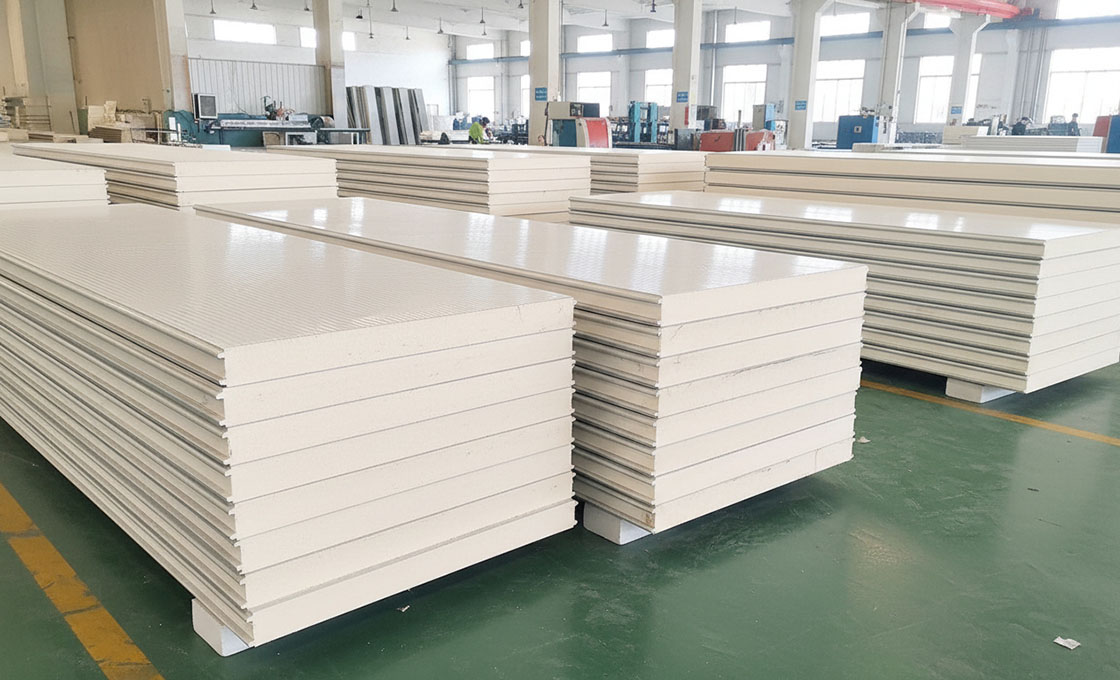
Prefabricated insulated metal panels (IMPs) replace labor-intensive field assembly with rapid mechanical fastening, cutting enclosure times by up to 50% and allowing immediate refrigeration system commissioning.
Prefabricated Panel Installation vs. On-Site Stick Framing Labor
Traditional cold storage stick framing relies heavily on field-assembled girts, batt insulation, and separate vapor barriers. This multi-trade sequence is highly vulnerable to weather delays, labor shortages, and inconsistent workmanship that can compromise the thermal envelope. Conversely, prefabricated IMPs arrive on-site cut to exact CAD specifications, ready for immediate mechanical placement.
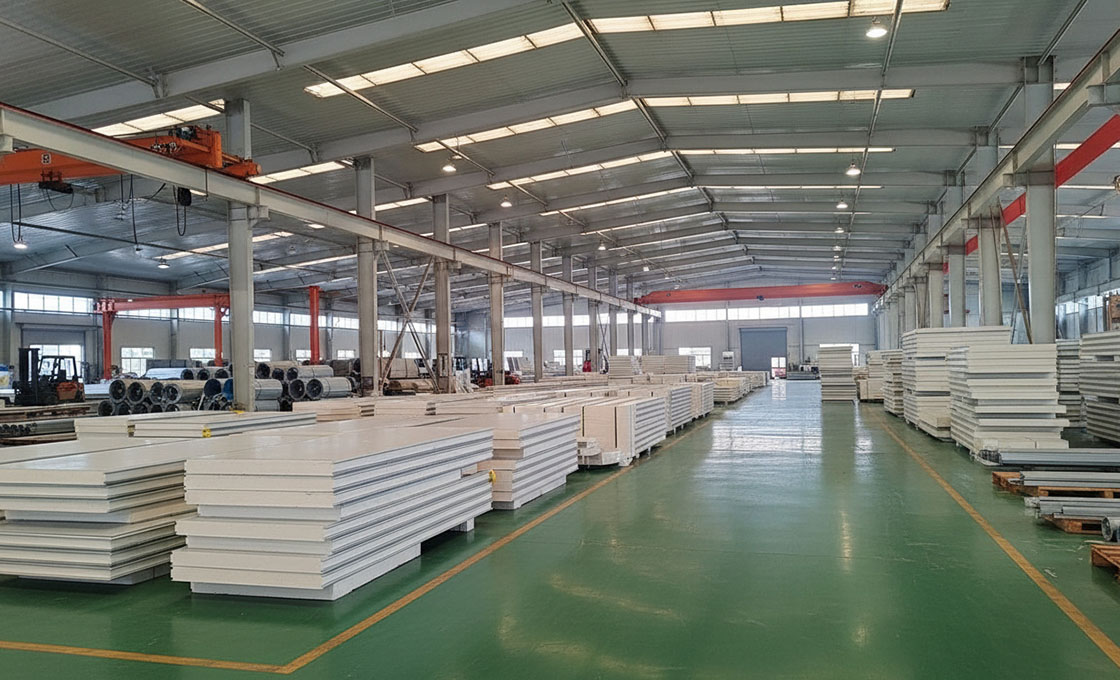
By using a single-step installation process, one crew can erect the walls and roof while simultaneously establishing the thermal barrier, vapor retarder, and interior finish. This interlocking process eliminates the lengthy curing times of adhesives and mastics used in conventional builds. Our facility maintains a production output exceeding 1,700 square meters daily, allowing us to match exactly the pace of aggressive contractors and prevent job-site bottlenecks.
Reducing Downtime During Retrofits of Aging Cold Storage Facilities
Aging refrigerated warehouses frequently suffer from degraded insulation and thermal bridging, forcing operators into a difficult choice: absorb rising energy costs or halt operations entirely for structural upgrades. Retrofitting with modular IMPs offers a practical path to restore envelope performance without completely shutting down the facility.
Because IMPs are modular, operators can execute phased retrofits. Contractors can strip compromised walls and install new panels in targeted zones, maintaining critical temperature controls in adjacent rooms. The rapid fastening allows a wall section to be upgraded over a single weekend shift, drastically minimizing operational disruption. We custom-engineer panel edge details to integrate smoothly with existing structural geometries, ensuring airtight transitions between the old envelope and the upgraded sections.
Accelerated Project Timelines for Speculative Development Projects
The rapid growth of e-commerce and global demand for fresh goods has created a severe supply-demand gap in modern cold storage infrastructure. Developers building speculatively need to bring facilities to market in record time to capture peak lease rates. IMP systems are the primary catalyst for these accelerated project schedules.
By consolidating the building envelope and interior finishes into a single component, developers bypass the multi-week delays associated with traditional masonry or multi-layered metal framing. Speculative buildings can achieve a dried-in, weather-tight envelope in a fraction of the time, allowing mechanical contractors to begin installing refrigeration units immediately. We support these high-speed developments by providing dedicated 24/7 international coordination, ensuring that material deliveries are synchronized exactly with the contractor’s installation phases to maintain continuous momentum.
Total Cost of Ownership Modeling for Procurement
Final numbers depend on material grade, panel thickness, order volume, and freight distance. A line-item quotation that separates material, fabrication, and logistics makes comparison straightforward.
Integrating Energy, Maintenance, and Replacement Costs into TCO
Maintenance and replacement costs present another critical variable in the TCO equation. Legacy construction methods using loose-fill insulation and separate vapor barriers are prone to settling and moisture intrusion. This leads to corrosion of metal facings and structural degradation, necessitating expensive repairs. In contrast, factory-bonded composite panels offer superior durability and resistance to the harsh, humid environments of cold storage. By factoring in the extended replacement cycle of strong IMPs, project owners can demonstrate substantial savings in facility management budgets.
Justifying Capital Expenditure with Measurable ROI Metrics
To build a compelling business case, compare the annual energy cost per square meter of envelope area between an IMP system and a conventional assembly. Factor in the reduced mechanical equipment sizing (smaller compressors and condensers), lower maintenance frequency, and extended replacement intervals. Most IMP installations in cold storage applications reach payback within 4-7 years through energy savings alone.
Additional ROI drivers include reduced insurance premiums due to fire-rated PIR cores, fewer regulatory compliance costs from smooth hygienic surfaces, and higher residual building value at the end of the asset life. These secondary benefits accelerate the return timeline beyond what a simple energy calculation suggests.
Aligning IMP Investment with Corporate Sustainability Goals
Modern procurement strategies are increasingly tied to Environmental, Social, and Governance (ESG) objectives. The choice of building envelope directly impacts a company’s carbon footprint. High-performance IMPs contribute to sustainability by minimizing operational energy use throughout the facility’s life cycle. Additionally, materials such as PMI foam cores offer high strength-to-weight ratios, reducing the overall material mass and transportation emissions associated with construction.
Procurement teams can use these technical advantages to meet corporate green building certifications. By specifying materials that eliminate thermal bridging and maintain consistent internal temperatures, organizations can significantly reduce greenhouse gas emissions. This alignment with sustainability goals not only satisfies regulatory requirements but also enhances brand reputation among environmentally conscious stakeholders and clients.
How IMPs Optimize Refrigeration System Efficiency
This factor has a direct bearing on project performance and long-term cost. Addressing it with specific data rather than general assumptions leads to better outcomes.
Lowering Compressor Workload Through a Consistent Thermal Envelope
While the refrigeration unit itself is a peripheral ecosystem component—Rax Panel engineers the panel envelope, not the cooling equipment—the two systems are deeply interdependent. However, the engineering team conducts experimental thermal testing on panel joints and core configurations to verify that the delivered U-value matches the design assumption, ensuring the compressor sizing calculation built on that envelope holds true in service.
Reducing Defrost Cycles Caused by Thermal Bridging
Defrost frequency is not a direct function of the panel itself, but of the moisture load reaching the evaporator coil. Thermal bridges and unsealed panel joints admit warm, humid ambient air into the cold zone. That moisture-laden air condenses and freezes on the evaporator fins, accelerating frost accumulation. As frost builds, coil heat-transfer efficiency drops, forcing the system into a defrost cycle—typically electric or hot-gas—which injects heat back into the space and temporarily raises the compressor load.
IMPs mitigate this cascade at the source. By eliminating thermal bridging at structural penetrations and providing a continuous air barrier through engineered joint geometry, the panels restrict the primary vehicle for moisture migration—infiltrating air.
Less infiltration means less moisture reaching the coil, which extends the interval between defrost events and shortens their duration when they do occur. The result is a measurable reduction in both the energy penalty of the defrost cycle itself and the secondary cooling load required to re-pull the box temperature down afterward.
This is not the elimination of defrost—any mechanical refrigeration system operating below dew point will require it—but a meaningful reduction in frequency, which compounds into significant energy and runtime savings across a 20-year facility life.
Enabling Smaller, More Efficient Refrigeration Unit Sizing
Refrigeration equipment is sized to meet the calculated heat load of the envelope plus a safety factor for product pull-down and door traffic. When the envelope performs poorly, engineers must specify larger compressors, condensers, and evaporators to cover the excess load—and oversized equipment then operates inefficiently at part-load for most of its life. A high-R-value IMP system tightens the design load, allowing the specifying engineer to select a smaller-capacity unit that runs closer to its peak-efficiency operating point.
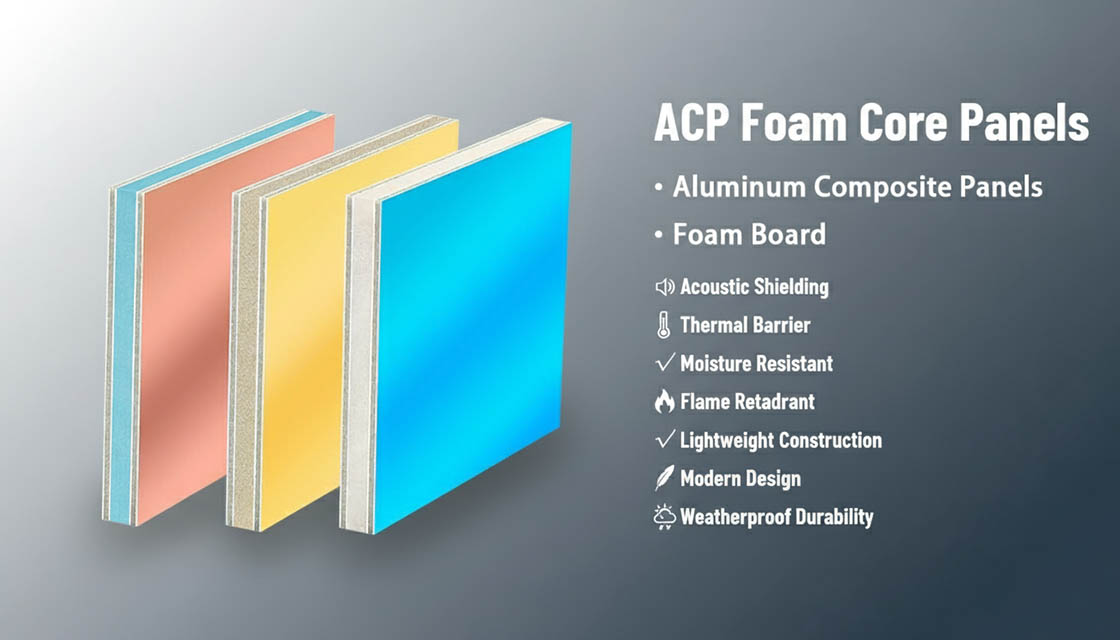
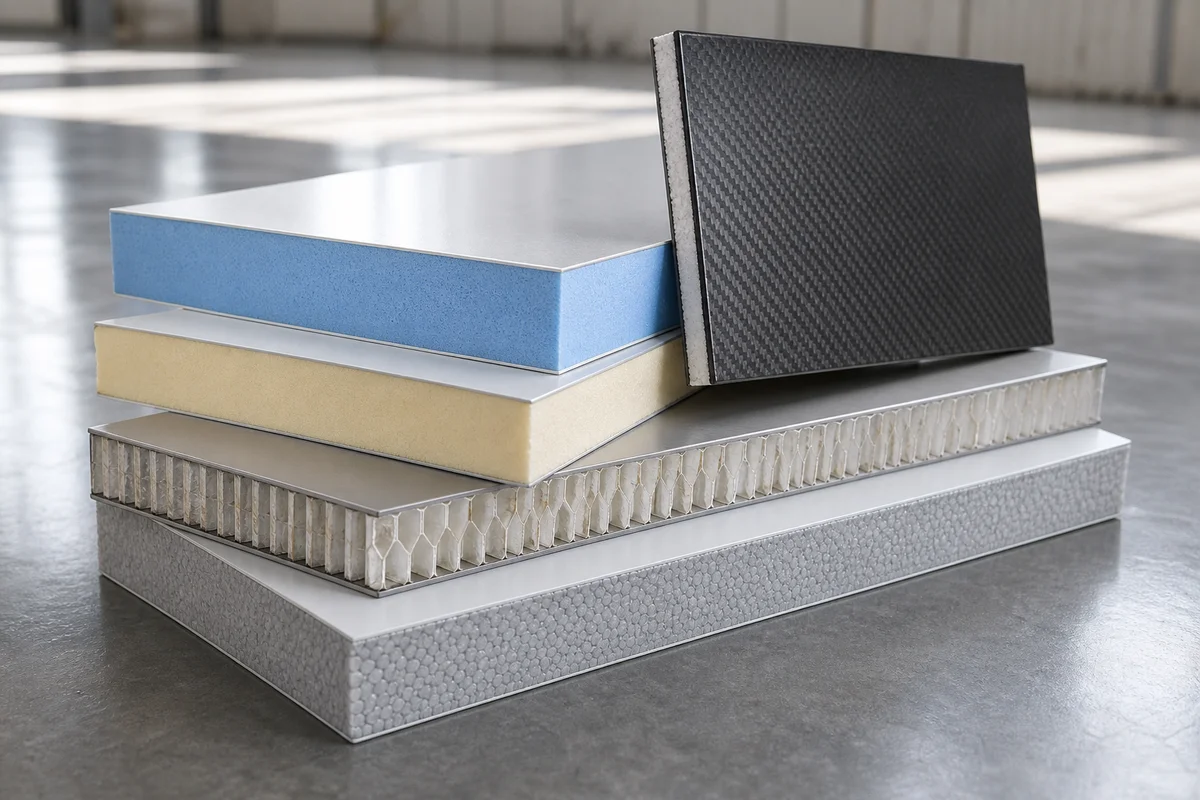
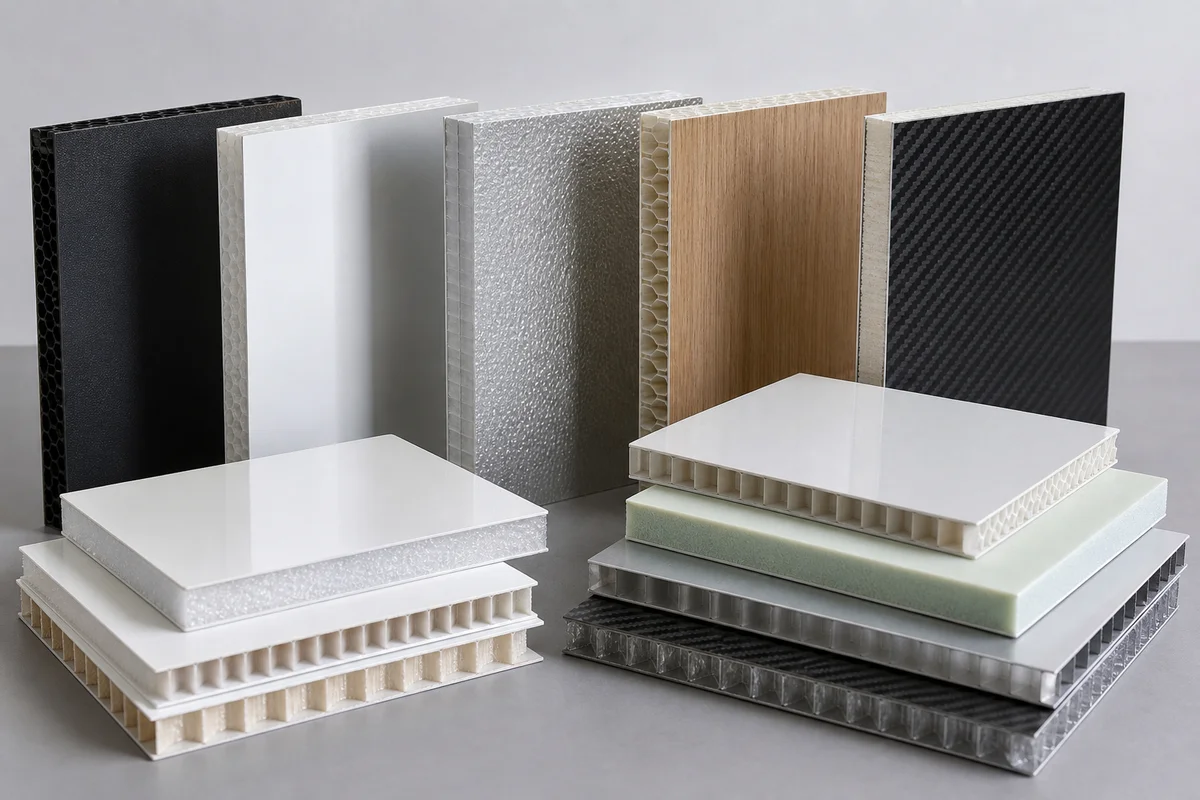
For buyers evaluating cold storage lifecycle economics, the relationship is straightforward: every watt of heat the envelope blocks is a watt the refrigeration system does not have to remove. Rax Panel’s portfolio of foam core panels—with options spanning PIR, PU, XPS, PET, PVC, and PMI cores paired with aluminum, steel, stainless steel, or Aluzinc facings—allows procurement teams to dial in the precise R-value and air-barrier performance their mechanical design requires, rather than over-specifying refrigeration capacity to compensate for a leaky envelope.
Addressing Common Buyer Concerns on Performance
This factor has a direct bearing on project performance and long-term cost. Addressing it with specific data rather than general assumptions leads to better outcomes.
Structural Integrity Under Heavy Snow and Wind Loads
Facility planners in extreme climates must account for severe structural loads. The inherent mechanics of a sandwich panel—where high-tensile skins are bonded to a rigid, thick core—create an exceptionally strong strength-to-weight ratio. The core material transfers shear loads, while the outer facings (such as Aluzinc, Steel, or high-strength CFRT) resist compressive and tensile forces. This engineering allows the panels to span long distances without intermediate support while deflecting high-velocity wind impacts and supporting substantial static snow loads.
We do not rely on off-the-shelf assumptions for structural safety. Our engineering team calculates the precise layup required—adjusting the composite material matrix to meet the exact wind and snow load data standards of the project’s geographic location, ensuring the envelope remains rigid and secure regardless of external pressures.
Key Takeaways
Custom insulated metal panels deliver their strongest financial return in cold chain applications where thermal performance directly drives operating cost. The continuous envelope eliminates bridging losses, shrinks refrigeration equipment, cuts defrost frequency, and extends the interval between major maintenance events. Over a 20-year horizon, these compounding savings convert a modest material premium into a substantial net gain.
For planners weighing envelope options, the decision framework is straightforward: model the total lifecycle cost (energy + maintenance + replacement + downtime) rather than comparing first-cost line items. The data consistently favors high-performance IMP systems for any facility operating below ambient temperature.
Rax Panel manufactures PIR, PU, XPS, PET, and PMI core panels with aluminum, steel, stainless steel, or Aluzinc facings, all engineered to the exact thermal and structural demands of your project. If you are evaluating envelope options for a new cold storage build or a retrofit, our engineering team can provide a side-by-side lifecycle cost comparison tailored to your climate zone and temperature setpoint. Request a project-specific quote to see how the numbers work for your facility.
Frequently Asked Questions
This factor has a direct bearing on project performance and long-term cost. Addressing it with specific data rather than general assumptions leads to better outcomes.
How much energy can insulated metal panels save compared to traditional construction?
In cold storage applications, IMP systems typically reduce refrigeration energy consumption by 25-40% compared to stick-built walls with batt insulation. The exact savings depend on climate zone, temperature setpoint, and panel thickness. The continuous insulation eliminates thermal bridging through studs, which is the primary source of heat gain in conventional construction.
What is the expected lifespan of PIR-core insulated panels in cold storage?
PIR-core panels maintain their engineered R-value for 25+ years in cold storage environments. The thermoset cellular structure does not degrade under thermal cycling, unlike EPS which can lose insulating performance as moisture penetrates bead boundaries. Properly installed panels with intact facings routinely outlast the mechanical refrigeration equipment they support.
Can insulated metal panels be retrofitted onto an existing cold storage building?
Yes. Modular IMPs are well suited for phased retrofits because contractors can replace compromised wall sections zone by zone without shutting down the entire facility. Custom edge details allow new panels to integrate with existing structural geometries, maintaining airtight transitions between old and upgraded envelope sections.
What panel thickness is needed for a -25°C freezer room?
For a -25°C setpoint in a moderate climate, 150-200mm PIR-core panels typically achieve the required U-value. The exact specification depends on ambient design temperature, humidity levels, and the acceptable refrigeration load. Thinner profiles are possible with higher-performance cores like PMI, though cost per square meter increases accordingly.
Do insulated metal panels meet food-grade fire safety requirements?
PIR-core panels are thermoset materials that char rather than melt when exposed to high heat, forming a protective carbonaceous layer that resists flame propagation. They satisfy most international fire safety codes required for food processing and cold storage facilities, including FM Global and EN 13501 classifications, depending on the specific facing and core combination specified.