

The first cold room quote is almost never the last number you pay. Published figures put a basic insulated structure plus refrigeration at $15,000 to $20,000 depending on size — and installation labor adds thousands more on top of that. Doors, flooring, controls, and the first year of power bills come later. Planners who budget off the sticker price spend month three explaining variances to finance instead of commissioning the room.
We’ve manufactured insulated sandwich panels at RaxPanel long enough to know which line items get negotiated hard and which get ignored. The panel price always gets negotiated. The core material inside it rarely does. EPS wins quotes because it’s the cheapest option per square meter — then it absorbs moisture, builds ice, forces thicker walls to hit the same thermal resistance, and makes the refrigeration plant work harder for the life of the room. The cheapest panel is rarely the cheapest room to run.
What follows is the full arithmetic: installed cost per square meter across small, medium, and large builds, what PIR, PU, and EPS cores genuinely change in that number, refrigeration package pricing, the door and control line items people miss, and the ten-year operating bill that separates a bargain from a slow leak. Run those numbers before the quotes arrive and you’ll budget from data instead of defending surprises.
What Does a Cold Room Cost by Size?
A fully installed cold room typically runs $150–$400 per square meter for the insulated envelope and refrigeration system combined, with small units starting around $15,000 and large distribution rooms exceeding $150,000 depending on temperature class and site complexity.
Understanding cold room pricing by size is the first step in budgeting that won’t leave you guessing. The total installed cost isn’t a simple per-square-meter multiplication—panel thickness, insulation core type, refrigeration capacity, and site conditions all swing the final number. What follows is a practical price breakdown by build tier, the benchmarks per square meter that buyers use to scope projects, and the engineering factors that determine whether you’re looking at the low end or the high end of each range.
Small Cold Room Pricing Under 50 Square Meters
Small cold rooms, typically ranging from 10 to 50 square meters, serve cafés, small retail operations, and compact commercial kitchens. A basic chiller-grade unit in this size band, built with 100 mm PU or PIR sandwich panels and a matched refrigeration package, generally lands in the $15,000 to $35,000 installed range. Freezer-grade units in the same footprint run higher—typically $25,000 to $50,000—because sub-zero temperatures demand thicker insulation, more powerful compressors, and larger evaporator loads.
The per-square-meter cost in this tier is at its highest, often $300 to $700 per square meter all-in. That’s because fixed costs—refrigeration unit, door, controls, electrical connection, and commissioning—don’t scale down proportionally with size. A 15-square-meter walk-in freezer carries roughly the same refrigeration hardware cost as a 30-square-meter unit, which pushes the per-square-meter figure up sharply for smaller spaces.
For buyers sourcing in bulk or equipping multiple small rooms across a site, panel-level pricing becomes more favorable. Manufacturers with high daily output, such as facilities producing over 1,700 square meters per day, can offer tighter per-panel pricing on repeat orders. This is where the distinction between a custom-engineered build and a standard modular kit starts to matter for your bottom line.
Medium Cold Room Costs Between 50 and 200 Square Meters
The 50 to 200 square meter range is where most supermarket cold rooms, food processing prep areas, and mid-scale distribution staging rooms live. Here, economies of scale kick in noticeably. A medium chiller room built to 0°C to +5°C with 100 to 150 mm panels typically costs between $40,000 and $120,000 fully installed. A medium freezer room at −18°C to −25°C in the same footprint runs $70,000 to $180,000, reflecting the jump in panel thickness, compressor capacity, and defrost energy requirements.
Per-square-meter benchmarks in this tier compress to roughly $200 to $500 all-in. The range is wide because temperature class, panel thickness, and door specification create meaningful cost divergence. A medium room specified with 150 mm PIR panels and a high-efficiency scroll compressor will sit at the upper end, while a 100 mm PU-panel chiller room with standard components lands toward the lower end.
One factor often missed in initial budgeting is the refrigeration plant ratio. In the medium tier, a single large compressor rack may serve multiple compartments or zones, which spreads the hardware cost across more storage area. This is why a 150-square-meter dual-zone room (chiller plus freezer) can sometimes cost less per square meter than two separate 75-square-meter single-zone rooms built to the same standard.
Large Cold Room Pricing Above 200 Square Meters
Large cold rooms—distribution centers, wholesale cold stores, and high-bay logistics facilities—enter a different cost paradigm. Floorspace above 200 square meters shifts the conversation from per-square-meter pricing to total project budgeting, because structural steel, floor insulation, loading dock integration, and multi-compressor plant systems all introduce variables that small and medium rooms don’t face.
A 200 to 500-square-meter freezer room with 150 mm panels and forklift-rated doors typically ranges from $150,000 to $400,000 installed. Beyond 500 square meters, prices scale more linearly but still carry a premium for the specialized components—forklift doors, high-capacity evaporator banks, and floor heating systems to prevent heaving. Per-square-meter costs in this tier compress to roughly $150 to $350 all-in for chiller applications and $250 to $500 for freezer applications, depending on specification depth.
At this scale, the panel envelope is only one line item. Floor insulation, structural engineering for taller bays, and the refrigeration plant’s part-load efficiency become the dominant cost drivers. Buyers who lock in panel specifications early and coordinate with their refrigeration engineer during the design phase—not after—tend to avoid the most costly change orders.
How Panel Thickness and Insulation Material Affect Unit Cost
Panel thickness and insulation core material are the two most influential variables in cold room unit cost, and they interact in ways that matter for your storage capacity as much as your budget. Thicker panels cost more per square meter, but they also reduce heat gain, which means a smaller refrigeration unit can do the same job. The question isn’t whether to spec thicker panels—it’s whether the energy savings and space preservation justify the upfront premium.
PU and PIR cores both deliver thermal conductivity in the range of 0.022 to 0.024 W/m·K, making them the benchmark for cold storage insulation. EPS, at 0.033 to 0.038 W/m·K, requires roughly 50% more thickness to achieve the same thermal resistance. That 50% thickness increase isn’t free—it eats into internal storage volume, requires more steel framing, and increases the panel’s weight and handling cost. At sub-zero temperatures, EPS also absorbs moisture over time, which degrades its insulating performance. That’s why EPS is rarely specified for freezer rooms above −10°C, and why buyers who choose it on upfront price alone often pay through energy waste within the first few years.
PIR panels carry a modest premium over PU—typically 10 to 20 percent per square meter—but offer superior fire performance and better dimensional stability at higher temperatures. For applications where fire rating matters, such as buildings with mixed occupancy or strict commercial building codes, that premium is usually non-negotiable. For a standalone walk-in cooler in a warehouse, PU delivers the same thermal performance at a lower panel cost.
Our engineering team evaluates panel thickness against the target temperature class and the expected door-open frequency for each project. In our experience, a 100 mm PU panel is sufficient for a chiller room with moderate traffic, but a freezer room with frequent forklift throughput at sub −20°C benefits from 150 mm or even 200 mm panels. The refrigeration system size drops accordingly, and the payback period for the thicker panel is often shorter than buyers expect because the compressor runs fewer hours and defrost cycles are less frequent.
Per-Square-Meter Benchmarks Across Cold Room Build Tiers
Per-square-meter benchmarks are useful for early-stage scoping, but they should be treated as directional guides rather than fixed targets. The following ranges reflect fully installed costs—including panels, refrigeration, doors, controls, and standard labor—for rooms built to typical commercial specifications. Actual project costs will vary based on site conditions, local labor rates, and specification choices.
- Entry-tier chiller room (small, under 50 m²): $300–$500 per square meter, 100 mm PU/PIR panels, standard compressor package
- Entry-tier freezer room (small, under 50 m²): $450–$700 per square meter, 150 mm PIR panels, high-capacity refrigeration unit
- Mid-tier chiller room (50–200 m²): $200–$350 per square meter, 100–150 mm panels, zoned refrigeration possible
- Mid-tier freezer room (50–200 m²): $300–$500 per square meter, 150 mm PIR panels, dual-compressor or rack system
- Large-tier chiller room (200+ m²): $150–$300 per square meter, 150 mm panels, rack-mounted plant with variable capacity
- Large-tier freezer room (200+ m²): $250–$500 per square meter, 150–200 mm PIR panels, floor heating and forklift-rated doors included
These benchmarks assume a standard concrete slab is already in place. If your site requires floor insulation, vapor barriers, or a heated slab to prevent frost heave, add $25 to $60 per square meter to the total. Similarly, if the location requires import logistics, customs clearance, or specialized freight for panel delivery, those costs sit outside the per-square-meter benchmark and should be budgeted separately.
The most common budgeting mistake we see is treating the per-square-meter figure as a hard cap and then discovering that site work, refrigeration commissioning, or special door specifications have blown the estimate. A well-scoped budget includes a 15 to 20 percent contingency for items that aren’t visible in the panel and equipment quote—site preparation, electrical upgrades, and local code compliance work are the usual culprits.
| Size Tier | Storage Volume | Typical Applications | Temperature Class | Panel & Insulation Guide |
|---|---|---|---|---|
| Compact Walk-In (~2×2 m footprint) | 6–10 m³ | Small cafés and restaurants storing daily fresh produce, dairy, and beverages | Chiller: 0°C to +5°C | 75–100 mm PUR/PIR sandwich panels; standard hinged walk-in door |
| Small Walk-In (Retail / Commercial Kitchen) | 10–15 m³ | Small retailers and commercial kitchens holding prepared ingredients and packaged goods | Chiller: 0°C to +5°C | 75–100 mm PUR/PIR sandwich panels; standard hinged door |
| Medium Walk-In | 15–50 m³ | Supermarkets, food processing, and mixed-storage operations with shelving and aisle space | Dual-zone: chiller 0°C to +5°C and freezer below 0°C | 100–150 mm PUR/PIR sandwich panels; hinged or sliding door depending on traffic |
| Large Walk-In / Distribution | 50 m³ and above | Distribution centres and wholesale operations built around pallet storage and throughput | Freezer: −18°C to −25°C | 150 mm PUR/PIR sandwich panels; forklift-rated sliding doors |
| Industrial Cold Warehouse (Custom-Built) | Custom high-bay volumes sized by pallet capacity | Cold chain logistics hubs with multi-temperature receiving, staging, and dispatch zones | Multi-temperature including blast freezing at −25°C and below | 150 mm+ PUR/PIR sandwich panel envelope; engineered steelwork, taller panels, and advanced controls |
How Much Do PIR, PU, and EPS Panels Cost?
The panel price you see first is only the entry fee—the real cost difference between PIR, PU, and EPS lives in the operating bill. On supply price alone, EPS cold room panels typically cost $10–40 per square meter depending on thickness, PU panels run $18–62, and PIR panels sit at $24–80, which puts PIR at roughly a 30–40% premium over PU and leaves EPS about 35–45% cheaper than PU. That spread is a direct reflection of thermal conductivity, or lambda value: PIR cores sit near 0.022 W/m·K, PU cores land around 0.024–0.026 W/m·K, and EPS cores trail at 0.033–0.038 W/m·K. A lower lambda means less heat leaking through every square meter of the envelope, so the refrigeration system runs shorter cycles, draws fewer kilowatt-hours, and holds the same setpoint for a smaller monthly power bill.
Here is the quick benchmark most buyers never get upfront: EPS cold room panels typically cost $10–40 per square meter depending on thickness, PU panels run $18–62, and PIR panels sit at $24–80. In practical terms, PIR commands roughly a 30–40% premium over PU, while EPS undercuts PU by around 35–45%. That spread is exactly why buyers get stuck — EPS looks like a steal, PIR looks overpriced, and PU floats in the middle. But the price per square meter tells only half the story. The real cost difference between these three cores comes down to thermal conductivity, which directly determines how thick the panel needs to be and how much energy the refrigeration system will consume over the life of the room.
Why PIR Costs More Per Square Meter
PIR (polyisocyanurate) panels are priced higher because the core material itself costs more to manufacture and because the formulation includes fire-retardant additives that PU does not require at the same level. PIR has a thermal conductivity of approximately 0.021–0.023 W/m·K, which is slightly better than PU. That 0.002 difference sounds tiny, but it compounds over the entire surface area of a cold room and across years of operation. The fire performance is where PIR justifies its premium. PIR chars rather than melts when exposed to flame, and it has a significantly lower flame spread rating than PU. For facilities that must meet strict fire codes — commercial kitchens, food processing plants, pharmaceutical storage — that difference is not optional. You are paying for a panel that will pass inspection without requiring additional fireproofing measures.
Where PU Panels Deliver the Best Value
PU (polyurethane) panels are the industry workhorse for a reason. At a thermal conductivity of 0.022–0.024 W/m·K, they sit almost shoulder-to-shoulder with PIR on insulation performance. The R-value per 25 mm of thickness is 1.2–1.4, which means a 100 mm PU panel delivers roughly the same thermal resistance as a 100 mm PIR panel for most practical cold room applications. The price difference is real — PU runs about 25–35% less per square meter than PIR — but the operating cost gap is small enough that PU remains the smart default for standard cold rooms and walk-in coolers operating above -18°C. If your facility does not have a fire code mandate requiring PIR, PU gives you nearly identical insulation at a materially lower upfront cost.
The EPS Trap: Cheap Upfront, Expensive Over Time
EPS panels undercut competitors on the quote but reveal their true cost through thicker walls and higher energy draw. The same low-density, air-filled structure that makes EPS cheap to produce also makes it a poor barrier against heat, and a cold room pays for that shortfall every hour its compressors run. In sub-zero conditions the penalty compounds: moisture absorbed into the panel freezes and expands, building up as ice that forces repeated defrost cycles, adds cleaning and maintenance labor, and steadily drags down thermal performance. For freezer applications, this usually ends one way — replacement within 5–8 years — so the money saved at purchase is repaid through the power bill and premature re-cladding, making EPS the most expensive panel per year of actual service.
There is a second problem specific to cold storage. EPS is a closed-cell material, but it is still more susceptible to moisture absorption than PU or PIR. In environments below 0°C, any moisture that penetrates the panel or forms through thermal bridging at joints can freeze and degrade the core over time. Ice build-up inside the EPS core reduces its already modest R-value further and can compromise the structural integrity of the panel. Buyers who choose EPS purely on upfront price often face replacement costs within 5–8 years in true freezer applications, which completely erases the initial savings.
Cost Breakdown by Panel Thickness Tier
The price spread between materials becomes more pronounced as thickness increases. For a 50 mm panel — typically used in mild cooling applications around 0–5°C — EPS runs approximately $10–18 per square meter, PU runs $18–28, and PIR runs $24–35. At 100 mm, which is the most common specification for standard cold rooms, EPS costs roughly $15–28 per square meter, PU costs $28–45, and PIR costs $38–55. For 150 mm panels used in deep freeze applications below -18°C, EPS runs $22–40, PU runs $42–62, and PIR runs $55–80. These ranges reflect typical market pricing for panels with standard metal facings such as galvanized steel or aluminum. Prices shift upward with specialty facings like stainless steel or coated aluminum, and downward with bulk orders from manufacturers.
The critical insight that most buyers miss is that the thickness you choose is not independent of the core material you choose. A 100 mm PIR panel and a 150 mm EPS panel may deliver similar thermal performance, but the EPS option requires a heavier support structure, larger door frames, and a refrigeration system that runs longer cycles due to slightly higher thermal bridging at joints. When you factor in those downstream costs, the per-square-meter price gap between PIR and EPS shrinks dramatically — and in many cases flips in favor of PIR on a total installed basis.
Never compare panel quotes on price per square meter alone. Two suppliers may quote the same thickness but use different facing gauges, core densities, or joint profiles. Always verify that the thermal conductivity (λ-value), core density, and facing material are identical before treating two quotes as comparable. A $5 per square meter difference can mean the difference between a panel that lasts 15 years and one that degrades in 5.
How to Translate Panel Cost into Real Operating Expense
The most effective way to evaluate panel cost is to calculate the annual energy impact of the thermal conductivity difference. A cold room with 100 square meters of wall and roof surface area, maintained at -18°C in a 25°C ambient environment, will lose heat through the envelope continuously. Using a simplified heat transfer model, switching from EPS (λ = 0.037) to PU (λ = 0.023) at the same 100 mm thickness reduces heat gain through the panels by approximately 38%. At an electricity cost of $0.12 per kWh and a typical COP of 2.5 for the refrigeration system, that translates to roughly $200–350 in annual energy savings per 100 square meters of envelope. Over a 10-year lifespan, that is $2,000–3,500 in cumulative savings — far exceeding the upfront price difference between the two panel types.
For PIR versus PU, the difference is smaller but still meaningful. The 0.002 W/m·K gap between PIR (0.021) and PU (0.023) represents roughly an 8–10% reduction in heat gain at equal thickness. On a 100 square meter cold room, that saves an additional $40–70 per year compared to PU. Whether that justifies the 30–40% price premium depends entirely on your local energy rates, your ambient temperature, and your fire code requirements. In hot climates with expensive electricity, the payback period for PIR can be under seven years. In mild climates with low energy costs, PU remains the more economical choice.
When EPS Makes Sense Despite the Higher Lifecycle Cost
EPS is not a bad choice across the board. It is a reasonable option for dry storage applications, packaging, and light insulation where temperature fluctuation is minimal and moisture exposure is controlled. It is also appropriate for temporary or relocatable cold rooms where the asset lifecycle is short and the upfront cost constraint is primary. For a permanent cold room that will operate for 10+ years in a freezing or sub-freezing environment, EPS is almost always the wrong material choice on a total cost basis. The panel may be cheaper to buy, but the combination of thicker walls, higher energy consumption, and earlier replacement creates a higher total cost of ownership than either PU or PIR.
What the Refrigeration System and Compressor Cost
The refrigeration package typically takes 20–30% of a monoblock cold room’s total budget and 30–40% for a remote split system — and inverter compressors carry a further 15–25% price premium.
If you remember one baseline from this section, make it this: the refrigeration system is the single largest variable cost after the panels themselves. Buyers consistently report sticker shock when their first compressor quote arrives — walk-in freezer replacements for a 100-square-meter unit regularly land between $13,000 and $23,000 when you include the compressor, condensing unit, evaporator coil, and full lineset installation. Labor alone can consume $13,000 of that figure, which is why understanding the cost structure upfront prevents unpleasant surprises.
Monoblock vs Remote Split: Where the Money Goes
The two primary refrigeration architectures diverge sharply in budget allocation. A monoblock unit — where the compressor and condenser are housed in a single packaged system — typically consumes 20–30% of your total cold room budget. The appeal is simplicity: one contractor, one warranty, one piece of equipment to service. The trade-off is capacity ceiling. Monoblock systems struggle above 50 tons of cooling, which is why larger facilities pivot to remote split systems.
Remote split refrigeration — where the condensing unit sits outside and connects via copper lineset to an indoor evaporator — pushes the refrigeration share to 30–40% of total project cost. You pay more upfront for the condensing unit, longer lineset, and additional mounting hardware. What you gain is serviceability and scalability. If the outdoor compressor fails, you replace only that module rather than dismantling an integrated monoblock. For 100-square-meter walk-in freezers targeting -18°C to -25°C, most specifiers choose remote split precisely because the lineset allows the noisy, heat-generating condenser to sit 10–30 meters away from the insulated enclosure.
The Inverter Compressor Premium: 15–25% or Lifelong Savings
Inverter compressors — also called variable-speed or DC-inverter units — adjust motor RPM to match real-time cooling demand rather than cycling on and off at fixed capacity. The hardware premium is genuine: expect 15–25% higher unit cost compared to equivalent fixed-speed compressors. A 20-ton inverter condensing unit might list at $8,500–$10,200 versus $6,800–$8,200 for a fixed-speed counterpart.
The payback narrative hinges on your duty cycle. Industry measurements show inverter compressors deliver 20–40% energy savings in partial-load conditions, which covers most cold rooms that spend 60–80% of operating hours at reduced cooling demand. A 100-square-meter -18°C freezer running 24/7 in a temperate climate might save 8,000–15,000 kWh annually versus fixed-speed — translating to $960–$1,800 per year at $0.12–$0.15/kWh electricity rates. The inverter premium pays back in 3–7 years depending on local energy pricing and usage patterns. After that, every kilowatt-hour is pure margin preservation.
Do not assume every cold room justifies an inverter. If your facility loads and unloads doors frequently with full warm-air exchange events, the compressor spends more time at peak demand where fixed-speed and inverter performance converge. In those high-traffic scenarios, the 15–25% premium may never recover. Request a duty-cycle analysis from your refrigeration contractor before committing.
Sub-Zero Freezers Demand Larger, Costlier Units Than Chill Rooms
This is the cost driver most buyers overlook until they receive their quote. A -18°C to -25°C walk-in freezer requires 35–50% more cooling capacity than a +2°C to +8°C chill room of identical volume. The physics is straightforward: the temperature differential between the interior setpoint and ambient outdoor air is far larger, which means more heat infiltration per square meter of panel surface. Your compressor must work harder, run longer, and handle greater thermal loads during defrost cycles.
The practical cost impact is significant. A 100-square-meter chill room at +4°C might spec a 15-ton remote condensing unit. The same footprint configured as a -20°C freezer typically requires 20–22 tons — and the larger compressor carries a proportionally higher unit price, larger lineset, and increased electrical service requirements. Some facilities attempt to underspec and accept longer pull-down times or higher humidity, but that strategy accelerates compressor wear and raises long-term maintenance costs. Budget for the capacity you actually need, not the capacity you hope to get away with.
Repair Versus Replace: The $13,000–$23,000 Dilemma
When a compressor fails on an 18-year-old cold room installation, the repair quote landing at $13,000–$23,000 triggers legitimate anxiety. Owners struggle to judge whether the price is fair, fear being overcharged, and cannot determine if a $16,700 quote represents market rate or inflation. This uncertainty creates decision paralysis — delay the repair and risk product loss, or approve the spend and wonder if you should have planned for full system replacement instead.
The repair-or-replace calculus depends on three variables: equipment age, remaining compressor lifespan, and total installed cost of a like-for-like replacement. If your existing condensing unit is 15–20 years old and the evaporator coil shows corrosion or refrigerant leaks, a $16,000 compressor replacement extends life by 3–5 years at best. The same $16,000 invested in a new remote split system with inverter technology, modern refrigerant (R449A or R452A), and a full 5-year warranty on all components delivers 10–15 additional years of reliable operation with 20–40% lower annual energy cost. The break-even point typically favors replacement when the existing system exceeds 15 years of service and the repair quote exceeds 40% of a new system’s installed price.
Lifespan Expectations and Payback Uncertainty
Industry data suggests well-maintained refrigeration systems deliver 12–18 years of service for monoblock units and 15–20 years for remote split installations with inverter compressors. Evaporator coils typically outlast the condensing unit by 3–5 years when proper defrost cycles are maintained. Compressor failures cluster around years 10–14 in aging systems, which is why owners of 18-year-old installations face the repair-versus-replace decision most acutely.
Building a credible business case for capital expenditure requires lifecycle cost modeling, not just hardware pricing. Include energy consumption at current kWh rates, projected maintenance spend over the next 5 years, and the risk-adjusted cost of a single catastrophic failure event. A 20-ton inverter remote system at $18,000 installed may appear expensive versus a $12,000 fixed-speed replacement, but the 25% energy savings, 30% reduction in maintenance visits, and 5-year extended warranty often justify the premium within 4–6 years. Without this modeling, management and lenders lack the data to approve the expenditure — which is why professional cold room specifiers now include total cost of ownership analysis in every proposal.
Always request a detailed scope of work from your refrigeration contractor that separates equipment cost, lineset material, electrical service upgrades, and installation labor. A $16,700 quote that bundles everything together makes it impossible to benchmark against market rates. Line-item pricing reveals whether you are paying for quality components or inflated labor margins.
Doors, Flooring, and Controls: Costs People Miss
Doors, flooring, and controls almost never headline a cold room quote, yet each typically absorbs 5–10% of the total build cost. Combined, they quietly claim 15–30% of the budget — the exact share most first-time budgets forget to hold.
Most first-time buyers budget for two things: insulated panels and the refrigeration system. Published price guides feed this habit, because headline figures usually bundle or skip everything else. Then the quote arrives with real line items attached — a freezer-grade door, heated flooring, a compliant control panel — and the “missing” 15–30% of the project suddenly has to come from somewhere. Understanding what these three components actually cost, and why, is the fastest way to turn a vague budget into a realistic one.
Cold Room Doors: Why Hinged and Sliding Units Are Priced So Differently
A hinged door — the same swing-open design as a household refrigerator, just scaled up — is the default for most walk-in coolers and small freezer rooms. A standard hinged cold room door typically costs between $800 and $2,500 depending on size, core thickness, and whether the frame is heated. Sliding doors are the workhorses for wide openings and forklift or pallet traffic. Because they carry more hardware (tracks, rollers, and drive systems on automated models) and a larger surface area to insulate, they typically start around $3,000 and can exceed $8,000 for large, freezer-grade units.
That price gap is real, but choosing purely on price backfires. Industry data suggests facilities running outdated or poorly sealed doors spend 20–30% more on energy annually than those with modern high-performance models. A few hundred dollars saved on gaskets and heated frames tends to leak out through the door frame for years afterward.
- Opening width and traffic: Manual walk-ins work fine with hinged doors; anything palletized needs sliding-door clearance.
- Heated components: Freezer-rated frames, gasket heaters, and heated door cables add several hundred dollars but prevent the door from freezing shut.
- Safety hardware: Inside safety releases, vision panels, and door-open alarms are standard expectations for most food-safety and insurance requirements.
Insulated Flooring: The Line Item Freezers Cannot Skip
For a chiller built on an existing reinforced concrete slab that stays above freezing, dedicated insulated flooring is often optional — a sealed, food-grade surface finish may be all that is required. Freezer rooms are different. Ground beneath an uninsulated freezer floor slowly freezes, and frozen soil expands — the same mechanism that buckles roads into potholes, only working against the slab. This “frost heave” cracks concrete, ruptures vapor barriers, and can eventually shut the room down for structural repairs.
That is why freezer floors are built as a system: insulated floor panels matched to the wall panel thickness, plus heater cables or mats laid beneath to keep the ground from ever freezing. Budget roughly $50–$120 per square meter for insulated cold room flooring, with heated freezer floors landing at the top of that range or above once heating mats and vapor barriers are included. On a 100-square-meter freezer, flooring alone can represent $8,000–$15,000 — a figure that routinely gets omitted from first-time budgets entirely.
Electrical Controls and Monitoring: Small Parts, Real Money
The third quiet line item is the electrical package. A cold room cannot run safely on a compressor plugged into a wall socket; it needs a control panel, a digital thermostat, contactors and breakers, and — in anything storing food or pharmaceuticals — some form of alarm and temperature logging. Individually these are small components; together they form a meaningful share of the build:
- Digital temperature controller: $150–$600 per room
- Full electrical control panel with breakers and contactors: $500–$2,000
- Door-open and high-temperature alarms: $200–$800
- Remote monitoring or data logging for compliance: $300–$1,500
Basic setups sit at the bottom of that stack; anything with compliance-grade logging or around-the-clock alerting moves toward the top. None of these components is exotic — the problem is that quotes often bundle them into a vague “electrical works” line, or assume the installing electrician will sort it out, so buyers never see the real number until the invoice lands.
📋 Actionable Steps
- Step 1: Request that doors, flooring, and controls be quoted as separate line items — never lumped into “installation” or “extras.”
- Step 2: Match the door type to real traffic: hinged for manual walk-ins, sliding wherever pallets or forklifts pass through.
- Step 3: Confirm before signing whether the floor needs heating — a freezer floor is the one item that cannot be value-engineered away after the slab is poured.
- Step 4: Specify the required monitoring level up front (basic thermostat versus alarm and data logging) so the control package is priced once, correctly.
None of these components will ever be the reason someone buys a cold room — but together they decide whether the final invoice matches the budget. Treat them as core infrastructure rather than accessories, and the gap between estimate and reality shrinks dramatically.
Installation, Delivery, and Site Prep: What You’ll Pay
The gap between a cold room’s quoted price and its final invoice almost always comes down to three line items that rarely appear in advertised package pricing: installation labor, site preparation, and delivery. As working benchmarks, professional installation adds roughly $1,000–$5,000 to a project, site preparation typically runs $500–$3,000, and delivery surcharges depend almost entirely on how easy your site is to reach. Budgeting for all three from day one is what separates a smooth build from a stalled one.
A realistic installed budget = panel and refrigeration package + $1,000–$5,000 labor + $500–$3,000 site works + delivery. Any quote missing these lines is not a final price.
Professional Installation Labor: What the $1,000–$5,000 Range Buys
Labor covers unloading and assembling the insulated panels, sealing joints, fitting door frames and trim, positioning the refrigeration components, and testing the finished room. Cost scales with panel count and layout complexity more than any other factor. A compact walk-in might take a two-person crew one to two days, while a larger multi-room layout can keep installers on site for three to five days.
Expressed per square meter of floor area, labor works out around $50–$100 per sqm on small rooms and drops toward $25–$50 per sqm on large builds. Smaller projects cost proportionally more because fixed tasks — commissioning the cooling system, leak testing, crew travel — get spread over fewer panels.
- Room size and panel count: more panels means more joints, more handling, and more hours.
- Layout complexity: internal partitions, corner-heavy designs, and multiple temperature zones add assembly time.
- Ceiling height: tall wall panels demand extra care and sometimes lifting equipment.
- Refrigeration scope: mounting and commissioning the cooling system is skilled work and often the single biggest labor variable.
It is also worth noting that modular cam-lock rooms — where self-supporting panels hook together on site — consistently quote lower labor than traditional built-in construction, which requires framing, cladding, and insulation to be assembled layer by layer.
Site Preparation: The $500–$3,000 Line Item Nobody Quotes
Installation crews assume the site is ready the moment they arrive. If it is not, you pay for their time while they wait — or reschedule entirely. Three things must exist before panel day:
- A flat, level concrete base: cold room panels are precision-molded and only align properly on a level slab. An uneven floor opens gaps at floor-panel joints that no amount of sealant fully corrects.
- A vapor barrier: a heavy plastic membrane that stops ground moisture wicking up into the insulation — think of it as a rain jacket under the floor. Skip it, and moisture slowly degrades insulation performance from below.
- A dedicated power supply: a licensed electrician installs the correct circuit at the room’s location. Larger freezer systems often require three-phase power, which can mean extra cabling or a supply upgrade.
The $500 end assumes an existing slab, power nearby, and simple drainage for defrost meltwater. The $3,000 end involves pouring a new base, trenching electrical conduit, or upgrading the supply — realistic outcomes for outdoor or rural installations.
Delivery and Access: Surcharges That Depend on Your Site
Insulated panels ship as long, rigid packs — usually larger than a standard pallet — on a tail-lift truck or flatbed. Offloading is frequently the buyer’s responsibility, which in practice means a forklift on site or a crane lift billed separately. Then site reality kicks in:
- No loading dock or narrow gates: crews hand-carrying panel packs charge for the extra time.
- Inner-city or restricted-access sites: delivery windows, permits, and smaller trucks all add fees.
- Remote locations: distance-based freight is predictable, but crane hire or extended crew travel is commonly invoiced as a separate line.
Measuring gate widths, driveway turning space, and offload points before ordering costs nothing and prevents the most common delivery-day surprise.
DIY Installation: Where the “Saved” Labor Budget Evaporates
Modular panel systems genuinely can be self-assembled — panels join with cam locks (hex-key-tightened hooks running inside the panel walls), and a competent handyman can build a small room over a weekend. So why do most DIY savings evaporate? Joint sealing.
Every panel seam carries a gasket and, on most systems, a silicone seal line. Miss one, and humid air migrates through the joint, condenses against the cold face, and turns to ice inside the wall. The result is a thermal bridge — a shortcut where heat bypasses the insulation — that forces the refrigeration system to run longer, inflates energy use, and can eventually lift floor panels out of level. Even a well-manufactured panel underperforms if the joints around it leak; installation quality determines whether rated insulation performance is ever actually achieved in the field.
Two further constraints cap the DIY route on most projects. Connecting the refrigerant circuit is legally restricted to certified technicians in the majority of countries, and many panel manufacturers condition warranty coverage on documented professional installation. A realistic rule of thumb: DIY only pays when the room is small, the slab is ready, and the assembler has done it before. Otherwise, rework quietly consumes the labor budget you thought you saved.
What Swings the Price of a Cold Room
The same cold room footprint can vary 2–3× in final price depending on insulation chemistry, wall thickness, temperature class, and site-specific requirements—not just raw square footage.
Insulation Thickness and Material Choice
Insulation is the single biggest swing factor in cold room pricing, and it operates on two competing axes: thermal performance and spatial efficiency. Buyers often focus on the per-panel cost without realizing that the material’s thermal conductivity (lambda value, measured in W/(m·K)) and required thickness directly determine how much sellable storage space they actually get inside the room.
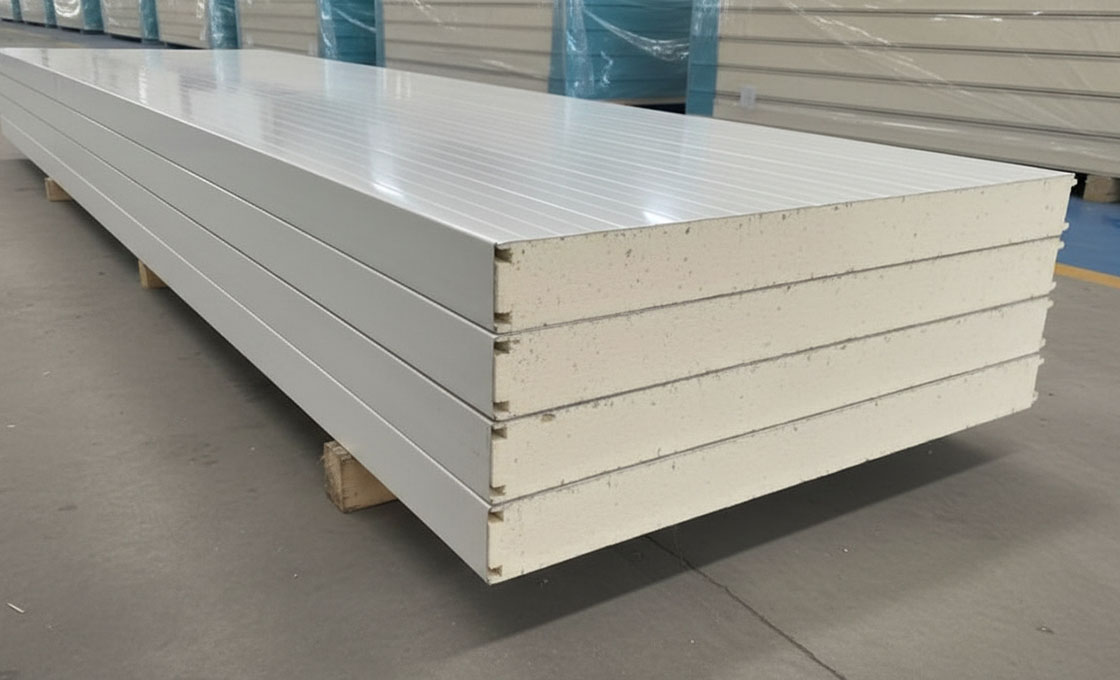
Polyisocyanurate (PIR) and polyurethane (PU) panels typically range from 50mm to 200mm in thickness, with higher lambda performance meaning thinner walls for the same insulating effect. EPS (expanded polystyrene) panels, by contrast, require roughly 50% more thickness to achieve an equivalent R-value. A 100mm EPS wall delivers similar insulation to a 65mm PIR panel—but the extra 35mm of wall thickness per side eats directly into internal floor area. For a 50-square-meter room, this spatial penalty can reduce usable storage volume by 8–12%, which matters significantly for high-density operations.
The upfront material cost gap between EPS and PU/PIR is substantial—EPS panels can be 30–50% cheaper per square meter—but the total installed cost picture is more complex. Thicker EPS walls also require more steel framing, larger structural supports, and potentially bigger door openings, which adds hidden costs that narrow the initial price advantage.
Fircode Compliance Versus Budget Constraints
Fire performance is a non-negotiable factor for many commercial installations, and it is where PIR panels justify their premium over PU and EPS. PIR panels are engineered to char rather than melt when exposed to flame, which limits flame spread and reduces the release of toxic smoke—a critical distinction in occupied or regulated buildings. This char-forming behavior means PIR typically achieves fire ratings that satisfy stringent building codes such as BS 476 Part 6 and NFPA standards, making it the default specification for food processing facilities, healthcare cold rooms, and any installation subject to municipal fire inspections.
PU panels occupy a middle ground: they offer solid thermal performance at a lower cost than PIR, but their fire behavior is less favorable under certain code interpretations. EPS panels, while the most budget-friendly insulation option, generally cannot meet fire-code requirements for commercial cold storage without additional flame-retardant treatments, and even treated EPS panels carry higher smoke development ratings than PIR.
The practical question buyers face is whether their specific application actually triggers a PIR mandate. A standalone warehouse freezer in a rural area may not require PIR-rated panels, but a cold room integrated into a multi-tenant food processing facility or a hospital refrigeration plant almost certainly will. Paying the PIR premium without a code requirement is unnecessary overhead; choosing PU or EPS where PIR is required, however, can result in failed inspections, mandatory retrofits, and insurance complications that dwarf the initial savings.
The Compounding Cost of Tiny Lambda Differences
The thermal conductivity gap between PIR and PU panels is often just 0.002 W/(m·K)—a difference that sounds negligible on a spec sheet but compounds into meaningful operating cost divergence over the life of the cold room. Lambda value measures how readily heat passes through a material: the lower the number, the better the insulation. PIR typically sits at approximately 0.022 W/(m·K), while PU is around 0.024 W/(m·K). That 0.002 difference may look like rounding error, but it translates into a real energy gap when panels run for thousands of hours per year.
For a typical 50-square-meter cold room with 100mm panels, the annual energy difference between a PIR and PU build can range from 250 to 400 kWh depending on climate, setpoint, and usage patterns. At commercial electricity rates, this represents hundreds of dollars in cumulative energy cost over five years—enough to offset a significant portion of the panel price premium. Buyers who compare quotes based solely on per-panel cost without factoring in lambda-driven energy performance are making a costly calculation error.
Above-Zero Versus Sub-Zero: The Material Disqualification Rule
Matching insulation material to temperature class isn’t a recommendation—it’s a hard requirement for sub-zero performance. EPS panels are structurally and thermally suitable only for above-zero applications such as produce coolers and pharmaceutical storage rooms operating at 2°C to 8°C. For freezer rooms operating at -25°C to -30°C or below, PU and PIR panels are the only viable insulated panel options. Using EPS in sub-zero environments creates a material-temperature mismatch that drives the refrigeration system to work harder, compounding energy costs beyond any initial panel savings.
For freezer rooms operating at -25°C to -30°C or below, PU and PIR panels are the only viable insulated panel options. Both materials maintain their closed-cell structure and thermal performance at sub-zero temperatures, and neither is susceptible to the moisture absorption that disables EPS in freezing conditions. The refrigeration system for a freezer also demands significantly more compressor capacity and additional defrost cycles, which further widens the cost gap between above-zero and sub-zero builds of identical footprint.
Cross-Cutting Price Multipliers
Beyond insulation selection, several additional variables multiply the base panel cost and can shift the total installed price by a factor of two or three for the same room footprint. Temperature class is the most powerful multiplier: a freezer build requires thicker panels, higher-capacity compressors, more frequent defrost cycles, and heavier-duty door hardware, pushing the total cost 40–60% above an equivalent cooler build.
Location and logistics introduce another layer of variation. Cold rooms shipped to remote or landlocked sites incur significantly higher freight costs than those delivered to industrial zones near manufacturing hubs. Import duties, customs clearance fees, and regional material availability can all shift the landed cost of the same panel specification by 15–25% depending on the destination market.
Power supply requirements also swing the price. A cold room designed for a standard three-phase industrial connection costs less to equip than one requiring a dedicated single-phase conversion or generator backup setup. Customization adds further cost: non-standard panel lengths, special interior finishes, integrated shelving mounts, or custom door cutouts all require engineered solutions that move the build away from off-the-shelf pricing.
- Temperature class: Freezer builds cost 40–60% more than equivalent coolers due to thicker panels, heavier compressors, and defrost systems.
- Panel thickness: Going from 100mm to 150mm panels increases material cost by approximately 30–40% but improves thermal resistance proportionally.
- Fire-rated specification: PIR panels carry a 15–30% premium over PU for equivalent thickness, driven by the isocyanurate chemistry required for char formation.
- Geographic logistics: Remote or international deliveries can add 15–25% to landed panel costs through freight and import duties.
- Custom configurations: Non-standard dimensions, special facings, or integrated features move pricing away from modular benchmarks into engineered territory.
The takeaway for buyers is that cold room pricing is never driven by a single variable. A 100-square-meter freezer in a fire-regulated facility, built with 150mm PIR panels and shipped to a remote site, will cost dramatically more than a 100-square-meter produce cooler with 100mm PU panels in an industrial zone with standard power. The most accurate way to compare quotes is to normalize them against a common specification matrix—same temperature class, same panel thickness, same fire rating, same dimensions—before evaluating the bottom line.
The Hidden Costs of Running a Cold Room
The purchase price is only the start. Monthly electricity, routine maintenance, refrigerant top-ups, and eventual component replacements often exceed the initial investment over a cold room’s operational life.
Monthly Electricity Consumption by Room Size and Temperature Class
Energy is almost always the single largest hidden cost of owning a cold room, and it scales non-linearly with size, temperature class, and insulation quality. The table below shows realistic monthly electricity ranges for well-installed units operating in moderate climates, using PIR or PU sandwich panels with standard 100 mm thickness. These figures assume normal door-opening frequency and a properly sized refrigeration package.
| Room Size | Temperature Class | Monthly kWh Range | Est. Monthly Cost (@ $0.12/kWh) |
|---|---|---|---|
| 30 m² | Frozen (-18°C to -22°C) | 900 – 1,500 | $108 – $180 |
| 30 m² | Chiller (0°C to +5°C) | 500 – 900 | $60 – $108 |
| 80 m² | Frozen (-18°C to -22°C) | 2,200 – 3,800 | $264 – $456 |
| 80 m² | Chiller (0°C to +5°C) | 1,200 – 2,200 | $144 – $264 |
| 150 m² | Frozen (-18°C to -22°C) | 4,500 – 7,500 | $540 – $900 |
| 150 m² | Chiller (0°C to +5°C) | 2,500 – 4,500 | $300 – $540 |
These are baseline figures for rooms with competent insulation and correctly matched refrigeration. Actual consumption can run 20–40% higher in hot climates, with frequent door cycling, poor seal integrity, or undersized panels. A chiller room operating at 4°C uses noticeably less energy than a frozen room at -20°C because the temperature differential between the interior and ambient air is smaller, reducing the heat load the compressor must continuously remove.
How Panel Insulation Quality Directly Impacts Monthly Bills
Thermal conductivity is the single variable that separates a cold room that pays for itself from one that bleeds money through the compressor. A difference of just 0.002 W/(m·K) between PIR and PU panels sounds marginal on paper, but it compounds dramatically over years of continuous compressor runtime. Standard PU panels typically sit at a lambda value around 0.022–0.024 W/(m·K), while PIR panels can achieve 0.022–0.024 W/(m·K). That gap translates into measurable kilowatt-hour savings, especially in frozen-storage applications where the refrigeration system runs nearly continuously.
EPS panels present a different cost trap entirely. With a thermal conductivity in the range of 0.033–0.038 W/(m·K), EPS requires roughly 50% greater panel thickness than PIR or PU to achieve an equivalent thermal resistance. In practice, buyers who choose EPS for its lower upfront price often end up with thicker walls that still underperform, while also facing moisture absorption and ice build-up inside the core when temperatures drop below 0°C. That degradation accelerates over time, pushing energy consumption higher each year until the panels are effectively replaced.
- PIR panels (λ ≈ 0.022–0.024 W/m·K): Best thermal performance for frozen storage; lowest lifetime energy cost per square meter.
- PU panels (λ ≈ 0.026–0.028 W/m·K): Solid mid-range performance; widely used in chiller and mild frozen applications.
- EPS panels (λ ≈ 0.033–0.038 W/m·K): Lowest upfront cost but highest long-term energy penalty; unsuitable for sustained sub-zero operation without significant thickness increases.
When comparing panel quotes, always ask for the declared lambda value and the panel thickness. Two panels at the same thickness can have very different energy profiles if their core materials differ. A lambda of 0.022 versus 0.028 is the difference between a room that runs efficiently and one that quietly drains profit.
Annual Preventive Maintenance Budget
Preventive maintenance is not optional if a cold room is to operate at its designed efficiency. A typical annual service contract covers compressor oil and filter checks, condenser coil cleaning, evaporator defrost cycle verification, door gasket inspection, refrigerant pressure testing, and electrical connection tightening. For a standard 80 m² frozen cold room, annual preventive maintenance typically costs between $600 and $1,200, depending on region, service provider, and system complexity. Smaller units may fall toward the lower end, while larger installations with multiple evaporators or complex control systems can approach or exceed the upper range.
Skipping preventive maintenance may seem like a short-term saving, but it reliably leads to higher energy consumption and premature component failure. A dirty condenser coil can increase compressor workload by 15–25%, directly inflating monthly electricity bills. Over a five-year period, that inefficiency can easily cost more than the maintenance itself.
Refrigerant Top-Ups and Leak Repair
All refrigeration systems experience some degree of refrigerant loss over time. Small, gradual leaks through service valve stems, flare connections, or evaporator coil joints are common and typically require a top-up once every 12 to 24 months. A standard refrigerant top-up for a medium-sized cold room system usually ranges from $150 to $400, depending on the refrigerant type and charge size. Larger systems using R404A or R507 may require 5 to 15 kg per top-up, while smaller units using R134a or R449A may need only 1 to 3 kg.
Major leaks that require full recovery and recharging are a different matter. A complete refrigerant recycle and recharge, including leak detection and repair, can run from $800 to $2,500 depending on system size and refrigerant pricing. Chronic leaks that are never properly addressed will continue to degrade cooling performance and increase compressor strain, creating a cycle of recurring top-up costs.
Spare Parts and Wear-Item Replacements
Several components in a cold room system are considered wear items and will need replacement during the operational life of the installation. The most common spare parts include fan motors for evaporators, contactors and relays in the electrical panel, defrost heaters, and door gaskets. A typical annual spare-parts budget for a medium-sized cold room falls in the $200 to $600 range, covering items like replacement fan motors at $80 to $250 each, contactors at $40 to $120, and gasket sets at $50 to $150 per door.
The defrost system is a particularly important category. Electric defrost heaters, defrost timers or controllers, and drain pan heaters all have finite lifespans. A defrost heater replacement typically costs $100 to $300 per unit, while a defrost control board replacement can run $200 to $500. In rooms that undergo heavy door-opening cycles or frequent product loading, defrost cycles activate more often and these components age faster.
Do not assume the refrigeration contractor who installed the unit will be available for emergency service years later. Independent technicians often charge higher emergency rates, and parts for discontinued or proprietary systems can be difficult to source. Keep a spare parts inventory for critical components—especially fan motors, contactors, and defrost heaters—to avoid prolonged downtime during off-season emergencies.
Worst-Case Component Replacement Costs
While routine maintenance and spare-part replacements are predictable, certain catastrophic failures can produce large unexpected expenses. The most significant risk is compressor failure. A full compressor replacement for a medium-sized cold room system, including labor, refrigerant recovery, and recharge, typically ranges from $2,500 to $6,000. In larger installations or those requiring multiple compressors, this figure can exceed $10,000.
Condenser unit failure is another major expense. Air-cooled condensers for commercial cold rooms can cost $1,500 to $4,000 per unit installed, while water-cooled condensers with associated piping and pump replacements can push the total higher. Evaporator coil damage from accidental impact or corrosion may require full coil replacement at $800 to $2,000 depending on size and refrigerant circuit design.
| Component | Typical Replacement Range | Frequency Expectation |
|---|---|---|
| Compressor | $2,500 – $6,000+ | Every 10–15 years (varies) |
| Air-cooled condenser | $1,500 – $4,000 | Every 10–12 years |
| Evaporator fan motor | $80 – $250 per unit | Every 5–8 years |
| Defrost heater element | $100 – $300 per unit | Every 5–7 years |
| Door gasket set | $50 – $150 per door | Every 3–5 years |
| Control board / defrost timer | $200 – $500 | Every 7–10 years |
How Poor Insulation Choice Creates Compounding Hidden Costs
The insulation material selected at the design stage creates a cost trajectory that is extremely difficult to reverse. EPS panels, while the cheapest option upfront, carry the highest long-term operating cost because their thermal conductivity is significantly worse than PIR or PU. In a frozen cold room operating below 0°C, EPS panels also absorb moisture from the interior air over time. That moisture migrates into the core, reducing thermal resistance further and creating ice crystals within the panel structure. The result is a compounding effect: the panels insulate less effectively each year, the compressor runs longer, and energy bills rise steadily until the panels are replaced.
PIR panels, with their lower lambda value and superior moisture resistance, maintain their insulating performance far longer. The higher initial material cost is typically recovered within three to five years through reduced electricity consumption alone, after which the buyer is operating at a net savings compared to a room built with PU or EPS panels of the same thickness.
Summary of Recurring Annual Operating Costs
| Cost Category | Typical Annual Range (Medium Room) |
|---|---|
| Electricity (frozen storage) | $3,000 – $5,500 |
| Electricity (chiller storage) | $1,500 – $3,000 |
| Preventive maintenance contract | $600 – $1,200 |
| Refrigerant top-ups | $150 – $400 |
| Spare parts and wear items | $200 – $600 |
| Total estimated annual operating cost | $4,050 – $10,700 |
These figures represent a medium-sized cold room with competent insulation and routine maintenance. Rooms with inferior panels, poor installation, or heavy usage cycles will sit at the upper end or above this range. The single most impactful decision a buyer can make to control these hidden costs is selecting the right insulation material and thickness at the design stage, because every kilowatt-hour saved by better thermal performance compounds annually across the entire operational life of the installation.
Owning a Cold Room: What 10 Years Really Costs
The purchase price of a cold room is only the entry fee. Over ten years, electricity often costs two to four times the build itself — and insulation quality decides where on that range a buyer lands.
Cumulative Energy: The Bill That Outgrows the Build
Ask operators who have run a cold room for a decade what they actually spent, and the story rarely starts with the purchase invoice. A refrigeration system does not store cold — it removes heat, and every watt of heat that leaks through the panels, joints, and door openings has to be pumped back out by the compressor, hour after hour. A useful way to picture it: the panels are the hull of a boat and the compressor is the bilge pump. A tighter hull means the pump runs less, and that difference repeats every single day for ten years.
This is why energy behaves as a compounding cost rather than a fixed one. A small daily consumption gap between two rooms is invisible on a monthly statement, yet across a decade it accumulates into thousands of kilowatt-hours. Worse, the gap widens over time: insulation does not hold its original performance forever. Low-density, open-structured foam cores can gradually take up moisture — a process often called thermal drift — and because water conducts heat far faster than the gas trapped in closed cells, a dampening panel insulates worse with each passing year. Ice bridging at panel joints tells the same story in miniature. The energy curve of a cheaply insulated room is therefore not flat; it slopes upward, and the owner pays the slope.