
Deciphering clean room panel prices requires distinguishing between high-volume manufacturers and low-output trading firms. A specialized manufacturer like Rax Panel operates proprietary production lines with a daily capacity exceeding 1,700 square meters. That volume level is the primary driver for consistent panel thickness and reliable lead times. Without this industrial scale, you face the high risk of receiving defective batches with delamination issues.
We break down price benchmarks by core material, comparing PU and Rockwool performance-to-price ratios, and analyze how facing materials like PVDF-coated steel alter unit costs. You will also find an export-ready supplier selection matrix focused on verifying ISO 14644-1 compliance. This approach provides the specific data you need to identify hidden mold fees and secure a supplier that meets your fire safety standards.
Price Benchmarks by Core Material
Core material selection drives up to 60% of your total sandwich panel cost. Understanding the exact price-to-performance metrics of PU, Rockwool, and EPS/XPS cores is critical to eliminating hidden sourcing fees and optimizing project margins.
Cost Per Square Meter Analysis: PU vs. Rockwool vs. EPS
Baseline manufacturing costs are dictated by the distinct chemical and mineral inputs required for each core material. EPS (Expanded Polystyrene) and XPS (Extruded Polystyrene) represent the most budget-friendly options, generally offering the lowest cost per square meter.
Polyurethane (PU) and Polyisocyanurate (PIR) cores command a mid-tier price point, reflecting their complex chemical foaming processes and superior closed-cell structure. Rockwool (Stone Wool) sits at the premium end of the hierarchy, typically commanding a 20-30% price premium over PU panels due to the rigorous processing required for Class A fire resistance and high-temperature structural integrity.
Performance-to-Price Ratio: Thermal Insulation vs. Fire Resistance
The decision matrix between thermal insulation and fire resistance is where many importers misallocate their budgets. If your facility requires strict Class A non-combustibility or up to 120 minutes of fire resistance, Rockwool is the undisputed cost-efficiency winner. It outperforms chemical foams in high-temperature structural integrity without the premium cost of specialized fire-retardant additives.
Conversely, for refrigerated trucks or controlled environments where maximum thermal retention (low K-value) is the priority, PU delivers a far better performance-to-price ratio. PU achieves target insulation metrics at significantly thinner profiles than EPS, which reduces overall steel facing usage and container shipping volume.
Our engineering team at Rax Panel frequently conducts experimental testing on these thermal metrics for large-scale distribution. We consistently find that buyers who default to thicker, cheaper EPS panels to save upfront costs end up paying heavily in long-term energy leakage and oversized refrigeration unit requirements. Optimizing for PU’s high insulation value often yields a lower total project cost.
Regional Material Cost Variations in Chinese Manufacturing Hubs
Material pricing is rarely uniform across China; it fluctuates heavily based on regional supply chain proximity. For instance, raw Rockwool production is highly concentrated in Northern industrial provinces, meaning Southern factories often face higher domestic freight charges to bring in those cores.
On the other hand, PU and PIR chemical processing is heavily optimized in Eastern and Southern hubs. If a factory lacks direct access to local chemical suppliers, their PU panel quotes will reflect hidden inbound logistics costs that artificially inflate the square meter price.
To bypass these regional pricing disparities, Rax Panel leverages its 15+ years of supply chain dominance and 1,700+ sqm daily production capacity to secure localized, bulk raw material pricing. When vetting suppliers, always demand transparency on their raw material sourcing regions, as inbound logistics directly impact your final landing cost.
| Core Material | Cost Efficiency | Key Specifications | Rax Manufacturing Advantage | Ideal Sector |
|---|---|---|---|---|
| Rock Wool (Stone Wool) | Rockwool components occupy a premium price bracket justified by their superior safety characteristics. Positioned at a 20-30% cost premium over standard PU foam, this material is categorized as a premium solution rather than an economy option, delivering exceptional high fire-safety value for applications where protection cannot be compromised. | Excellent sound insulation, Class A fire resistance (up to 120 mins), thermal stability, and moisture resistance. | Factory-direct hygiene-critical designs; engineering team ensures compliance with strict cleanroom and building safety standards. | Cleanroom Partitions, Exterior Wall Cladding, Industrial Hygiene Zones |
| Polyurethane (PU) / PIR | Balanced Performance / High Insulation Value | Superior thermal insulation (low K-value), lightweight structure, excellent adhesion to metal facings, and hygiene properties. | Specialized CKD kits for refrigerated trucks; optimized design solutions to reduce total project costs and logistics risks. | Refrigerated Truck Bodies, Cold Storage, Controlled Environments |
| Aluminum Honeycomb | Premium / High Strength-to-Weight Ratio | Extreme compressive strength, high surface flatness, impact resistance, and ultra-lightweight composition. | 15+ years of fabrication expertise; fully customized thickness and facing options (Steel, Aluzinc, FRP) for unique project specs. | High-end Mobile Homes, Aircraft Interiors, Vessel Solutions |
| PET Foam | Mid-Range / Eco-Friendly Option | Thermoplastic recyclability, good fatigue resistance, chemical stability, and lightweight composition. | Innovative lightweight solutions for RVs and sports goods; rigorous experimental testing ensures data standards for dynamic loads. | RV Furniture Panels, Sports Equipment, Wind Energy |
| PVC Foam | Mid-Range / Waterproof Solution | Closed-cell structure (100% water resistance), self-extinguishing properties, chemical resistance, and dimensional stability. | 24/7 one-to-one service for complex marine designs; rigorous quality control prevents delamination in humid conditions. | Marine Vessels, Bathroom Facilities, High-Humidity Cleanrooms |
| XPS Foam | Economy / High Compressive Strength | High density, effective moisture barrier, excellent thermal efficiency, and strong structural integrity. | Cost-effective bulk production capacity (1,700+ sqm/day); flexible MOQs for large-scale industrial and freight projects. | Dry Freight Truck Bodies, Industrial Flooring, General Insulation |
High-Volume Manufacturer Cost Analysis
High-volume cost analysis of cleanroom panels goes beyond raw material prices; it requires evaluating manufacturing throughput, core density optimization, and logistics engineering to eliminate hidden BOM costs and overcome steep minimum order quantities.
Deconstructing the BOM: Why Unit Prices Fluctuate Between Suppliers
Buyers frequently encounter massive price variances—often ranging from 1200 to 2500 INR per square meter—due to opaque quoting practices and hidden structural compromises. A lower invoice price typically masks reduced core density or downgraded chemical compositions, which critically undermines structural integrity under positive HVAC pressure.
To achieve true cost-efficiency in high-volume procurement, engineers must audit the precise density of the insulation core and the exact composition of the anti-bacterial skin, rather than relying on generic square-meter rates provided by trading companies.
Mitigating the 10,000 SQM Minimum Order Quantity (MOQ) Trap
A major procurement bottleneck is the rigid 10,000 SQM MOQ imposed by standard regional factories, which disrupts phased facility rollouts and pilot testing. At Rax Panel, our advanced composite panel production line yields over 1,700 square meters daily, backed by of specialized manufacturing expertise. This continuous high-speed throughput allows us to efficiently absorb custom-sized pilot runs into our mainstream production schedules, effectively removing the MOQ barrier for specialized medical and industrial cleanroom projects without imposing exorbitant small-batch premiums.
Engineering Logistics and Risk Mitigation at Scale
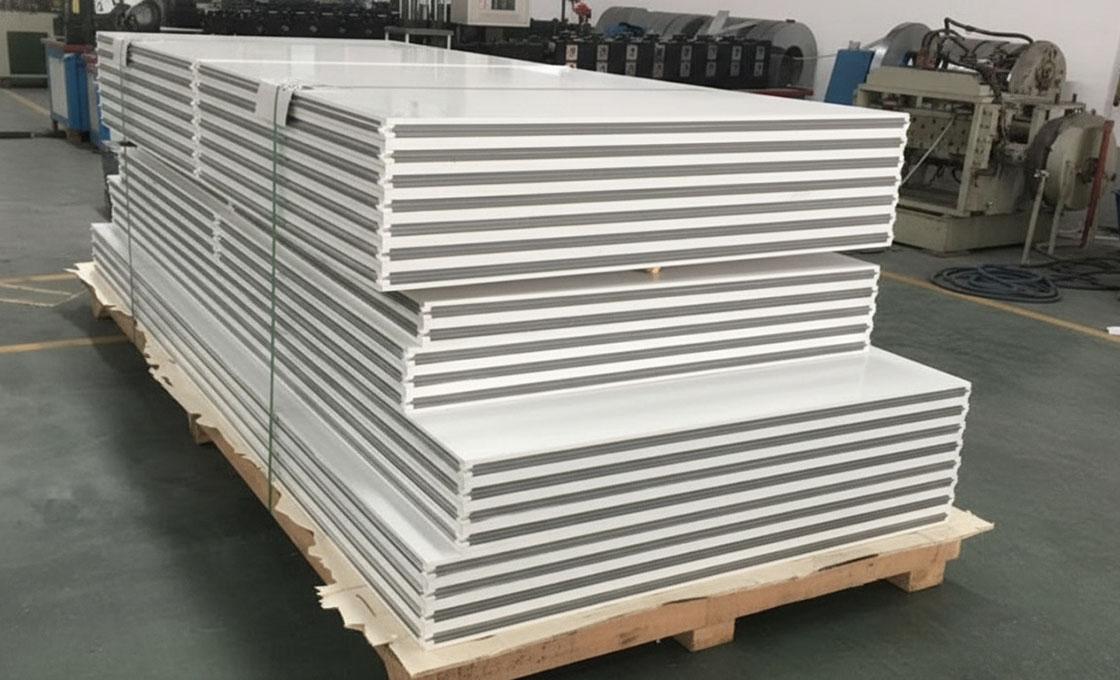
When procurement scales to full industrial deployment, shipping and packaging inefficiencies rapidly inflate the total landed cost. Substandard crating leads to micro-fractures in the panel joints, resulting in costly on-site replacements. We mitigate these logistics risks through engineered stacking solutions that maximize container fill rates while maintaining strict dimensional tolerances. This ensures manufacturers across our 50+ country supply chain receive precision-machined panels with zero transit-induced defects.
Never evaluate a supplier based solely on the ex-works panel price. High-volume orders can easily trigger oversized freight surcharges if the manufacturer fails to optimize pallet dimensions. Always demand a total landed cost analysis that includes custom stacking matrices to reduce cubic meter volume.
When analyzing supplier cost structures, request experimental testing data for the core-to-facing adhesive bond. Our technical team conducts rigorous lab testing to ensure composite products meet strict data standards. A cheaper panel with poor peel strength will delaminate under rigorous thermal cycling, drastically increasing your long-term facility maintenance BOM.
Specialized Application Supplier Comparison
How to Choose a composite supplier based solely on generic dimensions is a critical error in specialized sectors. The difference between a generalist and a specialized manufacturer is the ability to engineer dynamic solutions that withstand specific environmental stressors, rather than just supplying static materials.
RV & Mobile Home Solutions: Weight vs. Strength Trade-offs
In the recreational vehicle industry, fuel efficiency and payload limits are non-negotiable. Generic suppliers often push standard plywood or heavy aluminum composite panels (ACP) because they are readily available inventory items. However, these materials frequently add unnecessary structural mass and are prone to delamination under vibration. At Rax Panel, we approach RV manufacturing with a lightweight-first philosophy.
Instead of standard stock, we use PP honeycomb cores composited with fiberglass sheets. This specific configuration provides a high stiffness-to-weight ratio that traditional materials cannot match. We have found that switching to these advanced honeycomb structures allows manufacturers to significantly reduce wall thickness while maintaining superior impact resistance.
Refrigerated Transport: Thermal Integrity & CKD Capabilities
The cold chain logistics sector suffers when suppliers treat thermal insulation as an afterthought. Generalist traders often source PU (Polyurethane) or PUF panels from various third-party factories, resulting in inconsistent density and dangerous thermal bridging spots that compromise the cold chain. A specialized manufacturer controls the foaming process.
Our factory runs advanced continuous production lines for PU and PET foam cores, ensuring uniform density distribution across every square meter. Furthermore, we distinguish ourselves by offering CKD (Completely Knocked Down) solutions for refrigerated truck bodies. We do not just supply the board; our engineers provide the design optimization and structural calculations necessary to ensure the kit assembles into a perfectly insulated box, minimizing on-site assembly errors.
Marine & Vessel Solutions: Corrosion Resistance
Marine environments ruthlessly expose the weaknesses of standard construction materials. A standard steel or aluminum facing will corrode rapidly without expensive and heavy coatings, while standard foam cores can absorb moisture if the facing is breached. We mitigate this through the use of Glass Fiber Reinforced Plastic (GRP) sandwich panels with specialized gelcoat finishes.
Our GRP sheets act as a continuous, water-impermeable barrier that protects the structural core. In our experience working with vessel outfitters, the durability of our gel-coated FRP surfaces significantly lowers maintenance costs compared to metal facings, as they resist saltwater corrosion without the need for repainting.
Industrial & Clean Room Environments: Hygiene and Safety
While general suppliers can provide smooth metal sheets, they often lack the rigorous quality control required for sterile environments. In clean rooms and pharmaceutical applications, micro-joints and surface imperfections can harbor contaminants. We manufacture specialized panels with Rockwool or PU cores specifically for hygiene-critical zones.
Our production process ensures that facings are perfectly flat and free of defects that could trap dust. We also subject these materials to strict experimental testing to verify fire resistance and thermal stability. Our focus is not just on selling a wall panel, but on providing a validated component that helps our clients maintain strict ISO cleanliness standards.
Mid-Market Factory Quality Assessment
Mid-market factory reliability is not proven by a glossy website. It is verified through raw material traceability, equipment precision, and the engineering team’s ability to consistently reproduce complex composite structures at scale.
Importers frequently struggle to verify Chinese factory legitimacy because many mid-market suppliers operate as trading companies masquerading as manufacturers. Sourcing anxiety stems from a lack of structural transparency. Legitimate manufacturers prove capability through direct control over the continuous composite production line and actual mechanical test logs, not marketing brochures.
Benchmarking True Manufacturing Capacity
Our facility operates with a verified daily production capacity exceeding 1,700 square meters, backed by over 15 years of specialized production experience. When evaluating a mid-market factory, demand to see the specific extrusion and lamination speeds. If a factory cannot maintain strict temperature and pressure tolerances during high-volume runs, the core-to-skin adhesion fails. We enforce rigid experimental testing during the lamination process to ensure the structural integrity of PU and Rockwool cores remains flawless under stringent conditions.
📋 Actionable Steps
- Step 1: Request continuous production line footage, not static showroom photos, to verify in-house manufacturing capabilities.
- Step 2: Demand batch-specific shear strength and thermal conductivity test logs for the exact core materials specified.
- Step 3: Evaluate the factory’s engineering depth by requesting a feasibility study for a complex CKD refrigerated truck body or custom mobile home framing design.
- Step 4: Analyze their global supply chain infrastructure to ensure they have experience exporting to 50+ countries without logistics bottlenecks.
Many mid-market entities purchase raw foam or honeycomb cores and outsource the FRP or steel lamination to third-party workshops. This breaks material traceability and guarantees inconsistent panel flatness. Always mandate factory audits that specifically inspect the lamination and press lines under the same business license.
To test a factory’s true engineering bandwidth, ask for a customized tactical solution rather than standard catalog items. A qualified manufacturer will use their R&D team to calculate precise weight-to-strength ratios and optimize cost-effective material combinations, rather than simply redirecting you to pre-stocked inventory.
Export-Ready Supplier Selection Matrix
True export-readiness is defined by verifiable production scale, direct multilingual engineering support, and logistics risk mitigation—not just a product catalog.
Logistics and Communication Infrastructure
Reliability extends beyond the factory floor to include coordinated logistics and precise communication. Rax Panel serves the global market, having established supply chain cooperation with over 50 countries and regions, including Europe, North America, South America, and the Middle East.
We mitigate transportation risks through a dedicated international sales team fluent in English, French, Russian, Japanese, and Korean. This multilingual capability allows us to offer 24-hour one-to-one service for sales, product design, and production progress, eliminating errors common in cross-border technical discussions.
Technical Validation and Customization Capabilities
Generic specifications often fail in demanding environments such as clean rooms, refrigerated transport, or marine applications. An export-ready supplier must integrate research and development with production to meet strict data standards. Our technical team conducts rigorous experimental testing to ensure performance under stringent conditions. We customize composite materials by offering specific core options—such as XPS, PET, PU, and PVC—and skins to fit precise project requirements for applications ranging from RV walls to industrial equipment.
📋 Actionable Steps
- Step 1: Verify physical factory audits and daily production capacity (Target: >1,000 sqm/day).
- Step 2: Confirm direct multilingual support for technical engineering discussions.
- Step 3: Check for in-house R&D teams that conduct experimental testing.
- Step 4: Validate a track record of exports to your specific region (Europe/NA/Asia).
Many suppliers claim to be factories but lack R&D capabilities. If a vendor cannot provide specific data on raw material density or experimental test results for composite cores, they are likely a trading company posing as a manufacturer.
Vetting Criteria for Chinese Factories
ISO certifications are the baseline, not the finish line. A valid ISO 9001 certificate proves process control, but without ISO 14644-1 compliance verification and rigorous third-party fire testing, you cannot guarantee cleanroom integrity.
ISO 14644-1 and ISO 9001 Verification Protocols
Vetting a Chinese manufacturer requires looking beyond the logo on their website. ISO 9001 is a general quality management standard, but for cleanroom applications, you must specifically verify adherence to ISO 14644-1. This standard dictates the classification of air cleanliness. Many factories possess ISO 9001 for general metal fabrication but lack the specific environmental controls required for true cleanroom panel production.
📋 Actionable Steps
- Step 1: Request the certificate number and the issuing body’s name; avoid generic ‘registered’ organizations.
- Step 2: Cross-reference the certificate number directly on the registrar’s official online database to confirm validity and expiration dates.
- Step 3: Verify the ‘Scope of Certification’ explicitly lists ‘manufacturing of sandwich panels’ or ‘cleanroom materials’ rather than vague terms like ‘general trading’.
CE Marking and EN 14509 Compliance for European Exports
For the European market, the CE mark is mandatory but easily counterfeited. You must demand compliance with EN 14509, which is the specific harmonized standard for self-supporting double skin metal faced insulating panels. This standard governs critical structural properties including tensile strength, shear modulus, and bond adhesion. A supplier claiming compliance without a Declaration of Performance (DoP) referencing EN 14509 is a significant liability risk.
We maintain supply chain cooperation with over 50 countries, including strict adherence to EU regulations. Our experience shows that Customs in Europe frequently detain shipments where the technical file does not match the specific physical batch. Always ensure the factory provides the specific DoP for your ordered core thickness and facing material, not a generic template.
Fire Resistance Analysis: Class A Non-Combustible vs. Class B1
A common industry tactic is labeling Class B1 (flame retardant) materials as ‘fireproof’ to compete with Class A pricing. Class A (Non-Combustible) is typically achieved only with mineral wool (Rockwool) cores. Class B1 (Difficult to Burn) generally applies to PIR, PUR, or PF foams. Using B1 panels in a Class A mandated zone (such as certain pharmaceutical or high-voltage areas) can result in total project rejection.
When vetting, demand the original third-party fire test report. Check the specific test standard: EN 13501-1 is the European benchmark, while ASTM E84 is common in North America. Verify that the core density and facing thickness on the report match your purchase order exactly. Our technical team conducts rigorous experimental testing to ensure our Rockwool cores consistently achieve the Class A standard, whereas we clearly classify our PU and PET foam cores as B1 to maintain transparency.
MOQ and Tiered Pricing Structures
Pilot procurement serves strictly for material validation and engineering verification; actual volume pricing materializes only when order quantities justify the fixed setup costs of continuous line production.
Volume Discount Thresholds: Breaking the 500 SQM Barrier
Volume thresholds directly dictate supply chain efficiency rather than arbitrary markups. When an order crosses the 500 square meter threshold, raw material procurement shifts from retail transit logistics to direct mill supply. Steel coils, PU/PET chemicals, and Rockwool blocks arrive in full container quantities, heavily reducing the unit cost baseline.
On the factory floor, hitting this volume allows continuous press operation without major recalibration between panel lengths. Crossing this specific threshold triggers an immediate volume discount structure based purely on real material savings and optimized machine hours.
Cost Implications: Custom Dimensions vs. Standard Panel Sizes
Specifying custom dimensions directly impacts the project budget and often acts as a hidden cost trap. Standard panel sizes are engineered around raw material master coil widths to achieve maximum yield and zero kerf waste. When a project mandates bespoke widths or non-standard thicknesses, it generates offcuts that must be factored into the unit price.
We counter this financial friction through proactive design engineering support. Our technical team reviews architectural blueprints to slightly adjust dimensions to optimized modular layouts. This collaborative approach converts what would be a premium custom run into a standard-rate manufacturing workflow, ensuring you pay for panel performance rather than manufacturing waste.
| Order Tier | MOQ | Pricing Level | Customization | Ideal For |
|---|---|---|---|---|
| Sample / Pilot Testing | 1 – 50 sqm | Premium (Sample Rate) | Standard sizes; limited core options (PU, PVC foam); basic steel facings | Material validation, small R&D trials, prototype builds |
| Small Project | 50 – 200 sqm | Mid-High (Introductory Tier) | Full core selection (PU, Rockwool, PET, PVC); standard steel/stainless facings; standard dimensions | Pilot production runs, specialized vehicle builds, clean room fit-outs |
| Standard Commercial | 200 – 1,000 sqm | Mid (Volume Discount Applied) | Custom dimensions; extended facings (Steel, Stainless, Aluminum, GRP/FRP); design engineering support | RV walls, refrigerated truck bodies, mobile homes, vessel interiors |
| Bulk Industrial | 1,000 – 5,000 sqm | Low-Mid (Bulk Rate) | Full customization across all panel types; CKD/SKD packaging; project-specific engineering with experimental testing | Fleet orders, large-scale construction, industrial equipment manufacturing |
| Global Distributor / OEM | 5,000+ sqm | Lowest (Tier-1 Partner Pricing) | Unlimited design flexibility; dedicated production line allocation; custom branding and proprietary tooling | Long-term supply contracts, regional distribution across 50+ countries, OEM partnerships |
Key Takeaways
Stop chasing the lowest rockwool panel prices online without verifying the source. You will eventually pay for that mistake through failed fire tests or delayed container shipments. Quality consistency and ISO 14644-1 compliance protect your margin far better than a cheap initial quote. If the factory cannot provide a Class A fire report, walk away.
Rax Panel manufactures over 1,700 square meters of composite materials daily using our advanced production lines. We offer precise engineering for PU, Rockwool, and PET cores specifically for hygiene-critical environments across 50+ countries. Let our team handle the technical specifications and logistics so you avoid supply chain risks. Send us your drawings for a precise quote and material samples.
Frequently Asked Questions
This factor has a direct bearing on project performance and long-term cost. Addressing it with specific data rather than general assumptions leads to better outcomes.
What materials suit clean room panels?
Clean room panels typically feature steel or stainless steel facings for hygiene. Core materials include PU, PIR, rock wool, or aluminum honeycomb for insulation. These combinations ensure structural integrity and meet strict cleanliness standards.
Which standards govern clean room panels?
Manufacturers must comply with fire safety ratings such as Class A or Class 1. ISO 14644 standards define air cleanliness requirements for controlled environments. Panels are also subject to local building codes regarding flush surfaces and airtightness.
What factors influence clean room panel pricing?
The type of core material, such as rock wool versus foam, significantly impacts cost. Surface finish quality, like galvanized steel versus stainless steel, also varies the price. Custom thickness and specialized fire ratings can further adjust the total expense.
Can panel dimensions be customized?
Factories generally produce panels in standard modular widths to optimize production. However, length and height can often be adjusted to fit specific project layouts. Engineering teams may need to approve non-standard sizes to ensure load safety.
What affects manufacturing lead times?
Lead times depend largely on the factory’s current production capacity and order queue. Custom specifications, such as unique core thicknesses, require longer processing than standard stock items. Global shipping schedules and customs processing also impact final delivery dates.