

Walk any trade show floor in 2026 and you’ll hear the same conversation at booth after booth — a procurement manager holding two sample swatches, trying to decide whether their next build calls for an FRP honeycomb panel or a conventional aluminum alternative.
Most suppliers hand over a spec sheet and move on. That spec sheet won’t tell you which core material actually fits your application, and it definitely won’t explain why the wrong choice costs you money for the next decade.
After 15 years engineering composite panels at Rax Panel, I’ve watched one technical reality reshape how smart buyers source. A polypropylene honeycomb core delivers structural durability comparable to plywood-core FRP at roughly half the weight. That matters.
Every kilogram you strip from a trailer wall or RV roof becomes payload capacity — or fuel you stop burning across a 100-vehicle fleet. Yet buyers still default to aluminum cores without understanding what they sacrifice in thermal insulation, acoustic dampening, and per-square-meter cost.
This overview breaks down how PP and aluminum core materials dictate real-world performance across different load and environmental conditions, where thermoplastic and thermoset FRP skins diverge under sustained stress, and how to calculate the actual lifecycle savings when you replace solid materials with a fiberglass honeycomb panel. The core selection drives everything else — get that decision right, and the rest of your spec falls into place.
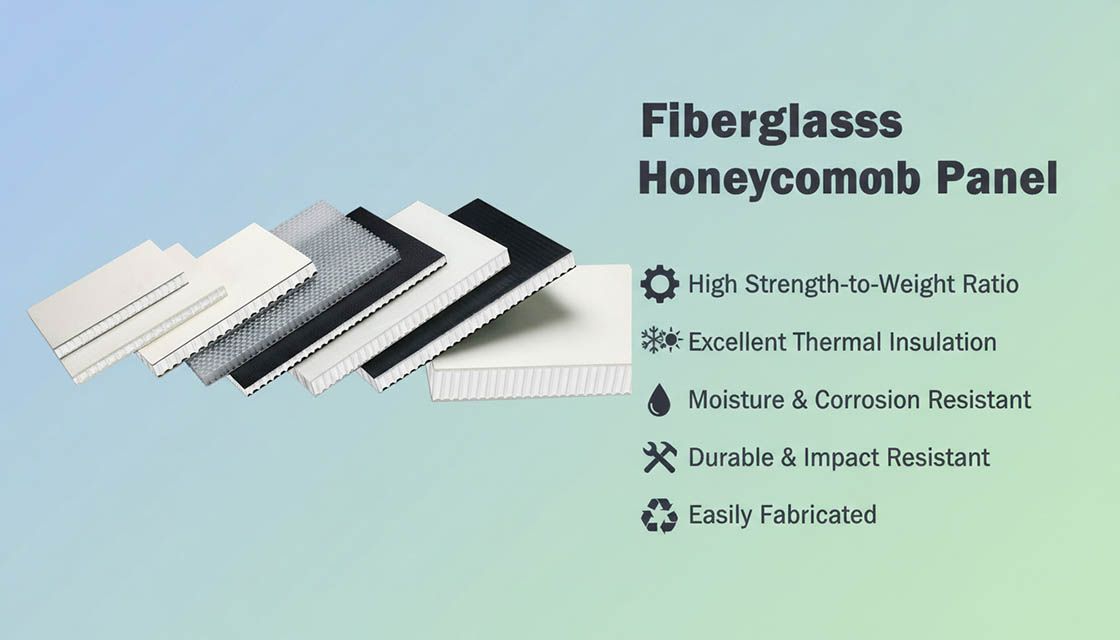
What Is an FRP Honeycomb Panel?
An FRP honeycomb panel bonds thin, high-strength Fiber Reinforced Polymer skins to a lightweight honeycomb core, forming a sandwich structure that delivers high stiffness with minimal mass.
What Is Fiber Reinforced Polymer (FRP)?
FRP stands for Fiber Reinforced Polymer, a composite produced by embedding continuous fibers—most commonly glass fibers—inside a polymer resin matrix. Neither component is structural on its own. The fibers carry tensile and compressive loads, while the resin binds the fibers, transfers shear between them, and shields them from moisture and abrasion.
A helpful analogy is reinforced concrete. The glass fibers behave like steel rebar; the resin behaves like the concrete surrounding it. Separately each is limited, but combined they form a single load-bearing composite far stronger and stiffer than either ingredient alone.
FRP skins are produced in two broad families: thermoset and thermoplastic. Thermoset resins cure into a permanent, rigid network that cannot be re-melted; thermoplastic resins remain meltable and reformable. This distinction drives bonding method, recyclability, and structural behavior, and is examined in detail in the dedicated thermoplastic versus thermoset FRP section.
The Sandwich Panel Concept
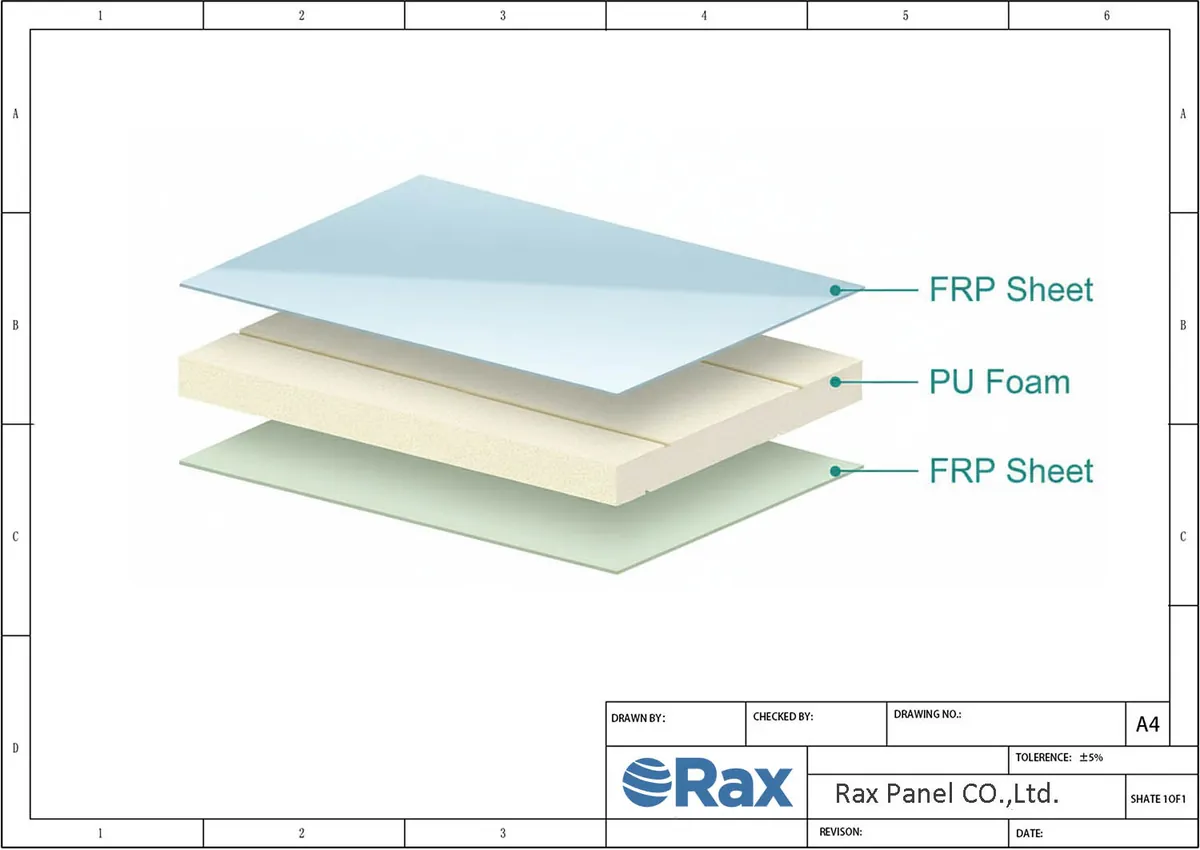
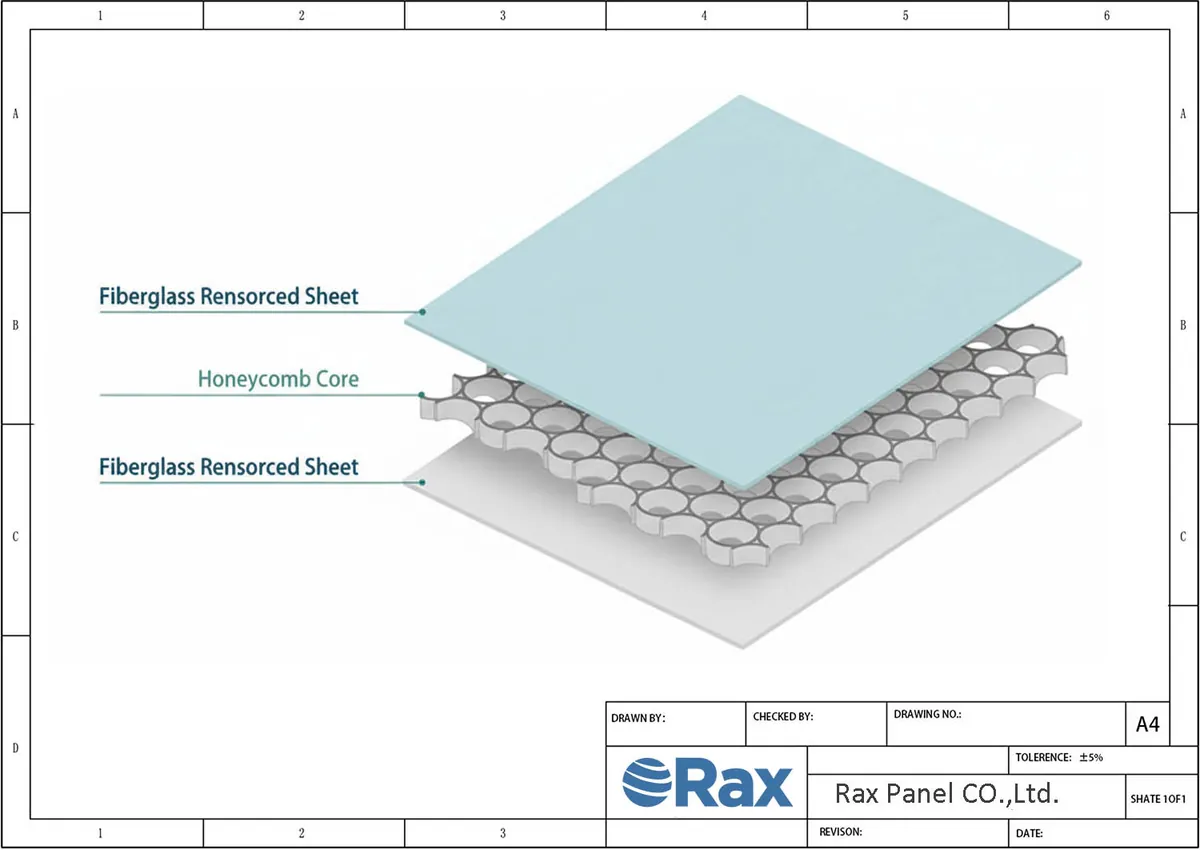
A sandwich panel is an engineered assembly of three bonded layers: two thin, stiff outer skins and a thicker, low-density core between them. The FRP honeycomb panel applies this principle by using FRP as the skins and a honeycomb-structured core—commonly polypropylene (PP)—as the separator.
The mechanics follow the same logic as an I-beam. In an I-beam, the flanges resist bending while the web holds them apart and resists shear. In a sandwich panel, the FRP skins act as the flanges and the honeycomb core acts as the web, keeping the strong skins at a fixed distance from the panel’s neutral axis.
This separation is the entire purpose of the design. Under classic beam mechanics, bending stiffness scales with the cube of section thickness (h³). By placing dense, strong FRP at the outermost fibers—where it contributes most to the moment of inertia—and filling the interior with a honeycomb that is largely air, the panel achieves stiffness-to-weight ratios that a solid sheet of the same skin material cannot match.
In our production process, we bond these layers under controlled heat and pressure to guarantee continuous skin-to-core adhesion. Bond integrity is the governing factor in any sandwich structure: if the core cannot transfer shear to the skins, the geometric advantage collapses and the panel fails in delamination rather than in the FRP itself.
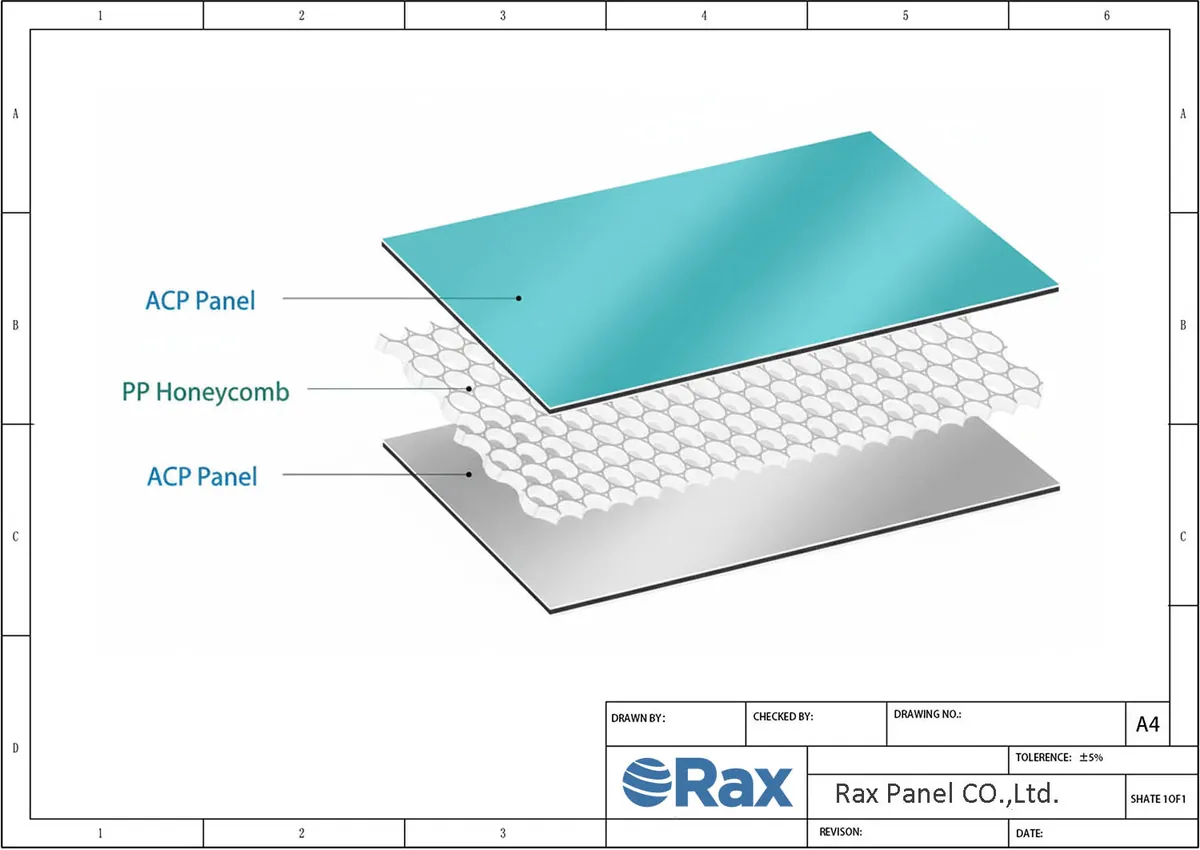
Panel Structure and Core Materials Explained
The structural integrity of any composite panel relies entirely on matching the correct facing sheet with the right core geometry. Selecting the wrong combination compromises both manufacturing efficiency and long-term project viability.
The Role and Variations of FRP Facing Sheets
In a sandwich panel, the facing sheets act as the primary structural armor. Think of the core as the soft inside of an Oreo cookie and the facing sheets as the hard outer wafers. The skins absorb the tensile and compressive forces, while the core simply keeps the two skins spaced apart to maximize bending stiffness. Without high-quality facing sheets, the internal core structure easily fails under load.
Fiber Reinforced Polymer (FRP) sheets dominate the market because they offer massive impact resistance without adding excess weight. However, not all outer skins are created equal. For applications requiring a high-gloss, impermeable surface—such as marine hulls or refrigerated truck exteriors—manufacturers apply a gel coat during lamination. This specialized coating chemically bonds to the resin, creating a waterproof barrier that prevents osmotic blistering.
Alternatively, Continuous Fiber Reinforced Thermoplastic (CFRT) sheets are rapidly replacing traditional options. In our production facility, we consistently see CFRT skins outperform standard materials in cold-weather environments because they resist micro-cracking far better than rigid thermoset plastics.
Comparing PP Versus Aluminum Honeycomb Core Types
Choosing between Polypropylene (PP) and Aluminum honeycomb cores is the most common material selection hurdle for B2B buyers, and the decision directly dictates application performance. Aluminum honeycomb features a metallic cellular structure that provides massive uniaxial compressive strength and excellent fire retardancy. It remains the gold standard for architectural building facades and aerospace interiors where strict fire codes and extreme load-bearing requirements apply.
PP honeycomb, by contrast, is a thermoplastic synthetic resin. It does not match aluminum in sheer fire resistance, but it brings distinct mechanical advantages to commercial transportation. Polypropylene naturally absorbs impact energy and dampens structural vibrations. When a delivery truck drives over uneven terrain, an aluminum core transfers shock directly to the fasteners, whereas a PP core absorbs the road vibration.
Our engineering team regularly conducts lifecycle cost analyses for commercial fleet operators. We consistently find that while aluminum cores offer absolute structural rigidity, PP honeycomb cores extend the usable lifespan of vehicle flooring and wall panels by reducing fastener fatigue and preventing long-term shear delamination.
Differentiating Basic Thermoplastic and Thermoset FRP
Understanding the basic chemistry between thermoplastic and thermoset FRP prevents massive assembly line failures. These two materials might look identical to the naked eye, but they behave entirely differently when exposed to heat. Thermoset FRP undergoes an irreversible chemical cross-linking process during curing. Once the resin hardens, it forms a permanent shape that will not melt under high heat, offering superior dimensional stability in extreme thermal environments.
Thermoplastic FRP operates on a completely different physical principle. Instead of relying on a permanent chemical cure, it relies on temperature. When heated, the polymer chains loosen, allowing the material to be reshaped, vacuum-formed, or fully melted down for recycling. This fundamental difference dictates how factories must bond these panels to core materials.
- Thermoset Assembly: Requires the use of industrial liquid adhesives, vacuum bagging, and extended curing times to bond the skin to the core.
- Thermoplastic Assembly: Utilizes direct thermal bonding, melting the skin directly to the core without the need for separate chemical glues.
If your manufacturing workflow relies on rapid, automated edge-banding and heat-welding processes, thermoplastic materials eliminate the bottleneck of adhesive curing times entirely.
| Panel Category | Core Options | Facing Options | Key Characteristics | Common Applications |
|---|---|---|---|---|
| CFRT Sandwich Panel | XPS, PET, PU, PVC foam | CFRT (Continuous Fiber Reinforced Thermoplastic) | Lightweight, high strength-to-weight, recyclable | RV walls, vehicle manufacturing, industrial enclosures |
| GRP/FRP Sandwich Panel | Foam, plywood, balsa, honeycomb | GRP/FRP with optional gelcoat | Waterproof, corrosion resistant, dimensionally stable | Marine vessels, truck bodies, chemical environments |
| Foam Core Sandwich Panel | XPS, PET, PU, PVC, PMI, EPP, MPP foam | GRP, CFRT, aluminum, steel, ACP, plywood, stainless, Aluzinc | Thermal insulation, waterproof, ultra-lightweight | Refrigerated trucks, mobile homes, building cladding |
| PIR Core Sandwich Panel | PIR (Polyisocyanurate) foam | Steel, aluminum, fiberglass | Superior fire performance, low thermal conductivity | Cold storage, building walls, industrial insulation |
| Rockwool Core Sandwich Panel | Rockwool (mineral wool) | Steel, aluminum | A1 fire rating, acoustic insulation, non-combustible | Fire-rated partitions, industrial buildings, cleanrooms |
| PP Honeycomb Panel | PP (Polypropylene) honeycomb | Fiberglass sheets, GRP/FRP skins | Exceptionally strong, minimal weight, impact resistant | Truck flooring, RV furniture, public transit interiors |
| Fiberglass Honeycomb Panel | Fiberglass honeycomb | GRP/FRP, various composite skins | High stiffness, moisture resistant, stable under load | Marine decks, aviation interiors, structural platforms |
| Carbon Fiber Honeycomb Panel | Carbon fiber honeycomb | Carbon fiber composite skins | Maximum strength-to-weight ratio, premium rigidity | Aerospace, high-performance sports equipment, racing |
| Aluminum Honeycomb Panel | Aluminum honeycomb | Aluminum, ACP skins | Fire resistant, high compression strength, flat surface | Exterior wall cladding, architectural facades, cleanrooms |
| Thermoplastic Honeycomb Panel | Thermoplastic honeycomb | Thermoplastic composite skins | Fully recyclable, impact absorbent, reformable | Automotive interiors, eco-friendly construction, packaging |
| Aramid Honeycomb Panel | Aramid (Nomex-type) honeycomb | Carbon fiber, fiberglass, aramid composite skins | Outstanding toughness, fire self-extinguishing, lightweight | Aviation interiors, racing yachts, defense equipment |
| Aluminum Foam Core Panel | Aluminum foam | Aluminum sheets | Sound absorption, fireproof, energy absorbent | Industrial equipment, railway interiors, fire barriers |
| Anti-Skid Honeycomb Panel | PP or thermoplastic honeycomb | Textured GRP/FRP with anti-skid surface | Slip resistant, wear resistant, weatherproof | RV steps, truck flooring, marine walkways, loading ramps |
| HPL Compact Laminate Panel | Kraft paper resin composite | HPL decorative surface | Scratch resistant, hygienic, impact resistant | Wall cladding, laboratory surfaces, public facilities |
High Strength-to-Weight Ratio and Lightweight Design
Optimizing honeycomb core density is the key to maximizing the strength-to-weight ratio in composite panels. Balancing core rigidity with FRP facing integrity ensures massive weight reduction without sacrificing structural load-bearing capacity.
How Honeycomb Core Density Impacts Overall Weight
In composite engineering, core density—typically measured in kilograms per cubic meter (kg/m³)—directly dictates the final mass of a sandwich panel. The core’s primary job is simply to act as a spacer, keeping the two rigid FRP (Fiberglass Reinforced Polymer) facing sheets apart to maximize thickness without adding solid mass. Think of it like a cardboard shipping box: the internal wavy paper is mostly empty space, yet it makes the whole structure incredibly stiff.
When you decrease the density of a honeycomb core, you remove physical material and replace it with air (in the case of open-cell honeycombs like PP or aramid). However, there is a strict engineering limit to this weight reduction. If the density drops too low, the vertical cell walls of the honeycomb become too thin and risk buckling under pressure. This creates a domino effect where the entire panel fails under a load that it should theoretically withstand.
In our production facility, we map this exact threshold by engineering customized polypropylene (PP) and fiberglass honeycomb cores. Our lab tests focus heavily on commercial applications like dry freight truck bodies, where we specifically utilize high-strength PP honeycomb cores composited with fiberglass sheets. We do this because the carefully calculated density of the PP core actively resists the compressive forces that occur when heavy cargo shifts during transit, all while keeping the panel exceptionally light.
Balancing Structural Load-Bearing Capacity with Mass Reduction
Successfully balancing these opposing forces requires precise material matching. If the core material is too soft or its density is mismatched with the strength of the outer skins, the panel will fail at the bonding line under heavy loads. Our engineering team specifically addresses this by pairing our continuous fiberglass reinforced thermoplastic sheets with the exact density of the underlying honeycomb, ensuring the adhesive bond is stronger than the core itself.
- Core Shear Strength: The core must be dense enough to resist sliding forces so the top and bottom skins do not shift independently under weight.
- Compressive Stability: The honeycomb cell walls must be thick enough to prevent localized crushing when heavy, concentrated point loads are applied to the panel surface.
- Bonding Surface Integrity: The structural adhesive used must perfectly bridge the gap between the high-strength FRP skin and the lower-density core to prevent delamination.

Moisture and Corrosion Resistance Properties
Thermoset FRP honeycomb panels resist water absorption, chemical corrosion, and UV degradation far better than metals or wood, making them the default choice for sustained harsh-environment deployment where material failure is not an option.
Performance in High Humidity and Chemical Exposure Environments
One of the biggest concerns engineers raise when specifying composite panels is whether the material can survive decades of moisture, salt spray, and chemical contact without degrading. With thermoset FRP (Fiber Reinforced Polymer) honeycomb panels, the answer comes down to the fundamental chemistry of the skin material itself.
Unlike steel—which oxidizes and rusts—or aluminum—which suffers pitting corrosion in chloride-rich environments—thermoset fiberglass is electrically non-conductive and chemically inert. It simply does not participate in electrochemical corrosion reactions, regardless of how wet the surrounding environment gets.
The waterproofing performance of an FRP honeycomb panel actually operates on two layers. The first is the structural fiberglass skin itself, which is a dense, cross-linked polymer matrix that blocks water vapor transmission. The second is an optional gel coat surface treatment applied during manufacturing.
Think of the gel coat like the clear coat on a car—it creates a hard, smooth, non-porous barrier that sheds water, resists chemical staining, and prevents micro-cracks from forming on the panel surface. When both layers are combined, the panel achieves near-zero water absorption, which is why these panels are extensively used in marine vessel construction and refrigerated truck bodies where constant condensation and wash-down cycles are unavoidable.
Chemical resistance extends well beyond just water. Thermoset FRP panels hold up against a broad spectrum of industrial substances that would rapidly destroy coated metals or organic materials like plywood:
- Acids and alkalis: Resistant to common industrial chemicals including dilute sulfuric acid, caustic soda solutions, and cleaning agents used in food-grade transport.
- Saltwater and de-icing salts: No galvanic corrosion risk, making panels suitable for coastal marine applications and winter road conditions.
- Fuels and oils: The thermoset matrix resists penetration by diesel, gasoline, and hydraulic fluids encountered in transportation and heavy equipment.
- UV radiation: Gel-coated and specially treated surfaces resist yellowing, chalking, and embrittlement from prolonged sun exposure.
It is worth noting that the PP (polypropylene) honeycomb core inside these panels brings its own corrosion-resistant properties to the structure. PP is a thermoplastic resin known for excellent chemical stability—it does not rot, mold, or break down when exposed to moisture. So even if the panel edge is cut or damaged, the internal core material remains protected against water ingress and biological degradation, unlike paper-based honeycomb alternatives which can swell and collapse when wet.
Long-Term Durability and Dimensional Stability of Thermoset FRP
Dimensional stability refers to a material’s ability to maintain its original shape, size, and flatness over time despite exposure to fluctuating temperatures, humidity cycles, and mechanical stress. This is where thermoset FRP fundamentally outperforms both thermoplastic composites and traditional metals.
The reason lies in the curing process: once a thermoset resin undergoes cross-linking during manufacturing, those molecular bonds are permanent and irreversible. The material cannot be re-melted, re-shaped, or creep (slowly deform) under sustained load, even when the ambient temperature rises significantly.
In our experience manufacturing composite panels for clients across more than 50 countries, the long-term moisture performance of thermoset FRP is consistently validated in real-world deployment.
Our engineering team conducts experimental testing on panel samples to verify that dimensional change remains within acceptable data standards after accelerated humidity and temperature cycling. What we consistently find is that properly gel-coated thermoset FRP skins show negligible thickness swelling, no delamination from the honeycomb core, and no loss of structural rigidity even after prolonged environmental exposure simulations.
This is not a marginal improvement over steel or aluminum—it is a categorical difference in how the material ages. Steel requires ongoing protective coatings and eventually corrodes from the inside out. Thermoset FRP requires essentially none of that maintenance overhead, which is why life-cycle cost analyses for fleet operators and facility managers increasingly favor composite panels over metallic alternatives in corrosive or high-moisture service environments.
Thermal and Acoustic Insulation Performance
While fiberglass facings provide a durable exterior, true thermal and acoustic performance is dictated by the core. Selecting the correct core material—whether PP honeycomb or closed-cell foams like PU/PET—determines long-term energy ROI.
How Core Materials Dictate Insulation Performance
Thermal and acoustic management in composite panels is a matter of physics: disrupting heat transfer and absorbing sound vibrations. While standard polypropylene (PP) honeycomb cores excel at lightweight structural support and sound deadening, their open cellular geometry allows for minor convective heat loops. For applications where extreme temperature differentials exist, relying solely on a honeycomb core is an engineering compromise. To achieve high-grade thermal isolation, the industry shifts to closed-cell foam cores.
- PP Honeycomb Core: Excellent acoustic dampening. The thermoplastic structure effectively absorbs structural vibrations and road noise, outperforming metallic cores in sound deadening, making it ideal for dry freight and passenger transport.
- XPS, PET, and PU Foams: The gold standards for thermal resistance. These closed-cell structures trap inert gases, drastically lowering the panel’s overall thermal conductivity (K-value) and preventing condensation.
- Hybrid Engineering: Combining a structural PP honeycomb with a layer of PU or XPS foam to achieve both high shear strength and maximum thermal isolation in a single lightweight profile.
Energy Efficiency in Temperature-Controlled Spaces
For B2B fleet operators and modular housing manufacturers, the insulation value of a sandwich panel directly dictates operational ROI. In refrigerated truck bodies and cold chain logistics, thermal bridging is the enemy. When a panel utilizes a high-grade PU or XPS core paired with gel-coated FRP sheets, the refrigeration unit cycles significantly less frequently. This translates directly into reduced fuel consumption, lower mechanical wear on the compressor, and guaranteed payload integrity.
In our production facility, we do not use a one-size-fits-all approach to thermal sealing. Our engineering team calculates the precise density and thickness required for the core material based on the client’s specific operational climate.
A mobile home or reefer truck operating in the Middle East requires a completely different thermal threshold and UV reflective gel-coat formulation than one deployed in Northern Europe. By optimizing the interaction between the waterproof FRP facing and the closed-cell foam core, we actively eliminate thermal leaks, ensuring that the end-user’s HVAC systems operate at maximum efficiency without wasted energy.

Structural Durability and Dimensional Stability
Getting specifications right upfront avoids change orders during fabrication. Confirm thickness, facing material, joint type, and dimensional tolerances in writing before production begins.
Resistance to Warping and Environmental Degradation
Beyond thermal warping, environmental degradation also threatens structural stability through UV exposure and physical weathering. While the fiberglass fibers themselves are immune to UV damage, an exposed resin matrix can become brittle, leading to micro-cracking that compromises the skin’s flatness and structural integrity.
To prevent this, high-quality panels use specialized surface treatments. Gel coats or thermoplastic films act as a rigid, protective sacrificial layer, absorbing the thermal and UV impact. This ensures the underlying core geometry remains completely stable over years of environmental exposure.
Maintaining Structural Integrity Under Demanding Physical Loads
To maintain integrity under demanding physical loads, the panel relies on a high-modulus adhesive bond between the FRP skins and the cellular geometry of the core. When the panel experiences a heavy load or an impact—such as a worker stepping on a mobile home roof or cargo shifting against a truck wall—the force is instantly transferred across the FRP skin and dispersed over a wide area of the honeycomb walls.
This continuous structural support prevents localized buckling. The vertical columns of the honeycomb cells provide immense compressive strength, allowing the panel to absorb and distribute point loads without permanent deformation.
However, surviving a single heavy load is different from maintaining long-term integrity. In real-world applications, these panels face thousands of hours of continuous vibration and flexing cycles from moving vehicles or industrial machinery. Our laboratory testing consistently shows that when the adhesive layer is engineered to perfectly match the shear modulus of the core material, the panel can endure these cyclical dynamic loads without delaminating.
If the adhesive is too brittle, the continuous flexing will cause microscopic fractures at the skin-to-core interface; if it is too soft, the core and skins will move independently, eventually destroying the sandwich structure. Precision in this bond is what allows the panel to act as a single, unified structural member capable of handling rigorous physical demands.

Advantages Over Traditional Solid Materials
Engineered composite panels outperform traditional solid materials by separating bending stiffness from structural mass, fundamentally eliminating issues like thermal bridging in metals and organic rot in wood.
Lifecycle and Performance Advantages Compared to Solid Aluminum
Solid aluminum sheets have been a staple in commercial transportation, but they carry inherent physical penalties. Solid metal acts as a highly efficient thermal conductor, meaning it readily transfers outside heat directly into a truck body or mobile structure. Metal sheets also act as acoustic drums, amplifying road vibrations and engine noise into the cabin. From a structural lifecycle perspective, solid sheets must rely purely on their own material thickness to resist bending and impact forces.
In our engineering lab, we observe that solid aluminum frequently suffers from metal fatigue and denting under the dynamic point-loads typical of heavy-duty transport. When we build composite solutions, the mechanical approach changes entirely.
By bonding high-strength fiberglass skins to a structural PP honeycomb matrix, the panel achieves its bending stiffness through physical geometry—the distance between the two skins—rather than sheer material mass. This structural isolation prevents the permanent deformation that plagues solid metal sheets after repeated hard impacts, extending the service life of the vehicle body.
Rot-Resistance and Weight Benefits Compared to Plywood
Decades of reliance on plywood in RV wall construction and cargo flooring reveal a material whose organic structure introduces inherent failure mechanisms under real-world operating conditions. While it offers adequate initial screw-holding retention, its primary vulnerability is its organic nature. Wood fibers naturally absorb ambient moisture and liquids. Over repeated wet and dry cycles, plywood inevitably delaminates, warps, and fosters internal mold growth. This structural degradation forces fleet operators and mobile home manufacturers to replace wall sections and flooring long before the vehicle reaches the end of its mechanical life. For manufacturers seeking to break this replacement cycle, Rax Panel’s RV solutions and mobile home solutions offer a proven path away from wood substrates toward fully synthetic, moisture-proof composite alternatives.
Our manufacturing team regularly helps B2B clients transition their assembly lines entirely away from wood cores to synthetic thermoplastic alternatives. A polypropylene (PP) or closed-cell foam core is entirely hydrophobic. Because the base materials are polymers and glass, there is nothing for mold or fungus to consume, and the panels will never rot or swell when exposed to continuous humidity. The material simply ignores the moisture conditions that destroy traditional wood.
Replacing dense plywood with engineered honeycomb structures removes a massive amount of dead weight from the vehicle chassis. This mass reduction directly addresses the commercial buyer’s primary concern: balancing weight limitations with structural load-bearing capacity. By stripping out the heavy wood and replacing it with an air-filled honeycomb matrix, manufacturers immediately increase the legal payload capacity of the truck or RV, while simultaneously reducing daily fuel consumption and axle wear.
| Performance Metric | Rax Composite Solution | Traditional Solid Material | Engineering Benefit |
|---|---|---|---|
| Weight & Density Profile | Lightweight honeycomb cores (PP, Thermoplastic, Aluminum) and foam cores (PET, PMI, XPS) with GRP/CFRT skins | Dense solid metals (Steel, Aluminum) or heavy solid wood | Significantly reduces overall structural mass, directly increasing payload capacity and reducing energy consumption |
| Strength-to-Weight Ratio | High-strength carbon fiber and fiberglass reinforced skins with aramid honeycomb cores | Standard isotropic solid steel or monolithic solid FRP sheets | Delivers superior structural integrity and stiffness without the associated mass penalty of solid materials |
| Corrosion & Moisture Resistance | Waterproof gel-coated FRP sheets and thermoplastic HDPE facings | Untreated metals prone to oxidation or solid wood vulnerable to rot and warping | Ensures exceptional long-term dimensional stability in highly humid or chemically aggressive environments |
| Design Optimization & Customization | Tailored core-to-skin matrix combinations balancing specific stiffness and resilience | Uniform, monolithic material profiles with fixed mechanical properties | Allows precise engineering customization for stringent load-bearing and lightweight application demands |

Common Industrial and Commercial Applications
The specific choice between a PP honeycomb and a structural foam core directly dictates whether a panel is optimized for high-impact trailer flooring or thermally insulated architectural partitions.
Truck Bodies, Trailers, and Transportation Components
We consistently see logistics fleets maximizing their lifecycle ROI by transitioning from traditional aluminum or plywood to our composite assemblies. For temperature-sensitive logistics, the engineering focus shifts entirely to thermal bridging. In these scenarios, we engineer CKD (Completely Knocked Down) refrigerated truck bodies using high-density PU or XPS foam cores, completely wrapping the insulation in waterproof gel-coated FRP sheets to secure the cold chain.
- Dry Freight Bodies: PP honeycomb cores bonded to fiberglass sheets provide maximum payload capacity without sacrificing wall rigidity during transit.
- Refrigerated Transport: XPS and PU foam cores offer the strict thermal insulation required to maintain precise temperature zones.
- Trailer Flooring: High-density plywood or balsa wood cores are integrated into GRP panels to handle concentrated forklift and pallet loads.
Marine, Aerospace, and Architectural Building Partitions
When our engineering team develops custom solutions for marine vessels or architectural facades, material selection is driven by the specific environmental threat. For instance, PVC and PET foams offer an excellent balance of strength and weight for boat hulls, while aramid and aluminum honeycombs are favored in aerospace for their extreme compression strength. In modern commercial architecture, these same panels allow designers to erect massive, lightweight partitions that require far less structural steel framing to support.
- Marine Vessels: Waterproof GRP panels with PVC or balsa cores prevent waterlogging in hulls, bulkheads, and decks.
- Architectural Partitions: Aluminum composite and rockwool panels deliver fire-retardant, sound-dampening walls for commercial real estate.
- Aerospace & Transit: PMI foam and carbon fiber laminates provide extreme rigidity and vibration damping for interior cabin shells.
Conclusion
Look, here’s the bottom line for your dealership: FRP honeycomb panels aren’t just another SKU — they’re a margin opportunity if you position them right. The buyers calling you are confused between aluminum and fiberglass cores, and that’s exactly where you add value.
PP honeycomb cores win on moisture resistance and cost for transportation clients; aluminum cores dominate where fire ratings matter. Push the thermoset FRP angle for marine and chemical exposure applications — that’s where plywood and solid aluminum simply can’t compete on lifecycle ROI. Remember, every kilogram shed from a truck body translates to fuel savings your customer can actually calculate.
- Stock both PP and aluminum core variants — don’t let competitors capture the spec you’re missing
- Lead with CNC machining and edge-banding customization — assembly-ready panels command 15–25% price premiums
- Target RV, trailer, and marine sectors aggressively — 2026 demand for lightweight construction is outpacing supply
- Partner with a manufacturer offering 24/7 engineering support — like Rax Panel’s 15-year track record across 50+ countries, ensuring your bids win on technical credibility, not just price
Frequently Asked Questions
This factor has a direct bearing on project performance and long-term cost. Addressing it with specific data rather than general assumptions leads to better outcomes.
What applications use FRP honeycomb panels?
FRP honeycomb panels are widely adopted in industries that demand lightweight yet rigid structural solutions, including marine, transportation, recreational vehicles, and modular construction. Typical use cases include boat interiors, refrigerated truck bodies, RV wall systems, architectural cladding, and industrial partitions. Their inherent corrosion resistance and thermal insulation properties make them equally suitable for humid, chemically aggressive, and temperature-sensitive environments. This versatility allows engineers to specify FRP honeycomb panels across a broad spectrum of commercial and industrial projects.
How strong are FRP honeycomb panels?
FRP honeycomb panels deliver exceptional strength-to-weight performance due to their sandwich structure, where the core provides shear support while the fiberglass skins carry tensile and compressive loads. This engineered architecture allows the panels to resist bending, impact, and fatigue forces while remaining significantly lighter than solid laminate alternatives.
Mechanical properties can be further optimized by adjusting core density, cell size, and skin thickness during the design phase. As a result, these panels frequently outperform monolithic materials of equivalent weight in structural applications.
What core materials are used?
FRP honeycomb panels typically incorporate polypropylene (PP), aluminum, aramid, or thermoplastic honeycomb cores as the structural intermediary between fiberglass skins. Each core material offers distinct advantages in stiffness, weight reduction, thermal insulation, and cost efficiency. PP honeycomb cores are particularly valued for their excellent strength-to-weight ratio and resistance to moisture absorption. The choice of core material is determined by the mechanical loads, operating environment, and weight constraints of the target application.
How are FRP honeycomb panels manufactured?
FRP honeycomb panels are produced through a lamination process in which fiberglass reinforced sheets are bonded to a honeycomb core under heat and pressure. The fiberglass skins are typically formed using continuous compression molding, pultrusion, or hand lay-up techniques, depending on volume and performance requirements. The core is then sandwiched between the cured skins using structural adhesive and consolidated in a heated press or vacuum bagging system. Stringent quality control during lamination ensures uniform bond strength and consistent dimensional accuracy.
Can FRP honeycomb panels be customized?
FRP honeycomb panels offer extensive customization options, including dimensions, core type, skin thickness, surface finish, and color specification. Engineers can tailor the material composition to meet precise performance targets such as flexural stiffness, thermal conductivity, fire resistance, or acoustic dampening. Custom cutting, edge sealing, and embedded mounting features can also be incorporated during the manufacturing process. This adaptability makes FRP honeycomb panels suitable for highly specialized applications across multiple industries.