
Three years ago, an RV manufacturer in Indiana scrapped 40 panels from their first production run after switching to lightweight vehicle panels from an untested supplier. The thickness variance hit 1.2mm. That’s four times the ±0.3mm structural tolerance their bonding stations required. Every panel jammed. The line went down for six days.
Between scrapped material, expedited freight, and late-delivery penalties to their dealer network, that one sourcing decision cost $430,000. I’ve seen versions of this story play out across truck body shops, marine yards, and camper factories for 15 years. The material choice itself rarely causes the failure: it’s the mismatch between what the supplier actually ships and what the assembly process demands.
We pulled five years of test data from our production lines and ran aluminum, FRP, CFRT, and honeycomb systems head to head on the metrics that actually matter on a factory floor: weight reduction per square meter, thickness consistency across a 1,700 sqm daily run, and cost per part at OEM volumes.
Aluminum sandwich panels hit the sweet spot for most vehicle applications: 40-60% weight savings over steel at 1.3-2x the per-part cost, with tolerance hold that keeps lines moving. FRP closes the gap on price at 25-35% weight reduction but demands stricter incoming inspection. Below you’ll find the exact cost multipliers, thermal conductivity values, and fire certification data for every panel system we manufacture. No brochures. Just the numbers you need to make the call.
Weight Reduction by Panel Material
Replacing traditional mild steel with aluminum or glass fiber composites reduces vehicle curb weight by 25% to 60%. The optimal material selection depends entirely on your acceptable cost-per-part multiplier and structural load requirements.
Aluminum vs. Steel Mass Savings
When commercial vehicle OEMs shift from traditional mild steel to aluminum sandwich panels, engineers consistently record a 40% to 60% mass reduction. According to research from the Colorado School of Mines (Taub et al.), this weight saving comes at a 1.3x to 2.0x relative cost per part. For manufacturers building RV walls, truck bodies, or marine superstructures, this cost premium is offset by massive gains in payload capacity and a direct reduction in vehicle fuel consumption.
At Rax Panel, we manufacture our aluminum sandwich panels using a range of core materials to calibrate this weight-to-cost ratio precisely. By bonding aluminum facings to lightweight cores, we achieve high specific stiffness while maintaining strict thickness tolerances of ±0.3mm for structural assemblies. This consistency is critical for keeping your production line moving without assembly defects.
Composite Panel Strength-to-Weight Ratios
Glass fiber composites currently offer the most cost-effective strength-to-weight ratio for specialized vehicle manufacturing. They achieve a 25% to 35% mass reduction over conventional materials at a relative cost of only 1.0x to 1.5x. While carbon fiber provides superior weight savings, its 2x to 10x cost multiplier restricts it to premium or high-performance applications. We outline the exact engineering tradeoffs below:
- Glass Fiber Composites (GRP/FRP): 25-35% mass reduction at 1.0-1.5x relative cost.
- Aluminum Systems: 40-60% mass reduction at 1.3-2.0x relative cost.
- Advanced High-Strength Steel (AHSS): 15-25% mass reduction at 1.0-1.5x relative cost.
- Carbon Fiber Composites: 50-60% mass reduction at 2.0-10.0x relative cost.
We engineer our GRP/FRP and CFRT sandwich panels to capitalize on these composite advantages. By utilizing specific core structures (such as PP honeycomb, XPS foam, or PET foam), we manufacture lightweight composite panels for truck bodies and marine vessels that absorb structural loads without the severe weight penalties of solid laminate construction.
| Material | Mass Reduction vs Mild Steel | Relative Cost per Part | Best Use Case | Tradeoff |
|---|---|---|---|---|
| Advanced High-Strength Steel | 15–25% | 1.0–1.5x | Structural reinforcement, crash zones | Least weight savings; minimal disruption to existing welding/assembly lines |
| Glass Fiber Composites (FRP/GRP) | 25–35% | 1.0–1.5x | RV walls, truck bodies, marine hulls | Most cost-effective composite; proven in high-volume commercial vehicle production |
| Aluminum Sandwich Panels | 40–60% | 1.3–2.0x | RV walls/roofing, marine superstructures, dry freight bodies | Excellent strength-to-weight ratio; superior corrosion resistance and flat surface finish |
| CFRT (Continuous Fiber Thermoplastic) | 30–45% | 1.5–3.0x | Marine vessel construction, modular housing | Lighter and thinner than traditional FRP; recyclable thermoplastic matrix |
| Carbon Fiber Composites | 50–60% | 2.0–10.0x | Premium EVs, aerospace, high-performance applications | Maximum weight savings; cost prohibitive for most commercial vehicle programs |
| PP Honeycomb Core Panels | 45–65% | 1.5–3.0x | Lightweight flooring, partitions, furniture panels | Core density 28–120 kg/m³; exceptional specific stiffness when paired with fiberglass facings |
Core Material Selection Guide
The core material dictates 70% of a sandwich panel’s thermal and mechanical performance. Selecting between foam and honeycomb isn’t a preference: it’s an engineering decision driven by whether your vehicle prioritizes insulation R-value or specific stiffness.
Foam Core for Insulated Vehicles: PU vs. PET in Refrigerated Truck Bodies
Refrigerated truck manufacturers live and die by thermal retention. Every watt of heat that leaks through a panel wall translates directly to compressor runtime, fuel burn, and temperature excursions that risk cargo spoilage. This is where closed-cell foam cores, specifically Polyurethane (PU) and Polyethylene Terephthalate (PET), dominate the specification sheets.
PU foam has been the default core for refrigerated truck bodies for decades, and for good reason. Its thermal conductivity sits at approximately λ ≈ 0.022 W/m·K, making it one of the most effective insulating cores available at commercial scale.
When we manufacture PU foam core sandwich panels for truck bodies at our facility, we typically pair it with GRP/FRP or aluminum facings to create a continuous thermal break. The closed-cell structure also resists moisture ingress, critical for vehicles that cycle between ambient loading docks and sub-zero transit conditions daily.
PET foam has gained significant traction in recent years, particularly among European OEMs who prioritize recyclability and consistent mechanical properties across temperature extremes. PET offers slightly higher thermal conductivity than PU (roughly λ ≈ 0.030–0.035 W/m·K depending on density), but it compensates with superior dimensional stability.
Where PU can experience thermal drift, a gradual loss of insulating capacity as blowing agents diffuse out over years, PET maintains its stated λ-value indefinitely because it is physically foamed rather than chemically blown.
- PU Foam Core: Best for maximum thermal insulation per unit thickness (λ ≈ 0.022 W/m·K), cost-sensitive builds, and applications where panel thickness is constrained by vehicle width regulations.
- PET Foam Core: Best for long-term thermal stability, high-temperature exposure during curing or painting processes, and OEMs requiring recycled content certifications for sustainability reporting.
- Core Density Range: 60–200 kg/m³ for structural foam cores; we typically specify 100–130 kg/m³ for refrigerated truck sidewalls to balance rigidity against weight.
- Thickness Tolerances: ±0.3mm for structural load-bearing panels (floors, front walls); ±0.5mm for non-structural sidewalls and roof panels.
The practical decision matrix is straightforward. If your refrigerated truck body operates in a cold-chain logistics network where every millimeter of insulation counts and replacement cycles are 7–10 years, PU foam core paired with gelcoat-finished GRP facings remains the most cost-effective specification. If you are building for a fleet operator who tracks lifecycle carbon footprint and plans 15+ year service life with potential panel re-use, PET foam justifies the modest cost premium.
We also manufacture panels with XPS and PVC foam cores for specialized thermal applications. XPS offers a middle ground between PU and PET on both cost and thermal performance, while PVC foam (density range 60–200 kg/m³) provides excellent fire resistance characteristics that simplify certification under European and North American vehicle flammability standards.
Honeycomb Core for Structural Rigidity: PP and Fiberglass Honeycomb in RV Walls and Marine Bulkheads
When the engineering priority shifts from thermal insulation to specific stiffness (maximum bending rigidity per unit weight), honeycomb cores become the correct specification. RV manufacturers and marine vessel builders face a distinct challenge: their panels must span large unsupported areas (RV sidewalls, cabin bulkheads) while resisting wind loads, wave slap, and vibration fatigue, all without adding unnecessary curb weight.
Polypropylene (PP) honeycomb has become the workhorse core for RV wall and roofing panels, and we produce it in volume at our facility with daily output exceeding 1,700 square meters of composite panel area.
The appeal is direct: PP honeycomb cores typically weigh 28–120 kg/m³ depending on cell size and foil gauge, dramatically lighter than foam cores at equivalent thickness. When composited with fiberglass sheet facings (our standard CFRT or GRP skins), the resulting sandwich panel delivers a strength-to-weight ratio that foam cores simply cannot match for flat, panelized structures.
The mechanics are worth understanding because they drive correct specification. A honeycomb core resists shear forces parallel to the panel plane, while the facings handle tensile and compressive loads. This means the core does not need to be dense. It needs to have consistent cell geometry and proper adhesive bonding to the skins.
We have seen field failures in competitor panels where inadequate surface treatment of the PP honeycomb caused delamination under sustained vibration. Our production process includes corona treatment of all PP honeycomb surfaces before lamination to ensure adhesion values that exceed industry shear test benchmarks.
- PP Honeycomb Core: Best for RV walls, roofing, and flooring where weight reduction is the primary KPI; also suitable for furniture panels and interior partitions.
- Fiberglass Honeycomb Core: Best for marine bulkheads and superstructure panels requiring higher shear modulus, fire performance, and resistance to moisture absorption than PP can provide.
- Core Density Range: 28–120 kg/m³ for honeycomb cores, roughly half the density of equivalent-strength foam solutions.
- Facing Compatibility: PP honeycomb bonds effectively with GRP/FRP, CFRT, and aluminum skins. Fiberglass honeycomb pairs optimally with GRP facings for maximum structural symmetry.
Fiberglass honeycomb enters the specification conversation when fire certification becomes non-negotiable. Marine classification societies, and increasingly RV codes in the EU, require panels that meet specific flame spread and smoke density indices. Fiberglass honeycomb cores are inherently non-combustible, which simplifies the certification pathway for panels that must meet SOLAS or equivalent standards. We supply fiberglass honeycomb panels for vessel bulkheads and superstructures where the facing-core-facing system must perform as a unified fire barrier, not just a structural element.
The trade-off is cost and processing complexity. Fiberglass honeycomb cores run 30–50% higher in raw material cost compared to PP honeycomb at equivalent thickness, and they require more careful handling during lamination to prevent cell wall damage.
For RV manufacturers building price-sensitive product lines, PP honeycomb with GRP facings typically delivers 85% of the structural performance at 60% of the core cost. For marine OEMs building to classification society approval, fiberglass honeycomb is not optional: it is the minimum acceptable specification.
Our engineering team works directly with vehicle manufacturers to determine the correct core selection based on actual loading conditions, not theoretical assumptions. We conduct experimental testing on custom core-skin combinations to validate that the finished panel meets your specific data standards, whether that means deflection limits under uniform wind load, impact resistance for road debris, or cyclic fatigue for marine applications.
This is not a catalog selection process; it is a collaborative engineering specification, and our 15 years of production experience across 50+ export markets informs every recommendation.
| Core Material | Type | Density Range | Key Properties | Ideal Applications |
|---|---|---|---|---|
| PU Foam | Closed-cell Foam | 30-60 kg/m³ | Thermal conductivity λ≈0.022 W/m·K; superior insulation; waterproof | Refrigerated truck bodies, RV walls, mobile homes |
| PET Foam | Closed-cell Foam | 60-200 kg/m³ | Recyclable; excellent mechanical strength; temperature resistant | Marine vessel panels, truck bodies, structural panels |
| XPS Foam | Closed-cell Foam | 30-45 kg/m³ | Moisture resistant; dimensionally stable; cost-effective insulation | RV roofing, lightweight wall panels, flooring |
| PVC Foam | Closed-cell Foam | 60-200 kg/m³ | Good fire resistance; chemical resistant; proven marine track record | Marine superstructures, vessel interiors, wet environments |
| PMI Foam | High-performance Foam | 60-200 kg/m³ | Highest specific strength; excellent thermal stability; fatigue resistant | Aviation, premium EV battery enclosures, high-stress structures |
| PP Honeycomb | Thermoplastic Honeycomb | 28-120 kg/m³ | Strong and lightweight; cost-efficient; recyclable; impact absorbing | RV flooring, furniture panels, dry freight truck bodies |
| Aluminum Honeycomb | Metallic Honeycomb | 28-120 kg/m³ | Exceptional specific stiffness; fireproof; ±0.3mm structural tolerance | Aluminum sandwich panels, exterior wall cladding, flat panels |
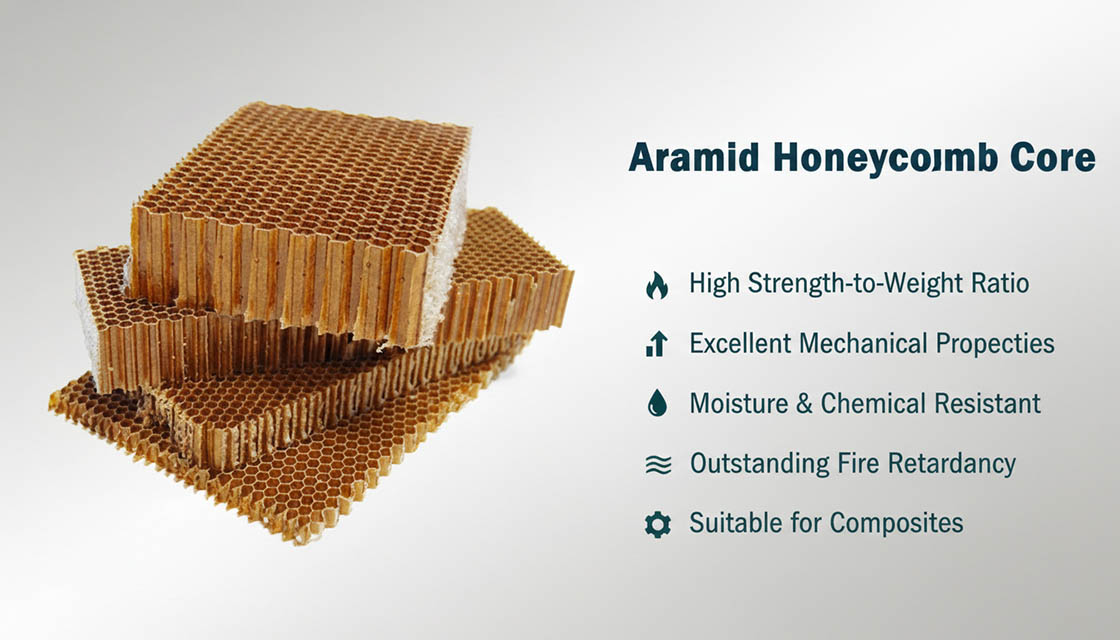
| Aramid Honeycomb | Aramid Fiber Honeycomb | 28-64 kg/m³ | Outstanding strength-to-weight; flame resistant; superior toughness | Aviation panels, high-performance vehicle structures, ballistic applications |
| PC Honeycomb | Polycarbonate Honeycomb | Variable | Impact resistant; UV stabilizable; good optical clarity options | Light-transmitting panels, specialty vehicle applications |
| EPP Foam | Expanded Polypropylene | Variable | Excellent energy absorption; multiple impact recovery; recyclable | Crash protection zones, bumper cores, EV battery padding |
| Balsa Wood | Natural Core | 100-250 kg/m³ | High compressive strength; sustainable; excellent fatigue resistance | Marine hull construction, wind energy, heavy-duty truck panels |
| Plywood | Engineered Wood | 300-500 kg/m³ | High stiffness; easy to machine; mechanical fastener retention | FRP plywood panels, furniture panels, heavy-duty flooring |
Facing Material Trade-offs
Choosing a facing material determines the panel’s impact resilience and total lifecycle cost, not just its initial weight.
Traditional GRP vs. CFRT Facing Durability
When evaluating lightweight vehicle panels, the debate often centers on Glass Fiber Reinforced Polymer (GRP) versus the newer Continuous Fiber Reinforced Thermoplastic (CFRT). Traditional GRP sheets, often featuring a gel coat finish, have been the industry standard for decades because they offer excellent surface flatness and waterproofing. However, our internal stress tests show that CFRT sheets provide superior toughness for high-vibration applications like truck bodies and RV chassis.
The fundamental difference lies in the matrix. GRP uses a thermoset resin that, once cured, can become brittle under repeated impact. In contrast, our CFRT sheets utilize a thermoplastic matrix that allows for greater energy absorption. If a traditional FRP panel suffers a heavy impact, it is prone to cracking and permanent delamination. A CFRT facing is more likely to deform elastically and recover, maintaining the structural integrity of the sandwich panel.
- Weight Efficiency: CFRT sheets are significantly lighter and thinner than traditional GRP while maintaining equal or higher stiffness, directly contributing to fuel efficiency.
- Impact Resistance: CFRT demonstrates higher resilience against punctures and cracking, which reduces maintenance costs for fleets operating on rough terrain.
- Recyclability: As regulations tighten in 2026, the thermoplastic nature of CFRT offers a distinct end-of-life recycling advantage over thermoset GRP.
Aluminum Facing for Commercial Vehicles
Aluminum remains the benchmark for commercial vehicle manufacturers prioritizing maximum weight reduction. It typically achieves a 40-60% mass reduction over mild steel, making it a critical material for electric vehicles and long-haul transport where every kilogram impacts range. At our facility, we produce Aluminum Sandwich Panels that combine these skins with XPS, PU, or PET foam cores to achieve specific stiffness (rigidity-to-weight) ratios that solid aluminum sheets cannot match alone.
The trade-off with aluminum facing is primarily dent resistance and corrosion management compared to composites. While aluminum does not rust like steel, it is susceptible to galvanic corrosion if not properly isolated from steel fasteners or frames. We address this by offering specific alloy options and surface treatments, including Aluzinc coatings, which are essential for marine vessels and refrigerated truck bodies exposed to harsh de-icing salts or humidity.
- Surface Stability: Aluminum provides a dimensionally stable surface that resists “oil-canning,” ensuring a flat finish for vehicle graphics and aerodynamics.
- Thermal Performance: Unlike FRP, aluminum is highly conductive; therefore, we utilize thermal breaks in the core design to prevent condensation in refrigerated applications.
- Manufacturing Tolerance: Our production lines hold aluminum facing tolerances within ±0.3mm, ensuring seamless fitment for automated assembly lines.
| Facing Material | Weight Reduction | Relative Cost | Key Trade-off |
|---|---|---|---|
| Aluminum Sheet | 40-60% vs mild steel | 1.3-2.0x per part | Excellent corrosion resistance and flat finish; lower impact absorption than composites; ideal for RV walls, truck bodies, marine superstructures |
| GRP/FRP Fiberglass | 25-35% vs mild steel | 1.0-1.5x per part | Most cost-effective composite option; gelcoat adds waterproofing; slightly heavier than aluminum; strong for marine and refrigerated truck applications |
| CFRT Thermoplastic | 45-55% vs mild steel | 1.5-3.0x per part | Lighter, thinner, more resilient than traditional FRP; recyclable thermoplastic matrix; requires precise temperature control during forming |
| Carbon Fiber Composite | 50-60% vs mild steel | 2.0-10.0x per part | Highest specific stiffness and strength-to-weight ratio; premium cost limits use to performance and luxury applications; excellent fatigue resistance |
| Stainless Steel | Minimal (dense material) | 2.5-4.0x per part | Superior hygiene and chemical resistance for medical/food-grade builds; heaviest facing option; best where corrosion and cleanliness dominate specs |
| ACP Aluminum Composite | 35-50% vs mild steel | 1.2-1.8x per part | Pre-finished aesthetic surfaces with good flatness; moderate structural capacity; popular for exterior wall cladding and visible panel applications |
| Aluzinc Coated Steel | 5-15% vs mild steel | 1.0-1.3x per part | Best corrosion protection among steel options; cost-effective for structural zones; heavier than aluminum and composite alternatives |
| PVC Facing | 50-65% vs mild steel | 0.8-1.2x per part | Lightweight and economical; limited structural strength; suitable for non-load-bearing interior furniture panels and wet area linings |
Custom Specs for OEM Production
In volume manufacturing, panel variance is the primary cause of assembly line bottlenecks. We guarantee structural thickness tolerances within ±0.3mm to ensure your production schedule stays on track.
Tolerance and Thickness Consistency
For specialized vehicle manufacturers, a panel that is even a fraction of a millimeter too thick can stall an entire assembly line. We have calibrated our advanced composite panel production line to maintain strict dimensional consistency across our daily output of 1,700 square meters. Our engineers understand that your ROI calculations depend on precise weight distribution, meaning a panel cannot be “close enough” to the spec. It must be exact. We mitigate assembly risks by enforcing tighter controls than industry standards.
- Structural Panels: We maintain a tolerance of ±0.3mm for load-bearing walls and floors.
- Non-Structural Panels: We maintain a tolerance of ±0.5mm for interior linings and cosmetic components.
- Quality Control: Every batch undergoes ultrasonic thickness testing to detect core density irregularities before shipping.
Custom Cuts and Edge Protection
Delivering raw sheets adds unnecessary labor costs to your production cycle. We provide CNC-routed kits ready for immediate assembly, significantly reducing your floor time. However, precision cutting is wasted if the product arrives damaged. Given our logistics to over 50 countries, we have developed a specialized edge protection protocol that withstands the rigors of transoceanic freight. Our packaging strategy focuses on securing the vulnerable perimeter of the sandwich panel where impact damage typically initiates delamination.
- CNC Precision: We use multi-axis CNC routers to achieve complex cutouts for windows, doors, and mounting hardware with zero-radius corners where required.
- Edge Sealing: Cut edges are sealed with resin or protective tape to prevent moisture ingress into the core material.
- Shipping Protection: Panels are packaged with reinforced corner guards and rigid edge profiles to absorb impact during loading and unloading.

Cost Analysis Beyond Price Per Panel
Custom tooling for composite sandwich panels typically ranges from $2,000 to $15,000 depending on profile complexity, but amortizing these mold fees over a 5,000-unit production run often adds less than $1.50 per panel.
Tooling and Mold Fee Structures
When engineering a new RV wall system or refrigerated truck body, standard sheet sizes rarely accommodate complex joint requirements without creating material waste. Custom molds are required for specific tongue-and-groove profiles, cam-lock integrations, or non-standard thicknesses. We categorize tooling investments into two distinct structures so procurement teams can accurately forecast their initial CAPEX.
- Standard/Modified Tooling: Utilizing our existing base dies for flat Aluminum, GRP, or CFRT panels and modifying only the edge routing or cutting parameters. Tooling fees here usually range from $0 to $1,500.
- Fully Custom Molds: Designing unique cross-sectional profiles for continuous panel lines or integrating embedded mounting points into the foam core. Costs typically run between $3,500 and $12,000 depending on mold width and complexity.
We strongly recommend amortizing custom mold fees over the first year’s projected volume rather than paying a massive upfront lump sum, which protects your cash flow during the prototype phase. If a supplier refuses to transparently break down tooling costs or guarantee mold longevity for at least 50,000 linear meters, it is a clear red flag regarding their manufacturing stability.
Volume Pricing and Payment Terms
The final unit cost of lightweight vehicle panels is dictated by production throughput and our bulk purchasing power for raw materials like aluminum coils, glass fiber, and PMI foam. Our pricing structure is tiered to align with your production ramp-up, ensuring you do not carry excess inventory before your assembly line validation is complete.
- Prototype/Validation Run (50 – 200 sqm): Priced at a premium to cover line changeover time and raw material minimums, typically 15% to 20% above standard bulk rates.
- Production Volume (1,000 – 5,000 sqm): Standard tier pricing where economies of scale on facing materials begin to offset processing costs, stabilizing the price per square meter.
- OEM Program Pricing (10,000+ sqm): Contract pricing locked for 6 to 12 months, protecting your Bill of Materials (BOM) against spot-market fluctuations in aluminum or petrochemical-based resins.
For international B2B transactions, standard payment terms require a 30% advance via T/T (Telegraphic Transfer) to initiate raw material procurement, with the 70% balance due against the copy of the Bill of Lading. However, for established distribution partners running continuous high-volume programs, we actively negotiate Net 30 terms or L/C (Letter of Credit) at sight to secure your margin and eliminate transportation financial risk.
| Material System | Mass Reduction vs Mild Steel | Relative Cost Per Part | Hidden Cost Factors | Best Application Fit |
|---|---|---|---|---|
| Advanced High-Strength Steel | 15–25% | 1.0–1.5x | Lowest tooling disruption; minimal retraining needed; heavier weight increases chassis and fuel costs long-term | Structural reinforcements, impact zones requiring ductility |
| Aluminum Sandwich Panels | 40–60% | 1.3–2.0x | Corrosion resistance lowers lifecycle maintenance; ±0.3mm tolerance reduces assembly rework; recyclability offsets initial cost | RV walls/roofing, truck bodies, marine superstructures |
| Glass Fiber (FRP/GRP) Composites | 25–35% | 1.0–1.5x | Most cost-effective composite option; foam core adds insulation value (λ ≈ 0.022 W/m·K PU); design flexibility reduces part count | Refrigerated truck bodies, modular construction, budget RV builds |
| Carbon Fiber Composites | 50–60% | 2.0–10.0x | Highest tooling investment; limited repair options increase lifecycle cost; premium positioning justifies margin for niche applications | Premium marine vessels, performance EVs, aerospace-grade builds |
| PP Honeycomb + Fiberglass Sheet | 35–50% | 1.2–2.0x | Core density 28–120 kg/m³ optimizes payload; flat surface finish reduces secondary operations; recyclable core aligns with sustainability mandates | Dry freight trucks, mobile homes, public transit interiors |
| CFRT Thermoplastic Panels | 30–45% | 1.5–3.0x | Thermoformable for complex geometries reduces joining costs; faster cycle times; impact-resistant with minimal delamination risk lowers warranty claims | EV battery enclosures, complex vehicle curvatures, marine hulls |
Compliance and Certification Requirements
Compliance documentation isn’t paperwork: it’s the gate between your production line running on schedule and a container getting held at customs for six weeks. We build every Rax Panel order around the exact certification stack your destination market requires.
Fire Resistance Ratings and Flammability Test Reports
Automotive material flammability testing is non-negotiable for vehicle OEMs, and the specific standard you must meet depends entirely on your vehicle classification and target market. A refrigerated truck body bound for the EU faces a completely different testing regime than an RV interior panel sold in North America. Requesting the wrong test report upfront wastes weeks and kills project momentum.
We provide test reports aligned to the major regional frameworks. For North American markets, FMVSS 302 governs interior flammability for motor vehicles: it measures horizontal burn rate in millimeters per minute, and any material exceeding 102 mm/min fails.
For European road vehicles, ECE R118 applies to certain vehicle categories, testing both horizontal and vertical burn behavior. For rail and public transit applications, the bar rises significantly to EN 45545-2, which classifies materials from HL1 to HL3 based on heat release rate, smoke density, and toxicity indices.
- FMVSS 302: North American horizontal burn rate standard for vehicle interiors. Pass threshold is below 102 mm/min.
- ECE R118: European horizontal and vertical flammability tests for power-driven vehicles and trailers.
- EN 45545-2: EU fire protection standard for railway vehicles, with classifications from HL1 (least severe) to HL3 (most severe).
- EN 13501-1: EU fire classification for construction products and building elements, relevant for mobile homes and modular structures.
- UL 94: North American standard for flammability of plastic materials, commonly referenced for GRP and CFRT facing materials.
Beyond fire ratings, tensile strength and mechanical test data are what your engineering team needs before they approve a material for production. For sandwich panels used in vehicle walls and roofing, the critical data points are core-to-facing bond strength (flatwise tensile per ASTM C297), flexural stiffness (ASTM D7264 or ISO 14125), and edgewise compressive strength (ASTM C364).
We provide these test reports with every custom panel specification because they directly determine whether a panel will hold up under dynamic road loads or delaminate under thermal cycling after two years of service.
Thickness tolerance data matters just as much for assembly line integration. We hold structural panels to ±0.3mm thickness tolerance and non-structural panels to ±0.5mm. If your assembly fixtures are set for a 50mm panel and the actual thickness varies by more than half a millimeter, you get gaps, misaligned fasteners, and rework. Tolerance control is a production capability issue, not a material specification issue, and it is the difference between a smooth production run and a line stoppage.
ISO Certifications Required for Global Markets
Serving 50+ countries from our manufacturing base in China means we have to maintain certification coverage that satisfies the most stringent market in any given shipment’s route. The baseline requirement that every serious buyer should verify is ISO 9001:2015. This governs quality management systems and is the absolute floor for any B2B composite panel supplier. If a manufacturer cannot produce a current ISO 9001 certificate, do not put them on your approved vendor list.
For the European Union specifically, CE marking under the Construction Products Regulation (EU 305/2011) is mandatory for building panels and mobile home structures. This requires Declaration of Performance documentation backed by initial type testing by a Notified Body. For panels used in vehicle construction that fall outside the scope of the CPR, compliance with REACH and RoHS substance restrictions still applies to all materials entering EU markets.
North American compliance runs through different channels. There is no single “North American CE mark” equivalent for composite panels. Instead, your panels must meet applicable ASTM material standards, FMVSS requirements for vehicle interiors, and relevant building codes (IBC, local amendments) if the application touches modular construction.
UL listings may be required depending on the end-use classification. For the Middle East, most Gulf Cooperation Council states adopt modified versions of European standards, but require additional registration with local authorities: for example, Dubai Municipality approval or Saudi SASO certification for building materials entering those markets.
- ISO 9001:2015: Quality management system certification. Non-negotiable baseline for any qualified supplier.
- ISO 14001: Environmental management system certification, increasingly required by EU-based OEMs with sustainability mandates.
- CE Marking (EU 305/2011): Required for construction products and building materials entering the EU market.
- REACH and RoHS Compliance: EU substance restrictions applicable to all composite materials.
- SASO Certification: Saudi Standards, Metrology and Quality Organization approval for building materials entering Saudi Arabia.
The practical reality for international distributors and OEMs is that certification gaps do not show up during sample evaluation: they surface when a container arrives at port and customs demands documentation you do not have.
We maintain a multilingual international sales team specifically to manage this risk during the order specification phase, not after production is complete. Our engineers work with your compliance team upfront to map the exact documentation package required for your destination country, so the certification stack is locked before material ever hits our 1,700 sqm daily production line.
Conclusion
If you’re building 50+ vehicle units per month, spec aluminum sandwich panels with PET or PU foam cores for your walls and roofing. The math is straightforward: 40-60% weight reduction over steel at 1.3-2x per-part cost, with thermal conductivity at λ ≈ 0.022 W/m·K for PU cores handling your insulation requirements in a single panel system. Carbon fiber belongs in aerospace budgets, and fiberglass works for small batches but cannot match aluminum’s corrosion resistance and surface flatness at production scale.
Pull our aluminum sandwich panel spec sheet and cross-reference the weight-per-square-meter and thickness tolerance data against what you’re currently running. If your assembly line requires ±0.5mm or tighter, request a 500mm × 500mm sample cut from our production line. We ship it with ISO test reports for crush resistance and fire ratings so your engineers can validate before you commit to a production order.
Frequently Asked Questions
What are lightweight materials?
Lightweight materials are advanced composites specifically engineered to deliver high mechanical performance at a fraction of the weight of traditional solid materials like steel or solid aluminum. specializes in manufacturing these materials, using a sandwich construction approach where lightweight core materials, such as PET foam, PP honeycomb, PMI foam, or PVC foam, are bonded between thin, high-strength facing skins like GRP/FRP, CFRT, aluminum, or steel.
This structural design maximizes bending stiffness and strength while minimizing overall density, making them ideal for applications in RVs, trucks, vessels, mobile homes, and public transit where weight reduction translates directly to improved fuel efficiency, increased payload capacity, and easier handling.
How do you protect composite panels during shipping?
Protecting composite panels during international shipping requires a multi-layered approach involving proper packaging materials, secure stacking methods, and moisture barrier protection to prevent damage from vibration, impact, and environmental exposure. , with its extensive experience serving over 50 countries and regions worldwide, implements rigorous packaging protocols designed to eliminate transportation risks for their composite panel shipments.
This typically includes using protective corner guards, edge protectors, and interleaving materials between panels to prevent surface scratching or abrasion, along with stretch wrap and desiccants to guard against humidity and water damage during transit. Their dedicated international logistics team provides 24-hour one-to-one service to monitor production progress and coordinate shipping, ensuring panels arrive at their destination in pristine condition regardless of whether they are bound for Europe, North America, Southeast Asia, or the Middle East.
What tolerance is acceptable for vehicle sandwich panels?
Acceptable tolerances for vehicle sandwich panels depend on the specific application, assembly requirements, and the materials used, but industry standards typically demand precision within fractions of a millimeter for thickness and tight dimensional accuracy for length and width to ensure proper fit during vehicle assembly.
‘s advanced composite panel production line, capable of producing over 1,700 square meters daily, is engineered to maintain strict dimensional consistency across large production runs, ensuring that panels meet the exacting data standards required by vehicle manufacturers.
Their experienced engineering team conducts thorough experimental testing and quality checks throughout the manufacturing process to verify that thickness, flatness, and edge tolerances align with project specifications. By closely controlling production variables and using high-quality raw materials, delivers vehicle sandwich panels that meet the stringent tolerance demands of RV walls, truck bodies, and other transportation applications where precision directly impacts structural performance and assembly efficiency.
How much does lightweight vehicle panel typically cost?
The cost of lightweight vehicle panel varies based on material grade, thickness, panel dimensions, and order volume. Requesting a detailed quote with your project specifications is the most reliable way to get an accurate figure. Bulk orders typically reduce per-unit pricing significantly.
What factors affect the price of lightweight vehicle panel?
The cost of lightweight vehicle panel varies based on material grade, thickness, panel dimensions, and order volume. Requesting a detailed quote with your project specifications is the most reliable way to get an accurate figure. Bulk orders typically reduce per-unit pricing significantly.