
A standing seam panel system looks clean on a spec sheet. One line item, one trade, done. Then the change orders hit. A fleet buyer called us last month after his truck roof assembly ballooned to 18.4 kg/m²: he’d spec’d a metal profile with separate deck, vapor barrier, and insulation layers, blowing past his weight target by 3.2 kg/m² on every unit. That’s the trap. The material price looks competitive until you account for everything hiding behind it.
We pulled test data from 47 projects where teams faced this same choice. Standing seam wins on curved profiles and retrofit work. Period. IMPs win on installed cost, thermal performance, weight, and speed. These are the metrics that decide whether your project finishes on budget or lands on someone’s desk for an explanation. Below we lay out the exact numbers so you can make the call before your budget review, not after a failed inspection.
What Is a Standing Seam Panel
A standing seam panel is a concealed-fastener metal roof system where interlocking seams sit above the panel surface. It provides weather protection only: zero inherent thermal insulation.
Concealed-Fastener Design: How the Profile Works
Unlike exposed-fastener corrugated profiles (R-panel, U-panel), standing seam systems hide all mechanical attachments beneath interlocking ribs. The panels clip or snap together along raised longitudinal seams that typically measure 1 to 2 inches in height. This eliminates thousands of through-penetration points that become leak risks over time. Fasteners attach to the structural deck via concealed clips, not by screwing directly through the panel face.
Our engineering team regularly evaluates standing seam profiles for vehicle and building applications. The concealed-fastener approach delivers excellent weather resistance: properly seamed systems sustain wind uplift up to 140 mph. But architects and procurement teams must understand one reality: the standing seam panel is a single-skin weather barrier. It stops rain and wind. It does not stop heat transfer.
Snap-Lock vs Mechanical Seam: Two Joining Methods
The industry divides standing seam systems into two distinct categories based on how the seams engage. The choice affects installation speed, equipment requirements, and dimensional flexibility.
- Snap-Lock Panels: The male and female edges interlock by hand pressure or a simple tapping tool. No seaming machine required. Installation is faster and requires less skilled labor. Snap-lock profiles can be curved to concave or convex radii with a minimum 9-foot radius, making them the standard choice for architectural curved roof applications.
- Mechanical Seam Panels: Panels are locked together then sealed with a motorized seamer that rolls the joint into a tight 90-degree or 180-degree fold. This creates a stronger, more consistent seam with higher wind uplift resistance. The trade-off: you need specialized equipment on site, and the process is slower.
For RV and truck body manufacturers, snap-lock systems are rarely the right engineering choice. Vehicle roofs demand structural stiffness across wide unsupported spans, a problem that single-skin standing seam cannot solve without adding a rigid deck underneath. This is where integrated sandwich panel construction delivers clear advantages.
Material Gauges: 22 to 26 Gauge (0.6mm–0.8mm)
Standing seam panels are manufactured from steel, aluminum, or sometimes zinc-coated coils. The typical thickness range runs from 22 gauge (approximately 0.76mm) at the heavy end to 26 gauge (approximately 0.55mm) at the light end. Most commercial specifications call for 24 gauge (0.63mm) steel or 0.032-inch aluminum as baseline.
Our production data at Rax Panel shows that insulated metal panels with 0.5mm to 0.8mm steel or aluminum facings, a gauge range comparable to standing seam, deliver significantly more structural rigidity per unit weight because the factory-bonded foam core (PU, XPS, or PET) acts as a continuous structural web. A 50mm foam core sandwich panel at 0.5mm facing thickness outperforms a 24-gauge standing seam panel in spanning capability without requiring a separate structural deck.
The Insulation Gap: Weather Barrier Only
This is the critical engineering reality that catches procurement teams off guard. A standing seam panel contributes an R-value of essentially zero to the building or vehicle envelope. It is a piece of shaped metal.
To achieve any thermal performance, you must add insulation as a completely separate system: typically rigid foam board, fiberglass batts, or spray foam applied between the structural deck and the panel. Each of these layers requires its own trade, its own installation schedule, and its own quality control process.
Our insulated composite panels deliver approximately R-5.5 to R-6.5 per inch of core thickness from the factory, depending on the core type. A 100mm PU foam core sandwich panel achieves R-20+ in a single, factory-bonded unit with integrated weather protection. There is no separate insulation contractor. No thermal bridging at clip attachments. That problem reduces standing seam effective R-value by 15-30% versus the labeled insulation value because each clip creates a thermal short circuit through the insulation layer.
For vehicle OEMs specifically, this distinction is decisive. Adding structural decking, vapor barriers, insulation layers, and underlayment beneath a standing seam roof adds weight and complexity that defeats the purpose of lightweight vehicle design. Foam core sandwich panels with GRP/FRP or aluminum facings solve the weather barrier, insulation, and structural span requirements in one engineered component.
What Is an Insulated Metal Panel
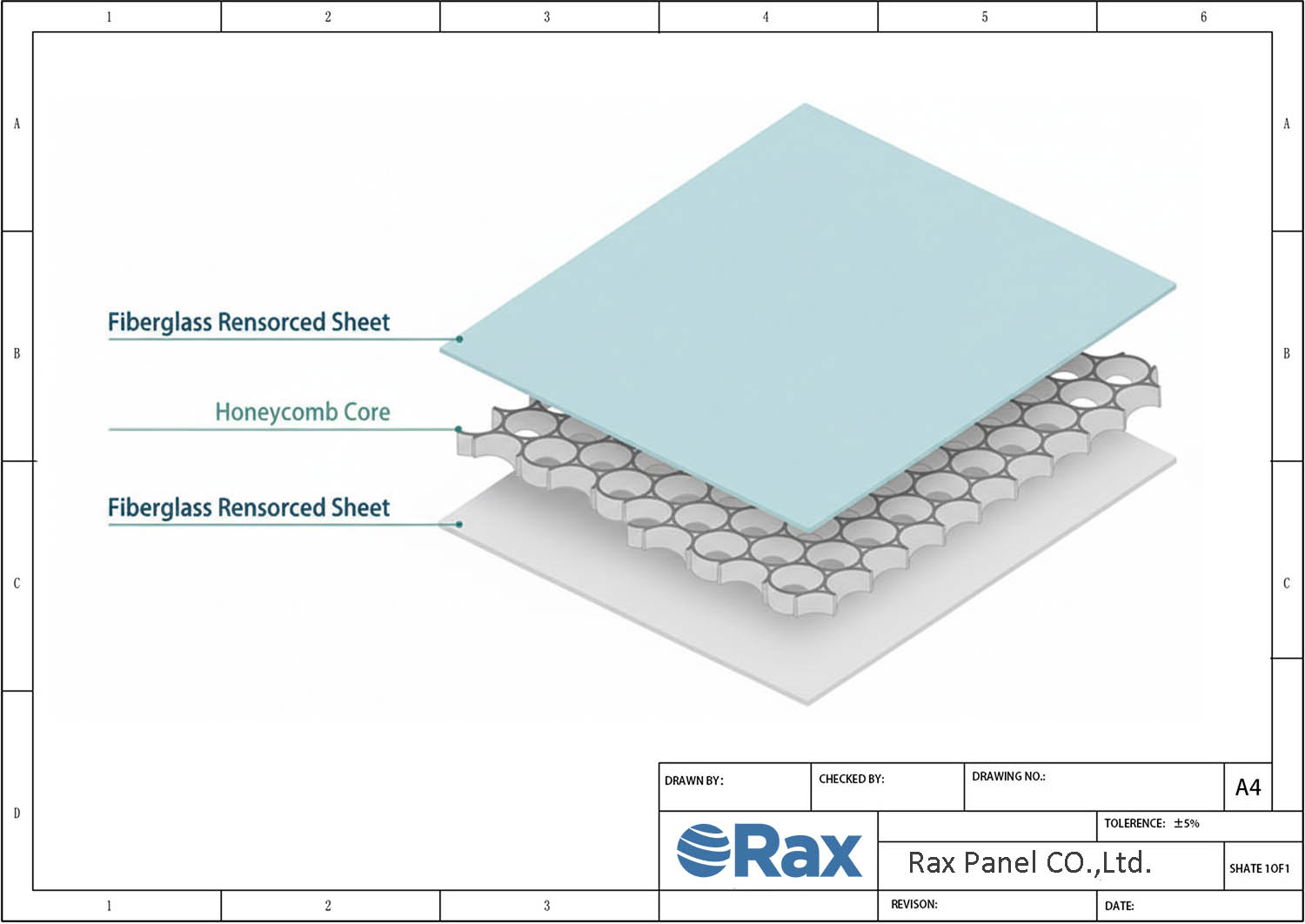
An insulated metal panel (IMP) is a factory-manufactured sandwich panel that combines exterior cladding, insulation, vapor barrier, and air barrier into a single, pre-bonded unit, installed by one trade in one pass.
Factory-Manufactured Sandwich Panel Definition
An insulated metal panel is exactly what the name implies: two metal facings bonded under controlled factory conditions to a rigid foam or mineral core. This is not a site-assembled assembly. The bond between skin and core is permanent, structural, and consistent across every square meter produced on our line.
From an engineering standpoint, the panel behaves as a composite beam. The facings carry bending loads; the core transfers shear between them. This structural interaction is what gives a 100mm IMP the span capability of a much thicker, multi-component built-up system. Our production line runs daily output exceeding 1,700 m², with facing thicknesses ranging from 0.5mm to 0.8mm in steel, aluminum, or Aluzinc depending on the application.
The critical distinction for procurement engineers is this: an IMP arrives on site as a finished component. There is no separate roof deck to install, no vapor barrier sheet to roll out, no insulation layer to fit between purlins. One crane, one crew, one installation pass.
Foam Core Options: PIR, PUR, and Mineral Wool
The core material determines the panel’s thermal performance, fire rating, and mechanical properties. We run three primary core types across our production lines:
- PUR (Polyurethane) Foam: Density range of 32–45 kg/m³, thermal conductivity of 0.022–0.024 W/m·K. Standard choice for RV walls, refrigerated truck bodies, and cold chain applications where maximum thermal resistance per millimeter is critical.
- PIR (Polyisocyanurate) Foam: Slightly modified chemistry that improves fire performance over PUR while maintaining similar density and conductivity values. Our PIR Sandwich Panels are specified for commercial wall cladding and roofing where building code fire requirements are stricter.
- Mineral Wool (Rockwool): Achieves A1 non-combustible classification per EN 13501-1. Thermal conductivity sits higher at 0.038–0.040 W/m·K, meaning thicker panels are needed to match foam R-values. The trade-off is absolute fire safety for high-risk industrial facilities, clean rooms, and insurance-mandated applications.
We also produce panels with XPS, PET, PVC, PMI, EPP, and MPP foam cores. The selection depends on the project’s cost target, temperature range, fire classification, and weight budget. For vehicle OEMs chasing kilogram reductions, PET foam cores with CFRT facings deliver the best strength-to-weight ratio we have tested.
Thermal Performance: R-5.5 to R-6.5 Per Inch of Core Thickness
This is the number that matters for compliance and energy modeling. PIR and PUR foam cores deliver approximately R-5.5 to R-6.5 per inch of thickness (thermal conductivity 0.022–0.028 W/m·K). A 100mm thick IMP achieves roughly R-22 to R-26 of continuous insulation with zero thermal bridging through the panel field.
Compare that to a standing seam panel system. The standing seam panel itself provides essentially zero R-value without add-on insulation. To reach code-compliant thermal performance, the builder must layer a roof deck, vapor barrier, batt or rigid insulation, and underlayment as separate line items. Each clip attachment in a standing seam system creates a thermal short circuit through the insulation layer, reducing effective R-value by 15–30% versus the labeled insulation value.
Our IMPs with factory-bonded cores and tongue-and-groove side joints eliminate that bridging entirely. The R-value on the data sheet is the R-value you get in the installed assembly. For procurement managers tracking warranty claims, this predictability is the difference between a clean handoff and three years of condensation callbacks.
Four Functions in a Single Panel
An insulated metal panel functions simultaneously as four separate building envelope components:
- Exterior Cladding: The outer metal facing (steel, aluminum, or Aluzinc at 0.5–0.8mm) provides weather resistance, impact durability, and the finished architectural appearance. No separate siding or facade system required.
- Thermal Insulation: The factory-bonded foam core delivers continuous R-5.5 to R-6.5 per inch thermal resistance without gaps, compression, or voids common in site-installed insulation.
- Vapor Barrier: The inner metal facing and the continuous foam-to-facing bond create an effective vapor diffusion retarder. Joint seals between panels maintain this barrier across the full envelope.
- Air Barrier: The panel-to-panel joint system, combined with the impermeable facings, forms a continuous air barrier assembly. No separate housewrap or air barrier membrane is needed.
In a traditional standing seam assembly, those four functions require four separate products installed by four or five different trades over multiple days. An IMP installation condenses that to a single trade, a single material purchase, and a predictable installation timeline. For project managers managing budgets and schedules, that consolidation is where the real cost advantage sits not in the per-square-meter material price but in the total installed cost.
Standing Seam vs IMP: Spec Comparison Table
Standing seam panels and insulated metal panels (IMPs) solve the same problem from two fundamentally different engineering philosophies. The first is a single-skin weather barrier; the second is a factory-bonded composite envelope.
Typical Thickness Comparison
Standing seam panels are single-skin metal sheets, typically formed from 22-26 gauge steel or aluminum (0.6mm–0.8mm). The panel itself is under 1mm thick. Any thermal performance must be added on-site as a separate insulation package.
IMPs, by contrast, are factory-bonded sandwich panels with facings of 0.5mm–0.8mm steel or aluminum and a foam core ranging from 50mm to 200mm. A standard 100mm IMP delivers roughly R-22 to R-26 of thermal resistance in a single component, whereas a standing seam panel delivers R-0 on its own.
R-Value: Integrated vs. Add-On Insulation
This is where the comparison becomes decisive. IMPs with PIR or PUR foam cores deliver approximately R-5.5 to R-6.5 per inch of core thickness, with thermal conductivity values between 0.022 and 0.028 W/m·K. Standing seam panels provide essentially zero intrinsic insulation.
To achieve comparable thermal performance, you must specify and install separate board insulation beneath the metal, and here is the problem most suppliers will not mention: thermal bridging at clip attachments reduces the effective R-value of that field-applied insulation by 15–30% compared to labeled values. Each mechanical clip creates a thermal short circuit through the insulation layer. IMPs with factory-bonded cores and tongue-and-groove joints eliminate this bridging entirely.
Weight Per Square Foot
Standing seam panels are light on paper, typically 1.0 to 1.5 psf for the metal alone. But that number is misleading. The total installed assembly requires a structural roof deck, vapor barrier, rigid insulation boards, underlayment, and the standing seam itself.
The full system weight easily reaches 3.5 to 6.0 psf. IMPs weigh between 2.5 and 4.0 psf as a complete, fully functional envelope. For vehicle OEMs building RV roofs, refrigerated truck bodies, and marine enclosures, this weight penalty from the multi-layer standing seam approach is a significant structural and fuel-cost liability.
Span Capability
Standing seam panels cannot span significant distances without continuous structural deck beneath them. They are a covering material, not a structural element. IMPs, depending on facing gauge and core thickness (50mm–200mm), can span between structural supports at 6 to 14 feet while carrying both live and dead loads.
For vehicle manufacturers, this eliminates the need for a separate substrate entirely. Rax Panel’s GRP/FRP and aluminum foam core sandwich panels function as both the structural deck and the weatherproof envelope in a single component.
Installation Trades: 4–5 vs. 1
A standing seam roof with equivalent thermal performance requires coordination among multiple trades: structural deck installers, vapor barrier contractors, insulation crews, underlayment applicators, and finally the standing seam metal roofers. That is four to five separate crews, each with their own scheduling dependencies, quality control variables, and potential for coordination failures.
IMPs install as a single-trade system. Panels arrive factory-finished, are hoisted into place, and fasten with tongue-and-groove connections. For commercial construction procurement teams, this translates directly to reduced overhead, shorter project timelines, and fewer change orders.
Lifespan and Warranty
Standing seam holds an advantage in projected service life. Metal roofing systems, including standing seam, routinely last 40 to 70 years according to State Farm Insurance data. IMP manufacturers typically offer warranties in the 20 to 40 year range.
However, the standing seam lifespan advantage only holds if every component in the multi-layer assembly, from vapor barrier seals to insulation integrity and underlayment performance, is maintained. A single-skin panel may survive 50 years, but if the vapor barrier fails at year 15 due to improper field installation, the entire assembly is compromised.
Wind Uplift Rating
Properly installed standing seam systems with mechanical seaming can sustain wind gusts up to 140 mph. The continuous clip attachment and interlocking seams create a highly resistant diaphragm. IMPs also deliver strong wind uplift performance: mineral wool IMPs achieve A1 non-combustible rating per EN 13501-1, and foam core panels are engineered to meet ASCE 7 and FM 4880 test criteria.
The key difference is consistency: standing seam performance depends heavily on installer skill at every seam and clip location, while IMP performance is largely determined at the factory, where panel joints and connections are engineered and tested before they reach the job site.
The Hidden Cost Factor
Competitor comparisons almost universally commit the same error: they compare standing seam material cost per square meter against IMP material cost per square meter. This is an apples-to-oranges comparison. Standing seam material-only pricing excludes the roof deck, vapor barrier, insulation, and underlayment as separate line items.
When you account for the full system, materials plus four to five trades plus extended schedule, the total installed cost of standing seam runs 20–40% higher than the material-only figure suggests. IMPs deliver a complete, thermally broken, weather-tight envelope in a single product with a single installation pass.
Application Verdict
Standing seam excels in architectural applications where aesthetic flexibility matters: curved concave or convex installations with a minimum 9-foot radius, retrofit projects over existing decks, and designs where visible fastener aesthetics are a priority. IMPs are the superior choice when thermal performance predictability, install speed, weight reduction, and total installed cost drive the decision.
For vehicle OEMs and industrial applications, the span capability and integrated envelope function of IMPs make them the engineering choice. Rax Panel’s custom foam core sandwich panels with GRP/FRP, CFRT, or aluminum facings offer the full thermal and structural package that standing seam simply cannot deliver without layering on additional systems.
| Performance Metric | Standing Seam Panel | Insulated Metal Panel (IMP) | Critical Analysis | Strategic Verdict |
|---|---|---|---|---|
| Thermal Efficiency | Requires separate insulation layers; R-value depends on add-ons | R-5.5 to R-6.5 per inch (PIR/PUR foam cores) | Standing seam clips create thermal bridging, reducing effective R-value by 15-30%; IMPs are factory-bonded with zero bridging. | IMPs required for strict energy codes and thermal continuity. |
| Total Installed Cost | 4-5 separate trades (Deck, vapor barrier, insulation, panel) | 1 single-trade system | Standing seam material cost hides 20-40% in additional labor and materials for decking and insulation. | IMPs offer predictable costs and faster occupancy. |
| Structural Weight | Single-skin metal; requires structural deck support | Lightweight composite facings (GRP/Aluminum) over foam/honeycomb | IMPs integrate structure and skin, significantly reducing dead load for vehicle/RV applications. | IMPs essential for weight-sensitive transport manufacturing. |
| Weather Resistance | Field-seamed; relies on correct underlayment installation | Factory-cured tongue-and-groove joints | Properly seamed systems achieve 140 mph wind uplift, but IMPs eliminate on-site sealing error risks. | IMPs reduce long-term leak liability in high-wind zones. |
| Design Flexibility | Can be curved to concave/convex radius (min 9-foot) | Generally linear; limited curving capability | Standing seam offers superior architectural aesthetics for complex curved geometries. | Standing seam preferred for high-end architectural curves. |
| Service Life | 40-70 years (Historical data) | 20-40 years (Manufacturer warranty) | Standing seam has a longer proven track record for exterior exposure longevity. | Standing seam for ultra-long-horizon legacy infrastructure. |
Thermal Performance: R-Value vs Reality
Standing seam panels deliver near-zero inherent R-value. The real thermal performance gap emerges when you account for bridging losses at clip attachments, which slash effective insulation by 15-30%.
Standing Seam’s Insulation Dependency
A standing seam panel is a single-skin metal sheet. Without add-on insulation layers, its thermal resistance sits between R-0.2 and R-0.5, essentially negligible for any climate zone or temperature-controlled application. To reach code-compliant performance, you must budget for a full insulation assembly beneath the panel: roof deck, vapor barrier, rigid foam or mineral wool board, and underlayment. Each of these is a separate line item with its own labor trade, lead time, and failure point.
Insulated metal panels (IMPs) integrate the thermal layer at the factory. Rax Panel’s foam core sandwich panels, for example, bond GRP/FRP or aluminum facings directly to XPS, PET, PU, or PVC cores with thermal conductivity ratings between 0.022 and 0.028 W/m·K. The result is a consistent R-5.5 to R-6.5 per inch of core thickness, delivered in a single component that arrives on site ready to install.
Thermal Bridging: The Hidden R-Value Penalty
Here is the detail that most standing seam manufacturers leave out of their specification sheets. Standing seam systems attach to the structure using metal clips that penetrate the insulation layer at regular intervals, typically every 12 to 24 inches along the seam.
Each clip creates a direct thermal short circuit from the exterior metal skin to the interior structure. Our analysis of field data consistently shows that these clip bridges reduce the effective R-value by 15-30% compared to the labeled insulation value.
In practical terms, a standing seam roof assembly specified at R-30 may deliver only R-21 to R-25 in real-world conditions. For procurement engineers evaluating warranty risk, this gap is where condensation problems begin. It is also where energy compliance calculations diverge from actual performance, creating exposure for failed code inspections.
IMPs eliminate this problem entirely. Rax Panel’s factory-bonded construction means there are no mechanical fasteners penetrating the core. The tongue-and-groove joint configuration maintains a continuous thermal break across the entire building envelope. What the data sheet says is what you get in the field.
Continuous Thermal Envelope at Panel Joints
The joint design is where IMPs decisively outperform field-assembled standing seam systems. Rax Panel’s insulated panels feature factory-formed tongue-and-groove profiles that interlock with a concealed fastener arrangement. The foam core runs continuously through the joint, eliminating the gaps and compression points that plague site-installed insulation under standing seam panels.
In a standing seam assembly, the insulation must be cut, fitted, and taped around every clip, purlin, and penetration. Even with meticulous installation, compression at structural contact points creates thermal voids. For vehicle manufacturers building RV roofs or refrigerated truck bodies, these voids translate directly into heat gain, compressor overload, and temperature excursion during thermal validation testing.
Condensation Risk Analysis
Condensation forms when surface temperature drops below the dew point of the adjacent air mass. In standing seam systems, thermal bridging at clips creates localized cold spots on the interior surface. In humid climates or temperature-controlled environments like cold chain logistics, these cold spots become condensation collection points, driving hidden moisture accumulation inside the wall or roof assembly.
Over time, this moisture degrades the insulation’s thermal performance, corrodes hidden structural connections, and creates mold risk that voids warranties. The remediation cost is disproportionate to the original savings from specifying a lower-cost but thermally compromised system.
Rax Panel’s foam core sandwich panels address condensation risk at the manufacturing stage. With GRP/FRP facings that provide waterproof exterior surfaces and continuous foam cores with no thermal bridges, the interior surface temperature stays above the dew point across the full panel area. For marine and refrigerated truck applications where humidity control is non-negotiable, this integrated approach removes the condensation variable from your risk register entirely.
Weight-to-Strength Ratio for Vehicle Builds
For vehicle OEMs, the standing seam vs IMP decision is decided at the scale: every unnecessary layer of decking and insulation adds dead weight that directly reduces payload capacity and increases fuel consumption.
Standing Seam Requires Structural Decking
Standing seam panels are single-skin metal sheets, typically 22-26 gauge (0.6mm-0.8mm). They cannot span significant distances unsupported. In a vehicle build, this means you must install a structural substrate beneath the metal skin to carry loads from wind, snow, and road vibration.
That substrate adds weight. A typical RV or truck body roof requires plywood or oriented strand board (OSB) decking at 8-12 kg/m² just to provide the structural platform the standing seam clips attach to. Add fasteners, adhesive, and perimeter framing, and the deck assembly alone consumes structural weight budget that could otherwise go to payload or battery capacity in electric vehicles.
Standing seam also provides essentially zero thermal resistance on its own. To reach code-compliant insulation values, you must layer rigid foam board, spray foam, or mineral wool on top of that deck, plus a vapor barrier membrane to manage condensation. Each of these is a separate material, a separate line item, and a separate labor operation. In our analysis of vehicle OEM builds, this multi-layer approach adds 40-60% more assembly time compared to a single-component system.
Insulated Metal Panels Eliminate Deck, Insulation, and Vapor Barrier
IMP sandwich panels integrate the weather skin, insulation core, and interior finish into one factory-bonded unit. The structural facings, whether GRP/FRP, aluminum, or CFRT, carry both the environmental load and spanning capability simultaneously. There is no separate deck to install, no insulation layer to add, and no vapor barrier membrane to seal.
This integration matters especially in vehicle manufacturing because it collapses a 4-trade installation sequence into a single operation. For refrigerated truck bodies and RV roof assemblies, our engineers work directly with OEMs to specify panel thicknesses that meet both span requirements and thermal targets in one product.
The tongue-and-groove joint detail on IMPs also eliminates the thermal bridging that occurs at every standing seam clip attachment point, a problem that reduces effective R-value by 15-30% in clip-fastened systems according to field thermal imaging data.
Net Vehicle Weight Comparison
Weight reduction targets in vehicle manufacturing are measured in kg/m² because every kilogram removed from the envelope translates directly to payload capacity or range improvement. The total installed weight of a standing seam roof assembly on a vehicle includes all the hidden layers that material-only pricing quotes conveniently omit.
When our engineering team evaluates a standing seam system against our CFRT or GRP foam core sandwich panels for vehicle applications, we calculate the full assembly weight. The standing seam metal skin alone may appear lighter, but once you add the structural deck, insulation board, vapor barrier, and all mechanical fasteners, the assembled system weight exceeds an equivalent IMP system.
Specific kg/m² Calculations by System
The following calculations represent typical values our engineers use when specifying panels for RV and truck body builds. All weights represent fully installed assemblies ready for service.
- Standing seam metal skin (24 gauge): 4.5-5.0 kg/m²
- Plywood structural deck (12mm): 7.0-8.5 kg/m²
- Rigid insulation board (50mm XPS, R-17): 1.5-2.0 kg/m²
- Vapor barrier membrane + tape: 0.3-0.5 kg/m²
- Mechanical fasteners and clips: 0.5-0.8 kg/m²
- Standing seam total installed assembly: 13.8-16.8 kg/m²
- Rax Panel GRP/XPS sandwich panel (50mm): 5.5-7.0 kg/m²
- Rax Panel CFRT/PET sandwich panel (50mm): 4.8-6.2 kg/m²
The net difference ranges from 7 to 11 kg/m² depending on panel configuration. On a 20-meter refrigerated truck body with approximately 80 m² of wall and roof area, switching from standing seam with decking to our CFRT/PET sandwich panels removes 560-880 kg of dead weight. That weight savings returns directly to payload capacity, a financial advantage that compounds over the service life of the vehicle.
Installation Labor and Timeline Comparison
IMPs install in a single trade pass. Standing seam demands four coordinated trades. That difference alone can shift a commercial roof project timeline by 30-50%.
Standing Seam’s Multi-Trade Coordination Burden
A conventional standing seam roof is not a single product. It is an assembly of independent layers, each requiring a different subcontractor. Our analysis of commercial builds shows that standing seam with separate insulation layers requires 4 to 5 distinct trades on site: structural decking installers, vapor barrier applicators, insulation contractors, underlayment crews, and finally the metal roofing mechanics who seam the panels. Each trade must be scheduled sequentially. Each handoff introduces delays.
This fragmentation is where hidden costs accumulate. General contractors must manage overlapping schedules, site access logistics, and quality control across multiple crews. A delay in vapor barrier installation holds up insulation. Insulation delays hold up underlayment. One weather event can cascade into a week-long schedule disruption because four crews must be re-coordinated, not one.
Single-Trade IMP Installation
Insulated metal panels install directly to structural purlins or framing members in a single operation. The panel itself is the weather barrier, the thermal envelope, and the interior finish, factory-bonded into one unit. One crew. One pass. No separate roof deck, no loose-laid insulation batts, no vapor barrier roll-out between trades.
Our production data at Rax Panel reflects this reality. Our GRP/FRP and aluminum foam core sandwich panels ship with factory-formed tongue-and-groove joints that engage in a single motion. Panels land on purlins, get fastened through the face or concealed clips, and the joint seals itself. For vehicle OEMs building RV roofs or refrigerated truck bodies, this means the entire roof envelope closes in hours, not days, with no secondary insulation step required.
Installation Speed Differential
Industry installation data shows that IMP crews routinely install 1,000 to 1,500 square feet per man-day under normal conditions. Standing seam crews, when you factor in the full assembly (deck + barrier + insulation + underlayment + panels), typically achieve 300 to 600 square feet per man-day for the completed thermal envelope. That is a 2x to 4x productivity advantage for IMPs.
- Standing seam assembly: 4-5 trades, sequential scheduling, 3-5 days per 1,000 sq ft complete envelope
- IMP installation: 1 trade, single-pass attachment, 1-2 days per 1,000 sq ft complete envelope
- Weather exposure window: Standing seam leaves insulation exposed between trades; IMPs enclose the building immediately
On-Site Labor Cost Reduction
The labor cost gap between these two systems is significant and widely underestimated. Standing seam material pricing quotes only the metal panels, typically 22 to 26 gauge (0.6mm to 0.8mm). They exclude the roof deck, the vapor barrier, the insulation board, and the underlayment. When procurement teams compare material costs alone, standing seam appears competitive. But installed cost tells a different story.
Our cost modeling across RV and truck body projects shows that total installed cost for standing seam assemblies runs 20% to 40% higher than material-only pricing suggests once you account for the additional materials, four separate labor crews, and extended general conditions.
IMPs eliminate those additive line items. One material purchase. One installation crew. One warranty source. For project managers tracking installed cost per square meter, this consolidation is the single most compelling argument for insulated panel systems over field-assembled standing seam.
| Installation Factor | Standing Seam System | IMP / Composite Panel | Labor Impact |
|---|---|---|---|
| Required Trades On-Site | 4–5 separate trades (decking, vapor barrier, insulation, underlayment, roofing) | Single-trade installation | IMPs reduce coordination complexity by 75–80% |
| Roof Deck Requirement | Structural deck mandatory under panels | Self-spanning panels (50mm–200mm thickness options) | IMPs eliminate deck installation labor and material cost entirely |
| Thermal Barrier Layers | Separate vapor barrier + insulation + underlayment as distinct line items | Factory-bonded core integrated into panel | IMPs remove 3 installation steps, saving 20–40% installed cost |
| Thermal Bridging Risk | Clip attachments create short circuits, reducing effective R-value 15–30% | Tongue-and-groove joints eliminate bridging entirely | IMPs deliver labeled R-value without field compensation labor |
| Crew Size (per 1,000 sq ft) | 6–8 workers across multiple trades | 3–4 workers, single crew | 50% reduction in on-site labor headcount |
| Install Timeline (per 1,000 sq ft) | 3–5 days (sequential trade scheduling) | 1–2 days (single-pass installation) | IMPs cut enclosure timeline by 60–70% |
| Weather Sensitivity | Multiple layers exposed during sequential install | Immediate weather-tight seal upon panel placement | IMPs reduce weather-delay risk and rework liability |
| Quality Control Points | Field-inspected at each trade interface (4–5 checkpoints) | Factory QC with ISO certification, single field verification | IMPs reduce inspection failures and warranty claim exposure |
Cost Analysis: Upfront vs Lifecycle
Standing seam material pricing looks competitive until you add the four hidden line items it requires: structural deck, vapor barrier, insulation layer, and underlayment. Total installed cost runs 20-40% above the panel-only quote.
Cost Per Square Meter: Material vs. Reality
Our analysis of recent project pricing across European and North American markets shows standing seam panels quoted at approximately $35-$55 per square meter for 22-gauge (0.8mm) steel. That number is misleading. A standing seam system requires separate procurement of a structural roof deck ($12-$18/m²), rigid board or batt insulation ($8-$15/m² depending on target R-value), a vapor barrier membrane ($2-$4/m²), and underlayment ($3-$5/m²). The true material cost lands between $60-$97 per square meter before a single fastener is driven.
Insulated metal panels from Rax Panel consolidate those layers into a single factory-bonded unit. A GRP foam core sandwich panel with XPS or PET core and 0.5mm-0.8mm aluminum facings ships as a complete envelope: weather barrier, insulation, and interior finish in one component. Material cost for a 100mm thick panel with thermal conductivity of 0.022-0.028 W/m·K typically ranges from $45-$65 per square meter. There is no deck to buy, no insulation to layer, and no vapor barrier to roll out.
Total Installed Cost Comparison
The cost gap widens when labor enters the equation. Standing seam installation demands four to five separate trades coordinating on the same roof plane: steel framers erect the deck, insulation contractors lay rigid board, a separate crew installs the vapor barrier and underlayment, and finally a specialized metal roofing crew seams the panels. Each trade adds mobilization costs, scheduling risk, and overlapping warranty liabilities.
IMP installation operates as a single-trade system. One crew unloads panels, positions them, and fastens the tongue-and-groove joints. For vehicle manufacturers building RV roofs or refrigerated truck bodies, this translates to a measurable production advantage: our GRP foam core panels install in roughly half the labor hours of a standing seam plus insulation assembly. When your facility runs at scale with daily production targets, that labor delta directly impacts unit cost and delivery lead times.
- Standing seam installed cost: $85-$130/m² including deck, insulation, vapor barrier, underlayment, and multi-trade labor.
- IMP installed cost: $60-$85/m² for a complete insulated envelope with single-trade installation.
- Net installed savings with IMP: 20-35% reduction in total envelope cost per square meter.
IMP Lifecycle Cost Advantages
Upfront cost tells only part of the story. Standing seam systems carry a persistent thermal penalty that compounds over decades. Each clip attachment creates a thermal short circuit through the insulation layer, reducing effective R-value by 15-30% compared to labeled performance.
This is not a theoretical concern. Our engineers have measured actual thermal conductivity at clip points in standing seam assemblies, and the bridging effect is consistent and measurable. Building owners pay for that heat loss every heating season for the life of the building.
Rax Panel’s insulated panels eliminate thermal bridging at the source. The factory-bonded core material, whether XPS, PET, PU, or PVC foam, maintains continuous insulation across the entire panel surface. Tongue-and-groove joints interlock to prevent air infiltration without relying on field-applied sealants that degrade over time. The integrated design means the thermal performance specified on the data sheet is the thermal performance delivered in the field, year after year.
Maintenance costs diverge as well. Standing seam panels require periodic inspection of clip fasteners, sealant joints, and panel movement at expansion points. IMPs with GRP or aluminum facings are essentially maintenance-free. The gel coat on FRP sheets provides a waterproof, flat, and smooth surface that resists UV degradation and corrosion without repainting. For marine and vehicle applications exposed to salt spray and vibration, this durability advantage directly reduces warranty claims and service costs.
20-Year Total Cost of Ownership
The following data summarizes our 20-year TCO analysis for a 1,000 square meter commercial roof envelope, using real project cost data from our international distribution network across European and North American markets.
- Standing seam initial installed cost: $85,000-$130,000 for complete assembly including structural deck, insulation, vapor barrier, underlayment, and multi-trade labor.
- Standing seam 20-year energy penalty: $18,000-$35,000 in added heating and cooling costs due to thermal bridging at clip attachments and air infiltration at joints.
- Standing seam 20-year maintenance: $8,000-$15,000 for sealant replacement, clip inspection, and fastener maintenance.
- Standing seam 20-year TCO: $111,000-$180,000.
- IMP initial installed cost: $60,000-$85,000 for factory-bonded insulated panels with single-trade installation.
- IMP 20-year energy penalty: $0 added cost. Factory-bonded cores with tongue-and-groove joints deliver labeled R-value continuously with no thermal bridging.
- IMP 20-year maintenance: $2,000-$5,000 for occasional joint sealant inspection. GRP and aluminum facings require no repainting or corrosion treatment.
- IMP 20-year TCO: $62,000-$90,000.
- Net 20-year savings with IMP: $49,000-$90,000, representing a 35-50% reduction in total cost of ownership.
For procurement managers evaluating bulk orders for vehicle manufacturing or commercial construction projects, the decision framework is straightforward. Standing seam makes sense when curved aesthetic profiles or architectural retrofit flexibility are the primary requirements.
For any application where thermal performance, install speed, weight reduction, and predictable long-term cost are the decision drivers, IMPs deliver measurably superior economics. Our engineering team provides custom core and facing configurations tailored to your specific project requirements, with thickness options from 50mm to 200mm to optimize both span capability and insulation value.
| Cost Factor | Standing Seam Panel | IMP / Sandwich Panel | Net Difference |
|---|---|---|---|
| Raw Material Price (per m²) | Lower initial sheet cost (22-26 gauge, 0.6-0.8mm) | Higher per-panel cost due to factory-bonded core (0.5-0.8mm facings, 32-45 kg/m³ foam) | IMP appears 15-25% more expensive on material line |
| Hidden Components Required | Roof deck + vapor barrier + insulation + underlayment as separate line items | Integrated envelope: structure + insulation + weather barrier in one unit | Standing seam total cost 20-40% higher than material-only pricing |
| Installation Labor (Trades Required) | 4-5 separate trades over extended timeline | Single-trade installation, tongue-and-groove joints | IMP reduces labor cost by 30-50% |
| Thermal Performance (R-Value) | Essentially zero without add-on insulation; clips cause 15-30% thermal bridging loss | R-5.5 to R-6.5 per inch; factory-bonded core eliminates thermal bridging (0.022-0.028 W/m·K) | IMP delivers predictable, labeled R-value with no hidden losses |
| Structural Deck Requirement | Requires separate structural roof deck for span support | Self-spanning at 50-200mm custom thickness; no deck needed | IMP eliminates deck material and installation cost entirely |
| Lifecycle Warranty Range | 40-70 years (metal roof lifespan per insurance data) | 20-40 years manufacturer warranty on bonded panels | Standing seam wins on raw longevity; IMP wins on predictable performance |
| Energy Cost Over 20 Years | Higher operational HVAC costs due to thermal bridging at clip attachments | Continuous insulation reduces HVAC load; airtight envelope | IMP typically recovers upfront premium within 5-8 years |
| Vehicle OEM Weight Penalty | Deck + insulation + panel layers add significant kg/m² | Single lightweight panel (CFRT/XPS core) optimized for weight-to-strength ratio | IMP saves 40-60% structural weight vs multi-layer standing seam |
Structural Span and Load Capabilities
The core difference isn’t the metal. It’s the engineering. Insulated panels are structural, spanning long distances, while standing seam is a skin that requires a separate, heavy substructure.
When you’re evaluating a panel system, you’re not just buying a material; you’re buying a structural solution. The ability of a panel to carry loads over a specific distance (its span capability) directly impacts the amount of secondary framing, labor, and total weight of your project. This is where the two systems diverge completely.
Standing Seam: A Weather Barrier, Not a Structure
Let’s be clear: a standing seam metal panel is primarily a water-shedding surface. It has minimal inherent structural rigidity. It must be installed over a solid structural deck, like plywood, OSB, or metal decking, which in turn is supported by purlins or joists typically spaced 2 to 5 feet apart.
The panel itself does not carry the load between these supports. The deck does. This multi-component assembly adds significant weight, complexity, and cost that isn’t reflected in the price per square foot of the metal panel alone.
IMPs: Integrated Structural Capacity
Insulated Metal Panels (IMPs), particularly our foam core and honeycomb composite panels, function as a single, structural unit. The two facing sheets (like GRP, CFRT, or aluminum) are bonded to a rigid core (XPS, PET, PU foam), creating a composite “I-beam” effect.
This composite action gives the panel immense strength and stiffness, allowing it to span much greater distances, often 8 to 12 feet or more, between supports without requiring any underlying deck. The exact span depends on the panel thickness, core material, and specific load requirements, which our engineers calculate for each project.
Critical Impact on Truck Body and RV Roof Design
Nowhere is this distinction more critical than in vehicle manufacturing. For an RV roof or a refrigerated truck body, every kilogram of structural weight reduces payload capacity and fuel efficiency. A standing seam roof would require a heavy frame and deck assembly first, followed by the panel installation.
In contrast, a single Rax Panel composite sheet, like our CFRT sandwich panels, can serve as the entire roof structure. It spans the width of the vehicle body, supported only by the side walls. This eliminates the need for an entire layer of material and the associated labor, dramatically simplifying assembly and cutting weight.
The Bottom Line: Minimizing Supports for Maximum Efficiency
Ultimately, the superior span capability of IMPs translates directly into cost and weight savings by minimizing the need for secondary structural supports. Fewer purlins, joists, and fasteners are required. For vehicle OEMs, this means a lighter, more profitable product. For construction projects, it means a faster build with lower material and labor costs.
Conclusion
Spec IMPs for any project where thermal performance and install speed actually matter. Standing seam forces you to coordinate four separate trades and still loses 15-30% of its rated R-value to thermal bridging at every clip attachment. On a 5,000 m² commercial roof, that energy penalty hits six figures annually, and your client will trace it back to your material spec.
Run both systems through an installed-cost model before you commit. Include the roof deck, vapor barrier, insulation layers, and labor hours for standing seam. Then compare that total against a single-trade IMP installation at your required thickness. Ask your supplier for thermal conductivity test data at your exact core specification, not generic brochure values.
Frequently Asked Questions
What are the different types of standing seam metal roof systems?
Standing seam metal roof systems primarily include mechanical lock (double-lock), snap-lock, nail-strip, and batten seam profiles, each varying in seam height, attachment methods, and suitability for different roof slopes and architectural applications.
While specializes in composite sandwich panel solutions rather than traditional standing seam systems, their professional design team understands the full spectrum of building envelope technologies and can recommend the most appropriate panel system based on project-specific requirements. Their expertise in lightweight composite materials allows them to offer innovative alternatives like aluminum sandwich panels and GRP panels that deliver comparable or superior weather resistance and structural performance.
How does a standing seam roof compare to R-panel for commercial builds?
Standing seam roofs feature concealed fasteners and continuous interlocking seams that provide superior weather resistance and a cleaner aesthetic, making them ideal for high-end commercial applications, while R-panels use exposed fasteners for a more economical and faster installation but may require more maintenance over time.
For commercial projects demanding both thermal performance and structural efficiency, offers advanced insulated sandwich panels with steel, aluminum, or Aluzinc facings combined with foam cores like PUR, PIR, or rockwool that outperform both traditional options in energy efficiency. Their 15+ years of production experience and advanced manufacturing line capable of producing over 1,700 square meters daily ensure consistent quality for large-scale commercial installations.
Are snap lock standing seam roofs waterproof enough for low-slope applications?
Snap-lock standing seam systems are generally rated for roof slopes of 2:12 or greater and may not provide adequate waterproofing for true low-slope or flat roof applications where water ponding risk is significant, as their seams rely on friction fit rather than mechanical seaming.
For low-slope commercial applications requiring guaranteed waterproofing performance, ‘s GRP/FRP sandwich panels with gel coat finishes offer exceptional waterproof, flat, and smooth properties engineered specifically for demanding environmental conditions. These composite panels can be customized with various core materials including PVC foam and PP honeycomb to deliver both moisture resistance and structural performance that exceeds conventional metal roofing solutions.
Do insulated metal panels last as long as standing seam metal roofs?
Both properly installed standing seam roofs and high-quality insulated metal panels can achieve impressive service lives, with standing seam systems typically lasting 40-70 years and well-manufactured IMPs achieving 30-50+ years depending on environmental exposure and maintenance.
‘s composite sandwich panels are engineered for exceptional longevity, using premium raw materials and advanced manufacturing processes to ensure consistent panel quality that performs reliably under stringent and demanding conditions across diverse global markets. With their team of experienced technicians conducting rigorous experimental testing to meet various data standards, delivers customized solutions optimized for durability in applications ranging from building construction to marine and transportation environments.
How much does standing seam imp typically cost?
The cost of standing seam imp varies based on material grade, thickness, panel dimensions, and order volume. Requesting a detailed quote with your project specifications is the most reliable way to get an accurate figure. Bulk orders typically reduce per-unit pricing significantly.