
Overweight DOT fines can reach five figures when a finished vehicle rolls out heavier than its design allows. One recurring cause is a supplier quietly swapping the agreed-upon core density to push an order through faster. A builder that specifies a 60 kg/m³ foam core can receive a 90 kg/m³ batch instead, and that extra 30 kilos per cubic meter is enough to push the rigs over the legal weight limit, halting deliveries and idling the assembly line for weeks. Pinning down your exact CFRT panel specs before the truck hits the road is the only way to avoid overweight DOT fines and the logistical nightmare that follows.
We pulled our lab test data from the last three years to give you the exact numbers you need for your CAD models. You need hard proof, not sales fluff. Below, you will find the precise skin densities, thickness tolerances from 6 to 120mm, and core weights for our materials. We also break down how hitting a 2.8-meter maximum width eliminates vertical joints on standard sidewalls. It saves assembly time. Plus, our glue-free thermal fusion process stops the delamination that ruins traditional adhesive-bonded builds.
CFRT Panel Dimensions & Tolerances
We manufacture CFRT panels up to 2.8m wide to eliminate vertical seams in RV sidewalls, maintaining strict thickness tolerances between 6.0mm and 120mm for precise CAD integration.
Maximum Dimensions and Assembly Line Efficiency
When engineering specialized vehicles, every millimeter and every joint directly impacts your production speed and structural integrity. We produce CFRT sandwich panels at a maximum width of 2.8 meters and lengths up to 12 meters. This specific 2.8m width is engineered to cover a standard RV or specialized vehicle sidewall in a single continuous piece.
By utilizing this broader format, you drastically reduce the number of vertical joints required during assembly compared to standard 2.4m competitor panels. Fewer seams translate to fewer potential failure points and faster assembly times. Combined with our glue-free thermal fusion process, the skin-core bond remains structurally sound across the entire 12m span without the delamination risks associated with traditional adhesives in extreme thermal cycles.
Strict Thickness Tolerances and Weight Targets
Achieving consistent vehicle weights to comply with strict road regulations requires uncompromising thickness control. Our CFRT panels are manufactured in a thickness range from 6.0mm up to 120mm. This allows you to precisely dial in the exact strength-to-weight ratio required for your specific Bill of Materials.
- Skin Density: 1.0 to 1.6 g/cm³
- Core Density: 60 to 120 kg/m³
We enforce rigid tolerances on these dimensions to ensure that what performs perfectly in your CAD software performs identically on your assembly line. We tightly control the panel density and thickness profile during our continuous lamination process to mitigate the risk of overweight vehicles or parts that fail to mate correctly during modular vehicle assembly.
| Dimension Parameter | Metric Specification | Standard Tolerance | Engineering Benefit |
|---|---|---|---|
| Maximum Panel Width | Up to 2800 mm | Custom Cut Precision | Reduces vertical seams in RV sidewalls, accelerating assembly time |
| Overall Thickness Range | 6 mm – 120 mm | ± 0.2 mm (Typical) | Accommodates precise CAD designs from thin linings to structural walls |
| CFRT Skin Density | 1.0 – 1.6 g/cm³ | ISO 9001 Certified Consistency | Ensures reliable weight-to-strength ratio for road regulation compliance |
| Core Material Density | 60 – 120 kg/m³ | Uniform Cell Structure | Maximizes weight reduction while maintaining structural thermal efficiency |
| Skin-Core Bonding Integrity | Glue-Free Thermal Lamination | Zero Adhesive Delamination | Withstands extreme thermal cycling without panel separation |
CFRT Skin & Core Material Specs
Optimizing your Bill of Materials requires exact data. Our CFRT skins deliver a strict density of 1.0 to 1.6 g/cm³ with a 60-75% continuous fiber matrix, guaranteeing consistent weight-to-strength ratios for specialized vehicle production.
CFRT Skin Specifications: Fiber Content and Density Parameters
When evaluating lightweight RV panel density, comparing CFRT vs plywood weight specs shows a clear advantage in thermoplastic composites. We engineer our CFRT skins with a strict density range of 1.0-1.6 g/cm³. This tightly controlled tolerance ensures that every batch matches your CAD drawings perfectly without pushing your vehicles over strict road weight limits. The high fiber content is what drives this performance.
- Fiber Content: 60-75% continuous glass fiber for maximum structural rigidity.
- Skin Density: Strictly maintained between 1.0 and 1.6 g/cm³.
- Thickness Range: Capable of spanning 6mm to 120mm profiles.
To directly reduce your assembly line time, we utilize a maximum panel width of 2.8 meters. This specific dimension serves as a seamless reduction strategy for standard RV sidewalls. By utilizing a single custom CFRT panel size, your production team eliminates the need to join multiple narrower sheets, thereby removing structural weak points and the risk of adhesive failures at the seams.
Core Material Options: Density and Thermal Lamination Integrity
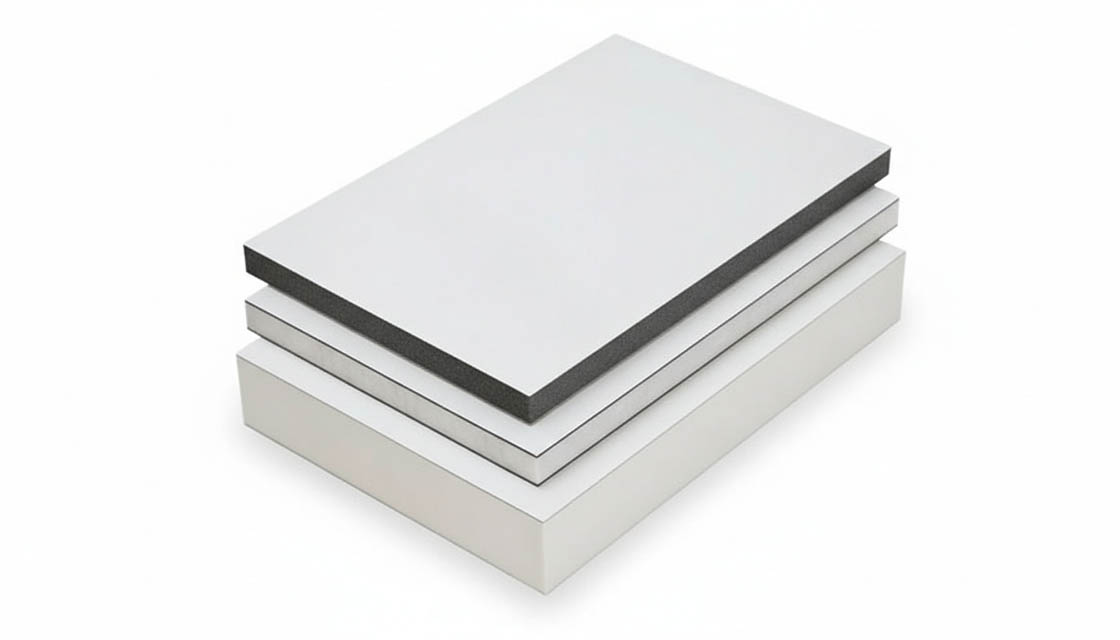
The core dictates both the insulation values and the sheer compression strength of the sandwich structure. We configure cores with densities ranging from 60 to 120 kg/m³, optimizing the CFRT panel thickness tolerance across your entire build. Depending on the engineering requirements of your specialized vehicles, we offer three primary core structures.
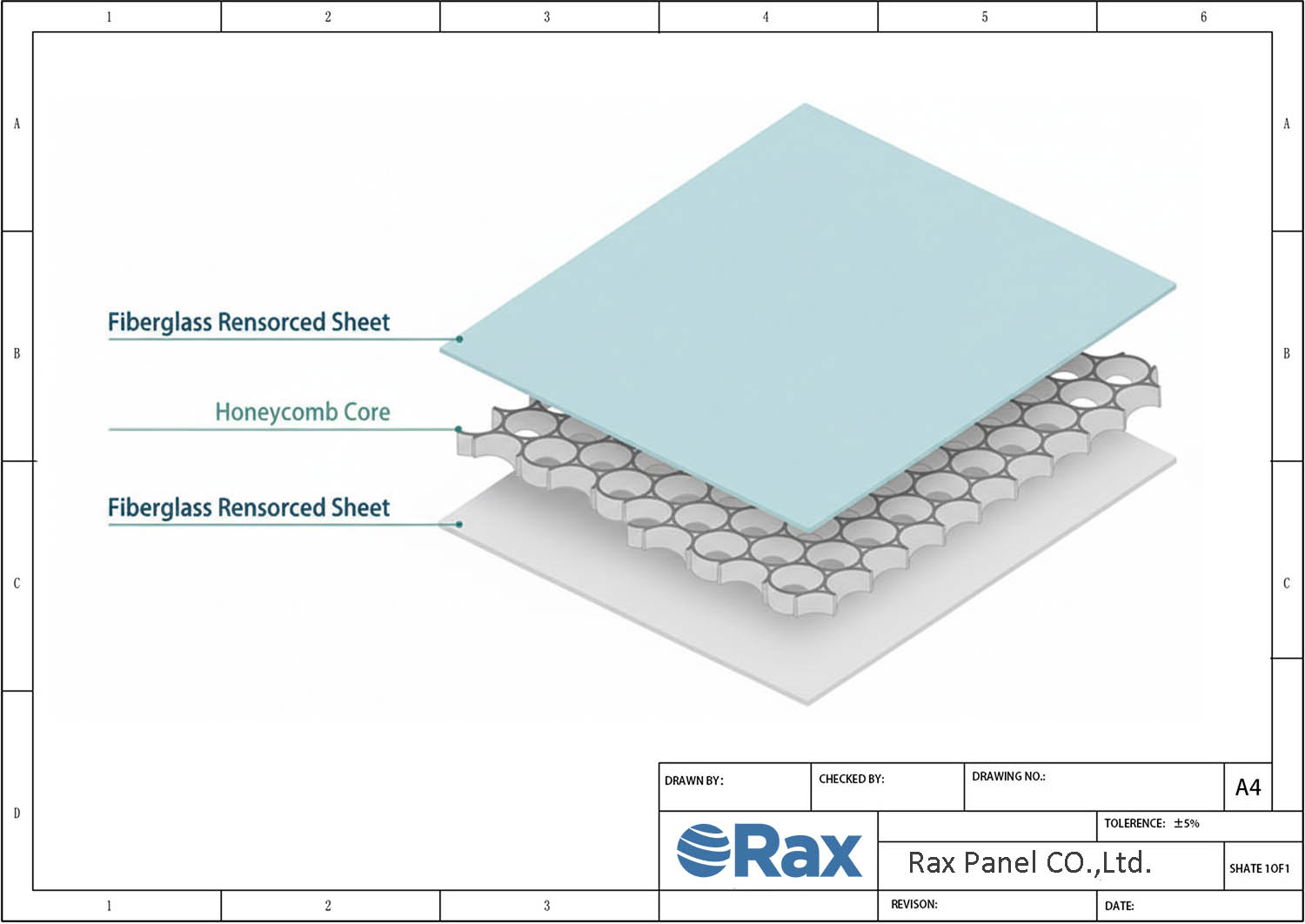
- PP Honeycomb: High shear strength, entirely recyclable, and ideal for structural flooring and load-bearing walls.
- XPS (Extruded Polystyrene): Superior moisture resistance and thermal insulation for temperature-controlled cargo vans.
- PU (Polyurethane): Excellent fire resistance and thermal conductivity coefficients for specialized enclosures.
Unlike competitors who rely on standard glues that can fail under extreme thermal cycling, we bond the core to the skins using a glue-free thermal fusion process. This creates a homogeneous bond at the molecular level. It ensures superior skin-core integrity, preventing the delamination issues that routinely halt production lines when dealing with standard CFRT sandwich panel dimensions.
| Parameter | Specification | Engineering Benefit |
|---|---|---|
| CFRT Skin Density | 1.0 – 1.6 g/cm³ | Optimizes weight-to-strength ratio to prevent overweight vehicle regulation violations |
| Core Material Density | 60 – 120 kg/m³ | Provides exceptional thermal insulation and impact absorption without structural bulk |
| Panel Thickness Range | 6 mm – 120 mm | Offers CAD design flexibility accommodating custom thickness tolerances for precise fits |
| Maximum Panel Width | 2.8 m (2800 mm) | Minimizes vertical seams in RV sidewalls, drastically reducing assembly time on the production line |
| Lamination Process | Glue-Free Thermal Fusion | Eliminates adhesive delamination risks in extreme thermal cycles, ensuring consistent batch reliability |
| Quality Assurance | ISO 9001 / Tensile & Fire Ratings | Delivers verifiable test data for risk mitigation and guaranteed material performance |
Weight Savings vs. Traditional Materials
Replacing traditional plywood and FRP with CFRT sandwich panels cuts structural weight by up to 40%, instantly increasing payload capacity and ensuring strict compliance with road weight regulations.
Areal Weight Comparison: CFRT vs. Traditional Materials
Specialized vehicle manufacturers live and die by the Gross Vehicle Weight Rating (GVWR). Every kilogram of dead weight saved on the body translates directly to payload capacity. Traditional materials trap engineers in a constant compromise between structural durability and overall mass. CFRT panel specs break this cycle by offering superior rigidity at a fraction of the weight.
- Marine-Grade Plywood: High density (often 1.5-1.8 g/cm³) and prone to moisture absorption, adding unpredictable weight over the vehicle’s lifespan.
- Solid FRP Layups: Requires heavy resin saturation to achieve structural stiffness, drastically driving up the areal weight compared to engineered sandwich structures.
- Aluminum Sheets: While lighter than steel, aluminum lacks the impact resistance of composites and requires heavy sub-framing to prevent denting and fatigue.
- CFRT Panels: With a skin density of just 1.0-1.6 g/cm³ combined with a lightweight 60-120 kg/m³ core, CFRT delivers the highest strength-to-weight ratio available for vehicle sidewalls and roofing.
Optimizing Fuel Efficiency Through Low-Density Engineering
Reducing mass does not just increase cargo capacity; it fundamentally lowers the energy required to move the vehicle. For fleet operators and specialized transport manufacturers, lightweight RV panel density is a critical operational metric. Lower rolling resistance and reduced mass yield measurable fuel savings over thousands of miles, directly improving the total cost of ownership.
Weight reduction must never come at the cost of structural integrity. By utilizing our 2.8m maximum panel width, engineers can cover standard vehicle sidewalls in a single pass, eliminating overlapping joints and heavy mechanical fasteners. RaxPanel uses a glue-free thermal lamination process to fuse the skins and core, removing the volatile weight variations associated with traditional liquid adhesives. This guarantees strict CFRT panel thickness tolerance and exact weight consistency across every production batch, eliminating the risk of an overweight shipment failing roadside inspections.
| Material | Density | Weight vs. CFRT | Engineering Benefit |
|---|---|---|---|
| RaxPanel CFRT Sandwich Panel | Skin: 1.0-1.6 g/cm³ | Core: 60-120 kg/m³ | Baseline (Optimal Lightweight) | Reduces overall vehicle weight, ensuring compliance with strict road regulations and maximizing payload capacity. |
| Traditional Marine Plywood | ~500 – 700 kg/m³ (Solid Core) | 40% – 60% Heavier | Adds significant deadweight to the chassis; highly susceptible to moisture rot and batch density inconsistencies. |
| Solid Aluminum Sheet | ~2.7 g/cm³ (2700 kg/m³) | 2x – 3x Heavier | Requires substantially thicker gauges to match CFRT flexural strength, eliminating payload design efficiencies. |
| Adhesive-Bonded FRP Panels | Heavy resin mix / Variable core | 10% – 25% Heavier | Prone to delamination in extreme thermal cycles; risk of inconsistent material batches halting production lines. |
| Standard Steel Framing/Sheets | ~7.8 g/cm³ (7800 kg/m³) | 5x – 8x Heavier | Massive weight penalty directly violates specialized vehicle weight limits and drastically increases fuel consumption. |
Mechanical Properties & Strength
For specialized vehicle manufacturers, structural failure is not an option. RaxPanel CFRT sandwich panels deliver a superior strength-to-weight profile utilizing continuous fiber reinforcement and glue-free thermal lamination, ensuring zero delamination under extreme operational stress.
High Modulus of Rupture (MOR) and Impact Resistance
When specifying materials for truck bodies or RV sidewalls, standard plywood or weak adhesives fail under repeated dynamic loads. RaxPanel CFRT panels are engineered to handle high bending stresses without catastrophic failure. Our continuous fiber reinforced thermoplastic skins, with a density of 1.0 to 1.6 g/cm³, provide exceptional impact resistance. They absorb and distribute kinetic energy from road debris or accidental impacts far better than traditional materials, preventing cracks that would otherwise compromise vehicle integrity and halt your production line.
Continuous Fiber Orientation (0°/90°)
Unidirectional strength is a common pitfall in composite design. We address this by aligning continuous fibers in a strict 0° and 90° biaxial orientation. This bidirectional reinforcement ensures the panel carries equal structural loads along both the length and the width. For your assembly line, this translates to consistent rigidity across our maximum 2.8-meter panel width, allowing you to minimize vertical joints and drastically reduce assembly time without sacrificing load-bearing capacity.
Toughness Maintenance in Sub-Zero Temperatures
Extreme cold environments destroy standard bonded panels. As temperatures drop, traditional chemical adhesives become brittle and fail, leading to catastrophic skin-core delamination. RaxPanel bypasses this failure mode entirely through our glue-free thermal lamination process. Because the skin and core are thermally fused rather than glued, the composite maintains its structural toughness and flexural properties even in severe sub-zero conditions. This ensures reliable performance for refrigerated transport vehicles operating continuously in harsh winter climates.
Customization Capabilities
Stop machining raw panels in-house. We handle the precise CNC cutting and structural layering so your production line receives drop-in ready components engineered to exact load specifications.
Precision CNC Processing and Thermoforming
Introducing a new structural material often creates a bottleneck if your facility lacks the right cutting equipment. We eliminate this step by executing all CNC pre-processing in-house. We cut and route CFRT sandwich panels directly from your CAD files to achieve precise dimensional tolerances, ensuring the parts fit your vehicle chassis jigs without secondary modification.
Beyond flat cuts, our thermoforming services allow us to mold continuous fiber reinforced thermoplastic skins into complex, curved geometries. This is critical for specialized vehicle roofs or aerodynamic fairings. Because our panels utilize a glue-free thermal lamination process, the skin-core bond remains intact during heating and forming, entirely avoiding the delamination issues common with adhesive-bonded FRP when subjected to thermal stress.
Tunable Unidirectional Tape Layers for Load Optimization
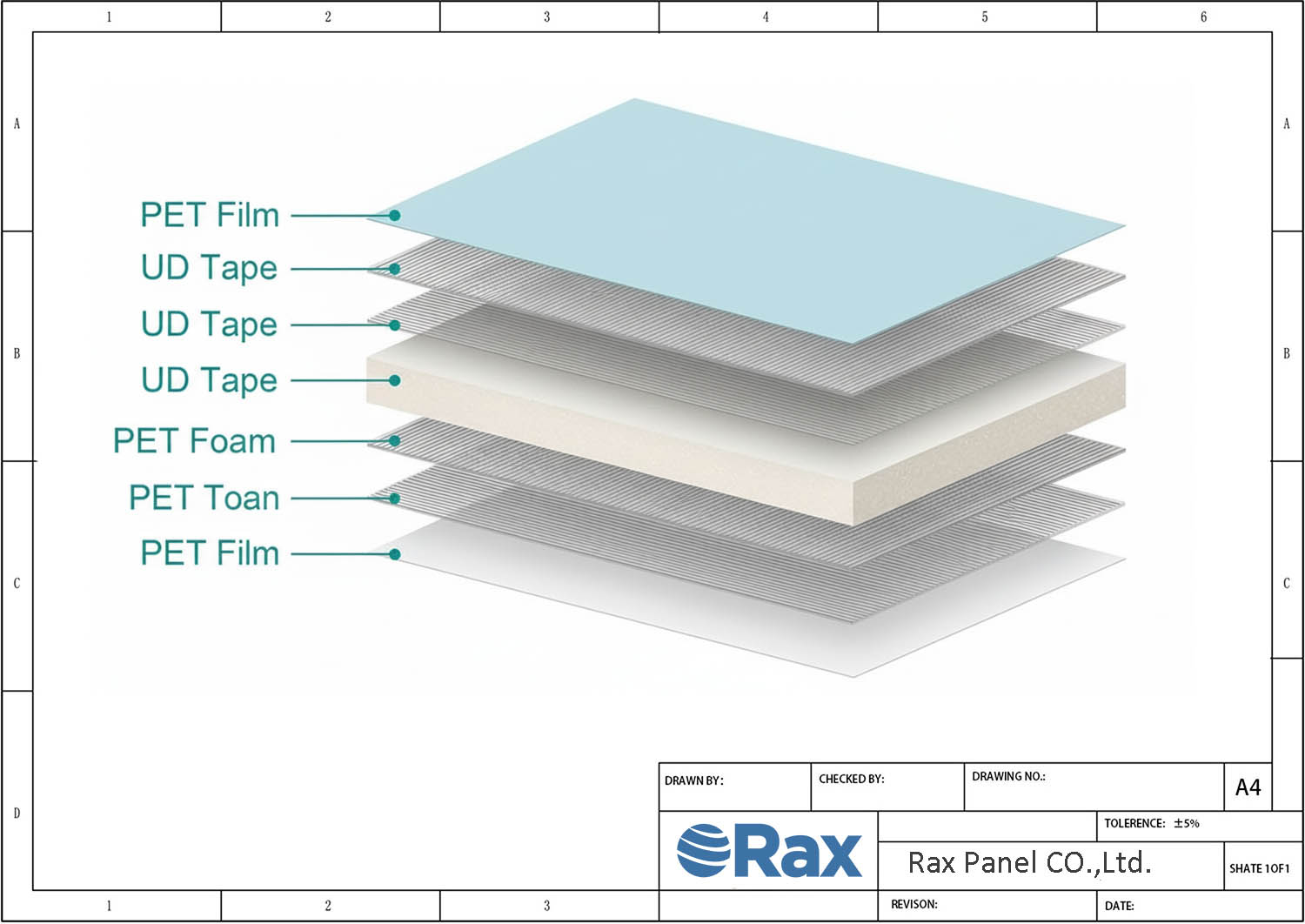
Standard off-the-shelf composite sheets force engineers to over-design parts, adding unnecessary weight to the vehicle. RaxPanel CFRT panels feature adjustable unidirectional tape layers, scalable from 2 to 9 layers, allowing your engineering team to dictate the exact stiffness and tensile strength required for specific load paths.
- Layer Configuration: Scalable from 2 to 9 unidirectional tape layers based on structural calculations.
- Directional Strength: Fiber orientation can be customized at the layup stage to match specific stress vectors in your CAD designs.
- Weight Optimization: Precise material placement prevents over-engineering, directly reducing overall vehicle mass to help comply with strict road weight regulations.
By adjusting the layers and matching the 60-120 kg/m³ core density to the application, you acquire a lightweight RV panel or commercial vehicle sidewall that strictly meets your weight-to-strength ratio targets without paying for unused material capacity.
Conclusion
If your vehicle design pushes weight limits, spec the 2.8m wide CFRT panels with the 1.0 g/cm³ skin density. That specific dimension eliminates the vertical seams you get with standard 2.4m sheets, dropping your assembly time per sidewall. Do not risk delamination on the production line by using glued alternatives.
Stop guessing if the tensile strength fits your CAD models. Request a 300mm x 300mm sample block of the exact thickness you need to run your own dead-weight bend test. Compare our thermal fusion bond against your current supplier’s adhesive failure point yourself.
Frequently Asked Questions
What are CFRT sheet specs?
CFRT (Continuous Fiber Reinforced Thermoplastic) sheet specifications typically feature a multi-layered structural design combining high-strength continuous fiber reinforcements, such as glass or carbon, with thermoplastic resins like polypropylene or PET. Standard thicknesses generally range from 2mm to 30mm depending on the specific core material, offering exceptional tensile strength, impact resistance, and a very high strength-to-weight ratio. These panels are manufactured using continuous lamination processes, resulting in a consistent, recyclable composite solution perfectly suited for demanding structural engineering applications.
How do CFRT and FRP panels compare?
While both CFRT and FRP panels offer exceptional structural reinforcement, CFRT utilizes a thermoplastic matrix that provides superior impact resistance, recyclability, and weight savings compared to the thermoset resins used in traditional GRP/FRP honeycomb panels. FRP panels are highly acclaimed for their immense structural rigidity and excellent corrosion resistance, making them a staple in harsh chemical or marine environments where structural stiffness is paramount. Ultimately, CFRT panels are preferred for dynamic applications requiring high fatigue resistance and thermoformability, whereas FRP panels are ideal for maximum static stiffness and thermal stability.
Are foam core panels lightweight?
Yes, foam core sandwich panels are exceptionally lightweight because they utilize low-density structural cores, such as PET, PVC, or polyurethane, securely sandwiched between high-strength composite or metal skins. This engineered design maximizes the moment of inertia, providing an incredibly high stiffness-to-weight ratio that significantly outperforms solid materials of equivalent thickness and weight. By drastically reducing the overall mass of the assembly, these panels lower transportation costs, simplify handling during commercial installation, and maintain outstanding structural integrity.
What are aluminum sandwich panel specs?
Specialized aluminum sandwich panels are engineered with high-grade aluminum alloy skins, such as 3003 or 5052 series, bonded to a lightweight core material, which can range from standard polyethylene (PE) to high-strength aluminum honeycomb. Typical specifications include overall panel thicknesses from 4mm up to 25mm, with skin thicknesses varying from 0.2mm to 1.0mm based on the precise architectural or industrial load requirements. These panels deliver outstanding surface flatness, superior weather resistance, and excellent fire-retardant properties, making them highly customizable for both aesthetic cladding and heavy-duty transportation applications.
Are polyurethane panels durable?
Polyurethane (PU) sandwich panels are incredibly durable, offering excellent long-term structural stability and reliable thermal insulation performance even in the most demanding temperature extremes. The advanced closed-cell structure of the polyurethane foam core provides exceptional resistance to moisture absorption, effectively preventing core degradation, mold, and rot over the entire lifespan of the panel. When paired with our robust outer skins, such as aluminum or CFRT, these specialized panels form a highly resilient composite structure capable of withstanding severe mechanical loads and harsh environmental conditions for decades.