
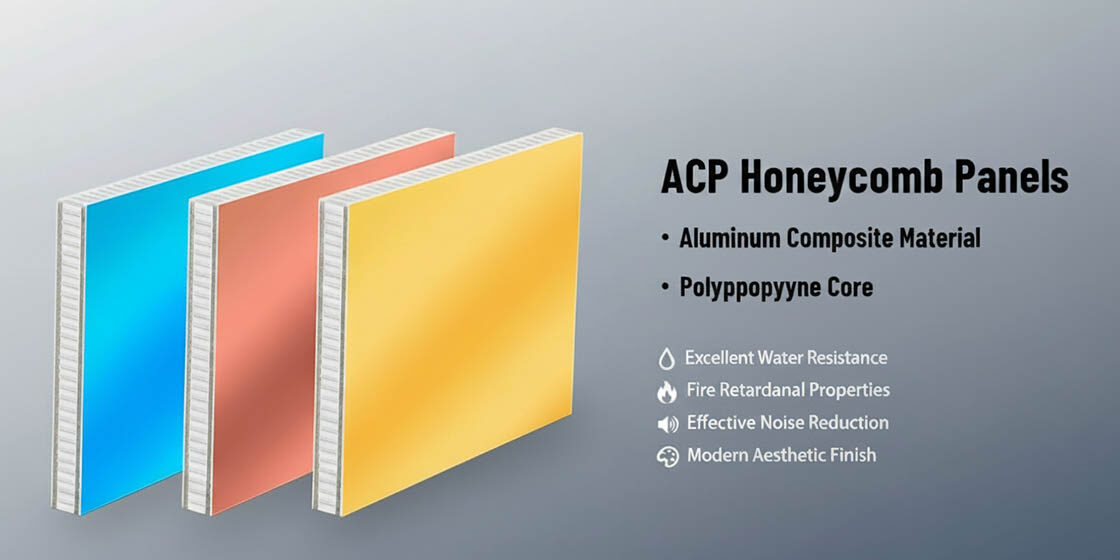
When a supplier quietly swaps a continuous fiber reinforced thermoplastic skin for a cheaper alternative without disclosing it, the thickness variance can jam an automated assembly line for days. The hidden cost resurfaces later as delamination-driven warranty claims once the vehicle hits the highway. Sourcing the wrong pp honeycomb panel for a commercial build does exactly this. It destroys your production throughput and invites massive warranty claims from delamination when the vehicle hits the highway.
We pulled our factory test data to eliminate the guessing game on your end. I am going to show you a direct comparison of exact area weights, matching specific skin materials like Carbon Black CFRT and aluminum to total kilograms per square meter. We will look at polypropylene core densities between 60 and 160 kg/m³ and explain how thermal-fused manufacturing prevents structural failure under constant vibration. You will walk away with the exact decimal points you need to calculate your vehicle’s payload limits.
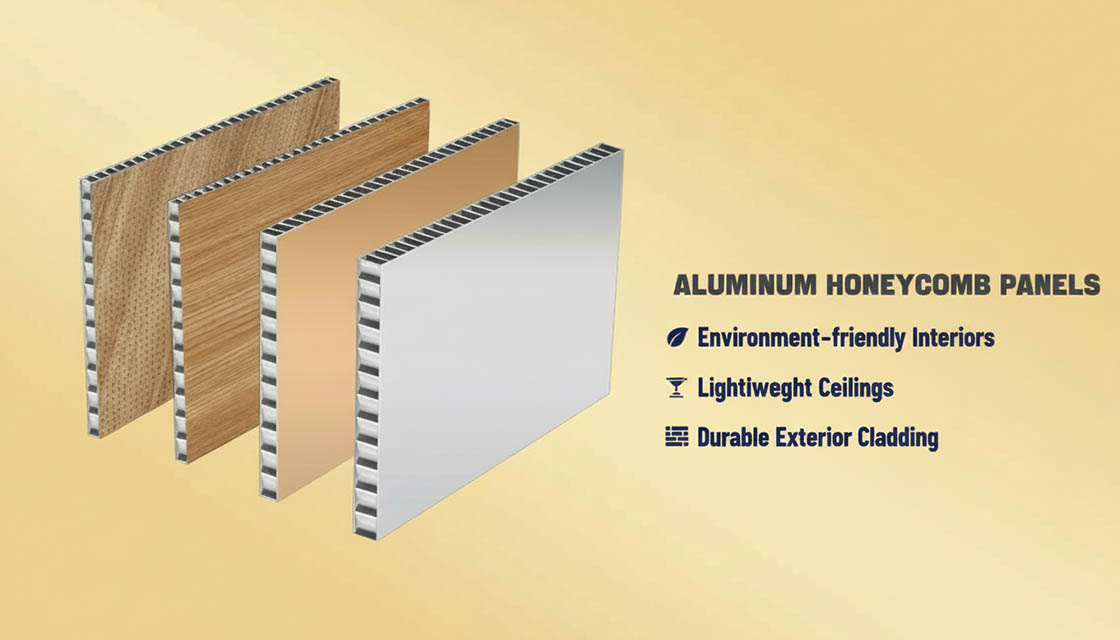
PP Honeycomb Core Density Data
We engineer our polypropylene honeycomb cores within a strict 60 kg/m³ to 160 kg/m³ density range, giving vehicle manufacturers exact control over payload limits and fuel efficiency.
Standard Polypropylene Core Weights (60 kg/m³ to 160 kg/m³)
When outfitting a truck body or RV, every kilogram impacts your bottom line. We manufacture our PP honeycomb panel cores to exact density specifications, ranging from 60 kg/m³ for standard lightweight fill up to 160 kg/m³ for high-load structural zones. This precise density control dictates the final compressive strength, which sits between 0.5 MPa and 2.0 MPa depending on the core selected.
By adjusting the wall thickness of the thermoplastic polypropylene foil during extrusion, we control the core density without altering the cell size. This results in predictable static flexural modulus ratings, specifically 4400 MPa for our sandwich structures, which ensures engineers can calculate exact deflection under load.
Comparison: PP vs. Aramid vs. Fiberglass Cores
Procurement teams often weigh polypropylene against aramid (Nomex) and fiberglass honeycombs. While aramid offers exceptional temperature resistance, its cost profile is tough to justify for standard freight applications. Fiberglass cores provide good stiffness but add considerable weight compared to thermoplastics. Polypropylene strikes the critical balance for commercial transport.
- Polypropylene (PP): Moisture-resistant, thermoplastic, highly cost-effective, and fully recyclable. Operates reliably up to 80 – 100°C.
- Aramid (Nomex): Superior fire retardancy and high-temperature performance, but carries a massive cost premium best suited for aerospace rather than commercial trucking.
- Fiberglass: High compressive strength, but susceptible to moisture ingress and significantly heavier than PP equivalents.
PP Advantage for Lightweight Vehicle Structures
The primary advantage of PP honeycomb lies in the massive weight savings translated directly into payload capacity. If a fleet manager saves weight on the vehicle body, they can legally haul more cargo per trip. To illustrate the engineering reality of these weight savings, look at the exact area weights we achieve with our standard panel configurations.
- 25mm CFRT Skin PP Honeycomb Panel Area Weight: 4.96 kg/m²
- 22mm Aluminum Skin PP Honeycomb Panel Area Weight: 7.2 kg/m²
- Thickness Customization Range: 6.0mm to 120mm
A major fear in vehicle assembly is material delamination caused by constant vibrational stress. We address this failure point directly. Because our thermoplastic polypropylene cores can be thermally fused to the skins, rather than relying solely on adhesive films, we create a monolithic composite structure. This thermal bond resists the shear stresses that typically peel skins apart on rough roads, ensuring a longer service life for the truck body or RV.
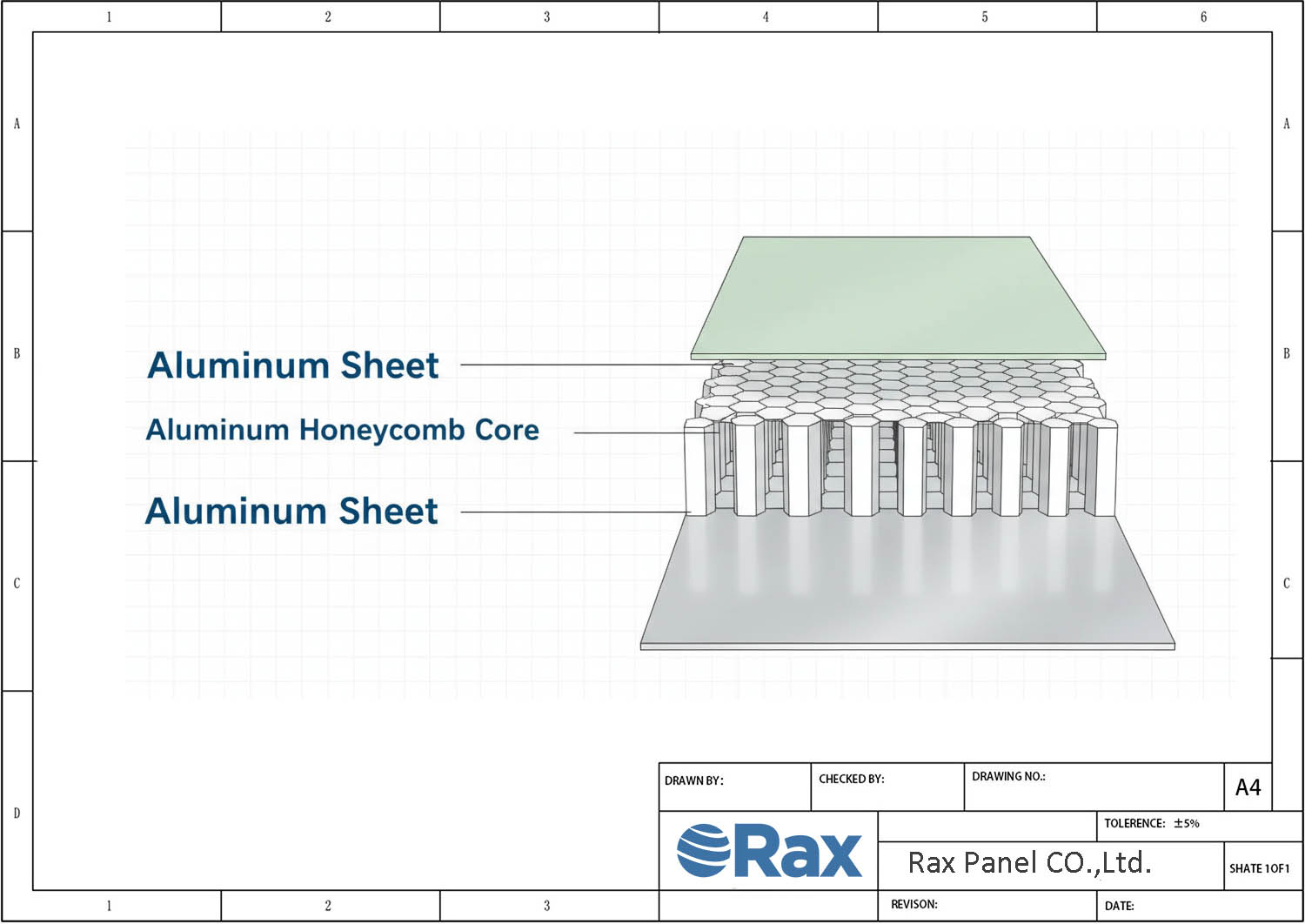
Area Weight by Thickness & Skin
CFRT skins drop panel area weight to 4.96 kg/m² at 25mm thickness, compared to 7.2 kg/m² for 22mm aluminum skins. This exact weight reduction directly increases payload limits and improves vehicle fuel efficiency.
CFRT Skin vs. Aluminum Skin Weights
When manufacturing truck bodies or RV walls, swapping traditional metal skins for Continuous Fiber Reinforced Thermoplastic (CFRT) yields immediate dividends in payload capacity. Our engineering tests confirm a stark difference in area weight. A standard 22mm aluminum skin PP honeycomb panel registers an area weight of 7.2 kg/m². Replace that aluminum with a CFRT skin at a slightly thicker 25mm profile, and the area weight drops to 4.96 kg/m². That represents a massive weight saving per square meter without sacrificing the structural modulus required for heavy-duty transport.
High Strength-to-Weight Ratios of 0.7mm CFRT Skins
Vehicle manufacturers constantly battle the balance between lightweighting and impact resistance. Our 0.7mm CFRT skins solve this equation. Unlike glued assemblies that succumb to vibrational stress and delamination on the highway, these thermoplastic skins are thermally fused directly to the polypropylene honeycomb core. This homogenous bond creates a static flexural modulus of 4400 MPa. The result is a composite panel that absorbs road vibration and point impacts without separating, maintaining structural rigidity at a fraction of traditional material weights.
10mm to 30mm Thickness Profiles
For commercial vehicle builds, panel thickness directly dictates insulation capacity and frame integration. We produce standard profiles ranging from 10mm to 30mm to match exact design requirements, whether you need thin interior dividers or thick, insulated refrigerated truck walls. Although our customization capabilities extend up to 120mm, the 10mm to 30mm range remains the sweet spot for balancing structural integrity and space efficiency in vehicle applications.
- Core Density Options: Ranging from 60 kg/m³ to 160 kg/m³ to accommodate specific compressive strength requirements.
- Compressive Strength: Rated between 0.5 MPa and 2.0 MPa, depending on the exact core density selected.
- Temperature Resistance: Maintains structural stability in continuous environments up to 80°C – 100°C.
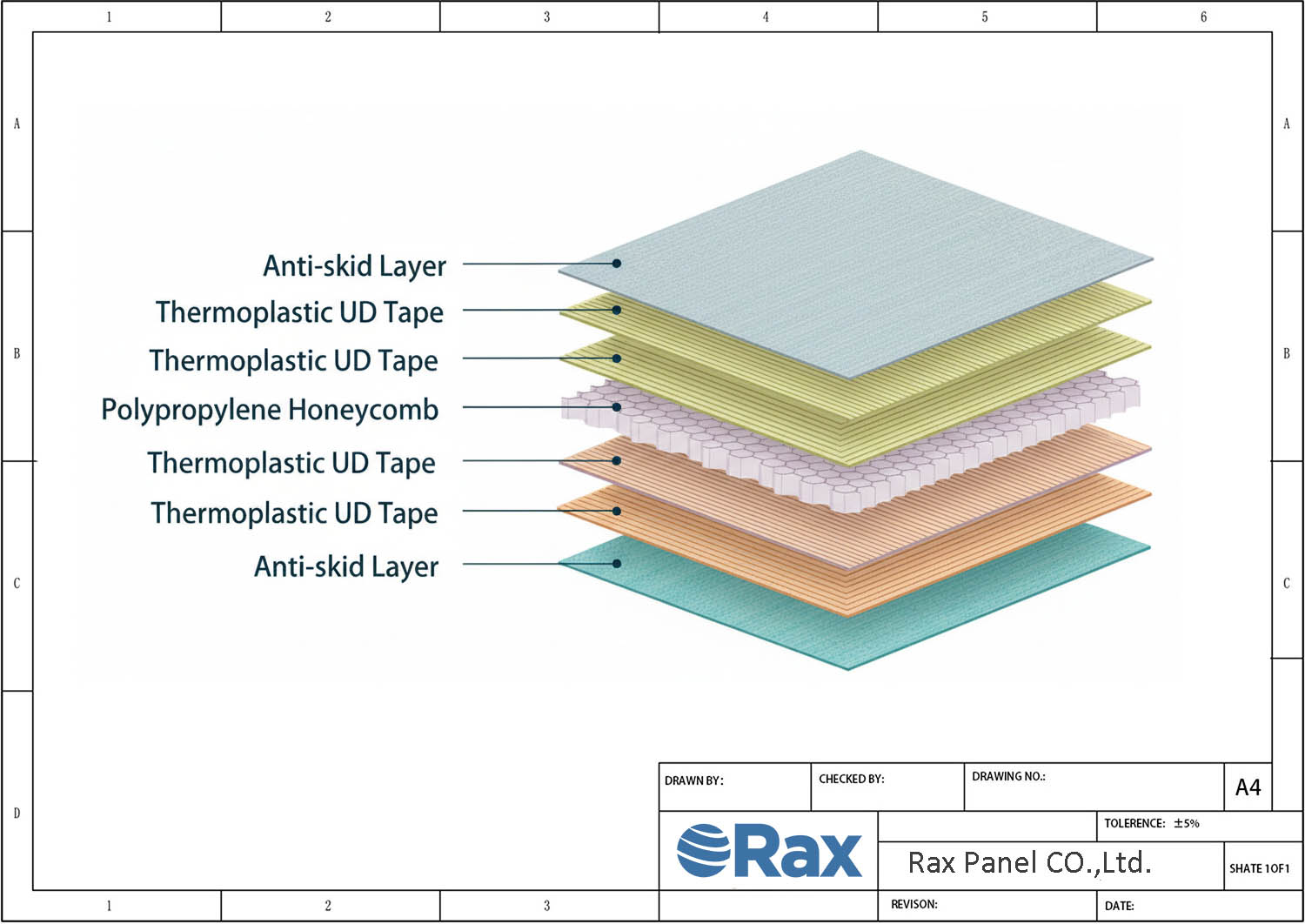
Mechanical Properties & Vehicle Specs
In commercial vehicle engineering, every kilogram saved translates directly to payload capacity. Our thermoplastic polypropylene honeycomb panels deliver a static flexural modulus of 4400 MPa at an area weight of just 4.96 kg/m², ensuring high structural stiffness without the mass penalty of traditional materials.
Flexural Modulus & Shear Strength
When evaluating lightweight honeycomb panels for trucks, the 4400 MPa static flexural modulus is the defining metric. This high modulus indicates exceptional resistance to bending under heavy loads. During our physical testing, we found that utilizing a continuous fiber reinforced thermoplastic (CFRT) skin combined with a polypropylene honeycomb core prevents the structural flexing that leads to material fatigue in long-haul applications.
Unlike chemically bonded panels that degrade over time, our thermal-fused PP cores eliminate delamination risks caused by constant vibrational stress on the highway. The core density directly dictates the shear strength, allowing our engineering team to dial in the exact compression and shear profiles required for your specific RV or truck body build.
- Static Flexural Modulus: 4400 MPa
- Core Density Range: 60 kg/m³ to 160 kg/m³
- Compressive Strength: 0.5 – 2.0 MPa (core dependent)
- Operating Temperature: 80°C to 100°C
Load-bearing Capacities for Truck Bodies
Achieving a high strength-to-weight ratio is the primary objective for procurement engineers specifying RV composite panels. By swapping traditional plywood or heavy GRP for our CFRT skin PP honeycomb panel, you drastically reduce the dead weight of the vehicle shell. For context, a standard 25mm Carbon Black CFRT PP Honeycomb Panel registers an area weight of only 4.96 kg/m². Even our 22mm Aluminum Skin PP Honeycomb Panel, built for high-impact wear zones, weighs just 7.2 kg/m².
This direct weight reduction increases legal payload limits and improves vehicle fuel efficiency over the lifecycle of the fleet. The sheer strength of the polypropylene honeycomb core efficiently transfers loads between the outer skins, preventing localized buckling under dynamic road conditions. Because we offer a pp honeycomb panel thickness chart ranging from 6.0mm up to 120mm, we can fine-tune the load-bearing capacity to meet your exact specifications while maintaining strict millimeter tolerances to prevent assembly line delays.

Weight Savings vs. Traditional Materials
Swapping standard 15mm plywood for a 25mm CFRT PP honeycomb panel drops wall weight to precisely 4.96 kg/m². This structural shift immediately increases your legal cargo payload.
Plywood vs. PP Honeycomb Payload Impact
Vehicle manufacturers face strict payload limits and run constant calculations to balance durability against dead weight. Traditional plywood adds significant mass, and worse, it absorbs moisture over time. That water intrusion silently adds weight while degrading the structural integrity of the vehicle body.
By contrast, our polypropylene honeycomb core features a density range of just 60 kg/m³ to 160 kg/m³. This closed-cell thermoplastic structure completely repels water, ensuring the panel’s weight remains constant throughout the vehicle’s service life. You simply cannot achieve a high strength-to-weight ratio with standard wood once a PP honeycomb sandwich offers a static flexural modulus of 4400 MPa without the bulk.
Weight Reduction Switching from 15mm Plywood
Let us look at the exact engineering numbers. A standard 15mm plywood commonly used in truck and RV bodies typically weighs between 10.0 kg/m² and 12.0 kg/m². When you transition to our Carbon Black CFRT Skin Polypropylene Honeycomb Panel, the area weight drops drastically to exactly 4.96 kg/m². You are essentially doubling the panel thickness for greater insulation and rigidity, while cutting the weight by more than half.
- Standard 15mm Plywood: ~10.0 – 12.0 kg/m² (Vulnerable to moisture rot)
- 25mm CFRT PP Honeycomb Panel: 4.96 kg/m² (Thermally fused, rot-proof)
- 22mm Aluminum Skin PP Honeycomb Panel: 7.20 kg/m² (High-impact resistance)
Even if your specific application requires heavy-duty aluminum exterior skins, the savings remain substantial. A 22mm Aluminum Skin PP Honeycomb Panel registers an area weight of just 7.2 kg/m². When extrapolated across a 12-meter truck body or a large RV roof, that decimal difference accounts for hundreds of kilograms of eliminated dead weight.
Increased Cargo Payload or Improved Fuel Efficiency
Every kilogram saved in the wall and roof panels goes directly to your operational bottom line. For commercial trucking fleets, shedding 200 kg of panel weight allows for an extra 200 kg of legally billable cargo per trip. For RV and marine manufacturers, this lightweighting means smaller, more efficient chassis can carry larger living quarters without requiring suspension upgrades.
Weight reduction is no longer just a design preference; it is a strict operational requirement. We manufacture these panels in thicknesses ranging from 6.0mm up to 120mm precisely to give your engineering team the dimensional flexibility needed to shed weight wherever possible, ensuring you meet payload restrictions without risking delamination under vibrational stress.
| Panel Material Type | Area Weight (kg/m²) | Weight Savings vs Traditional | Structural Advantage for Vehicles |
|---|---|---|---|
| Standard Marine Plywood (Baseline) | ~12.0 kg/m² | Baseline (0%) | High weight negatively impacts fuel efficiency and payload capacity |
| Standard GRP/FRP Plywood Composite | ~15.0 kg/m² | Baseline (0%) | Heavy and highly susceptible to moisture absorption and rot |
| Carbon Black CFRT Skin PP Honeycomb Panel | 4.96 kg/m² | Up to 67% Weight Reduction | Extreme lightweighting maximizes cargo payload and vehicle fuel efficiency |
| Aluminum Skin PP Honeycomb Panel | 7.2 kg/m² | Up to 52% Weight Reduction | Thermoplastic fused core completely prevents delamination under vibrational stress |
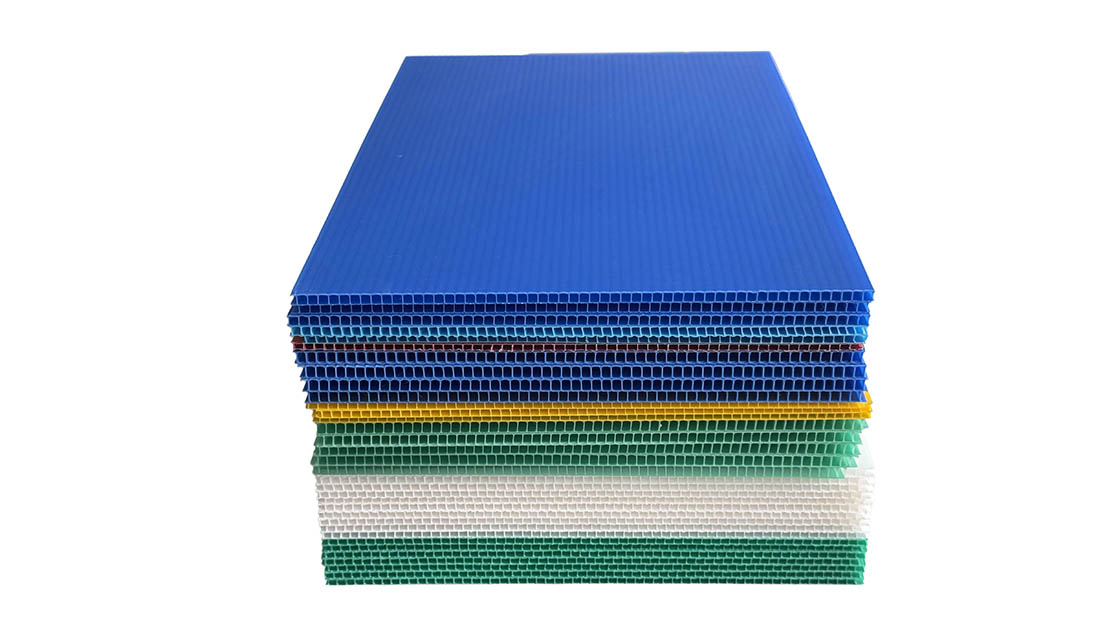
Precision Sizing & Tolerances
Tolerance management dictates assembly line throughput. In vehicle manufacturing, a variance of just 1mm across a 12m panel run will jam automated tooling and derail payload calculations.
CNC Cutting & Thickness Consistency
When you are building truck bodies or RVs, standard routing practices simply do not cut it. We rely on precision CNC equipment to process our CFRT and Aluminum skin PP honeycomb panels. This isn’t just about making a clean edge; it is about protecting the structural integrity of the panel during the sizing phase. Our engineers program specific tool paths and speeds tailored to thermoplastic polypropylene cores. This prevents the friction buildup that causes core melting or skin delamination: the exact structural failures you are trying to avoid.
Tight Tolerances in 6.0~120mm Custom Thicknesses
We maintain strict dimensional control across an extensive range of custom profiles. Whether you require a thin 6.0mm lightweight panel for an interior RV bulkhead or a 120mm thick foam core panel for heavy-duty industrial flooring, the consistency of the thickness is non-negotiable. We achieve this through continuous inline thickness monitoring during the thermoplastic fusion process.
- Thickness Range: Custom engineering from 6.0mm up to 120mm.
- Maximum Width: 2.8m continuous.
- Maximum Length: Up to 12m to minimize seaming on long truck bodies.
Why does this precision matter down to the millimeter? Because your weight specifications rely on it. If you order a 25mm Carbon Black CFRT PP Honeycomb Panel, your structural calculations are built around an exact 4.96 kg/m² area weight. If the thickness fluctuates, your area weight fluctuates, and your fuel efficiency targets go out the window. We hold the line on these tolerances to ensure your static flexural modulus remains a consistent 4400 MPa across the entire batch.
Prevention of Assembly Line Snags
Uneven panels are a nightmare for automated manufacturing. High and low spots create inconsistent adhesive gaps, misaligned fastener holes, and structural weak points that ultimately lead to vibrational delamination on the highway. By guaranteeing uniform thickness and perfectly square CNC-cut edges across the full 2.8m width, we eliminate the manual adjustments and bottlenecks that eat into your production line throughput. Your jigs fit exactly as designed, and your trucks roll off the line faster.
Conclusion
Stop risking payload limits with heavy plywood walls. If you build truck or RV bodies, specify the 25mm CFRT PP honeycomb panel for your standard structural layouts. At exactly 4.96 kg/m² and a 4400 MPa flexural modulus, this thermoplastic core eliminates delamination while adding pure cargo capacity.
Do not sign a supply contract based on a datasheet alone. Ask our engineering team to route two custom-cut CFRT samples directly to your facility so your technicians can physically test the flexural strength on the assembly line. Prove the literal weight savings to your finance department before you commit to a full production order.
Frequently Asked Questions
What are PP honeycomb panels?
PP honeycomb panels are lightweight yet durable composite structures featuring a polypropylene honeycomb core sandwiched between facing materials. The hexagonal cell structure provides exceptional strength-to-weight ratio while maintaining flexibility and impact resistance. As part of our comprehensive product range, these panels offer superior moisture resistance compared to traditional materials, making them ideal for transportation, construction, and marine applications where weight reduction is critical.
What is the weight specification of a PP honeycomb panel?
PP honeycomb panels typically weigh between 2.5-8.0 kg/m² depending on core thickness, cell size, and facing materials selected. Standard 10mm panels weigh approximately 2.5-3.5 kg/m², while heavier-duty applications utilizing 30mm cores with reinforced facings range from 5.0-8.0 kg/m². This weight advantage of up to 70% less than solid alternatives positions our PP honeycomb panels as the preferred solution when structural efficiency and weight optimization are paramount concerns.
Are plastic honeycomb panels 4×8 standard?
Yes, the 4’×8′ (1220mm×2440mm) dimension is our standard production size for plastic honeycomb panels, accommodating most common application requirements. However, our manufacturing capabilities allow for customization in both length and width to meet specific project needs, with larger formats available up to 2500mm×6000mm for specialized orders. This flexibility in dimensions complements our comprehensive range of sandwich panels, ensuring we can provide optimal solutions across diverse industries and applications.
What is the core density of a polymer honeycomb core?
The core density of our polymer honeycomb cores typically ranges from 45-150 kg/m³, depending on the specific grade and structural requirements of the application. Higher density cores (120-150 kg/m³) deliver superior compressive strength and are typically specified for heavy-duty applications, while standard cores (45-80 kg/m³) offer an optimal balance of strength and weight for general purpose use. This density range represents our commitment to engineering versatility across our sandwich panel product line.
Can plastic honeycomb panels be used for driveways or heavy loads?
Standard PP honeycomb panels are not typically recommended for direct driveway applications as they are not designed for concentrated point loads from vehicle tires. However, our specialized heavy-duty variants with reinforced facings and higher density cores can be engineered for load distribution applications when properly supported and installed according to our technical specifications. For permanent driveway installations, we would recommend our CFRT Sandwich Panels or specialized Aluminum Sandwich Panels, which offer superior long-term performance under heavy dynamic loads.