

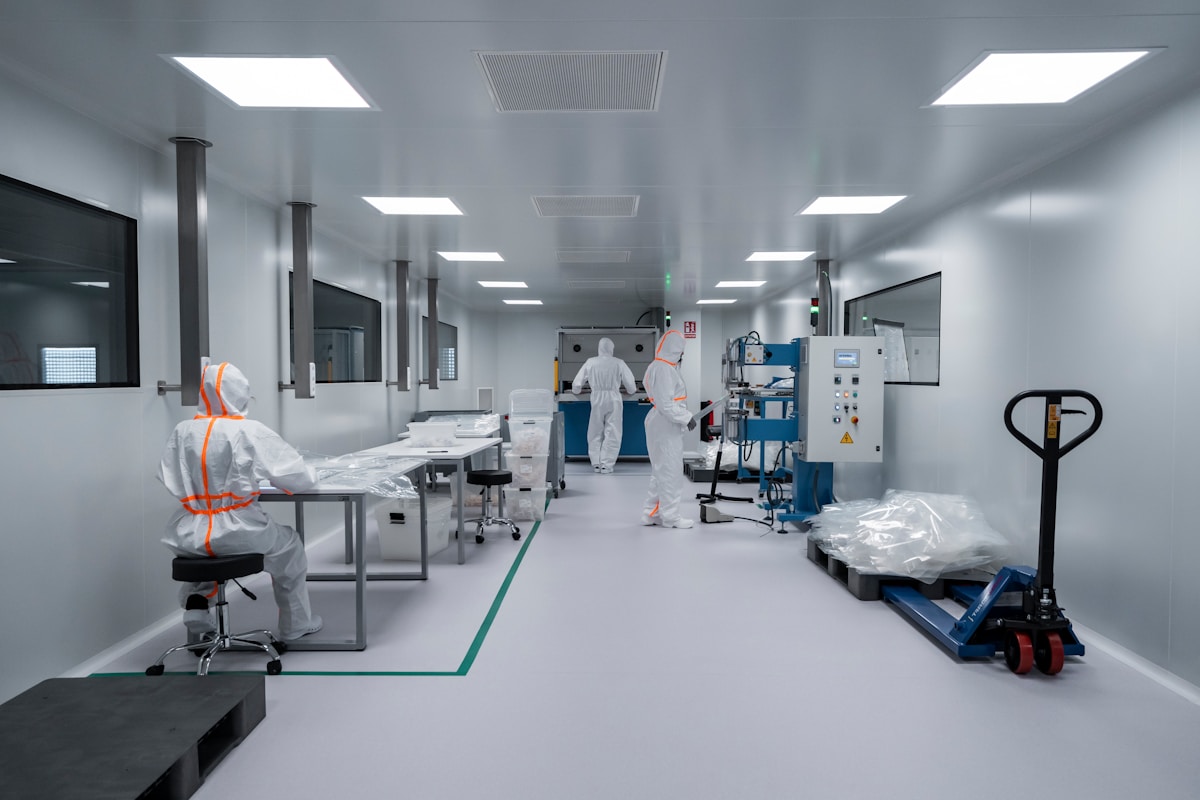
A cleanroom is not a room with filters in the ceiling. That description passes the marketing test and fails the engineering one. A cleanroom is a pressure-and-flow system. Filtered air is supplied in controlled volumes. Pressure relationships push contamination away from critical zones, surfaces refuse to shed, and people and materials move along routes that never cross the gradients.
Classification numbers describe the output of that system, not the system itself. This guide defines the whole mechanism first. Then it explains how cleanroom classifications are counted under ISO 14644-1, walks each class level with its practical behavior, and closes with the misconceptions that skew purchasing decisions.
Defining a Cleanroom as a Controlled System
Start with the definition that engineers can act on. A cleanroom is a room where airborne particle concentration is controlled to a stated limit, which requires four systems working together. HEPA or ULPA filtration scrubs the supply air. A pressure cascade holds 10 to 15 Pascals of positive offset between adjacent zones so leakage always flows outward.
Airflow patterns carry particles away from the work. Gowning, material transfer, and cleaning routines stop the people and the parts from importing what the air just removed.

Read that definition again and the purchasing implications follow. The envelope, the airside, and the operating discipline share the certification outcome equally, so a quotation that prices only walls describes a third of the system. RaxPanel builds the envelope portion of that system, laminating cleanroom wall, ceiling, partition, and door panels on production lines our own engineers run. For a full walkthrough of this topic, see this guide to cleanroom contractor selection value.
The system view also explains why two rooms with identical class certificates can behave differently in production. One was commissioned around its process layout, the other around a generic drawing. Recovery after a door opening, particle clearance over a workstation, and stability across shifts are all system properties, and they are the properties your product actually experiences. Definitions matter because they decide which questions get asked before the concrete pours. For a full walkthrough of this topic, see this guide to what makes a cleanroom reliable.
How ISO 14644-1 Counts Particles
The ISO 14644-1 classification standard counts particles per cubic meter of air at stated size thresholds, and cleanroom classifications are named for the logarithm of the concentration at 0.5 microns. ISO 5 permits 3,520 particles per cubic meter, ISO 6 permits 35,200, ISO 7 permits 352,000, and ISO 8 permits 3,520,000. Each step multiplies the allowance tenfold, which is why each step also divides the airside cost.

Two words on the certificate decide what the number means. At-rest readings are taken with the room equipped but empty. In-operation readings are taken while people work and machines run, and they are always harder to hold. A certificate earned at rest says little about your production shift, so buyers should demand the operational state in their acceptance clauses.
What Each Class Level Means
Classes differ in airflow regime as much as in particle counts, and the regime decides how the room behaves under disturbance. The table below walks the working classes from the top down.
| ISO Class | Particles per m3 at 0.5 um | Airflow Regime | Typical Applications | Acceptance Note |
|---|---|---|---|---|
| ISO 5 | 3,520 | Laminar flow, 0.36 to 0.54 m/s | Aseptic filling, GMP Grade A, semiconductor critical zones | Continuous monitoring expected |
| ISO 6 | 35,200 | Mixed, high change rate | Precision instrument rooms, optics | Watch recovery after disturbances |
| ISO 7 | 352,000 | Turbulent dilution | GMP Grade B backgrounds, medical device assembly | Cascade integrity matters most |
| ISO 8 | 3,520,000 | Turbulent dilution | Packaging, general electronics, support zones | Lowest airside burden, still needs discipline |
Where sterile pharmaceutical work overlaps, the GMP grades map onto the same ladder. Grade A corresponds to ISO 5 in operation. Grade B is its ISO 7 background, and Grades C and D cover the less critical steps at ISO 7 and ISO 8 at rest.
How a Room Reaches Its Rated Class
A class is earned by a system, then defended by a routine. On the construction side, the envelope must hold its pressure boundaries, the filtration must deliver its rated efficiency, and the change rate must match the contamination load. On the operating side, five pillars carry the certificate between tests. The layout must support the airflow, consumables must be compliant, cleaning cycles must be documented, monitoring must run continuously, and personnel must follow the gowning sequence.
The certificate then renews on a clock. ISO 5 and cleaner rooms requalify every six months, while ISO 6 through 9 rooms requalify every twelve, and continuous monitoring of pressure and particles sits between those events. Rooms that skip the routine do not stay certified; they simply stay uncertified in ways nobody has measured yet.
The envelope carries a quiet share of that defense. Flush joints, sealed penetrations, and surfaces that survive repeated cleaning hold the pressure boundaries between certificate events. That is the portion of the system our modular cleanroom wall panels own, engineered so the airside investment is never leaked away through a wall detail.
Define Your Class With an Engineer, Not a Guess
Share your process and its contamination load, and our engineers will map the class, the zoning, and the envelope that holds it.
Where Industries Place Their Rooms
Class choice follows process sensitivity, and most industries cluster predictably. General chemical analysis and sample preparation sit at ISO 7 or 8. Precision instrument rooms justify ISO 6. Semiconductor critical steps and aseptic pharmaceutical filling occupy ISO 5, with the surrounding support zones one and two classes looser. Packaging and general electronics assembly live comfortably at ISO 8, where the airside burden is lowest.
Use those clusters as a starting position rather than a verdict. Product changes move processes across class boundaries, and a room designed with spare wall runs and ceiling grid capacity absorbs the move without demolition. For labs that handle solvents alongside particles, our guide to clean rooms for chemical laboratories adds the surface chemistry dimension.
Misconceptions That Skew Class Decisions
Four misconceptions account for most of the waste and most of the audit pain around cleanroom classifications.
Building the whole room at the highest class
Only the critical zone usually needs the tight number. Zoning the room achieves the same protection at a fraction of the airside investment. Keep it tight where the product sits and looser around it, and let the pressure cascade do the guarding between zones.
Accepting the at-rest certificate
A room that passes empty can fail the moment the shift starts. Specify, test, and accept in operation, with personnel working and equipment running, so the certificate describes the room you actually own.
Treating the class as the whole specification
Particle limits are one line on a wider specification. Pressure cascade, recovery time, temperature, humidity, and surface chemistry all shape whether the room supports the process. Our guide to which ISO class your process needs walks that selection step by step.
Ignoring the industries that run tighter rooms
Context sharpens the choice. Our article on industries that require Class 100 environments shows where ISO 5 is mandatory rather than optional, which is a useful boundary check before you commit a budget.
Frequently Asked Questions
What defines a cleanroom?
A room where airborne particle concentration is controlled to a stated limit. Filtered supply air, a pressure cascade that pushes contamination away from critical zones, and controlled movement of people and materials all serve that limit.
What do the ISO class numbers mean?
They cap particles per cubic meter at 0.5 microns and larger. ISO 5 allows 3,520, ISO 6 allows 35,200, ISO 7 allows 352,000, and ISO 8 allows 3,520,000, with each step a tenfold change.
What is the difference between at-rest and in-operation?
At-rest readings are taken with the room equipped but empty. In-operation readings are taken during production, and they are harder to hold, which is why acceptance clauses should specify the operational state.
How do GMP grades relate to ISO classes?
GMP Grade A matches ISO 5 in operation. Grade B is its ISO 7 background, Grade C spans ISO 7 at rest to ISO 8 in operation, and Grade D sits at ISO 8 at rest.
How often must a cleanroom be requalified?
ISO 5 and cleaner rooms requalify every 6 months, and ISO 6 through 9 rooms every 12 months. Continuous monitoring of pressure and particles sits between the requalification events.