
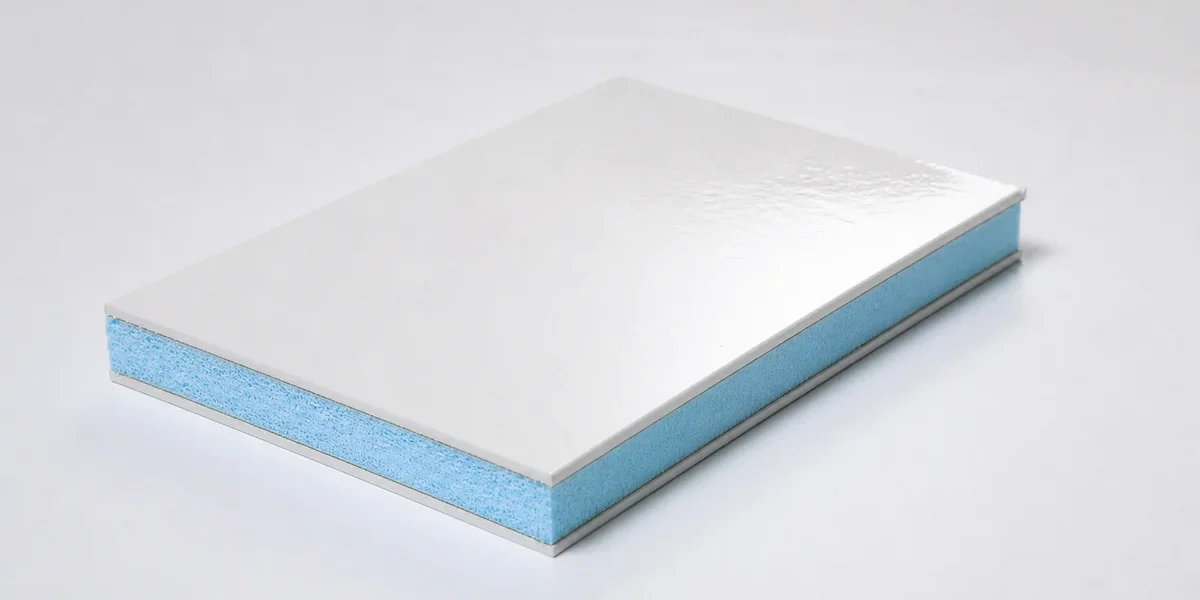
ACP sheets earn their keep through arithmetic, and two numbers show it. Run a back-of-envelope calculation and a 4 mm sheet with two 0.5 mm skins weighs about 5.5 kg/m² against 10.8 kg/m² for solid 4 mm aluminium plate. That is roughly half the mass at identical thickness, taking aluminium at 2.70 g/cm³ against a core polymer near 0.92 g/cm³. Peel strength is the second account: GB/T 17748-2016 asks curtain-wall stock for an average of 180 N·mm/mm in roller peel, with no single reading below 150. In plain terms, ACP sheets are two aluminium skins bonded to a thermoplastic core, and every pro, con and use traces back to three choices: thickness, core grade, coating.
Buyers pay for the lesson twice: once on the quotation, which lists the pros they were promised, and again on site, where the cons nobody quoted are waiting. Every claim below is therefore written as a specification consequence, not a slogan, so the same three decisions decide both sides of the ledger. RaxPanel laminates ACP alongside honeycomb-core and foam-core variants on its own line, which is one reason this page sorts arguments by decision first and adjectives last. Thickness with skin gauge, core grade and coating: read the pros, cons and uses against those three, and few surprises survive to delivery.
What an ACP Sheet Is in One Look
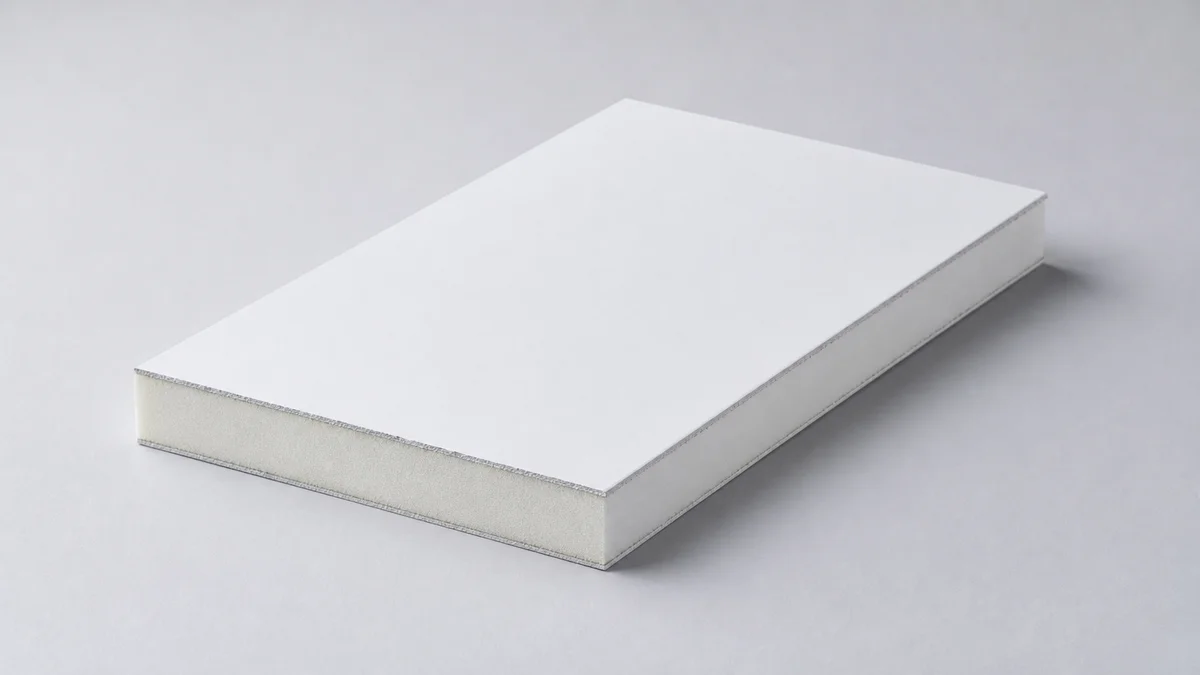
Under the paint, every ACP sheet is one repeated idea: aluminium skin, polymer core, aluminium skin, pressed and bonded into a total thickness of 2-6 mm. The skins bring weather resistance and color; the core brings lightness, bending stiffness and clean routing for folds, corners and cassettes. One construction, two different jobs, with only the recipe changed between a high-rise facade and a shopfront fascia.
| Property | Architectural snapshot |
|---|---|
| Total thickness | 2-6 mm, with 4 mm the facade standard |
| Aluminium skins | 0.21-0.50 mm architectural; market range down to about 0.06 mm |
| Weight at 4 mm | About 5.5 kg/m² by calculation, versus 10.8 for solid aluminium |
| Coating | PVDF or polyester, applied on coil before lamination |
| Standard sheet | 1220 x 2440 mm |
Treat the table as defaults rather than limits: 4 mm is the facade standard, 1220 x 2440 mm is the stock sheet, and 0.21-0.50 mm is the architectural skin band. The layered anatomy behind those numbers gets its own walkthrough in this guide to ACP panel structure.
Numbers on a page hold only if the line behind them does. RaxPanel runs this product family on its own lamination line, next to honeycomb-core and foam-core siblings, so the rows above describe production, not a catalogue.
The Pros Buyers Actually Bank On
Stiffness without the weight
Sandwich geometry is where the stiffness comparison is won. Run the back-of-envelope numbers and a 4 mm sheet with two 0.5 mm skins lands near 5.5 kg/m², against 10.8 kg/m² for solid 4 mm plate. Skins held apart by a light core sit far from the neutral axis, so each gram of metal does more bending work. The bond is what keeps that trick alive: GB/T 17748-2016 requires curtain-wall stock to average 180 N·mm/mm in roller peel or better. No single reading may fall below 150, and the test method is a climbing drum, close cousin to ASTM D1781.
Flatness straight from the coil
The flatness buyers notice is born on the coating line. Paint is applied to aluminium in continuous coil runs before lamination, so color and gloss stay consistent from the first metre of a batch to the last. Architectural skins run 0.21-0.50 mm, thick enough to hold flat through thermal movement yet light enough to keep the sandwich advantage. The market’s wider range reaches down to about 0.06 mm for interior and signage grades, which is exactly where dent complaints begin. Ask which skin gauge a quotation assumes before comparing anything else about ACP panels.
Installation that skips the crane time
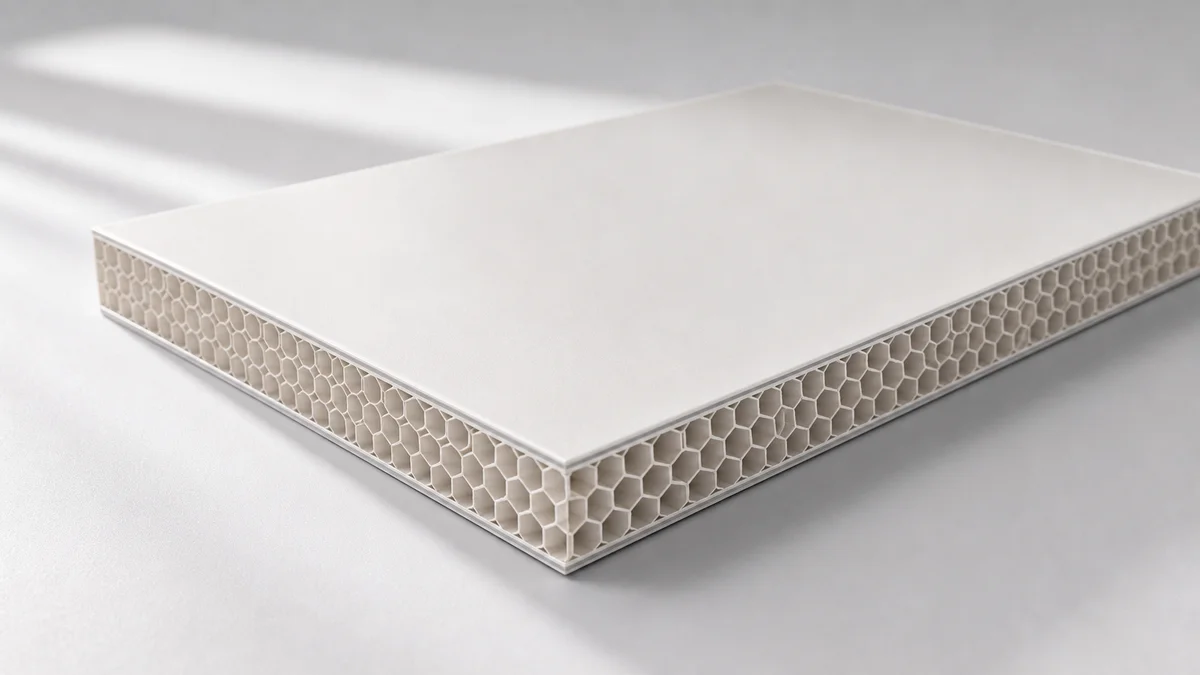
Weight pays a second dividend on site. At roughly 5.5 kg/m² for a 4 mm sheet, ACP lets a single fitter move a full 1220 x 2440 mm panel without mechanical assistance. Crane time, scaffolding hours and fixing hardware all shrink, and program risk shrinks with them. Ventilated facade systems make the most of this, because cassettes can be hung from mobile platforms rather than heavy plant. Faster, quieter installs are why contractors keep writing the material into tenders.
Coatings that outlive the warranty promise
Set against solid aluminium or stainless steel, ACP brings the same weather-facing surface with a fraction of the metal. That is why it tends to be the more economical route without giving up impact or weather resistance. Genuine architectural PVDF holds 70% PVDF resin and meets AAMA 2605, built on 10-year South Florida exposure with fade held to 5 Delta E. Outdoors, that chemistry serves 15-20 years, and makers back it with warranties of up to 25. Polyester covers the indoor shifts at 8-10 years.
The Cons to Price In Before You Buy
No honest ledger stops at credits, and ACP carries four debits that show up often enough to price. Thin skins dent: hail, trolleys and corner knocks mark a 0.21 mm face, so match skin gauge to the abuse a location takes. Oil canning, a wavy ripple across the face, comes from forcing panels out of flat or over-fixing them, so respect the fixing grid. Joints are the third debit: the face sheds water, but every seam lives on sealant and gasket discipline, so detail and inspect them like the waterproofing layer they are. Fire is the fourth: PE core is a combustible thermoplastic, so it belongs inside and on signage, and code-exposed positions step up to FR or A2.
The costliest mistake is rarely a dent; it is a combustible-core sheet installed where the code or the insurer expects better. Confirm the required EN 13501-1 class or ASTM E84 Class A rating before the order is placed, not after the cladding is on the wall.
Four cons, four mitigations, none of them saved for the complaint call — that is the honest version of the pitch. When a project throws up a fifth problem, the ranked breakdown of ACP cladding disadvantages digs into causes and risk order.
Where ACP Sheets Go in Real Projects
Facades and ventilated systems
Ventilated facade cladding is the flagship job: 4 mm total, 0.50 mm architectural skins, PVDF on the weather face. Buyers searching ACP sheets for facade cladding are usually specifying this exact stack, mounted as cassettes on a ventilated subframe so the cavity carries moisture away. Column cladding and fascia bands follow the same specification logic at smaller scales.
Signage and branding
Outdoor branding rewards low weight twice: smaller frames behind the board, and less structure in whatever carries it. Printable lacquers accept direct ink, so shopfronts, hoardings and channel-letter backers print, cut and fold from the same stock. The working anchor is a 3 mm sheet with a polyester or printable lacquer face, scaled up in thickness only when spans grow.
Interior walls, partitions and ceilings
Inside buildings, the same sheet becomes wall linings, room dividers, column wraps and suspended ceilings, with ACP ceiling panels the trade’s shorthand for the last of those. The anchor here is 3 mm with a polyester finish, a pairing planned around 8-10 years of indoor service. Fire grading moves the decision to the core table below, because interiors are exactly where PE stays the economical and compliant choice.
Kitchens, transport and industrial linings
Questions about ACP sheets for kitchen cabinets usually end at a 3 mm polyester-faced sheet, cut on a beam saw and edged for doors, splashbacks and cupboard skins. The same logic extends to bathroom linings, door skins, ducting and transport interiors, wherever a light, washable, color-stable face earns its keep. For layouts, edge detail and hardware, the ACP kitchen design guide walks through the joinery side in depth.
Which Core Grade Fits Which Use
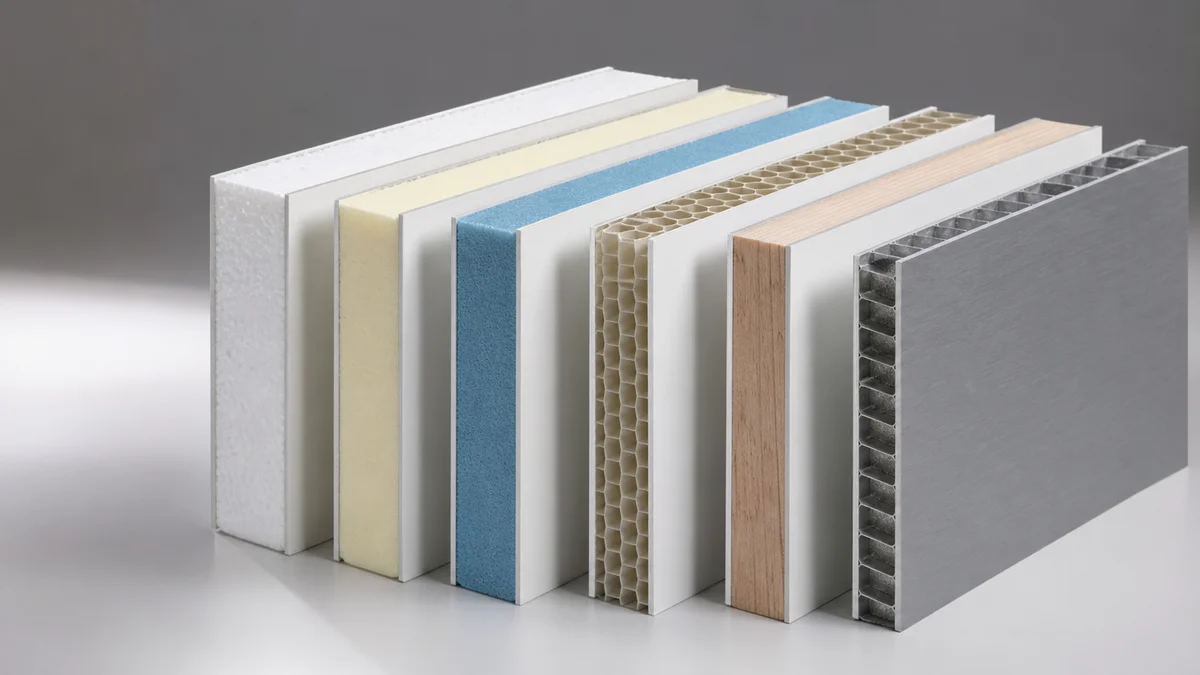
Core grade is the decision fire codes actually read, and it sorts into three shelves. Picking a fire rated ACP sheet therefore means picking the shelf before the color, because the certificate travels with the core.
| Core | EN 13501-1 class | Where it belongs |
|---|---|---|
| PE (thermoplastic) | Combustible, no rating claimed | Interior walls, partitions and signage |
| FR (mineral-filled) | Typically B-s1,d0 | Commercial facades and regulated exterior zones |
| A2 (about 90% mineral) | Rated A2-s1,d0 | High-rise facades and strictly regulated sites |
For US projects, ASTM E84 translates the same idea: Class A means a flame spread index at or below 25 and a smoke developed index at or below 450. Exterior wall assemblies on taller buildings can also fall under NFPA 285, the multi-story fire propagation test, so confirm which regime the permit names before the FR-versus-A2 conversation starts.
Matching the Coating to the Environment
Coating choice splits on one line: UV or no UV. Exterior faces need genuine architectural PVDF: 70% PVDF resin certified to AAMA 2605, laid as three coats with a dry film thickness of 25-35 um. That is the recipe behind the 15-20 year service life quoted earlier. A PVDF coating without the AAMA citation is a claim, not a specification.
Polyester is the interior economizer: honest service for 8-10 years indoors, and the wrong answer outside, where UV drags it off color. The mismatch costs money both ways: sun-facing polyester fades early and pulls a repaint forward, while corridor PVDF is budget spent where nobody looks.
Sheets That Match the Checklist
RaxPanel laminates ACP alongside honeycomb-core and foam-core variants on its own line. Engineers test designs to the data standard each project agrees on, and the international team answers within 24 hours, one to one. Bring the three decisions above and the reply comes back as numbers, not adjectives.
The Five-Minute ACP Sheet Checklist
Run these five checks against the batch in front of you, not against the brochure.
- Peel report: batch test results showing an average of at least 180 N·mm/mm with no single reading below 150, or the values your specification agreed with the mill.
- Coating certificate: 70% PVDF resin and 25-35 um dry film declared for exterior faces, polyester stated plainly for interior ones.
- Protective film: intact, unweathered and still bonded on arrival, because it is the sheet’s only protection until fabrication day.
- Batch color match: every sheet for one elevation carries the same batch number, checked side by side under daylight.
- Core certificate: the grade — PE, FR or A2 — matching the fire class the permit actually names.
A sheet that clears all five deserves its place on the drawing. The aluminum composite panel page from RaxPanel lists grades, coatings and test documents, so the checklist can be matched against a real datasheet.
Pros, Cons and Uses in One Sentence
Compress this page into one line and it reads: the pros and the cons are two faces of the same specification decision. Choose thickness, core grade and coating for the real site, and the pros arrive on schedule; choose them from a price list, and the cons show up instead.
- Bond first: an average roller peel of 180 N·mm/mm, never below 150 on a single reading, is the curtain-wall benchmark worth seeing on paper.
- Coating life is plannable: PVDF is the 15-20 year outdoor answer, polyester the 8-10 year indoor one.
- US fire language translates cleanly: ASTM E84 Class A means flame spread at or under 25 and smoke developed at or under 450.
- End of life is a credit, not a write-off: recycling aluminium consumes about 5% of the energy of virgin production.
When a quotation is on your desk, run it against the checklist above before the deposit moves. If you want a second pair of eyes, RaxPanel’s engineers will read a datasheet one to one and flag anything that fails the three-decision test.
Frequently Asked Questions About ACP Sheets
Are ACP sheets waterproof?
Yes on the face, no guarantee at the joints. The aluminium skins do not absorb water; leaks come from sealant and gasket failures, so joint design and workmanship decide the real-world answer.
How long do ACP sheets last?
PVDF-coated sheets serve 15-20 years outdoors, with manufacturer warranties reaching up to 25 years. Polyester-coated interior panels are planned around 8-10 years before a refresh deserves budgeting.
Can ACP sheets be used for outdoor signage?
Yes, and it is one of the oldest jobs for the material. Low weight keeps supporting frames small, printable lacquers take ink directly, and coated faces hold color through years of weather.
Are ACP sheets recyclable?
Yes at end of life. The aluminium skins are widely recycled, and recycling aluminium consumes only about 5% of the energy of virgin production. Recyclable describes the material’s fate, not a recycled-content percentage.
Which standards govern ACP sheet quality and fire safety?
GB/T 17748-2016 sets the mechanical floor: curtain-wall sheets need a roller peel average of 180 N·mm/mm. EN 13501-1 grades fire behavior from B-s1,d0 upward, and ASTM E84 Class A serves the same screening role in the US.