
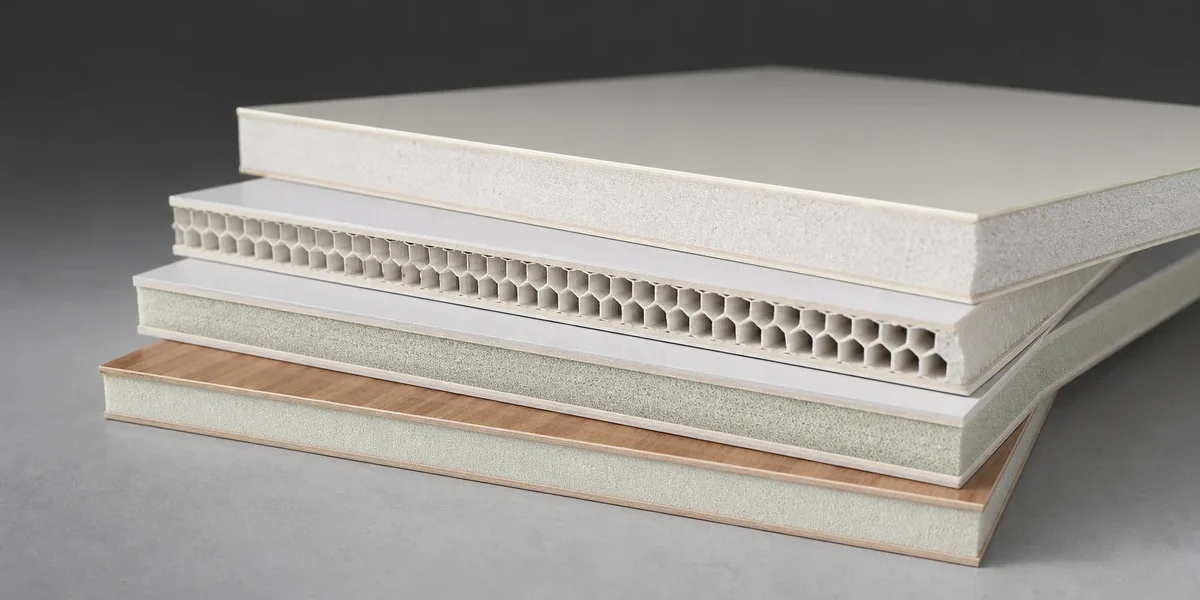
Moisture swells wood-based boards at the sink, grease soaks porous surfaces around the cooker, and open-flame heat punishes anything combustible behind the hob. Those three working conditions eliminate most finish materials before looks enter the discussion, which is why ACP panels took over cabinet doors, backsplashes and wall linings.
The specification that earned that position is short: 3 mm total thickness, a PE core for interior use, and a polyester coating rated for indoor service. RaxPanel laminates aluminium composite panel sheet, honeycomb-core and foam-core variants on its own line, interior grades included, so the grade decisions below are production choices rather than bought-in guesswork. Every boundary that follows, from where panels belong to how close they may sit to the hob, depends on getting that grade right.
Why Kitchens Punish the Wrong Panel
A kitchen attacks a finish from three directions at once. Steam keeps the sink run humid for hours, and any wood-based board in that zone takes on moisture, swells and lets edges drift out of square. Around the hob, airborne grease settles on every face, and porous surfaces drink it in, holding colour and odour long after wiping stops.
The third attack is thermal, and it is the least forgiving. Directly behind and beside the hob, surfaces heat up with every long simmer, and any material that feeds a fire is disqualified there, whatever the wipe-down performance. Moisture and grease failures develop over months; a fire-safety failure is judged in one inspection. So the material question splits in two: what survives the wet and greasy everyday, and what is allowed anywhere near the flame.
Measured against those conditions, ACP panels hold their ground: aluminium skins block water, the coating sheds grease, and the sheet stays light on hinges and wall fixings. An aluminium composite panel is a skin-core-skin laminate, and that build is the source of every advantage and every limit described below. For a wider primer on the material family, these eight essential points on ACP and ACM pair well with this guide.
Where ACP Belongs in a Kitchen Layout
Position decides specification in a kitchen, so walk the layout before ordering anything. ACP kitchen cabinet doors are the anchor application. Standard sheets run 1220 x 2440 mm in 3 mm and 4 mm thicknesses, which means a typical door schedule nests on whole sheets with usable offcuts.
The fold matters as much as the cut. V-grooving with a CNC router removes the core down to the lower skin, so the panel folds into a finished edge without breaking the skin. Consistent groove depth prevents cracking, and the minimum bending radius has to be respected. That is how one flat sheet becomes a door face, returns and all.
Backsplashes and wall linings take the same 3 mm grade in the largest sheets the room allows, because wide panels mean fewer joints to seal along the wet zones. Modular kitchen ACP sheets arrive with wood, marble, metallic and solid-colour finishes, so the doors and the walls can read as one surface or as deliberate contrast. ACP kitchen backsplash panels behind the sink run particularly well here: no grout lines, no porous face, one wipe.
One position fails the material: the countertop. Knife edges and hot cookware scar aluminium skins permanently, and no coating in this class resists a chopping motion or a lifted pot lid. Any brief that puts ACP sheets on a working countertop surface should be corrected at quotation stage, not after the first week of use.
The Interior-Grade Specification Trio Explained
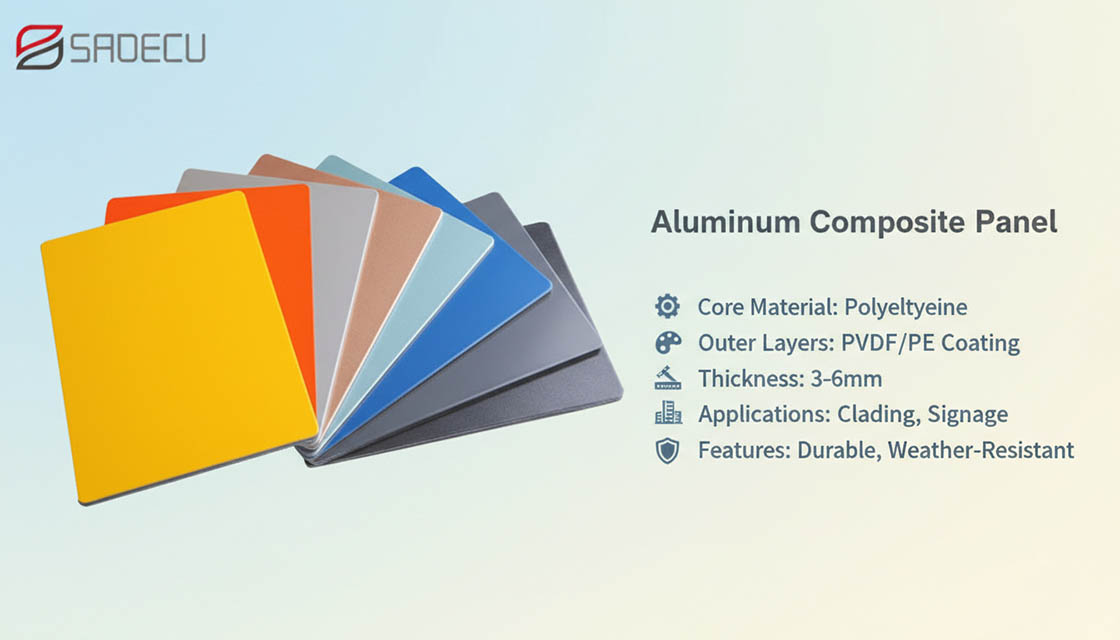
Three choices define interior-grade ACP panels, and each one differs from the facade version of the same product. First, thickness: 3 mm total with a PE core covers doors, backsplashes and linings, while 4 mm is facade stock where wind load pays for the extra stiffness. Second, the core: polyethylene is lightweight, flexible and cost-effective indoors, and it is also combustible, which the fire section below treats in full. Third, the coating: polyester suits interior use and is rated for 8 to 10 years of service.
PVDF coating is the exterior counterpart, rated 15 to 20 years against weather, and paying for it indoors buys nothing but cost. Skin thickness follows the same logic: the market spans roughly 0.06 to 0.50 mm, and the 0.21 mm architectural floor exists for exterior exposure. The aluminium composite panel build accepts thinner skins indoors, because wind load is absent. If a folding schedule is demanding, step up within the interior range rather than reaching for facade sheet. The anatomy behind that choice sits in our ACP panel structure breakdown.
Acceptance paperwork closes the trio. Aluminium skins are produced to ASTM B209, and decorative interior sheet in China is accepted against GB/T 22412-2016 with a 180-degree peel strength of at least 4 N/mm. Curtain-wall grades carry their own GB/T 17748 roller-peel minimums. Ask the supplier for the coating specification sheet with the batch, and check it before the film comes off.
Buyer tip: before signing acceptance, confirm the coating specification sheet matches the batch number on every sheet and that the protective film is intact.
How Close to the Hob Can ACP Go
No honest answer starts with a fireproof claim. A PE core is polyethylene, a combustible polymer, and marketing lines that describe PE-core sheet as unable to burn should be read as advertising, not specification. In an aluminium composite panel the skins will not burn, but the core sets the fire behaviour, so the grade on the order decides what happens near heat.
The industry grades reaction to fire on the EN 13501-1 ladder. Fire-retardant cores typically reach class B-s1,d0, and mineral-filled A2 cores with roughly 90% mineral content reach A2-s1,d0, which is the level specified where non-combustible performance is demanded. Those grades exist precisely so a fire rated ACP interior order can name its limit on paper instead of in a sales conversation.

Weight is the quiet reason PE dominates interior orders: the core keeps a 3 mm sheet light enough for hinge screws and wall adhesive, and it routes without chipping. The fire grades exist as a parallel choice, not a replacement, so the specification names both the core chemistry and the class it must reach.
Exterior walls face assembly-level testing such as NFPA 285, while interior positions near cooking appliances lean on material grade and detailing instead. That difference is not a relaxation; it moves the responsibility onto the person writing the specification. The same logic applies to cladding drawbacks generally, which our ACP cladding disadvantages overview sets out for facade work.
Practice for the kitchen is straightforward. Keep PE-core ACP panels out of the zone directly behind and beside the hob, and put a non-combustible backing such as tile or stainless steel there instead. If the design insists on panel in that zone, upgrade to a fire-retardant core and say so on the drawing.
Boundary: never bond PE-core sheet directly behind an open-flame hob; specify non-combustible backing or an FR core certified to EN 13501-1 B-s1,d0.
ACP Against Wood, Particle Board and Steel
Every kitchen material fight ends the same way: each candidate survives some working conditions and loses others. An ACP vs plywood kitchen comparison, for example, usually settles on swelling and termites, where plywood and particle board lose both rounds. Stainless steel wins the heat zone outright, then pays for it in cost and in fingerprints on every door front.

The table below compresses the trade-offs, and all three materials can look the part in a showroom, so the comparison has to run on behaviour, not photographs. What separates them is behaviour under moisture, pests, daily cleaning, shaping and fire. ACP panels occupy the middle ground: strong on water and weight, honest about the hob.
| Property | ACP | Wood and particle board | Stainless steel |
|---|---|---|---|
| Swelling in damp air | None in the sheet; seal joints | Swells at edges and seams | None |
| Termites | Not a food source | Vulnerable unless treated | Immune |
| Daily cleaning | Neutral detergent wipe, no absorbing | Porous faces hold grease | Easy, shows fingerprints |
| Shaping freedom | V-groove folds and curved work | Needs machining and edge banding | Welding and specialist fabrication |
| Fire reaction | PE core burns; FR or A2 cores reach B-s1,d0 and A2-s1,d0 | Combustible | Non-combustible |
Read the table as a zoning tool rather than a scoreboard. Wood earns its place on cost and warmth in dry rooms, steel earns the hob zone, and the composite earns doors and walls where water and weight rule. Cleaning chemistry separates them too: steel tolerates aggressive agents, while the polyester surface wants pH-neutral products. The mistake is asking any one of them to cover all five rows.
Interior-Grade ACP, Specified Like a Facade
RaxPanel laminates ACP and its honeycomb-core and foam-core variants on its own line, engineers test designs to the data standard each project agrees on, and the international team answers within 24 hours, one to one.
Cleaning and Handover Checks That Keep Panels New
The non-porous, moisture resistant surface keeps daily care short: grease sits on the coating instead of soaking in, so a soft cloth and neutral detergent do the work. Skip abrasive pads, powders and strong solvents, because they dull the finish that everything else in this guide depends on. Handover is where the list gets longer, and it is worth writing down.
- Wipe surfaces with a soft cloth and neutral detergent; never use abrasive pads or solvent cleaners.
- Confirm the protective film on every sheet is intact at acceptance, with no tears at the edges.
- Check batch numbers match across all doors and wall panels, and compare colour under the kitchen’s own lighting.
- Inspect every V-groove fold for hairline cracks at the bend, on door fronts and returns alike.
- Seal and inspect joints along the sink run and behind the hob before final sign-off.
A slow walk-through with this list at handover prevents most warranty calls in year one. Photograph the batch labels, keep a spare offcut of each colour for future repairs, and file the coating specification sheet with the kitchen drawings. Care this simple is the difference between a panel that reads new at year eight and one that reads tired at year three.
Matching the Panel to the Kitchen Instead of the Brochure
Every decision above follows one pattern: match the material grade to the working zone, not to the most photogenic page in a brochure. Doors and wall linings take 3 mm PE-core polyester sheet, the hob zone takes non-combustible backing or a fire-rated core, and no position takes a countertop. That grade-matching logic is what keeps ACP panels for modern kitchen design briefs winning work against materials that cannot survive all three working conditions. RaxPanel keeps the interior-grade sheet options, coatings and core choices on its ACP product page. One boundary bears repeating: a panel chosen for looks alone will still meet the same moisture, grease and heat that removed its rivals.
Frequently Asked Questions About ACP Kitchens
How Long Do ACP Kitchen Cabinet Panels Last?
A polyester-coated interior sheet is rated for 8 to 10 years of indoor service. Keep abrasive cleaners off the coating and the finish typically reaches the top of that range before a refresh is worth considering.
Can ACP Be Used for Kitchen Countertops?
No. Knife edges and hot cookware scar aluminium skins permanently, so the sheet belongs on doors, backsplashes and wall linings, never on a working countertop.
Is ACP Waterproof?
The panel surface does not absorb water, which is what protects it where wood-based boards swell. Joints, cut edges and penetrations still need sealing, because water finds any open path behind the sheet.
Should Kitchen Doors Be 3 mm or 4 mm ACP?
Use 3 mm for interior cabinet doors and linings; it folds cleanly on a V-groove and keeps door weight low. The 4 mm sheet is facade stock, where wind load justifies the extra stiffness.
Is ACP Safe Near Stoves?
A PE-core aluminium composite panel is combustible, so keep it out of the open-flame zone. Specify non-combustible backing there, or upgrade to a fire-retardant core certified to EN 13501-1 class B-s1,d0.