
Coils of aluminium go in at one end of the line; stacked, film-wrapped panels come out at the other. An aluminium composite panel is made by running two aluminium coils and a core material continuously through cleaning, coating, bonding and cutting. Most buyers inspect the finished sheet and none of the process. Yet peel failures, coating loss and flatness complaints trace straight back to pretreatment, adhesive film control and bonding pressure decisions made on a line they have never seen.
- Holding surface roughness between 1.75 and 2.5 µm can raise bond strength by 30-40 percent.
- A three-coat PVDF system lays down 25-35 µm of dry film: 5-7 primer, 18-20 color, 5-7 clear.
- GB/T 17748-2016 sets peel acceptance at 180 N·mm/mm average with no single value below 150.
- Architectural skins run 0.21-0.50 mm on 2-6 mm panels; 4 mm remains the facade standard.
- An A2 core swaps most polymer for mineral filler, roughly 90%, to reach class A2-s1,d0 under EN 13501-1.
Between those ends, the line runs five stages in one continuous pass: material preparation, coating, bonding, cutting and packing. Coating machine, compounding line and hot press behave as one system, because a sheet that stops between stages picks up defects. Each stage sets a ceiling for the next: a dirty coil cannot hold coating, and a poorly coated skin cannot hold adhesive. RaxPanel runs its own ACP line producing standard sandwich panels plus honeycomb-core and foam-core variants. The process below is the one behind every panel the company ships, so it pays to know where quality is actually decided.
What Happens on an ACP Production Line
An ACP panel production line is deceptively simple to describe. Two coil feeds unwind aluminium skin at controlled tension while the core extruder or feeder supplies the middle layer. From there the web passes through cleaning and conversion, then the coater, then the compounding section, where hot press rolls activate the adhesive. Cutters slice the continuous sheet into ordered lengths, and packing takes over.
Continuity is the whole trick of aluminium composite panel production. A line that stops and starts invites thickness drift, contaminated bonds and color mismatch between runs. The three core machines divide the work: the coater builds the weather face, the compounding machine joins skin to core, the hot press sets the bond. This is the same continuous logic behind how sandwich panels are manufactured in general, narrowed to a sheet this thin.
Understanding ACP panels and their production starts with what happens between the coil feeder and the stacking table. Our compounding section takes the same platform beyond flat sheet into honeycomb and foam-core territory. Buyers rarely see that part of the line, which is exactly why the checks in this guide matter.
Raw Materials Set the Ceiling on Quality
No stage downstream can rescue a wrong order of material. The skins of an aluminium composite panel are rolled to ASTM B209, the standard specification for aluminium sheet. Common architectural alloys are 1100, at least 99.0% pure aluminium, and 3003, a manganese-bearing grade roughly 20% stronger than 1100. Industry shorthand splits skin stock into 3000-series for facade workability and 5000-series where strength and corrosion resistance lead, as in marine work.
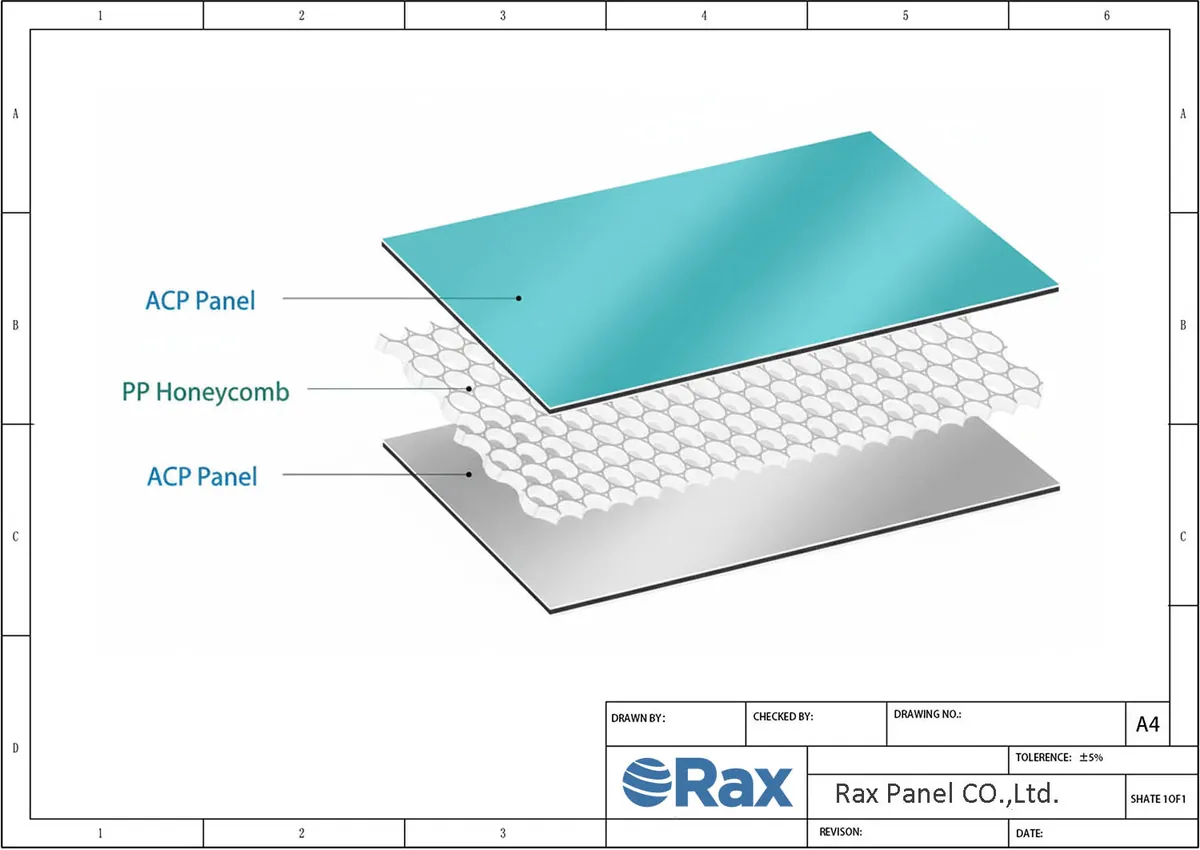
The core decides fire behavior before anything else happens on the line. PE core suits interior signage, FR core adds mineral filler for commercial facades at class B-s1,d0, and A2 core pushes mineral content to roughly 90% for class A2-s1,d0. Coating is chosen here too, because PVDF carries 15-20 years of exterior life while polyester suits interiors for 8-10 years.
A buyer who locks alloy, core class and coating system at order stage has already controlled most of the outcome. The line can only execute those choices well or badly. That is why material certificates come first in any inspection conversation. Alloy certificates, core test reports and coating datasheets are the three documents that prove those choices.
Coil Cleaning and Chemical Pretreatment
Rolled aluminium arrives lubricated, and rolling oil plus mill dirt kill adhesion on contact. The line therefore degreases each coil with alkaline, acid or solvent cleaners before anything else touches the surface. A chemical conversion coating follows, growing a microscopic layer that gives paint and adhesive something to grip.
Roughness is the quiet variable in pretreatment. Surface texture held between 1.75 and 2.5 micrometres gives adhesive a mechanical anchor, and controlling it can raise bond strength by 30-40 percent. Skip or rush this stage and the loss shows up later as peeling skins, never as an obvious line fault.
Pretreatment is also the cheapest place to gain bond performance, because conversion chemistry and roughness control cost far less than re-bonding rejected panels. Cheap lines cut these baths first. The defect only surfaces months later, on a wall, under warranty claims.
The Coating Line Builds the Weather Face
Coil coating means paint is applied to the flat coil, not to the finished sheet, and the line runs it as a sequence of passes. Each pass lays a measured layer whose thickness is verified as dry film, in micrometres. Because coating happens before bonding, any defect in the paint line is frozen under the skin for life.
- Primer, 5-7 µm. The primer stops corrosion and forms a smooth layer that cuts delamination risk before any color goes down.
- Color coat, 18-20 µm. Pigmented PVDF or polyester carries the shade and most of the weather load.
- Clear coat, 5-7 µm. The top layer seals color against UV and holds gloss.
Three passes on an exterior PVDF system add up to 25-35 µm of dry film: 5-7 primer, 18-20 color, 5-7 clear. Genuine architectural PVDF carries 70% PVDF resin and is rated to AAMA 2605, which demands a 10-year South Florida exposure with fade held to 5 Delta E or less. Polyester stays an interior grade; it was never formulated for that duty.
Your verification step is arithmetic, not trust. Add the three quoted film thicknesses and check they land inside 25-35 µm, then ask what resin share the color coat actually contains. A supplier quoting PVDF over a low-resin blend is not selling an AAMA 2605 face.
Continuous Bonding Joins Skin to Core
Compounding is where an aluminium composite panel either becomes one sheet or three problems. Most manufacturers bond skin to core with PUR adhesive, applied by roller or spray. Film thickness decides the outcome: too much adhesive traps bubbles, too little leaves dry patches that delaminate.
The line fights bubbles with geometry. Crescent-shaped polyethylene extrusion lays the core in a profile that sweeps air out of the sandwich. Simultaneous leveling of the PE and adhesive film keeps dust and insects out of the bond line. Heat and pressure then activate the adhesive under sensor control, so the bond cures the same way at the head of the coil as at the tail.
The peel certificate is the only honest sentence a bonding section ever writes.
Acceptance is numeric. GB/T 17748-2016, the national standard for curtain-wall ACP, requires climbing-drum peel strength averaging at least 180 N·mm/mm with no single value below 150 N·mm/mm. The test method is ASTM D1781, which peels a skin around a 102 mm drum and reports the result in the same units. Those two documents let a buyer in any country argue about one number, not adjectives.
Your verification action: request the peel test report for the actual batch you are buying, with average and minimum values stated in N·mm/mm. A certificate that says “tested to standard” without numbers is decoration. Average at or above 180, minimum at or above 150, or the batch goes back.
Sizing, Inspection and Packing Lock Consistency
Cutting to size looks like the least technical stage, and it is where many orders quietly go wrong. Shearing and cross-cutting set panel dimensions and edge quality, and a bad cut cannot be polished out later. Dimensional tolerance decides how joints look on the wall, long before anyone opens a sealant gun.
Inspection runs at four gates. Raw materials are checked before storage, work in process on the line, finished panels against GB/T 17748-2016, and a pre-delivery pass catches defects before crates close. A batch that skips any gate is a batch you cannot defend.
- Incoming: alloy and core certificates match the purchase order.
- In-process: film thickness, bond activation and flatness checked on the line.
- Finished: peel, coating and dimensional tests against the agreed standard.
- Pre-delivery: visual pass for surface defects, then rework or rejection of failures.
Defective panels are reprocessed or rejected, never quietly discounted. Packing then protects the result: wooden crates for heavy loads, plastic film and bubble wrap against moisture, pallets for bulk quantity. Panels should travel and wait vertically, covered, because edge-stacked sheets resist scratches and bowing.
Batch color consistency belongs in this stage too. Color shifts between coating runs are invisible on a single sheet and glaring across a finished facade, so one project should draw from one batch number. Handling after delivery is a different discipline; the installation engineering protocols cover what happens once crates reach site.
Your verification action: put the four gates and the batch rule into the purchase order itself. Ask which panels were tested, against which acceptance values, and demand one batch number for one facade. Suppliers who resist that sentence usually know exactly why. That paper trail is what turns a production line into a supplier.
See the Line Behind Your Specification
RaxPanel laminates ACP, ACP honeycomb and ACP foam-core panels on its own line, outputting over 1,700 m2 per day. Engineers test designs against the data standard each project agrees on, and the team replies within 24 hours, one to one.
Specification Choices the Line Cannot Fix
The line decides how a sheet is made; the order decides what is made. Skin gauge runs 0.21-0.50 mm on panels 2-6 mm thick, with 4 mm the facade default. Core grade, from PE through FR to A2, and the coating system are fixed the same way, before a coil is loaded. A perfect line executing a wrong specification still ships the wrong panel.
So write the specification before comparing factories, then use the process above to judge who can hold it. Our aluminium composite panel specifications are published panel by panel, which is the level of disclosure a buyer needs to run the checks in this guide. If a supplier will not put skin gauge, core class, resin share and peel values in writing, the line behind them is not the variable that should worry you.
For the layer-by-layer anatomy behind those choices, the structure guide breaks down what each stratum contributes. Read the two together: one explains what the panel is, this one explains how it gets made. Order decisions plus line discipline decide the quality you receive.
From Coil to Cladding the Takeaways
An aluminium composite panel is a chain of decisions, and every number in this article marks one of them. The sheet you approve at delivery was shaped by baths, passes and presses you will never watch in person. That is not a reason for suspicion; it is a reason for a short checklist.
- Skin alloy certificates to ASTM B209: 1100 at minimum 99.0% aluminium, or 3003 at roughly 20% higher strength.
- Coating proof: 70% PVDF resin to AAMA 2605, rated for 15-20 exterior years.
- Four inspection gates, incoming through pre-delivery, before any panel is cleared to ship.
- One batch number for the whole facade, so color matches from the first panel to the last.
Take the quotations on your desk and mark each against the numbers in this guide: peel values in N·mm/mm, dry film in micrometres, one batch per facade. A quote that cannot show those three lines is not a price; it is a guess.
Frequently Asked Questions About ACP Production
What is coil coating in ACP production?
Coil coating means paint is applied to the flat aluminium coil before bonding, not to the finished sheet. The coil is cleaned, converted, primed and coated in one continuous pass, which keeps dry film thickness controlled across the entire roll.
How is peel strength tested on ACP panels?
Labs run the ASTM D1781 climbing drum test, peeling a skin over a 102 mm drum and reporting N·mm/mm. GB/T 17748-2016 accepts a batch at 180 N·mm/mm average with no single value below 150.
Which standard governs aluminium composite panel quality?
GB/T 17748-2016 governs curtain-wall ACP acceptance, including peel strength, while EN 13501-1 classifies core fire performance. Check which standard each certificate cites, then match it to the code requirements of your project.
Can the core grade change from project to project?
Yes. The same line platform laminates PE cores for interiors, FR mineral-filled cores at B-s1,d0 for commercial facades, and A2 cores with roughly 90% mineral content at A2-s1,d0. Core grade is an order decision, not a line limitation.
Why should ACP panels be stored vertically?
Vertical storage keeps the weight on the stiff edge, so sheets do not bow and surfaces stay clear of scratches. Keep panels covered until installation; the film and crate protection assumes the stack stands on edge.