
Two cold storage warehouses sit in the same city with identical footprints and refrigeration capacity. One facility runs at peak efficiency, while the other pays nearly 40 percent more in electricity every single month. The difference isn’t the compressor size or the building automation system. It is the cold storage panel specification.
Quality manufacturers build these systems with a foam density typically between 40 and 42 kilograms per cubic metre. Anything less degrades quickly, creating thermal bridges that spike your energy consumption and risk expensive health inspections. You need to know exactly what you are buying before the first panel ships.
This guide breaks down the critical differences between PUF and PIR cores, explains how to calculate the right thickness for blast freezers versus processing rooms, and outlines the fire compliance standards you cannot ignore. You will learn how to select an envelope that guarantees temperature stability and protects your long-term operational budget.
Defining Cold Storage Panel Fundamentals
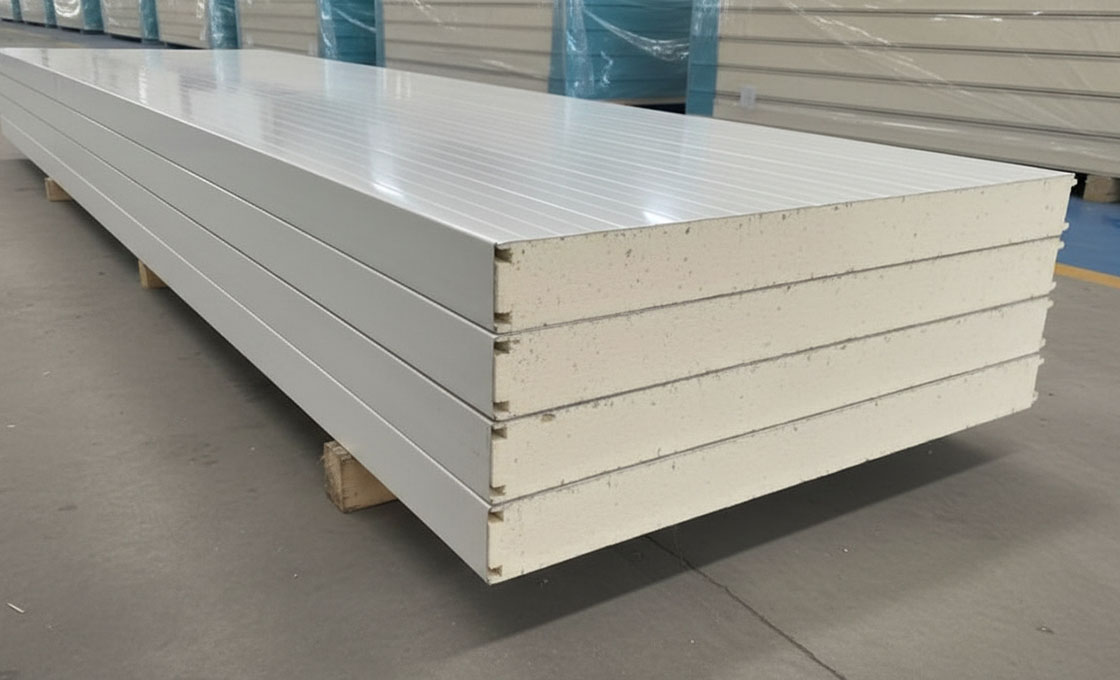
Cold storage panels are not just insulated boxes; they are continuous, interlocking structural envelopes that merge thermal barriers, vapor seals, and load-bearing surfaces into a single factory-engineered module.
Defining the Sandwich Panel Building Envelope System
A cold storage building envelope is the complete thermal and physical shell that isolates your facility from the external environment. Instead of constructing traditional masonry walls and then retrofitting separate insulation boards and vapor barriers, you install pre-fabricated sandwich panels that lock together mechanically. This transforms your cold room from a collection of disparate building materials into a unified, load-bearing structure.
Think of the system like a high-performance thermos flask. The outer metal sheet provides structural rigidity and impact resistance, the inner sheet maintains hygienic standards, and the foamed core trapped between them acts as the insulating vacuum. By sourcing both wall and ceiling panels from a single manufacturing source, you guarantee that interlocking joint profiles, face specifications, and sealing mechanisms are co-engineered to perform as a continuous shield rather than a series of patched seams.
How Insulated Cores Prevent Thermal Bridging
Thermal bridging occurs when heat bypasses insulation by traveling through highly conductive materials, typically creating a shortcut from the warm exterior to the cold interior. In refrigeration, these shortcuts manifest as localized condensation, frost buildup, and massive spikes in compressor energy draw. The insulated core completely eliminates this pathway by filling the entire cavity between the outer and inner facings with a closed-cell polymer matrix.
When polyurethane (PU), polyisocyanurate (PIR), extruded polystyrene (XPS), or polyethylene terephthalate (PET) foams expand inside the panel mold, they chemically bond to both metal skins under controlled pressure. This creates a monolithic, gap-free barrier that forces heat to travel through the slow-conducting foam rather than jumping across structural joints. Our engineering team strictly monitors lambda values (the technical measurement of thermal conductivity) because even microscopic voids in the foam matrix can create measurable heat leaks across a multi-thousand-square-foot facility.
- Continuous Seal: Factory-foamed cores eliminate the need for on-site spray application, ensuring zero shrinkage gaps that commonly cause bridging in stick-built structures.
- Vapor Lock Integration: Closed-cell polymer structures inherently resist moisture vapor transmission, preventing the damp insulation failure that destroys thermal performance in traditional wall assemblies.
- Structural Decoupling: The foam matrix physically separates the inner and outer metal facings, ensuring no direct metallic contact exists to transfer temperature extremes across the panel width.
Key Structural Components of Refrigeration Wall Panels
Every refrigeration wall panel relies on four precisely balanced components to maintain operational integrity under extreme temperature cycling. Understanding how these pieces interact allows procurement managers and facility engineers to evaluate panel quality beyond simple price-per-square-meter metrics.
- Outer Facing Sheet: Typically galvanized steel, aluminum, or GRP (glass-reinforced plastic), this layer absorbs environmental exposure, forklift impacts, and structural wind loads while housing the mechanical locking profile.
- Inner Facing Sheet: Designed for direct contact with stored goods, this surface must be smooth, non-porous, and resistant to aggressive chemical cleaning agents, ammonia leaks, and constant freeze-thaw cycles.
- Polymer Foam Core: The thermal and structural heart of the panel. Injected directly into the cavity, it cures into a rigid, dimensionally stable block that transfers shear forces between the facings and locks the joint geometry in place.
- Interlocking Joint Profile: Precision-milled edges (typically tongue-and-groove or hidden clip systems) that mechanically seal adjacent panels together, distributing structural stress and maintaining an unbroken airtight barrier across the entire wall plane.
Why Composite Materials Outperform Traditional Cold Storage Walls
Traditional cold storage construction relies on stacking individual materials: masonry or steel stud framing, loose insulation batts or rigid boards, tape-sealed vapor barriers, and interior lining panels. This fragmented approach introduces multiple failure points, requires extensive on-site labor, and rarely achieves a consistent thermal boundary. Composite sandwich panels consolidate all those layers into a single, repeatable manufacturing process that drastically reduces installation time and long-term maintenance costs.
The performance gap becomes undeniable when evaluating moisture management and structural longevity. Loose insulation boards absorb ambient humidity over time, losing their insulating capacity and promoting microbial growth behind interior linings. Fully encapsulated composite cores remain completely dry because the closed-cell polymer structure blocks water ingress entirely. Furthermore, the unified panel system handles dynamic structural loads far more efficiently than bolted-together traditional walls, which settle and crack as temperature fluctuations cause differential expansion between dissimilar materials.
In our fifteen years of integrated production and testing, we consistently see cold storage failures traced back to mismatched installation components rather than poor material quality. When walls, ceilings, and joint seals are engineered as a single cohesive unit, we control the adhesive chemistry, foam expansion ratios, and mechanical tolerances in one controlled environment. That level of precision eliminates the delamination risks and seasonal air infiltration that plague conventional stick-built refrigeration facilities.
Core Material Types: PUF, PIR, EPS
Each option differs in material composition, thermal resistance, and load-bearing capacity. The right choice depends on your climate zone, building use, and whether the priority is energy efficiency or structural span.
Polyurethane (PUF): The Industry Standard Workhorse
Polyurethane Foam, commonly referred to as PUF, serves as the baseline insulation material for the majority of modern cold storage facilities. It is formed through a chemical reaction between polyol and isocyanate, which causes the material to expand and adhere rigidly between the metal or composite facings.
For buyers, PUF offers a balanced profile, delivering strong thermal performance at a mid-range price point. Think of PUF as the “standard sedan” of the insulation world: it is reliable, widely available, and performs efficiently for general refrigeration tasks without breaking the budget.
From a structural perspective, PUF exhibits excellent adhesion to different facing materials, creating a monolithic bond that enhances the panel’s overall rigidity. Its closed-cell structure effectively resists moisture absorption, which is critical for maintaining long-term thermal efficiency in humid environments. However, while it is cost-effective, standard PUF has limitations regarding fire resistance, typically requiring additional additives or facings to meet strict building codes in high-risk zones.
Polyisocyanurate (PIR): The High-Performance Safety Upgrade
Polyisocyanurate (PIR) is essentially a technologically advanced cousin of PUF, modified to provide superior fire resistance. The key differentiator lies in the chemical structure; PIR incorporates a higher proportion of isocyanate and a specialized trimer catalyst.
This alteration allows the foam to form a protective char layer when exposed to high heat, rather than melting and feeding the fire. For pharmaceutical storage, high-compliance food processing zones, or exterior wall cladding, PIR is often the mandatory choice to satisfy stringent insurance and safety regulations.
While PIR typically comes at a higher material cost compared to standard PUF, it offers a better “density-to-performance” ratio for high-stakes environments. It maintains excellent dimensional stability across a wide temperature range, ensuring the panels do not deform or shrink over time. For distributors targeting projects where fire safety is a non-negotiable compliance requirement, the premium price of PIR is justified by the reduction in liability and the elimination of expensive fire-retardant coatings.
Expanded Polystyrene (EPS): The Cost-Effective Structural Option
Expanded Polystyrene (EPS) utilizes a different manufacturing process, expanding polystyrene beads with steam to fuse them into a rigid board. It is the most economical option available in the market, offering the lowest cost per unit of volume. EPS is particularly favored for dry warehousing, partition walls, and structural infill where deep-freeze capabilities are not the primary requirement. It acts like the “pickup truck” of insulation—utilitarian, affordable, and capable of handling heavy structural loads without significant deformation.
However, cost-conscious buyers must weigh the trade-offs. EPS has a lower thermal resistance per inch of thickness compared to PUF or PIR, meaning EPS panels must be significantly thicker to achieve the same insulation value.
This can reduce the interior storage space of a cold room. Additionally, EPS is inherently more combustible and requires specific fire-retardant treatments to meet safety standards. Its thermal stability is also lower, making it less suitable for applications involving rapid temperature cycling or extreme low temperatures.
Analyzing Density, Stability, and Cost Profiles
When selecting a core material, understanding the interplay between density, thermal stability, and cost is crucial for project success.
- Density and Strength: PUF and PIR generally offer a higher density-to-strength ratio, providing better screw-holding power for fixtures and equipment. EPS is lightweight but can feel “crunchier” and may require specialized fasteners to prevent pull-through in high-stress areas.
- Thermal Stability: PIR leads the pack in stability under fire conditions. PUF performs well within standard refrigeration ranges but may degrade faster than PIR when exposed to extreme temperature fluctuations over decades. EPS remains stable structurally in dry conditions but loses efficiency if moisture penetrates the facings.
- Cost vs. Efficiency: EPS wins on upfront material cost, making it ideal for budget-conscious dry storage. PUF offers the best balance for general refrigeration, minimizing operational energy costs without the high premium of PIR. PIR demands the highest initial investment but yields the lowest long-term risk for fire-sensitive facilities.
How to Choose the right core is not just about insulation value; it is about calculating the Total Cost of Ownership (TCO). While EPS is cheaper to buy, its larger thickness footprint may increase structural steel costs, whereas PIR reduces insurance premiums through superior fire safety compliance.
| Material | Thermal Specification | Fire Rating | Operating Range | Primary Application |
|---|---|---|---|---|
| PUF / PUR | R-6.5 per inch (~0.022 W/m·K) | Euroclass B / B1 | -40°C to +80°C | Standard cold storage, refrigerated transport, cost-effective insulation |
| PIR | Procurement teams must validate polyisocyanurate thermal ratings against manufacturer specifications to prevent overestimating insulation capacity. Verified thermal performance for this PIR insulation is R-6 to R-6.5 per inch (~0.020 W/m·K), ensuring precise engineering procurement data while maintaining compliance with its Euroclass B+ / B1 fire rating. | Euroclass B+ / B1 | -40°C to +80°C | Fire-critical facilities, pharmaceutical storage, exterior cladding |
| EPS | R-3.5 per inch (~0.033 W/m·K) | Class E / F (B2 with retardants) | -20°C to +60°C | Dry warehousing, non-refrigerated partitions, budget structural infill |
Thermal Insulation Properties and R-Values
The R-value is the definitive benchmark for thermal resistance, directly dictating how effectively a composite panel blocks heat transfer, stabilizes internal temperatures, and minimizes refrigeration energy consumption.
What Is the Relationship Between R-Value and K-Value?
Engineers evaluate insulation performance using two complementary metrics: the R-value and the K-value (thermal conductivity). The R-value measures total resistance across a specific panel assembly, while the K-value indicates how readily heat moves through one meter of the core material itself. A lower K-value translates to superior inherent insulating capability. Closed-cell foam cores utilized in industrial cold storage typically demonstrate K-values ranging from 0.022 to 0.028 W/m·K.
Because R-value is calculated by dividing material thickness by its K-value, specifying panel depth alongside accurate conductivity data is essential for predicting real-world temperature retention. Independent laboratories validate these figures using standardized protocols such as ASTM C518 or ISO 10292, ensuring that quoted ratings reflect consistent manufacturing quality rather than theoretical estimates.
How Core Density and Thickness Influence Temperature Stability
Insulation performance scales predictably with core density and panel depth, though the relationship requires careful engineering alignment. Standard refrigerated construction uses panel thicknesses between 100 mm and 200 mm, which typically yield R-values ranging from R-25 to R-50 depending on the foam chemistry and service temperature.
Higher density cores limit the migration of insulating blowing agents over time, preserving the original thermal resistance throughout the asset lifecycle. If a manufacturer specifies an excessively thin core to reduce upfront material costs, the resulting low R-value forces refrigeration compressors to cycle continuously. This operational strain accelerates mechanical wear, increases peak demand charges, and creates micro-climate fluctuations that compromise temperature-sensitive inventory.
Eliminating Thermal Bridging Through Joint Engineering
Even panels with excellent standalone R-values can fail to maintain temperature integrity if thermal bridging occurs at connection points. Thermal bridging happens when conductive pathways bypass the insulation layer, allowing heat to shortcut through seams, fasteners, or poorly fitted profiles. High-grade insulated wall systems mitigate this risk through multi-stage interlocking geometries and compression-activated gaskets that seal adjacent panels tightly together.
By ensuring continuous insulation across the entire vertical and horizontal plane, the overall envelope maintains its designed thermal resistance. Facilities that neglect joint continuity often experience localized frost accumulation and uneven cooling loads, which rapidly degrade both product quality and panel surface finishes.
Is a higher R-value always better for cold storage applications?
A higher R-value improves thermal resistance, but optimal performance requires matching the rating to your specific temperature zone. Deep-freeze environments operating below -25°C generally demand higher R-values to combat intense heat differentials, while positive cooling rooms may achieve efficient operation with moderate resistance levels. Specifying excessive thickness without verifying structural load requirements or spatial constraints can lead to unnecessary capital expenditure and reduced storage footprint. Proper system design balances thermal resistance with structural rigidity and refrigeration capacity.
Do R-values change depending on the operating temperature?
Yes. Unlike conventional building insulation, closed-cell foam cores used in cold storage often exhibit improved thermal resistance as the mean core temperature decreases. The reduced molecular activity at lower temperatures slows conductive heat transfer, allowing panels to perform closer to or slightly beyond their rated summer-season values. This characteristic makes foam-core composite panels particularly effective for temperature-controlled logistics, where maintaining strict internal climates under varying external conditions is critical.

Fire Safety Ratings and Compliance Standards
Cold storage panel fire compliance hinges on meeting strict thermal performance thresholds. Selecting panels with verified Euroclass or ASTM ratings ensures regulatory approval, reduces insurance premiums, and prevents catastrophic flame spread in enclosed refrigeration environments.
Decoding Fire Resistance Classifications
Regulatory bodies evaluate panel assemblies through standardized combustion testing. The European EN 13501-1 system classifies products from A1 (non-combustible) to F (unclassified). Most commercial cold storage projects mandate a minimum of Euroclass B-s1,d0 or C-s1,d0.
The suffixes indicate critical safety metrics. The letter s denotes smoke production capacity, where s1 restricts smoke density to less than 500 square meters during the first ten minutes. The letter d addresses flaming droplets, with d0 guaranteeing zero combustion particles detach during testing. Meeting these thresholds prevents rapid visibility loss and toxic gas accumulation during emergency evacuation scenarios.
North American facilities typically reference ASTM E84 tunnel testing. Class A certification requires a flame spread index below 25 and a smoke developed index under 450. These numerical limits directly correlate with how quickly fire can travel across interior wall surfaces in tightly packed warehouse aisles.
Structural Integrity During Thermal Exposure
Fire compliance extends beyond ignition resistance. Panel assemblies must maintain load-bearing capacity while subjected to direct flame contact. International building codes require sandwich panels to preserve structural stability for a minimum duration during standard furnace tests.
- Charring Rate: Thermoset cores develop a protective carbon layer that insulates the remaining material. This natural barrier slows internal temperature escalation and preserves panel rigidity.
- Melting Thresholds: Panels with lower decomposition temperatures risk rapid core vaporization. This creates voids that compromise the outer facings and accelerate structural collapse.
- Joint System Performance: Interlocking profiles must remain sealed under heat expansion. Failed joints allow fire to penetrate the wall cavity and bypass surface-rated protections.
Verifying Third-Party Certification Documentation
Reliable fire safety depends on independent laboratory validation rather than manufacturer claims. purchasers must audit technical dossiers before procurement authorization. Valid documentation includes full assembly test reports, not isolated core material evaluations.
Auditors should cross-reference test specimen dimensions, facing material thickness, and adhesive bond lines against actual project specifications. Discrepancies between certified samples and delivered goods frequently cause failed site inspections and costly retrofit mandates.
Frequently Asked Questions
This factor has a direct bearing on project performance and long-term cost. Addressing it with specific data rather than general assumptions leads to better outcomes.
Is a Class A fire rating mandatory for all cold storage facilities?
Not universally. Building codes dictate requirements based on occupancy type, facility height, and proximity to property lines. Standard food warehouses often accept Class II or Euroclass C ratings, while high-bay distribution centers strictly require Class A or Euroclass B limits.
Do exterior metal facings impact the overall fire classification of the panel?
Yes. Fire testing evaluates the complete composite system. Aluminum or galvanized steel skins influence heat dissipation and structural survival time. Even non-combustible facings require tested anchor points and specialized sealants to achieve certified ratings.
How often must fire compliance certificates be renewed for existing installations?
Certificates themselves do not expire, but facility modifications trigger re-evaluation requirements. Adding new insulation layers or altering joint sealing methods voids original certifications. Regular third-party audits are recommended every five years to maintain insurance validity.
Surface Materials and Hygiene Standards
Material selection at this point sets the thermal efficiency, fire rating, and weight of the finished assembly. Balance R-value requirements against span capability and code-mandated fire performance.
The Core Hygiene Challenge in Cold Storage Environments
The fundamental issue buyers face with surface materials in refrigeration environments is accelerated coating failure under thermal cycling and aggressive sanitation protocols. Standard painted metals degrade rapidly when exposed to constant condensation, freeze-thaw expansion, and industrial cleaning chemicals. This degradation creates microscopic surface porosity that traps moisture and harbors bacterial colonies, directly triggering HACCP and FDA audit failures. The correct facing selection dictates whether a facility maintains long-term compliance or faces premature panel replacement.
Evaluating Surface Facings for Wash-Down Durability
High-specification cold storage panels utilize chemically inert laminates engineered to withstand abrasive wash-downs without losing structural or hygienic integrity. Material performance depends entirely on non-porous surface density and corrosion resistance thresholds.
- Stainless Steel Facings: Grade 304 or 316 stainless steel is the mandatory standard for direct food processing zones and heavy chemical wash-down areas. It provides inherent resistance to chlorinated sanitizers and prevents the pitting corrosion that rapidly compromises hygienic surfaces.
- Gelcoat-Finished GRP/FRP Sheets: Fiberglass reinforced panels treated with a professional-grade gelcoat deliver a completely smooth, impervious barrier. This finish eliminates surface micro-cracks, ensures rapid fluid runoff during cleaning cycles, and maintains continuous thermal insulation without moisture ingress.
- CFRT & Aluminum Composite Skins: Continuous fiber reinforced thermoplastics and aluminum composite panels offer impact-resistant, corrosion-free alternatives. These laminates maintain surface integrity across extreme temperature drops and are engineered to resist chemical stripping during routine facility maintenance.
Underpaying for standard coated steel to reduce initial capital expenditure guarantees higher lifecycle costs. Surface degradation forces costly regulatory non-compliance fines and mandates premature full-panel replacement.
Regulatory Alignment and Material Selection Strategy
Achieving food-grade and pharmaceutical compliance requires matching the facing laminate to the specific sanitation frequency and ambient humidity of each storage zone. Blast freezers demand facings that retain flexibility at sub-zero temperatures to prevent cracking, while dry storage areas prioritize chemical resistance over extreme cold tolerance.
Advanced composite manufacturing allows for engineered skin-core pairings, ensuring that every panel meets precise load-bearing, waterproof, and hygienic specifications without relying on generic off-the-shelf components. Procurement teams should evaluate facing durability through chemical compatibility charts and abrasion resistance ratings rather than upfront price alone.
Industry Applications and Usage Zones
Suitability depends on environmental exposure, hygiene requirements, and structural loading. Matching the panel specification to these three factors prevents premature degradation in service.
Application-Centric Design: Matching Environment to Envelope
In the cold storage industry, the “one-size-fits-all” approach is a primary driver of long-term operational failure. The specific application zone—whether it is a ripening room for fruit or a sterile holding area for vaccines—dictates the mechanical and chemical requirements of the sandwich panel system.
A facility’s performance is defined not just by thermal efficiency, but by how well the wall and ceiling systems withstand the unique stressors of their environment. Selecting the correct panel specification requires a rigorous analysis of three critical vectors: hygiene protocols, traffic intensity, and thermal shock frequency.
Food Processing and Hygiene-Critical Zones
Facilities handling meat, dairy, or prepared foods operate under strict sanitary regulations where the wall surface is a direct food safety consideration. In these zones, the primary enemy is contamination, not heat transfer. Panels must withstand frequent, aggressive wash-downs with chemical cleaners and high-pressure hot water. Industry standards typically mandate smooth, non-porous surfaces that prevent bacterial harborage.
For these environments, standard painted steel skins are often insufficient due to their susceptibility to chipping and corrosion. Instead, specifications increasingly favor Fiber Reinforced Polymer (FRP) or Stainless Steel facings. These materials provide a smooth, waterproof, and chemically resistant barrier that maintains integrity even after years of exposure to caustic cleaning agents.
Additionally, the joint profile must be designed to prevent water ingress; a simple tongue-and-groove joint may fail under high-pressure spray, whereas stepped or cam-lock systems provide a tighter seal that protects the insulation core from moisture saturation.
Pharmaceutical and Cold Chain Logistics
Pharmaceutical storage and medical logistics centers prioritize absolute temperature stability and air-tightness over impact resistance. In these applications, the panel system functions as a critical part of the “cold chain” integrity. Any thermal bridging or air leakage can compromise sensitive biological products, leading to significant financial loss. therefore, the usage zones in this sector require panels with high dimensional stability and superior air-sealing capabilities.
Unlike high-traffic food processing floors, pharmaceutical storage areas are often automated. The wall panels here must integrate flawlessly with automated retrieval systems, requiring strict tolerances in flatness and squareness. Insulated doors and personnel doors in these zones must also match the thermal performance of the walls exactly; often, these are specified as specialized insulated slam-doors rather than standard industrial sectional doors, ensuring that the R-value of the envelope is consistent throughout the structure.
Distribution and High-Traffic Loading Docks
The most physically demanding usage zone in any cold storage facility is the loading dock and the immediate internal transfer corridors. These areas face constant impact from forklifts, pallet jacks, and tugger trains. A standard interior wall panel installed in a high-velocity corridor will inevitably suffer damage, leading to dented facings, compromised cores, and thermal leaks.
Experienced engineers specify higher-density facings or dedicated “impact rails” for these zones, typically installed at the lower 1 to 1.5 meters of the wall where vehicle impact is most likely. Additionally, the flooring-to-panel transition is a critical failure point.
Thermal movement can cause gaps to open between the concrete floor and the wall panel, allowing warm air and pests to enter. Best practices dictate the use of hydraulic coving or integrated thermo-plastic baseboards to create a sanitary and durable curb that seals this vulnerable junction.
A common error in facility design is procuring wall panels from one manufacturer and doors from another. The door systems must be specifically engineered to match the wall panel thickness and joint profile. If the door jamb does not align perfectly with the wall’s cam-lock or tongue-and-groove system, the resulting gap becomes a permanent thermal bridge. Always ensure that the specified door hardware is compatible with the specific panel system’s geometry to guarantee a continuous thermal envelope.
When auditing a facility for retrofit or new construction, always ask for the “cleaning agent schedule.” If the facility uses quaternary ammonium compounds or chlorine-based sanitizers daily, standard galvanized steel skins may corrode within months. Specifying FRP (Glass Fiber Reinforced Polymer) or 304/316 Stainless Steel facings in these specific zones prevents costly panel replacements and maintains hygiene compliance.
Calculating Panel Thickness Requirements
Calculating panel thickness is not a guessing game; it requires aligning your core density and facing material with your exact target temperature and expected mechanical load. An oversized or undersized envelope forces refrigeration compressors to cycle inefficiently, bleeding profit through wasted electricity and accelerated equipment wear.
Our engineering team prioritizes precise thermal resistance thresholds to maintain stable internal environments without adding unnecessary dead weight to your facility. When sized correctly, you eliminate thermal bridging, reduce operational overhead, and extend the service life of your entire cold chain infrastructure.
Matching panel thickness to target temperatures
Think of thermal envelope sizing like selecting outdoor gear. A lightly insulated partition works fine for ambient processing areas, but freezing zones demand a substantially deeper barrier to stop heat migration. As the temperature differential widens, vapor drive increases aggressively. If the insulation layer is too thin, moisture penetrates the core, freezes into ice crystals, and permanently degrades the material’s insulating capability.
We design our panels to handle extreme delta-T conditions by optimizing the closed-cell ratio within the foam matrix. This physical structure traps inert gases that resist conductive heat transfer far longer than open-cell alternatives. In our factory testing, we validate that thicker profiles for deep-freeze applications actively arrest interfacial delamination caused by repeated thermal cycling. You simply cannot compromise on depth when operating below zero without risking catastrophic condensation failures inside the wall cavity.
How core density impacts thermal resistance ratings
For optimal thermal performance, engineers must balance polymer chain density with blowing agent purity rather than assuming thicker foam always yields higher R-values. Higher material density does not automatically equal superior insulation performance; in fact, packing too many polymer chains together can sometimes restrict the formation of optimal microscopic air pockets that actually block heat flow.
Thermal resistance, commonly measured as the R-value, relies heavily on the purity and stability of the blowing agent trapped inside each cell. While lower-density cores often deliver exceptional R-values per inch, the Product Bible specifies that the R-6 to R-6.5 per inch rating applies exclusively to PIR cores.
- Closed-Cell Integrity: Prevents moisture ingress and maintains consistent lambda values over decades of operation.
- Gas Retention: Premium foams lock in low-conductivity gases that resist diffusion into the surrounding environment.
- Structural Trade-offs: Excessive density increases compressive strength but may add unnecessary weight and cost to mobile or suspended installations.
Standard gauge options for different cold room zones
Facility layout dictates your gauge strategy. Refrigerated transport containers, commercial kitchen cold rooms, and large-scale distribution hubs all operate under different stress profiles. Walls primarily function as vertical thermal barriers, so they require moderate thickness paired with strong surface coatings like gel-coated fiberglass or marine-grade stainless steel. Roofs, however, face dual punishment from solar radiation and routine maintenance traffic, necessitating significantly deeper insulation profiles and reinforced facings to prevent sagging.
We recommend mapping your operational zones before committing to a single panel specification. Chilled storage corridors typically demand lighter gauges focused on rapid temperature recovery after frequent door openings. Deep freeze aisles require heavier, multi-layered assemblies that can withstand constant forklift proximity and heavy racking loads. Our customization process matches each zone’s duty cycle to the appropriate core chemistry and facing thickness, ensuring you never overpay for unused insulation capacity.
Balancing insulation depth with structural load requirements
Thicker panels inherently improve wind, snow, and seismic resistance, but they also shift the center of gravity and increase span limitations. When selecting your gauge, you must calculate the maximum allowable distance between support beams. A panel that exceeds its design span will flex under its own weight, eventually cracking the facing material and breaking the continuous thermal seal.
Our technicians run rigorous compression and shear tests to guarantee that every thickness tier supports the intended building geometry. We routinely reinforce critical load-bearing zones with high-density foam substrates or composite honeycomb infills when projects require wide clear spans without interior columns. By integrating structural mechanics with thermal physics early in the design phase, we deliver lightweight solutions that meet strict compliance standards while keeping installation costs predictable and manageable.
| Operating Temperature Range | Optimal Core Material | Standard Thickness (mm) | Thermal & Structural Note |
|---|---|---|---|
| 0°C to +5°C (Chilled Storage) | PUR or PIR Foam | 50 – 75 | Maintains baseline R-6.5/inch conductivity; enforces high closed-cell ratio to block vapor drive and mitigate thermal bridging. |
| -18°C to -25°C (Frozen Storage) | XPS or PET Closed-Cell Foam | 100 – 120 | Requires elevated core density to resist cyclic freeze-thaw stress; prevents polymeric shrinkage and maintains compressive strength. |
| -30°C to -40°C (Deep Freeze) | High-Density PU or PIR | 150 – 200 | Demands increased thickness to counteract extreme ΔT; specifies reinforced facings to arrest interfacial delamination under mechanical load. |
| +10°C to +80°C (Ambient/Cooling) | Standard PU or PIR Foam | 25 – 50 | Utilizes lower-density core for moderate thermal gradients; optimizes coefficient of thermal expansion matching to prevent facing warping. |
Key Takeaways
Match panel thickness to your target temperature zones first. Thicker PIR cores deliver higher R-values without adding structural weight, but you must balance insulation depth against load requirements for high-bay racking. Standard gauge options vary by zone, yet high-density cores consistently outperform traditional polyurethane when maintaining sub-zero environments over long contracts.
Our dual-lane production line guarantees consistent core density across every batch. You save maintenance costs by installing hygienic stainless steel skins that resist chemical washdowns and prevent moisture intrusion behind the wall system.
- Confirm your target operating temperature before selecting core density.
- Request engineering blueprints from our team for custom cold room layouts.
- Treat our technical staff as a free resource for early-stage design questions or material specification uncertainties.
Frequently Asked Questions
This factor has a direct bearing on project performance and long-term cost. Addressing it with specific data rather than general assumptions leads to better outcomes.
Do insulated panels resist moisture and corrosion?
Yes, these panels typically use durable facings like stainless steel or fiberglass that are highly resistant to moisture and corrosion. The closed-cell core structure prevents water absorption, protecting the insulation’s thermal properties. This design prevents mold growth and maintains structural integrity in humid environments.
How are cold room panels installed?
Panels are typically connected using cam-lock or tongue-and-groove mechanisms to ensure rapid and secure assembly. Installers align panels within floor and ceiling tracks, using gaskets to create an airtight vapor barrier. This method ensures structural stability while maintaining continuous insulation integrity.
How do panels reduce cold storage energy costs?
High-quality insulated panels minimize thermal transfer, significantly reducing the heat load on refrigeration units. This reduction decreases the frequency and intensity of compressor cycles, leading to lower electricity consumption. Optimized thermal performance results in substantial operational savings over the facility’s lifespan.
How do panels impact refrigeration system lifespan?
By providing a consistent thermal envelope, panels reduce the workload strain on cooling equipment. Reduced thermal cycling prevents compressor burnout and extends the operational life of refrigeration components. Efficient insulation allows systems to run at optimal capacity without overexertion.
Are insulated panels cost-effective long-term?
While initial costs are higher than traditional methods, the rapid assembly time reduces labor expenses significantly. Superior thermal insulation drastically cuts ongoing energy bills, offsetting the upfront investment over time. Additionally, low maintenance requirements contribute to a lower total cost of ownership.