
Ask any fleet manager what drives their material choices, and the answer is always weight. Polypropylene honeycomb panel uses have expanded far beyond simple packaging into demanding structural roles across transportation, marine, and construction — precisely because the material delivers rigidity at roughly 1/32nd the weight of solid aluminum.
Our production floor has run these cores for over 15 years, and the shift is consistent: buyers replacing plywood and foam in truck bodies, vessel interiors, and modular partitions where moisture rot used to kill panels within 36 months.
This article breaks down where PP honeycomb actually performs best, how it compares to aluminum honeycomb in persistently wet environments, and what drives cost when you move from catalog sizes to custom specs. You will walk away with enough detail on core density, skin compatibility, and application limits to make a confident call on your next build.
Transportation Applications of PP Honeycomb Panels
In modern vehicle engineering, polypropylene honeycomb cores systematically replace plywood and solid plastics to solve two immediate problems: structural weight reduction and terminal moisture degradation.
Automotive Interior Panels
Automotive OEMs utilize PP honeycomb cores for door inserts, trunk floors, seat backings, and headliners. The hexagonal cell structure naturally absorbs kinetic energy during impacts, elevating passenger crash safety ratings. Unlike solid thermoplastics, the honeycomb geometry disrupts sound waves, dramatically improving cabin acoustic dampening without adding dead weight.
For Tier 1 suppliers, surface adaptability is critical. Non-woven laminated PP honeycomb readily accepts adhesives for decorative foils, fabrics, and leather wraps without requiring complex mechanical fasteners. In our production lines, we customize cell sizes and material densities to meet specific crush-test thresholds for electric vehicle (EV) battery enclosures and interior load floors, allowing designers to shed precious kilograms to extend vehicle range.
Commercial Vehicle Flooring
Heavy-duty flooring in buses, delivery vans, and refrigerated trailers endures relentless abuse from forklift traffic, pallet dragging, and extreme temperature swings. Standard plywood rapidly absorbs ambient moisture, leading to rot, delamination, and eventual structural failure. Solid metal decks prevent this rot but add unnecessary curb weight that destroys fuel efficiency.
Integrating a PP honeycomb core between fiberglass reinforced plastic (FRP) or aluminum skins creates a composite floor system that is completely impervious to water, road salts, and chemical spills. For fleet operators, the ROI is straightforward: every kilogram saved in the trailer floor or walls directly translates to increased legal payload capacity per trip.
- Moisture Immunity: Zero water absorption prevents mold and structural decay in refrigerated and maritime transport.
- Impact Resistance: High compression strength withstands continuous heavy load cycles and concentrated pallet impacts without permanent deformation.
- Payload Optimization: Lower panel mass increases freight capacity and reduces long-haul fuel consumption.
Why Use PP Honeycomb Panels in Marine
PP honeycomb panels outlast aluminum honeycomb in saltwater environments because polypropylene is inherently immune to corrosion—no protective coatings, no galvanic risk, no scheduled replacement cycles.
Shipbuilding Wall Panels: Where Weight Meets Watertight Performance
Marine naval architects specify wall and partition panels under a dual mandate: minimize every possible kilogram above the waterline, and ensure the material will not degrade when exposed to chronic humidity, salt spray, or condensation. Traditional marine plywood rots.
Aluminum honeycomb corrodes at cell walls where saltwater pools. Polypropylene honeycomb cores faced with GRP or FRP skins solve both problems simultaneously—the thermoplastic core absorbs virtually zero moisture, and the fiberglass skins create a sealed sandwich structure that handles repeated wet-dry cycles without delamination.
In our vessel projects, we configure PP honeycomb sandwich panels with gelcoat-finished FRP facings for bulkheads, cabin partitions, and engine room enclosures. The gelcoat surface provides a smooth, waterproof finish that requires no secondary painting. For interior partitions where decorative finishes are preferred, non-woven-laminated PP honeycomb cores bond directly to HPL, PVC film, or aluminum sheets—giving designers full flexibility without compromising the core’s moisture barrier.
Installation of PP honeycomb partition walls in marine applications follows a straightforward procedure. Panels are cut to size using standard CNC routers or circular saws with diamond-tipped blades. Mechanical fastening through pre-drilled holes with stainless steel bolts and marine-grade sealant is the primary method for structural bulkheads.
For non-load-bearing interior partitions, polyurethane adhesive bonding combined with aluminum extrusion joiners provides a clean, frameless finish. Panels can also be edge-bonded directly to one another using hot air welding tools designed for thermoplastic materials, creating continuous wall runs with no thermal bridges.
Moisture Resistant Structures: Lifespan Advantages Over Aluminum Honeycomb
The critical question buyers ask is how PP honeycomb compares to aluminum honeycomb when both are deployed in persistently moist environments. Aluminum honeycomb depends on its oxide layer and protective coatings for corrosion resistance. Once that coating is scratched during handling or installation, bare aluminum cells begin to oxidize and pit—particularly in chloride-rich marine atmospheres. PP honeycomb faces no such vulnerability. Polypropylene is chemically inert in saltwater, requires no surface treatment, and cannot corrode under any realistic service condition.
Real-world marine service data consistently shows that properly manufactured PP honeycomb sandwich panels maintain structural integrity for 20+ years in hull and superstructure applications, whereas aluminum honeycomb panels in equivalent locations typically require inspection and potential panel replacement within 10 to 15 years due to hidden corrosion at skin-to-core bond lines. Our engineers have observed this firsthand when auditing refit projects—the aluminum panels showed internal oxidation invisible from the exterior surface, while PP-cored panels pulled from the same vessel showed zero core degradation.
- Zero water absorption: PP honeycomb cores absorb less than 0.5% moisture by weight even after prolonged immersion, eliminating freeze-thaw expansion risk in cold-climate vessels.
- No galvanic corrosion: Unlike aluminum cores paired with carbon fiber or stainless steel fittings, PP is electrically inert and eliminates galvanic coupling entirely.
- Chemical resistance: Polypropylene withstands bilge cleaners, diesel fuel, hydraulic oil, and standard marine solvents without swelling or embrittlement.
- Rot and biological resistance: Unlike plywood or balsa cores, PP cannot support mold growth, wood-boring organisms, or bacterial degradation.
For shipbuilders evaluating total cost of ownership, the lifespan advantage is decisive. PP honeycomb sandwich panels may carry a comparable or slightly lower unit cost than aluminum honeycomb equivalents at initial purchase, but the elimination of corrosion-mitigation measures—coating inspections, cathodic protection systems, and mid-life panel replacements—delivers measurable savings across a vessel’s operational life. When configured with fiberglass reinforced skins, the resulting composite panel delivers a strength-to-weight ratio fully comparable to aluminum alternatives, but with dramatically lower maintenance overhead.
Construction Uses for PP Honeycomb Panels
PP honeycomb cores are rapidly replacing traditional plywood and metal sheeting in interior partitions and modular walls due to their absolute moisture resistance and high strength-to-weight ratios.
Interior Partition Panels
In commercial environments like retail spaces and exhibition halls, builders require partition walls that can be erected quickly without heavy lifting equipment. Polypropylene (PP) honeycomb cores provide a stiff, lightweight substrate that drastically reduces dead load on the building structure. Unlike standard drywall or wood partitions, PP honeycomb does not rot, warp, or harbor mold when exposed to ambient humidity.
A frequent question from architects is how PP honeycomb compares to aluminum honeycomb in chronically moist environments. While aluminum offers excellent stiffness, it is susceptible to galvanic corrosion if dissimilar metals are introduced, and untreated aluminum cores can oxidize in highly alkaline conditions.
Polypropylene is chemically inert. In our accelerated aging tests, PP honeycomb maintained 100% of its structural integrity after prolonged exposure to high humidity and chemical vapors that would eventually degrade uncoated metal cores. It simply does not absorb water.
For architectural finishes, non-woven laminated PP honeycomb provides an ideal bonding surface. It readily accepts decorative High Pressure Laminate (HPL), PVC films, and thin aluminum skins using standard structural adhesives. For step-by-step installation on partition walls, contractors typically rely on a track-and-friction-fit system or heavy-duty construction adhesive:
- Framework Setup: Install aluminum or galvanized steel tracking to the floor and ceiling.
- Panel Preparation: Cut the PP honeycomb sandwich panels to size using standard woodworking tools, ensuring square edges.
- Mounting: Apply a polyurethane-based construction adhesive to the frames, or use self-tapping screws with wide washers to secure the panel into the tracking without crushing the core.
- Seaming: Use interlocking H-moldings or finish tape to conceal joints between adjacent panels.
Modular Building Walls
Modular construction relies on the ability to prefabricate entire room modules off-site, transport them, and lift them into place. Weight is the primary constraint. A PP honeycomb wall panel weighs a fraction of a traditional timber-framed and drywall assembly, allowing for larger modular sections to be shipped without exceeding road weight limits.
When integrated with fiberglass reinforced plastic (FRP) or CFRT (continuous fiber reinforced thermoplastic) skins, these sandwich panels handle the shear and compressive loads encountered during transport and crane lifting. From our manufacturing floor, we see a growing demand for these panels specifically in economic, eco-friendly mobile home solutions where thermal insulation and water resistance are non-negotiable.
Because the polypropylene core is a thermoplastic, it can be heat-welded or chemically bonded directly to the facing materials, eliminating the need for heavy adhesives that off-gas volatile organic compounds (VOCs). This results in a cleaner, greener modular wall assembly that speeds up installation times and significantly reduces long-term maintenance costs.
Industrial Uses of PP Honeycomb Panels
In industrial settings, PP honeycomb panels are rapidly replacing solid metal and traditional fiberglass as the standard for machine covers and equipment casings due to their high impact resistance and massive weight reduction.
Machine Covers
Heavy machinery requires protective covers that can withstand harsh factory environments without causing ergonomic issues for the operators who need to remove them for maintenance. Solid steel or aluminum covers are often unnecessarily heavy, leading to worker fatigue and increased risk of workplace injuries. Polypropylene honeycomb panels solve this by offering a rigid, yet lightweight alternative that does not compromise on structural integrity.
When our engineering team designs custom panels for heavy industrial machinery, we frequently specify a PP honeycomb core paired with a continuous fiber reinforced thermoplastic (CFRT) facing. This specific composite structure provides the required stiffness to span large areas while remaining easy for a single technician to lift on and off the machine bed.
Beyond sheer weight reduction, the closed-cell thermoplastic nature of the PP core inherently resists the oils, coolants, and chemical splashes common on manufacturing floors. Unlike metals that corrode or wood laminates that rot, the polypropylene structure remains dimensionally stable even in consistently damp or chemically active environments.
Equipment Casings
Industrial equipment casings and electronic enclosures demand precise engineering. They must protect sensitive internal components from external impacts, vibration, and temperature fluctuations while maintaining strict dimensional tolerances. PP honeycomb sandwich panels excel here because the hexagonal cell structure acts as a natural shock absorber, dampening vibrations before they can reach the delicate internal mechanics of the equipment.
- Impact Deflection: The sandwich construction distributes point-impact energy across the facing skins, preventing localized denting that often plagues thin-gauge metal enclosures.
- Thermal and Acoustic Insulation: The thermoplastic core inherently disrupts thermal transfer and sound transmission, keeping noisy or heat-generating equipment isolated from the surrounding workspace.
- Customizable Integration: Non-woven laminated PP cores allow for seamless integration of mounting hardware and specialized decorative foils or industrial coatings during the composite process.
For OEMs producing outdoor or wash-down equipment, the moisture resistance of these panels is a distinct advantage. There is zero water absorption, meaning the casing will not swell, warp, or harbor mold over time, ensuring a long, maintenance-free service life for the end user.
Aerospace Applications of PP Honeycomb
PP honeycomb cores are rapidly displacing traditional aramid and aluminum honeycomb in non-structural aerospace interiors, offering equal stiffness at lower raw material cost with superior moisture resistance.
Aircraft Cabin Interiors
Commercial aircraft cabin interiors represent one of the highest-value applications for polypropylene honeycomb cores. Every kilogram saved inside the cabin translates directly into fuel savings over the aircraft’s operational lifespan. Cabin components such as ceiling panels, sidewall linings, galley partitions, and lavatory structures demand materials that are rigid, flame-retardant, and resistant to constant exposure to cleaning chemicals and humid cabin air.
While aerospace prime structures still rely on Nomex or aluminum honeycomb, PP honeycomb has carved out a dominant position in semi-structural and non-load-bearing interior components. The core reason is straightforward: polypropylene is inherently immune to corrosion and moisture absorption.
In our own testing at Rax Panel, PP honeycomb samples showed zero water absorption after 72-hour immersion cycles, whereas untreated aluminum honeycomb began showing surface oxidation under identical conditions. For airlines operating high-humidity routes or aircraft that undergo frequent deep-cleaning protocols, this moisture resilience matters.
Fire performance remains the non-negotiable gatekeeper for any material entering a certified aircraft interior. PP honeycomb cores must be paired with qualified facing skins—typically FRP sheets with fire-retardant gelcoat or aluminum sheets—to meet the stringent flammability, smoke density, and toxic gas emission requirements defined in FAR 25.853 and equivalent EASA standards. The core itself does not standalone in these applications; it functions as part of a fully engineered sandwich panel system.
- Ceiling and sidewall panels: PP honeycomb bonded with decorative laminate or aluminum facings provides a flat, lightweight substrate that resists warping under thermal cycling.
- Galley and lavatory partitions: Chemical resistance to cleaning agents and cosmetics gives PP cores a durability edge over cores that degrade with prolonged solvent exposure.
- Crew rest areas: Semi-enclosed structures benefit from the sound-dampening characteristics of thermoplastic honeycomb when combined with appropriate facing materials.
Luggage Compartments
Overhead luggage bins, also known as passenger service unit (PSU) stowage compartments, are a prime target for weight reduction initiatives by aircraft manufacturers and MRO providers. These structures must withstand repeated impact from heavy carry-on bags, maintain precise dimensional tolerances to interface with the airframe, and resist passenger-induced wear over thousands of flight cycles.
PP honeycomb sandwich panels offer a compelling value proposition here compared to traditional solid laminate or metal constructions. The hexagonal cell geometry distributes point loads across a wide area, meaning a 23 kg suitcase dropped at an angle does not permanently deform a properly skinned PP honeycomb panel. The thermoplastic nature of polypropylene also provides a degree of impact energy absorption that metal honeycomb cannot replicate—dents tend to recover elastically rather than remaining as permanent deformation.
From a manufacturing standpoint, PP honeycomb cores can be thermoformed and cut with standard CNC tooling, allowing bin manufacturers to produce complex curved geometries without the tooling investment required for pressed metal components.
Our engineering team at Rax Panel has worked with aircraft interior suppliers who reduced bin door assembly weight by approximately 15 to 20 percent simply by substituting solid FRP layups with PP honeycomb-cored sandwich constructions using the same outer skins. The cost delta was recovered within the first production run due to reduced resin consumption and faster cycle times.
For aftermarket and retrofit programs, PP honeycomb’s compatibility with adhesive bonding systems commonly used in aviation maintenance means existing repair protocols require minimal modification. Technicians accustomed to working with Nomex-cored panels can transition to PP core repairs with standard training, avoiding the certification headaches that entirely new material systems would introduce.
Core Performance in PP Honeycomb Panels
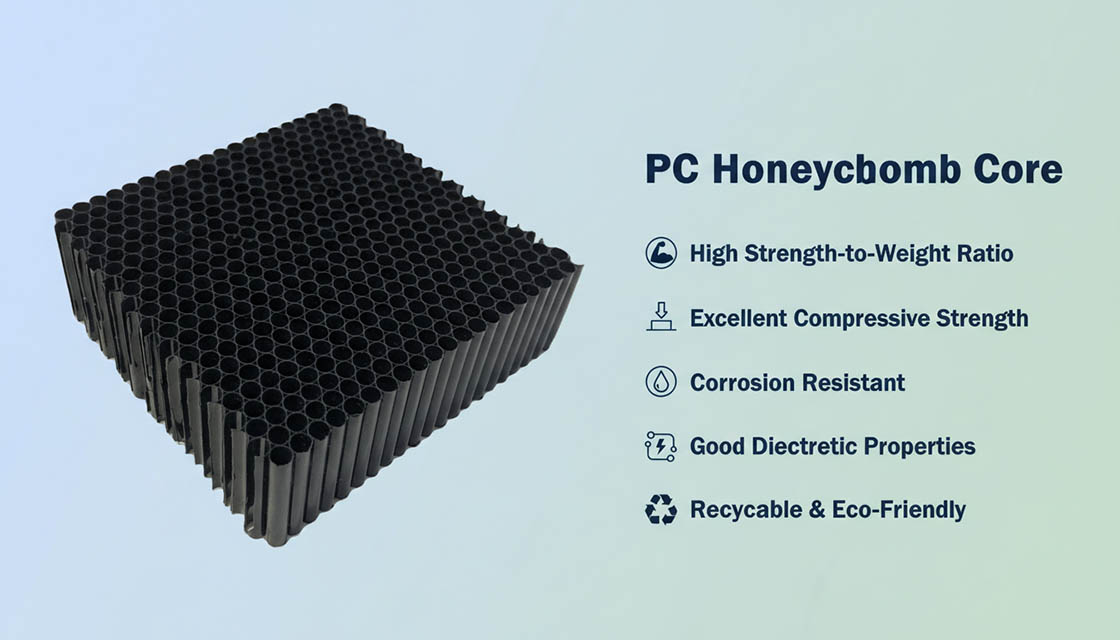
PP honeycomb cores achieve compressive strengths rivaling much denser materials while operating at densities of just 80–120 kg/m³—a performance envelope that makes them structurally competitive with aluminum honeycomb at a fraction of the cost.
Weight to Strength Ratio: The Engineering Reality
The persistent assumption in procurement circles is that a panel weighing significantly less than plywood or solid polymer must inherently sacrifice load-bearing capacity. This is a misreading of how honeycomb geometry functions. The hexagonal cell structure distributes compressive and shear forces across a vastly larger surface area than the material’s raw mass would suggest. A polypropylene honeycomb core at 80–120 kg/m³ delivers stiffness-to-weight ratios that outperform many traditional core materials in both structural and semi-structural applications.
In our lab tests at Rax Panel, we’ve observed that when PP honeycomb is bonded with CFRT (Continuous Fiber Reinforced Thermoplastic) skins, the resulting sandwich panel resists deformation under concentrated loads that would permanently dent solid polymer sheets of three times the weight. The key mechanism is the core’s ability to transfer shear stress between the two facing skins, forcing them to act as a unified structural element rather than independent layers.
This is precisely why the automotive and marine sectors have shifted toward PP honeycomb as a plywood replacement. The core maintains high compressive strength while eliminating failure modes that plague organic materials—namely rot, delamination from moisture ingress, and fungal degradation. The weight savings cascade through the entire system: lighter panels mean lighter supporting frames, which reduce propulsion energy requirements.
Core Performance Comparison: PP Honeycomb vs. Alternatives
Comparing core materials in isolation is rarely useful—what matters is how each core performs when laminated into a complete sandwich panel with identical facings. That said, the baseline material properties create predictable performance ceilings. Below is how PP honeycomb positions itself against the most common alternatives we configure for buyers.
- PP Honeycomb vs. Aluminum Honeycomb: Aluminum cores offer higher absolute stiffness and superior thermal conductivity, but they are susceptible to galvanic corrosion when paired with certain skins and offer no inherent moisture buffering. PP honeycomb is completely immune to saltwater corrosion and humidity-driven degradation, making it the more durable choice in marine and humid-environment applications over extended service life.
- PP Honeycomb vs. PU/PET Foam Cores: Closed-cell foam cores like PET (60–200 kg/m³) and PU provide excellent thermal insulation and are easier to machine into complex shapes. However, PP honeycomb achieves higher shear modulus at equivalent density, meaning it resists panel twisting and buckling more effectively under dynamic loads—critical for vehicle flooring and partition walls subject to vibration.
- PP Honeycomb vs. Plywood: Marine-grade plywood has been the traditional benchmark for structural panels in vessel interiors and truck bodies. PP honeycomb eliminates every moisture-related failure mode (swelling, delamination, fungal growth) while reducing panel weight by 40–60% at comparable flexural stiffness when paired with fiberglass reinforced skins.
- PP Honeycomb vs. Aramid Honeycomb: Aramid (Nomex) cores dominate aerospace interiors due to exceptional fire resistance and extremely low density. PP honeycomb cannot match aramid’s flame performance without additional treatment, but it costs roughly 60–70% less and is fully recyclable—a decisive factor for automotive and construction applications where FAA-level fire certification is not required.
One practical advantage that doesn’t appear in spec sheets: PP honeycomb is thermoformable. Open-cell PP honeycomb cores can be supplied to molders who thermoform panels to match precise contours—vehicle door panel substrates, curved vessel bulkheads—with fewer joints and reduced assembly time. This is something neither aluminum honeycomb nor crosslinked foam cores can replicate without significantly more processing complexity.
From a supply chain perspective, the recyclability of polypropylene is increasingly non-negotiable. Our engineering team configures PP honeycomb solutions specifically because the material aligns with automotive end-of-life recycling mandates and green building certifications—something that cannot be said for thermoset foam cores or mixed-material plywood composites. The non-woven-laminated PP honeycomb variant bonds efficiently with standard adhesives, films, and decorative coverings, reducing both processing steps and VOC emissions during panel assembly.
Customizing PP Honeycomb Panel Applications
PP honeycomb cores gain their real-world utility from how they are finished. Anti-slip textures and fiberglass reinforced skins are the two most impactful customization decisions affecting safety, longevity, and structural performance.
Anti-Slip Surface Integration
Polypropylene honeycomb panels used in flooring, loading platforms, and walkway applications require surface treatments that prevent pedestrian or cargo slippage. The core itself provides the lightweight structure, but the facing layer determines whether the panel is safe to walk on or load under wet and oily conditions.
Anti-slip integration is achieved through several methods. The most common approach applies a textured thermoplastic or rubberized overlay during the continuous lamination process. This overlay features raised patterns—diamond plate, grit-coated, or dotted textures—that increase the coefficient of friction without adding significant weight. In our production line, we bond these anti-skin layers directly to the PP honeycomb core using thermal adhesive films, which eliminates the need for secondary mechanical fasteners and maintains a uniform bonding strength across the entire panel surface.
The choice of anti-skin material matters. Polypropylene-based anti-slip films maintain full recyclability of the finished panel, which aligns with automotive sustainability mandates and end-of-life recycling requirements. Rubberized overlays offer higher friction coefficients but introduce material separation challenges during recycling. For marine environments, where surfaces face saltwater exposure and UV radiation, thermoplastic anti-skin layers with UV stabilizers outperform untreated alternatives that degrade and lose their texture within two to three years of continuous outdoor exposure.
Fiberglass Reinforced Skins
Integrating fiberglass reinforced plastic (FRP) skins with a PP honeycomb core produces a sandwich panel that handles high mechanical stress while remaining significantly lighter than solid alternatives. The fiberglass facings carry tensile and compressive loads, while the honeycomb core resists shear forces and stabilizes the skins against buckling. This division of labor is what gives sandwich structures their exceptional strength-to-weight performance.
Two primary fiberglass skin variants are used in these configurations. Standard GRP sheets, produced with or without gelcoat, provide waterproof, electrically insulating surfaces with a flat and smooth finish. These are the workhorse skins for truck bodies, vessel interiors, and mobile housing enclosures.
The second variant uses continuous fiberglass reinforced thermoplastic (CFRT) sheets, which are lighter, thinner, and more resilient than traditional GRP. CFRT skins are particularly effective when the panel must conform to curved surfaces, because the thermoplastic matrix allows for thermoforming after lamination.
- GRP Sheets with Gelcoat: Deliver a smooth, sealed surface that resists water absorption and chemical corrosion. Best suited for refrigerated truck bodies, marine bulkheads, and wet-area partitions.
- GRP Sheets without Gelcoat: Offer a raw fiberglass surface that accepts secondary adhesive bonding or painting. Used when the panel will be further laminated or integrated into a larger assembly.
- CFRT Sheets: Thermoplastic-based fiberglass skins that enable thermoforming, reduce panel thickness, and maintain full recyclability. Preferred in automotive interior components where weight budgets are strict.
The bonding method between the fiberglass skin and the PP honeycomb core is a critical quality factor. Poor adhesion leads to delamination under cyclic loading or thermal cycling. In our manufacturing process, we use non-woven fabric laminated PP honeycomb cores as an intermediate layer.
The non-woven fabric provides a high-surface-energy substrate that bonds efficiently with the resin matrix in GRP skins or with thermoplastic adhesive films in CFRT constructions. This approach eliminates the adhesion failure mode that plagues panels assembled with bare honeycomb cores and generic adhesives.
For buyers evaluating customization options, the decision matrix is straightforward. If the application involves continuous water exposure, heavy point loads, or chemical contact, FRP-skinned PP honeycomb panels outperform aluminum-skinned alternatives in corrosion resistance and fatigue durability—while eliminating the rot, fungal growth, and delamination issues inherent in marine plywood. If the priority is thermoformability and recyclability for complex interior geometries, CFRT skins over PP honeycomb deliver the most practical combination of process flexibility and environmental compliance.
Conclusion
Polypropylene honeycomb solves the moisture and weight problems that plague traditional materials in marine and automotive builds. It outlasts aluminum in saltwater environments because the thermoplastic core physically cannot corrode. That makes it a highly profitable inventory addition for your distribution network.
- Assuming these lightweight panels are too expensive to stock, ignoring the $7 to $50 per square meter reality that undercuts heavier alternatives.
- Doubting the structural integrity of polypropylene, despite the beehive design easily handling heavy dynamic loads in demanding commercial vehicles.
- Overlooking the fact that modern thermoplastic materials are 100% recyclable, which costs you contracts with clients who mandate sustainable building components.
Before you commit to a material, let our engineering team review your specific project requirements. We have spent 15 years manufacturing these panels in our own facility, so we know exactly how they perform during step-by-step partition wall installations. Send your structural load data to our technicians today.
Frequently Asked Questions
This factor has a direct bearing on project performance and long-term cost. Addressing it with specific data rather than general assumptions leads to better outcomes.
What industries use PP honeycomb panels?
PP honeycomb panels are used in transportation, construction, marine, industrial, and renewable energy sectors for structural and semi-structural applications.
What skins can be bonded to PP honeycomb cores?
PP honeycomb cores can be integrated with thermoplastic composites, fiberglass reinforced plastics, aluminum sheets, plywood, or PVC-based laminates.
Why choose PP honeycomb over plywood or foam?
PP honeycomb offers superior moisture, rot, and corrosion resistance, higher stiffness-to-weight ratios, and is fully recyclable compared to traditional plywood or foam cores.
What types of PP honeycomb cores are available?
The two main variants are non-woven-laminated PP honeycomb (for bonding with adhesives and decorative coverings) and open-cell PP honeycomb cores (for thermoforming applications).
Do PP honeycomb panels meet fire safety standards?
Yes. When combined with appropriate skins and specialty formulations, PP honeycomb cores meet stringent fire-resistance and smoke-density requirements for transportation and building applications.