
Lumber conducts heat. In a standard stick-framed wall, 15 to 25 percent of the building shell is solid wood, and those studs, headers, and plates pull thermal energy straight through the fiberglass batts. Every 4 feet you have another joint, another potential air leak, another break in the insulation.
When builders ask how do structural insulated panels work, the answer starts with removing those interruptions: blower door tests show SIP rooms are 15 times more airtight than stick-framed assemblies, and a single panel can span 8 by 24 feet with continuous rigid foam.
This article covers the structural mechanics behind that performance, how bonded skins and foam cores carry loads without stud framing, and compares EPS versus XPS insulation with real R-value numbers. We also break down the joint connection types, from surface splines to cam locks, because the spline is where SIP buildings either hit their energy targets or fail at the seams.
What Are Structural Insulated Panels
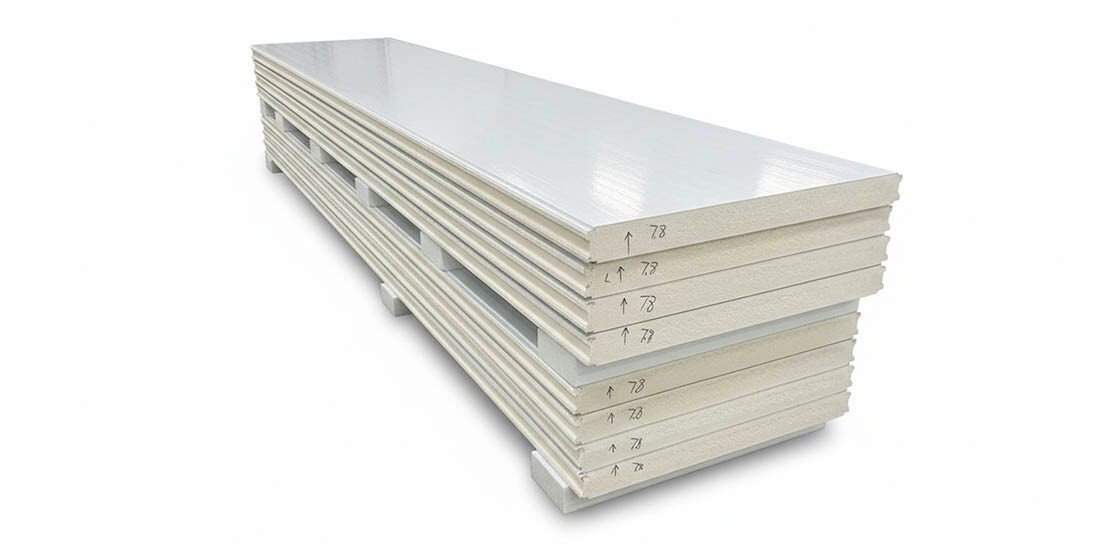
A structural insulated panel is a high-performance sandwich composite where two rigid facings are bonded to a continuous insulating core, engineered to carry structural loads while eliminating thermal bridging.
Despite a common misconception that SIPs are an experimental building method, the technology has proven itself since the 1930s. A SIP functions as a complete structural system. The facing materials handle compressive and tensile loads, while the core transfers shear forces, resulting in a remarkably stiff assembly that outperforms traditional stick framing.
Facing Materials and Core Options
While the construction industry standard traditionally relies on OSB and EPS foam, modern commercial and industrial applications demand higher durability, water resistance, and precise strength-to-weight ratios. Selecting the correct combination of skins and cores dictates the panel’s final R-value, fire rating, and mechanical performance.
For specialized vehicle manufacturing, commercial construction, and marine applications, material selection goes far beyond standard wood shells. We engineer composite panels using specific facings and cores to meet strict project requirements:
- Facings: GRP/FRP, CFRT, Aluminum, Steel, ACP, PVC, Plywood, Stainless Steel, and Aluzinc.
- Foam Cores: XPS, PET, PU, PVC, PMI, EPP, and MPP foams.
- Honeycomb Cores: PP, Fiberglass, Aramid, and PC honeycomb.
Buyers often struggle to differentiate between foam cores. Expanded Polystyrene (EPS) is cheap but offers lower compressive strength and moisture resistance. For demanding applications like refrigerated truck bodies or marine vessels, we advise using XPS, PET, or PU cores. These higher-density options provide superior thermal retention, better fire resistance, and virtually zero water absorption.
The Adhesive Bonding Process
A panel is only as reliable as the bond holding its layers together. The adhesive bonding process is where the structural integrity of the SIP is actually forged. If the bond fails, the sandwich structure loses its shear transfer capabilities and fails mechanically.
During manufacturing, a specialized structural adhesive is applied evenly across the core material. The top and bottom facings are then aligned and pressed together under precise temperature and pressure controls. This continuous bond line ensures there are no air gaps between the skin and the core, preventing delamination and blocking moisture intrusion.
Consistency in this process is critical for B2B buyers who need guaranteed performance across thousands of square meters. Using advanced composite panel production lines, this bonding process is strictly controlled to ensure every panel meets exact structural and thermal data standards before leaving the factory.
How SIPs Provide Structural Support
SIPs carry loads through a stress-skin principle: the facings resist bending and compression while the core transfers shear forces between them, creating an I-beam effect that outperforms individual component strengths.
Load Distribution Mechanics
A structural insulated panel distributes load the same way an I-beam does. The two rigid facings, whether GRP, aluminum, CFRT, or steel, act as the flanges, handling compressive and tensile forces. The foam core (XPS, PET, PU, or PVC) functions as the web, keeping those facings separated and transferring shear stress between them. This separation distance is what gives the panel its bending stiffness.
When a vertical load presses down on a SIP wall, the top facing goes into compression and the bottom facing goes into tension. The core prevents those facings from sliding past each other. If the core fails to resist that shear, the panel delaminates and the structural advantage collapses entirely. This is why core density and the adhesive bond between core and facing are non-negotiable quality checkpoints in production.
In real-world applications like RV walls or refrigerated truck bodies, loads rarely come from one direction. Wind pressure, road vibration, and thermal expansion all hit the panel simultaneously. The sandwich structure distributes these point loads across a wider surface area, reducing stress concentrations that would crack a single-layer material. Our engineers test this with three-point bending protocols on panels using PP honeycomb and fiberglass sheet composites to verify load ratings before shipping.
Shear and Axial Capacity
Shear capacity in a SIP comes almost entirely from the core material. Denser cores like PVC foam or PP honeycomb deliver higher shear strength than lighter XPS or EPP foams. The facing material contributes almost nothing to in-plane shear. It is purely a core property. When specifying panels for truck sidewalls or vessel bulkheads where racking forces are significant, selecting the right core density is the single most important structural decision.
Axial capacity, on the other hand, depends heavily on the facing material and its thickness. A panel with 1.0mm GRP skins will handle less vertical compressive load than one with 2.0mm GRP skins, even if they share the same core. The facing stiffness determines how much buckling resistance the panel has under axial load. For wall assemblies in multi-story construction or heavy vehicle applications, facing gauge and material selection drive the axial rating.
- Core shear strength: PVC foam typically ranges 0.8–1.2 MPa, while PP honeycomb cores can exceed 1.5 MPa depending on cell size and density.
- Facing contribution to axial load: Aluminum (0.5–1.0mm) suits light cladding loads; GRP (1.5–3.0mm) handles structural wall applications; steel facings are reserved for high-load industrial panels.
- Panel thickness and stiffness: Doubling core thickness roughly quadruples bending stiffness due to the I-beam geometric advantage, without adding proportional weight.
- Joint connection impact: Surface splines, block splines, and cam-locks create localized weak points in shear transfer. Proper sealing and spline material selection are critical at panel interfaces.
The practical takeaway for procurement teams and engineers: do not treat all sandwich panels as interchangeable. A foam core panel with GRP facings and a honeycomb panel with aluminum facings will have radically different shear-to-axial strength ratios. Our engineering team runs application-specific load simulations using the exact core and facing combination before finalizing any production run, because swapping one core type for another without recalculating capacity is where structural failures originate.
The Science of SIPs Insulation
SIPs outperform stick-frame walls not because of thicker insulation, but because they eliminate the three silent energy thieves: thermal bridging, air infiltration, and convective looping.
Preventing Thermal Bridging
Thermal bridging occurs whenever a highly conductive material, like a wood stud or steel framing member, cuts straight through the insulation layer, creating a highway for heat to escape. In a conventional stick-framed wall, lumber makes up 15% to 25% of the total shell surface. Every single stud is a thermal bridge.
Structural insulated panels flip this ratio. A typical SIP building envelope contains as little as 3% framing material, and that framing is isolated at the panel joints rather than scattered every 16 or 24 inches on center. The continuous foam core, whether XPS, PET, PU, or PVC, stretches uninterrupted from face to face.
This is where joint design becomes critical. Our engineering team at Rax Panel works with distributors and vehicle manufacturers to specify spline systems that maintain thermal breaks at connection points. A poorly designed joint can undermine the R-value of an entire wall section. The key is selecting connection methods that minimize conductive pathways. Common configurations we produce for include:
- Insulated lumber splines: Replace solid timber with foam-backed alternatives at panel seams.
- Cam-lock or mechanical lock joints: Used heavily in refrigerated truck and cold-chain applications where thermal integrity is non-negotiable.
- Overlapping surface splines: Maintain structural capacity while keeping the insulation layer largely unbroken.
For procurement teams evaluating SIP suppliers, the question is never just “what is the center-of-panel R-value?” The real question is what the whole-wall R-value looks like after accounting for joints, splines, and fasteners. That number tells you whether the building envelope will actually perform as simulated.
Airtightness and Air Transfer
Air leakage is responsible for up to 40% of energy loss in conventional buildings. Stick-frame assemblies rely on fiberglass batts, house wrap, and caulking to create an air barrier. Each of these components degrades over time. Gaps form at every stud cavity, electrical box, and plumbing penetration.
SIPs approach airtightness from a fundamentally different angle. The panels themselves are the air barrier. With manufacturing dimensions reaching 8 feet by 24 feet in a single piece, the number of joints in a SIP wall is a fraction of what you find in site-framed construction. Fewer joints mean fewer failure points.
Blower door testing has consistently validated this. Independent tests have shown SIP rooms to be 15 times more airtight than comparable stick-framed rooms. Energy Star recognizes this performance to the point that SIP homes can earn certification without requiring a blower door test. For commercial construction procurement teams, that translates to predictable HVAC sizing and reduced mechanical system costs from day one.
In our production facility, we seal and bond core materials such as XPS, PET, PU, and PVC foams between structural facings under controlled conditions. This factory-controlled process eliminates the variability that plagues site-installed insulation. Whether the facing is GRP/FRP, aluminum, CFRT, or plywood, the bond is consistent across the entire 1,700+ square meters of daily production output.
Eliminating Convective Looping
Convective looping is the quiet performance killer that most insulation specifications ignore. In cavity insulation like fiberglass batts, temperature differences between the interior and exterior faces cause small air currents to form inside the cavity. Warm air rises on one side, cold air sinks on the other, and the cycle continuously transfers heat through the wall, even if the wall is perfectly sealed from outside drafts.
The physics is straightforward: air needs space to move. Give it a gap, and it will loop. Fiberglass batts leave microscopic air pockets throughout the cavity. Over time, these pockets grow as the batts settle or compress, accelerating the convective cycle and degrading the effective R-value.
Solid foam cores eliminate this mechanism entirely. The rigid cell structure of XPS, PET, PU, PVC, and PMI foams physically prevents internal air movement. There is no cavity, no air gap, and no settling. The R-value measured on day one is the R-value you get on day five thousand. For industrial facility planners and specialized vehicle manufacturers specifying panels for temperature-sensitive environments such as refrigerated transport, cold storage, and climate-controlled enclosures, this stability is a hard requirement, not a nice-to-have.
The secondary benefit is moisture control. When air circulates inside a wall cavity, it carries moisture. When that moisture hits a cold surface, it condenses. This is how hidden rot and mold develop in stick-frame walls over years.
Solid core panels remove the air pathway, and by extension, they remove the moisture delivery mechanism. Combined with waterproof facing options like gelcoat-finished GRP sheets or aluminum, the result is an envelope that stays dry structurally and thermally for the service life of the building.
How SIPs Connect During Construction
The joint connection method you choose directly determines whether your SIP envelope holds its rated R-value or bleeds energy at every seam. Splines and sealants are not accessories. They are the structural and thermal backbone of the entire system.
Spline Joint Types
Structural insulated panels cannot perform as isolated slabs. Every panel must interlock with its neighbor to transfer shear loads, resist wind uplift, and maintain a continuous thermal break. The connector piece between two SIPs is called a spline, and the type you specify changes both the structural capacity and the insulation continuity of the wall or roof assembly.
The three dominant spline systems in commercial SIP construction each serve a different engineering priority. Understanding the trade-offs between nailing surface, thermal bridging, and installation speed is essential before you commit to a connection detail on your project drawings.
- Surface Spline (Thin Spline): A narrow strip of OSB, plywood, or engineered wood inserted into routed channels along the panel edges. It aligns the panels and provides modest shear transfer. This method preserves a thick layer of continuous foam insulation at the joint, minimizing thermal bridging. However, it offers limited nailing surface for interior trim or exterior cladding attachment at the seam.
- Block Spline (Dimensional Lumber): A solid timber block, typically 2×4, 2×6, or 2×8, set into a routed pocket between panels. This is the most common connection in North American SIP construction because it provides a full nailing surface for drywall, siding, and structural load transfer. The trade-off is thermal bridging: solid wood has a lower R-value per inch (roughly R-1.25/inch) compared to XPS foam (R-5/inch) or PET foam (R-4.2/inch), so each block spline becomes a minor thermal weak point in the envelope.
- Insulated Box Spline: An engineered profile, often an LVL or plywood box filled with rigid foam, that slides into pre-routed channels. This hybrid approach delivers structural load capacity close to a block spline while trapping foam inside the spline cavity to reduce thermal bridging. It is the preferred detail for commercial projects targeting aggressive energy codes or Passive House certification.
- Mechanical Cam-Lock: A proprietary hardware system embedded in the foam core during manufacturing. Panels are pulled together by rotating a lever with an Allen key. Cam-locks provide excellent joint compression and are common in cold-chain applications such as refrigerated truck bodies and walk-in freezers, where gap-free seams are critical to thermal performance.
At Rax Panel, we engineer the spline profile into the panel during production based on your project’s structural and thermal requirements. For refrigerated truck bodies and mobile cold-storage units, we frequently specify cam-lock systems combined with PU or XPS foam cores to eliminate any possibility of thermal leakage at the joint. For RV wall assemblies where weight is the priority, surface splines with CFRT or GRP facing sheets keep the envelope light while maintaining shear integrity.
Sealing and Tape Applications
Even the tightest mechanical joint between two SIPs leaves a micro-gap. Over the life of a building, that micro-gap becomes an air infiltration pathway. Air carries moisture, and moisture inside a closed wall cavity is the single fastest path to foam core degradation, mold growth, and R-value loss. Sealing is therefore not optional. It is the difference between a SIP envelope that performs at design specifications for decades and one that fails within five years.
The sealing protocol for SIP construction relies on three material categories applied in sequence. Each layer addresses a different failure mode, and skipping any one of them voids the thermal advantage of the panel system.
- Expanding Foam Sealant (Gap Fill): Applied to the routed spline cavity and all panel-to-panel contact surfaces before panels are pushed together. Low-expansion polyurethane foam is the industry standard because it fills voids without exerting enough pressure to bow the facing sheets. This layer provides the primary air barrier and prevents convective looping at the joint.
- Peel-and-Stick SIP Tape (Membrane Seal): A butyl-backed or acrylic-adhesive tape applied over the interior and exterior seams after panels are locked together. This tape acts as a secondary air barrier and a vapor retarder. Proper application requires clean, dry facing surfaces and firm pressure along the entire tape length. Wrinkles, bubbles, or peeling edges become air leakage points. Most SIP manufacturers specify tape widths between 4 inches and 6 inches to ensure adequate coverage over the joint.
- Liquid Applied Sealant (Detail Sealing): Used at transitions where tape cannot conform, such as around window and door openings, at roof-to-wall intersections, and at foundation sill plates. High-quality polyurethane or silicone-based sealants bond to OSB, MgO, GRP, and aluminum facing materials. These sealants accommodate differential movement between dissimilar materials without cracking.
The sequencing matters. Foam first, then mechanical connection, then tape, then liquid sealant at the perimeter details. Installers who reverse this order or skip the foam step routinely fail blower door tests. Data from the Structural Insulated Panel Association (SIPA) consistently shows that properly sealed SIP homes achieve air leakage rates 10 to 15 times lower than conventional stick-framed construction, but only when the sealing protocol is followed without shortcuts.
For projects using Rax Panel’s GRP or CFRT facing sheets instead of OSB, the sealing approach shifts slightly. Fiberglass-reinforced plastic surfaces are non-porous, which means tape adhesion is actually stronger than on wood-based facings, provided the gelcoat surface is wiped clean of dust before application. Our engineering team provides joint detailing drawings specific to each facing material, ensuring that distributors and installers have exact tape specifications and foam expansion ratings matched to the panel configuration they ordered.
Comparing SIPs to Traditional Framing
SIPs outperform traditional stick framing by delivering up to 15x better airtightness and cutting enclosure timelines by up to 55%, according to comparative blower door testing.
Energy Efficiency Differences
Traditional stick framing relies on lumber studs placed every 16 or 24 inches, with fiberglass batts stuffed into the cavities between them. This approach introduces two chronic problems: thermal bridging through the studs, and convective looping within the insulation itself.
The lumber alone accounts for 15% to 25% of the building shell’s surface area, acting as a direct highway for heat transfer. SIPs flip this ratio. A typical SIP building envelope contains as little as 3% lumber, replacing the rest with continuous, solid foam insulation that eliminates both issues at the source.
The numbers are not subtle. Blower door tests have repeatedly shown that SIP-built rooms are approximately 15 times more airtight than comparable stick-framed assemblies. The reason is straightforward geometry. A stick-framed wall has joints, seams, and potential gaps every 3 to 4 feet at every stud bay.
SIPs can be manufactured up to 8 feet by 24 feet in a single continuous panel, drastically reducing the total linear footage of joints where air can infiltrate. Energy Star even exempts SIP homes from requiring a blower door test to qualify for certification, which tells you how consistently these panels perform.
For commercial construction procurement teams and distributors evaluating structural insulated panels, R-value alone does not tell the full story. A 6-inch EPS-core SIP might list an R-24 thermal rating, but its “whole-wall” R-value remains significantly higher than a stick-framed wall with R-19 batts, because the SIP avoids the thermal bridging penalty that studs impose.
This distinction matters when you are calculating HVAC load requirements for large commercial facilities, refrigerated truck bodies, or mobile home builds. Our foam core sandwich panels at Rax Panel, available with XPS, PET, PU, and PVC cores paired with GRP, aluminum, or steel facings, give engineers the ability to tune both the insulation value and the facing material to match the specific thermal demands of the project.
Construction Timeline Comparison
Speed of enclosure is where SIPs deliver the most immediately visible ROI compared to traditional framing. Stick framing is a sequential, labor-intensive process: erect the studs, install blocking, add sheathing, house-wrap, then fill cavities with insulation.
Each step requires a different trade, different materials, and waiting on the previous crew to finish. SIPs collapse those steps into one. A single panel arrives on site with the structure, insulation, and sheathing already integrated. erection crews can typically dry-in a building in a fraction of the time.
For manufacturers and distributors, this compression of the construction schedule translates directly into reduced labor costs and faster project turnover. Instead of coordinating framers, insulators, and sheathing contractors over several weeks, a trained SIP installation crew can enclose a structure in days.
This is particularly relevant for our clients building mobile homes, RVs, and refrigerated truck bodies, where production cycle time directly impacts throughput and revenue. A CKD (completely knocked down) refrigerated truck build using pre-cut composite panels eliminates the multiple fitting and insulating steps that a traditional metal-and-foam assembly requires.
There is a tradeoff worth acknowledging up front. SIP construction front-loads the planning effort. Electrical chases and plumbing routes must be mapped and routed into the foam core during the design phase, because you cannot simply drill through studs and run wire later the way you can with stick framing. This means your engineering team needs to be precise from the start.
Our engineers at Rax Panel work directly with clients during the design phase to map these penetrations and conduct experimental testing to ensure the composite structure maintains its load-bearing integrity after routing. The planning investment pays off downstream with fewer change orders, less jobsite waste, and a building envelope that performs as specified from day one.
| Feature | SIP Construction | Traditional Framing | Key Advantage |
|---|---|---|---|
| Airtightness | 15x more airtight; panels up to 8ft x 24ft with no intermediate joints | Joints every 3-4 ft; significant air leakage through gaps | Superior energy retention and indoor air quality |
| Thermal Bridging | As little as 3% lumber in building shell | 15-25% lumber in shell acting as thermal bridges | Significantly higher effective R-value across entire envelope |
| Insulation Continuity | Solid engineered rigid foam core (EPS/XPS/PU/PET) | Batt fiberglass with gaps and voids throughout cavity | Eliminates convective looping and moisture-related decay |
| Energy Consumption | Uses roughly 50% less energy for heating and cooling | Higher energy use due to continuous air infiltration | Energy Star qualified without requiring blower door testing |
| Construction Speed | Pre-fabricated panels enable rapid on-site assembly | Site-built stud by stud; labor-intensive and weather-dependent | Faster project completion and reduced on-site labor costs |
| Moisture Protection | Solid core blocks air flow and moisture intrusion pathways | Vulnerable to moisture penetration through wall gaps and voids | Long-term structural durability and mold prevention |
| Proven Longevity | Documented field performance since the 1930s with retained strength | Susceptible to settling, warping, and gradual degradation | Decades-verified durability supporting 50+ year lifespan |
Optimizing SIPs for Maximum Performance
Optimizing SIPs means engineering the details before production. Electrical routing and moisture control are not afterthoughts. They dictate whether a panel assembly lasts 15 years or 50.
Routing Electrical Wiring Through SIPs
One of the most common questions we get from specialized vehicle manufacturers and commercial builders is how to run wiring through a solid foam core. You cannot simply drill and fish wire through a SIP the way you would with a stick-framed stud wall. The panel is a continuous sandwich, which means routing must be planned during the engineering phase, before a single panel leaves our production line.
At Rax Panel, our engineers work directly with your project team to pre-engineer electrical chases directly into the foam core during manufacturing. This eliminates the need for field routing, which compromises the panel’s structural integrity and thermal envelope. Pre-routed chases maintain the continuous insulation that gives SIPs their superior R-values.
- Horizontal Chases: Typically routed at standard switch height (approximately 14 inches from the floor) and outlet height (approximately 18 inches) through the foam core, whether that core is XPS, PET, PU, or PVC foam.
- Vertical Chases: Routed from the horizontal chase up to junction boxes or fixture locations, maintaining minimum clearances from panel edges to preserve structural capacity.
- Pre-Installed Conduit: For RV and truck body applications where vibrations are constant, we recommend pre-installing PVC or HDPE conduit within the chase to protect wiring from foam abrasion over time.
For field modifications, a hot-wire cutter or long flexible drill bit can be used, but this should be the exception, not the standard. Every field-cut chase must be sealed with low-expansion foam after wiring is pulled to restore the airtight envelope. Unsealed chases become convection paths that channel moisture-laden air into the panel core, which leads directly to the next critical topic.
Moisture and Vapor Control in SIP Assemblies
Moisture is the single greatest threat to any sandwich panel assembly. Unlike traditional stud walls, which can dry out through air gaps, a SIP has a solid foam core with nowhere for trapped moisture to escape. If water vapor condenses inside the panel, it stays there. Over time, this degrades the core-to-skin bond and destroys both structural capacity and insulation performance.
The solution is not complicated, but it requires discipline. Vapor control must be addressed at three levels: the facing material, the joint seals, and the building envelope design.
- Facing Selection: Rax Panel offers waterproof facing options including GRP/FRP sheets with gelcoat, aluminum, stainless steel, and Aluzinc. For marine and refrigerated truck applications where moisture exposure is constant, gelcoat-finished GRP facings provide an essentially impermeable exterior skin. This eliminates water ingress at the source.
- Joint Sealing: Panel joints are the weak points in any SIP envelope. We recommend using compatible sealant tapes and expanding foam at every panel connection. SIP joint types, whether surface spline, block spline, or mechanical lock, must be specified with the appropriate gasket or sealant system for your climate zone.
- Vapor Retarder Placement: In cold climates, a vapor retarder must be installed on the warm side of the panel (interior). In hot-humid climates, the exterior facing often serves this role. Getting this wrong reverses the vapor drive and forces moisture into the core. There is no universal answer: placement depends on your project’s climate zone and interior operating conditions.
For our international distributors serving markets across Europe, the Middle East, and Southeast Asia, we customize facing and core combinations to match regional moisture profiles. A PET foam core with GRP facings performs differently in a humid tropical environment than an XPS core with aluminum facings in an arid climate. Our engineering team conducts project-specific testing to validate these configurations before mass production.
The bottom line: moisture control in SIPs is a design decision, not a maintenance task. If the panel specification, joint detailing, and vapor retarder strategy are correct from day one, the assembly will perform for decades. If any one of those elements is neglected, no amount of aftermarket sealing will fix it.
Conclusion
If you’re not already stocking SIPs for your builder accounts, you’re late. These panels cut building energy costs by 50% and test 15 times more airtight than stick framing, numbers your clients can’t ignore when they’re comparing quotes. On a standard commercial project, the panel cost premium pays for itself in 18 months through energy savings alone.
Before you commit inventory dollars, request physical samples of XPS-core and PU-core panels so you can show your builders exactly what they’re getting. Get the fire test reports and R-value certifications from your supplier. Your commercial procurement clients will demand those on the first call. That documentation package is what separates serious distributors from the ones still selling fiberglass batts.
Frequently Asked Questions
What materials are used to manufacture SIPs?
SIPs typically consist of an insulating rigid foam core, such as expanded polystyrene (EPS) or polyurethane, sandwiched between two layers of structural board like oriented strand board (OSB), plywood, or sheet metal.
What is the maximum size of a SIP panel?
SIPs can be manufactured in large dimensions up to 8 feet by 24 feet without requiring joints between the panels.
How do SIPs prevent moisture and fungal decay?
Because SIPs are manufactured with a solid, engineered rigid insulated core, they prevent air flow within the walls, thereby mitigating the risk of moisture accumulation and fungal decay.
Do SIPs need a blower door test for energy rating?
No, Energy Star does not require a blower door test for SIP homes to earn the Energy Star rating because blower door tests have repeatedly confirmed their high level of airtightness.
What types of buildings use structural insulated panels?
SIPs are versatile and can be used as building materials for roofs, walls, and floors in both commercial buildings and residential homes.