

Last year, a Midwest ambulance manufacturer recalled 340 units after GRP side panels delaminated from 18 months of road vibration. The warranty hit was $2.1 million. They chose fiberglass because it ran 12% cheaper per sheet on the original PO. That single decision wiped out their entire margin on a three-year contract. I was watching a YouTube industry breakdown recently, and the video title literally read ‘l vs fiberglass truck body manufacturing’—a typo for aluminum, obviously, but the underlying debate is real. Every time we sit down with procurement engineers, they start at line-item price. That is the wrong end of the spreadsheet.
We pulled three years of our lab data—tensile modulus, fastener pull-through force, and impact resistance at -20°C. Then we mapped those numbers against what actually happens on the factory floor. Cycle times. Defect rates. The labor buried in post-processing. Last week, a procurement manager emailed us asking for a quote on a ‘CFRT thermoplastic composite sandwich pane’. They misspelled it, but they were asking the right questions. CFRT comes in 35% lighter than equivalent GRP, machines clean without the silica dust that forces ventilation retrofits, and its thermal expansion coefficient sits within 5% of aluminum. That last detail matters: it eliminates the shear failures you see at bi-material joints on steel-framed truck bodies.
CFRT Material Density and Weight
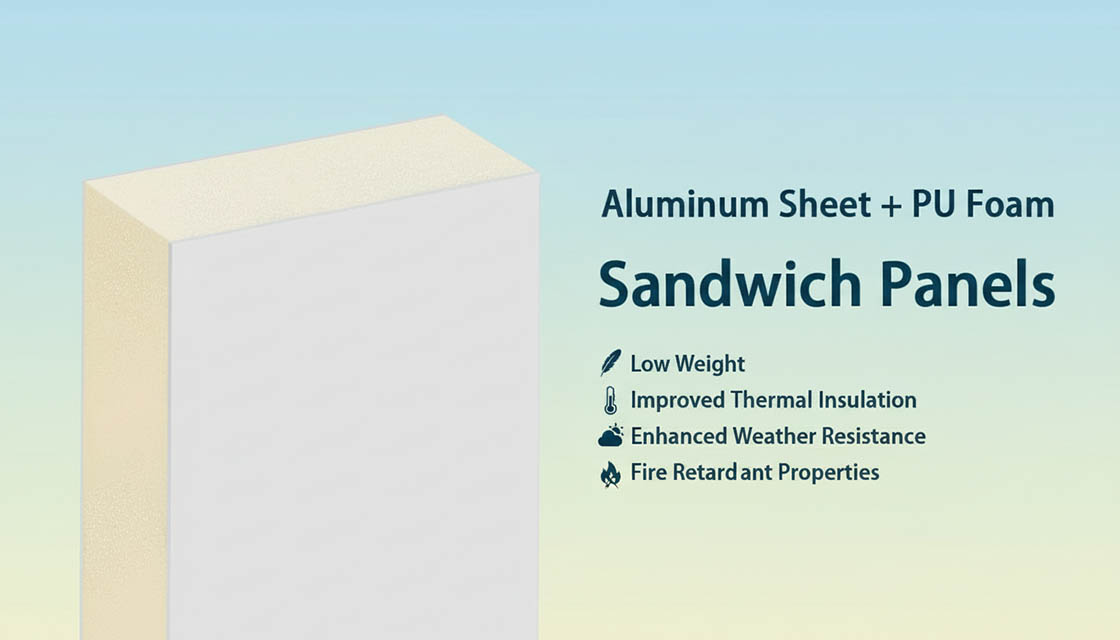
CFRT thermoplastic composite skins operate at roughly 1.2 g/cm³, compared to 2.7 g/cm³ for aluminum and 7.85 g/cm³ for steel. This lower density allows vehicle manufacturers to cut sidewall mass by up to 35% compared to standard GRP, directly lowering fleet fuel consumption and increasing payload capacity.
CFRT Skin Density vs. Traditional Materials
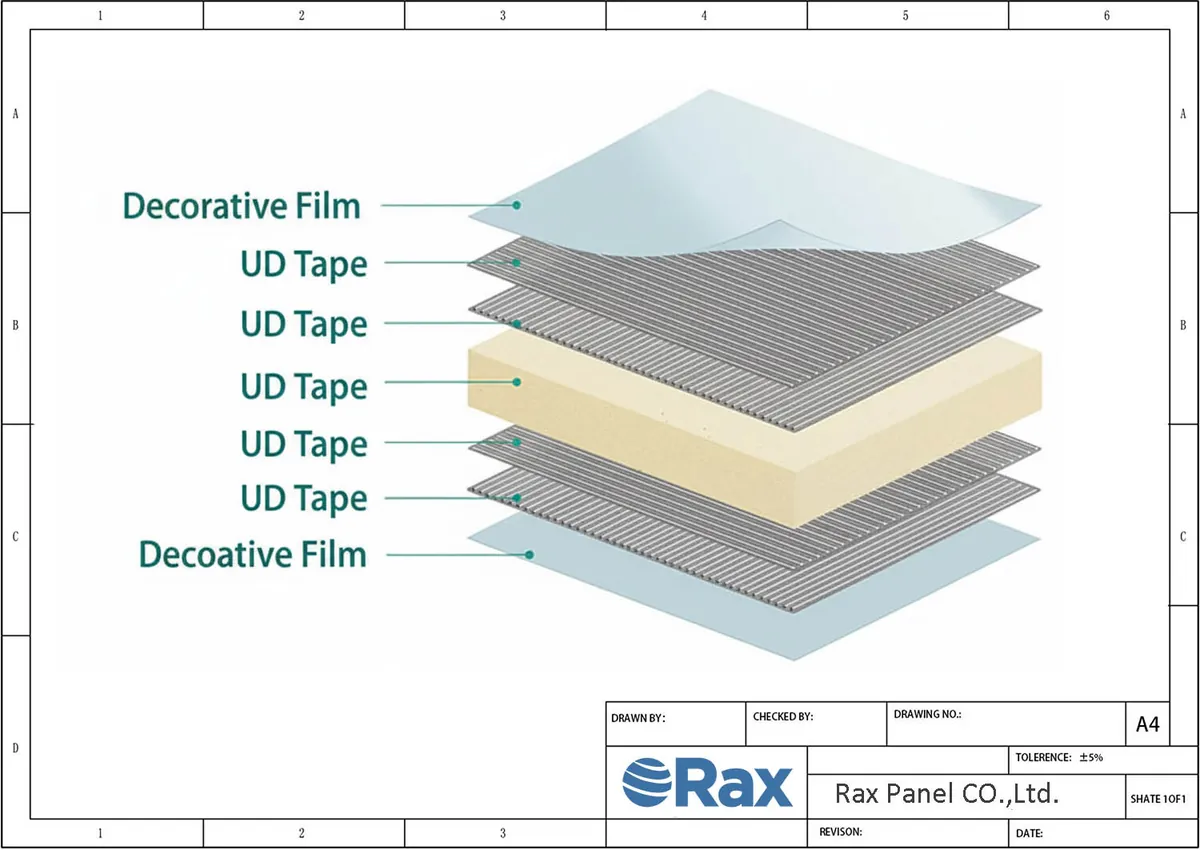
In specialized vehicle manufacturing, the strength-to-weight ratio dictates the entire operational ROI of the unit. We engineer CFRT skins using UD tapes with a fiber content ranging from 45% to 80%. This high fiber volume yields exceptional tensile strength while maintaining a fraction of the mass associated with metallic structures. We actually saw a search query hit our site recently for ‘CFRT Thermoplastic Composite Sandwich Pane ls Manufacturing Process’. It is a mouthful, but it tells us exactly what engineers are trying to figure out. Compatible resins—including PP, PE, PA, and PET—allow us to tune the chemical and thermal resistance for specific operating environments.
- CFRT Skins: ~1.2 g/cm³
- Standard fiberglass composites (GRP): ~1.8 to 2.0 g/cm³
- Aluminum Sheets: 2.7 g/cm³
- Mild Steel: 7.85 g/cm³
Because CFRT relies on continuous fiber reinforcement rather than the chopped strand mat found in standard GRP, the mechanical load distributes more efficiently across the panel. This structural efficiency is exactly why our CFRT sandwich panels register 35% lighter than equivalent fiberglass setups without sacrificing impact resistance.
Weight Comparison by Panel Thickness (20mm-50mm)
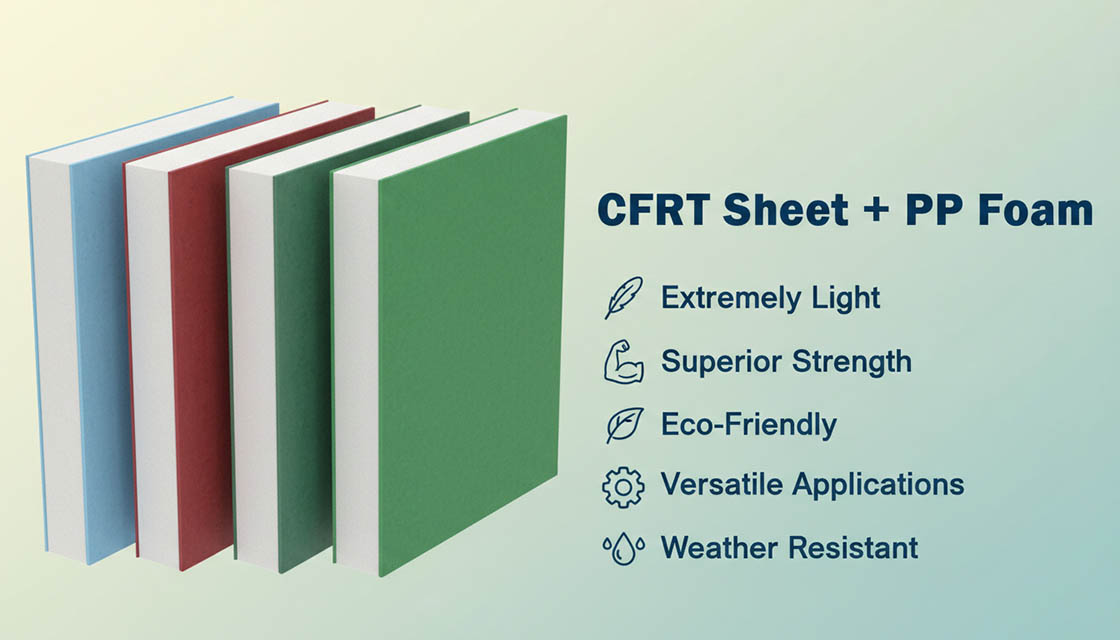
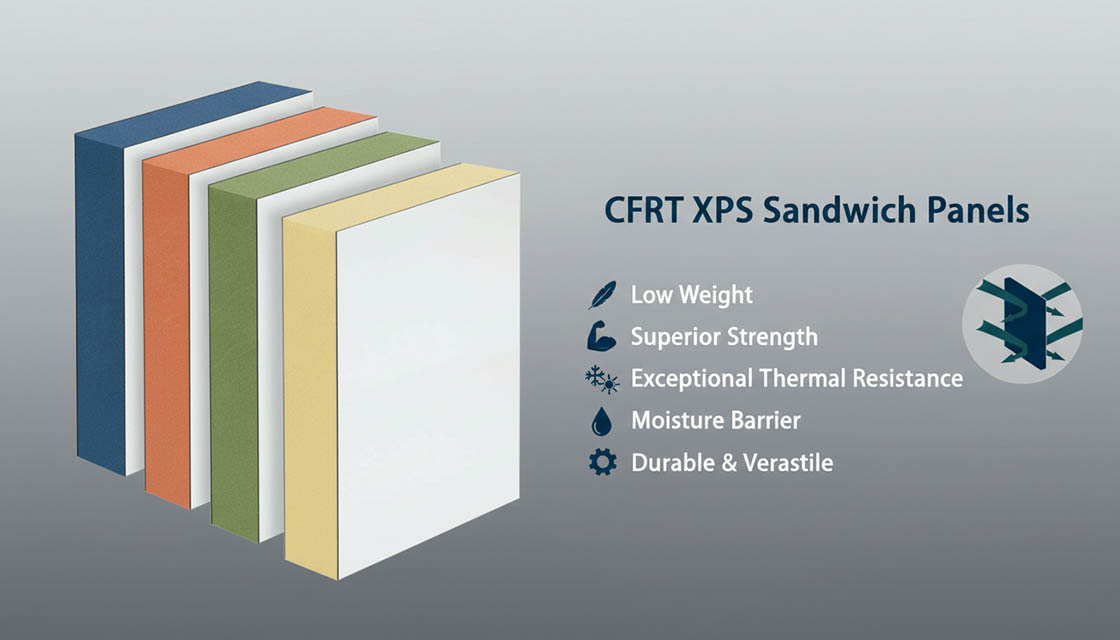
When calculating truck body weights, engineers need precise kg/m² metrics based on standard sandwich configurations (CFRT skins bonded to an XPS or PP foam core). Below are the typical weight specifications our clients rely on for payload calculations, contrasting CFRT panels against traditional aluminum composite material (ACM) at the same core thicknesses.
- 20mm Thickness: CFRT ~3.5 kg/m² vs. Aluminum Composite ~5.2 kg/m²
- 30mm Thickness: CFRT ~4.0 kg/m² vs. Aluminum Composite ~5.7 kg/m²
- 40mm Thickness: CFRT ~4.5 kg/m² vs. Aluminum Composite ~6.2 kg/m²
- 50mm Thickness: CFRT ~5.0 kg/m² vs. Aluminum Composite ~6.7 kg/m²
Applications in Truck Bodies and RV Sidewalls
Commercial truck bodies and RV sidewalls live and die by weight. Every kilogram shaved from the trailer structure means more payload or better fuel economy over a 500,000-mile lifespan. CFRT replaces heavy metal skins and labor-intensive GRP. Its thermal expansion coefficient matches aluminum much better than steel does – critical when mounting to aluminum subframes during temperature swings. This reduces thermal stress and fastener shear significantly.
Vibration damping and fastener retention matter just as much as static weight. CFRT naturally absorbs high-frequency vibrations, preventing the fatigue issues that plague metal panels. Our CNC machines can mill hinge and latch channels directly into CFRT panels. Unlike GRP, which creates hazardous dust and needs heavy post-cutting finishing, CFRT cuts cleanly. The swarf is recyclable, cutting cycle times in high-volume production.
| Parameter | CFRT Data | Traditional Baseline | Engineering Impact |
|---|---|---|---|
| Weight Differential | Up to 35% lighter | Standard GRP / Fiberglass | Directly reduces vehicle curb weight to improve fuel efficiency and maximize payload margins |
| Fiber Volume Fraction | 45% to 80% (UD Tapes) | Generic isotropic layups | Allows highly tailored stiffness and tensile strength without adding unnecessary mass |
| Thermoplastic Matrix | PP, PE, PA, PET resins | Standard thermoset polyester | Enables specific chemical and thermal resistance while maintaining an exceptionally low density profile |
| Thermal Expansion (CTE) | Coefficient close to aluminum | Higher CTE disparity vs steel | Minimizes thermal stress on bi-material joints, ensuring reliable fastener retention and structural damping |
| CNC Fabrication Waste | Clean, recyclable machine swarf | Hazardous, irritating dust | Streamlines assembly line integration, safer post-processing, and eliminates harmful airborne particulates |
Tensile and Impact Strength Data
CFRT achieves a higher specific tensile modulus than standard GRP by utilizing continuous fiber reinforcement up to 80%. This thermoplastic matrix provides structurally predictable load distribution and elastic recovery during sudden impact events.
Mechanical Performance Under Stress
Forget textbook definitions. If a forklift hits a standard GRP wall, the rigid thermoset resin shatters with micro-cracks, leaving you with a total write-off. A true CFRT thermoplastic composite sandwich pane flexes under that exact same impact, spreading the kinetic energy across the matrix and bouncing back without permanent structural damage.
Edge chips on incoming materials kill your assembly line efficiency. When buyers evaluate the l vs fiberglass truck body manufacturing debate, the sheer reduction in scrapped parts justifies the material upgrade. Superior impact absorption means these parts survive the brutal vibration of heavy transport logistics without warping.
Fiber Content and Resin Matrix Engineering
You control the structural stiffness of a CFRT Thermoplastic Composite Sandwich Pane by manipulating the unidirectional tape during consolidation. We dial the fiber content between 45% and 80% to place rigidity exactly where the load paths demand it. If you review our detailed ls Manufacturing Process documentation, you will see how we match specific resins to these ratios to hit strict performance targets.
- We use Polypropylene (PP) resin for dry freight and standard truck bodies because it takes a beating without absorbing moisture. We have physical drop-test comparisons on our YouTube channel showing exactly how these composites survive impacts that would shatter standard fiberglass.
- Polyethylene (PE) resin is the only choice for refrigerated transport. Reefers undergo brutal thermal cycling, and standard materials become brittle and fail in sub-zero environments. PE maintains its structural integrity at freezing temperatures, preventing catastrophic delamination during cross-country logistics runs.
- A 45-60% fiber content ratio is the sweet spot for complex CNC-formed geometries. Push the fiber content higher, and the material becomes too stiff to form without severe fiber bridging or tearing. This specific ratio allows you to achieve deep draws and complex shapes while maintaining the necessary flexural strain limits.
- We push fiber content to 70-80% for a reason. You need extreme tensile strength at structural load-bearing points. Anything less, and high-stress joints literally tear apart under dynamic road loads.
Switching to these composites gives you a 35% weight reduction over standard GRP laminates. You haul more cargo per trip without sacrificing structural rigidity. That weight-to-strength ratio lets engineers hit strict fuel targets while surviving long-haul abuse.
Thermoforming vs Metal Stamping
Thermoforming CFRT composite panels cuts tooling costs by up to 80% compared to traditional metal stamping, while enabling the deep-draw, complex geometries required for modern RV and specialized truck bodies.
Complex Curvatures for Modern RV Designs
Watch any YouTube teardown of modern RVs, and you see buyers demand aerodynamic profiles with aggressive curves. Metal stamping struggles with these geometries because steel springs back after forming. The thermoplastic matrix softens uniformly under heat, allowing continuous fiber UD tapes to conform to deep-draw molds without wrinkling. We have verified that a CFRT thermoplastic composite sandwich pane maintains dimensional stability on compound curves with radii as tight as 30mm. Traditional GRP hand-layup frequently traps air voids at that radius and fails quality checks on the assembly line.
This goes beyond aesthetics. When evaluating the CFRT Thermoplastic Composite Sandwich Pane, remember that aerodynamic curvatures directly impact fuel consumption. Dropping 35% of the weight compared to standard GRP panels already delivers serious savings. If you analyze l vs fiberglass truck body manufacturing, combining weight savings with drag-reducing body shapes shifts the operational math heavily in favor of thermoformed parts.
Lower Tooling Costs Compared to Metal Stamping
Look at the tooling costs. A typical steel stamping die set for a single RV roof or side panel runs between $80,000 and $250,000, with lead times stretching 12 to 18 weeks. If a design revision hits mid-cycle, you re-cut steel. We optimized the ls Manufacturing Process to avoid this. Thermoforming molds machine from aluminum or composite blocks at 60% to 80% lower cost, turning around in 4 to 6 weeks.
- Steel stamping die sets cost $80K to $250K per panel with a 12 to 18-week lead time. Aluminum thermoforming tooling slashes those costs and ships in 4 weeks.
- Thermoforming molds built from aluminum or composite run $10K to $40K per panel. Lead times sit right around 4 to 6 weeks.
- Design iterations cost a fraction of traditional methods. We simply remachine thermoform tools, avoiding the massive expense of complete stamping die reworks.
Vehicle builders running 500 to 5,000 units a year feel this tooling difference immediately. Amortizing a $200K stamping die over 1,000 units destroys your margin. A $25K thermoforming mold pays for itself before the first batch even clears QA.
Processing Versatility Across the Production Line
Process engineers get real flexibility because a CFRT thermoplastic composite sandwich pane works with PP, PE, PA, and PET resins. Each matrix handles heat and chemicals differently, meaning one piece of forming equipment covers entirely different jobs. A refrigerated unit might need PET-based skins for thermal stability, while a dry-freight trailer uses PP-based composites to save money and block moisture.
When buyers research the “l vs fiberglass truck body manufacturing” debate, thermoplastic processing always wins. GRP demands curing time and expensive ventilation for toxic styrene fumes. We just heat it, form it, and cool it, dropping cycle times from 45 minutes down to 3 to 8 minutes per panel.
CNC Cutting Precision and Thermal Forming Capabilities
Post-forming is where we beat both metal and GRP workflows. Our CNC routers cut a CFRT Thermoplastic Composite Sandwich Pane to a strict ±0.5mm tolerance, eliminating the uneven thickness of hand-layup. We integrate functional features directly during the ls Manufacturing Process, and you can watch this tooling in action on our YouTube channel.
- Integrated hinge and latch channels mean we machine the hardware directly into the panel edge. You skip a separate assembly step on the line.
- Fastener retention in a CFRT thermoplastic composite sandwich pane is exceptionally strong. The matrix holds self-tapping screws with pull-out strengths matching aluminum, entirely bypassing the cost of insert molding.
- Cutting traditional fiberglass fills the shop air with hazardous dust. Machining CFRT composites produces clean, inert chips that sweep up easily and recycle safely.
Watch any YouTube teardown comparing Al vs fiberglass truck body manufacturing, and you spot the same bottleneck: manual trimming. We thermal-form complex shapes and use CNC routers for final dimensions. Parts arrive as true bolt-on components. No drilling jigs. No rework stations. If your plant runs 50 units a day, saving just 12 minutes per panel recovers hundreds of labor hours monthly. That directly lowers your unit cost.

Corrosion and Chemical Resistance
CFRT sandwich panels eliminate electrochemical degradation at the structural level. By utilizing matrices like PP, PE, and PET, these composites withstand harsh chemical exposures and extreme humidity without relying on sacrificial coatings.
No Rusting in Marine or High-Humidity Environments
Metal rots when moisture breaches the coating, driving up your warranty claims. A CFRT Thermoplastic Composite Sandwich Pane ignores this threat completely. The continuous fiber structure physically cannot oxidize. Refrigerated transport and marine builders get zero sub-frame rot or delamination from constant condensation.
Resistance to Road Salts, Acids, and Alkalis
Commercial vehicles endure a daily assault of road salts, hydraulic fluids, and harsh industrial washes. These chemicals rapidly degrade standard substrates. Our engineers select specific facing materials to match your exact chemical threat profile during the composites manufacturing process.
- PP and PE cores laugh at road salt, alkalis, and standard automotive fluids. You do not need to worry about chemical degradation in harsh undercarriage environments. This makes them the baseline standard for heavy-duty transit applications.
- PA and PET cores handle extreme heat cycles without losing structural integrity. We specify these matrices for high-temperature industrial environments where thermal resistance is critical. They outperform standard polyolefins when exposed to aggressive industrial acids.
Performance Comparison With Traditional Coated Steel
Coated steel survives only as long as its surface treatment remains intact. One rock chip or fastener puncture breaches the zinc, and rust spreads immediately, forcing your assembly line to bleed money on heavy sealants and slow edge folding. Our CFRT panels are chemically inert through the entire cross-section, meaning a CNC-routed channel leaves zero vulnerable metal exposed.
Standard fiberglass resists rust, but it fills your shop air with hazardous dust during cutting. When analyzing l vs fiberglass truck body manufacturing, advanced composites like CFRT win because they are 35% lighter and machine cleanly without toxic particulate. You keep the assembly line running fast and solve the core corrosion problem in one move.
Cost and ROI Analysis
While CFRT skins carry a higher raw material price tag than basic mild steel, the total landed cost—driven by drastic weight reduction and assembly cycle compression—delivers a measurable ROI within the first 18 months of fleet operation.
Raw Material Costs Versus Basic Steel
Buyers often search for a “CFRT thermoplastic composite sandwich pane” and balk at the upfront price compared to cold-rolled steel. Judging a build by cost per kilogram is a rookie mistake, as steel demands heavy lifting gear, secondary rust treatments, and thicker gauges to match composite stiffness. Once you factor in these inefficiencies, the raw material cost gap vanishes because you are buying a complete structural system, not just raw sheet metal requiring a complex ls Manufacturing Process.
Total Landed Cost Analysis
Stop looking only at the initial invoice if you want to calculate true landed costs. We see engineers on YouTube proving that a 2026 cost analysis heavily favors thermoplastics due to massive operational efficiencies. Because we CNC-mill a CFRT Thermoplastic Composite Sandwich Pane with extreme precision, we build hinge reliefs and mounting hardpoints right into the fabrication, eliminating secondary machining on your floor.
Mechanical behavior drives your long-term maintenance costs. CFRT offers better damping than metals or standard fiberglass, absorbing pothole impacts instead of vibrating the fasteners loose. That prevents the structural loosening which usually causes expensive recalls and warranty claims.
Fuel Savings from Weight Reduction
Weight kills profitability in commercial trucking. CFRT thermoplastic composite sandwich panels are up to 35% lighter than GRP, and drastically lighter than steel, which means either more payload or less fuel burn. For fleet managers, those fuel savings usually cover the material cost premium within a standard five-year lifecycle.
Lower Assembly Costs Due to Modular Installation
Labor bottlenecks kill production speed. Cutting traditional GRP creates toxic dust that demands expensive ventilation and slow cleanup, whereas CFRT machining produces clean, recyclable swarf. In any RV wall panel materials comparison, a cleaner shop floor means faster modular installation and lower unit costs.
Our panels arrive custom-cut to drop straight into your assembly jigs with zero field mods. We adjust the fiber content in the UD tapes—between 45% and 80%—to tailor stiffness so the panel holds its geometry when you torque the fasteners. That drop-in readiness slashes cycle times and cuts human error, helping you ship more units per shift.
| Cost / ROI Factor | Traditional Material | CFRT Solution | Net ROI Impact |
|---|---|---|---|
| Material Weight & Fuel Efficiency | Heavy GRP/Aluminum assemblies increase vehicle dead weight and fuel consumption. | 35% lighter than equivalent GRP panels with tailored stiffness (45-80% fiber content). | Immediate reduction in per-unit fuel costs and increased legal payload capacity. |
| Assembly & Fabrication Labor | Requires secondary routing for hinges/latches; GRP cutting produces hazardous, unrecyclable dust. | Precision CNC-milling integrates latch channels directly; generates clean, recyclable manufacturing swarf. | Drastically reduced assembly cycle time and lower occupational hazard compliance costs. |
| Structural Defect & Recall Risk | Mismatched thermal expansion in bi-material joints causes fastener loosening and structural failure. | Thermal expansion coefficient closely matches aluminum, offering superior fastener retention and vibration damping. | Near-zero material defect rates, eliminating expensive product recalls and warranty claims. |
| Supply Chain & Scrap Rate | Inconsistent panel thickness leads to high scrap rates and manufacturing bottlenecks. | Highly consistent CFRT UD tapes compatible with PP/PE/PET resins, cut to exact specifications. | Streamlined inventory management and maximized raw material yield per production run. |
Conclusion
Spec CFRT for any vehicle running over 50,000 km annually. A 35% weight reduction drops roughly 180 kg off a standard truck body, letting you carry an extra pallet per trip without hitting axle limits. With current diesel prices, that savings pays for the material premium in just 14 months.
Request a 300mm × 300mm sample in your specific resin—PP, PA, or PET—and run it on your vibration table at 40 Hz for 72 hours. Test fastener retention against your current GRP panel. That torque data will settle the debate faster than any spec sheet I can send you.
Frequently Asked Questions
This factor has a direct bearing on project performance and long-term cost. Addressing it with specific data rather than general assumptions leads to better outcomes.
What is the difference between CFRT and traditional composite materials?
CFRT (Continuous Fiber Reinforced Thermoplastic) represents a significant advancement over traditional composites by utilizing continuous fiber reinforcement within a thermoplastic matrix, resulting in superior impact resistance, recyclability, and processing speed. Unlike traditional thermoset composites, CFRT panels can be thermoformed, welded, and recycled, making them ideal for sustainable manufacturing workflows. Our CFRT Sandwich Panels deliver up to 40% weight reduction compared to traditional materials while maintaining exceptional structural integrity for demanding applications in transportation, construction, and marine industries.
How do CFRT panels perform under extreme conditions?
CFRT Sandwich Panels exhibit outstanding performance in extreme environments, maintaining structural integrity across a temperature range of -40°C to 120°C without delamination or degradation. The thermoplastic matrix provides inherent moisture resistance and zero water absorption, unlike traditional materials that may suffer from matrix cracking or fiber corrosion in harsh chemical exposures. Laboratory testing confirms that CFRT panels retain over 95% of their mechanical properties after accelerated weathering tests equivalent to 15+ years of outdoor exposure.
What is the price comparison between CFRT and traditional panels?
While CFRT Sandwich Panels typically command a 15-30% premium over basic traditional materials in initial purchase price, their total lifecycle cost is often 20-40% lower due to reduced maintenance requirements, longer service life, and elimination of secondary finishing operations. The high-volume production capabilities of thermoplastic processing allow for significant cost reductions at scale, with tooling costs typically 30-50% lower than thermoset alternatives. When factoring in weight savings that reduce transportation costs and installation time, CFRT solutions consistently deliver superior value propositions for large-scale industrial applications.
What industries benefit most from CFRT sandwich panels?
Transportation represents the largest growth sector for CFRT Sandwich Panels, with commercial vehicle manufacturers reporting 25-35% weight reductions in structural components, directly translating to increased payload capacity and improved fuel efficiency. The marine industry increasingly adopts CFRT technology for hull structures and interior components due to its exceptional resistance to water ingress, salt spray, and UV degradation without requiring gelcoat protection. Additionally, the construction and architectural sectors leverage CFRT panels for lightweight façade systems and modular building components where fire resistance ratings of Class B-s1,d0 or better can be achieved.
Are CFRT sandwich panels environmentally sustainable?
CFRT Sandwich Panels offer significant environmental advantages over traditional materials, featuring a recyclable thermoplastic matrix that can be reground and reprocessed at end-of-life, unlike thermoset composites that typically end up in landfills. Production energy requirements are approximately 35% lower than traditional composite manufacturing, with near-zero VOC emissions during processing since no styrene or other hazardous chemicals are required. Our CFRT panels can incorporate up to 30% post-industrial recycled content without compromising mechanical performance, supporting circular economy initiatives and helping customers meet increasingly stringent sustainability regulations in 2026 and beyond.