
Spec sheets list a thermal conductivity of 0.022 W/m·K for PIR, but that number is worthless if the factory’s chemical ratios drift during a night shift. A reliable PIR sandwich panel manufacturer guarantees that density and fire performance stay consistent across every pallet, which is the difference between passing inspection and a total tear-out. You are not just buying foam; you are buying the process control that keeps it stable.
We show you how to audit production lines and verify ISO and FM certifications directly. You will learn to cross-reference lab-tested Lambda values against marketing specs, protecting your project from long-term thermal bridging and expensive retrofit costs.
Strategic Importance of Rigorous Manufacturer Vetting
Vetting a manufacturer is not administrative paperwork; it is the primary defense against project failure, liability exposure, and margin erosion.
Impact of Production Variance on Project ROI
In the composite panel industry, production variance is a silent budget killer. When panels arrive with inconsistent thickness or flatness, the installation timeline explodes. Contractors spend hours shimming and force-fitting sheets that should have been uniform. This labor overruns the initial material savings instantly. Dimensional stability is not a luxury; it is a prerequisite for profitable installation.
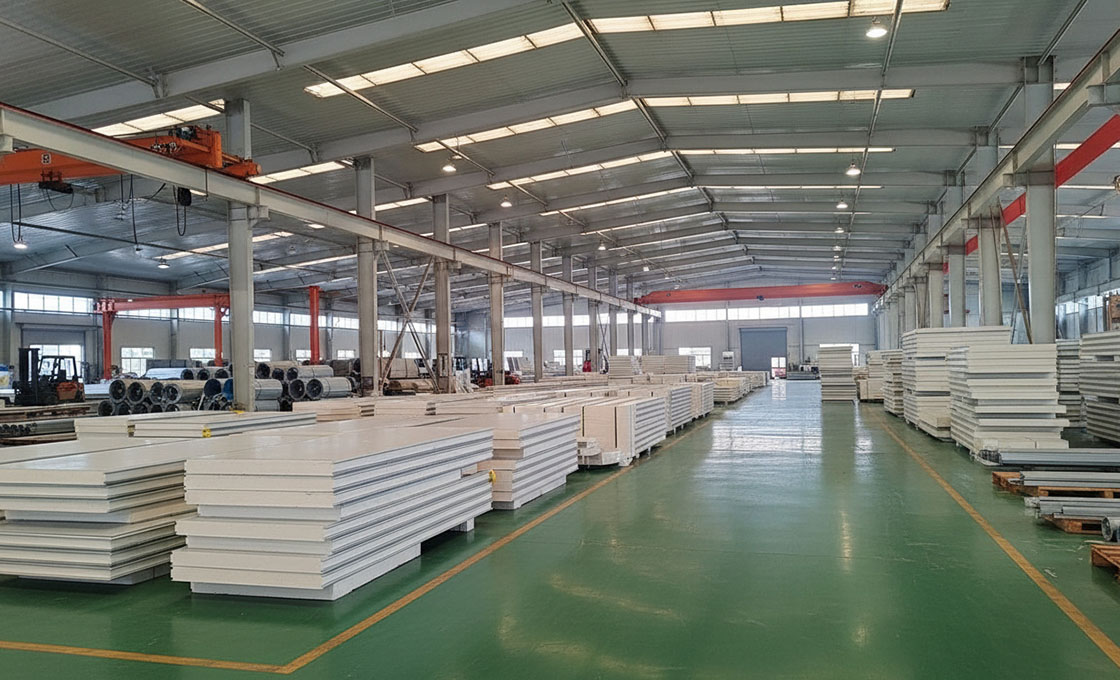
At Rax Panel, we have seen the consequences of unstable supply lines. That is why we utilize advanced continuous production lines to guarantee consistent panel quality. Our technicians monitor the process to ensure flatness and dimensional accuracy, preventing the on-site headaches that plague projects sourced from lower-tier manufacturers.
Risks of Non-Compliant Materials in Critical Infrastructure
Using non-compliant materials in critical infrastructure—such as cold storage logistics hubs or hygienic processing plants—is a catastrophic liability. If a panel fails fire testing or degrades under thermal cycling, the cost of retrofitting far exceeds the initial procurement price. Regulatory non-compliance can result in facility shutdowns and severe legal action.
Aligning Technical Specs with Manufacturing Reality
Never assume a manufacturer can achieve a specific R-value or fire rating without asking for their internal test data. Ask specifically: “How do you handle the thermal conductivity spread in your cores?” A competent manufacturer will explain their density control methods rather than just quoting a marketing brochure.
We bridge this gap by conducting rigorous experimental testing before production begins. Our engineers analyze the specific project requirements and develop core and facing combinations that actually perform as specified, rather than relying on generic stock solutions that might compromise the build.
| Vetting Aspect | Risk of Neglect | Verified Manufacturer Standard (Rax Panel) | Strategic Value |
|---|---|---|---|
| Technical & Fire Compliance | Misestimating fire ratings (assuming A2 vs. Euroclass B-s1,d0) or ignoring thermal conductivity spread (PIR vs. PUR). | Rigorous experimental testing of PIR, PUR, and Rockwool panels by experienced technicians. | Ensures code compliance, thermal efficiency, and safety under demanding conditions. |
| Engineering & Customization | Operational cost overruns and wasted space caused by generic thickness sizing or incorrect core selection. | Custom engineering analysis to develop specific core/facing combinations tailored to project requirements. | Delivers optimized balance between R-value, weight, cost, and structural integrity. |
| Production Stability | Dimensional instability, joint defects, and condensation issues caused by poor manufacturing control. | Utilization of advanced production lines backed by 15+ years of experience and >1,700 sqm daily capacity. | Guarantees consistent panel quality and flatness essential for installation. |
| Global Service Integration | Project delays, communication barriers, and transportation risks across international borders. | Proactive production tracking and cost reduction strategies delivered by a 24-hour multilingual team. | Provides transparent supply chain visibility and risk elimination for global distributors. |
Verifying Global Certification Compliance (ISO, FM, CE)
Global certifications are not merely administrative badges; they are your primary insurance against liability, customs seizures, and catastrophic structural failure.
For buyers, the pain point is rarely finding a certificate, but verifying its validity and scope. A generic ISO 9001 certificate does not guarantee a specific PIR panel meets fire safety standards. You must distinguish between quality management systems (ISO), regional product conformity (CE), and property loss prevention standards (FM).
ISO 9001: The Foundation of Process Stability
ISO 9001 certification verifies that the manufacturer adheres to consistent quality management protocols, not that a specific panel is fireproof. In our factory, where our daily production area exceeds 1,700 square meters, ISO 9001 principles are the backbone of our workflow. They ensure that the PIR core we produce today matches the thermal conductivity and density specifications of the batch we shipped three months ago. Without this process consistency, you cannot trust the repeatability of your engineering specs.
CE Marking and EN 14509: The European Passport
For distribution in Europe or regions adopting EU norms, the CE mark is non-negotiable. However, the critical detail is the underlying standard, typically EN 14509 for self-supporting double-skin metal faced panels. This standard governs load-bearing capacity and thermal conductivity.
We ensure our panels are tested against EN 14509 because it validates the core’s ability to maintain structural integrity under thermal stress. Do not accept a CE declaration of conformity for a ‘building material’ if the specific application requires a certified structural sandwich panel.
FM Approvals: High-Stakes Risk Mitigation
Factory Mutual (FM) Global approvals are the gold standard for clients in North America and for high-value industrial assets globally. FM Approval is particularly critical for PIR and Rockwool panels used in cold storage and heavy industrial facilities.
This certification goes beyond compliance; it is often a prerequisite for securing favorable insurance premiums. FM standards rigorously test fire resistance, wind uplift, and structural performance. Our experience shows that substituting non-FM panels in these environments exposes the project to massive uninsurable risks.
A common industry scam is presenting a valid certificate but for a different product category or thickness. Always verify that the ‘Scope of Certification’ explicitly lists your specific panel configuration (e.g., ‘PIR Sandwich Panel with specific core density’).
We provide full traceability for our supply chain across 50+ countries. When you work with our team, we don’t just email a PDF; we provide the original test reports and mill certificates for the steel coils used in your specific batch, ensuring your documentation survives any third-party audit.
Analyzing Production Capacity and Lead Time Reliability
Verifying actual daily output is more critical than assessing theoretical machinery limits for predicting lead times.
Analyzing production capacity requires looking beyond the machinery on the factory floor. For manufacturers and distributors, the difference between installed capacity and effective net capacity determines whether a project stays on schedule. A supplier might list high-speed continuous lines, but inconsistencies in raw material supply or labor shortages can reduce real-world throughput significantly. Buyers must verify if the stated capacity accounts for standard downtime, maintenance, and changeover times between different core materials like XPS, PET, or PU.
Quantifying Daily Output and Scalability
Reliable suppliers provide quantifiable daily metrics rather than vague estimates. At Rax Panel, our advanced production lines support a daily production area exceeding 1,700 square meters. This volume allows us to absorb urgent orders without disrupting standard supply chains for long-term partners across 50+ countries. We prioritize consistent output over sporadic bursts, which stabilizes lead times for complex orders such as refrigerated truck bodies and RV wall panels. High-volume scalability is essential for mitigating risks during peak construction seasons.
Engineering Latency in Customized Orders
High-volume standard panel production is rapid, but customized composite solutions introduce engineering latency that must be calculated into the schedule. Our technicians conduct experimental testing for every custom specification to ensure data standards are met under demanding conditions. While this process adds days to the front end, it eliminates retrofit risks. To optimize this, we utilize a 24-hour one-to-one service team that manages production progress, allowing us to synchronize design iterations with material preparation before the physical run begins.
📋 Actionable Steps
- Step 1: Request the manufacturer’s production log for the last 30 days to identify variance in daily output versus claimed capacity.
- Step 2: Verify the buffer stock of core materials (e.g., PIR foam, fiberglass sheets) to detect potential supply chain dependencies.
- Step 3: Ask for specific shift patterns—single-shift factories effectively halve their stated capacity compared to double-shift operations.
Evaluating In-House Quality Control and QA Processes
In composite manufacturing, a quality certificate is a snapshot of potential, but the daily QA process is the video of reality. It determines the variance between your approved sample and the mass shipment.
Managing Process Drift in High-Volume Production
For buyers, the greatest risk in sourcing sandwich panels is process drift. When a factory operates advanced production lines exceeding 1,700 square meters daily, even minor deviations in curing temperatures or lamination pressure can create weak spots in the core-to-skin bond. Effective QA requires real-time monitoring, not just end-of-line batch sampling. We focus on maintaining strict parameters during the continuous lamination phase to ensure the PIR or PUR foam density remains uniform across every meter produced.
Experimental Testing and Custom Validation
Our engineers do not rely solely on standard assumptions; they conduct experimental testing to validate specific project requirements. With of production experience, we have learned that generic specifications often fail in demanding conditions. We simulate the environmental stressors—such as thermal cycling and impact load—that the panels will face in the field. This preemptive validation ensures that the composite structure performs as specified, preventing costly retrofits and material failures for our clients.
Dimensional Accuracy and Joint Integrity
Dimensional stability is a critical metric that is frequently overlooked during initial vetting. If panels deviate from specified flatness tolerances, the resulting gaps during installation compromise the thermal envelope and invite condensation. Stringent QA protocols must include laser-guided profiling to verify that the surface flatness and thickness are consistent. This precision is vital for applications like refrigerated truck bodies and cold storage, where a tight seal is non-negotiable for energy efficiency.
Do not accept a generic quality checklist as proof of compliance. Request evidence of inline monitoring systems and ask how the supplier handles density outliers in foam cores like XPS or PET. A factory that cannot demonstrate real-time intervention capabilities is likely shipping panels with latent defects that will only manifest after installation.
Auditing Raw Material Sourcing and Supply Chain Transparency
Traceability constitutes the baseline for validating any specification regarding thermal efficiency or fire safety. With supply chain opacity acting as the primary driver of thermal variance and fire safety failures, if you cannot trace the raw material, you cannot trust the performance data.
The Invisible Risk of Raw Material Substitution
The most common pain point for buyers is the ‘bait and switch’ on core materials. PIR and PUR panels are highly sensitive to the specific formulation of polyols and isocyanates used. Unverified suppliers often substitute high-grade fire-retardant additives with cheaper alternatives to protect margins during raw material price spikes.
This invisible substitution directly undermines thermal conductivity (Lambda) values and can cause a panel to fail its Euroclass fire rating, even if the initial sample provided was certified. Without access to the manufacturer’s raw material chain of custody, you are essentially betting your project’s compliance on a black box.
Direct Factory Control and Traceability
Rax Panel mitigates this risk by operating as a fully integrated manufacturer, not a trading company. With of production experience and a daily output exceeding 1,700 square meters, we maintain direct, auditable relationships with top-tier chemical suppliers.
We do not outsource the lamination process; we control the foaming and pressing of our PIR, PUR, and Rockwool cores on our own advanced production lines. This vertical integration allows our technicians to conduct experimental testing on raw material batches before they enter the production line, ensuring density and consistency are strictly adhered to for every order.
When auditing a supplier, demand the ‘Birth Certificate’ of the panel. This documentation must link the finished panel’s serial number to the specific batch numbers of the core foam and the facings. If they cannot provide this granular traceability for their CFRT or GRP facings, assume their quality control is reactive rather than preventative.
Our global footprint, serving over 50 countries, requires a supply chain capable of withstanding rigorous international scrutiny. Whether we are sourcing PMI foam for high-end insulation or fiberglass sheets for GRP panels, we prioritize material stability over short-term cost savings. We provide full transparency on our sourcing standards, giving you the data assurance needed to secure your project margins and safety compliance.
Assessing Customization Capabilities for Technical Specifications
True customization is not merely about altering dimensions; it is the engineering of the laminate structure to hit exact thermal, structural, and fire-performance targets without inflating costs.
In the composite panel sector, the term ‘customization’ is frequently reduced to simple length and width cutting. However, genuine technical customization involves manipulating the laminate stack-up—the density of the core, the thickness of the facings, and the specific adhesive formulations—to meet strict operational requirements. When vetting a manufacturer, you must determine if they are merely a fabricator of standard sheets or an engineering partner capable of altering material physics to solve specific project constraints.
Thermal and Fire Performance Precision
Assessing a manufacturer’s technical capability begins with their ability to hit precise thermal conductivity targets. For PIR sandwich panels, manufacturers must consistently achieve Lambda values ranging from 0.022 to 0.025 W/m·K. If a supplier cannot guarantee these specific numbers within a tight tolerance, you risk over-engineering wall thickness or facing higher energy operational costs over the asset’s lifecycle.
Fire performance remains a critical compliance variable where technical precision is non-negotiable. Many distributors mistakenly assume standard PIR panels achieve an A2 rating; the reality is that premium PIR typically caps at Euroclass B-s1,d0. A capable manufacturer must be transparent about this limitation and offer alternatives, such as Rockwool core panels, to meet stricter A2 non-combustible requirements for high-risk zones.
Advanced Engineering and Production Flexibility
At Rax Panel, we distinguish our services by moving beyond catalog options. With of production experience and a daily capacity exceeding 1,700 square meters, our engineering team conducts experimental testing to develop composite products that meet specific data standards. We do not simply assemble off-the-shelf parts; we customize cost-effective composite materials by offering a rich variety of core materials and skins to fit specific project requirements, whether for cryogenic stability or high-impact resistance.
Customization fails if the joint system is ignored. Ensure the manufacturer designs the tongue-and-groove or cam-lock profiles specifically for the customized thickness and core material you select. Poorly matched joints between different facing types are a primary cause of thermal bridging and condensation leaks in cold storage facilities.
Validating Claims on Thermal and Fire Performance
Marketing brochures often quote thermal values measured in perfect lab conditions; real-world performance depends on understanding the gap between ‘declared’ and ‘design’ values.
Cross-referencing Lab-Tested Lambda Values
Marketing datasheets for PIR and PUR panels frequently highlight thermal conductivity (Lambda) values achieved at mean temperatures of 10°C or 24°C. While technically accurate for those specific test conditions, these numbers do not always reflect operational reality in extreme environments. For instance, a PIR core performing efficiently in a mild climate warehouse will exhibit different conductivity properties in a refrigerated truck body operating at -20°C.
We often see contractors calculating insulation thickness based on a best-case Lambda of 0.021 W/m·K, only to find the actual production batch performs closer to 0.024 W/m·K. This discrepancy forces a redesign or retrofit to meet energy codes, consuming both time and budget.
Be wary of suppliers who only provide initial thermal conductivity values. Blowing agents in foam cores slowly diffuse over time, degrading R-value. Always demand the ‘Long-Term Thermal Resistance’ (LTTR) or ‘Design Lambda’ which reflects performance after 5, 10, or 15 years of aging.
Distinguishing Reaction to Fire and Fire Resistance
A critical compliance error is conflating ‘Reaction to Fire’ with ‘Fire Resistance.’ Reaction to Fire, classified by standards such as Euroclass (e.g., B-s1,d0), measures how a material contributes to flame spread and smoke generation. PIR panels typically achieve a Class B rating, meaning they have limited combustibility.
However, this rating does not indicate how long the panel can withstand a fire and maintain structural integrity—known as Fire Resistance (EI). A standard PIR sandwich panel may achieve a Reaction to Fire rating of B-s1,d0, yet fail to provide 60 minutes of fire resistance without specific intumescent coatings or non-combustible facings. Assuming otherwise exposes projects to severe safety code violations.
When vetting fire safety, request the test report for the ‘System Assembly,’ not just the core material. The fire performance of a PIR panel changes drastically based on the type of facing—steel, aluminum, or fiberglass—bonded to the core.
Impact of Core Density Consistency
Core density is the primary indicator of a sandwich panel’s structural stability and insulation longevity. Inconsistent density often points to unstable foaming processes, resulting in voids or weak cell structures within the panel. These low-density pockets act as thermal bridges, significantly diminishing the overall insulation efficiency of the envelope. More critically, density variations cause differential expansion and contraction. Over time, this leads to panel bowing or delamination, particularly in applications with severe thermal cycling like refrigerated transport or exterior cladding.
We enforce a rigid density tolerance protocol across our manufacturing lines. Our technical team conducts experimental testing on core samples from the start, middle, and end of every production run to ensure uniformity. We have found that maintaining consistent density is essential for the adhesive bond between the foam and the facings. This scrutiny prevents the ‘soft spots’ that compromise both the thermal envelope and the structural integrity of the final installation.
Lifecycle Cost Analysis and Total Ownership Evaluation
Assessing the total cost of ownership involves calculating the gap between procurement costs and lifecycle energy efficiency. It represents the delta between upfront procurement spend and cumulative operational energy savings over the asset’s lifespan, not the sticker price alone.
Factoring Operational Energy Efficiency Against Procurement Cost
Procurement teams often fixate on the invoice price, causing friction when Polyisocyanurate (PIR) panels are quoted at a 15–20% premium over standard Polyurethane (PUR) or fiberglass alternatives. However, this initial delta is frequently misleading. PIR cores typically exhibit a thermal conductivity (Lambda value) of 0.022–0.025 W/m·K, whereas standard PUR averages 0.025–0.028 W/m·K. In a 24/7 refrigerated environment or a climate-controlled facility, this improvement in thermal efficiency significantly reduces the thermal load on HVAC and refrigeration systems.
For high-usage assets like refrigerated truck bodies or cold storage warehouses, the energy savings generated by superior insulation often amortize the initial material premium within 18 to 36 months. When evaluating bids, buyers must request a heat-load calculation based on the specific Lambda values provided, rather than comparing costs on a per-square-meter basis alone.
Analyzing Dimensional Stability to Prevent Retrofit Costs
Dimensional instability is a silent budget killer that manifests years after installation. If a panel core shrinks, expands, or warps due to thermal cycling, the joint seals fail. This leads to thermal bridging, condensation, and ultimately, structural rot in the facings. Rectifying these issues often requires dismantling large sections of the building envelope—a retrofit cost that dwarfs the original material savings.
Polyisocyanurate (PIR) outperforms lower-cost foams by maintaining structural integrity across a broader operational temperature spectrum, typically stable from -40°C to +80°C. We conduct rigorous experimental testing on our PIR cores, subjecting them to extreme thermal shock cycles to verify zero linear shrinkage before they are approved for production. Ensuring this level of stability upfront prevents the operational downtime and expense of replacing degrading panels in critical infrastructure.
Calculating ROI for Premium PIR Cores
Calculating the Return on Investment (ROI) for premium PIR sandwich panels requires a dual-variable approach: energy modeling and spatial efficiency. Because PIR offers a higher R-value per inch of thickness, engineers can often achieve the required thermal performance with a thinner panel profile compared to cheaper alternatives.
In logistics and mobile applications, such as refrigerated truck bodies or RVs, reducing wall thickness increases internal usable volume. This ‘space efficiency’ allows for more cargo per trip, directly increasing revenue potential. Therefore, the ROI formula for PIR is not just (Energy Savings – Premium Cost), but (Energy Savings + Revenue Gain from Space Optimization – Premium Cost).
Do not base procurement decisions solely on the lowest price per square meter without modeling the 5-year operational expenditure. A cheaper, low-density core will compress over time, losing its insulation value and causing a permanent spike in energy costs that negates any initial capital savings.
📋 Actionable Steps
- Step 1: Request the specific Lambda (thermal conductivity) value and density for the proposed core material.
- Step 2: Calculate the annual energy cost difference between a standard PUR panel and the proposed PIR panel.
- Step 3: Assess if the superior R-value of PIR allows for a reduction in panel thickness to gain internal volume.
- Step 4: Compare the 3-year cumulative energy savings against the initial 15-20% price premium to determine the break-even point.
Key Takeaways
Buying strictly on price per square meter is a dangerous trap. You need consistent core density and verified ISO certifications to avoid retrofit costs later. Euroclass B-s1,d0 is not guaranteed; you must verify it. For cold storage or controlled environments, dimensional stability matters more than a slightly lower upfront bid.
Frequently Asked Questions
This factor has a direct bearing on project performance and long-term cost. Addressing it with specific data rather than general assumptions leads to better outcomes.
How to select the right facings?
The selection of facings should be based on the environmental exposure, required durability, and aesthetic finish of the project. Common options include pre-painted steel, aluminum, and fiberglass, each offering different levels of corrosion resistance and mechanical strength. Ensuring the facing material is compatible with the PIR core chemistry prevents chemical reactions that could degrade the panel.
What affects thermal conductivity values?
Thermal conductivity is primarily influenced by the density of the foam core and the blowing agents used during manufacturing. Aging and moisture absorption can also slightly increase conductivity values over the lifespan of the panel. It is crucial to reference long-term thermal resistance values rather than just initial test data for accurate energy modeling.
How reliable is PIR fire safety?
PIR panels offer excellent fire resistance compared to standard materials due to their chemical composition, often achieving Euroclass B or better. However, total fire safety depends on the entire system, including facings and joint seals, not just the foam core. Engineers must ensure compliance with local building codes and consider fire propagation rates for the specific application.
How to prevent joint condensation?
Joint condensation occurs due to thermal bridging where insulation continuity is broken, requiring careful design of connection details. Using thermal breaks and ensuring airtight seals with compatible gaskets prevents moisture infiltration and thermal leakage. Proper installation techniques are essential to maintain the thermal envelope’s integrity across panel joints.
What are transport handling risks?
Improper handling during transport can cause edge damage, surface scratches, or core crushing, which compromise the panel’s aesthetic and thermal properties. Panels must be secured correctly to prevent vibration and friction, while lifting points must be used to avoid bending stresses. Adherence to strict handling guidelines ensures the materials arrive on site in prime condition.