
Aluminum honeycomb panel core density that drifts from a 54 kg/m³ specification on the PO to 62 kg/m³ in the shipment can fall entirely within a supplier’s stated ±15% tolerance, so technically they delivered what their spec sheet promised while your build absorbs the difference.
But across a 40-foot fifth-wheel, those 2.3 extra kilograms per panel can push a build 89 kg over its GVWR target and stop the assembly line for a week and a half. Vehicle OEMs see this exact scenario play out whenever density tolerance is left vague. Engineers specify a density, the supplier ships within their own loose tolerance window, and the OEM eats the cost of rework or rejected inventory.
We pulled 15 years of test data from our production floor: compressive strength results across 60,000+ panels, density measurements on PP and aluminum cores, resin uptake rates at different cell sizes, and batch consistency records from high-volume truck body runs.
This article lays out those numbers so you can select the right density for your application without relying on guesswork or vague supplier claims. You will see where PP honeycomb saves 15–30% over aluminum at equivalent panel stiffness, where aluminum remains the better engineering choice, and why aramid cores occupy a performance tier most vehicle builders should not be paying for.
What Is Honeycomb Panel Core Density
Core density dictates the compressive strength and final weight of your sandwich panel. Specifying the exact kg/m³ prevents field failures without blowing your vehicle’s weight budget.
Defining Core Density and Measurement Units
In composite manufacturing, honeycomb core density refers to the mass of the cellular structure per unit volume. We measure this primarily in kilograms per cubic meter (kg/m³) for global engineering calculations, though you will frequently see pounds per cubic foot (lb/ft³) in North American automotive and aerospace specs. For context, a standard PP honeycomb core for truck bodies typically ranges from 80 to 120 kg/m³ (5.0 to 7.5 lb/ft³).
Density is not just a number on a datasheet; it is the primary indicator of how much load the core can take before crushing. Procurement teams often focus solely on the facing material, but it is the core density that ultimately dictates panel failure modes under compression and shear.
How Cell Size and Wall Thickness Determine Density
You control core density by adjusting two variables during production: cell diameter and the material’s wall thickness. If you decrease the cell size while keeping wall thickness constant, you pack more structural material into the same volume, driving up the density and compressive strength. Conversely, using a larger cell size with a thinner wall reduces weight but sacrifices crush resistance.
However, cell size dictates more than just mechanical properties: it directly controls your resin consumption during lamination. Our production data shows that 19.1mm cells absorb up to 40% less resin than 3.2mm cells at an equivalent density. For vehicle OEMs running high-volume lines, shifting to a larger cell size reduces total panel cost by 8–12% purely through resin savings.
Nominal Density vs. Effective In-Panel Density
A common trap we see engineers fall into is failing to separate nominal density from effective in-panel density. Nominal density is the density of the raw, expanded honeycomb block before it goes into your sandwich panel. Effective in-panel density accounts for the weight of the resin or adhesive that fills the cell walls during the bonding process.
If you spec a nominal 80 kg/m³ core but use a small cell size, the resin uptake will push your effective in-panel density significantly higher. You end up with a heavier panel than your design team calculated. We always provide effective density calculations to our clients so weight estimates match the final production reality.
Typical Density Ranges by Material
Material selection limits your density options. Each core material operates within a specific structural sweet spot. Based on our 15+ years of production experience, here are the standard ranges you will encounter for sandwich panel construction:
- PP Honeycomb: Typically 60–120 kg/m³. PP provides a 15–30% cost savings over aluminum at equivalent panel stiffness, making it the standard for RV walls and truck bodies.
- Aluminum Honeycomb: Ranges from 28–130 kg/m³ for standard vehicle applications, though specialized grades can reach up to 240 kg/m³ (15 lb/ft³). Commonly processed in 3003 and 5052 alloy grades.
- Aramid (Nomex) Honeycomb: Operates between 32–128 kg/m³. Commercial grades usually sit at 48 kg/m³ (3.0 lb/ft³) for non-aerospace applications demanding high fire resistance.
Tolerance is where assembly line yields are won or lost. The industry standard allows a ±15% density variance, which is unacceptable for robotic assembly in vehicle manufacturing where panels must align perfectly. At Rax Panel, we manufacture our PP honeycomb cores to a tighter ±5% tolerance, directly improving our clients’ production yield by 3–7% by eliminating misalignment and gaps.
Density Comparison: PP vs Aluminum vs Aramid
PP honeycomb offers a 15–30% cost advantage over aluminum at equivalent panel stiffness for vehicle applications, but material selection ultimately comes down to your specific fire rating requirements and production line yield targets.
Density Ranges and Structural Metrics
Selecting the correct honeycomb panel core density requires balancing structural load against strict vehicle weight limits. We manufacture all three core types at Rax Panel, and our testing consistently shows that vehicle OEMs often default to aluminum when PP honeycomb can easily achieve the required compressive and shear strength at a significantly lower landed cost per panel.
- PP (Polypropylene) Honeycomb: Density range of 60–120 kg/m³. Compressive strength sits between 0.4–1.5 MPa depending on cell size (8–19mm). Cost index is the lowest of the three, offering 15–30% savings over aluminum at equivalent stiffness. However, it is not suitable for applications requiring fire ratings above Class B.
- Aluminum Honeycomb (3003/5052 Alloys): Density ranges widely from 28 kg/m³ to 240 kg/m³ (an 8.5× range). Offers very high shear and compressive strength. The cost index is moderate to high, heavily influenced by foil thickness. Cell sizes range from 3.2mm to 19.1mm.
- Aramid (Nomex) Honeycomb: Density ranges from 32 kg/m³ to 128 kg/m³, with commercial grade typically at 48 kg/m³ for non-aerospace uses. Phenolic resin coated for exceptional fatigue resistance. Cost index is the highest of the three materials.
Primary Vehicle Applications by Core Material
Specifying the wrong core density directly causes field failures or destroyed weight budgets. In our experience supplying international truck and RV manufacturers, each core material maps to distinct production realities and end-use environments.
- PP Honeycomb Core Applications: The dominant choice for RV walls, roofing, flooring, and dry freight truck bodies. It is 100% waterproof and thermoformable for curved RV roofs. Crucially, our ±5% density tolerance (versus the industry standard ±15%) prevents the panel misalignment issues that cause robotic assembly line stoppages for high-volume OEMs.
- Aluminum Honeycomb Core Applications: Ideal for refrigerated truck bodies and structural bulkheads. The wide density range allows engineers to dial in exact crush strength test parameters. Be mindful of resin uptake; small 3.2mm cells absorb up to 40% more resin than 19.1mm cells during lamination, increasing total panel cost by 8–12%.
- Aramid Honeycomb Core Applications: Used primarily in high-end marine vessels, public transit, and specialized logistics vehicles where strict fire, smoke, and toxicity (FST) compliance is non-negotiable.
| Core Material | Density Range (kg/m³) | Compressive Strength (MPa) | Cell Size (mm) | Best Vehicle Application |
|---|---|---|---|---|
| PP Honeycomb | 60–120 | 0.4–1.5 | 8–19 | RV walls/roofs, truck bodies, marine: 15–30% cost savings over aluminum at equivalent stiffness |
| Aluminum 3003 Alloy | 28–240 | 0.5–8.0+ | 3.2–19.1 | Fire-rated panels, structural components requiring Class A fire compliance |
| Aluminum 5052 Alloy | 37–240 | Higher than 3003 | 3.2–19.1 | Heavy-duty structural panels, corrosion-resistant marine and transport applications |
| Aramid (Nomex) | 32–128 | 0.6–5.0+ | 3.2–9.5 | High fire-resistance panels, phenolic coated: aerospace-grade performance at premium cost |
| Aramid (Commercial Grade) | 48 (typical) | Moderate | Standard | Non-aerospace applications requiring superior fire rating: most common Nomex specification |
Why PP Honeycomb Dominates Vehicle Manufacturing
PP honeycomb cores in the 80–120 kg/m³ density range deliver a 15–30% cost advantage over aluminum while eliminating corrosion risks entirely for vehicle OEMs.
The 80–120 kg/m³ Sweet Spot for Vehicle Panels
When our engineering team tests cores for RV walls, refrigerated truck bodies, and marine bulkheads, the 80–120 kg/m³ density range consistently hits the structural target. Within this range, polypropylene (PP) honeycomb delivers a compressive strength of 0.4–1.5 MPa. This is the exact load-bearing threshold required to handle dynamic road stresses and point loads from interior hardware without over-engineering the panel weight.
Designers often ask us for the exact density specifications for specific vehicle applications. For standard RV sidewalls and furniture panels, 80 kg/m³ provides sufficient rigidity. For dry freight truck bodies or marine bulkheads that face higher impact loads, stepping up to the 110–120 kg/m³ range gives you the necessary crush resistance without requiring a facing material upgrade.
Material Advantages: Beyond Just Weight Reduction
Aluminum honeycomb offers high stiffness, but it introduces critical failure points in vehicle manufacturing: galvanic corrosion when paired with certain skins, moisture trapping in cavities, and an inability to form complex curves without expensive tooling. PP honeycomb solves these production bottlenecks entirely.
- Moisture Resistance: The closed-cell polypropylene structure is 100% waterproof. It will not rot, freeze-crack, or absorb ambient humidity over a vehicle’s lifespan.
- Zero Corrosion Risk: You can bond PP cores directly to FRP, CFRT, or aluminum skins without worrying about galvanic reactions or requiring isolation barrier layers.
- Thermoformability: Unlike rigid aluminum, PP honeycomb can be thermoformed. This allows manufacturers to create seamless curved RV roofs and aerodynamic truck fairings in a single molding step.
The Economic Equation: 15–30% Cost Savings
Procurement teams naturally focus on raw material cost per square meter, but the real savings in PP honeycomb come from equivalent stiffness at a lower total system cost. Our production data shows that PP honeycomb in the 80–120 kg/m³ range provides a 15–30% cost advantage over aluminum cores while matching the required flexural rigidity for standard vehicle panels.
A hidden cost driver many buyers overlook is resin uptake during lamination. By optimizing the honeycomb cell size, typically using 8–19mm cells for vehicle applications, we reduce the surface area available for resin absorption. In our testing, switching from a 3.2mm cell to a larger 19.1mm cell at an equivalent density absorbs up to 40% less resin, which reduces total panel cost by an additional 8–12%.
Production Capacity and Batch Consistency
Specifying the right density on an engineering drawing is useless if the manufacturer cannot hold the tolerance. The industry standard density tolerance is ±15%. However, in high-volume vehicle manufacturing, a 15% density variance means panels that do not align during robotic assembly, directly causing line stoppages and scrap.
At Rax Panel, we maintain a strict ±5% density tolerance across our PP honeycomb cores to support automated vehicle assembly lines. We secure this consistency through our advanced continuous production line, backed by over 15 years of specialized composite manufacturing history. With a daily production capacity exceeding 1,700 square meters, we provide the exact batch-to-batch consistency and volume that global RV, truck, and marine OEMs require to keep their production schedules intact.
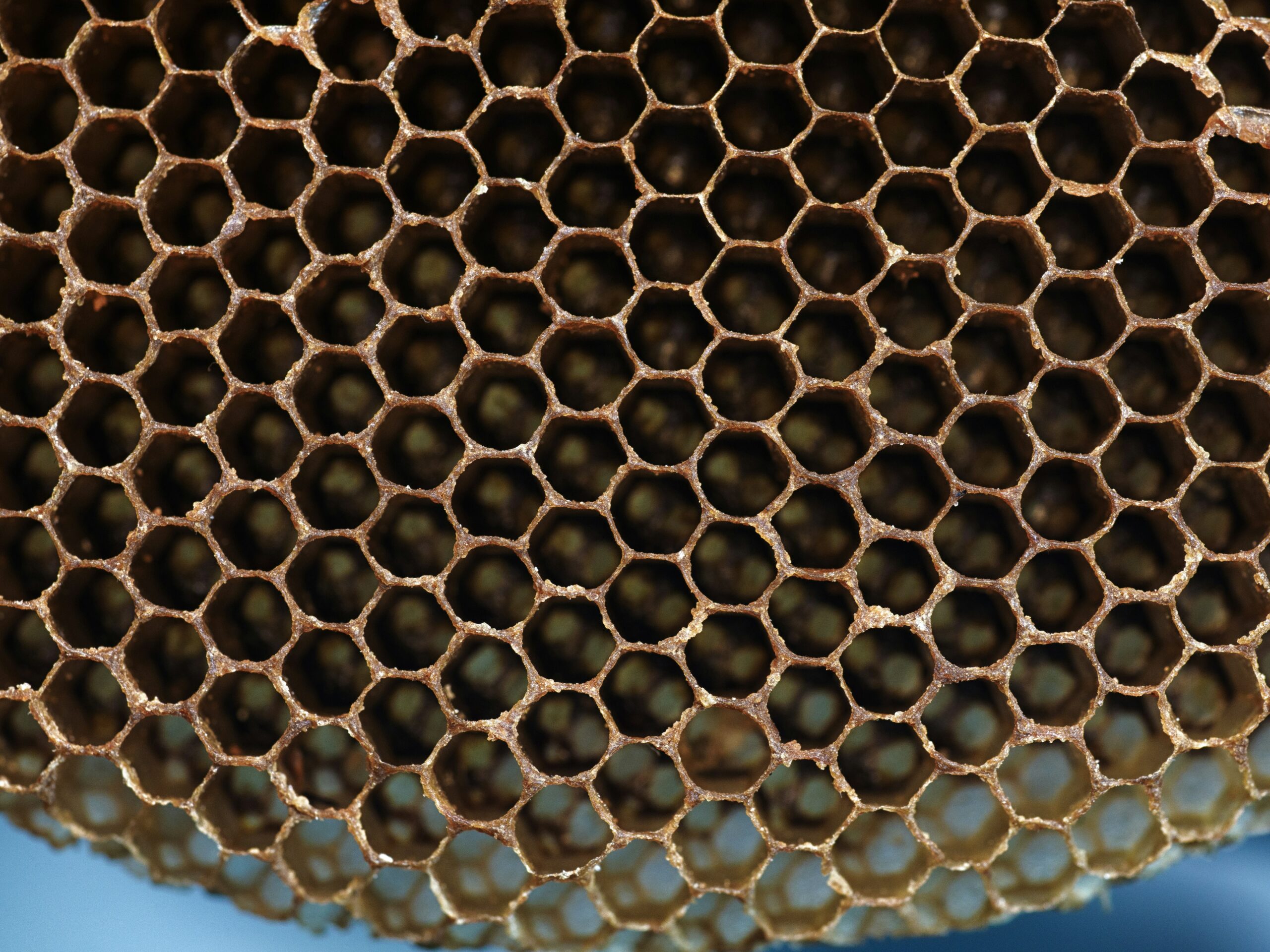
Low Density Cores (28–60 kg/m³): Use Cases and Risks
Cores below 60 kg/m³ are structural liabilities in vehicle manufacturing. We specify them only for non-load-bearing applications where weight savings justify the compromised crush resistance.
Where Low-Density Cores Actually Work
At 28–60 kg/m³, you are working with the lightest end of the aluminum honeycomb spectrum (alloy 3003, thin foil gauges between 0.025–0.05mm) or lightweight aramid (Nomex) cores at the 32–48 kg/m³ mark. These densities have legitimate use cases, but they are narrow. Our production data shows that fewer than 8% of vehicle-related inquiries legitimately require cores in this range.
The primary applications where this density performs acceptably include laser cutting beds, where the honeycomb serves as a sacrificial support surface that must allow gas passage rather than bear structural loads. Non-structural interior panels in climate-controlled environments such as cabinetry backers, ceiling tiles, and decorative partitions also function well at these densities because they experience minimal mechanical stress and stable environmental conditions.
- Laser cutting beds: Aluminum honeycomb at 28–40 kg/m³ with large cell sizes (12.7–19.1mm) allows efficient fume extraction and debris clearance.
- Interior non-structural panels: Aramid cores at 32–48 kg/m³ provide adequate stiffness for wall cladding in controlled environments.
- Prototyping and mockups: Where dimensional accuracy matters more than mechanical performance during short-term design validation.
Structural Risks: Crush Failure and Delamination
The fundamental problem with cores below 60 kg/m³ is inadequate compressive strength. To put specific numbers on this: aluminum honeycomb at 28 kg/m³ (1.8 lb/ft³) typically delivers a compressive strength of approximately 0.25–0.40 MPa. Compare that against our standard PP honeycomb at 80 kg/m³, which delivers 0.8–1.2 MPa. That is a 3× reduction in crush resistance for less than a 3× reduction in density. The strength-to-density curve is not linear. It drops off aggressively below 60 kg/m³.
Point loads are the silent killer. A technician stepping on a panel during assembly, a tool dropped from bench height, or a mounting bracket torqued to standard specs: all of these create localized loads that exceed the crush strength of low-density cores. The facing sheets deflect into the core cells, permanently deforming the honeycomb structure. Once crushed, the core provides zero local shear transfer, creating a permanent soft spot that cannot be repaired.
Delamination risk increases dramatically when low-density cores are paired with thin skins. At 28–40 kg/m³, the core’s surface area available for bonding is identical to higher densities (same cell geometry), but the foil or substrate is so thin that it lacks the rigidity to maintain flat contact with the adhesive during cure.
Our testing shows that peel strength drops by 35–50% when bonding 0.5mm aluminum skins to 28 kg/m³ aluminum core versus 80 kg/m³ core, using identical resin systems and press cycles.
Why Vehicle OEMs Should Avoid This Density Range
In 15 years of supplying composite panels to RV, truck body, and marine manufacturers across 50+ countries, we have seen the same failure pattern repeat. An engineering team specifies a 40 kg/m³ aluminum honeycomb to hit an aggressive weight target. Lab testing on flat coupon samples passes. The panels ship. Six months into production, field failures start accumulating, not from design loads but from handling, assembly torque, and incidental contact that the core simply cannot absorb.
The cost “savings” from reduced weight per square meter evaporate when you factor in warranty claims, assembly line rework rates, and the engineering hours spent investigating field failures. One European RV manufacturer we worked with had specified a 36 kg/m³ aluminum core for interior furniture panels.
Within a single production season, they reported a 12% defect rate from localized crushing during cabinet hardware installation. We re-engineered the panels using PP honeycomb at 80 kg/m³. Panel weight increased by 1.4 kg/m², but the defect rate dropped below 0.5%. The net cost saving from eliminated rework exceeded the raw material cost increase by a factor of four.
For vehicle applications specifically, PP honeycomb in the 60–120 kg/m³ range eliminates the corrosion risk inherent to thin-foil aluminum cores, provides 100% waterproof performance, and offers 15–30% cost savings over aluminum at equivalent panel stiffness. There is no engineering justification for going below 60 kg/m³ in structural or semi-structural vehicle panels unless the application is purely decorative and will never see mechanical load during its service life.

Medium Density Cores (60–120 kg/m³): The Vehicle Sweet Spot
Medium density cores (60–120 kg/m³) handle approximately 80% of commercial vehicle panel requirements: RV walls, truck bodies, and marine decks. Specifying outside this range means you’re either overpaying or under-engineering.
Market Coverage: Why 60–120 kg/m³ Covers 80% of Vehicle Applications
Our production data over the past 15 years shows a clear pattern. The vast majority of RV wall panels, truck body sidewalls, and marine deck assemblies require a compressive strength window between 0.4 and 1.5 MPa. PP honeycomb cores in the 60–120 kg/m³ density range hit this window consistently, which is why they dominate commercial vehicle manufacturing globally.
At these densities, PP honeycomb composited with FRP or CFRT facing sheets delivers panel stiffness equivalent to aluminum honeycomb construction at 15–30% lower material cost. That cost advantage compounds fast when you’re running a truck body line producing 50+ units per week. The weight-to-strength ratio at 80–100 kg/m³ is the engineering sweet spot: light enough to keep vehicle payload capacity high, strong enough to pass structural validation without additional reinforcement.
Where medium density cores fall short is in applications demanding fire ratings above Class B. If your spec sheet requires Class A fire resistance, PP honeycomb is not the right call regardless of density. For that, you should be evaluating aluminum honeycomb cores in the higher density ranges. It is an honest tradeoff: accept it and spec accordingly.
Compliance: Compressive Strength Thresholds for DOT-Regulated Vehicles
For truck bodies and RVs operating under DOT jurisdiction, sandwich panels must meet minimum compressive strength requirements that vary by application zone. Sidewall panels typically require a minimum of 0.4 MPa compressive strength, while flooring and structural bulkheads demand 0.8 MPa or higher. Our PP honeycomb at 80 kg/m³ consistently tests at 0.6–0.8 MPa compressive strength. At 100–120 kg/m³, you’re looking at 0.9–1.5 MPa, well above the threshold for DOT-compliant truck body panels.
The critical factor for compliance testing is not just nominal strength but batch consistency. A density tolerance of ±15%, which is the industry standard from many suppliers, means your weakest panels in a batch could test 15% below nominal compressive strength.
That margin can be the difference between passing and failing a DOT audit. Rax Panel holds PP honeycomb core density to ±5% tolerance. In practical terms, this means our 80 kg/m³ core will never ship below 76 kg/m³, keeping every panel in the batch above the minimum threshold.
- Sidewall panels (RV, truck body): 60–80 kg/m³ PP honeycomb, minimum 0.4 MPa compressive strength
- Flooring and structural panels: 80–120 kg/m³ PP honeycomb, minimum 0.8 MPa compressive strength
- Marine deck applications: 80–100 kg/m³ with waterproof FRP facing, tested per ISO 12215 for small craft construction
Manufacturer Specs: Rax Panel’s Recommended PP Honeycomb for Truck Body Panels
For standard dry freight truck body panels, we recommend PP honeycomb core at 80 kg/m³ density with 12mm cell size, laminated with 1.5mm FRP facing sheets on both sides.
This configuration produces a finished panel weighing approximately 3.8–4.2 kg/m² depending on resin system, which is 15–20% lighter than a comparable plywood-core panel and fully waterproof. The 12mm cell size balances resin uptake during lamination: large enough to keep adhesive consumption controlled, small enough to maintain uniform load distribution across the panel face.
For refrigerated truck bodies where thermal performance is critical, we shift the recommendation to 100 kg/m³ PP honeycomb or PET foam core with gelcoat-finished FRP sheets. The higher density provides better fastener retention for hardware mounting and reduces thermal bridging through the core. Cell size drops to 8mm in this configuration to minimize resin channels that could create thermal leaks.
- Dry freight truck body sidewalls: 80 kg/m³ PP honeycomb, 12mm cell size, FRP facing: cost-optimized for weight and stiffness
- Refrigerated truck body panels: 100 kg/m³ PP honeycomb or PET foam, 8mm cell size, gelcoat FRP facing: thermal and structural priority
- RV wall panels: 60–80 kg/m³ PP honeycomb, 12–19mm cell size, CFRT or FRP facing: thermoformable for curved roof profiles
All configurations are cut to vehicle-specific dimensions at our factory with ±0.5mm tolerance, eliminating secondary processing on your assembly line. Our daily production capacity exceeds 1,700 m², which means batch sizes for standard truck body panels ship in 5–7 working days for most orders. If your production line requires robotic assembly, the ±5% density tolerance ensures panel-to-panel weight consistency that keeps automated processes running without recalibration stops.
High Density Cores (120–240 kg/m³): When You Need Maximum Strength
Densities above 120 kg/m³ exist for one reason: impact survival. Specify them for load zones where compressive failure would compromise the entire structure, not as a default safety margin.
Heavy-Duty Applications at 120–240 kg/m³
In our production experience, high-density cores rarely appear in standard RV or dry freight builds. They show up in three specific scenarios where point-load failure and repeated impact are certifiable risks, not just design assumptions.
- Refrigerated truck floors: Forklift traffic and load-dropping cycles demand core compressive strength well above 1.5 MPa. Densities of 130–180 kg/m³ in aluminum honeycomb distribute point loads across a wider area, preventing localized cell collapse under the floor surface.
- Marine hull impact zones: Waterline and below-waterline sections face debris strikes, dock contact, and wave-slam loading. 5052 alloy aluminum honeycomb at 150–200 kg/m³, combined with GRP facing sheets, absorbs and dissipates impact energy that would fracture lower-density foam or PP cores.
- Structural bulkheads: Load-bearing partitions in vessel and heavy vehicle applications require shear transfer capacity that only dense honeycomb provides. Our engineers typically specify 160–220 kg/m³ when the bulkhead carries bolted equipment racks or serves as a structural frame member.
If your design does not involve one of these three scenarios, you are likely over-engineering. A 80–120 kg/m³ PP honeycomb core handles 90% of vehicle panel requirements at a fraction of the cost.
Trade-offs: Weight Penalty and Cost Escalation
Moving from a standard 80 kg/m³ core to a 200 kg/m³ core does not simply double your weight. It compounds. A panel with 200 kg/m³ aluminum honeycomb core and 1.5mm GRP skins can weigh 35–50% more than an equivalent panel using 80 kg/m³ PP honeycomb with the same skins. In vehicle manufacturing, that extra weight eats directly into payload capacity.
The cost curve is even steeper. Aluminum honeycomb at high density requires heavier gauge foil and tighter cell configurations. Raw material cost for 200 kg/m³ 5052 aluminum honeycomb runs 2.5–3× higher than 80 kg/m³ PP honeycomb per square meter. Add machining complexity: aluminum honeycomb at these densities requires diamond-tool cutting and produces abrasive wear on standard equipment.
- Weight factor: Expect a 35–50% panel weight increase when jumping from 80 kg/m³ PP to 180–200 kg/m³ aluminum core.
- Cost factor: Raw core material cost escalates 2.5–3×. Total panel landed cost typically increases 40–60%.
- Processing factor: Aluminum at these densities accelerates tool wear. Factor in higher fabrication costs and longer lead times for custom cuts.
Our recommendation: run a honest cost-benefit analysis before specifying above 150 kg/m³. If a 120 kg/m³ PP core with reinforced facing passes your crush test, use it. Save high-density aluminum for the zones that genuinely require it.
Material Limits: Aluminum Honeycomb up to 240 kg/m³
Aluminum honeycomb tops out around 240 kg/m³ (15 lb/ft³) for practical manufacturing reasons. Beyond this density, you are approaching solid plate territory where the honeycomb structure no longer delivers meaningful weight savings over solid sheet. At 240 kg/m³, cell walls are so thick that the core behaves more like perforated plate than honeycomb.
We produce aluminum honeycomb cores in both 3003 and 5052 alloy grades across the full 28–240 kg/m³ range with cell sizes from 3.2mm to 19.1mm. For densities above 180 kg/m³, we specify 5052 alloy exclusively. The higher tensile strength of 5052 provides better shear performance in heavy-load applications where 3003 would risk cell wall buckling under sustained stress.
One limitation to state clearly: we do not recommend PP honeycomb above 120 kg/m³. PP cell walls at higher densities become too rigid, losing the energy-absorption characteristic that makes polypropylene valuable in the first place. If your project requires density above 120 kg/m³, aluminum honeycomb remains the correct engineering choice, regardless of the cost difference.
Cost Analysis: Density vs Price per Square Meter
Core material accounts for 35–55% of total honeycomb panel cost. But the real price driver isn’t just the raw material. It’s the interplay between density, cell size, and resin uptake that catches most procurement teams off guard.
Core Material Cost Breakdown by Density and Type
When we quote a honeycomb sandwich panel, the core cost is the single largest variable, and it scales non-linearly with density. Our production data across thousands of vehicle panel orders shows that a PP honeycomb core at 80 kg/m³ runs approximately 15–30% cheaper than an aluminum core engineered to deliver equivalent panel stiffness.
That gap exists because aluminum requires precision foil expansion at tighter tolerances, and the raw alloy cost (typically 3003 or 5052 grade) carries a commodities-linked premium that PP simply does not.
The density range itself tells the story. PP honeycomb cores for vehicle applications sit in a practical band of 60–120 kg/m³, with compressive strengths of 0.4–1.5 MPa. Aluminum honeycomb spans an 8.5× density range, from 28 kg/m³ up to 240 kg/m³, because you can manipulate foil thickness and cell geometry far more aggressively.
Aramid (Nomex) honeycomb lands between 32 kg/m³ and 128 kg/m³, with the 48 kg/m³ commercial grade being the workhorse for non-aerospace applications. Wider density ranges mean more manufacturing steps, tighter process controls, and higher unit costs.
The Cost Curve: PP vs Aluminum vs Aramid
If you normalize cost against a PP honeycomb baseline at equivalent panel stiffness, the multiplier looks roughly like this:
- PP Honeycomb (60–120 kg/m³): Baseline cost. Thermoplastic processing, no corrosion risk, thermoformable for curved surfaces like RV roofs. Optimal for vehicle walls, flooring, and furniture panels where fire ratings above Class B are not required.
- Aluminum Honeycomb (28–240 kg/m³): 2–3× the cost of PP at equivalent stiffness. Justified when you need higher compressive strength, fire resistance, or strict dimensional stability under thermal cycling. Common in marine hull structures and high-end truck body panels.
- Aramid Honeycomb (32–128 kg/m³): 4–6× the cost of PP. Phenolic resin-coated Nomex paper delivers exceptional fire performance and fatigue resistance. Reserved for applications where both weight savings and stringent fire certification are non-negotiable.
We have seen procurement teams specify aramid cores for truck body panels where PP would have met every structural and regulatory requirement. That is a 4–6× cost premium with zero performance upside. Always match the core material to the actual engineering demand, not to an assumption that higher price means better performance.
Resin Consumption: The Hidden Cost Variable
This is the cost factor most procurement engineers overlook during initial spec selection, and it can swing total panel cost by 8–12%. During lamination, resin fills the honeycomb cells at the skin-to-core interface. Smaller cell sizes mean more cell walls per unit area, which means more surface area for resin to wet out. Our testing confirms that 3.2mm aluminum honeycomb cells absorb up to 40% more resin than 19.1mm cells at the same nominal density.
Here is what that looks like in practice. If you specify a fine-cell aluminum honeycomb (3.2mm) at 80 kg/m³ for an FRP-skinned truck body panel, the resin consumption during vacuum bagging or press lamination will be measurably higher than if you had specified a 19.1mm cell PP honeycomb at the same density. The resin cost alone can erase the perceived savings from a cheaper core. Our engineers run resin uptake calculations during the quoting phase specifically to prevent this surprise.
PP honeycomb cores are available in cell sizes from 8–19mm. For most vehicle applications, we recommend 12–19mm cells because they strike the practical balance between shear strength, resin economy, and panel flatness. Go smaller only if your design engineer can demonstrate that the compressive or shear load requirements actually demand it.
Total Panel Cost Calculation Guide
To calculate your true landed cost per square meter of honeycomb sandwich panel, you need to account for four cost layers that most initial quotations leave opaque. Use this framework when evaluating quotes from any supplier, including ours:
- Core material cost (per m²): Density × thickness × price per kg. For PP honeycomb at 80 kg/m³ and 20mm thickness, that is 1.6 kg of core per m². Multiply by your supplier’s per-kg rate.
- Facing sheet cost (per m²): Both skins combined. GRP sheets, CFRT sheets, aluminum, or ACP. Each has a fixed per-m² cost that varies with thickness and whether gelcoat is applied.
- Adhesive and resin cost (per m²): Factor in cell size. Smaller cells consume more resin. Ask your supplier for their measured resin uptake data at your specified cell size and density, not an estimate.
- Processing and yield cost: This is where density tolerance directly impacts your bottom line. A supplier quoting ±15% density tolerance is quoting a lower theoretical price per m², but their actual delivered panels will have inconsistent weight and dimensional variance. Our production line holds PP honeycomb cores to ±5% density tolerance. For a vehicle OEM running high-volume assembly, that tighter tolerance improves line yield by 3–7%, which translates to a measurable reduction in per-unit production cost that procurement rarely attributes back to the core specification.
One final note on the calculation. When comparing quotes between suppliers, normalize for density tolerance. A PP honeycomb core quoted at 80 kg/m³ with ±15% tolerance could deliver panels anywhere from 68 to 92 kg/m³. That variance affects panel weight, bonding consistency, and ultimately your assembly line reject rate.
Our engineers provide density test certificates with every production batch so your team can verify before it hits the line. If a supplier cannot or will not provide batch-specific density data, that is a reliability risk worth pricing into your calculation.
| Core Material & Density | Relative Price/m² | Key Cost Factor |
|---|---|---|
| PP Honeycomb, 60 kg/m³ | Base (Lowest) | Minimal material usage; ideal for non-structural RV furniture panels |
| PP Honeycomb, 80 kg/m³ | +12–18% over 60 kg/m³ | Optimal balance for truck body sidewalls; 15–30% cheaper than aluminum equivalent |
| PP Honeycomb, 120 kg/m³ | +35–50% over 60 kg/m³ | Maximum PP density; best for flooring and high-load vehicle applications |
| Aluminum Honeycomb, 28 kg/m³ | 2.5–3× PP at equivalent stiffness | Ultra-light aerospace grade; over-engineered for most vehicle applications |
| Aluminum Honeycomb, 130 kg/m³ | 4–6× PP at 80 kg/m³ | High crush strength; justified only where Class A fire rating is mandatory |
| Aluminum Honeycomb, 240 kg/m³ | 8–12× PP at 120 kg/m³ | Maximum density; reserved for extreme structural or ballistic applications |
| Aramid (Nomex), 48 kg/m³ | 5–8× PP at equivalent density | Commercial-grade standard; phenolic coated; best for marine and transit interiors |
| Aramid (Nomex), 128 kg/m³ | 10–15× PP at 80 kg/m³ | Premium aerospace-grade; excessive cost for standard vehicle manufacturing |
Conclusion
For 90% of the vehicle projects crossing my desk, whether RV walls, truck bodies, or marine interiors, PP honeycomb core at 80–100 kg/m³ is the right spec. You save 15–30% versus aluminum at equivalent panel stiffness, and the zero-corrosion, 100% waterproof factor eliminates an entire category of warranty claims I’ve watched competitors eat. Spec aluminum only when your application demands fire ratings above Class B. Everything else is over-engineering that blows your weight budget.
Do this before you commit: request sample panels at 80 kg/m³ and 100 kg/m³ with 12mm cell size, then run your own crush strength test against your current panel. Ask for the density tolerance certificate. If it reads ±15%, walk away. Our ±5% tolerance is the difference between panels that snap together on your assembly line and panels that don’t.
Frequently Asked Questions
How does core density affect panel strength?
Higher density honeycomb cores generally offer greater strength and stiffness, allowing them to withstand higher loads without deforming.
How does cell size impact core density?
Smaller cell sizes result in a higher density because more material is packed into a given volume, while larger cells lower the density.
What density is best for aerospace applications?
Aerospace applications generally require high-density aramid or aluminum cores to provide necessary structural integrity while keeping overall weight low.
Does core density affect insulation properties?
Yes, lower density cores with larger cell sizes trap more air, providing better thermal and acoustic insulation capabilities.
How much does honeycomb panel core typically cost?
The cost of honeycomb panel core varies based on material grade, thickness, panel dimensions, and order volume. Requesting a detailed quote with your project specifications is the most reliable way to get an accurate figure. Bulk orders typically reduce per-unit pricing significantly.