
Most engineers we talk to start exploring CFRT applications after a panel failure costs them real money. Last year, an RV manufacturer in Germany switched suppliers to save €12 per square meter on dual-GRP skins. Six months later, they recalled 340 units.
The adhesive between skins and XPS foam core had delaminated under thermal cycling, leaving walls warped and uninsulated. That €2.3M recall hurt. But the real damage was the 11-week production halt while they requalified a new supplier and scrapped 2,800 blank panels sitting in their warehouse. That’s the hidden cost no procurement spreadsheet captures.
We’ve built composite sandwich panels for 15 years at our facility, shipping to vehicle builders in 50 countries. We know where continuous fiber reinforced thermoplastic beats traditional FRP—and where it doesn’t justify the cost delta. This guide covers five specific use cases: RV walls, refrigerated truck bodies, dry freight trailers, marine hulls, and interior paneling.
Each section gives you hard numbers. Weight in kg/m². Thermal conductivity in W/m·K. Material cost per sqm. Defect rates from actual production runs. By the end, you’ll know if this material fits your production line or if you should stick with what’s already working.

What CFRT Means for Vehicle OEMs
Continuous Fiber Reinforced Thermoplastic (CFRT) gives vehicle OEMs a lighter, fully recyclable alternative to traditional FRP, eliminating adhesive failure risks while maintaining strict production tolerances.
Defining Continuous Fiber Reinforced Thermoplastic
CFRT stands for Continuous Fiber Reinforced Thermoplastic. At Rax Panel, we manufacture these sheets by combining continuous unidirectional glass fibers with a melt-processable thermoplastic matrix. Unlike chopped strand materials, continuous fibers carry structural loads across the entire length of the sheet. This specific fiber orientation allows us to produce a composite that is lighter, thinner, and tougher than standard alternatives.
We produce CFRT sheets without using adhesives during the entire manufacturing process. The thermoplastic resin melts and encapsulates the continuous fibers, resulting in a single, homogeneous material that provides consistent structural stiffness across every square meter.
CFRT vs Thermoset FRP: The Engineering Reality
When vehicle OEMs evaluate CFRT vs FRP panels weight comparison data, the structural logic immediately becomes clear. Traditional thermoset FRP relies on a chemical curing process and requires secondary adhesives to bond to core materials like XPS or PET foam. Over time, thermal cycling breaks down these glues, causing costly delamination. CFRT bypasses this flaw by fusing directly to the core without glue.
- Adhesive-free bonding: Eliminates delamination risks caused by extreme temperature swings in refrigerated truck or marine applications.
- Weight reduction: Achieves equal or greater stiffness than dual-GRP skin construction at thinner profiles, driving CFRT interior wall panels cost savings up to 20%.
- Recyclability: CFRT is fully recyclable as a thermoplastic. Thermoset FRP cannot be reprocessed, creating permanent landfill waste.
Production Line Consistency and End-of-Life Compliance
For specialized vehicle manufacturers, dimensional consistency dictates assembly line profitability. Our advanced continuous production line maintains a strict ±0.5mm thickness tolerance across a daily output exceeding 1,700 square meters. When production teams feed these panels into automated CNC routers or fastening stations, this stability prevents the misalignments and jams that halt assembly throughput.
Regulatory pressure is shifting how OEMs source materials. The EU End-of-Life Vehicle Directive demands higher recyclability rates for new vehicles. Thermoset composites pose a massive disposal liability. By adopting CFRT sandwich panels for RV walls and truck bodies now, manufacturers future-proof their designs against upcoming compliance mandates without sacrificing structural performance.
CFRT in RV Wall and Roof Systems
Replacing dual-GRP layups with CFRT sandwich panels in RV manufacturing cuts interior wall material costs by 20% and removes significant roof weight to lower the vehicle’s center of gravity.
Interior Wall Panels: Achieving a 20% Cost Reduction
Traditional RV wall construction relies on a dual-GRP (Glass Reinforced Plastic) layup, which demands intensive labor, heavy adhesives, and lengthy curing times. We manufacture CFRT (Continuous Fiber Reinforced Thermoplastic) sandwich panels using an adhesive-free continuous production process. By eliminating the adhesive layer entirely, we remove the risk of delamination during thermal cycling and significantly reduce raw material costs.
- Cost Savings: CFRT interior wall panels deliver a verified 20% material cost reduction compared to standard dual-GRP skin construction.
- Production Tolerance: We maintain a strict ±0.5mm thickness consistency, ensuring panels fit vehicle assembly jigs without costly on-site modifications.
- Throughput Speed: Our 1,700 sqm/day continuous line capacity guarantees high-volume orders ship under 15 business days for standard configurations.
For specialized vehicle manufacturers, this structural efficiency translates directly to higher assembly throughput and lower defect rates per batch, protecting your margins without sacrificing build quality.
Roof Panels: Weight-to-Strength Advantage and Lower Center of Gravity
RV roof panels dictate the vehicle’s center of gravity and overall stability. Heavy thermoset FRP or metal roofing raises the center of gravity, negatively impacting high-speed handling and fuel efficiency. CFRT sheets are inherently lighter and thinner than standard FRP, allowing OEMs to shed critical kilograms from the highest point of the vehicle.
- Weight Reduction: The high strength-to-weight ratio of CFRT directly lowers total vehicle mass, improving fuel efficiency.
- Structural Cores: We pair CFRT skins with lightweight XPS or PP honeycomb cores to achieve maximum stiffness with minimum mass.
- Handling Dynamics: Shedding roof weight drops the vehicle’s center of gravity, drastically improving lateral stability and occupant safety.
By utilizing thermoplastic composite panels for vehicle manufacturing, engineers can meet strict emissions targets and payload limits without redesigning the chassis.
Furniture and Partition Panels: Lightweight, Moisture-Resistant, and Warp-Free
RV interiors are subjected to constant humidity fluctuations and temperature extremes. Standard wood-based panels absorb ambient moisture, swell, and warp over time, leading to costly warranty claims. Our CFRT sandwich panels utilize thermoplastic matrices that naturally resist water absorption, ensuring cabinetry and partitions remain dimensionally stable over the vehicle’s lifespan.
- Moisture Resistance: Zero water absorption prevents rot, mold growth, and structural degradation in high-humidity environments.
- Dimensional Stability: Panels remain entirely warp-free across extreme thermal cycling, maintaining tight joint lines in furniture.
- Chassis Load Reduction: Significantly lighter than traditional plywood, lowering the overall base vehicle weight.
We custom-engineer these interior panels to your exact specifications. Because CFRT is fully recyclable as a thermoplastic composite, it also provides a distinct advantage for manufacturers needing to comply with tightening EU End-of-Life Vehicle Directive regulations.
CFRT in Refrigerated Truck Bodies
CFRT sandwich panels with XPS or PU foam cores deliver thermal conductivity values capable of maintaining -20°C environments in refrigerated truck bodies, while adhesive-free production eliminates delamination risk from repeated thermal cycling.
Insulation Performance: CFRT + Foam Core Thermal Data
Refrigerated truck bodies demand two things from a panel system: consistent internal temperature retention and long-term structural integrity under extreme temperature swings. CFRT sandwich panels address both simultaneously. The continuous fiber reinforced thermoplastic facing acts as a durable, waterproof skin, while the foam core dictates the thermal performance profile.
We engineer our CFRT refrigerated truck panels with two primary core options, selected based on the specific cold-chain requirement:
- XPS (Extruded Polystyrene) Core: The priority choice for maximum thermal insulation. XPS offers a closed-cell structure that provides consistent thermal conductivity values across the entire panel surface, making it suitable for deep-freeze applications maintaining -20°C internal environments.
- PU (Polyurethane) Foam Core: A cost-effective option that still delivers strong thermal insulation performance for standard refrigerated transport. PU cores are widely adopted in cold-chain logistics due to their balance of thermal resistance and structural rigidity.
A critical advantage of our CFRT sheet production is that it requires zero adhesive in the manufacturing process. The thermoplastic matrix bonds directly to the foam core during consolidation. For refrigerated truck bodies, this is not a minor feature—it is a structural necessity. Traditional adhesive-bonded panels risk delamination when subjected to continuous thermal cycling between ambient loading temperatures and sub-zero transit conditions. Adhesive-free CFRT panels remove that failure mode entirely.
Body Panel Thickness Tolerances: Production Line Consistency
In OEM truck body assembly, inconsistent panel thickness causes measurable problems: gaps in joint seals, misaligned fastener holes, and thermal bridges where the foam core thins out. These defects force line stoppages and drive up rejection rates per batch. Our continuous composite panel production line addresses this directly by maintaining a strict ±0.5mm thickness tolerance across the entire panel surface.
This level of consistency comes from the production method itself. Continuous in-line consolidation allows real-time monitoring and adjustment of panel thickness as the material moves through the line, rather than relying on batch-by-batch quality checks after the fact. For specialized vehicle manufacturers assembling refrigerated truck bodies, this means every panel in a CKD kit or bulk shipment fits the intended frame geometry without on-site modification or shimming.
Our production capacity exceeds 1,700 square meters per day on this continuous line. For standard CFRT sandwich configurations—such as CFRT facing with XPS or PU cores—lead times sit under 15 business days. This throughput enables us to support both high-volume OEM truck body programs and custom-length refrigerated trailer builds without forcing the customer into inventory commitments they do not need.
CFRT in Dry Freight and Utility Trucks
CFRT skirt and tail panels cut aerodynamic drag on dry freight trucks by up to 15%, translating to measurable fuel savings across a fleet’s lifecycle.
Skirt and Tail Panels: Aerodynamic Drag Reduction and Fuel Cost Savings
Dry freight truck operators lose significant fuel to aerodynamic drag generated by the underbody and rear turbulence zone. Side skirt panels smooth airflow along the trailer undercarriage, while tail panels (commonly called boat-tails or rear fairings) reduce the low-pressure wake behind the vehicle. Our engineers specify CFRT sandwich panels for these components because the material delivers the required stiffness at a fraction of aluminum’s weight — each skirt panel typically weighs 30-40% less than an equivalent steel solution.
The critical engineering factor here is directional fiber tunability. CFRT (Continuous Fiber Reinforced Thermoplastic) allows us to orient fibers longitudinally along the panel span where skirt panels need maximum bending resistance against road debris and wind shear. This is a distinct advantage over isotropic materials like standard FRP, which distributes fiber strength evenly in directions where it is largely wasted. For trailer skirt applications, longitudinal stiffness prevents panel deflection at highway speeds that would otherwise negate the aerodynamic benefit.
Our manufacturing process produces these panels without adhesive between the CFRT skin and core. Traditional bonded panels risk delamination when subjected to repeated thermal cycling — daytime highway temperatures followed by overnight cold. Adhesive-free thermoplastic bonding eliminates that failure mode entirely, which directly reduces warranty claims for fleet operators. Available core configurations for skirt and tail panels include:
- PET Foam Core: Best balance of structural stiffness and impact resistance for side skirts exposed to road debris.
- PP Honeycomb Core: Minimum weight option for tail fairings where mass reduction is the priority and impact exposure is lower.
- XPS Foam Core: Added thermal insulation value for trailers carrying temperature-sensitive goods in the cargo zone behind fairings.
Production tolerance matters for aerodynamic components. Gaps between skirt panels and the trailer underbody create turbulence that undermines fuel savings. Our continuous production line maintains ±0.5mm thickness consistency, ensuring flat, predictable panels that mount flush on the first attempt — no shimming or field modification during assembly. With daily output exceeding 1,700 square meters, we can supply full skirt and tail panel kits for fleet-level orders within 15 business days for standard CFRT sandwich configurations.
Anti-Slip Flooring Options: Load-Bearing Capacity and Surface Texture
Dry freight and utility truck floors face a different engineering challenge: concentrated point loads from pallet jacks, forklift entry, and shifting cargo. The flooring panel must resist localized denting while providing enough surface grip to prevent load movement during braking and cornering. We manufacture anti-skip flooring solutions using CFRT and GRP facing skins bonded to high-density core materials, with surface textures engineered for specific coefficient-of-friction requirements.
Our anti-skid honeycomb panels — specifically PP honeycomb core composited with fiberglass sheet — deliver the highest strength-to-weight ratio in our flooring portfolio. The PP honeycomb structure distributes point loads across a wide area, preventing permanent deformation even under concentrated forklift wheel loads. Compared to traditional plywood flooring that absorbs moisture and rots from the inside, the closed-cell honeycomb structure is waterproof and dimensionally stable across the vehicle’s service life.
Surface texture options are not one-size-fits-all. Our engineering team works with vehicle OEMs to specify the correct texture pattern based on the cargo profile and operational environment:
- Diamond Plate Texture: Raised pattern for general dry freight applications. Provides reliable grip for boxed and palletized cargo without being aggressive enough to damage packaging.
- Coarse Grit-Integrated Surface: Fine aggregate embedded in the CFRT or GRP skin during production. Used for utility trucks carrying loose equipment, tools, or drums that shift during transport.
- Smooth Gelcoat Finish: Selected for refrigerated truck flooring where hygiene and cleanability are prioritized over maximum grip. Compatible with CFRT XPS foam core panels maintaining -20°C environments.
From a cost standpoint, CFRT interior flooring panels save approximately 20% in material costs compared to dual-GRP skin construction, based on our analysis of competitor application data.
The thermoplastic matrix is also fully recyclable — an increasingly relevant factor for OEMs exporting to jurisdictions governed by the EU End-of-Life Vehicle Directive, where thermoset FRP panels cannot be reprocessed and incur higher disposal costs. We customize panel dimensions via CNC cutting to match exact truck body specifications, eliminating on-site trimming and reducing assembly throughput delays.

CFRT in Marine Vessel Structures
Marine environments punish subpar materials with relentless saltwater corrosion and structural fatigue. CFRT sandwich panels engineered with PVC closed-cell foam cores deliver absolute moisture impermeability while slashing hull weight.
Hull and Deck Sandwich Panels: Saltwater Corrosion Resistance and Closed-Cell Foam Cores
Saltwater destroys traditional steel and aluminum framing through galvanic corrosion, and it rots wooden cores. When we engineer CFRT marine vessel structural panels, the primary objective is total moisture isolation. Continuous fiber reinforced thermoplastic (CFRT) skins are inherently non-porous, eliminating the micro-cracking issues standard thermoset FRP faces after years of UV exposure and wave impact.
For hull and deck structures, the core material dictates long-term survivability. We manufacture marine panels using closed-cell PVC foam cores specifically rated for saline environments. Unlike open-cell structures, closed-cell PVC physically prevents water migration, meaning a localized puncture will not spread rot throughout the hull. We also produce these CFRT sheets using an entirely adhesive-free continuous production process. By removing the adhesive layer, we eliminate the primary risk of delamination during extreme thermal cycling on open water.
- PVC Foam Core: Provides optimal structural stiffness and zero water absorption for underwater and salt-exposed surfaces.
- Adhesive-Free Bonding: Continuous fiber integration removes glue layers, neutralizing the risk of salt-induced adhesive failure.
- Thermoplastic Resilience: CFRT facings withstand repeated impact stress without permanent deformation or cracking.
Cabin and Bulkhead Interiors: Fire Resistance and Payload Capacity Improvements
Inside the vessel, every kilogram of material dictates your payload limit. Standard dual-GRP skin construction is needlessly heavy, directly reducing cargo capacity or passenger count. Our CFRT interior wall panels generate a documented 20% material cost savings compared to dual-GRP setups, but the true metric for vessel OEMs is the weight-to-strength ratio. Lighter bulkheads lower the vessel’s center of gravity, improving stability without sacrificing internal volume.
Fire safety in confined marine cabins is a strict regulatory bottleneck. Bulkhead materials must resist ignition and limit flame spread. Because our thermoplastic composite panels are manufactured under strict ISO-compliant parameters, they are engineered to meet international marine fire safety thresholds. The material chars predictably rather than dripping or releasing highly toxic fumes, providing crucial evacuation time.
Consistency during the assembly phase is just as critical as the material specs. Shipyard assembly lines cannot afford to halt production because panels are out of alignment. Our continuous production line maintains a strict ±0.5mm thickness tolerance across the entire CFRT sheet. This precision allows OEMs to fit cabin modules and bulkheads directly onto the vessel frame without costly on-site modifications or forced alignments.
CFRT vs Traditional GRP/FRP: Direct Comparison
CFRT sandwich panels deliver up to 20% material cost savings over dual-GRP skin construction, eliminate adhesive-based delamination risk entirely, and are fully recyclable — a critical advantage as EU End-of-Life Vehicle Directive compliance tightens through 2026 and beyond.
Weight, Thermal Conductivity, and Recyclability
The core difference between CFRT (Continuous Fiber Reinforced Thermoplastic) and traditional GRP/FRP comes down to the matrix resin. CFRT uses a thermoplastic matrix that can be heated, formed, and reprocessed. Traditional FRP uses a thermoset resin that cures permanently. This single distinction drives the weight, recyclability, and long-term performance gap between the two materials.
On weight, CFRT sheets are inherently lighter and thinner than equivalent-strength GRP laminates. Our CFRT facing sheets achieve comparable structural performance at lower grammage, which directly reduces vehicle mass. For RV manufacturers tracking fuel efficiency improvements, this weight delta per square meter compounds quickly across an entire wall or roofing assembly. In our production data, switching from dual-GRP skins to CFRT facings on XPS core panels yields measurable weight reductions without sacrificing flexural rigidity.
Thermal performance depends primarily on the core material — not the facing. Both CFRT and GRP panels paired with XPS or PU foam cores provide thermal conductivity values suitable for refrigerated truck insulation maintaining -20°C environments.
The facing material’s contribution to overall thermal resistance is minimal compared to the core. Where CFRT gains an edge is in the consistency of the bond: because CFRT is produced without adhesive, there are no thermal bridges created by uneven resin distribution or adhesive voids.
- Weight: CFRT facings are lighter and thinner than equivalent GRP skins at comparable stiffness ratings.
- Thermal Conductivity: Governed by core selection (XPS, PU, PET, PVC). Both CFRT and GRP panels achieve -20°C insulation targets when paired with appropriate foam cores.
- Recyclability: CFRT is fully recyclable as a thermoplastic composite. Thermoset FRP cannot be reprocessed and typically ends up in landfill or energy recovery.
The recyclability point is no longer theoretical. European OEMs are actively scoring suppliers on circular economy compliance. Thermoplastic composites align with these mandates. Thermoset FRP does not. For exporters serving EU markets, this distinction will increasingly affect procurement decisions.
Production Methods: Adhesive-Free vs. Resin-Bonded
Traditional GRP sandwich panels are assembled using liquid resin systems — either polyester, vinyl ester, or epoxy — applied in a wet layup or infusion process. The resin bonds the fiberglass facing to the core material through chemical curing. This process works, but it introduces variables: resin viscosity, cure temperature, humidity, and operator technique all affect final panel quality.
CFRT production is fundamentally different. Our CFRT sheets are produced without adhesive in the entire process. The thermoplastic matrix is heated and consolidated under pressure directly onto the core material. There is no separate bonding agent. This eliminates the primary failure mode we see in field returns from GRP panels: delamination caused by adhesive breakdown under thermal cycling.
In practical terms, a refrigerated truck body operating between -20°C cargo temperatures and +40°C ambient exterior temperatures experiences thousands of thermal cycles over its service life. Each cycle stresses the adhesive bond line in a GRP panel. CFRT panels have no bond line to degrade. The facing and core are thermally fused into a monolithic structure.
Our continuous production line maintains ±0.5mm thickness consistency across a daily output exceeding 1,700 square meters. This tolerance control is easier to achieve with adhesive-free thermoplastic processing than with variable-resin wet layup, where thickness can fluctuate based on resin uptake and cure shrinkage.
Cost Delta and Expected Lifespan by Application
Raw material cost per square meter for CFRT facings is generally higher than basic GRP laminates at the point of purchase. However, the total system cost tells a different story. CFRT interior wall panels save 20% material cost versus dual-GRP skin construction in RV bodies when you factor in eliminated adhesive consumables, reduced scrap rates, and faster assembly throughput.
- RV Walls and Roofing: CFRT over PET or PP honeycomb core. Expected lifespan: 15–20 years. Primary cost driver is facing gauge thickness, not core material. Weight savings of 15–25% versus GRP-honeycomb equivalents translate to fuel efficiency improvements over the vehicle’s service life.
- Refrigerated Truck Bodies: CFRT over XPS or PU foam core. Expected lifespan: 10–15 years under continuous thermal cycling. The adhesive-free bond eliminates the delamination failures that force premature panel replacement in GRP-based truck bodies.
- Marine Vessel Panels: CFRT over PVC foam core. Expected lifespan: 20+ years with proper gelcoat finish. PVC core provides superior closed-cell water resistance. CFRT’s recyclability is a significant advantage for vessel builders facing end-of-life disposal regulations.
- Dry Freight Truck Bodies: CFRT over PET foam core for structural stiffness. Cost-effective solution where thermal insulation is secondary to impact resistance and load-bearing capacity.
The cost equation also shifts when you account for defect rates. GRP panels produced via wet layup carry inherent variability — voids, dry spots, uneven resin distribution. These defects may not surface until the panel is in service. CFRT’s continuous thermoplastic process produces more consistent output, reducing the defect rate per batch and the associated warranty and replacement costs that erode manufacturer margins.
For standard CFRT sandwich configurations, we maintain lead times under 15 business days. This production reliability allows OEMs to schedule assembly runs with confidence rather than stockpiling buffer inventory against supplier delays — another hidden cost that GRP’s longer cure times and batch-dependent quality often impose on production planning.
| Performance Property | CFRT Sandwich Panel | Traditional GRP/FRP | OEM Impact |
|---|---|---|---|
| Weight per Square Meter | Lighter — thinner facing achieves equivalent stiffness; 20% material cost savings vs dual-GRP skins | Heavier — thicker resin-rich skins required for structural parity | Directly reduces vehicle mass, improving fuel efficiency and increasing payload capacity |
| Delamination Risk Under Thermal Cycling | Zero adhesive in production process — continuous fiber reinforced thermoplastic bonds without glue layers | Adhesive-bonded skins vulnerable to separation under repeated freeze-thaw and heat cycling | Eliminates field warranty claims and batch rejections caused by skin-core separation |
| Recyclability & Regulatory Compliance | Fully recyclable thermoplastic — reprocessable at end of service life | Thermoset resin cannot be reprocessed — landfill or incineration only | Meets EU End-of-Life Vehicle Directive requirements; future-proofs procurement strategy |
| Thickness Tolerance Consistency | ±0.5mm across full panel width on continuous production line (1,700+ sqm/day capacity) | Wider tolerance variance due to manual layup or batch curing variability | Ensures assembly-line fit precision; eliminates stoppages caused by out-of-spec panels |
| Thermal Insulation (XPS/PU Core Configurations) | Maintains -20°C environments in refrigerated truck bodies; W/m·K values tuned via XPS, PET, PU, or PVC core selection | Comparable core options available, but heavier skins add weight without improving insulation value | Achieves target R-value with lower total panel weight — critical for reefer fuel cost reduction |
| Directional Property Tunability (Fiber Orientation) | Fiber orientation engineered directionally — longitudinal stiffness for truck skirts, isotropic stability for RV walls | Generally quasi-isotropic or random fiber orientation; limited directional optimization | Material properties tailored to exact load paths; avoids over-engineering and excess weight |
| Surface Finish & Waterproofing | Smooth, flat thermoplastic surface inherently waterproof — no gelcoat layer required | Requires gelcoat for waterproofing, insulation, and surface flatness — adds weight and curing time | Fewer production steps, simpler supply chain, consistent finish quality across production batches |
| Lead Time for Standard Configurations | Under 15 business days from order confirmation — continuous line manufacturing at 1,700+ sqm/day | Batch curing process extends lead times; manual layup creates bottleneck at scale | Faster production scaling for fleet orders; reduced inventory holding costs for just-in-time assembly |
How to Specify CFRT Panels for Your Build
Specifying a CFRT panel requires matching the core to the structural and thermal loads of the vehicle, while demanding ±0.5mm production tolerances and reinforced export packaging to prevent assembly line defects.
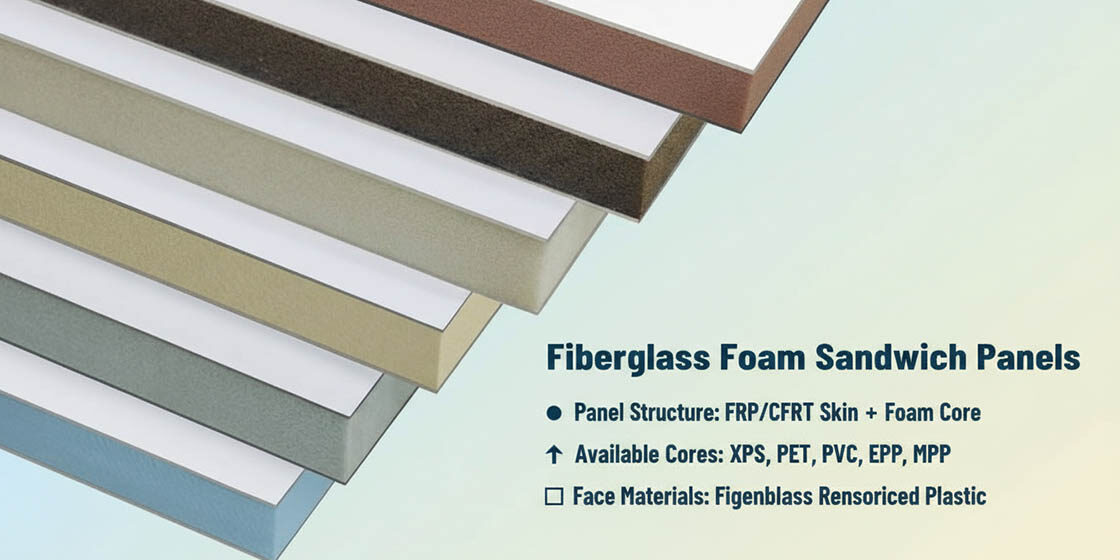
Choosing the Right Core Material (XPS, PET, PU, PVC, Honeycomb)
A continuous fiber reinforced thermoplastic (CFRT) skin provides the structural backbone, but the core dictates the panel’s functional performance in your specific build. Our engineers tune panels by selecting cores based on a strict matrix of thermal conductivity (W/m·K), shear strength, and weight targets (kg/m²). Because our CFRT sheets are produced without adhesives, the bond between the thermoplastic skin and the core eliminates the delamination risk common in traditional FRP panels under thermal cycling.
We manufacture CFRT sandwich panels with five primary core options, each optimized for distinct vehicle manufacturing requirements:
- XPS (Extruded Polystyrene): The standard for CFRT XPS foam core refrigerated truck insulation. It provides the highest thermal retention for maintaining -20°C environments in cold chain logistics.
- PET (Polyethylene Terephthalate): Delivers high structural stiffness for dry freight truck bodies and RV flooring where compressive strength and load-bearing capacity are critical.
- PU (Polyurethane): A highly cost-effective foam offering a strong balance of thermal insulation and structural support for standard continuous fiber reinforced thermoplastic truck body builds.
- PVC (Polyvinyl Chloride): Closed-cell PVC is our recommendation for CFRT marine vessel structural panels, offering unmatched resistance to water absorption and marine corrosion.
- PP Honeycomb (Polypropylene): The absolute lightest option. We use PP honeycomb cores for RV roofing and interior furniture panels where achieving maximum weight reduction per vehicle is the primary KPI.
Custom Cuts and Tolerances for Production Lines
Inconsistent material halts assembly lines. We produce thermoplastic composite panels for vehicle manufacturing with a strict thickness consistency of ±0.5mm. This predictability allows your automated routing and fastening equipment to operate without constant recalibration, driving down your defect rate per batch.
With our production line output exceeding 1,700 square meters daily, we supply exact CNC-cut panels to your CAD specifications. We do not ship raw sheets for your factory to struggle with; we deliver ready-to-install components. To ensure these precise CFRT interior wall panels survive ocean freight intact, we implement strict protective measures:
- CNC Precision: Panels are cut to match exact vehicle dimensions, fully eliminating on-site modification waste.
- Thickness Tolerance: Maintained at ±0.5mm to ensure flush joints and seamless integration on the assembly line.
- Reinforced Packaging: Panels are stacked and secured in reinforced wooden crates with integrated edge protectors and corner reinforcement to prevent bending or surface damage during international transit.
Conclusion
If you’re building 50+ vehicle units per month, spec CFRT with XPS core for refrigerated bodies and PET core for dry freight. The math is undeniable: 20% material cost savings over dual-GRP construction, zero adhesive layers to delaminate under thermal cycling, and ±0.5mm thickness consistency that keeps your assembly line moving. I’ve watched OEMs switch from traditional FRP and recover their retooling investment within the first production quarter.
Pull your current panel spec sheet right now and compare the weight per square meter against our CFRT data. If you see a gap over 15%, request a cut sample from us with your exact core and facing configuration — run it through your actual production process for one shift. Your line operators will tell you in two hours whether it works, and then we can talk specific pricing for your volume.
Frequently Asked Questions
This factor has a direct bearing on project performance and long-term cost. Addressing it with specific data rather than general assumptions leads to better outcomes.
What does CFRT mean?
CFRT stands for Continuous Fiber Reinforced Thermoplastic. It is a composite material where continuous fibers (typically glass fiber) are impregnated with a thermoplastic resin matrix. Unlike thermoset FRP, CFRT uses no adhesives in production, is fully recyclable, and can be thermoformed — making it ideal for vehicle OEMs needing consistent thickness tolerances and lower weight at comparable strength.
What does the CFRT acronym stand for?
CFRT stands for Continuous Fiber Reinforced Thermoplastic. The acronym describes the manufacturing method: continuous (not chopped) fibers are combined with a thermoplastic polymer, producing sheets that are thinner, lighter, and more resilient than traditional thermoset FRP alternatives.
How much weight does CFRT save compared to GRP panels in RV builds?
CFRT sheets are thinner and lighter than equivalent-strength GRP sheets. In RV interior wall applications, replacing the inner GRP skin with CFRT reduces material cost by approximately 20% while also lowering panel weight per square meter. Exact savings depend on core selection (XPS, PET, PU) and panel thickness specifications.
Are CFRT sandwich panels suitable for refrigerated truck insulation?
Yes. CFRT sheets combined with XPS or PU foam cores create sandwich panels with thermal conductivity values low enough to maintain -20°C environments in refrigerated truck bodies. The adhesive-free CFRT production process eliminates thermal bridging risks caused by adhesive failure under temperature cycling.
Can CFRT panels be recycled at end of life?
Unlike thermoset FRP, which cannot be reprocessed, CFRT is a thermoplastic composite and is fully recyclable. This is increasingly important for vehicle manufacturers exporting to regions with strict end-of-life material recovery regulations, such as the EU End-of-Life Vehicle Directive.