
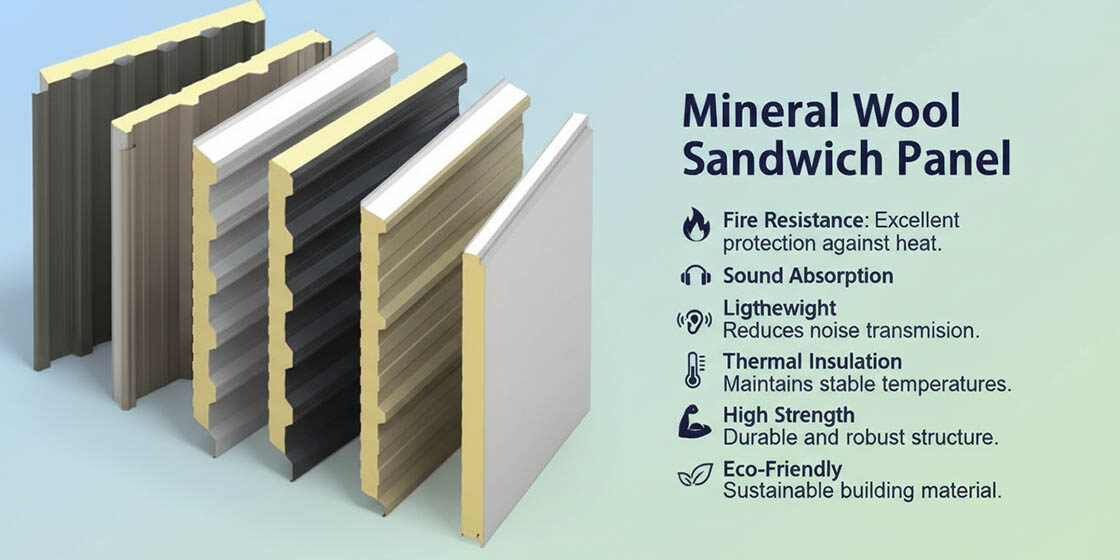
The math on a standard mineral wool sandwich panel often breaks down at the weighbridge. A quote that looks sharp on paper can still leave a 40ft container severely overweight at just 65% floor capacity, because high-density rock wool hits the weight limit long before the volume fills. When that happens, procurement teams either absorb a 20% spike in landed costs to air-freight the balance or watch delivery deadlines slip. That weight penalty catches even veteran engineers off guard.
We pulled our shipping data from the last three years to solve this exact problem. This breakdown shows you how to balance strict Class A fire compliance against your vehicle payload limits. You will see the exact rock wool panel vs foam core cost differences at varying thicknesses. We map out how core density drives your freight bills, and give you the exact formulas to calculate total landed costs before you sign the next purchase order.
Mineral Wool Panel Cost Factors
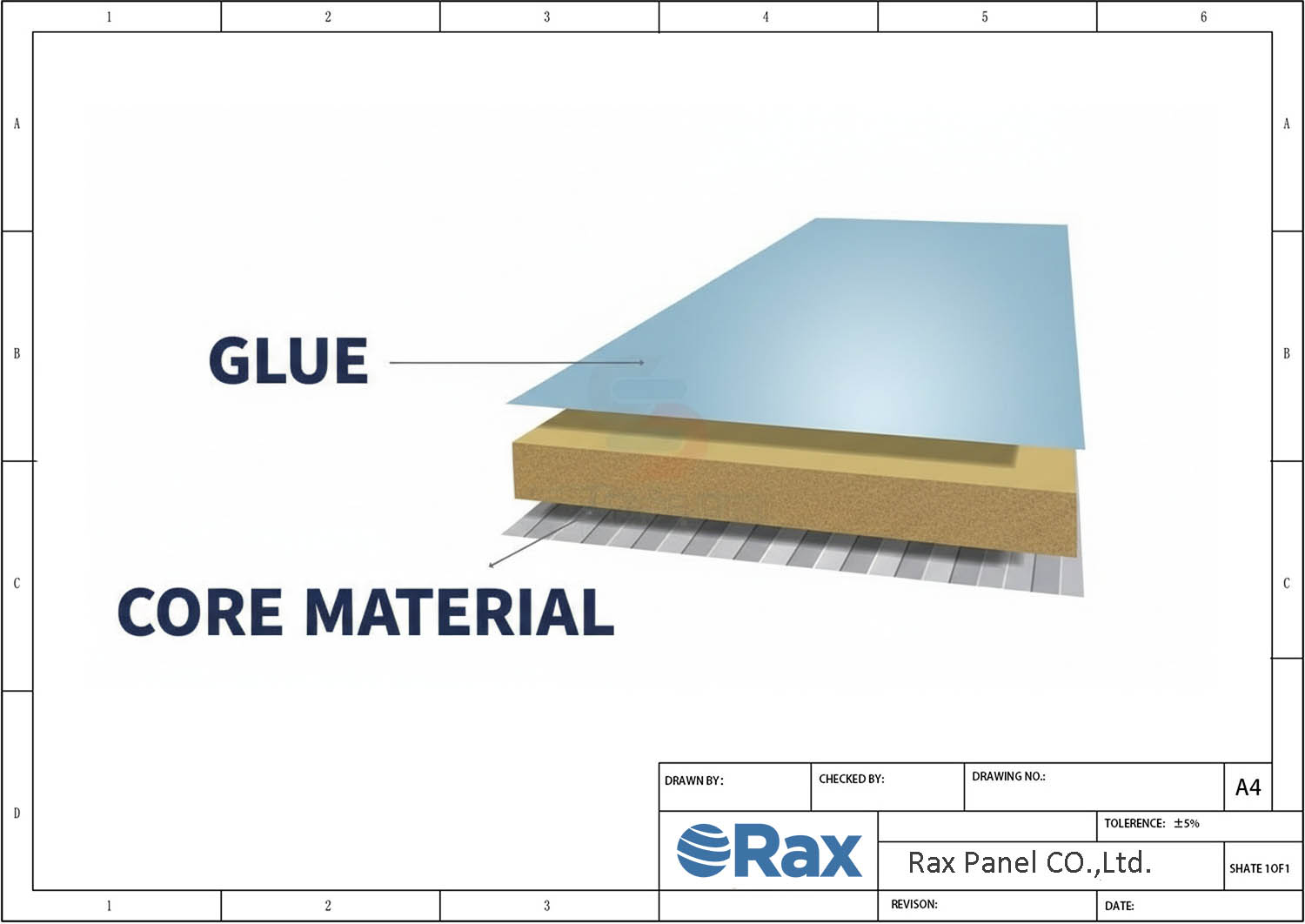
The total landed cost of a mineral wool sandwich panel is driven primarily by core density shipping penalties and precision CNC cutting requirements for fire partitions.
Core Density and Thickness
Standard mineral wool sandwich panel price per square meter shifts heavily based on core volume. Panel thickness ranges from 50mm for standard partitions up to 150mm for high-insulation thermal zones. Shifting from a 50mm to a 150mm profile alters the base material price by up to 40%.
The true cost driver for specialized vehicle OEMs is weight. Standard rock wool core density ranges from 100 kg/m³ to 150 kg/m³ to maintain structural balance and achieve a tensile strength of ≥10 kPa. Because mineral wool is significantly heavier than PIR foam, a standard 40ft container hits weight limits before reaching maximum volume capacity. This physical limitation drives up the freight cost per panel by 15 to 20 percent.
- Thickness Range: 50mm (standard) to 150mm (high insulation).
- Core Density: 100 kg/m³ to 150 kg/m³.
- Thermal Conductivity: λ ≤ 0.045 W/m·K.
Joint configuration dictates your final raw material order. Overlapping joints can consume 2 to 5 percent of the total panel width. We apply precise CNC cutting to your exact vehicle CAD drawings to maximize the useful area calculation, ensuring you do not order 5% excess material just to account for fabrication scrap.
Metal Facing Material Upgrades
Upgrading the metal facing allows you to manage the vehicle’s overall weight-to-strength ratio without compromising the Class A non-combustible fire rating of the core. Veteran buyers frequently evaluate the rock wool panel vs foam core cost dynamic, but fail to calculate the facing material’s impact on total weight. Specialized aluminum sandwich panels provide a distinct advantage here, allowing OEMs to shed critical chassis weight while maintaining structural integrity.
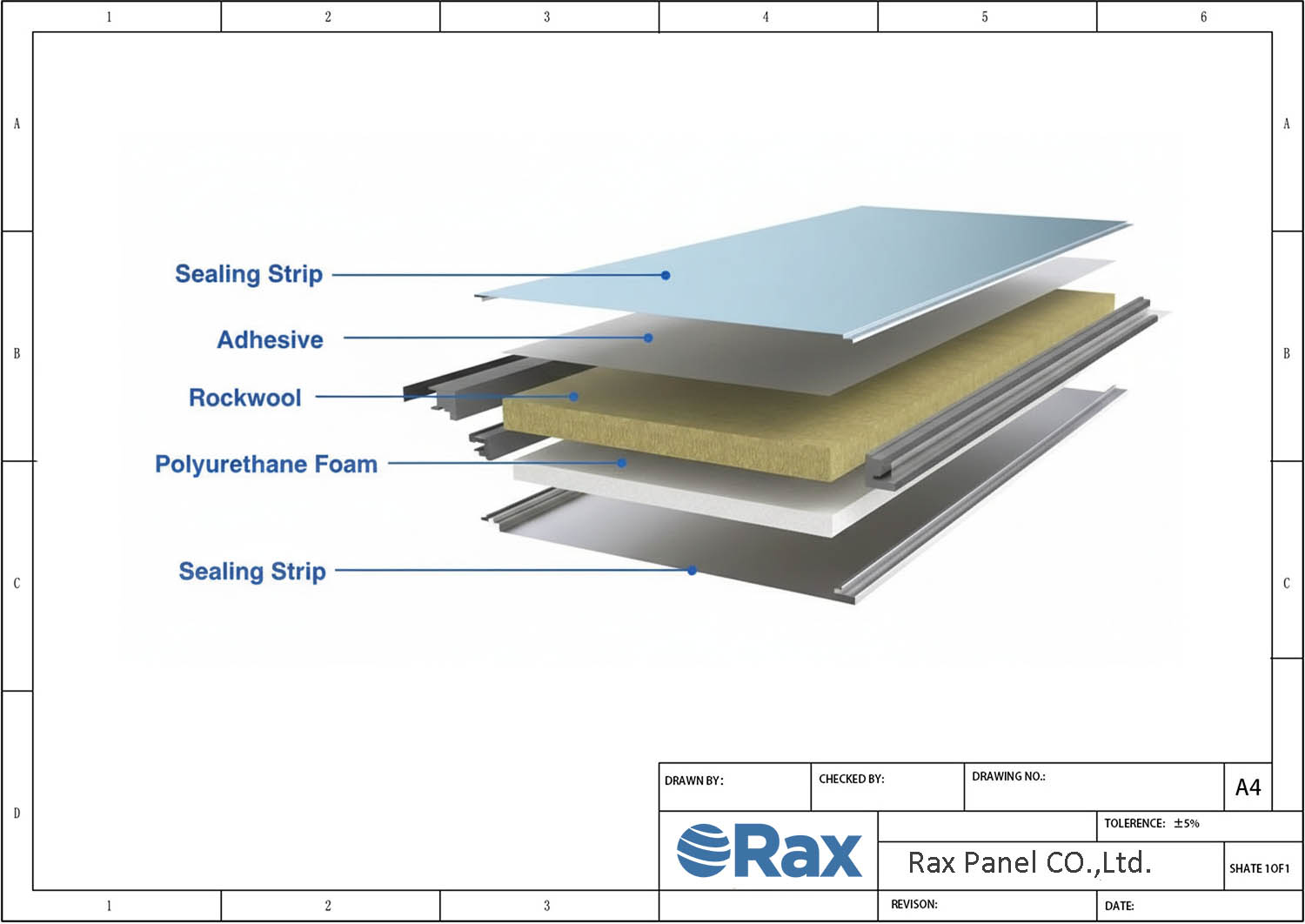
Joint systems directly influence the final processing premium of these facing upgrades. Mineral wool panels require specialized tongue-and-groove joints with PIR side sealing to prevent thermal bridging and moisture ingress. This specific fabrication step ensures a peel strength of ≥0.1 MPa between the core and metal sheets, securing long-term durability under dynamic road loads.
| Cost Factor | Parameter | Cost Impact | OEM Recommendation |
|---|---|---|---|
| Base Material & Thickness | $7 – $14 per sq ft (50mm – 150mm) | Up to 40% price variation | Optimize thickness for thermal needs without over-specifying |
| Freight & Weight Penalty | High density (100-150 kg/m³ core) | +15-20% freight cost per panel | Calculate Total Landed Cost (TCO) rather than just raw panel price |
| Joint Systems & Sealing | Specialized tongue-and-groove with PIR seal | Adds distinct processing premium | Ensure quotes include thermal-break joints to avoid hidden fees |
| Useful Area & Processing | 2-5% width loss on overlapping joints | Risk of paying for 5% unused excess material | Utilize precise CNC cutting to vehicle CAD drawings |
Mineral Wool vs. Foam Core Costs
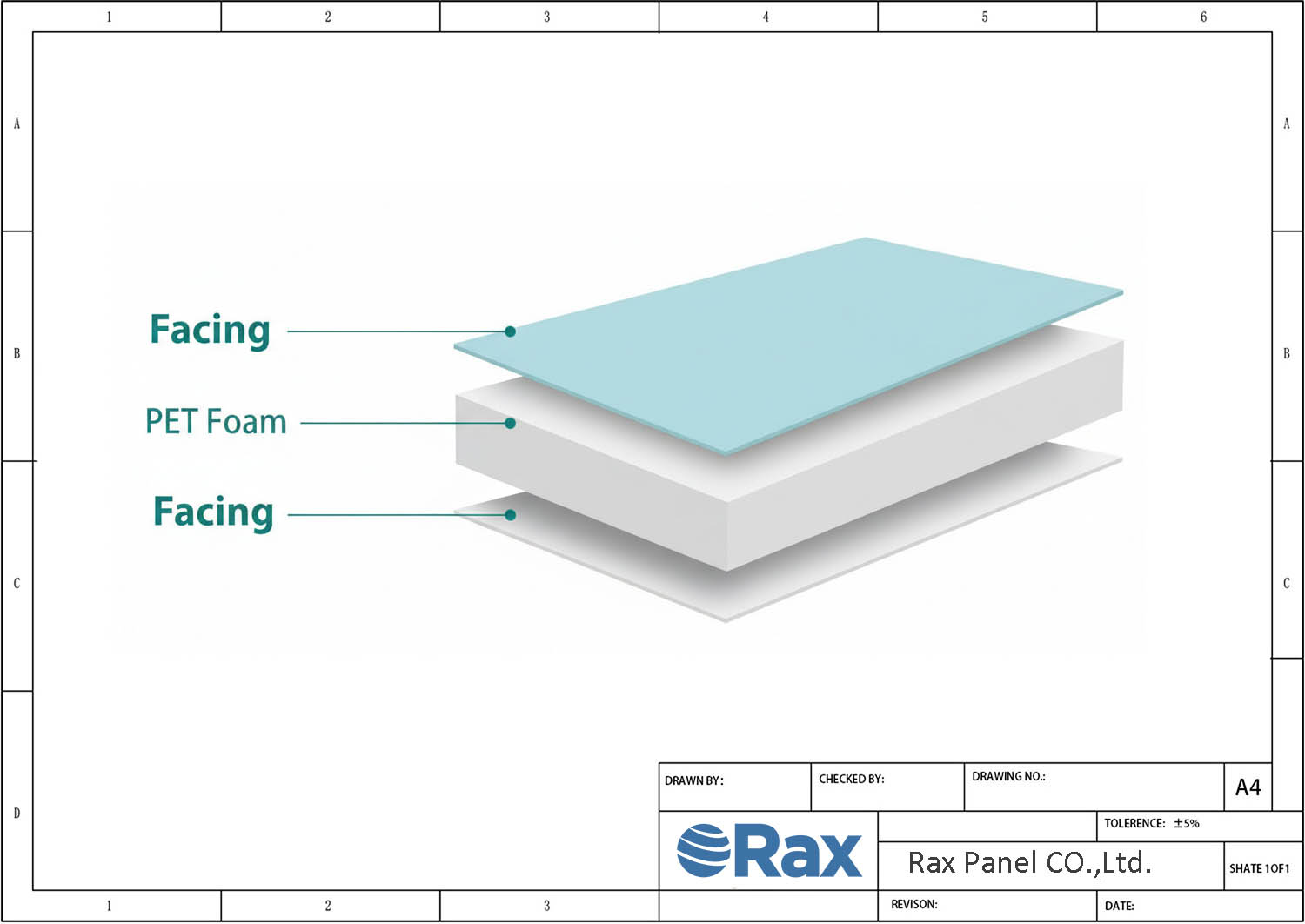
Mineral wool delivers essential Class A fire resistance for specialized vehicle partitions, but OEM procurement must calculate the total landed cost, as its higher core density drives up freight expenses by 15-20% compared to lightweight foam cores.
Fire Rating Compliance vs. Foam Core
The primary engineering justification for choosing mineral wool over standard PIR or EPS foam cores is strict regulatory compliance. While standard foam cores typically achieve a B1-level fire rating, mineral wool panels provide a definitive Class A (A-level) non-combustible fire resistance. We verify these ratings strictly against GB 8624-2012 and EN 13501-1 standards. For specialized vehicle manufacturers building fire-rated partitions, substituting foam for mineral wool is often the only viable path to passing rigorous safety inspections.
Unit Price and Material Cost Drivers
Analyzing the raw material costs, mineral wool sandwich panels typically range from $7 to $14 per square foot, heavily dependent on thickness. Panel thickness requirements generally range from 50mm for standard partitions up to 150mm for high-insulation applications. Shifting within this thickness range can alter the base material price by up to 40%.
- Price Range: $7 to $14 per square foot.
- Thickness Impact: 50mm to 150mm alters price by up to 40%.
- Joint Premium: Specialized tongue-and-groove joints with PIR side sealing add a distinct processing premium not found in basic EPS panel quotes.
Weight Per Square Meter and Freight Penalties
While competitors often highlight only the raw unit price, the true OEM cost driver is weight. Standard mineral wool core density ranges from 100 kg/m³ to 150 kg/m³ to maintain structural balance and a tensile strength of ≥10 kPa. Because mineral wool is significantly heavier than PIR foam, a standard 40ft container hits its weight limit long before it is volumetrically full. This constraint means you ship less square footage per load, driving up the freight cost per panel by 15-20%.
- Core Density: 100 kg/m³ to 150 kg/m³.
- Freight Penalty: 15-20% increase in freight cost per panel due to container weight limits.
- Thermal Conductivity: λ ≤ 0.045 W/m·K for rock wool cores.
Furthermore, precise CNC cutting to vehicle CAD drawings is critical for these heavy panels. Overlapping joints can consume 2-5% of the panel width, meaning inaccurate cutting forces you to order excess material to account for the useful area calculation.
| Cost Parameter | Mineral Wool Panel Data | Total Cost Impact |
|---|---|---|
| Base Material Price | $7 to $14 per sq ft (50mm to 150mm thickness) | Higher initial raw material cost compared to standard B1-level foam core panels |
| Freight and Weight Penalty | Standard core density of 100 kg/m³ to 150 kg/m³ | Heavier weight increases freight cost per panel by 15-20% vs. PIR foam due to container limits |
| Joint System Processing | Requires specialized tongue-and-groove joints with PIR side sealing | Adds a distinct processing premium over basic EPS quotes to prevent thermal bridging |
| Material Yield and Waste | Overlapping joints consume 2-5% of total panel width | Precise CNC custom cutting is strictly required to avoid ordering 5% excess material |
| Compliance and Insulation | Class A fire rating and thermal conductivity of λ ≤ 0.045 W/m·K | Justifies higher total landed cost by guaranteeing vehicle weight limits and strict fire code compliance |
OEM Bulk Pricing and Landed Costs
Raw panel price is irrelevant if you hit the weight limit on a 40ft container. Calculating true landed cost requires analyzing mineral wool density and joint processing premiums.
MOQ and Volume Discounts
We typically see mineral wool sandwich panel prices range from $7 to $14 per square foot. However, basing your procurement strategy purely on raw cost per square meter ignores the reality of specialized vehicle manufacturing. The thickness (ranging from 50mm standard to 150mm high insulation) alone can alter the price by up to 40%.
More importantly, the joint system dictates the actual processing premium. Mineral wool panels require specialized tongue-and-groove joints with PIR side sealing to prevent thermal bridging. This specific manufacturing step adds a distinct premium not seen in basic EPS panel quotes, but it is mandatory for maintaining Class A fire compliance and structural reliability.
- Base Pricing: $7 – $14 per sq ft, heavily dependent on core density (100 kg/m³ to 150 kg/m³) and thickness.
- Customization Premium: Precise CNC cutting to your vehicle CAD drawings prevents the 2-5% material waste caused by overlapping joints, balancing out the initial processing costs.
- Volume MOQ: A standard 40ft container serves as the baseline MOQ for optimal pricing, ensuring you secure the best rates for those specialized PIR-sealed joints.
International Freight Rates
Veteran buyers know that the true OEM cost driver is weight. Mineral wool provides Class A (A-level) non-combustible fire resistance, but it is significantly heavier than PIR foam. This means a standard 40ft container holds less square footage before hitting legal weight limits, directly driving up the freight cost per panel by 15-20%.
Our data shows that ignoring this weight penalty during the TCO analysis is a critical failure point for vehicle OEMs. While the rock wool core offers exceptional low thermal conductivity (λ ≤ 0.045 W/m·K) and a hydrophobic rate of ≥98%, its physical density means you must optimize the container payload strategically to protect your margins.
- Weight Penalty: High-density cores (up to 150 kg/m³) restrict container volume utilization, requiring precise freight forwarding calculations.
- Cost Mitigation: We recommend combining varying panel thicknesses in a single shipment to maximize the weight-to-volume ratio without exceeding transport limits.
- Specification Balance: Tensile strength (≥10 kPa) and peel strength (≥0.1 MPa) remain consistent, so we can adjust core density down to 100 kg/m³ for non-load-bearing partitions to save on freight.
| Cost Factor | Specification | Cost Impact | OEM Strategy |
|---|---|---|---|
| Base Panel Pricing | $7 to $14 per square foot | Price varies up to 40% based on chosen thickness | Optimize thickness based on exact vehicle thermal requirements |
| Panel Thickness | 50mm (Standard) to 150mm (High Insulation) | Directly increases raw material and core density costs | Balance structural needs with strict weight-to-strength ratios |
| Freight Weight Penalty | Core density of 100 to 150 kg/m³ | Increases freight cost per panel by 15-20% vs lightweight foam | Calculate freight by container weight limits rather than volume |
| Joint Processing | Tongue-and-groove with PIR side sealing | Adds a processing premium not found in basic EPS panel quotes | Account for thermal bridge prevention in total cost of ownership |
| Material Utilization | 2-5% width loss from overlapping joints | Hidden cost of paying for 5% unusable excess material | Order custom CNC cuts mapped directly to vehicle CAD drawings |
Mineral Wool Panel Specs and Compliance
For specialized vehicle OEMs, mineral wool panels are the definitive solution to achieve Class A non-combustible fire partitions without compromising structural integrity under dynamic road stresses.
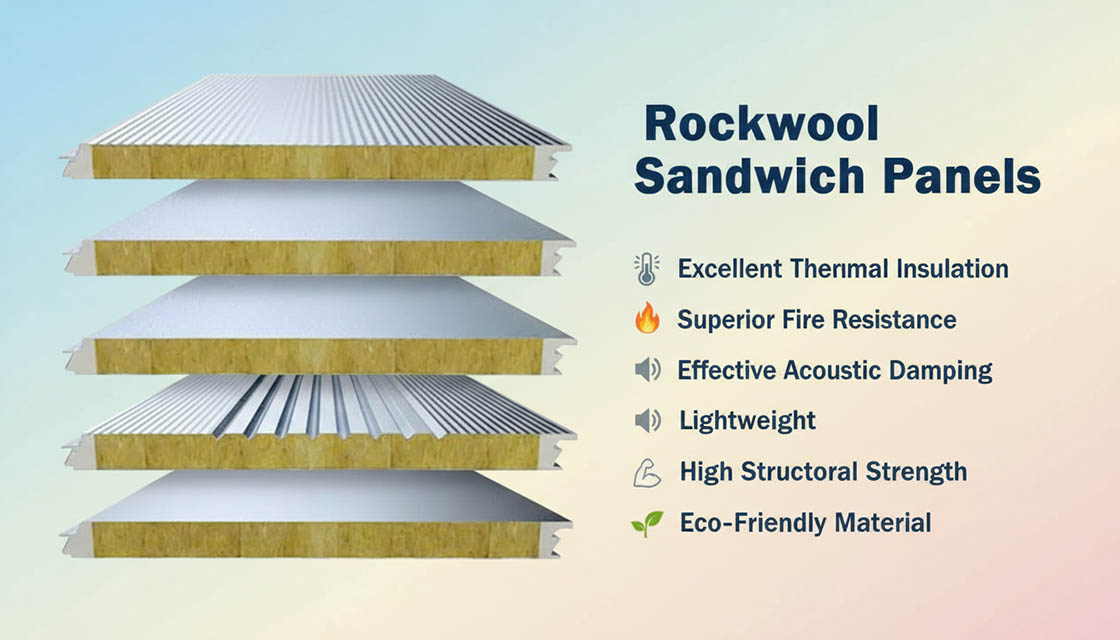
When outfitting specialized vehicles, ranging from mobile rescue units to hazardous material transport, standard B1-level foam cores rarely pass rigorous fire safety inspections. We manufacture our mineral wool sandwich panels to strictly meet Class A non-combustible requirements. This guarantees compliance with both GB 8624-2012 and EN 13501-1 fire safety standards, ensuring your vehicle designs pass exacting international audits where failure is not an option.
Achieving these fire ratings is only half the battle; the panel must survive the continuous dynamic loads of a moving vehicle. Our engineering data shows that maintaining structural reliability requires a precise balance of core density and adhesive Peel Strength to prevent delamination over the vehicle’s lifecycle.
- Fire Rating: Class A non-combustible (GB 8624-2012 / EN 13501-1)
- Hydrophobic Rate: ≥98% to prevent moisture degradation during vehicle washdowns
- Tensile Strength: ≥10 kPa for reliable structural support
- Peel Strength: ≥0.1 MPa between core and metal sheets to prevent delamination
Managing the Weight-to-Strength Ratio
We know that veteran procurement engineers are highly sensitive to the weight penalty of rock wool compared to standard foam cores. While standard mineral wool core density ranges from 100 kg/m³ to 150 kg/m³ for structural balance, pushing toward the higher end significantly impacts your vehicle’s weight limits and container shipping costs. We work directly with your CAD drawings to optimize the exact core density required, ensuring you get the mandated fire protection without unnecessarily exceeding vehicle weight limits.
Mineral Wool Panel Buyer Questions
We frequently see OEMs struggle to justify mineral wool pricing until they factor in total landed cost. Our data shows that while mineral wool guarantees Class A non-combustible compliance, its high density spikes freight costs by 15-20% compared to PIR foam.
How much does mineral wool cost per square foot?
Direct answer: Mineral wool sandwich panels typically run between $7 to $14 per square foot. However, quoting a flat rate is a trap for procurement engineers. The final price fluctuates heavily based on panel thickness (50mm standard up to 150mm for high insulation), which can alter the material price by up to 40%.
| Specification / Cost Driver | Mineral Wool Panel Data |
|---|---|
| Base Cost Range | $7 – $14 per square foot |
| Core Density (Structural Balance) | 100 kg/m³ to 150 kg/m³ |
| Thermal Conductivity | λ ≤ 0.045 W/m·K |
| Fire Rating (GB 8624-2012 / EN 13501-1) | Class A Non-combustible |
| Tensile / Peel Strength | ≥10 kPa / ≥0.1 MPa
ConclusionIf your vehicle requires strict Class A fire compliance, spec the mineral wool core and accept the 20% freight penalty as a necessary engineering trade-off. Standard PIR foam will fail the inspection. We suggest offsetting that heavy weight limit by ordering custom CNC-cut pieces to eliminate the 5% material waste from standard overlaps. Before you commit to a full order, ask your supplier for a physical corner sample of the tongue-and-groove joint. Pull it apart. If the rock wool separates from the metal facing easily, view our catalog for CNC-cut alternatives that actually meet the 0.1 MPa peel strength requirement. Frequently Asked QuestionsCost of mineral wool per square foot?The raw mineral wool core material typically ranges from $1.50 to $4.00 per square foot, depending heavily on density, thickness, and fire-resistance ratings. However, when integrated into a finished composite solution like our CFRT Sandwich Panels or specialized Aluminum Sandwich Panels, the total cost per square foot increases to account for the high-performance facings and manufacturing processes. For B2B buyers evaluating a complete system in 2026, expect the finished mineral wool sandwich panel to range between $8.00 and $18.00 per square foot. Pricing ultimately fluctuates based on raw material availability, project-specific thickness requirements, and bulk order volume. What is the cost of a sandwich panel?The cost of a sandwich panel varies significantly based on the core material, facing skins, and structural application, generally ranging from $6 to $25 per square foot. For instance, lightweight Foam Core Panels designed for standard insulation are highly cost-effective, while our premium GRP/FRP Honeycomb Panels or specialized Aluminum Sandwich Panels command a higher price due to their superior strength-to-weight ratio. In 2026, market projections indicate a slight price adjustment driven by energy costs and raw material supply chains. Buyers should request a tailored quotation to get an accurate price reflecting their specific engineering tolerances and thermal requirements. Rockwool vs. sandwich panels?Rockwool is actually a proprietary brand name for a specific type of mineral wool insulation, whereas a sandwich panel is a complete, factory-assembled composite building product. Mineral wool acts as the fire-resistant core material sandwiched between two durable outer facings, such as the high-quality skins we use in our CFRT Sandwich Panels. While Rockwool itself is a raw insulation batt or board designed for thermal and acoustic protection, a mineral wool sandwich panel provides immediate structural load-bearing capacity and instant installation readiness. Therefore, Rockwool is the essential interior component, while the sandwich panel is the comprehensive architectural solution delivered to the job site. Is mineral wool worth the extra cost?Mineral wool is unequivocally worth the extra upfront investment for commercial and industrial applications requiring stringent fire safety and acoustic control. Unlike standard Foam Core Panels, mineral wool delivers unmatched A1/A2 fire resistance, effectively preventing fire propagation and ensuring compliance with strict 2026 building codes. Furthermore, when incorporated into our specialized Aluminum Sandwich Panels, it provides exceptional dimensional stability, moisture resistance, and sound absorption that lower-cost alternatives cannot match. For B2B clients focused on long-term operational safety and lifecycle costs, the ROI on mineral wool panels rapidly justifies the initial premium. How do you calculate sandwich panel needs?Calculating the requirements for a sandwich panel begins with determining the total square footage of the surface area, factoring in a 5% to 10% allowance for architectural overlaps, cuts, and waste. Next, engineers must calculate the necessary thickness and density of the core, whether utilizing Foam Core Panels for maximum thermal insulation or GRP/FRP Honeycomb Panels for extreme structural stiffness. You then multiply the total area by the panel’s weight per unit to ensure the supporting framework can safely handle the structural load. Finally, buyers should work directly with our technical team to configure the specific joint profiles and facing materials, ensuring an accurate material and cost calculation for the entire project.
|