FRP/GRP Sheet Selection & Engineering Guide
Selecting the right FRP/GRP sheet specification involves matching resin type, fiberglass reinforcement, gelcoat finish, and sheet thickness to your structural, environmental, and aesthetic requirements. RaxPanel supplies gelcoat flat sheets and rolls for transportation, marine, and building applications.
Pro Tip: Resin Selection for Service Environment
Unsaturated polyester resin (UPR) is cost-effective for general-purpose RV and truck applications. Vinyl ester resin offers superior chemical resistance for marine and industrial environments. Epoxy resin provides the highest mechanical performance for structural and aerospace uses.
1. How to Choose the Right Resin and Fiberglass Lay-up
Resin type governs chemical resistance and thermal stability, while fiberglass reinforcement (mat, woven roving, or combination) sets tensile and flexural performance. Mat-based sheets offer good cost-to-performance for general applications; fabric-based sheets achieve higher strength and a smoother surface.
2. How to Match Thickness and Glass Content to Load Requirements
Sheet thickness, glass content, and reinforcement type work together to set mechanical performance:
| Performance Metric |
Typical Range |
Application Advantage |
| Tensile Strength |
60–150 MPa |
Comparable to steel at 1/4–1/5 the weight |
| Flexural Strength |
80–250 MPa |
High rigidity for wall and panel applications |
| Glass Content |
30%–70% by weight |
Higher content increases strength and stiffness |
| Water Absorption |
≤ 0.2% |
Excellent moisture resistance for marine use |
3. Which Gelcoat Finish Suits Your Application?
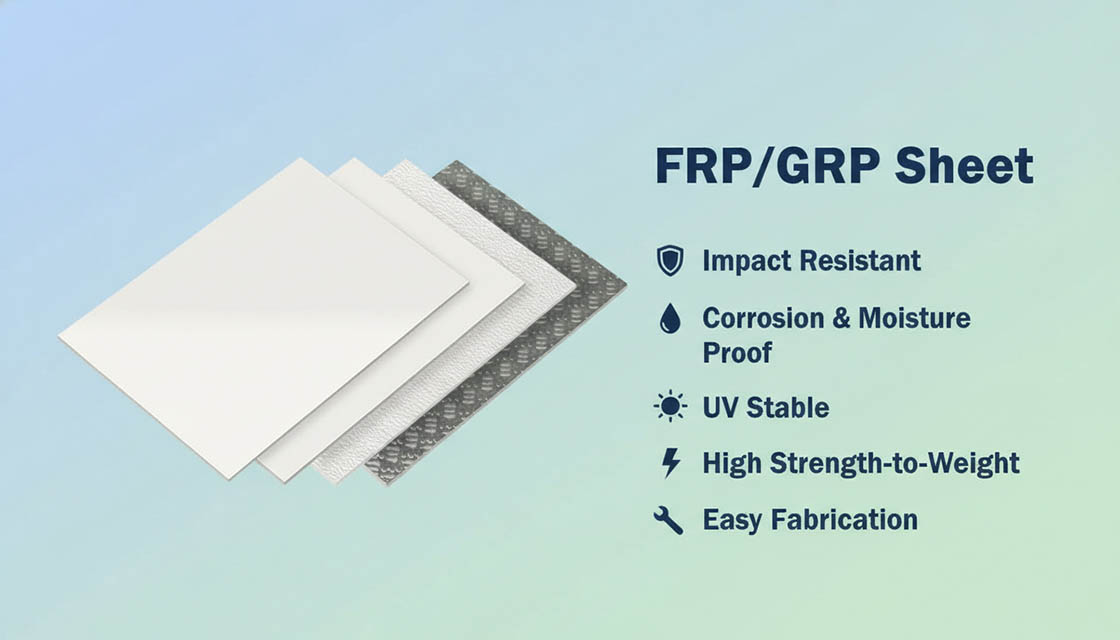
Gelcoat surfaces are available in glossy, matte, or textured patterns (stone, weave, embossed). Choose a UV-stable gelcoat with RAL color matching for exterior applications. Textured surfaces provide grip for flooring; glossy surfaces maximize aesthetics for visible RV and camper walls.
4. How to Bond FRP Sheets to Foam Cores and Substrates
Bonding Methods:
- Polyurethane Adhesive: Bonds FRP skins to PU, XPS, or PET foam cores for sandwich panel production.
- Epoxy Adhesive: Higher strength bonding for structural assemblies and metal interfaces.
- Contact Adhesive: Fast tacking for interior wall and ceiling installations.
5. Where Are FRP/GRP Sheets Most Commonly Used?
Transportation
RV and camper exterior walls, refrigerated truck and trailer bodies, dry van interiors.
Marine & Building
Boat hulls and decks, architectural wall cladding, cleanroom panels, and sanitary partitions.
6. How to Cut, Drill, and Install FRP Sheets
FRP sheets cut easily with carbide-tipped saws, circular saws, or CNC routers. Use standard drill bits for holes and chamfer edges to prevent delamination. Clean surfaces with mild detergent before bonding. Store sheets flat on pallets, away from direct sunlight.
Frequently Asked Questions (FAQS)
1. What are the standard sheet sizes and thickness options for FRP/GRP sheets?
Standard flat sheets measure 1220 mm × 2440 mm (4 × 8 ft). Roll stock is available up to 3200 mm wide and 250 m long. Thicknesses range from 0.7 mm to 5.0 mm, with thicker sheets available for specialized applications.
2. What tensile and flexural strength can FRP sheets achieve?
Depending on glass content (30%–70%) and reinforcement type, FRP sheets achieve tensile strengths of 60–150 MPa and flexural strengths of 80–250 MPa, making them competitive with metals at significantly lower weight.
3. What is the difference between mat-based and fabric-based FRP sheets?
Mat-based sheets use randomly oriented chopped strands, offering good cost-to-performance and uniform properties. Fabric-based sheets use woven roving, delivering higher tensile and flexural strength with a smoother surface finish.
4. Can FRP sheets be bonded to foam cores for sandwich panels?
Yes. FRP sheets bond well to PU, XPS, and PET foam cores using polyurethane or epoxy adhesives, creating lightweight sandwich panels for refrigerated trucks, RV walls, and modular buildings.
5. What gelcoat color and surface options are available?
Gelcoat surfaces are available in standard RAL colors with custom color matching. Finishes include high-gloss, matte, and textured patterns (stone, weave, embossed). UV-stable gelcoats provide long-term color retention for exterior use.
6. How do FRP sheets perform in marine and chemical environments?
With water absorption below 0.2% and excellent resistance to salt spray, acids, and alkalis, FRP sheets are widely used in marine hulls, chemical plant cladding, and food-processing facilities where corrosion resistance is essential.
7. How are FRP sheet shipments packaged for export?
Flat sheets are stacked with protective PE film interleaving on wooden pallets. Roll stock is wound onto cores, wrapped in film, and secured on pallets. Export packaging uses heavy-duty pallets or crates for container shipping.