Aramid Honeycomb Core Selection & Engineering Guide
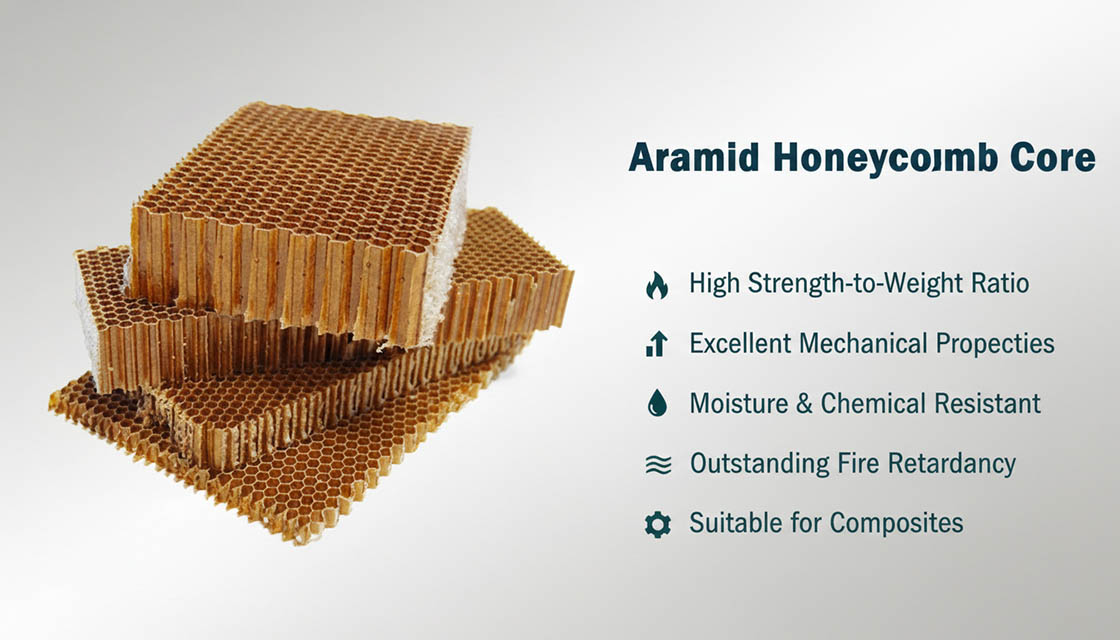
Specifying aramid honeycomb means choosing the right density, cell size, and cell configuration for the loads and geometry of your sandwich structure. The points below cover the decisions that most affect performance, weight, and cost.
💡 Pro Tip: Balance Density Against Cell Size
For a given density, a smaller cell size spreads the load over more cell walls and improves compression and buckling performance, while a larger cell saves weight and resin. Match the cell size to your skin thickness so the skin is well supported without excessive resin fill.
1. How to Select Density and Cell Size
Lower densities (29-48 kg/m³) are used where minimum weight is the priority, such as UAVs, interiors, and radomes. Medium densities (64-80 kg/m³) suit primary aircraft structures, motorsport bodies, and marine components that carry higher shear and compression. Higher densities (130-160 kg/m³) are reserved for inserts, fittings, and heavily loaded joints. Common cell sizes run from 3.2 mm (1/8″) up to 9.6 mm (3/8″).
2. Typical Mechanical Performance by Density
| Density |
Compressive Strength |
L-Dir Shear Strength |
| ~29 kg/m³ |
~0.9 MPa |
~0.5 MPa |
| ~48 kg/m³ |
~1.9 MPa |
~1.0 MPa |
| ~80 kg/m³ |
~5.1 MPa |
~1.9 MPa |
Values are indicative for standard aramid (Nomex-type) honeycomb; actual figures vary with cell size and test standard. L-direction is the ribbon direction.
3. Regular Hexagonal vs. Over-Expanded Cells
Regular hexagonal cells give the highest overall stability and are the default for flat panels. Over-expanded cells are elongated in one direction, so the core drapes and curves easily around cylindrical or contoured tooling such as radomes and fairings, with little springback.
4. Where Aramid Honeycomb Core Performs Best
✈️ Aerospace & Defense
Aircraft interiors, flooring, galleys, control surfaces, radomes, and military shelters.
🏎️ Motorsport & Marine
Racing car bodies, boat hulls and decks, rail interiors, and high-end sports equipment.
5. Machining, Forming, and Bonding
Aramid honeycomb can be cut, profiled, and contour-machined on CNC equipment. It bonds with film adhesives, epoxy, and polyurethane systems, and is compatible with prepreg, vacuum bagging, and wet lay-up. A surface scrim or filler is often used where potting compound or inserts are placed so local loads transfer cleanly into the core.
Frequently Asked Questions (FAQS)
1. What density, cell size, and thickness range is available for aramid honeycomb?
Densities typically run from 29 kg/m³ to 160 kg/m³. Common cell sizes are 3.2 mm (1/8″), 4.8 mm (3/16″), 6.4 mm (1/4″), and 9.6 mm (3/8″), with sheet dimensions up to about 2,440 mm × 1,220 mm. Thickness can be sliced to your specification.
2. What are the main engineering benefits of aramid honeycomb core?
An outstanding strength-to-weight and stiffness-to-weight ratio, good fatigue and impact performance, self-extinguishing behavior, corrosion resistance, and excellent dielectric (radome) properties.
3. Why is aramid honeycomb used for radomes and antenna structures?
Aramid paper and phenolic resin are largely transparent to electromagnetic waves, so the core minimizes signal loss and reflection. This makes it a preferred core for radomes, antennas, and radar-transparent panels.
4. What is the difference between regular hexagonal and over-expanded cells?
Regular hexagonal cells offer the highest stability for flat panels. Over-expanded cells are stretched in one direction, so the core forms and holds curved shapes (cylinders, fairings) with minimal springback.
5. Which manufacturing processes is aramid honeycomb compatible with?
Prepreg, vacuum bagging, film-adhesive bonding, and wet lay-up. The core tolerates elevated cure temperatures (typical maximum service temperature around 180°C) and bonds with most adhesives used in sandwich composites.
6. Can aramid honeycomb be machined and formed to shape?
Yes. It can be contour-machined and cut on CNC equipment, and over-expanded grades can be formed over curved tooling. Inserts and potting compounds are used where fasteners pass through the core.
7. How are aramid honeycomb sheets packed for shipping?
Honeycomb is supplied as sheets or blocks, protected and palletized for 20ft and 40ft container freight. Custom thicknesses and sheet sizes can be prepared to your drawings.