PMI Foam Core

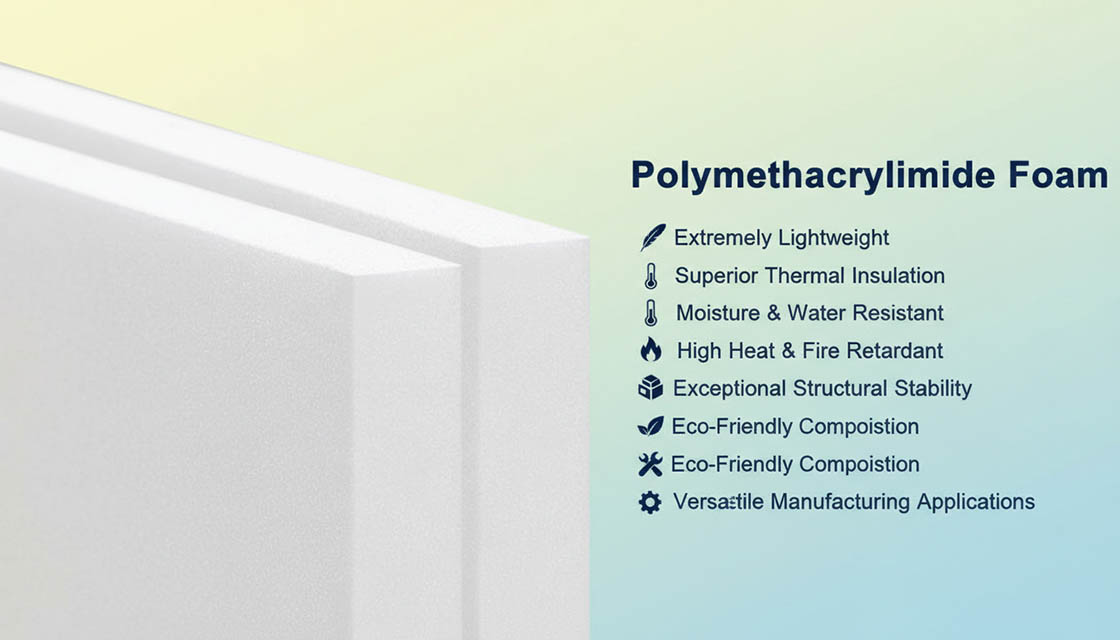
Polymethacrylimide (PMI) Foam Core features a rigid, 100% closed-cell foam used as a high-performance core material in composite sandwich structures. The uniform cell architecture provides structural stability with low density and high mechanical performance, making it ideal for weight-critical applications across aerospace, automotive, marine, and wind energy industries.

Available in densities from 30 kg/m³ to 200 kg/m³, PMI foam offers compressive strength ranging from 0.4 MPa to 10 MPa, tensile strength from 0.8 MPa to 8 MPa, and shear strength from 0.4 MPa to 5 MPa. The material maintains properties at elevated temperatures with glass transition temperatures between 130°C and 190°C, while its fine cell structure (0.1–0.3 mm) ensures low resin uptake during processing.

PMI foam demonstrates superior dimensional stability, creep resistance, and high fatigue life compared to Polyvinyl Chloride (PVC) or Polyethylene Terephthalate (PET) alternatives. The closed-cell structure provides thermal insulation and chemical resistance while supporting processing pressures up to 3 bar. Compatible with hand lay-up, vacuum bagging, Resin Transfer Molding (RTM), and prepreg methods, it can be thermoformed at 175–220°C and machined using CNC equipment for complex geometries.
Global PMI Foam Board Supplier | RaxPanel Excellence

RaxPanel supplies polymethacrylimide (PMI) foam boards for aerospace, wind energy, marine, and industrial composite applications. Our PMI foam is produced with controlled cell structure and density grading, delivering consistent mechanical performance for prepreg, RTM, and vacuum infusion processes.

Our PMI foam boards are available with:

  • Density grades from 30 kg/m³ to 200 kg/m³
  • Glass transition temperatures from 130°C to 190°C
  • Sheet sizes up to 2500 mm × 1250 mm
  • Thermoformable and CNC-machinable for complex core geometries
  • Low resin uptake due to fine, uniform cell structure

Every production batch is tested for compressive strength, shear modulus, and dimensional stability. Contact our engineering team to discuss density grade, Tg requirement, sheet dimensions, and order volume for your project.

Parameter Unit Value / Range
General Properties
Material Type Polymethacrylimide (PMI)
Cell Structure 100% Closed-Cell
Density kg/m³ 30 – 200
Maximum Sheet Size mm 2500 x 1250
Thickness Range mm 1 – 120
Typical Cell Size mm 0.1 – 0.3
Mechanical Properties
Compressive Strength MPa 0.4 – 10
Compressive Modulus MPa 20 – 500
Tensile Strength MPa 0.8 – 8
Tensile Modulus MPa 37 – 500
Elongation at Break % 2.4 – 4
Flexural Strength MPa 0.8 – 12
Shear Strength MPa 0.4 – 5
Shear Modulus MPa 14 – 300
Thermal Properties
Glass Transition Temperature °C 130 – 190
Processing & Performance
Max Processing Pressure bar 3
Compressive Creep (max) % ≤ 2.0


    This site is protected by reCAPTCHA and the Google Privacy Policy and Terms of Service apply.

    Related Products

    PMI Foam Core Selection & Engineering Guide

    Selecting the right PMI foam core specification involves matching density grade, glass transition temperature, and sheet thickness to your structural load, processing method, and service temperature requirements. RaxPanel supplies PMI foam boards for aerospace, wind energy, and high-performance composite applications.

    Pro Tip: Matching Tg to Your Curing Cycle
    Standard PMI grades have a glass transition temperature of 130°C, suitable for 120°C prepreg cure cycles. For higher-temperature curing (up to 180°C), select HT or XT grades with Tg of 180–190°C to prevent core deformation during autoclave processing.

    1. How to Choose the Right Density Grade

    Density is the primary driver of mechanical performance. Lower densities (30–60 kg/m³) suit non-structural and lightly loaded cores. Medium densities (75–110 kg/m³) balance weight and strength for most aerospace and wind applications. Higher densities (150–200 kg/m³) provide maximum compressive and shear performance for heavily loaded insert regions and leading edges.

    2. How Do Mechanical Properties Scale with Density?

    Compressive, tensile, and shear properties all increase with density:

    Property Low (30–60 kg/m³) High (150–200 kg/m³)
    Compressive Strength 0.4–0.9 MPa 6–10 MPa
    Shear Strength 0.4–0.8 MPa 3–5 MPa
    Tensile Strength 0.8–1.9 MPa 5–8 MPa

    3. Which Processing Method Suits Your Composite Process?

    Compatible Processes:

    • Prepreg Autoclave: PMI cores withstand autoclave pressures up to 3 bar and elevated cure temperatures when Tg is correctly matched.
    • Resin Transfer Molding (RTM): Fine, uniform cell structure minimizes resin uptake during injection.
    • Vacuum Infusion: Low resin absorption and excellent dimensional stability under vacuum pressure.

    4. Where Are PMI Foam Cores Most Commonly Used?

    Aerospace & Wind Energy

    Aircraft interiors, radomes, helicopter rotor blades, wind turbine shear webs and tips.

    Marine, Auto & Sport

    Racing boat hulls, automotive structural components, bicycle frames, skis, and radar antennas.

    5. How to Thermoform and Machine PMI Foam Cores

    PMI foam can be thermoformed at 175–220°C to create curved core geometries for blades and contoured parts. CNC milling, contour cutting, and edge profiling achieve tight tolerances for complex core shapes. Always pre-dry PMI foam before high-temperature processing to remove residual moisture.

    Frequently Asked Questions (FAQS)

    1. What density grades and sheet sizes are available for PMI foam cores?
    Density grades range from 30 kg/m³ to 200 kg/m³. Standard sheet sizes are up to 2500 mm × 1250 mm, with thicknesses from 1 mm to 120 mm. Custom cuts and CNC-machined contours are available on request.
    2. What compressive and shear strength can PMI foam achieve?
    Compressive strength ranges from 0.4 MPa (at 30 kg/m³) to 10 MPa (at 200 kg/m³). Shear strength ranges from 0.4 MPa to 5 MPa across the same density range, scaling proportionally with density.
    3. What is the glass transition temperature of PMI foam?
    Standard grades have a Tg of approximately 130°C. HT (high-temperature) grades reach 180°C, and XT grades up to 190°C. Select the Tg grade based on your prepreg cure temperature and autoclave cycle.
    4. How does PMI foam compare to PVC and PET foam cores?
    PMI foam offers higher specific stiffness, better creep resistance, and higher temperature stability than PVC and PET foams. It is the preferred core for aerospace prepreg and autoclave applications where dimensional accuracy under thermal and pressure loading is critical.
    5. Can PMI foam be used in autoclave prepreg processing?
    Yes. PMI foam is widely used in autoclave processing up to 3 bar and 180°C (with HT/XT grades). Its 100% closed-cell structure and fine cell size minimize resin uptake and maintain dimensional stability under cure pressure.
    6. Can PMI foam cores be thermoformed into curved shapes?
    Yes. PMI foam can be thermoformed at 175–220°C to create curved core geometries for wind blade profiles, aircraft radomes, and contoured sandwich panels. Pre-drying before thermoforming is recommended.
    7. How are PMI foam board shipments packaged for export?
    PMI foam boards are stacked flat with protective film interleaving, wrapped in PE film, and secured on wooden pallets or in export crates. Fragile or CNC-machined cores receive additional foam padding to prevent edge damage during transit.


    Sandwich Panel Manufacturer

    Custom Core & Skin • Tailored Dimensions


      This site is protected by reCAPTCHA and the Google Privacy Policy and Terms of Service apply.