LWRT Sheets Selection & Engineering Guide
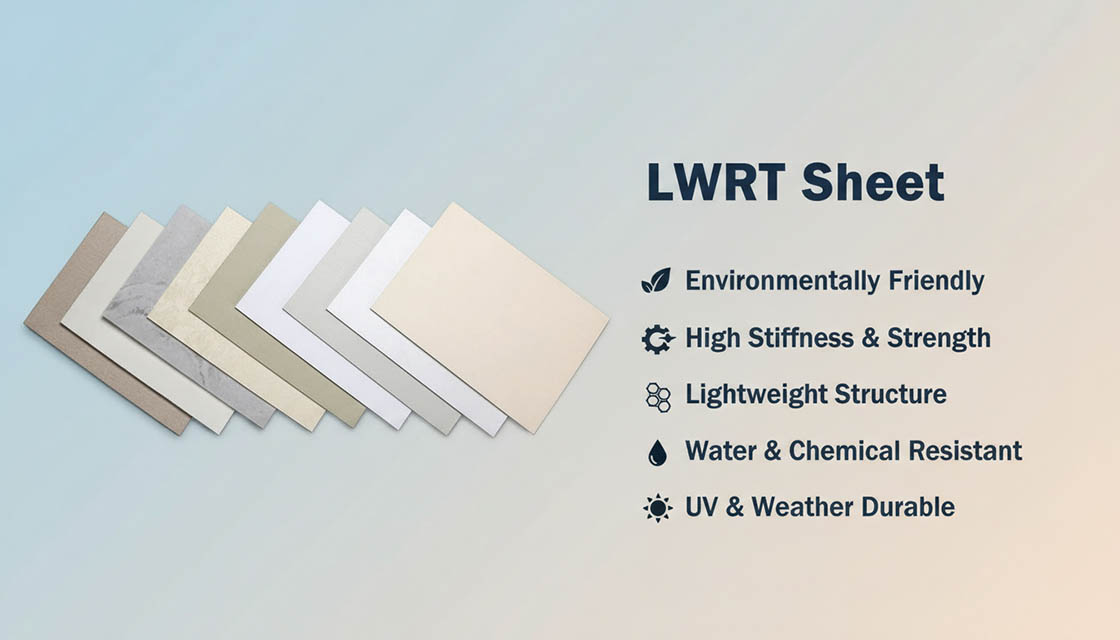
Specifying LWRT sheet is mainly about choosing the right basis weight and thickness for the target automotive part. Because the mat lofts when reheated, a thin shipping sheet can be thermoformed into a much thicker, deep-draw component, so selection depends on the finished part geometry rather than on the raw sheet alone.
💡 Pro Tip: Match Basis Weight to Lofted Thickness
LWRT expands to several times its consolidated thickness on reheating. Specifying basis weight against the finished (formable) thickness — not the shipping thickness — avoids over- or under-fill in the mold and keeps part density and stiffness on target.
1. How to Choose Basis Weight and Thickness
Basis weight (g/m²) sets how much material is available to fill the mold. Lower weights (around 900-1200 g/m²) suit thin interior trim and headliner substrates; heavier grades (1500-2600 g/m²) give the rigidity needed for load-bearing plates and underbody shields. Thickness scales with basis weight.
2. How Much Weight Does LWRT Save?
With a density of roughly 0.9-1.2 g/cm³ and a lofted porous structure, LWRT is typically 20-50% lighter than solid plastics or steel for a comparable stiffness, which directly supports vehicle weight and emissions targets.
| Basis Weight |
Sheet Thickness |
Typical Use |
| 900 – 1200 g/m² |
1.8 – 2.8 mm |
Headliner substrates, thin door trim |
| 1500 – 1900 g/m² |
3.0 – 4.0 mm |
Door panels, parcel shelves, trunk trim |
| 2200 – 2600 g/m² |
4.5 – 5.2 mm |
Underbody shields, load-bearing plates |
3. How Is LWRT Thermoformed?
The sheet is heated until the polypropylene softens and the mat lofts, then pressed in a matched-die mold. Cycle times are short, the material holds detail well, and there is little springback after molding, which suits high-volume automotive production.
4. What About Acoustics and Cabin Comfort?
The open fiber structure absorbs sound, helping attenuate road, tire, and powertrain noise. This makes LWRT effective in headliners, door trim, and trunk systems where NVH control matters alongside weight savings.
5. Where Are LWRT Sheets Most Commonly Applied?
🚗 Interior Trim
Headliners, door trim panels, parcel shelves, and pillar trim with decorative surface layers.
🔧 Underbody & Cargo
Underbody shields, wheel-arch liners, load-bearing plates, trunk liners, and engine covers.
6. Can Surface Finishes and Decorative Layers Be Applied?
Yes. Non-woven, film, or fabric decorative skins can be laminated to the LWRT core to match interior color and texture, producing a finished Class-A surface in a single press cycle.
Frequently Asked Questions (FAQS)
1. What is LWRT and how does it differ from GMT?
LWRT (Lightweight Reinforced Thermoplastic) is a lower-density member of the Glass-Mat Reinforced Thermoplastic (GMT) family, made from glass fiber and polypropylene through carding, needle punching, and hot pressing. Its loftable, porous structure gives lower density and better sound absorption than conventional solid GMT.
2. What basis weights and thicknesses are available?
Standard basis weights range from 900 to 2600 g/m², with consolidated sheet thicknesses from about 1.8 mm to 5.2 mm. On reheating the mat lofts to a much greater formable thickness, so the finished part thickness can be several times the shipping thickness.
3. How is LWRT thermoformed into parts?
The sheet is heated until the polypropylene softens and the fiber mat lofts, then pressed in a matched-die mold. The process runs in short cycles, holds mold detail well, and shows little springback, suiting high-volume automotive production.
4. How much weight does LWRT save?
With a density of about 0.9-1.2 g/cm³ and a lofted structure, LWRT is typically 20-50% lighter than solid plastics or steel for comparable stiffness, directly reducing vehicle weight.
5. Does LWRT help with cabin noise?
Yes. The open glass-fiber/PP structure naturally absorbs sound, so LWRT is effective in headliners, door trim, and trunk systems where reducing road, tire, and powertrain noise matters.
6. Can decorative surface layers be laminated to LWRT?
Yes. Non-woven, film, or fabric decorative skins can be laminated to the LWRT core to provide a finished color and texture, often produced in a single press cycle for a Class-A interior surface.
7. Is LWRT recyclable?
Yes. Because the matrix is thermoplastic polypropylene, LWRT can be reground and reprocessed, and it contains no benzene or formaldehyde, which supports cabin air-quality and end-of-life recycling goals.