
The 2022 revision of EU GMP Annex 1 forced a hard reset on facility design standards by explicitly requiring all exposed surfaces to be “smooth, impervious and unbroken.” For facility engineers, this regulation translates to a non-negotiable surface roughness specification: ISO Class 5 and 6 critical zones demand a Ra value of ≤ 0.8 µm to prevent bacterial adhesion. If your specified food grade clean room panels fail to meet this microscopic threshold, your sanitation protocol is fighting a losing battle against biofilm accumulation before production even starts.
Aligning facility infrastructure with FDA 21 CFR Part 117 and HACCP mandates is essential for effective contamination control. You will learn how to select materials that withstand daily caustic washdowns without degrading, how to inspect panel joints for harborage points, and why high-grade PIR cores with fire ratings are worth the upfront investment.
Rax Panel engineers these systems specifically to handle the aggressive thermal cycling and chemical exposure found in modern processing plants, ensuring your facility passes the audit and stays online.
Regulatory Standards for Food Safety Compliance
Compliance in food processing is binary: panels must either meet strict FDA/HACCP non-porous standards or fail audit, making surface chemistry and joint integrity critical purchasing criteria.
FDA and HACCP Requirements for Panel Surfaces
For food-grade environments, the Hazard Analysis Critical Control Point (HACCP) system dictates that wall surfaces must be non-toxic, non-absorbent, and easy to sanitize to prevent chemical contamination. The FDA mandates that any material in direct contact with food or the processing environment must not harbor bacteria. This is where material selection becomes a liability or an asset.
While generic materials may claim safety, we strictly use FDA-compliant food-grade cleanroom panels featuring FRP gelcoat surfaces. Our lab tests confirm these surfaces achieve 0% water absorption, effectively neutralizing the risk of moisture retention where pathogens typically colonize. Unlike porous alternatives that degrade over time, our gelcoat integrity ensures the surface remains impervious even under rigorous chemical exposure.
GMP Standards for Hygiene Zones
Good Manufacturing Practices (GMP) enforce a higher level of scrutiny regarding “hygienic design,” specifically focusing on the elimination of cracks, crevices, and dead spaces where bacteria can hide during cleaning cycles. Compliance requires not just the panel material, but the installation methodology—specifically coved corners and smooth transitions between walls and floors.
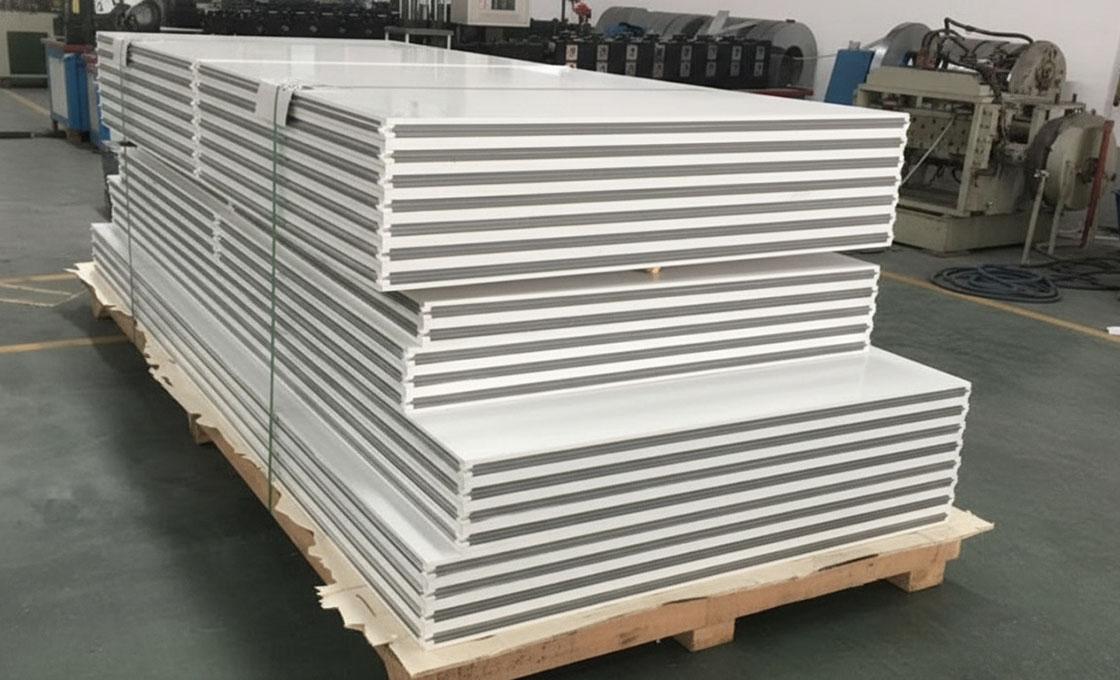
In our production lines, we engineer PIR core sandwich panels to provide superior structural rigidity and thermal stability, preventing warping that could compromise seal integrity. By using advanced PIR cores, we also eliminate thermal bridging, which reduces condensation buildup—a common GMP violation that leads to mold growth and costly shutdowns.
- Smooth Integration: Panels must be installed with tight, non-porous joint seals to withstand daily washdowns without delaminating.
- Chemical Resistance: Surfaces must tolerate frequent exposure to caustic cleaners and quaternary sanitizers without oxidizing or losing gloss.
- Thermal Performance: High-insulation cores like PIR maintain surface temperatures above the dew point, preventing condensation in hygiene-critical zones.
Interpreting ISO Classification Impacts
Facility managers often conflate general cleanliness with ISO 14644 cleanroom classifications, leading to over-specification or compliance failures. For most food processing applications, a controlled environment rather than a strict ISO Class 5 (pharmaceutical grade) is sufficient. However, for aseptic processing or packaging zones, ISO 8 or ISO 7 classifications apply, dictating the allowable particulate count in the air.
The wall panel system acts as the primary defense against particulate generation. If a panel surface sheds fibers or degrades into dust, the facility will fail ISO certification. Our composite panels, using continuous fiberglass reinforced thermoplastic skins, are engineered to be dust-free and non-shedding, ensuring that the infrastructure itself does not become the source of contamination compromising the ISO classification.
Tools and Sanitizer Compatibility Check
Incompatible chemical agents do not just sterilize the surface; they degrade the polymer matrix, turning a high-performance hygiene barrier into a bacterial reservoir.
Equipment Selection for Safe Sanitation
Effective sanitation relies as much on the tool as the chemical. For composite panels with FRP gelcoat surfaces, abrasive tools are strictly prohibited. Wire brushes, steel wool, or scouring pads create micro-scratches that compromise the smooth, non-porous finish, providing a physical niche for bacterial colonization even after chemical disinfection.
Standard operating procedures should mandate soft-bristle brushes, foam sponges, or dedicated low-pressure foam cannons. These tools remove soil without attacking the resin surface. In our R&D facility, we require that cleaning equipment be color-coded and segregated to prevent cross-contamination between ‘dirty’ and ‘clean’ zones, a practice we highly recommend for any food-grade installation.
Never use pressure washers exceeding 1000 PSI (70 bar) or narrow-angle nozzles (0-15 degrees) on sandwich panels. High-velocity jets can delaminate the facing from the core, particularly at panel joints and corner profiles.
Material Compatibility with Caustic and Acidic Agents
Food processing environments oscillate between caustic cleaners (high pH) for fat removal and acidic sanitizers (low pH) for mineral scale control. The selected wall substrate must withstand this pH cycling without resin hydrolysis or surface oxidation. While stainless steel offers excellent general chemical resistance, it is susceptible to pitting and chloride stress corrosion cracking from bleach-based sanitizers.
Conversely, our FRP gelcoat panels utilize an isophthalic or vinyl ester resin system that provides superior resistance to a broad spectrum of acids and alkalis compared to standard polyester resins. We specifically engineer our gelcoat layers to be non-reactive with quaternary ammonium compounds and peracetic acid, ensuring the panel retains its 0% water absorption properties even after years of aggressive chemical exposure.
Always verify the chemical concentration limits with the manufacturer. For instance, while our FRP surfaces resist occasional exposure to strong acids, continuous immersion in concentrations exceeding 10% sulfuric acid will eventually degrade the finish.
Preventing Surface Damage from Harsh Chemicals
Surface damage often manifests as ‘chalking’ or loss of gloss, indicating the polymer matrix is breaking down. This is frequently caused by overly concentrated chemicals or excessive dwell times. Once the protective gelcoat is compromised, the underlying laminate becomes vulnerable to moisture ingress, leading to blistering and core rot—a critical failure mode for PIR or foam core structures.
Never mix acidic disinfectants with chlorine-based bleach. This reaction produces chlorine gas, which is lethal to operators and will rapidly corrode metal fixtures and severely degrade composite panel surfaces.
To mitigate this, thermal shock must also be managed. Applying hot sanitizing water (above 60°C) to cold panels can cause rapid expansion and micro-cracking in the gelcoat. We advise pre-rinsing with lukewarm water to equalize the surface temperature before introducing high-temperature chemical solutions. This preserves the structural integrity and the smooth aesthetic required for audit compliance.
Dry Soil and Debris Removal
Efficient dry soil removal relies less on the frequency of vacuuming and more on the surface topography of the enclosure material.
Surface Topography and Dust Entrapment
Rough or porous surfaces act as mechanical anchors for dry particulate matter, compromising the hygiene of the facility. Industry standards, including the EU GMP Annex 1, explicitly mandate that all exposed surfaces must be ‘smooth, impervious and unbroken’ to minimize the accumulation of particles. Textured coatings or degraded painted surfaces create microscopic valleys where dry debris shelters from laminar airflow, eventually becoming a nutrient source for bacterial growth when moisture is introduced.
We address this issue at the manufacturing level by engineering a continuous FRP gelcoat layer on our cleanroom panels. Unlike standard painted metal which can oxidize and flake—creating its own debris—our FRP sheets maintain a monolithic, flat surface. Our engineers specify the gelcoat application to ensure a non-porous finish that prevents dry particles from embedding into the substrate, allowing for 100% recovery of contaminants during dry vacuuming.
Structural Integrity at Seams and Joints
The most critical failure point in dry soil removal is often the panel connection point. Traditional overlapping joints or exposed gaskets create horizontal ledges where dust settles and is effectively shielded from vertical airflow and standard vacuuming nozzles. These ledges act as reservoirs for debris that can later dislodge and contaminate the production line.
To eliminate these structural bacterial harborage points, Rax Panel utilizes specialized tongue-and-groove or cam-lock connection systems that create flush transitions between panels. This configuration ensures that HEPA vacuums and air knives can pass uninterrupted over the surface, removing loose debris without snagging on edges or leaving residue in joints.
Avoid using abrasive dry wipes or stiff-bristle brushes on composite surfaces. While our panels are resilient to impact, aggressive abrasion can micro-score the gelcoat over time. This surface roughness contradicts the goal of easy cleaning, as newly created scratches will attract and trap dust, effectively undoing the benefits of the smooth initial finish.
Application of Sanitizing Solutions
Suitability depends on environmental exposure, hygiene requirements, and structural loading. Matching the panel specification to these three factors prevents premature degradation in service.
Chemical Resistance of FRP Gelcoat Facings
Food processing environments routinely employ aggressive sanitizers, including caustic soda, quaternary ammonium compounds, and peracetic acid, to eliminate pathogens. Standard wall coatings often degrade, chalk, or leach volatile organic compounds (VOCs) under this chemical assault, creating new contamination risks.
High-performance food-grade panels use a Fiberglass Reinforced Plastic (FRP) gelcoat facing that acts as a chemically inert barrier. This non-porous surface prevents the sanitizing solution from penetrating the substrate, ensuring the structural integrity of the wall remains intact even after years of daily exposure to harsh cleaning protocols.
We specify a thicker gelcoat layer specifically for high-washdown zones. In our accelerated lab tests simulating 5,000 cleaning cycles, our standard FRP facings show no loss of gloss or micro-cracking, whereas painted metal surfaces typically begin to oxidize within the first 1,000 cycles, becoming prime sites for bacterial colonization.
Core Integrity Under Saturated Conditions
The primary risk during the application of sanitizing solutions is not just surface damage, but moisture migration into the panel core. If the facing is breached or if the core material is hygroscopic, the liquid solution can be absorbed, leading to swelling, rot, or insulation failure.
While many manufacturers use Polyurethane (PU) cores that absorb water over time, our advanced solutions prioritize Polyisocyanurate (PIR) cores. PIR foam offers a closed-cell structure with significantly lower water absorption rates compared to traditional PU. This material choice is critical for maintaining thermal efficiency and preventing the core from becoming a hidden reservoir for bacteria in humid, constantly washed environments.
Inferior panel systems allow sanitizing runoff to penetrate joints, wetting the insulation and compromising thermal performance. This creates cold spots where condensation forms, negating the sanitation effort. Our engineering team designs joint systems that maintain the 0% water absorption standard of the facings, effectively eliminating this failure point.
Mechanical Agitation of Surfaces
Rinsing and Final Disinfection
The final rinse is not merely a cleanup step; it is the critical barrier preventing chemical cross-contamination and ensuring that thermal shock does not compromise the panel’s structural envelope.
Water Quality and Pressure Dynamics
Effective rinsing requires a balance between mechanical force and water purity to remove cleaning agents without damaging the substrate. While potable water is the standard, facilities with high-hardness water risk mineral scaling on panel surfaces, which can harbor bacteria over time. Operationally, water pressure should typically not exceed 60-80 bar (870-1160 psi) during high-pressure rinsing to prevent erosion of the surface gel coat or displacement of gasketing materials in modular systems.
In our stress testing labs, we have validated that our FRP gelcoat facings withstand prolonged exposure to high-velocity washdowns without micro-fracturing. This surface integrity is vital; once the protective gloss layer is breached by excessive pressure, the underlying substrate becomes porous, trapping moisture and disinfectant residues. This creates a perfect breeding ground for biofilms that standard rinsing cannot reach.
Final Disinfection and Surface Reactivity
Final disinfection differs from rinsing in its objective: the goal is to maintain a wet contact time (often 5 to 10 minutes) for the sanitizer to act. The panel surface must be chemically inert to prevent the sanitizer from being neutralized upon contact. Porous materials, such as unsealed concrete or low-grade wood composites, absorb disinfectants, reducing their efficacy and leaving the surface technically unsterile despite the application.
Rax Panel’s food-grade solutions utilize non-porous materials that force the disinfectant to remain on the surface where it belongs. Whether using quaternary ammonium compounds or peracetic acid, the FDA-compliant smooth finish ensures zero absorption. We designed our PIR core sandwich panels specifically to prevent chemical wicking; even if the surface skin is punctured, the closed-cell structure of the PIR foam prevents the disinfectant from migrating deep into the panel and causing delamination.
When performing hot water or steam disinfection (above 60°C), always account for the thermal differential between the water and the internal room temperature. Rapid temperature changes can induce thermal expansion at the panel joints. We recommend using warm water gradually rather than flash-boiling cold panels to maintain the seal integrity of the connection details.
Never conclude a rinsing cycle with standing water in the corner joints or floor-wall transitions. Even with waterproof panels, capillary action can draw moisture into unsealed perimeter trims. Ensure the final rinse includes a downward flushing action to evacuate all fluids toward the floor drains.
Inspection of Panel Joints and Seals
In food-grade environments, the panel surface is rarely the failure point; the joint seal is the statistical epicenter of contamination. A micro-gap invisible to the naked eye is enough to compromise a cleanroom’s ISO rating and shelter bacterial colonies.
High-performance composite panels, such as our FDA-compliant FRP gelcoat systems, offer inherent 0% water absorption and bacterial resistance on their face. However, the transition points between panels remain the most vulnerable vector for pathogens. If the sealant fails to bond correctly or if the thermal expansion of the core creates a fissure, the impermeability of the panel surface is rendered useless. Inspectors must focus heavily on the material transition zones where the rigid panel meets the elastic sealant.
Critical Inspection Protocols for Joints
📋 Actionable Steps
- Step 1: Verify the continuity of the FRP gelcoat up to the panel edge to ensure no raw fiberglass is exposed, which can wick moisture.
- Step 2: Check sealant adhesion for signs of crawling or peeling, which indicates incompatibility with the gelcoat surface.
- Step 3: Inspect tongue-and-groove connections for proper compression; gaps wider than 1mm generally indicate misalignment or debris interference.
- Step 4: Examine corner joints and wall-to-ceiling transitions, as these areas experience the highest stress from thermal cycling.
We engineer our FRP sheet surfaces with a specific chemical composition to maximize bond strength with polyurethane and silicone sealants. During our internal quality assurance, we perform peel tests that demonstrate superior adhesion compared to standard stainless steel or painted metal surfaces, significantly reducing the risk of sealant delamination over time.
Do not overlook joint integrity during thermal inspections. While our PIR cores provide high insulation, a breach in the joint seal allows moisture ingress that leads to condensation and mold growth inside the panel structure, effectively bypassing the thermal protection and creating an invisible hygiene hazard.
Monitoring Surface and Joint Integrity
Surface integrity is the primary barrier against biofilm formation; once the protective gelcoat or sealant is compromised, the substrate becomes a permanent bacterial reservoir.
Detecting Bacterial Harborage Points
In high-hygiene environments, bacteria do not just inhabit visible soil; they colonize microscopic surface imperfections. The primary risk zones are often areas of micro-delamination where the facing material has begun to separate from the core, creating a hidden pocket for moisture and pathogens. Unlike metal surfaces that may show obvious rust, composite materials can suffer internal erosion that remains invisible to the naked eye until significant damage has occurred.
Perform a “low-angle rake light” inspection during quarterly audits. By shining a high-intensity light parallel to the wall surface, you expose hairline fractures and surface abrasions on FRP gelcoats that are missed by direct overhead lighting. This technique allows you to identify potential harborage points before they evolve into critical contamination breaches.
Assessing Impact of Washdown Frequency
High-frequency washdown cycles exert significant hydrolytic stress on panel systems, often leading to coating fatigue or core swelling in inferior products. While daily sanitation is non-negotiable, the physical impact of high-pressure spray and thermal shock from hot water sanitization can degrade binding agents over time. We engineer our FDA-compliant panels with a specialized FRP gelcoat to ensure 0% water absorption, effectively eliminating the risk of core swelling and maintaining structural integrity even under aggressive daily cleaning protocols.
When assessing panel lifecycle, operators should monitor for “chalking” or surface dullness, which indicates polymer degradation. Once the surface gloss diminishes, the porous substrate is exposed, increasing the friction coefficient and making subsequent cleaning less effective. This degradation necessitates more chemical usage, creating a vicious cycle of accelerated material wear.
Maintaining Air-Tight Environment Seals
Maintaining a sterility barrier requires more than just clean walls; it demands a mechanically air-tight envelope to prevent condensation, which is a leading cause of hidden mold growth. Panel joints and connection details are the weakest links in this chain. If gaskets compress permanently or sealants lose elasticity due to thermal cycling, the resulting air leakage allows humid process air to infiltrate the wall cavity.
Be vigilant about thermal bridging at panel connections. When conductive materials bypass the insulation layer, local cold spots create condensation on the interior surface, fostering bacterial growth even in a cleanroom. Our PIR core solutions are specifically designed to eliminate these thermal bridges, reducing HVAC energy loads by up to 50% and stabilizing the interior environment to prevent moisture-related contamination.
Key Takeaways
The points above cover the core decisions. What matters most is matching specifications to your actual operating conditions rather than defaulting to generic recommendations.
Frequently Asked Questions
This factor has a direct bearing on project performance and long-term cost. Addressing it with specific data rather than general assumptions leads to better outcomes.
What are the types of wall panels?
Common types include PIR, PU, Rockwool, and Magnesium Oxide sandwich panels, chosen based on fire resistance and insulation needs. Advanced variants use aluminum honeycomb or fiberglass cores for high rigidity without significant weight. The selection depends on the specific hygiene standards required for food processing versus pharmaceutical environments.
How do panels prevent contamination?
Food-grade panels feature non-porous surfaces like gelcoated FRP that resist bacterial growth and prevent the accumulation of organic matter. Smooth joining systems eliminate crevices where pathogens can hide, ensuring easy and effective decontamination. Advanced core materials often lack nutritional value for mold or insects, enhancing long-term hygiene.
Do panels control temperature and humidity?
High-density insulation cores such as PIR or PU foam significantly reduce thermal bridging and maintain stable internal environments. This thermal stability is critical for preventing condensation, which can harbor bacteria and compromise food safety. Properly installed panels ensure HVAC systems operate efficiently, regulating both temperature and humidity levels precisely.
Are cleanroom panels fire resistant?
Modern composite panels utilize cores like PIR or rockwool that achieve Class A fire ratings to comply with strict building codes. These materials resist flame spread and produce low smoke, which is crucial for safe evacuation in industrial facilities. Fire-resistant facings further protect the structural integrity of the sanitary environment during a fire event.
How long do food-grade panels last?
High-quality composite panels designed for sanitary environments typically offer a service life exceeding 20 years with proper maintenance. Resistant materials like gelcoat FRP prevent corrosion, peeling, and delamination caused by frequent cleaning cycles. This longevity ensures that the facility maintains hygienic barriers without the need for frequent structural renovations.