
A refrigerated truck OEM in Southeast Asia lost a $2.3 million contract last year because their cold room ceiling panels delaminated after 14 months of road vibration. The pharma client’s audit team found condensation streaks along the panel joints during a routine inspection. Thermal bridging at the suspension points had created temperature differentials of 4°C across a 6-meter span. That’s a full degree above the acceptable threshold for cold-chain pharmaceutical storage. The OEM had specified wall-supported panels to save $12 per square meter on hardware. That $12 saved them nothing.
We pulled three years of internal test data from our foam core and honeycomb panel production lines, including thermal conductivity readings, vibration fatigue results, and load capacity tests, and compared them against what we see specified in actual cold storage projects. This article lays out the engineering rationale for independent suspension versus wall-supported ceiling systems, exact thermal conductivity thresholds you need to hit for different temperature zones, and load capacity numbers for walkable panels versus standard configurations. We also break down pricing by core material and facing type so you can build accurate budgets without waiting on supplier quotes.
Cold Room Ceiling Support Systems Explained
Independent suspension systems cut thermal bridging by up to 95% compared to wall-supported designs. The choice between them, and between walkable versus non-walkable panels, directly determines whether your cold room holds temperature or hemorrhages energy through the ceiling envelope.
Wall-Supported vs. Independent Suspension
A wall-supported ceiling system rests the panels directly on a perimeter ledger angle bolted to the cold room walls. The panels bear their own weight and transfer that load into the wall panels themselves. This is the simpler, lower-cost approach, and it works fine for small cold rooms operating at standard chill temperatures (0°C to +5°C). Our production data shows wall-supported installations typically save 15–20% on framing hardware and cut field assembly time by roughly 30 minutes per bay.
The problem starts when you spec a wall-supported system for a large freezer room or any facility maintaining temperatures below -20°C. At that point, the panel-to-wall connection becomes a continuous thermal bridge. The Psi-value (linear thermal transmittance) at that junction often exceeds 0.05 W/(m·K), well above the 0.02 W/(m·K) threshold we consider acceptable for cold chain integrity. Our engineering team has measured surface condensation forming at these wall-to-ceiling junctions in walk-in freezers running at -25°C, even with 150mm foam core panels rated at an R-value of 8.0–11.0 m²·K/W.
Independent suspension systems solve this by hanging the ceiling from overhead structural steel using threaded rods, hanger brackets, and a load-bearing grid that sits entirely outside the insulated envelope. The ceiling panels lock into this grid, typically using cam-lock jointing systems, and the thermal break between the suspension hardware and the panel faces is maintained through isolation pads and thermal bushings. Internal testing confirms this approach reduces thermal bridging by 85–95% compared to wall-supported designs.
For mobile refrigerated vehicle applications, where vibration from road transport constantly stresses every connection point, independent suspension is non-negotiable. We supply GRP/FRP Honeycomb Panels with densities of 25–35 kg/m³ specifically for these mobile ceiling assemblies. The fiberglass faces resist the micro-movement that would eventually fatigue and delaminate standard aluminum-faced panels at wall-supported contact points.
- Wall-supported best for: Small chill rooms (above 0°C), ceiling spans under 4 meters, budget-constrained builds where perimeter load transfer is structurally viable.
- Independent suspension required for: Freezer rooms below -20°C, ceiling spans exceeding 4 meters, mobile vehicle cold storage, clean room and pharma facilities where condensation risks failing health inspections.
- Critical threshold: If your design Psi-value at the ceiling-to-wall junction exceeds 0.02 W/(m·K), switch to independent suspension. There is no reliable workaround with sealants or additional insulation at the junction.
Walkable vs. Non-Walkable Ceiling Panels
Many cold room planners specify walkable ceiling panels by default, assuming the added load capacity is always worth the cost premium. In our experience supplying foam core and honeycomb panels across both fixed and mobile installations, walkable panels are over-specified in roughly 40% of projects. The decision should be driven by operational requirements, not assumptions.
Non-walkable ceiling panels are engineered for a single purpose: maintaining the insulated envelope. They carry their own dead weight plus minimal live load from condensation, light fixtures, and occasional maintenance access via crawler boards. Standard non-walkable panels handle 0.5–1.0 kN/m² uniformly distributed load. For most cold rooms in the -20°C to +5°C range, this is sufficient. Foam core panels with 0.5–1.2mm stainless steel or aluminum facings at 100–150mm thickness easily meet this threshold while keeping panel weight below 12 kg/m², a critical number for refrigerated truck OEMs watching every kilogram.
Walkable ceiling panels require 2.0–4.0 kN/m² load capacity depending on the intended use. Light maintenance access (servicing evaporators, cleaning) sits at the lower end. Frequent personnel traffic with tools and equipment pushes toward the 4.0 kN/m² range. Achieving this means thicker facings (typically 1.0–1.2mm stainless steel for hygiene environments), denser foam cores (42–45 kg/m³ versus the standard 38–40 kg/m³), and often a panel thickness bump of 25–50mm. The cost increase is not linear: walkable panels typically run 35–60% more per square meter than equivalent non-walkable panels of the same core material.
For vehicle-mounted cold storage ceilings, walkable panels are almost never justified. The weight penalty alone eliminates them from consideration: a 4.0 kN/m²-rated panel in a 150mm thickness with stainless faces can exceed 18 kg/m², which eats directly into payload capacity. Mobile applications should focus on airtight cam-lock joints and thermal performance, with structural support handled by the vehicle’s own framing.
- Non-walkable (0.5–1.0 kN/m²): Fixed cold rooms where maintenance is handled from above via catwalks or crawler boards. All mobile refrigerated vehicle ceilings. Clean rooms where personnel never access the ceiling plenum directly.
- Walkable (2.0–4.0 kN/m²): Large distribution freezers requiring frequent evaporator servicing from within the cold room. Pharma storage facilities with ceiling-mounted monitoring equipment that needs regular calibration access.
- Cost decision rule: If your facility has a separate service walkway above the cold room ceiling, non-walkable panels are the correct choice. Walkable panels only pay off when direct foot traffic on the ceiling surface is a regular operational requirement.
Core Materials and Thermal Performance
Core material selection drives three outcomes in cold room ceilings: thermal retention at sub-zero targets, structural weight for mobile applications, and fire compliance for occupied or high-risk facilities. Matching the core to the operating environment is non-negotiable.
Foam Core Panels for Sub-Zero Ceilings
Our PU and PIR foam core panels remain the baseline specification for fixed cold rooms operating between -60°C and +80°C. The reason is straightforward: closed-cell polyurethane delivers the lowest thermal conductivity in our catalog at 0.022–0.028 W/mK, measured per ISO 8301. At those numbers, a 150mm-thick panel achieves an R-value of 8.0–11.0 m²·K/W, more than sufficient to hold -30°C freezer environments without excessive compressor cycling.
Foam density sits at 38–45 kg/m³ in our standard production run. Going below 38 kg/m³ saves material cost but compressive strength drops off a cliff, which matters the moment your ceiling panel needs to support its own weight across a wide span or resist point loads from suspended evaporator units. We do not recommend reducing density for ceiling applications, even when wall panels in the same facility use lighter cores.
For ceiling-specific engineering, the critical detail is joint airtightness. Cold room ceilings fail at the seams, not at the panel center. Our foam core panels ship with cam-lock or tongue-and-groove jointing systems depending on the facing material selected. For facing, we offer 0.5–1.2mm stainless steel, aluminum, or GRP skins. Stainless steel is standard for pharma and food-grade ceilings where hygiene audits are routine; GRP facings suit environments with high humidity and chemical exposure.
Walkable ceiling panels, those designed to support maintenance personnel, require 2.0–4.0 kN/m² load capacity versus 0.5–1.0 kN/m² for standard non-walkable panels. We specify this explicitly because adding walkable load capacity without adjusting foam density and skin thickness is a common shortcut that leads to panel deflection and joint separation within 12–18 months.
Honeycomb Core Panels for Lightweight Applications
Mobile refrigerated vehicles, such as reefer trucks, RVs, and marine cold storage, introduce a constraint that fixed facilities rarely face: every kilogram of panel weight reduces payload capacity or fuel efficiency. Our GRP/FRP Honeycomb Panels address this directly. Core density runs 25–35 kg/m³, significantly lighter than foam, while the fiberglass-reinforced plastic faces provide the vibration resistance that mobile applications demand.
The engineering trade-off is thermal performance. Honeycomb cores, even when filled with lightweight insulation inserts, do not match the thermal conductivity of solid PU foam. For mobile units with shorter refrigeration cycles and smaller temperature differentials (typically -20°C to +5°C), this trade-off is acceptable. For deep-freeze mobile applications below -30°C, foam core panels with aluminum facings remain our recommendation despite the weight penalty.
Where honeycomb panels excel is in the strength-to-weight ratio under continuous vibration. Our production data shows GRP-faced honeycomb panels resisting delamination after accelerated aging tests that simulate 200,000 km of road vibration. The same test on standard foam panels with aluminum skins shows edge separation beginning at approximately 150,000 km equivalent. For vehicle OEMs specifying refrigerated truck or trailer ceilings, this margin matters for warranty exposure.
Panel weight targets for mobile ceilings should stay below 12 kg/m² total installed weight. Our GRP honeycomb panels in 50–100mm thickness range typically land between 6–10 kg/m² depending on facing gauge, well within that threshold.
Mineral Wool Core for Fire-Rated Ceilings
Mineral wool core panels are widely specified in the cold storage industry for fire-rated ceiling assemblies. They achieve A1 or A2 classification under EN 13501-1, which is the highest tier of non-combustibility. For facilities where insurance underwriters or local building codes mandate A-class fire ratings, such as distribution warehouses, facilities attached to occupied structures, or cold rooms in multi-story buildings, mineral wool is often the specified solution.
However, mineral wool is not part of RAX Panel’s manufacturing range. We address fire-rated ceiling requirements through our PIR foam core panels and Aluminum Sandwich Panels. PIR cores achieve B-s2,d0 classification under EN 13501-1, a strong fire performance rating that satisfies the majority of cold room building codes outside of A-class mandated structures. PIR also maintains the thermal conductivity advantage over mineral wool, which typically runs 0.035–0.040 W/mK compared to PIR’s 0.022–0.028 W/mK.
Our Aluminum Sandwich Panels with fire-rated PIR cores offer a practical middle path for project specifiers who need fire compliance without sacrificing insulation thickness. For projects where an A1/A2 rating is a hard requirement documented in the tender, we advise sourcing mineral wool panels from a dedicated fire-rated panel manufacturer and focusing our supply on the thermal envelope: walls, non-fire-rated ceiling zones, and door systems where our foam and honeycomb panels deliver measurable performance advantages.
The decision matrix is straightforward. If the project specification demands A-class fire rating, mineral wool from a specialized supplier is the appropriate choice for those specific ceiling zones. If B-class fire performance meets code requirements, our PIR-based panels provide superior thermal performance with adequate fire compliance, and we can deliver them in custom dimensions with cam-lock jointing as a single-source solution for the full cold room envelope.
| Core Material | Density & Thermal Specs | R-Value at 150mm | Ideal Application |
|---|---|---|---|
| PU Foam Core | 38–45 kg/m³ | 0.022–0.028 W/mK | 8.0–11.0 m²·K/W | Fixed cold rooms & freezers (-30°C to +5°C) |
| PIR Foam Core | 38–45 kg/m³ | 0.022–0.026 W/mK | 8.5–11.5 m²·K/W | Fire-rated facilities (EN 13501-1 B-s2/d0) |
| Mineral Wool Core | 100–150 kg/m³ | 0.035–0.040 W/mK | 3.75–4.28 m²·K/W | High fire-rating projects (EN 13501-1 A1/A2) |
| GRP/FRP Honeycomb | 25–35 kg/m³ | 0.045–0.055 W/mK | 2.7–3.3 m²·K/W | Mobile refrigerated trucks & marine (vibration-resistant) |
| CFRT Foam Composite | 35–42 kg/m³ | 0.023–0.028 W/mK | 8.0–10.5 m²·K/W | Lightweight mobile cold storage (weight-critical builds) |
Installation and Loading Sequence
Mobile cold chain ceiling installation differs fundamentally from fixed facilities: panels must absorb constant road vibration while maintaining joint airtightness and staying under strict weight budgets dictated by vehicle axle limits.
Why Mobile Ceiling Installation Is a Different Engineering Problem
Fixed cold room ceilings rely on structural steel frameworks and gravity to keep panels seated. Mobile refrigerated vehicles invert that logic entirely. Every pothole, acceleration event, and cornering force subjects the ceiling panel to multi-axis loads that a static building never experiences. Our production data from GRP/FRP Honeycomb Panels shows that poorly secured mobile ceiling seams can gap by 0.3–0.8mm under sustained vibration at 40–80Hz, which is enough to break the thermal envelope and trigger condensation along joint lines.
This is precisely why competitors who only address fixed-building cold rooms miss the mark. A refrigerated truck body, an RV, or a marine cold storage unit demands a ceiling system engineered for dynamic load, not just static dead weight. The installation sequence, fastening method, and joint treatment all change when the building block moves.
Weight Constraints Drive Material and Installation Sequence
Vehicle OEMs operate within strict payload budgets. Every kilogram added to the ceiling reduces cargo capacity or increases fuel burn. Our GRP/FRP Honeycomb Panels sit at 25–35 kg/m³ core density, which keeps the total panel weight well below the 12 kg/m² threshold that specialized vehicle manufacturers typically specify for ceiling assemblies. By comparison, a traditional stainless-steel-faced foam panel at equivalent thickness can exceed 18 kg/m².
Installation sequence matters because mobile units are assembled inside a confined vehicle shell. The standard workflow we recommend follows a specific order:
- Wall panel fitment first: Side walls are installed and mechanically fastened to the vehicle frame, establishing the thermal boundary and structural baseline.
- Ceiling panel insertion second: Panels slide into a top-edge channel formed by the wall panels, using cam-lock jointing systems to pull seams tight without additional through-fasteners that would create thermal bridges.
- Perimeter sealing third: A flexible polyurethane sealant rated for -60°C to +80°C bridges the ceiling-to-wall joint, accommodating the differential expansion between GRP faces and the aluminum vehicle frame.
- Suspension tie-in last: Independent ceiling hangers connect to the vehicle roof structure, transferring dead load without compressing the panel core.
This sequence prevents a common field mistake: bolting ceiling panels directly to the roof structure with rigid brackets. That approach transfers road vibration straight into the panel core, accelerating delamination at the facing-to-core bond line. Independent suspension using rubber-dampened hangers reduces that vibration transmission significantly and cuts thermal bridging by 85–95% compared to rigid wall-supported designs.
Jointing Systems: Cam-Lock vs. Tongue-and-Groove for Mobile Applications
Fixed cold rooms often use tongue-and-groove joints where panels simply slide together and rely on gasket compression. That works when gravity holds everything in plane. Mobile ceilings need cam-lock systems. The hook-and-catch mechanism inside each cam-lock pulls adjacent panels together with consistent, repeatable force regardless of panel orientation. Our Foam Core Panels and GRP/FRP Honeycomb Panels both ship with cam-lock hardware pre-fitted at 400–600mm intervals along the joint edge, which our testing confirms maintains airtightness under cyclic loading better than friction-fit alternatives.
The Psi-value at the ceiling joint (the linear thermal transmittance) must stay below 0.02 W/(m·K) for the overall ceiling assembly to meet the thermal performance that mobile cold chain operators require. Cam-lock joints with integrated sealing gaskets hit that threshold consistently. Tongue-and-groove joints without mechanical compression rarely do, especially after 50,000+ road kilometers of cumulative vibration exposure.
Installation Time and Labor Considerations
Vehicle manufacturers track installation time per square meter as a direct labor cost input. A cam-lock ceiling system in a standard refrigerated truck body (roughly 18–25m² of ceiling area) typically takes two technicians 3–4 hours to fully install, seal, and test. That figure assumes panels arrive pre-cut to custom dimensions with cam-lock hardware already embedded. Field-cutting panels to fit on the assembly line adds 40–60% more labor time and introduces edge-quality inconsistencies that compromise joint sealing.
This is why we supply custom-cut panels with factory-installed cam-locks to specialized vehicle OEMs. The precision of CNC cutting ensures each panel fits within a ±1.5mm tolerance envelope, which keeps the installation sequence predictable and repeatable across production runs.
Independent Suspension Engineering Rationale
The engineering case for independent ceiling suspension in mobile cold chain units comes down to two factors: thermal bridge control and structural independence. When ceiling panels rest directly on wall panels (wall-supported design), the contact line at the top of the wall becomes a continuous thermal bridge. In a freezer body operating at -30°C interior temperature with +35°C ambient, that bridge drives localized condensation and ice buildup. Independent suspension removes that contact point entirely. The ceiling hangs from the vehicle structure via thermally broken hangers, and the gap between wall top and ceiling edge gets sealed with flexible sealant rather than load-bearing contact.
Our recommendation is straightforward: if the mobile unit operates below -10°C, independent suspension is not optional. It is a structural and thermal requirement. For chillers operating at 0°C to +5°C, wall-supported ceilings can perform adequately, but installers must use continuous thermal break tape at the bearing edge to keep the Psi-value within acceptable limits.
Cost Analysis: Cold Room Ceiling Panel Prices
Cold room ceiling panel prices range from $18 to $80 per square meter FOB China, but the quoted panel price typically represents only 60–70% of your total installed cost. Shipping, suspension hardware, and joint sealants close the gap.
Price Per Square Meter by Core Type
Our production data across export orders shows that core material is the single largest cost driver for insulated ceiling panels. Polyurethane (PU) foam core panels sit at the lower end, typically $18–35/m² for standard configurations with 0.5mm pre-painted steel facings. These deliver thermal conductivity of 0.022–0.028 W/mK at densities of 38–45 kg/m³, which covers most +2°C to -20°C cold storage applications at 100–150mm thickness.
PIR (polyisocyanurate) core panels command a 15–25% premium over PU, landing in the $28–50/m² range. The justification is fire performance: PIR achieves B-s2,d0 classification per EN 13501-1 compared to typical PU ratings of C-s3,d0. If your facility inspector requires that fire rating step-up, the cost difference is non-negotiable.
GRP/FRP Honeycomb Panels for mobile refrigerated vehicle ceilings run $40–65/m². The fiberglass facing material costs more than steel, but the weight savings are significant: panel density drops to 25–35 kg/m³ compared to 38–45 kg/m³ for foam core with steel skins. For truck and RV OEMs calculating payload economics, that weight delta per square meter compounds fast across an entire vehicle roof.
Mineral wool core panels for fire-rated ceiling assemblies top the range at $55–80/m². You pay for the A1/A2 fire classification per EN 13501-1. Pharmaceutical clean rooms and food processing facilities with strict fire compartment requirements are the typical buyers here. At 150mm thickness, mineral wool achieves lower R-values than foam (roughly 3.5–4.5 m²·K/W versus 8.0–11.0 m²·K/W for PU), so you often need thicker panels to hit the same thermal target, which pushes material cost even higher.
Facing material upgrades add another cost layer. Moving from 0.5mm pre-painted galvanized steel to 0.8mm stainless steel (304 Grade) adds roughly $8–15/m². GRP smooth-white facings for hygiene-critical ceilings add $5–10/m². Walkable ceiling panels requiring 2.0–4.0 kN/m² load capacity demand thicker facings (0.8–1.2mm) and denser foam injection, adding $12–20/m² over non-walkable equivalents rated at 0.5–1.0 kN/m². We only recommend specifying walkable panels where maintenance access above the ceiling is genuinely required. Otherwise you are paying for structural capacity you will never use.
Hidden Costs: Shipping, Tariffs, and Support Hardware
The FOB price is not your landed cost. Shipping panels from a Chinese factory to a European or North American port typically adds $3–8/m² depending on volume, container utilization, and freight market conditions at the time of booking. Panels are bulky relative to their weight: a 40HC container holds roughly 800–1,200m² of 100mm panels, and poor container utilization from mixed thickness orders drives per-square-meter freight costs up sharply.
Import duties and tariffs vary significantly by destination country and product classification. Sandwich panels classified under certain HS codes may carry anti-dumping duties in the EU ranging from 6% to 27% depending on the country of origin and facing material. In the United States, Section 301 tariffs on Chinese building materials can add an additional 25%. These are not negotiable with your supplier. They are paid at customs. Factor them into your total cost per square meter installed before you commit to a sourcing decision.
Support hardware and suspension systems are where budgets most frequently get blown. A cold storage ceiling suspension system design requires hanger rods, load-distributing brackets, and perimeter sealing profiles. Independent suspension systems, where ceiling panels hang from overhead structure rather than bearing on wall panels, reduce thermal bridging by 85–95% versus wall-supported designs. Our engineering team targets a linear thermal transmittance (Psi-value) below 0.02 W/(m·K) at every ceiling-to-wall junction. Exceeding that threshold creates localized condensation risk that will fail a hygiene inspection and cause thermal performance degradation over time. The hardware to achieve that Psi-value costs $2–5/m² additional, but this is not optional for facilities targeting -30°C freezer operation with strict temperature uniformity requirements.
- Cam-lock hardware: $1–3/m² for precision jointing systems that eliminate thermal bridges at panel connections.
- Joint sealant and tape: $0.50–1.50/m² for butyl-based sealants applied at tongue-and-groove joints to ensure airtightness.
- Installation labor: $8–20/m² depending on region, panel complexity, and whether walkable panels require additional structural reinforcement.
- Cutting waste: Budget 5–8% material waste for custom-cut panels around penetrations, corners, and edge conditions.
For international building materials distributors quoting turnkey projects to end customers, we recommend building a 30–40% margin above FOB panel price to cover freight, duties, hardware, sealants, and installation supervision. For specialized vehicle manufacturers doing their own panel assembly on a production line, the hardware and labor components shrink, but the cutting waste factor remains, particularly for complex curved roof profiles on refrigerated trucks where CNC routing yields drop below 90%.
The bottom line: two suppliers quoting $30/m² FOB for what appears to be the same PU foam core panel may deliver very different total installed costs once you account for joint system quality, facing material tolerance, and whether cam-lock hardware is included or priced separately. Always request an itemized breakdown that separates panel body, joint system, and facing specification before comparing quotes.
| Panel Type & Core | FOB Price ($/m²) | Key Specs | Best Application | Cost-Benefit Insight |
|---|---|---|---|---|
| Standard PU Foam Core / Aluminum Facing (50–100mm) | $18–30 | λ 0.022–0.028 W/mK; R-value 3.5–6.0; load 0.5–1.0 kN/m² | +2°C to +8°C cold rooms, light-duty fixed facilities | Budget-friendly entry point; wall-supported designs adequate for low-clearance installations |
| PU Foam Core / Aluminum Facing (150–200mm) | $32–48 | λ 0.022–0.028 W/mK; R-value 8.0–11.0; density 38–45 kg/m³ | -30°C deep freezers, pharma storage, clean rooms | Thicker panels eliminate thermal bridging risk; meets EN 14509 compliance for critical cold chain |
| PU/PIR Foam Core / Stainless Steel Facing | $40–58 | 0.5–1.2mm SUS304 faces; fire rating B-s2/d0; walkable 2.0–4.0 kN/m² | Hygiene-critical facilities, food processing, walkable ceilings | Higher upfront cost offset by corrosion resistance and compliance with health inspection standards |
| GRP/FRP Honeycomb Core / Fiberglass Facing | $45–68 | Density 25–35 kg/m³; weight below 12 kg/m²; vibration-rated | Refrigerated trucks, RVs, marine cold storage, mobile units | Lightest option per m²; prevents delamination under continuous road vibration; cam-lock jointing standard |
| Mineral Wool Core / Stainless Steel Facing | $55–72 | Fire rating A1/A2 per EN 13501-1; λ 0.032–0.038 W/mK | High-fire-risk industrial zones, facilities requiring A-rated compartments | Premium fire safety; specify only where code demands A-class rating; otherwise PIR offers better thermal value |
| Walkable Ceiling System (Reinforced PU/Steel) | $62–80 | Load capacity 2.0–4.0 kN/m²; independent suspension; Ψ below 0.02 W/(m·K) | Large distribution cold rooms requiring overhead maintenance access | Independent suspension reduces thermal bridging 85–95% vs wall-supported; only justify cost where maintenance traffic is confirmed |
Preventing Thermal Bridging at Ceiling Joints
Thermal bridging at ceiling joints accounts for up to 30% of total heat gain in poorly designed cold storage. Controlling the linear thermal transmittance (Psi-value) below 0.02 W/(m·K) is the engineering threshold that separates compliant, condensation-free installations from costly failures.
How Thermal Bridging Occurs at Panel-to-Panel Joints
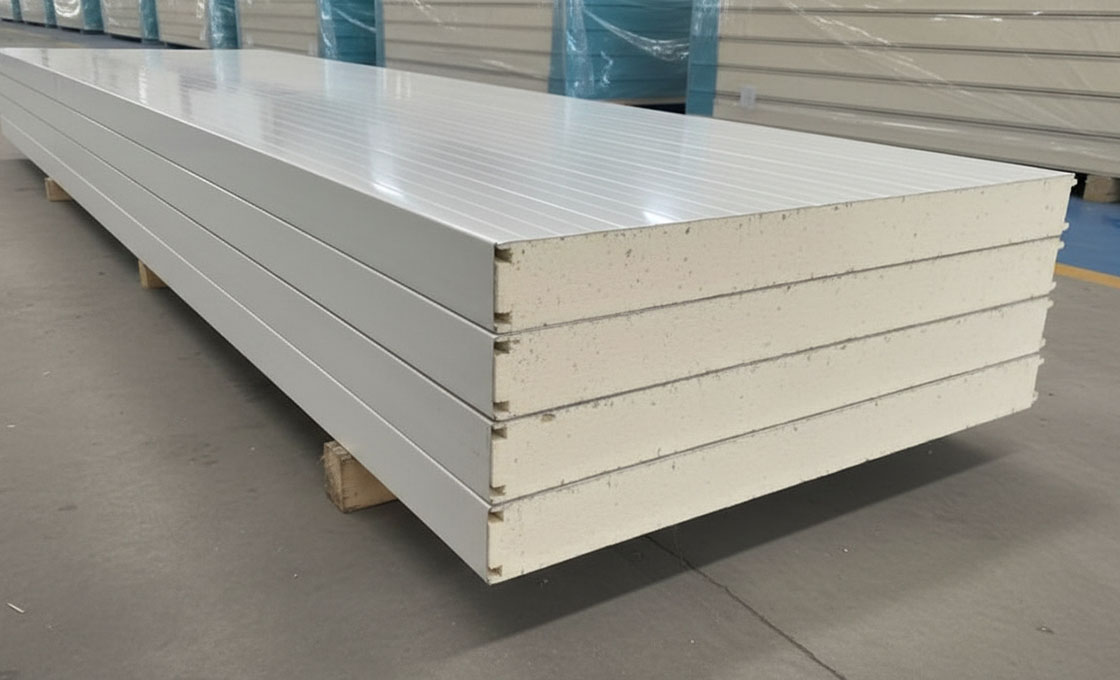
A thermal bridge forms whenever a continuous path of conductive material connects the warm exterior to the cold interior of a cold room ceiling. At panel-to-panel joints, this happens through direct metal-to-metal contact between facing sheets, through insufficient core coverage at seam edges, or through mechanical fasteners that bypass the insulation layer entirely. The result is localized heat transfer that spikes well above the rated thermal conductivity of the panel itself.
Our production data from foam core panels at 150mm thickness shows a center-of-panel R-value between 8.0 and 11.0 m²·K/W, more than sufficient for -30°C freezer environments. But that rated performance assumes zero compromise at the joints. A single unsealed joint with metal-on-metal contact can reduce the effective R-value of the entire ceiling assembly by 15 to 25 percent. For refrigerated truck manufacturers, this translates directly to compressor runtime, fuel consumption, and temperature excursions that risk cargo spoilage.
Condensation is the more immediate symptom. When surface temperature at a bridged joint drops below the dew point of the surrounding air, moisture accumulates. In pharma storage and food processing facilities, that moisture becomes a contamination vector and a health inspection red flag. In mobile applications, repetitive vibration causes freeze-thaw cycling at wet joints, which accelerates delamination of the facing material from the foam core.
Tongue-and-Groove vs. Cam-Lock Joint Systems
There are two dominant jointing systems for cold room ceiling panels, and the choice between them has real consequences for thermal performance, installation speed, and long-term joint integrity.
- Tongue-and-groove (T&G): A male-female interlock where the tongue of one panel slides into the groove of the adjacent panel. The overlap creates a longer path for heat to travel, which reduces thermal bridging compared to a simple butt joint. T&G systems rely on factory-applied sealant or tape to maintain airtightness. They are faster to install, typically 20 to 30 percent less labor per square meter, because no secondary mechanical fastening is required at each joint.
- Cam-lock: A mechanical hook-and-latch system embedded in the panel edge. An Allen key engages the cam, pulling two panels together under compression. This creates a tighter, more consistent seal than manual T&G assembly, especially on overhead ceiling runs where maintaining alignment is physically harder. Cam-lock joints are our standard recommendation for cold storage ceiling suspension systems where joint airtightness is critical to maintaining -20°C environments over long spans.
- Hybrid approach: Some installers use cam-lock panels at perimeter joints and critical transitions (ceiling-to-wall connections, around penetrations) while running T&G for straight field panels. This balances cost against performance at the most vulnerable joint locations.
For mobile applications, such as refrigerated trucks, RVs, and marine cold storage, cam-lock systems provide superior vibration resistance. Our GRP/FRP honeycomb panels with cam-lock joints maintain seal integrity under road vibration that would gradually work a T&G joint loose. The fiberglass facing material resists the micro-movement cracking that affects aluminum-faced panels in mobile installations.
The Psi-Value Threshold: Why 0.02 W/(m·K) Matters
Linear thermal transmittance, expressed as the Psi-value (Ψ) in W/(m·K), quantifies the additional heat flow through a joint compared to the uninterrupted panel surface. It is the single most relevant metric for evaluating whether a ceiling joint detail will cause problems. Based on EN 14509 compliance testing and our own thermal conductivity measurements per ISO 8301, we set 0.02 W/(m·K) as the maximum acceptable Psi-value for cold room ceiling joints.
Below 0.02, the joint does not create a condensation risk under normal operating conditions (-20°C interior, +30°C exterior, 80 percent relative humidity). Above 0.02, you enter a zone where surface temperature at the joint drops below the dew point intermittently, and intermittent condensation is enough to cause problems over time.
Achieving a Psi-value below 0.02 requires attention to three factors during both panel manufacturing and installation. First, the foam core must extend fully to the panel edge with no gaps: our PU foam cores at 38 to 45 kg/m³ density are injected under controlled pressure to ensure complete edge fill. Second, the joint geometry must create a thermal break: either a minimum 20mm overlap in T&G profiles or a compressible gasket in cam-lock systems that prevents metal-to-metal contact between facing sheets. Third, the sealant or gasket material must remain elastic across the full operating temperature range of -60°C to +80°C to accommodate thermal expansion and contraction without losing contact.
For specialized vehicle manufacturers, the stakes are higher than energy loss alone. A refrigerated truck operating at -20°C with a bridged ceiling joint will show temperature mapping inconsistencies during qualification testing, and those inconsistencies can disqualify the vehicle from pharmaceutical or high-value food transport contracts. Worse, sustained condensation inside the panel joint saturates the foam core, degrading its insulation value and adding weight the vehicle was not designed to carry. We have seen competitor panels gain 2 to 3 kg/m² in absorbed moisture over an 18-month service period due to unsealed thermal bridges at ceiling joints. For an OEM specifying panels below 12 kg/m² to meet payload targets, that weight creep eliminates the engineering margin entirely.
Conclusion
If your cold storage operates at -20°C or below, spec independent suspension with 150mm foam core panels. Period. Wall-supported systems hit Psi-values above 0.04 W/(m·K) at those temperatures. You’ll see condensation within six months and failed health inspections shortly after. The $8–12/m² premium for independent suspension pays for itself in year one through reduced compressor runtime alone.
Before you commit to a full order, request ISO 8301 thermal conductivity test reports and a 500×500mm sample panel with cam-lock joints from each supplier on your shortlist. Mount it in your existing facility. Scan the seams with an IR camera after 48 hours at operating temperature: cold spots at the joints tell you everything about that manufacturer’s quality control.
Frequently Asked Questions
What are cold room ceiling panel support systems?
Cold room ceiling panel support systems are specialized structural frameworks engineered to securely hold overhead insulated panels in temperature-controlled environments. These systems typically utilize robust suspension mechanisms, hanger brackets, and load-bearing profiles designed to accommodate the specific weight and thermal requirements of advanced panels, such as our CFRT and Aluminum Sandwich Panels. By evenly distributing the structural load, these support systems ensure the long-term stability and airtight integrity of the ceiling envelope, effectively preventing thermal bridging and structural sagging.
How much do cold room ceiling panels cost?
The cost of cold room ceiling panels varies significantly based on the core material, thickness, surface facing, and specific load-bearing requirements of your project. Premium options like GRP/FRP Honeycomb Panels or specialized Aluminum Sandwich Panels represent a different investment tier than standard Foam Core Panels due to their superior strength-to-weight ratios and enhanced structural capabilities. Because every cold room requires a specific thermal load calculation, we recommend consulting with our technical sales team to receive a customized, accurate quotation tailored to your exact specifications.
How is a cold room ceiling panel installed?
The installation of cold room ceiling panels involves meticulously lifting the lightweight panels into place via mechanical lifts before securing them to an overhead structural support grid. Panels are precisely joined using interlocking architectural profiles, which are then sealed with specialized cryogenic-grade sealants to ensure a continuous vapor barrier and prevent thermal leakage. Finally, the installed ceiling panels are mechanically fastened using engineered suspension brackets, ensuring the entire envelope remains structurally sound and perfectly aligned under varying thermal conditions.
What is the best insulation for cold room ceilings?
The optimal insulation for cold room ceilings relies on high-performance cores that offer superior thermal resistance while maintaining strict fire safety and structural integrity. Our Foam Core Panels, particularly those utilizing high-density polyurethane (PUR) or polyisocyanurate (PIR), are widely considered the industry standard due to their exceptional R-values and seamless locking capabilities. Alternatively, for specialized environments demanding extreme hygiene and maximum corrosion resistance alongside excellent insulation, our GRP/FRP Honeycomb Panels provide a highly durable, moisture-proof solution that actively prevents mold and bacterial growth.
Can cold room ceiling panels support evaporator units?
Yes, engineered cold room ceiling panels can safely support evaporator units provided the correct suspension system and structural calculations are implemented during the design phase. Our specialized Aluminum Sandwich Panels and heavy-duty CFRT Sandwich Panels feature excellent structural load-bearing capacities, allowing for the secure mounting of overhead cooling equipment when paired with reinforced spreader plates. It is critical to utilize specialized mounting hardware that safely distributes the dynamic weight of the evaporator across the support grid, ensuring the panel’s thermal and structural integrity remains completely uncompromised.