PET Foam Core Selection & Engineering Guide
Specifying the right PET foam core means matching density and thickness to the loads your sandwich structure will carry, the resin system and process you use, and the service temperature of the end application. The points below cover the choices that most affect performance and cost.
💡 Pro Tip: Match Density to the Load Path
Higher density is not always better value. Most shear-dominated structures perform well at 100-130 kg/m³, while compression-critical zones (blade roots, joints, inserts) benefit from 200 kg/m³ or higher. Step the density only where local loads require it.
1. How to Select the Right Density for Your Structure
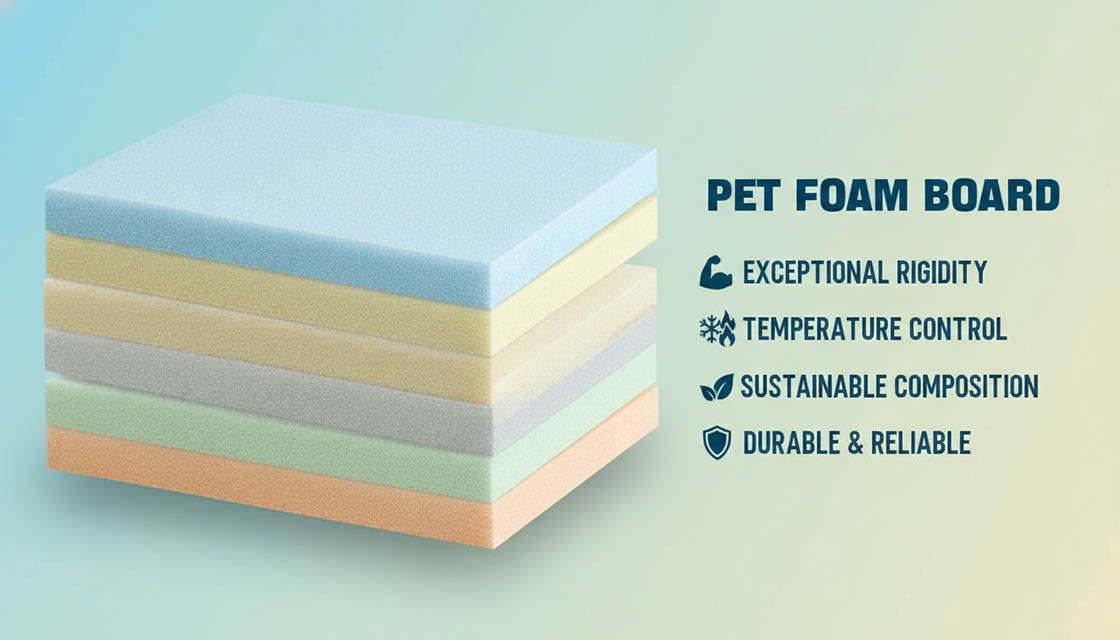
Density drives nearly every mechanical property of PET foam. Lower densities (80-110 kg/m³) suit large, lightly loaded areas such as wind-blade skins and marine interiors, where weight savings matter most. Medium densities (130-150 kg/m³) are a strong all-round choice for transportation floors and hulls. High-density grades (200-300 kg/m³) are used around fasteners, inserts, and highly loaded joints.
2. Typical Mechanical Performance by Density
| Density Grade |
Compressive Strength |
Shear Strength |
| ~100 kg/m³ |
~1.5 MPa |
~0.75 MPa |
| ~150 kg/m³ |
~2.5 MPa |
~1.2 MPa |
| ~200 kg/m³ |
~3.5 MPa |
~1.6 MPa |
Values are indicative for standard PET structural-foam grades; confirm exact figures for the density and test standard you require.
3. Matching the Core to Your Manufacturing Process
PET foam is compatible with vacuum infusion, resin transfer molding (RTM/VARTM), prepreg, and compression molding. Its closed-cell structure keeps resin uptake low, and because it is thermoformable it can be pre-shaped to curves before lay-up. It tolerates processing temperatures up to 150-180°C, with some grades handling short peaks near 220°C, so it pairs well with typical epoxy and polyester curing cycles.
4. Where PET Foam Core Performs Best
🌬️ Wind Energy
Blade skins, shear webs, and nacelle covers, where fatigue resistance and low weight are critical.
⛵ Marine & Transportation
Hulls, decks, bulkheads, and vehicle bodies that need stiffness, low water absorption, and impact tolerance.
5. Machining, Bonding, and Edge Detailing
PET foam machines cleanly on CNC routers and offers good screw-holding strength for inserts. It bonds reliably with epoxy, polyester, polyurethane, and vinyl-ester adhesives. Sealing cut edges before skin lay-up or gel-coat prevents resin migration and keeps the bond line consistent.
Frequently Asked Questions (FAQS)
1. What density and thickness range is available for PET foam core?
Standard PET structural foam is supplied from about 80 kg/m³ to 300 kg/m³, with thicknesses from roughly 3 mm to 200 mm. Blocks and sheets can be cut to your required dimensions.
2. What are the main engineering benefits of PET foam core?
A high stiffness-to-weight ratio, good fatigue and impact resistance, very low water absorption, and reliable thermal stability through normal processing temperatures.
3. How does PET foam core behave in high humidity and outdoor service?
The closed-cell structure limits water uptake, so the core resists saturation and rot in marine and outdoor environments. As with any core, the finished sandwich should be properly sealed at edges and fastener points.
4. Which manufacturing processes is PET foam core compatible with?
Vacuum infusion, RTM, VARTM, prepreg, and compression molding. PET foam tolerates processing temperatures up to 150-180°C (short peaks near 220°C for some grades), making it suitable for standard epoxy and polyester cure cycles.
5. Can PET foam core be machined, thermoformed, and bonded easily?
Yes. It cuts cleanly on CNC routers, can be thermoformed to curves before lay-up, and bonds well with epoxy, polyester, polyurethane, and vinyl-ester adhesive systems. It also offers good screw retention for inserts.
6. Is PET foam core environmentally sustainable?
PET foam is a 100% recyclable thermoplastic, often produced from post-consumer and post-industrial recycled PET. This supports circular-economy goals without sacrificing structural performance.
7. How are PET foam blocks and sheets packed for shipping?
Foam is protected with PE film and stacked on export pallets or in crates suitable for 20ft and 40ft container freight. Custom sheet and block sizes can be cut to match your laminate tooling.