
Monday, 6 a.m. The night crew left a puddle by the door frame, the gasket has grown a fur collar of frost, and somebody has put the wet floor sign out again. Nothing on the refrigeration gauge looks wrong. That is usually where cold room humidity gets treated as a mystery, when it is really a leak with a pattern.
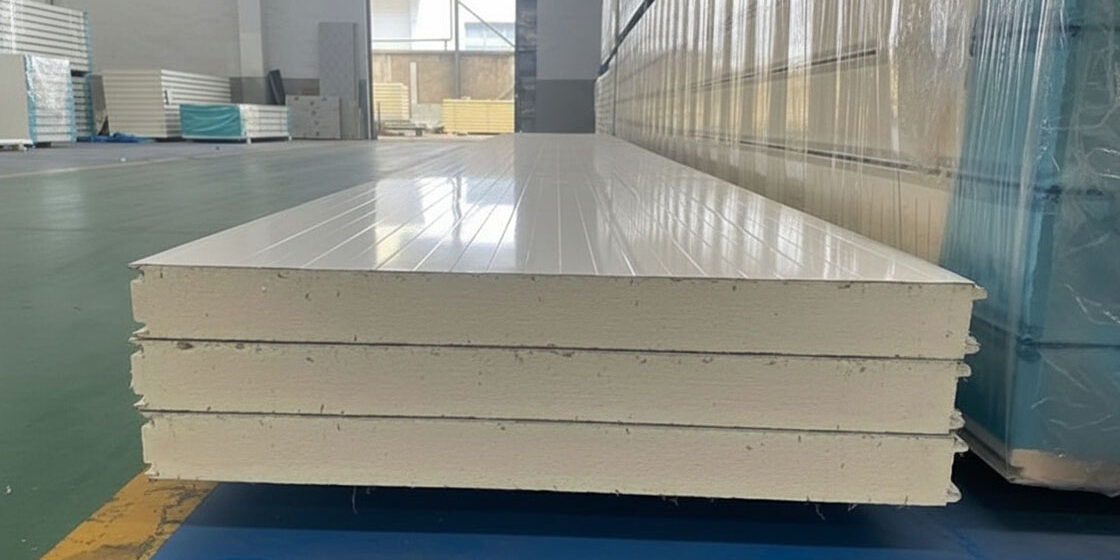
Here is the frame for reading it. The insulated envelope – panels, joints, gaskets, penetrations – decides how moisture behaves in your room, and most complaints are the envelope reporting a fault. We laminate cold room wall, floor, ceiling and door panels on our own line. The same faults show up whether the room was built last year or a decade ago. Work through the room in the order below and you end the week with a routine instead of a hunch.
Why Cold Room Humidity Slips Out of Balance
Air holds water as vapor, and the warmer the air, the more it holds. Cool that air without removing moisture and relative humidity climbs until the surplus condenses on the first surface below the Taupunkt. No panel brand changes that physics.
A cold room runs the physics in reverse of a heated building. Vapor pressure pushes from the warm side toward the cold side, so in your room the drive points inward: moisture tries to get in, all day, every day. Chilled rooms target a wide band – trade-typically 60 to 95 percent relative humidity, set by the goods. Freezers at or below -18°C mostly fight frost instead of percentages.
The moisture arrives through three doors, sometimes literally. It walks in as warm air every time the door swings or a gasket gives up. It rides in on the load – wet crates, breathing produce, washdown water. And it comes back as defrost water when a drain line blocks. Cold room humidity control means closing those entries and letting the envelope hold the line, not chasing the gauge.
What Condensation on Panels Is Telling You
Cold room humidity leaves a signature, and the location of sweat or frost names the failed element more reliably than any gauge inside. The display can read a steady 85 percent while the real fault is half a metre of split gasket on the north wall. Before you touch the refrigeration pack, walk the room and match what you see against the table below.
A ring of ice on the door frame is the gasket or its heater strip. Beads on a single wall, or one corner, mean a joint has opened or a thermal bridge is chilling that patch from behind. Our guide to thermal bridging in cold room panels covers that trail in depth. Drips from the ceiling near the doorway mean warm air rolling in over the threshold.
Ice under the evaporator usually starts in a blocked defrost drain, not in the air. Sweat across the whole outer face usually says the surrounding space is humid and still rather than anything wrong indoors.
| What you see | Most likely cause | First move |
|---|---|---|
| Ice ring around the door frame | Gasket leaking or heater strip dead | Paper-pull test; restore power to the strip |
| Beads on one wall or a corner | Joint seal gap or a thermal bridge behind | Re-seal the joint; inspect the backing |
| Drips from the ceiling near the door | Warm air rolling in over the open door | Strip curtain; traffic rules at the threshold |
| Ice on the floor under the evaporator | Blocked defrost drain line | Clear the line; check the heater tape |
| Sweat across the whole outer face | Ambient air humid, room skin cold | Ventilate the dock area; move the moisture source |
Read the room once and you will usually find one dominant leak feeding the rest. Fix that first. Sealing the joint under the sweat beats wiping it, and a dry Monday beats a dehumidifier running all weekend to mop up a gap a cartridge gun could close.
RaxPanel manufactures cold room wall, floor, ceiling and door panels – plus modular cold rooms – matched to your temperature band and sealing hardware. Send your cold room humidity symptoms and target temperature; an engineer returns the panel specification within 24 hours, one to one.
Panel Joints and Vapor Seals That Hold Moisture Out
A sandwich panel is only as dry as its weakest seam. The core stops conduction and the skins stop water, but vapor slips through any path that is not sealed, and it moves with patience. A joint that looks fine in February can wick all summer.
Good joints are sealed in layers. The mechanical lock – cam-lock cables drawn tight on wall and ceiling panels – closes the gap. Cut edges and butt joints get filled so the core is never exposed. Then the warm side gets its vapor seal: tape or liquid sealant over the seam, because the warm face is where the vapor pushes from. Skip that last layer and the joint breathes moisture into the core, where you will not see it until frost proves the point.
Penetrations deserve the same suspicion. Every pipe sleeve, wall brace, hinge anchor and cable gland through the skin is a vapor path unless it carries a gasket or a sealant bed. Panels leave our line with machined cam-lock pockets and matched gasket grooves for exactly this reason – the field crew should never have to improvise airtightness. Where the room was sealed properly at assembly, maintenance stays inspection, not invention; if it was not, the cold room assembly sequence shows what correct looks like.
One habit separates tight rooms from weepy ones: every penetration gets logged. When the crew adds a line for a new evaporator or a probe, someone signs for the seal that closes it. Rooms drift toward leaks one unlogged hole at a time, and the log line costs ten seconds.

Doors, Traffic and the Daily Humidity Tax
Every open door trades your cold, dry air for the dock’s warm, wet air, and the bill lands as frost. Doorways are the one part of the envelope you open on purpose, so they carry the heaviest humidity tax in the room. A tired gasket turns every cycle into an infiltration event.
The gasket gets checked in seconds. Close the door on a strip of paper at shoulder height and pull. If it slides out freely, the seal has given up, and every cycle now pumps humid air in. Frames in frost-prone rooms carry a heater strip inside the gasket line – confirm it is warm, because a dead strip ices the seal until the leaf cannot close. Techs who fight door ice for a living rank the fixes in the same order: seal first, heat second, curtain third.
Then discipline does the rest. Strip curtains or air curtains cut the exchange while the leaf is open, and they earn their keep on dock doors that cycle dozens of times an hour. Trolleys staged inside beat long idles with the door wide. And traffic gets rules, because uncontrolled forklift flow sits behind most frost-on-the-floor stories. One walker with a checklist beats three heaters on a timer.

A Weekly Humidity Walkthrough You Can Run
Cold room humidity management fails as a project and succeeds as a habit. The routine takes one person about fifteen minutes a week. It works because each stop checks one envelope element in the order moisture travels: air in, seams, joints, water out.
Same clock time every week, because a log only means something comparable. Read the RH display and write the number down. Walk the door frame with the paper strip. Follow the warm-air path: curtain, threshold, gasket.
Then trace the cold side. Frost-map the corners and ceiling joints with a torch. Stand at the evaporator long enough to watch a defrost end with water running to the drain, not pooling on the floor.
Trend beats threshold. A room that holds 80 percent for three months and then walks to 90 has told you something changed. A gasket, a drain, a joint moved – while the number itself never broke a limit. Escalate on change, not on panic.
Frost that regrows in the same spot two weeks running earns a joint inspection. Floor ice gets fixed the same day, because nobody walks out of a slip incident praising the schedule.

When the Envelope Needs More Than a Patch
Sealant and discipline cover most of what this page describes, but panels themselves age, and there is a point where patching lies to you. The core does the insulating, and it only works while it stays dry. Water conducts heat roughly twenty times better than the trapped air it replaces, so a soaked core turns the panel into a conductor wearing two cold skins.
The tells are consistent. Frost or swelling inside a joint. A cold patch that returns after re-sealing. Sweat that migrates along a wall instead of staying put. Ice on the outer face in summer.
When those show up, stop re-caulking and price the panel: skin, core and thickness matched to the temperature band, not just to the footprint. Surface temperature is what keeps a skin above the dew point, and panel selection sets it – our walkthrough of freezer panel thickness and temperature ratings covers that arithmetic.
Keep the boundary honest, too. If the envelope tests tight and relative humidity still will not hold, the remaining lever is mechanical dehumidification, and that is your refrigeration contractor’s brief, not a panel problem. The envelope’s job is to stop the room fighting the plant. Once it does, the plant can win.
Frequently Asked Questions About Cold Room Humidity
What humidity should a cold room run at?
Most chilled rooms sit between 60 and 95 percent relative humidity, set by the product rather than the panel. Frozen rooms focus on frost control instead. Treat that band as trade-typical and let your product spec set the final number.
Why do my cold room panels sweat?
Sweating means a surface has fallen below the dew point of the air touching it. Warm, moist air is reaching cold skin through a joint, a penetration, a tired gasket or a thermal bridge. Find the path, and the sweat stops.
How do I stop ice building up around the door?
Start with the gasket: paper-pull test it, replace it if it slides out freely, and confirm the heater strip works. Then cut open-door time with strip curtains and traffic rules. Ice around a door is almost always incoming air.
Does condensation on panels mean they are failing?
Not automatically. Condensation on the outer face near a door or a joint points to air leaks you can seal. Frost or swelling inside a joint, or a persistent cold patch, points to a wet core. That panel has failed.
Can panel upgrades alone stabilize cold room humidity?
They hold the boundary, not the balance. Panels and seals stop moisture moving where it should not; product load, defrost water and door traffic still need managing. A persistent RH deficit after the envelope is tight belongs to your refrigeration contractor.