
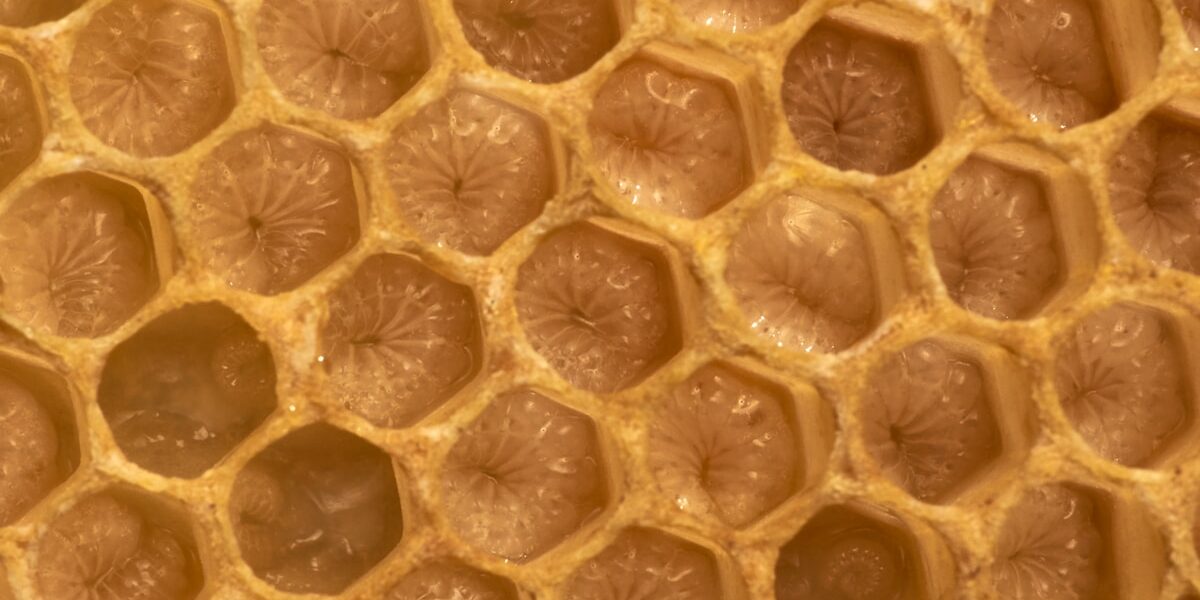
A honeycomb core earns its stiffness from geometry, not from mass: a hexagonal foil web separates two skins and transfers shear between them. That geometry obeys a hard law, because in-plane stiffness scales with the cube of the foil thickness-to-cell ratio, written (t/L)^3. Two datasheets that look identical can therefore differ by several times in stiffness, and the difference never shows on a photograph. A supplier image proves nothing about foil thickness, cell size, alloy or bond. The numbers decide.
Three levers decide what arrives on site: geometry, alloy and bond. Geometry covers cell size, foil thickness and direction, and it moves stiffness by cubes rather than percentages. Alloy and temper set what foil and skins can sustain before they buckle or yield. Bond quality decides whether skins and core survive peel, handling and thermal cycling as one structural unit. RaxPanel laminates aluminium honeycomb panels — including oversized panels up to 1,500 by 4,000 mm — on its own line.
What a Honeycomb Core Actually Does
A sandwich panel behaves like an I-beam rolled flat. The skins carry the bending tension and compression, while the honeycomb core holds them apart and carries the shear between them. Bending stiffness climbs with the square of the skin separation, which is how a thin sandwich outstiffens a solid sheet of the same weight. At equal weight, honeycomb also beats foam and corrugated cores in compression, because the cell walls support one another. Our руководство по устройству панелей ACP walks through the same principle with foam cores.
The core is not the same in every direction, and that is the part buyers miss. Hexagonal cells make the assembly orthotropic: the L, or length, direction is the strongest, while the W, or width, direction is more compliant. Both axes are measurable, and both belong on the datasheet you approve. Engineering references on the сотовая структура treat direction as a first-order property rather than a footnote. Your span direction and the ribbon direction on the shop drawing need to agree.
What the core does not do matters just as much when reading a datasheet. The core does not carry bending; that job belongs to the skins, which is why skin alloy and skin thickness sit in the same conversation. It carries shear, holds the gap open and stabilizes the skins against local failure. Every line a supplier prints about the core should serve one of those three jobs.
- Кожухи
- Aluminium sheets, commonly 3003-H14 or 5005-H34, that carry the bending stress.
- Сердечник
- A hexagonal web of thin foil that keeps the skins apart and carries shear.
- L direction
- Ribbon direction along the web’s length; the strongest axis.
- W direction
- The width direction; more compliant, so it suits shorter spans and secondary loads.
Alloy and Foil: The Two Inputs You Name
Start with the two inputs a datasheet has to name. The industry-standard honeycomb core foil is 3003-H18 aluminium alloy, and structural skins are commonly 3003-H14 or 5005-H34 sheet. If a quotation says only “aluminium”, send it back, because alloy and temper are what separate elastic recovery from a permanent dent. Temper labels look like bureaucracy until a panel dents around a clip, and then they look like money.

Production route shapes those inputs as well. Cores are produced by expansion or by continuous roll forming of aluminium foil, and each route controls cell regularity in its own way. Ask which process your supplier runs, then ask how cell geometry is held from batch to batch. The answer usually predicts the tolerances you will find on the delivered panels.
Only then should price enter the comparison. In-plane stiffness moves with the cube of the foil thickness-to-cell ratio, so a small difference in print becomes a multiple in service. Two quotes for nominally identical panels can sit far apart once that cube finishes its work.
Names matter because they travel. The alloy called out on the datasheet is what the fabricator orders again at replacement time, and what a warranty reviewer reads first. A specification that skips the temper leaves every later decision to whoever happens to be quoting. None of this is exotic; it is disciplined reading.
Density and Cell Size Trade-Offs
Density is the gate that selects the failure mode. Loaded out of plane, honeycomb walls fail through elastic buckling, plastic yielding or brittle crushing, and buckling stress itself scales with relative density cubed. Lower density saves weight right up to the point where those cubes catch up with the panel. That is why the lightest line on a price list deserves suspicion before it deserves an order.
Cell size feeds the same mathematics. Hold the foil thickness constant and shrink the cell, and the t/L ratio climbs, so stiffness rises sharply because the ratio is cubed. Keep the cell constant and reduce the foil instead, and stiffness falls just as fast. Either way, the datasheet price will not warn you, but the deflection will.
Relative density is the honest way to talk about this. It is the fraction of panel volume that is solid aluminium, and it moves whenever foil thickness or cell size moves. Because the cubes compound quietly, two cores with the same nominal density but different cell structures are not interchangeable. Ask for the cell structure, not just the headline number.
- 5. The permanent deformation a gasket keeps after release; beyond about 20 percent lost recovery the contact line stops sealing reliably. Put two quotations side by side at equal density and equal t/L before comparing prices. A cheaper core at the same cell count is usually thinner foil, and the cube law always finds it.
Turn this into a purchasing habit before the next enquiry. Require two lines on every datasheet you accept: core density, and the foil thickness-to-cell ratio written as t/L. If either line is missing, the quotation describes a photograph rather than a core.
Direction Matters: L and W Orientations
Every honeycomb core has a strong axis and a compliant axis, and datasheets print them as L and W. The L, or ribbon, direction is the strongest; the W direction is the most compliant. A panel bent along L deflects less than the identical panel bent along W, and the gap widens as spans grow. That difference is structural, not cosmetic.
The rule that follows is simple. Point L along the main span, whether that span runs floor to floor on a facade or across the shortest support distance overhead. On high-rise projects, corner suction zones change the loads at the panel edges, and our high-rise wind load guide explains how orientation, clip spacing and cassette folds interact there. Getting this wrong rarely fails a panel loudly; it delivers a facade that moves more than the calculation expected.
One core can answer two different questions in one building. A ceiling raft spanning between joists loads the panel across its width, while a facade cassette loads it along its height. Same alloy, same density, different axis doing the work.
Suppliers who know their product mark the ribbon direction on the packaging or the protective film. If the crate arrives without a mark, ask before the fabricator cuts. Orientation that is never stated is orientation that gets guessed.
Write the orientation into the purchase order and the cutting list. L runs along the span; W runs across it. The note costs nothing, and it removes a whole class of deflection complaints.
RaxPanel laminates honeycomb panels – including oversized 1,500 by 4,000 mm formats – on its own line. Engineers test to each project’s agreed data standard, and replies come within 24 hours, one to one.
The Bond Decides Whether Any of It Holds
A perfect honeycomb core with a weak bond is scrap with a certificate. Skin-to-core adhesion turns two aluminium sheets and a foil web into one structural unit, and it is produced on heated press lines that cure structural thermosetting epoxy films under pressure. Press temperature, film condition and cure time all end up expressed in one number. That number is peel strength.
The standard instrument is the ASTM D1781 climbing drum peel test, reported in N.mm/mm. For curtain-wall panels, GB/T 17748-2016 requires a roller peel average of at least 180 N.mm/mm, with no single value below 150. Ask which standard the batch was tested to, and then ask to see the report itself.
Внимание: the larger the panel, the less forgiving the bond. Oversized formats concentrate peel and shear loads during handling, transport and service, so at large sizes a batch peel report stops being optional.
Durability rides on that same interface over years of service, which is why our core durability guide treats peel as a long-term question. A panel that debonds slowly goes wavy first, long before anything visible happens at an edge. Neither symptom appears in a product photograph or on a price list. A peel report filed today is the cheapest insurance a facade will ever carry.

The Selection Checklist to Send Your Supplier
Aluminum honeycomb core selection compresses into five lines that fit inside an enquiry email. Send them as written, and every bidder has to answer with data instead of adjectives. For the product side of that conversation, the RaxPanel aluminium honeycomb panel range lists the honeycomb family laminated in-house.
- Name alloy and temper for core foil and skins; 3003-H18 foil with 3003-H14 or 5005-H34 skins is the accepted baseline.
- Print core density and the foil thickness-to-cell ratio (t/L) as stated lines on the datasheet.
- Require a batch peel report to ASTM D1781 or GB/T 17748-2016, with average and single-minimum values shown.
- Ask for shear modulus and compression data at the density actually quoted.
- Fix the size envelope: maximum panel width and length, flatness tolerance and edge detail.
One copy of the list goes to every bidder on the project. Identical questions force comparable numbers onto the table, and comparable numbers leave the thin-foil option nowhere to hide. Suppliers who test properly welcome the list; the rest reveal themselves by the blanks they leave. The exercise costs an hour and routinely prevents a re-order.

File the replies with the purchase order when they arrive. Hold delivery acceptance to the same lines you specified. A specification that lives in one PDF is enforceable; a verbal agreement is not. Buyers who keep that file rarely argue twice with the same supplier.
Core Selection in One Sentence
Geometry, alloy and bond are the three levers, and every serious datasheet line serves one of them. Read a quotation in that order and the cube law starts working for you instead of against you. Stiffness was never visible in a photograph, and it never will be.
- In-plane stiffness scales with (t/L)^3, so make the supplier print foil thickness and cell size.
- The L direction is the strong axis; point it along the main span.
- 3003-H18 foil with 3003-H14 or 5005-H34 skins is the baseline every quote gets measured against.
- Peel strength per batch, in N.mm/mm, decides whether any of it holds.
Send RaxPanel your spans, loads and panel sizes, and engineers return datasheets tested to the data standard the project agrees on. The first reply lands within 24 hours.
Frequently Asked Questions About Honeycomb Cores
Почему ячейки сотовой структуры имеют шестиугольную форму?
Шестиугольные ячейки имеют общие стенки с соседними, поэтому фольга выполняет больше работы при меньшем расходе материала. Такая геометрия обеспечивает высокую прочность на внеплоскостное сжатие и сдвиг при очень низкой плотности, именно поэтому сотовая форма повторяется в природе и инженерии.
Какой сплав фольги следует использовать для ядра?
3003-H18 — это стандартная для отрасли фольга для сердечника из алюминиевого сотового заполнителя, а в качестве обшивки используются листы 3003-H14 или 5005-H34. Требуйте, чтобы поставщик указал марку сплава и состояние термообработки как для обшивки, так и для сердечника.
Имеет ли значение ориентация сердцевины для фасадных панелей?
Да. Направление L — самое прочное, а направление W более податливое, поэтому ориентируйте L вдоль основного пролёта панели, а W располагайте поперёк.
Как проверяется сцепление обшивки с сердечником?
ASTM D1781 определяет метод испытания на отслаивание вращающимся барабаном, результат выражается в Н·мм/мм. По стандарту GB/T 17748-2016 среднее значение должно составлять не менее 180 Н·мм/мм, а отдельные показания — не ниже 150 для панелей навесных фасадов.
Какие размеры панелей можно ламинировать?
RaxPanel ламинирует крупноформатные сотовые панели шириной до 1500 мм и длиной до 4000 мм на собственных пресс-линиях. Уточните допустимые габариты и профиль кромки перед заказом.