
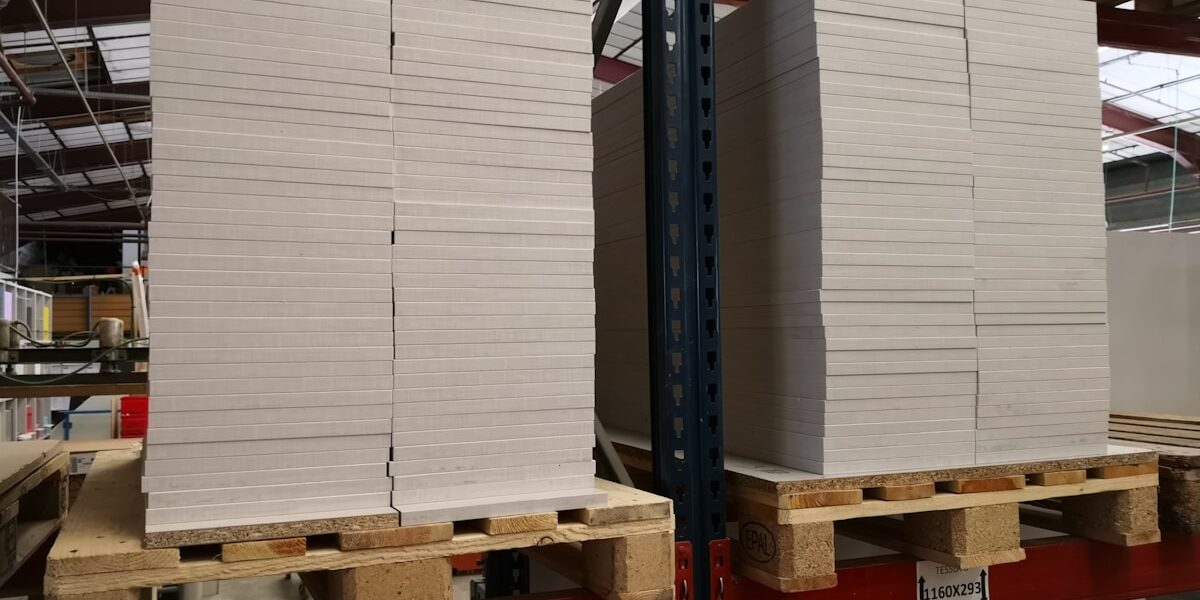
A foam-cored panel comes off the truck with one crushed corner, and the receiving-bay light lands on the exposed core edge. Press a thumb into the damage and sound foam pushes back; powdery, split cells mean the batch never stood a chance. Understanding PU foam lives in that moment – between the lines a supplier prints and what the cells admit at a thumb’s press.
RaxPanel laminates PUR, PIR, EPS and rockwool cores alongside PU, PVC, PET and XPS foam cores on one line, so datasheet claims get tested against real panels here. The inspection-bay habit is to treat every printed line as a claim until a test method and a certificate back it.
What PU Foam Is Made Of
Polyurethane foam is not one plastic but the cured product of a reaction between two liquids. A polyol blend meets MDI, the isocyanate behind most rigid grades; TDI serves the flexible ones. Industry bodies ISOPA and PFA describe the reaction the same way: diisocyanates plus polyols, curing into urethane linkages. Small recipe changes yield hundreds of foam types, and PFA credits Otto Bayer’s team with the 1937 start.
For a buyer, the two-drum picture beats the polymer lecture. Every additive holds one job:
- Poliol: hydroxyl-side base liquid; its recipe shapes the foam’s character.
- MDI (TDI flexible): isocyanate partner locking the urethane linkage.
- Catalyst: paces the reaction so the rise finishes before cure stalls.
- Surfactant: sets cell size, keeps bubble walls uniform.
- Flame retardants: additive options specified per application (PFA).
How a mixhead and a curing line turn the recipe into a slab is production-line territory for its own guide; this page stops at the drum labels.

Why Closed Cells Do the Work
Insulation in rigid foam is a housing story. Every micrometre-scale cell is a sealed room, and the gas locked inside – pentane in modern rigid grades, per ISOPA – conducts less heat than air. The polymer contributes little beyond the wall film. Cut a coupon open and the structure, not the polymer chemistry, is what an audit weighs.
Bay note: picture each closed cell as a sealed room with the heating off. Pentane sits behind the door; the polymer is only the wall. Crush the wall and the room trades its quiet gas for ordinary air.
Closed-cell content is a measured number, not a mood. It is determined per ASTM D6226, which sizes open-cell volume by porosity and leaves closed cells and walls as the remainder. Cold-grade panel cores are specified at 95%+ on that basis.
The same structure holds water back. Intact closed-cell foam absorbs under one percent of its volume (General Plastics, vendor attributed), while cut or crushed faces are the entry points. Protect the cells in handling; damaged ones leak heat and take up water at once.
Density, Strength and Lambda Move Together
Density is the master dial on a PU foam datasheet. Turn it up and compressive strength with dimensional stability climb; lambda creeps up too, because more solid polymer sits in the heat path. You cannot max both, and denser does not mean better. The table below shows both tracks side by side.
Understanding PU foam at the parameter table means reading the columns together. General Plastics attributes a family spread of 2-60 pcf, about 32-960 kg/m3, with tooling grades reaching 2,100 psi in compression. First-party data pins the insulation band: RaxPanel cold-room cores run 40-45 kg/m3, above 160 kPa, at 0.019-0.022 W/(m-K). Across our building sandwich panels, the core table spans 0.020-0.038 W/mK at 10-150 mm thickness. The foam core selection guide compares families line by line at equal thickness.
| Parámetro | First-party core data | Family context (attributed) |
|---|---|---|
| Densidad de espuma | 40-45 kg/m3 cold-room cores | 2-60 pcf, about 32-960 kg/m3 |
| Contenido de celdas cerradas | 95%+ según ASTM D6226 | same basis |
| Resistencia a la compresión | above 160 kPa | up to 2,100 psi tooling grade |
| Conductividad térmica | cores 0.019-0.022; panels 0.020-0.038 W/mK | per ASTM C518 |
| Grosor | 10-150 building; 50-200 cold rooms | grade-specific |
| Temperatura de servicio | -45 to +10 C duty | grade-specific |
| Clasificación de fuego | EN 13501-1 B-s1,d0 | grade-specific |
Reading a PU Foam Spec Sheet
A spec sheet earns trust line by line, and four carry most of the weight. Understanding PU foam at the receiving bay means checking each against a test method with a number on it:
- Densidad – per ISO 845; weigh a sawn coupon against the printed line.
- Contenido de celdas cerradas – per ASTM D6226; ask for the certificate, not just a percentage.
- Lambda – per ASTM C518; ask whether the figure is press-fresh or declared long-term.
- Compressive strength and service temperature – matched to duty, freezer wall to truck body.
The scene repeats at every third inspection: the lambda line quotes a best-case number and no declared value appears anywhere. The inspector asks for the test certificate, and a supplier without one has answered anyway. An incomplete datasheet is itself a quality signal.
Send the spec, get the core answered. Send the density, lambda and thickness lines you must meet. The engineering team returns a core and thickness list from the PU, PIR, EPS and rockwool line – over 1,500 m2 of panel a day, projects in 30+ countries.
How PU Foam Ages in Service
Closed-cell foam ages by exchange. The low-conductivity blowing agent sealed in the cells diffuses out over the years while ordinary air diffuses in, and lambda drifts upward. Literature attributes a rise of roughly 10-30 percent across 10-25 years – an attributed range, never a guarantee. Standards such as ASTM C1303 and C1519 estimate the long-term figure. A panel that starts lower stays lower.
Mature suppliers sell against that reality. Under BS EN 13165, the declared lambda already accounts for gas-diffusion aging (SOPREMA), and the declared figure is the one your calculation carries. Gaps, shrinkage and settlement cost performance through installation, per Isowall’s analysis. No foam grade repairs a bad joint.
The press-fresh lambda is a reading off a new instrument. The declared value is the one calibrated for the years ahead – that is the number I pay for, and the other can stay on the brochure.

Where PU Foam Fits Among Cores
No core wins every column, so place PU by parameter space rather than by slogan. Its edge is insulation per millimetre at low density: vendor-attributed R-values run 6.0-7.0 per inch for closed-cell polyurethane, against about 3.6 for EPS and 5.0 for XPS. Where thickness is scarce, that gap writes the shortlist.
- Cold rooms and freezers: the default answer – first-party cores at 40-45 kg/m3 and 0.019-0.022 W/(m-K).
- Building envelopes: one option among PUR, PIR, EPS and rockwool on the same line.
- Truck bodies and RV shells: PET and PVC enter where flame or stiffness demands shift.
- Marine buoyancy: closed cells hold uptake under one percent (vendor attributed).
Two neighbours mark the boundaries. PIR is the same two-liquid chemistry pushed to a higher isocyanate share for fire performance. The head-to-head data lives in our Paneles de PU vs PIR para cuartos fríos comparison. EPS stays the budget answer where lambda can afford to be worse, and our EPS vs PU breakdown prices that trade.

Read as a map, the choice stops being a brand debate. PU foam is the default core where insulation per millimetre meets moderate structure – freezer walls, chiller envelopes, truck bodies. Outside that space, PIR takes fire-critical specifications and EPS takes budget envelopes. The datasheet lines decide the row before any brand does.
Frequently Asked Questions About PU Foam
¿La espuma de poliuretano es de celda cerrada o de celda abierta?
Rigid insulation and structural grades are closed cell – 95%+ per ASTM D6226 in cold-grade cores. Cushioning grades are open cell. Understanding PU foam starts with the grade, because one name covers both structures.
What density should rigid PU foam be?
Cold-grade panel cores run 40-45 kg/m3 in the first-party spec, with compressive strength above 160 kPa. The attributed family spans 2-60 pcf, about 32-960 kg/m3, topping out in tooling grades. Choose by strength and lambda requirements.
Does PU foam lose insulation value over time?
Yes, slowly. Blowing agent trades places with diffusing air inside closed cells, and literature attributes a 10-30 percent lambda rise over 10-25 years. Design against the declared long-term value; BS EN 13165 already age-adjusts it.
Is PU foam waterproof?
Intact closed-cell foam absorbs under one percent of its volume in water, per vendor testing. Cut or crushed faces are the entry points: seal them, and keep the foam from UV exposure.
Is PU foam the same as PIR?
Same two liquids, higher isocyanate share: the recipe turns PUR into PIR and lifts fire performance. For procurement checks, see our PIR cold storage panel guide.