
The infrared camera sweeps a cold store wall and finds one bright stripe. It is not the door seal and not a panel joint; it runs straight through the middle of a panel where nothing should leak. That stripe is the gap between a datasheet and the wall it landed on, and this page exists to close it.
Ranking questions deserve ranked answers, so here is ours: thermal conductivity comes first, the face-core bond delivers it, and fire rating qualifies the panel before either gets scored. RaxPanel laminates foam-core and honeycomb-core sandwich panels on its own line and engineers them against project data standards, which keeps us on the factory side of that gap. When buyers ask for the most important sandwich panel property, the honest reply is a ranking with reasons – and every reason below carries its source.
Why Thermal Conductivity Ranks First
Most buyer conversations start from the same three words: insulation performance, fire resistance and durability. Jinggong’s own opening admits that trio before steering readers toward its weight axis. The list is honest. It is also unordered, and the order is the entire decision.
Rank the trio by what the invoice meters and thermal conductivity wins outright. A sandwich panel is bought, before anything else, to be the insulation layer of a building or a vehicle body. That is the job it is paid for every day of its service life. Fire resistance bills once, at inspection. Durability bills in events, years apart.
Heat loss bills daily, in the same currency the camera sees. The physics sits inside the core’s closed cells. Rigid PU foam insulates because the low-conductivity blowing-agent gas sealed in those cells conducts far less heat than air (Isowall explains the mechanism). Lambda – thermal conductivity – is the one figure on the sheet with a direct line to your energy ledger, and every degree of temperature difference you maintain prices it. That is why the question of the most important sandwich panel property starts here rather than anywhere else.
One warning before the numbers: first place is not a licence to ignore the rest. A perfect lambda can still be thrown away after installation. The sections below follow that failure path: first the buyer’s way of reading lambda, then the property that delivers it to the wall.
Read Lambda Like a Buyer
Lambda reads like a single number and behaves like a contract. It is a material property, independent of thickness; R-value is simply thickness divided by lambda. SOPREMA’s worked example makes the conversion concrete: a 150 mm board at 0.022 W/mK delivers R = 6.818 m2K/W. Two quotes at the same thickness can therefore hide very different R-values, and the lambda line is where the difference sits.
Ask for the declared value, not the fresh one. Under BS EN 13163, low EPS thermal values are declared as 90/90 figures. That label means the level 90 percent of production reaches at 90 percent statistical confidence, per the BPF, the UK EPS industry body. Such values are measured on heat flow meter apparatus to methods like ASTM C518, the standard test method behind most quoted lambdas.
| Núcleo | Declared lambda (W/mK) | Attribution |
|---|---|---|
| PIR / PUR foam | 0.020-0.022 | SOPREMA technical guide |
| EPS70 | 0.038 | BPF, BS EN 13163 grades |
| EPS100 | 0.036 | BPF, BS EN 13163 grades |
| EPS150 | 0.035 | BPF, BS EN 13163 grades |
| EPS200-250 | 0.034 | BPF, BS EN 13163 grades |
| Rockwool | approx 0.041 | Jinggong rockwool specification |
| RaxPanel PU cold room (first-party) | panel 0.022-0.024 / core 0.019-0.022 | first-party data |
BPF adds that a 0.030 W/mK declared value can be achieved for EPS 70 or 100 grades. The low end of the EPS family rewards grade discipline as much as density.
Read the table as ranking evidence, not as a catalogue. Sandwich panel thermal conductivity varies less between good products than marketing implies. SOPREMA’s technical team notes that products for different applications often share the same value, which is precisely what confuses specifiers. The opposite failure is the supplier page that bullets insulation, strength, sound and fire as equal-weight key features. Equal-weight lists are how a buyer ends up paying for the wrong property.
First-party numbers earn their row too: our PU cold room panels run 0.022-0.024 W/mK as a laminated panel and 0.019-0.022 at the core. When a quote prints a single lambda, ask which layer it describes and whether it is declared. If the full sheet needs decoding line by line, our especificações de painéis sanduíche de aço colorido guide continues the reading from here.
Face-Core Bond: The Property That Delivers Lambda
Ranking lambda first is only half of the verdict, because a lambda is only as real as the bond line beneath it. The most important sandwich panel property has a delivery mechanism, and that mechanism is the adhesive joining skin to core.
Sandwich mechanics is compact enough for a checklist:
- Chapas
- Carry tension and compression – the flanges of the beam.
- Núcleo
- Carries shear and holds the skins apart.
- Linha de ligação
- Transfers shear between them; lose it and three layers stop working as one composite.
The consequence is the stripe from the opening. When the bond line fails, the panel loses most of its bending stiffness and load capacity even though skins and core look intact. That failure chain is documented across delamination case work by Puglue, an adhesive manufacturer. Delamination also arrives late, months after delivery, on the customer’s roof or cold-store wall. Replacement there can cost 10-50 times the failed adhesive, a vendor analysis figure from Puglue quoted as scale, not as a guarantee.
Cold storage and refrigerated transport amplify every one of these loads through temperature difference, condensation, humidity and repeated thermal cycling (Chemique Adhesives). A dark facing can reach 80 C in sun while the shaded back skin holds 25 C, and the daily bow works the bond like a lever (Puglue). The buyer-side check is one question: does the line run periodic peel and shear tests on finished panels? On EPS block panels the bond is the only structural connection, so the bonding station is the quality gate of the entire line (Kindus). A building sandwich panel is bought as a composite; the bond is what keeps it one.
Send the application – cold room, warehouse roof or truck body – and the RaxPanel engineering team returns the property ranking that fits it. Core options come from our foam-core and honeycomb-core panel line, and the answer comes back as data, not a brochure. Output runs over 1,700 m2 a day to projects in 30+ countries.
Fire, Strength, Acoustics: Where They Rank
Fire does not compete in this ranking; it decides who is allowed to enter. Treat it as a qualifying round. A panel that fails reaction-to-fire requirements scores zero on everything else, and a panel that passes gains no daily advantage over another that also passed. Fire is pass or fail; lambda is points. Keeping those two kinds of importance apart is what makes the ranking honest.
Three myths keep muddying the gate (Bordj Steel catalogs them):
- “All sandwich panels are fireproof” – the core material, not the category, decides fire behaviour.
- “Thicker panels always provide better fire resistance” – thickness helps, but the core sets the class.
- “Fire resistance only matters for industrial buildings” – any occupied or insured building writes the fire line first.
The numbers show what qualifying looks like. Rockwool cores hold Euroclass A1 non-combustible classification (Jinggong). Fire resistance runs typically 1.5-3 hours depending on thickness, up to 4 hours in optimized designs. Those cores work at a lambda near 0.041 W/mK and a core density of 100-150 kg/m3. Higher density improves fire, mechanical and acoustic performance but adds weight – a trade, never a free upgrade.
Mechanical strength ranks below lambda and bond yet still earns a line: our PU cores hold compressive strength above 160 kPa (first-party). Acoustics takes one sentence – panel builds can reach about 50 dB of sound insulation (Jinggong) – because absorption detail belongs to a dedicated piece. The classification itself gets checked against statutory guidance such as England’s Documento Aprovado B, and the clause-level EN versus GB translation lives in our fire standards comparison.
Match the Ranking to Your Project
A default ranking earns its keep by bending to working conditions without breaking. Heat bills daily, so thermal conductivity holds the first seat in most envelopes. The matrix below shows where another property jumps the queue, and every queue-jump needs a stated reason.
| Seu cenário | First-ranked property | Who jumps the queue |
|---|---|---|
| Cold room or freezer | Lambda (our PU panel: 0.022-0.024 W/mK) | Face-core bond rises with condensation and thermal cycling |
| Warehouse roof or wall | Lambda | Fire gate first, then bending stiffness on long spans |
| Truck body or RV shell | Face-core bond with stiffness-to-weight | Lambda drops back where the box carries no continuous temperature duty |
| Humid or pharma cleanroom | Lambda | Bond weight rises again with washdown and humidity |
| Insurance-constrained project | Fire gate | Pass first; lambda ranks among the survivors |
Run the decision in order:
- Write the fire line from code and insurer – it qualifies everything else.
- Set the temperature duty – a continuous difference keeps lambda first.
- Weight the bond against the environment – cycling, humidity and washdown raise it.
- Check stiffness and weight against span and transport.
- Compare declared lambdas among the survivors.
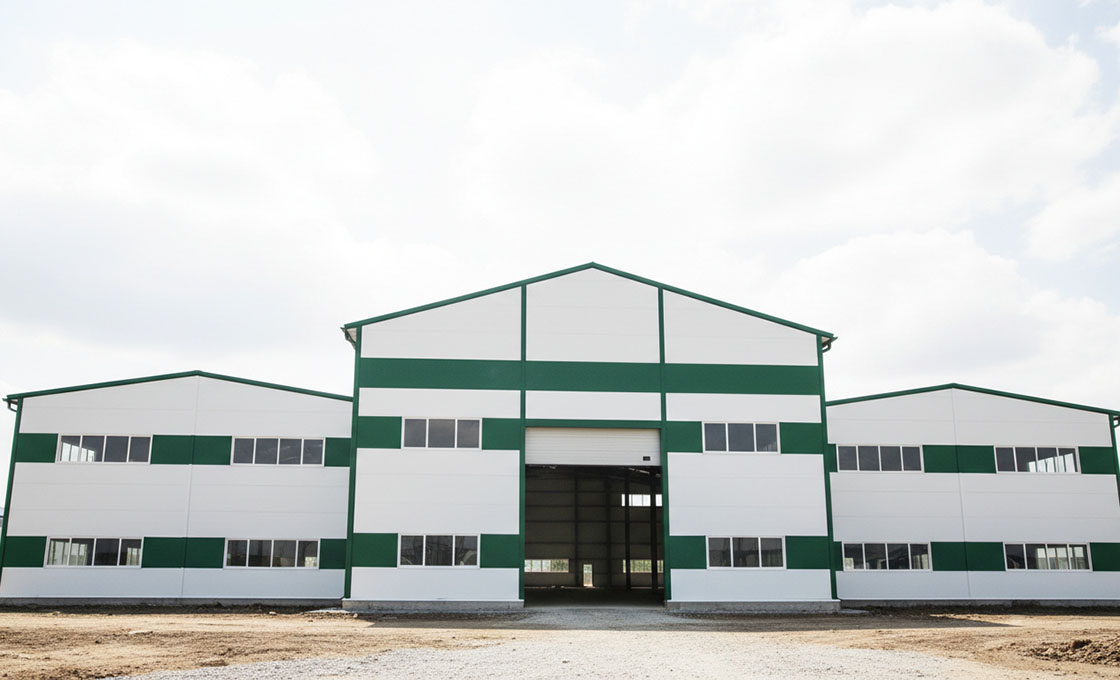
Cold-store operators should read the matrix’s first row as the anchor, because the default verdict holds there in its purest form. The most important sandwich panel property is thermal conductivity, delivered by the bond and qualified by fire. The scenario table moves it only when a working condition says so. When the matrix sends you to choose a core, our core-by-core analysis owns the catalogue; this page owns the ranking.
Frequently Asked Questions About Sandwich Panel Properties
What is the most important property of a sandwich panel?
Thermal conductivity ranks first: it is the most important sandwich panel property because heat loss bills daily. The face-core bond decides whether that lambda survives installation, and fire rating qualifies the panel before either is scored.
Which core has the lowest thermal conductivity?
PIR and PUR cores, with declared lambdas around 0.020-0.022 W/mK (SOPREMA). Sandwich panel thermal conductivity then climbs through EPS grades at 0.034-0.038 (BPF) to rockwool near 0.041 (Jinggong).
What causes face-core delamination in sandwich panels?
Adhesive mismatch or contamination, poor surface preparation, uneven application or press pressure, then moisture and thermal cycling working the bond line (Puglue, Kindus). Failures surface months after delivery, most often at edges and fastener penetrations.
Is fire rating more important than insulation in a sandwich panel?
They are different kinds of important. Fire is a qualifying gate: fail it once and nothing else gets scored. Insulation is the ranked property, billing daily once the panel has passed the gate.
Which lambda value should I ask a supplier for?
The declared value – a 90/90 figure under BS EN 13163 – measured to a heat flow meter method such as ASTM C518. Specify panel or core lambda too, rather than accepting a bare number.