
The clipboard hangs by the airlock of a distribution-center cold room, and the gap shows three pages before the auditor says anything. Three signature lines in a row, blank. The crew may have sprayed every single night, but without a record the room fails on arrival, because the requirement was never just spraying.
Cold room disinfection requirements reward operators who treat cleaning as evidence rather than chore. We build the box this work happens in: RaxPanel manufactures cold room wall, ceiling, floor and door panels plus modular cold rooms on one line. Smooth, sealed, food-safe skins are what make a room realistically disinfectable. Five auditable controls separate a pass from a prosecution letter, and every one of them is cheap to hold.
What the Requirements Actually Ask You For
No regulator writes “spray the walls now and then” into law. What GOV.UK food hygiene guidance asks for is a schedule stating what needs cleaning, how often, and which products – plus proof that cleaning works. Disinfection requirements are auditable mechanisms, not gestures with a trigger bottle.
Read that way, cold room disinfection requirements decompose into five testable things. They are: how often the work runs, which chemicals qualify, how long the disinfectant stays wet, where the dead zones sit, and what the logbook shows afterwards. Miss one and the other four stop counting. The blank signature line in the opening scene failed a room whose spray bottles were visibly full.
Different countries wrap the same idea in different paper. US retail practice runs on the FDA Food Code, the model document that state, local and tribal regulators adapt into their own rules. The current edition is 2026, and new editions now arrive every four years. The paperwork differs; the mechanics do not: schedule, chemistry, contact time, dead zones, records.
“Not cleaning thoroughly is one of the most common reasons why food businesses are prosecuted.”
That line is the regulator’s own, and it reframes the task. A cold room that smells clean but cannot show its work is one clipboard away from the same file. The five controls below turn each item into something an operator can actually hold.
How Often a Cold Room Needs Disinfecting
Start with cadence, because frequency is the first line an auditor checks against the schedule. The vendor norm for commercial rooms: clean and inspect at least monthly, treat leaks and spillages as immediate jobs, and book a professional deep clean about every 6 months. That ladder is the rhythm cold room disinfection runs on – vendor guidance rather than statute, but the rhythm inspection reports expect to see written down. Domestic fridges get a weekly version of the same logic.
The cleaning window itself runs cold. Chilled food must sit at 8 degrees C or below in England, Wales and Northern Ireland, with 5 C the recommended set point. Bacteria multiply fastest between 8 and 63 C, which is exactly the band a warm cleaning session drifts into. Chilled food may sit out for up to 4 hours – that is the whole budget for an extended clean.
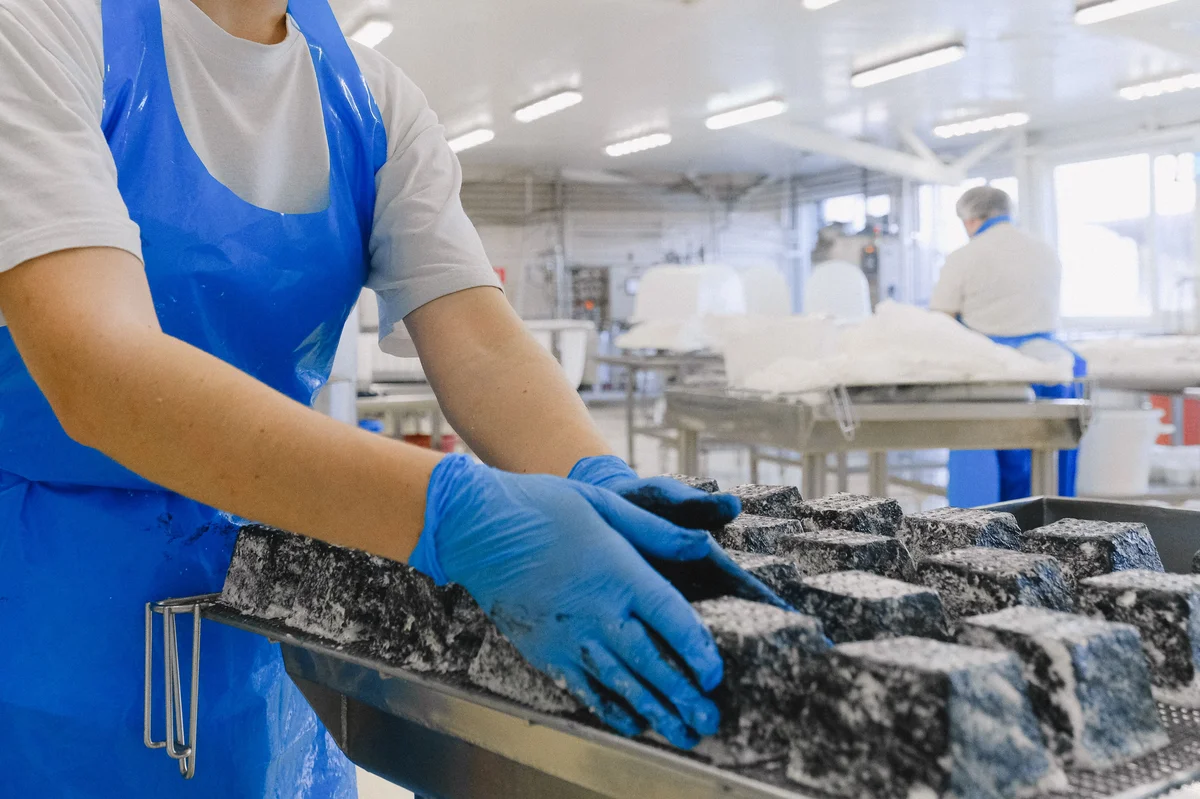
Between the monthly baseline and the six-monthly deep clean, daily and weekly habits carry the load. Wipe spills the moment they happen and confirm the door closes and seals, every day. Weekly: shelving, handles, floor edges and corners, plus a hunt for recurring moisture. Monthly: gaskets and door hardware, condensation or frost, and airflow clearance at the evaporators. A spill left unattended becomes pooling water, mold, ice build-up or a threshold hazard – each one a bigger job than the wipe it skipped.
| Area or task | Cadence | Trigger that moves it up |
|---|---|---|
| Walls, ceiling, shelving | Monthly baseline clean and disinfect | Visible soil, or any spill: immediately |
| Floor and drainage points | Weekly, with daily spill wipes | Standing water or ice forming |
| Door gaskets and hardware | Wipe weekly, inspect monthly | Sticky, perished or folded rubber |
| Door tracks and guide rails | Monthly, plus any visible debris | Ice or carton fragments in the channel |
| Evaporator face and airflow path | Monthly clearance check | Frost build-up or weak airflow |
| Whole room, professional deep clean | About every 6 months (vendor guidance) | Stock rotation or a major spill |
Write the cadence into the schedule with a trigger column. “Immediately” needs a definition, or it quietly becomes “at the weekend”.
Which Disinfectants Qualify in a Food Room
Qualification starts at the label, not at the trade counter. GOV.UK puts it bluntly: not all products kill bacteria and viruses, and disinfectants meant for food areas should carry BS EN 1276 or BS EN 13697 on the label. Those codes sit behind laboratory suspension and surface tests. A bottle showing neither code is a cleaner, not a disinfectant, and the schedule has to treat it as one.
Food rooms constrain the chemistry itself. Panels want food-safe, non-abrasive cleaner, because abrasive products damage panel skins over time. Door gaskets want a gentle cleaner that will not dry out or perish the rubber. A disinfectant that passes the laboratory but chews the room fails the second test.
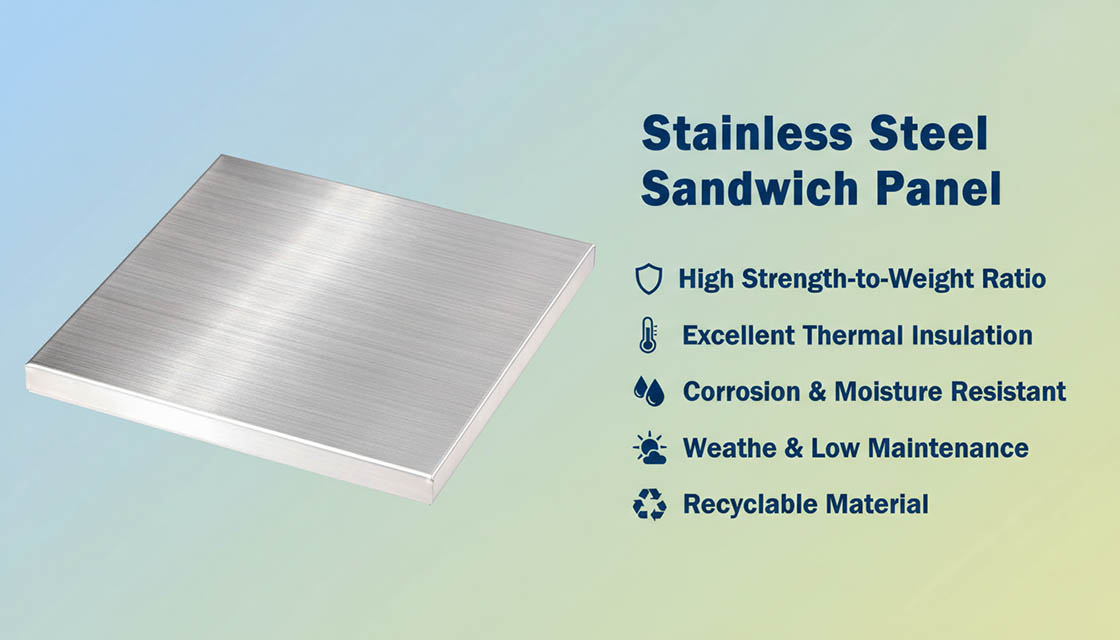
Application technique decides whether a qualified product stays qualified on your walls. US Cooler’s cleaning guidance compresses into five habits:
- Spray onto the rag, never directly onto panels or equipment – mist finds joints and electrical parts.
- Test any new product on an inconspicuous spot before it touches a full wall.
- Keep it mild and non-caustic, and keep scouring pads away from panel skins.
- Rinse with clean water, then dry with a soft cloth.
- Store cleaning chemicals away from food – regulators list them among chemical hazards.
Disinfection is a build decision before it is a cleaning one. Smooth, food-safe skins and sealed joints survive years of chemical washdowns. That washdown survival is what our painel de câmera fria line is engineered for: wall, ceiling, floor and door panels from one system.
Contact Time Beats the Strongest Chemical
Strength does not kill bacteria; dwell time does. A disinfectant works while the surface stays wet for the contact time printed on its label. Newer low-alcohol quaternary ammonium formulations – broad-spectrum workhorses in food rooms – typically ask for 3 to 5 minutes of wet contact. Wipe the surface dry after ten seconds and you have paid for chemistry it never received.
A produce distribution center learned this at the floor drain. The crew sprayed, wiped and moved on; the swab came back carrying Listeria monocytogenes, a bacterium that grows at temperatures as low as 0 degrees C. Refrigeration slows organisms like that down – it does not sterilize anything. The retrain took one sentence: the surface stays visibly wet for the full label time.
Order matters as much as patience. Organic load – blood, fat, food residue – shields bacteria from the chemistry, so every effective cycle is clean first, disinfect second:
- Clear the zone and preclean with detergent until no visible soil remains.
- Rinse the detergent slurry away with clean water.
- Apply the BS EN-labeled disinfectant and keep the surface wet for the full label contact time.
- Rinse if the label directs, then dry the surface completely so no moisture is trapped.
- Restock only once everything is dry.
A disinfectant wiped dry after ten seconds is the thermometer that never went in – a reassuring number attached to nothing. Three minutes wet beats five minutes strong, every week of the year.
RaxPanel extrudes cold room wall, ceiling, floor and door panels plus complete modular cold rooms on one line. Capacity runs over 1,700 m2 of panel a day, shipped to projects in 30+ countries. Send your room size and temperature class, and an engineer returns a washdown-ready panel schedule with sealed-joint details.
The Dead Zones Auditors Wipe First
Auditors wipe where failure lives, and failure lives where mops skim past. The checklist language about drains is blunt: standing water turns to slippery ice if left – a slip hazard and a refrigeration fault in one puddle. Gaskets, tracks and corners fail just as quietly, which is why the schedule names each one instead of writing “floors”.
| Dead zone | Failure mode | Where the glove lands first |
|---|---|---|
| Floor drain and grates | Water backs up, turns to slippery ice | Grate lip and the water seal below |
| Door gasket folds | Rubber perishes; folds harbor soil | Each fold line and the seal face |
| Door tracks and guide rails | Ice and debris jam the leaf | Channel bottom and the rollers |
| Floor edges and corners | Soil rings the mop keeps missing | Corner radius behind the racking |
| Evaporator face and drain pan | Frost chokes airflow; pan breeds slime | Coil face, then the pan outlet |
| Entry threshold and touch points | Gloves re-seed handles all shift | Handle, latch plate, threshold strip |
Raw protein raises the stakes. After contact with raw food, food areas and equipment must be cleaned and disinfected – cleaning alone does not close that loop. Touch points such as door handles need regular cleaning, because every glove transfer re-seeds them. Cardboard is the quiet offender: unpack it outside the room, because box debris is the first cleanliness failure an inspector spots.
The discipline bites hardest in raw-meat rooms, which our meat processing walk-in freezer buyers guide covers in depth. Door gaskets and tracks are hardware choices as much as cleaning targets – our Portas deslizantes vs. portas com batente para câmaras frigoríficas comparison lays out the hardware side.
The table earns its keep as a schedule annex: every dead zone gets a named line, an owner and a frequency. Unnamed zones are uncleaned zones with paperwork.
The Logbook That Proves It Happened
The logbook is where the other four controls become visible. HACCP-based food safety management expects records of the checks you run, plus notes on how you put things right when a check fails. If an incident ever lands on the business, those records are the evidence that gets shown. A schedule in a drawer proves nothing; a signed line on the right day proves the system ran.
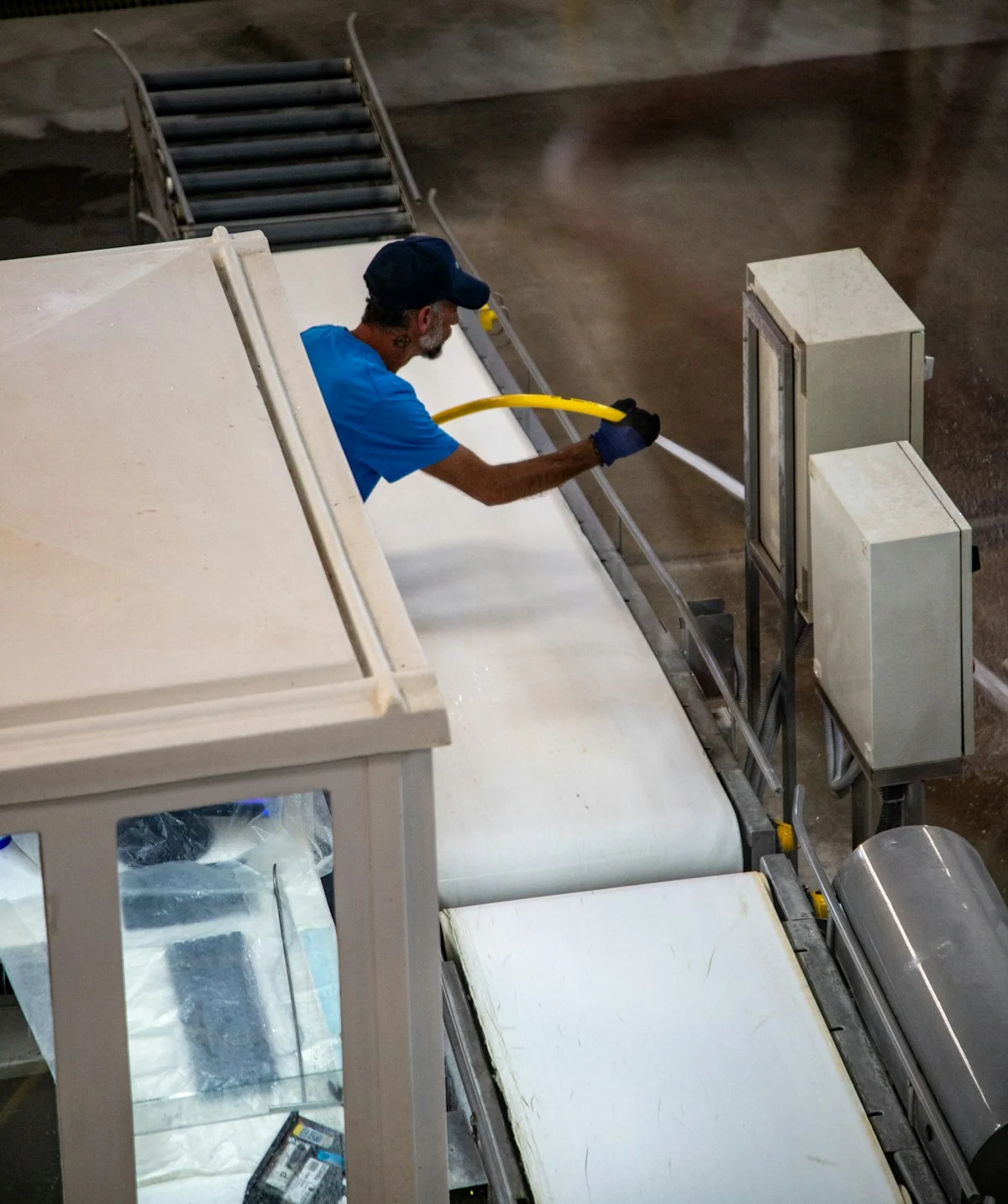
The regulator’s test is provability: businesses “must be able to prove that you’re cleaning effectively.” The spray bottle proves nothing on its own – the record is the proof.
That is why “not cleaning thoroughly” sits near the top of the prosecution list – the log gap and the dirty surface are the same finding in two files. Done properly, cold room disinfection leaves a paper trail an auditor can walk: schedule, products, frequencies, signatures, corrective actions.
Before the next audit, hand this six-line cold room disinfection self-audit to whoever owns the log:
- The schedule is written down and states what needs cleaning, how often, and which products.
- Every disinfectant on the shelf carries a BS EN 1276 or BS EN 13697 label code.
- Contact times are in the SOP, with “keep wet for X minutes” spelled out.
- Dead zones – drains, gaskets, tracks, corners – appear as named lines, never as “floors”.
- Every completed line carries a signature and a date from the day the work ran.
- Corrective actions record what failed and how it was put right.
Rooms make this easier or harder by build. Moisture control removes the water that microbes need – our cold room humidity and insulated panels guide owns that physics. Kit-built rooms empty, deep clean and restart faster, which our câmaras frigoríficas montadas vs modulares comparison prices out. Pick hardware that wants the schedule, and the schedule keeps itself.
Frequently Asked Questions About Cold Room Sanitation
How often should a cold room be disinfected?
For commercial rooms, vendor guidance puts cold room disinfection at least monthly, leaks and spills immediately, and a professional deep clean about every 6 months. Daily spill wipe-downs and weekly shelf work sit on top of that rhythm.
Which disinfectant is safe for a cold room?
One labeled food-safe and non-abrasive, whose label carries BS EN 1276 or BS EN 13697. Skip anything scented or abrasive – it can taint food and scratch panel skins – and keep chemicals stored away from food.
How long should disinfectant stay on the surface?
For the contact time printed on its label, with the surface staying wet the whole while. Typical quaternary ammonium formulations run 3-5 minutes. Let everything dry – or towel it dry – before restocking.
Where does hygiene fail first in a cold room?
At floor drains, door gaskets, door tracks and floor corners. Standing water turns to slippery ice, gasket rubber perishes and harbors soil, and tracks jam with debris – wipe each by name in the schedule.
What records do inspectors ask to see?
A written cleaning schedule stating what needs cleaning, how often and which products, plus signed records that the work happened and notes on how you put anything wrong right.