

Most facility planners treat cold room panels as interchangeable commodity stock. That approach ignores the single biggest variable in cold storage ROI: thermal performance across your target temperature range. Production facilities manufacture panels from 50mm to 200mm, but thickness alone doesn’t guarantee insulation performance. The foam core chemistry, facing gauge, and joint design work together to control heat transfer—and they fail together when any component falls short.
Real specification review starts with three questions: What K-value does your foam core deliver at operating temperature? Does the fire rating match your jurisdiction’s submission requirements? Will the joint system maintain its seal after years of door cycling? This breakdown answers those questions using measured data, not vendor brochures, so you can size refrigeration equipment correctly and pass inspections on the first submission.
Spot the Key Specs That Actually Matter
Stop chasing initial unit prices. Your cold room’s profitability depends on aged thermal drift, jurisdiction-specific fire codes, and washdown-resistant facings that survive long before the warranty expires.
When you are comparing insulated sandwich panels for refrigerated logistics, most supplier datasheets look interchangeable on paper. The failures that actually bleed margin show up years later: compressor oversizing, interstitial moisture buildup, and failed health inspections because the surface couldn’t tolerate aggressive sanitation cycles. We have seen project after project derailed by buyers who validated the panel’s appearance instead of its long-term engineering behavior. Here is what you actually need to audit before signing off on a purchase order.
Thermal Conductivity K-Values Across Foam Core Types
A K-value is useful, but it is only meaningful if you know whether it represents fresh foam or stabilized foam. New cellular insulation contains blowing agents that have not yet reached equilibrium with the surrounding environment, which means initial laboratory readings often look aggressively favorable compared to real-world performance after three to five years of continuous operation.
Polyisocyanurate generally retains its thermal advantage longer because its molecular structure resists gas diffusion better than standard polyurethane. Expanded polystyrene remains a viable option for moderate-duty storage, but its conductivity climbs noticeably in deep-freeze zones where sustained thermal gradients stress the cell walls. The material choice should never be made on paper alone; it has to match your actual duty cycle.
- Aged Performance vs. Initial Rating: Compressor sizing and monthly electricity spend depend on steady-state resistance. Specifying panels based solely on factory-fresh K-values usually forces you to oversize the refrigeration plant and pay for unused capacity.
- Cell Structure Integrity: Uniform density prevents micro-fractures during repeated freeze-thaw cycles. When foam shrinks or separates from the outer skin, thermal bridges form at fastener points and panel joints.
- Independent Lab Validation: Third-party aging tests reveal drift rates that internal manufacturer certificates often smooth over. Always ask for the certificate issuer and the test duration before approving a core selection.
Panel Thickness Mapping to Storage Temperature Ranges
Mapping wall depth to a target temperature sounds linear, but it is rarely that simple. Ambient humidity, door-open frequency, product heat load, and defrost intensity all push the required insulation level in different directions. A facility in a coastal tropical market needs substantially more barrier performance than an identical warehouse in an arid, temperate climate, purely because the vapor drive is far more aggressive.
We engineered our manufacturing process to eliminate on-site cutting waste by producing precision-manufactured dimensions straight from the line. Our factory-controlled lamination pressure guarantees uniform core distribution from edge to edge, which means every installed panel carries the same structural and thermal load without weak spots near fasteners.
- Ambient Humidity Load: High-moisture environments demand thicker barriers and superior vapor seals to stop interstitial condensation from forming inside the wall cavity.
- Defrost Cycle Severity: Frequent hot-gas defrosting creates rapid temperature swings. Heavier panels absorb these spikes better, protecting the refrigeration plant from short-cycling and mechanical fatigue.
- Local Energy Code Minimums: Several jurisdictions mandate baseline R-value thresholds for commercial cold stores regardless of the internal setpoint. Always cross-check regional building regulations before finalizing the panel schedule.
Fire Resistance Ratings Required for Cold Room Projects
Cold rooms are deceptively high-risk environments for fire propagation. They are tightly sealed, packed with combustible insulation, and frequently contain electrical components mounted directly against the panel surfaces. When inspectors reject a refrigeration installation, it is almost never because the panel lacked basic flame retardancy; it is because the submitted classification did not align with the specific code pathway the local authority having jurisdiction requires.
European builds typically reference EN 13501-1, while North American projects lean on UL or ASTM pathways. For high-occupancy or tightly sealed facilities, we supply fire-rated polyisocyanurate formulations that achieve Euroclass B-s1-d0, which satisfies the most demanding compliance checkpoints without forcing architects to bolt on expensive external fireproofing layers.
- Smoke Density and Toxicity: A panel can resist ignition but still fail inspection if it releases dense, corrosive smoke. The “s1” and “d0” ratings specify low smoke production and no flaming droplets, which directly impacts occupant evacuation safety.
- Accredited Test Report Validity: Ensure the certificate came from an independent, internationally recognized laboratory, not an internal quality desk. Expired or mismatched core density reports are the fastest way for customs or building inspectors to flag a shipment.
- Joint Sealant Compatibility: Fire-rated panels require matching sealants that maintain elasticity during thermal contraction without off-gassing into the storage zone or compromising the fire barrier at seams.
Hygienic Facing Materials for Food Safety Compliance
If your cold room stores proteins, dairy, or ready-to-eat goods, the inner surface must do far more than look clean. It has to resist microbial adhesion, survive repeated chemical washdowns, and maintain a non-porous barrier even after months of abrasive scrubbing. Many facility managers skip this step until they fail a health audit, only to discover that panel replacement costs dwarf the original material savings.
Gelcoat-finished fiberglass facings perform exceptionally well in food-grade zones because the resin layer cures into a smooth, impervious membrane. Our design team specifically tuned these surfaces to prevent condensation pooling, which is the primary driver of mold growth in low-temperature storage. Unlike bare metal skins that can scratch, pit, or corrode at seam intersections, a properly cured gelcoat maintains its sanitary profile through aggressive sanitizer cycles without degrading the underlying structural reinforcement.
- Clean-in-Place Chemical Compatibility: Verify that the facing tolerates the pH and temperature of your facility’s sanitation regimen. Some polymer coatings break down under quaternary ammonium compounds or peracetic acid washes.
- Seam and Fastener Protection: Even the best surface fails if water penetrates panel edges. Interlocking profiles and sealed mounting points keep sanitation fluids from reaching the insulating core.
- Inspection Visibility: Matte or heavily textured finishes hide wear but can trap organic residue. A smooth, non-glare coating allows health inspectors to spot contamination quickly without compromising footing in wet walkways.
| Specification Parameter | Details & Options | Engineering Benefit | Application Value |
|---|---|---|---|
| Insulation Core Material | PU, PIR, XPS | PIR formulations deliver verified thermal conductivity; optimized R-value per thickness for energy efficiency. | Optimal balance of fire safety and thermal performance for cold storage zones. |
| Panel Facings | GRP/FRP Gelcoat, Stainless Steel, Aluminum | Gelcoat finish provides a waterproof, smooth, anti-condensation surface with enhanced chemical resistance. | Superior hygiene standards for food-safe, washdown, and sterile environments. |
| Dimensions & Precision | Thickness 50mm–200mm; Exact Custom Lengths | Factory-controlled lamination pressure ensures uniform density and eliminates thermal bridging at joints. | Reduces on-site cutting waste and lowers installation labor costs. |
| Foam Density & Resilience | High-density rigid foam; Closed-cell moisture barrier | Maintains structural integrity and insulating R-value under repeated thermal cycling and humidity exposure. | Extends service life and prevents degradation in demanding industrial cold rooms. |
| Testing & Technical Support | λ-value Data Sheets, MSDS, 24h Multilingual Response | Data-backed performance validation meets strict building codes and accelerates engineering approvals. | Streamlined project compliance and reliable technical assistance for global deployments. |

PU vs. PIR Cores: Which Insulation Performs Best?
PIR cores outperform PU in fire safety, thermal retention, and deep-freeze reliability. PU remains a practical, cost-optimized choice for standard chilled storage where strict fire codes do not apply.
Thermal Conductivity & Long-Term Insulation Retention
Both polyurethane (PU) and polyisocyanurate (PIR) are closed-cell foam cores, but their molecular structures respond differently to heat flow and aging. PIR delivers a slightly lower initial thermal conductivity, typically bracketing 0.020–0.022 W/(m·K), compared to PU at roughly 0.022–0.024 W/(m·K).
More importantly, PIR retains its insulating value over time because the blowing agents degrade more slowly inside the rigid matrix. For cold room operators, this means fewer panel thicknesses are needed to hit the same R-value target, directly reducing thermal bridging at joints and fasteners.
- Typical Lambda (λ) Range: PIR ~0.020–0.022 W/(m·K); PU ~0.022–0.024 W/(m·K).
- Ageing Performance: PIR exhibits slower thermal drift, maintaining design R-values across a longer service life.
- Panel Thickness Impact: A thinner PIR core can match the thermal resistance of a thicker PU core, freeing up internal cubic capacity.
Fire Self-Extinguishing Behavior
This is where the two cores diverge sharply. PU is inherently combustible and relies heavily on added flame retardants. When exposed to direct flame, PU softens, melts, and can drip burning material, which accelerates fire spread. PIR, by contrast, undergoes char formation upon heating.
This carbonized surface acts as a physical barrier that limits oxygen access and suppresses further combustion. For projects governed by EN 13501, BS 476, or NFPA-adjacent standards, PIR is frequently the only foam core that meets Class B/s1/d0 or equivalent fire classifications without excessive additive packages.
- Reaction to Flame: PU melts and drips; PIR chars and self-extinguishes once the ignition source is removed.
- Toxic Gas Release: PIR generally produces lower heat release rates and reduced smoke density during combustion events.
- Code Compliance: PIR is the preferred core for high-occupancy facilities, pharma cold rooms, and regions with strict fire-load mandates.
Density & Structural Trade-offs
Density dictates how much mechanical load a foam core can absorb before face-sheet delamination occurs. Standard PU cores typically run between 38–48 kg/m³, while PIR cores achieve equivalent or higher compressive strength at slightly lower densities, commonly 35–45 kg/m³.
Lower density matters in logistics-heavy supply chains because it reduces total panel weight without sacrificing rigidity. However, if a project demands heavy point loads, such as racking systems bolted directly into cold room walls, specifying the upper end of the density bracket for either core minimizes local deformation.
- Standard PU Density: 38–48 kg/m³ for typical cold room sandwich panels.
- Standard PIR Density: 35–45 kg/m³, delivering comparable stiffness at reduced mass.
- Load Sensitivity: Higher-density cores resist puncture and fastener pull-out better under racked storage conditions.
Optimal Temperature Application Ranges
Temperature selection should align with the operational profile of the facility. PU performs reliably in general chilled storage environments ranging from approximately +2°C to -18°C. It is widely used in produce cold rooms, beverage warehouses, and ambient-to-chill logistics hubs where energy budgets drive material selection.
PIR extends comfortably into deep-freeze and cryogenic-adjacent zones, routinely supporting -25°C to -45°C operations. The tighter molecular crosslinking in PIR also reduces thermal contraction stress during rapid cool-down cycles, which helps prevent micro-cracking at panel seams in facilities that undergo frequent door cycling.
- PU Ideal Zone: Chilled storage, +2°C to -18°C, standard food logistics.
- PIR Ideal Zone: Deep-freeze, blast freezing, and -25°C to -45°C applications.
- Cycle Resistance: PIR handles rapid thermal shifts with lower risk of seam fatigue in high-traffic cold rooms.
Match Panel Thickness to Your Target Temperature
Material selection at this point sets the thermal efficiency, fire rating, and weight of the finished assembly. Balance R-value requirements against span capability and code-mandated fire performance.
The Critical Relationship Between Thickness and Thermal Efficiency
How to Choose the correct panel thickness is the single most impactful factor in determining a cold storage facility’s lifecycle energy efficiency and operational stability.
Panel depth serves as the primary control for thermal resistance, scaling proportionally with the Delta T required to maintain lower internal temperatures. Increasing this depth is critical to minimize heat gain and thermal bridging, necessitating a careful balance between the higher capital expenditure (CapEx) of thicker panels and the long-term operational expenditure (OpEx) of refrigeration energy costs.
Under-specifying thickness results in excessive compressor runtimes and temperature fluctuations, directly jeopardizing inventory integrity. Conversely, over-specifying adds unnecessary material costs without proportional energy returns. The following mapping outlines standard industry specifications for Polyurethane (PU) and Polyisocyanurate (PIR) cores, which are the prevailing standards for high-performance cold storage due to their low thermal conductivity.
Standard Thickness Mapping by Temperature Zone
While specific project requirements may vary based on climate zone and humidity control, the table below provides the baseline technical specifications for matching panel thickness to storage temperature ranges. These figures assume the use of high-density PU or PIR foam cores.
| Target Temperature Range | Application Type | Recommended Panel Thickness | Thermal Performance Goal |
|---|---|---|---|
| 0°C to +12°C (32°F – 54°F) | Cooling Rooms / Processing Areas | 75mm – 100mm | R-value ~ 3.5 – 4.5 |
| -18°C to -23°C (0°F – -10°F) | Standard Freezer / Storage | 100mm – 120mm | R-value ~ 5.0 – 6.0 |
| -25°C to -35°C (-13°F – -31°F) | Deep Freeze / Blast Freezing | 150mm – 180mm | R-value ~ 7.5 – 9.0 |
| Below -40°C (-40°F) | Ultra-Low Temp / Specialized | 200mm+ | R-value > 10.0 |
Balancing Compressor Load and Material Costs
A common error in procurement is selecting thinner panels to reduce initial material spend, ignoring the cascading effect on refrigeration systems. Increasing panel thickness from 100mm to 150mm significantly reduces the thermal load (kW/hr) entering the structure. This reduction allows for the specification of smaller, less expensive refrigeration compressors and condensing units. Additionally, the reduced duty cycle extends the lifespan of the HVAC equipment.
- Thermal Inertia: Thicker panels provide greater thermal mass, helping maintain stable internal temperatures during power outages or defrost cycles, which is critical for deep freeze applications.
- Condensation Control: In high-humidity environments, insufficient thickness can lower the internal surface temperature of the panel below the dew point, leading to condensation and ice formation. Adequate thickness ensures the facing remains warm enough to prevent moisture buildup.
Core Material Variations and Thickness Equivalency
While PU and PIR are the benchmarks for thermal efficiency, projects using alternative core materials like XPS (Extruded Polystyrene), PET, or PVC Foam must adjust their thickness calculations accordingly. These materials generally possess higher thermal conductivity values than PU/PIR, meaning they require greater thickness to achieve the same R-value.
For instance, a 100mm thick PU foam panel provides roughly equivalent insulation to a 120mm–130mm thick XPS panel. When selecting lightweight sandwich panels for applications such as refrigerated truck bodies or mobile structures, where weight is a critical constraint, using higher-performance cores like CFRT (Continuous Fiber Reinforced Thermoplastic) facings with PU cores allows for optimal thermal performance without adding excessive structural weight.
When requesting quotes, always demand the declared thermal conductivity (Lambda value) in W/m·K alongside the thickness. A “100mm panel” is only as good as the Lambda value of the foam inside. Premium PU/PIR cores typically range between 0.020 and 0.022 W/m·K, whereas lower-grade foams may exceed 0.026 W/m·K, drastically reducing efficiency despite the thickness.
Pick a Facing That Withstands Cleaning and Wear
The facing material is the first line of defense against sanitation chemicals, thermal cycling, and physical impact. Selecting based on upfront cost rather than surface integrity drives premature replacement and contamination risk.
Cold room operators often underestimate how aggressive the internal environment is. A panel facing endures repeated washdowns, temperature fluctuations, and mechanical contact from pallets and forklifts. If the surface degrades, microscopic cracks become reservoirs for moisture and bacteria. The choice of facing determines whether the panel maintains a smooth, impervious barrier or enters a cycle of repair and replacement.
Facing Materials for Cleanability and Wear: Which Should You Choose?
Not all facings perform equally under rigorous cleaning regimes. Below is a breakdown of the most common options used in insulated sandwich panels, evaluated for hygiene maintenance and physical durability.
- Stainless Steel: Offers superior cleanability and corrosion resistance. Ideal for high-pressure washdown zones. However, it is heavier and more susceptible to denting from impact compared to composite alternatives.
- Gelcoat GRP / FRP: Provides a non-porous, smooth surface that resists water absorption and mold growth. The gelcoat layer delivers waterproof and flat properties, making it suitable for humid or wet environments where metal facings may corrode.
- Aluminum: Lightweight and naturally corrosion-resistant. Embossed variants add grip but can trap residue in textures. Smooth aluminum performs well in dry cold storage but may degrade under highly alkaline cleaning agents.
- CFRT (Continuous Fiberglass Reinforced Thermoplastic): Thinner and more resilient than traditional mats. It combines lightweight characteristics with improved impact resistance, suitable for applications where weight reduction and durability are both priorities.
- Galvanized or Painted Steel: Cost-effective and strong against abrasion. Performance depends on coating integrity. Once the finish is scratched through to the base metal, corrosion can spread underneath the panel skin.
Surface Smoothness and Sanitation Standards
Food safety and pharmaceutical storage regulations require smooth, impervious surfaces in contact zones. Standards such as FSSC 22000 mandate facings that can be effectively sanitized without retaining organic matter. A porous or degraded surface fails this requirement regardless of the insulation core performance.
When selecting a facing for hygiene-critical cold rooms, prioritize materials that maintain a consistent finish over time. Gelcoat GRP panels are frequently specified in wet environments because they resist mold and mildew while offering a flat, easy-to-clean interface. For operations requiring metal hygiene, stainless steel remains the benchmark, provided budget allows for its weight and cost premium.
Wear Resistance in High-Traffic Installations
Physical wear is just as critical as chemical resistance. Cold rooms with frequent forklift traffic or manual pallet handling experience constant impact against lower panel sections. Aluminum and thin steel facings can dent or puncture under repeated stress. Composite facings like CFRT and reinforced thermoplastic variants offer higher resilience, absorbing impact without cracking.
Thermal cycling also stresses facing materials. Repeated expansion and contraction can cause micro-fractures in rigid coatings. Fiberglass-reinforced panels, including those with balsa or plywood core options, provide structural stability that reduces facing fatigue. For mobile or vibration-prone applications, such as refrigerated truck bodies, flexible yet durable facings extend service life significantly.
Always match the facing to the cleaning protocol. If your sanitation team uses harsh alkaline or acidic cleaners, avoid unprotected aluminum. Specify gelcoat GRP or coated steel to prevent surface degradation and maintain long-term hygiene compliance.
Which Fire Rating and Load Capacity Do You Need?
This factor has a direct bearing on project performance and long-term cost. Addressing it with specific data rather than general assumptions leads to better outcomes.
Balancing Fire Safety Compliance with Structural Integrity
How to Choose the correct fire rating and load capacity is not merely a technical checkbox; it is the primary defense against project stoppages and legal liability. For buyers, the anxiety around regulatory compliance is well-founded—using panels that fail to meet local building codes can result in failed health inspections, severe fines, or total facility closure. The core dilemma often lies in balancing superior fire resistance against the structural weight of the panel, especially in multi-story cold storage warehouses.
Decoding Fire Ratings: Reaction to Fire and Smoke Density
When evaluating fire ratings, understanding the specific behavior of the core material under heat is critical. Standard PU foam typically achieves a lower fire classification (often Class C or D in Euroclass systems, or B2/B3 in China) and can produce melting droplets that spread fire.
In contrast, PIR foam modifies the chemical composition to create a thermoset polymer that chars rather than melts. For export projects to Europe or North America, specifying panels that achieve at least Euroclass B-s1,d0 is frequently required for high-occupancy or industrial logistics centers.
- PIR (Polyisocyanurate): Offers enhanced fire resistance with limited organic combustibility. It maintains structural integrity longer under high temperatures compared to standard PU, making it the optimal choice for regulatory compliance.
- Mineral Wool / Rockwool: A non-combustible core (Euroclass A1 or A2) that provides the highest level of fire safety. It is essential for high-risk zones but significantly increases the panel’s dead load.
- Smoke Generation (s1/s2/s3): In enclosed cold storage, smoke toxicity is often more lethal than the fire itself. Always verify that the core material is tested for low smoke emission (s1) and no flaming droplets (d0).
Load Capacity: Compressive Strength and Lateral Stability
Load capacity in composite panels is determined by two distinct factors: the compressive strength of the core material and the tensile strength of the facings. For refrigerated truck bodies or cold room flooring, the panel must withstand dynamic point loads (pallet jacks, forklifts) without permanent deformation.
A standard PU or PIR panel typically requires a compressive strength of at least 150-200 kPa for flooring applications. However, when specifying for walls or ceilings in high-bay warehouses, the focus shifts to the panel’s ability to support its own weight and resist wind suction or negative pressure.
Do not assume that a thicker panel automatically guarantees higher load-bearing capacity. If the core density is too low, increasing thickness only improves insulation, not strength. Always request compressive strength test data (in kPa) specific to the core density.
The Weight Trade-Off: Fire Performance vs. Dead Load
A critical oversight in project planning is the cumulative weight of the chosen panels. Mineral wool panels offer the best fire protection but are roughly twice as heavy as foam-based equivalents. In retrofit projects or multi-story mezzanine installations, this increased “dead load” can exceed the structural limits of the existing steel framework. For these scenarios, high-performance PIR or specialized fiberglass-reinforced panels offer a compromise, providing Class B fire ratings with a lightweight profile that reduces the structural steel requirement.
- Multi-Story Facilities: Prioritize lightweight cores (PIR/PET) with high-strength facings to minimize column size and foundation costs.
- High-Risk Industrial Zones: The dead load penalty of Mineral Wool is a necessary investment to meet non-combustible insurance requirements and fire codes.
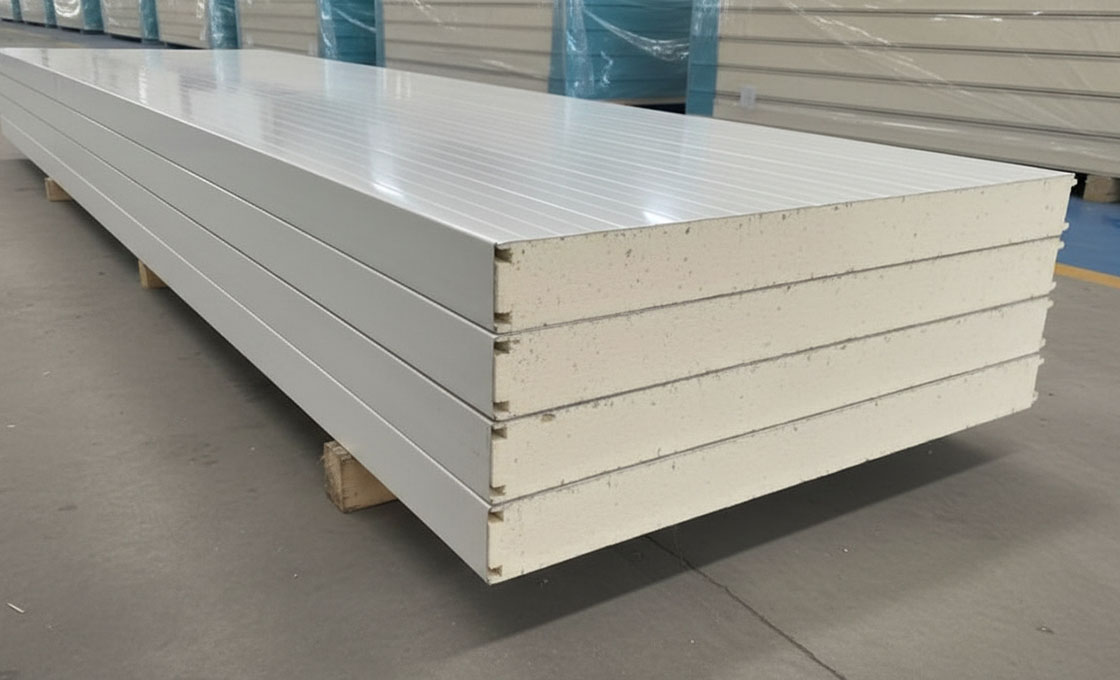
Should You Choose Tongue-and-Groove, Hidden Clips, or Interlocks?
The joint profile selected for cold room sandwich panels determines long-term energy efficiency, moisture management, and installation labor cost. Tongue-and-groove systems provide the most reliable passive air seal, hidden clip profiles deliver the fastest field erection, and interlock mechanisms are reserved for high-load roofing and structural freezer spans.
Thermal Bridge Management Across Joint Profiles
Every panel joint represents a potential failure point for conductive heat gain. The geometry of the edge connection either interrupts the thermal path or creates a direct conductive bridge through the facing material. Specifiers should evaluate how each profile handles the transition between exterior cladding and interior insulation core.
- Tongue-and-Groove: The interlocking edge naturally separates the outer and inner facings, forcing heat to travel through the low-conductivity foam core rather than metal-to-metal. When paired with a continuous gasket channel, thermal bridging is minimized at the perimeter.
- Hidden Clips: Concealed bracket hardware can penetrate the insulation boundary if polymer thermal breaks are omitted. Systems without dedicated insulating isolators risk localized cold spots along fastener lines.
- Interlocks: Positive mechanical engagement resists panel separation but requires precise facing termination. Without an integrated thermal break strip, the metal engagement surfaces can track condensation across the joint line.
Air-Tightness and Long-Term Seal Reliability
Cold room operations depend on maintaining a stable vapor barrier across decades of freeze-thaw cycling. The joint design must accommodate panel settling, thermal expansion, and compressor vibration without degrading the gasket interface.
Tongue-and-groove joints with molded elastomeric gaskets remain the industry baseline for vapor-tight performance. The compressed seal compensates for minor fabrication variances and maintains continuity even after structural settling. Hidden clip assemblies shift the reliability burden to clip spacing and gasket compression ratings, making long-term performance highly dependent on fastener torque consistency. Interlock systems excel under high wind pressure or mechanical impact but offer less inherent forgiveness for panel warping over extended service life.
Installation Speed vs. Field Tolerance
Erection methodology directly impacts project timelines and specialized labor requirements. General contractors typically weigh installation velocity against the skill ceiling needed to achieve a sealed envelope.
- Hidden Clip Systems: Fastest assembly cycle. Panels attach independently to the substrate, allowing rapid alignment and individual replacement without disturbing adjacent rows. Ideal for large-wall commercial buildouts with strict schedule pressure.
- Tongue-and-Groove Systems: Requires sequential panel alignment into adjacent channels. Demands skilled labor and precise leveling, but produces a unified wall plane that settles uniformly.
- Interlock Mechanisms: Moderate assembly pace with strict tolerance requirements. Best suited for roofing applications and heavy-duty freezer environments where mechanical resistance outweighs rapid deployment.
⚠️ Critical Pitfall:Specifying exposed-fastener hidden clip profiles without verifying gasket compression ratings can lead to long-term seal degradation under repeated freeze-thaw cycling. Always require manufacturer-published compression set data before locking a project specification.
Do Cheaper Panels Really Cost More Over Time?
Higher initial panel quality typically yields a lower Total Cost of Ownership (TCO) by reducing operational energy spend, allowing for smaller HVAC systems, and extending maintenance intervals.
Annual Energy Consumption Differences by Insulation Core
When evaluating long-term profitability, the insulation core’s thermal stability is the primary driver of OpEx (Operating Expense). While Polyurethane (PUR) and Polyisocyanurate (PIR) dominate the market, their performance over time differs significantly due to “thermal drift.” Lower-quality PUR cores often experience faster gas diffusion, causing the insulation value to degrade by 10-15% within the first few years.
In contrast, advanced PIR formulations maintain a more stable Lambda value, ensuring the cooling load does not creep up annually. This discrepancy forces refrigeration compressors to work harder and run longer cycles to compensate for heat gain, directly inflating electricity bills.
Beyond the material chemistry itself, the consistency of the foam structure plays a critical role. Variations in density create microscopic thermal bridges that act as highways for heat transfer. In our experience, panels manufactured with strict factory-controlled lamination pressure eliminate these internal inconsistencies. This uniformity ensures that the thermal performance promised on day one is effectively maintained throughout the facility’s lifecycle, preventing the silent capital drain of energy leakage.
HVAC Equipment Sizing Benefits of Superior Thermal Performance
The insulation quality directly dictates the capacity of the refrigeration plant required for the project. Many contractors fall into the trap of oversizing HVAC equipment to compensate for anticipated thermal loss in substandard panels. While this solves the temperature maintenance issue, it creates a massive inefficiency: compressors running at low loads or short-cycling, which accelerates wear and tears. Conversely, specifying high-performance sandwich panels with verified low thermal conductivity allows engineers to downsize the refrigeration plant.
Reducing the compressor capacity by even a few kilowatts translates to immediate CapEx (Capital Expenditure) savings on the machinery procurement and electrical infrastructure. Additionally, a correctly sized system operating at optimal efficiency consumes significantly less power. This is a critical strategic point for buyers: investing in a higher-spec wall panel creates a budget surplus that can be reallocated to more efficient cooling technology, rather than spending it just to overcome the wall’s deficiencies.
Shipping Weight Advantages of Lightweight Sandwich Panel Designs
Logistics and structural engineering costs are frequently overlooked in the “cheap vs. expensive” panel debate. Traditional heavy-weight solutions or panels with excessive moisture absorption add significant dead load to the structure. For international projects, this weight directly impacts the overall project cost.
Heavier panels mean fewer square meters fit into a standard container, increasing the shipping cost per unit of area. In vehicle applications like refrigerated trucks or RVs, heavier panels reduce payload capacity and increase fuel consumption during the vehicle’s operational life.
Modern lightweight cores, such as PET foam or advanced honeycomb structures, offer high strength-to-weight ratios without sacrificing rigidity. We optimize container loading plans to ensure every cubic meter of shipping space is utilized effectively. By reducing the weight per square meter, buyers not only save on freight but also often reduce the steel requirements for the building’s support framework, offering a double-dip on cost savings that heavier, cheaper alternatives cannot match.
Lifecycle Durability and Replacement Frequency Analysis
The most expensive panel is the one you have to replace twice in ten years. Budget-friendly panels often utilize facings with minimal corrosion protection or foam cores that absorb moisture over time. Once water penetrates the facing—often through micro-cracks or poorly sealed joints—the insulation value plummets, and the structural integrity of the panel is compromised. In hygiene-sensitive environments, this moisture creates a breeding ground for mold behind the walls, necessitating a complete strip-out and replacement to meet health codes.
Investing in durable facings, such as GRP/FRP with a high-quality gelcoat finish, acts as an impermeable barrier against humidity and cleaning chemicals. This durability extends the service life well beyond standard metal-clad options.
For facility owners, this means the depreciation period extends, and the capital replacement cost is deferred for decades. The ROI calculation must include the cost of downtime; tearing down a cold room for panel replacement halts operations, causing revenue loss that far exceeds the material cost of the original panels.
| Cost Driver | Low-Quality Panel Risk | Rax Panel Engineering Standard | Long-Term Financial Impact |
|---|---|---|---|
| Thermal Efficiency | Density inconsistencies create thermal bridges, forcing refrigeration systems to run continuously. | Factory-controlled lamination pressure ensures uniform density across PU, PIR, and XPS cores with verified thermal conductivity. | Substantial reduction in electricity consumption and compressor wear over the facility lifecycle. |
| Moisture & Condensation | Unsealed facings allow condensation buildup, causing mold, structural decay, and hygiene violations. | GRP/FRP gelcoat facings provide a waterproof, smooth, and hygienic barrier specifically designed for cold environments. | Extended panel service life and minimized risk of stored product spoilage due to contamination. |
| Installation Labor & Waste | Fixed standard dimensions require on-site cutting, generating material scrap and increasing labor hours. | Precision manufacturing delivers exact panel lengths from 50mm to 200mm tailored to specific project requirements. | Elimination of installation waste and significant savings on on-site labor fees. |
| Regulatory Compliance | Non-compliant fire ratings can result in failed inspections, legal penalties, or mandatory facility shutdowns. | Advanced PIR formulations verified to achieve Euroclass B-s1-d0 fire safety ratings. | Avoided regulatory fines and ensured continuous operational approval for industrial cold storage. |
| overall project cost | Inefficient packaging and poor logistics planning inflate shipping expenses per square meter. | Optimized container loading plans and rigorous logistics management by an experienced international sales team. | Lower total delivered cost through supply chain efficiency, offsetting any initial price difference. |
Verify Test Reports Against Local Building Codes
Test reports must match the exact jurisdiction, lab accreditation, and project application—not just look technically impressive on paper.
Submitting non-compliant or misaligned documentation is one of the fastest ways to kill a cold storage project before construction even begins. Inspectors do not care about marketing copy; they care about accredited test certificates that reference the correct regional standard, valid testing temperatures, and matching panel configurations. Every submission packet needs to prove that the supplied sandwich panels meet the fire, thermal, and hygiene thresholds of the local building code.
Required Fire Test Standards for Cold Room Submissions
PIR-based cold room panels commonly achieve Euroclass B-s1-d0 when tested according to EN 13501-1. That rating indicates limited flame spread, no dripping particles, and low smoke development. We regularly see procurement teams accept a generic fire certificate only to realize it was issued under an outdated standard or tested on a different core formulation than what is actually being shipped. Always cross-reference the test report’s sample configuration against your final panel order.
- EN 13501-1: Required for EU, UK, and many Middle Eastern exports. Look for B-s1-d0 or higher for cold room enclosures.
- ASTM E84 / UL 1040: Standard for US and Canadian commercial builds. Class A or Class 1 thermal barrier performance is typical.
- AS/NZS 1530.4: Required for Australia and New Zealand cold chain facilities. Flame spread index thresholds apply.
Never submit a manufacturer’s marketing PDF as a code compliance document. Building authorities require third-party lab certificates issued within the last 5 years, ideally from an ISO/IEC 17025 accredited facility.
Validating Thermal Performance Data from Accredited Laboratories
Thermal conductivity is not a fixed number across all operating temperatures. Cold room panels must maintain performance at low mean temperatures, usually measured at 0°C, -10°C, or -25°C depending on the storage zone. Lab data should always state the mean temperature at which the k-value or lambda value was recorded.
We verify thermal data by checking three things: the test method (EN 12667 or ISO 11613), the age of the certificate, and whether the measurement matches the actual core density and facing combination being delivered. Factory-controlled lamination pressure and precise foam injection allow us to maintain uniform core density, which eliminates thermal bridging at joints and fasteners. Generic SIP manufacturers often cannot provide consistent k-values because their production tolerances drift between batches.
- Test Method Verification: Confirm the report references EN 12667, ISO 11613, or ASTM C518 depending on the target market.
- Mean Temperature Label: A k-value without a stated mean temperature is legally useless for cold room design calculations.
- Batch Consistency Check: Request density logs alongside thermal reports to prove the shipped panels match the tested samples.
Food and Pharma Sanitation Certification Requirements
Cold rooms storing food, pharmaceuticals, or biologics face stricter inspection criteria than standard warehouse insulation. The interior facing material must resist repeated washdowns, harsh cleaning chemicals, and microbial growth without degrading or leaching compounds into the storage environment.
For EU markets, panel facings used in food-contact-adjacent zones should comply with Regulation (EC) No 1935/2004. In the US, FDA 21 CFR compliance is the baseline expectation for polymeric sheets and coatings. GRP panels with a high-quality gelcoat finish provide a non-porous, smooth surface that meets these sanitation demands while remaining structurally rigid. Stainless steel facings are preferred for pharma cleanrooms where chemical resistance and metal washdown frequency are highest.
- Surface Porosity: Reject any panel with visible texture, pinholes, or unsealed joints in the sanitary zone.
- Chemical Resistance: Verify that gelcoat or coated aluminum can withstand quaternary ammonium disinfectants without clouding or cracking.
- Certification Scope: Food-safe compliance covers the facing and adhesive, not just the foam core.
Regional Building Code Alignment for Export Projects
Exporting cold room panels means navigating multiple regulatory frameworks simultaneously. A panel that clears inspection in Germany may fail fire load calculations in California or vapor barrier requirements in Southeast Asian tropical storage facilities. Project engineers must map each panel specification to the local building authority’s checklist before procurement.
Structural load capacity, wind resistance, fire separation distances, and thermal bridging allowances vary by region. Our international sales team reviews export project specifications against the destination country’s building code requirements before finalizing panel thickness, facing type, and joint system. This prevents costly rerouting, customs holds, or on-site rejection after delivery.
- Vapor Barrier Migration: Tropical climates require higher vapor diffusion resistance than temperate European storage zones.
- Seismic & Wind Loads: Panel span ratings must be validated against local structural codes, not just thermal performance.
- Customs Documentation: Include material safety data sheets, fire classification certificates, and origin declarations with every container shipment.
Can a single test report satisfy multiple countries?
Rarely. Most building authorities require testing under their own national or regional standard. A Euroclass B-s1-d0 certificate is recognized in Europe, but it will not automatically satisfy ASTM E84 requirements in the US. Some manufacturers can arrange dual-standard testing, but it must be requested upfront and paid separately.
What happens if the submitted report does not match the shipped panel?
Inspection failure, project delays, and potential contract penalties. If the foam core density, facing thickness, or fire retardant formulation changes during production, the original test report becomes invalid. Always request pre-shipment certificates that match the exact batch being loaded.
Key Takeaways
Pick PIR when storage density matters; its R-value beats PU foam without adding bulk. Low-density cores leak heat, run compressors harder, and cost you more by year four. Verify fire ratings against local codes before panels ship. We build custom thickness cold storage sandwich panels and our engineering team spots specification gaps that kill project timelines.
- Ask for thermal conductivity reports from accredited labs, not just the supplier’s spec sheet.
- Confirm the facing gauge handles your sanitation chemicals before you mix the order.
- Position our engineering team as your technical backup for early-stage designs; share temperature targets and layout sketches to resolve sizing uncertainties before you lock in a panel spec.
Frequently Asked Questions
This factor has a direct bearing on project performance and long-term cost. Addressing it with specific data rather than general assumptions leads to better outcomes.
What role does the vapor barrier play in cold rooms?
A vapor barrier prevents moisture migration into the insulation core, which can degrade thermal performance and cause structural damage over time. In cold environments, the barrier is usually positioned on the warm side of the panel to stop humid air from reaching the foam. Proper sealing at joints and penetrations is essential to maintain the panel’s long-term insulating effectiveness.
Which panel is best for high humidity?
For high-humidity environments, select panels with closed-cell cores like PIR or PU foam, as they resist water absorption far better than open-cell alternatives. Pair this with a non-porous facing such as gelcoat-coated GRP or aluminum to block moisture ingress and prevent mold growth. Ensuring proper vapor barriers are sealed at all joints further protects the insulation integrity over the system’s lifespan.
How can thermal bridging be prevented in panel systems?
Thermal bridging occurs when conductive materials bypass the insulation layer, significantly reducing overall energy efficiency. Using interlocking joint designs, such as tongue-and-groove or cam-lock systems, helps minimize gaps and air leakage between panels. Selecting panels with insulated profiles or break-out mechanisms ensures a continuous thermal barrier across the entire cold room structure.
Can panels be customized to specific project dimensions?
Most manufacturers offer custom lengths and thicknesses to match your facility’s design requirements, which reduces on-site cutting and material waste. Standard widths are typically maintained for handling efficiency, while lengths can be adjusted to accommodate ceiling heights or wall layouts. Confirming exact measurements during the design phase ensures a precise fit and a streamlined installation process.
How much does choose cold room typically cost?
The cost of choose cold room varies based on material grade, thickness, panel dimensions, and order volume. Requesting a detailed quote with your project specifications is the most reliable way to get an accurate figure. Bulk orders typically reduce per-unit pricing significantly.