
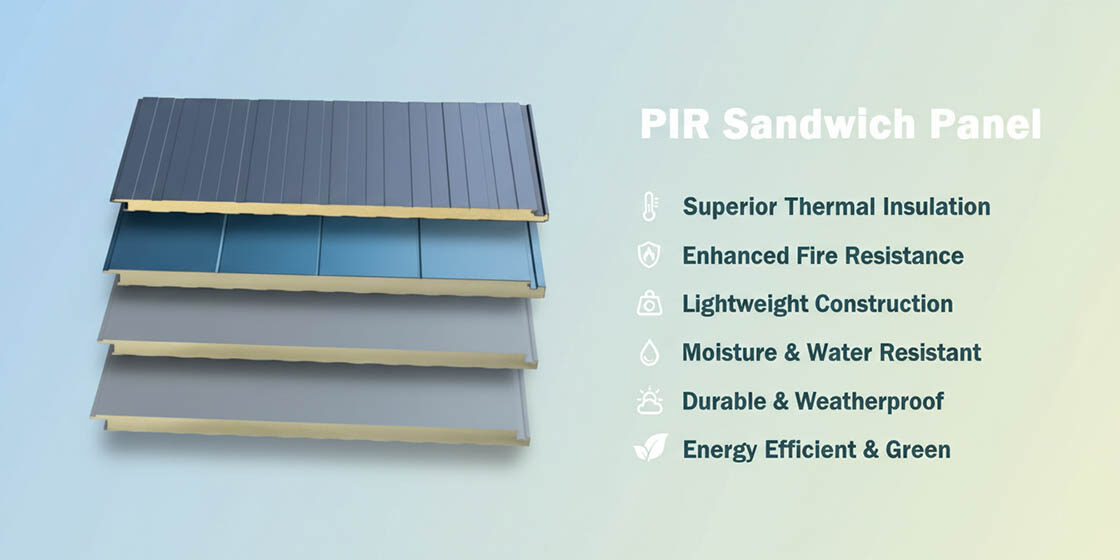
A 50 mm panel quoted for a dry goods warehouse and a 50 mm panel quoted for a cold store can carry the same print and the same price. One passes handover; the other fails acceptance the first time the room pulls down to temperature. The panel did not change – the scenario did, and somebody read the specification sheet as a price list instead of four promises.
We ship color steel sandwich panels from our own line: steel-faced and aluzinc-faced builds with PUR, PIR, rockwool and EPS cores. This page is the checklist our engineers run before a bundle leaves the floor. Read it once and you will know which line answers which question, and where the trade-typical numbers stop and the drawing begins.
Four Promises Ship Inside Every Sandwich Panel
Every consignment travels with a specification sheet, and the sheet makes four promises in a fixed order: total thickness, core material, steel facing with its coating, and the fire grade. Each promise governs one family of failures. Misread one and the building still goes up – it simply fails in the way that line was written to prevent.
| Spec line | What it sets | Failure when ignored |
|---|---|---|
| Total thickness | Rigidity, span, insulation level | Sagging roofs, deflected walls, thin thermal resistance |
| Core material | Density, lambda, the fire line | Cold bridges, foam shrinkage, failed fire acceptance |
| Facing and coating | Corrosion life, surface strength | Cut-edge rust, oil-canning, premature aging |
| Fire grade | Reaction-to-fire class of the build-up | Rejection at permit or insurance inspection |
That mapping is the whole subject of this page. A price per square metre tells you what color steel sandwich panels cost. The four lines tell you what they will do in your building, in your climate, under your inspector. The next four sections take the lines one at a time, then map all four onto buildings we quote every week.
Total Thickness Sets Span, Stiffness and Insulation
Thickness is the easiest line to read and the easiest to misuse. A sandwich panel works like a shallow I-beam: the two steel faces carry the bending while the core holds them apart and resists shear. Distance between the faces, more than the steel itself, buys stiffness – which is why a thicker panel resists sagging long before it feels heavy in the hand.
The standard range runs from 40 mm to more than 200 mm, with area weights between 10 and 35 kg/m² across it. Trade-typical steps for color steel sandwich panels sit at 50, 75, 100 and 150 mm. That ladder comes from warehouse and cold-chain practice rather than from any single standard. Support spacing follows the same logic: 3 to 5 metres is the normal bay, and wall builds can reach 11 m with the right panel. Order the thickness the span demands, not the one the discount table favours; every step down is a bay the roof can no longer bridge.
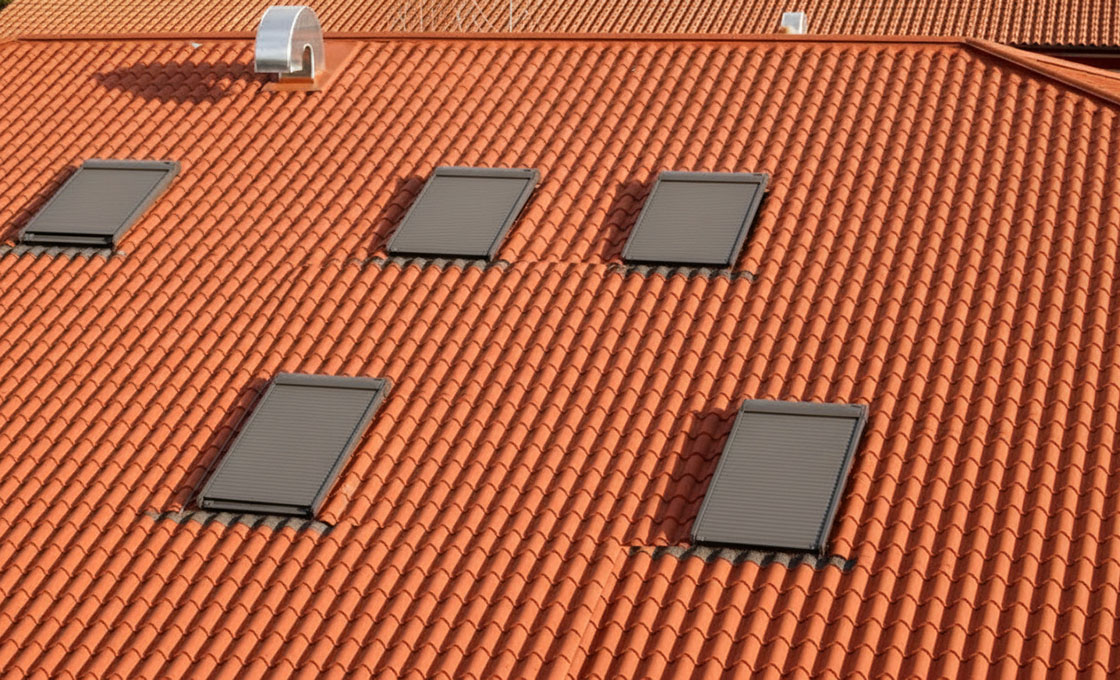
Roofs and walls abuse the same thickness differently. A roof fights wind uplift, foot traffic and standing water, so it spends thickness on stiffness and drainage profile. A wall mostly fights wind and impact, so it can run thinner – until the insulation target pulls it back up. A 100 mm panel can be generous on a wall and marginal on a long roof span.
One more line hides under the thickness figure: tolerance. A batch that drifts past its stated tolerance stops an assembly line faster than a thin panel ever would, and the shortfall stays invisible until installation day. Our guide to the insulation thickness chart walks the tolerance and inspection story in full.
Core Material: The Density and Fire Line
Core selection is where scenarios stop being polite. The same foam family can hold a workshop comfortable and fail a cold store, because thermal performance scales with density, thickness and temperature difference together. The physics is compact: polyurethane foams sit near 0.024 W/(m·K) and mineral wool near 0.05, so every extra degree of requirement is paid in core quality or in thickness.
Catalogue numbers put meat on that ladder. Trade-typical sheets list EPS cores from about 15 kg/m³ with a service ceiling near 100 °C. Rockwool cores run heavier, from about 110 kg/m³, and hold service toward 500 °C. PU bond strength sits around 0.09 MPa. Those figures come from supplier datasheets, not from one standard – so ask for the batch certificate before you trust the brochure.
Sound follows the same pattern. Assessed reduction sits near 25 dB for PU builds and near 30 dB for mineral wool. Workshops sharing a wall with offices ask for the wool for that reason.
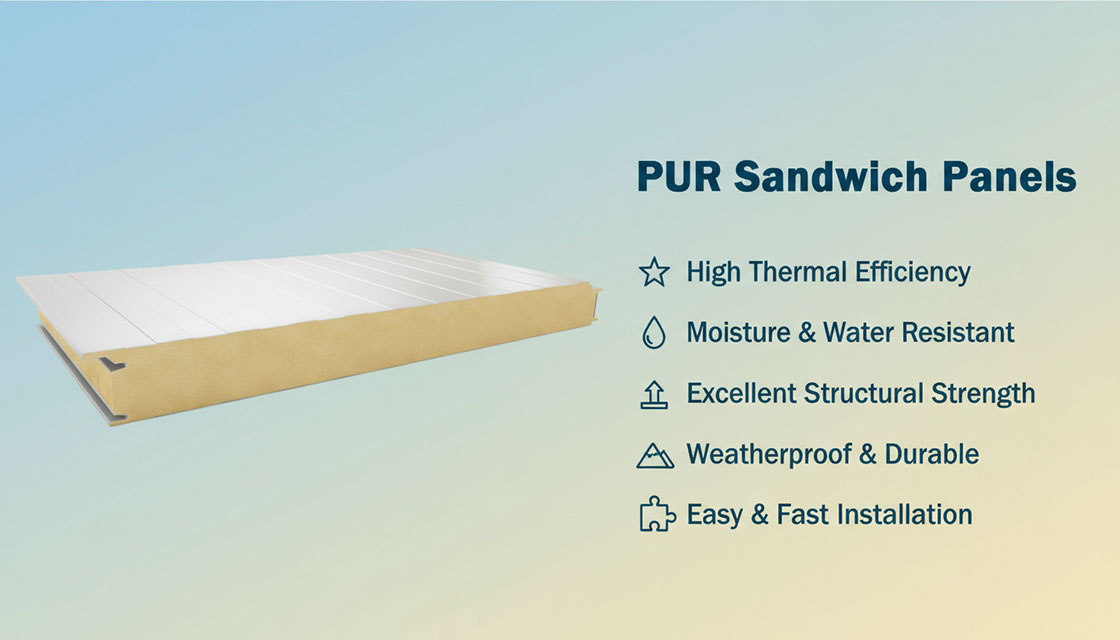
The fire line is the one an acceptance inspector reads first. Europe grades reaction to fire from A1 down to F under EN 13501-1. A wall drawn as A2 will not pass with a B-class core, no matter how well the rest of the sheet reads. Foam cores only earn their ratings when density and bond are honest; a starved bond line is where delamination starts years before any fire.
Standards also overlap and disagree between Europe and China, and translating a drawing’s fire line into the certificate your inspector expects is a guide of its own. Our EN versus GB comparison takes that translation layer apart, clause by clause.
Steel Facing and Coating Decide How Panels Age
Two panels can look identical in the bundle and age a decade apart on the wall. The facing line carries that story. Trade-typical steel faces run from 0.2 to 0.6 mm. The coating account on top decides how the surface spends its years: galvanized to ASTM A653, or aluzinc, or a PPGI paint system.
The faces do structural work too. As the flanges of that shallow I-beam, they take the bending the core separates. A starved facing shows up first as oil-canning across the flat and fastener pull-through in wind gusts. Edges bruise as well, whenever bundles are handled the way real sites handle them.
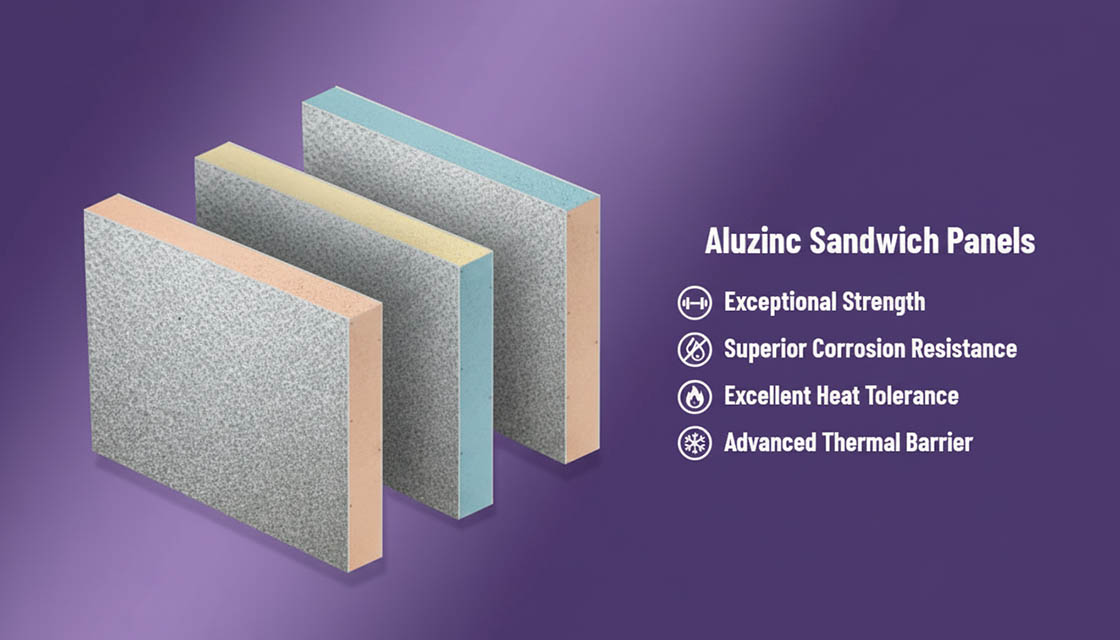
Environment sets the exchange rate. A dry inland warehouse can spend its budget on thickness instead of coating. Color steel sandwich panels near a coast need their coating class raised first, because salt finds every cut edge and every fastener. Farm buildings add ammonia that works on cheap coatings from the inside. Industrial parks add an atmosphere of their own, and matching the coating to the site still costs less than re-cladding.
Facing choices deserve their own depth: 0.4 versus 0.6 mm, pull-out values, paint systems. Our steel sandwich panel materials guide takes them apart, and this page stops where that one starts.
One boundary note belongs here. Color steel is the trade’s shorthand for pre-painted galvanized or aluzinc-faced panels. Every specification rule on this page applies to any steel-faced build; the colour is the smallest promise on the sheet.
RaxPanel builds steel-faced and aluzinc-faced sandwich panels with PUR, PIR, rockwool and EPS cores, tested to project data standards before anything ships. Send your scenario and span; an engineer returns the matched specification within 24 hours, one to one.
Four Buildings, Four Sets of Spec Answers
Set the four lines side by side and scenarios become readable. The table below is how our quotation desk translates a building type into starting values. Every cell is a trade-typical answer that a drawing can move – but rarely needs to.
| Gebäude | Thickness and core | Facing and coating | Watch for |
|---|---|---|---|
| Dry inland warehouse | 50-100 mm, EPS or PU | Standard PPGI face | Fastener quality and gutter detailing |
| Cold store | 100-200 mm, PIR or PU | Sealed joints throughout | Thermal bridges at every penetration |
| Fire-rated partition, food plant | 100-150 mm, mineral wool | A2-rated build-up | Certificate matching the drawn class |
| Coastal workshop | 75-150 mm, PU or PIR | Aluzinc or upgraded coating | Cut edges, fasteners, wash zones |
Treat those cells as starting points that a written requirement can move in either direction. A warehouse beside a salt works is a coastal building, whatever the invoice says. A cold store at -30 °C is not the same specification problem as one at -18 °C. The table buys you an honest first quotation; the drawing settles it.
Where a build crosses into hygiene territory – food plants and cleanrooms being the common cases – the panel conversation grows a third dimension of surfaces, joints and door interfaces. That layer is its own discipline, and it deserves panels designed for it rather than a stretched warehouse sheet.
Demand the Whole Sheet in Writing
Every failure on this page traces back to a line somebody accepted on trust. Close that gap by demanding the sheet, whole and in writing, before the deposit moves.
- Total thickness with its tolerance band, batch by batch
- Core material with density and bond strength values
- Coating class and coating mass on the facing steel
- Fire certificate for the actual build-up, not a family brochure
- Joint and fastener system matched to wind and water loads
- Batch-tied test records that follow the delivery, not the sample
Our Gebäudesandwichpaneel range covers the steel-faced and aluzinc-faced formats with PUR, PIR, rockwool and EPS cores described here. Our engineers run project-specific tests against agreed data standards, so the numbers arrive with evidence attached rather than with a salesman’s blessing.
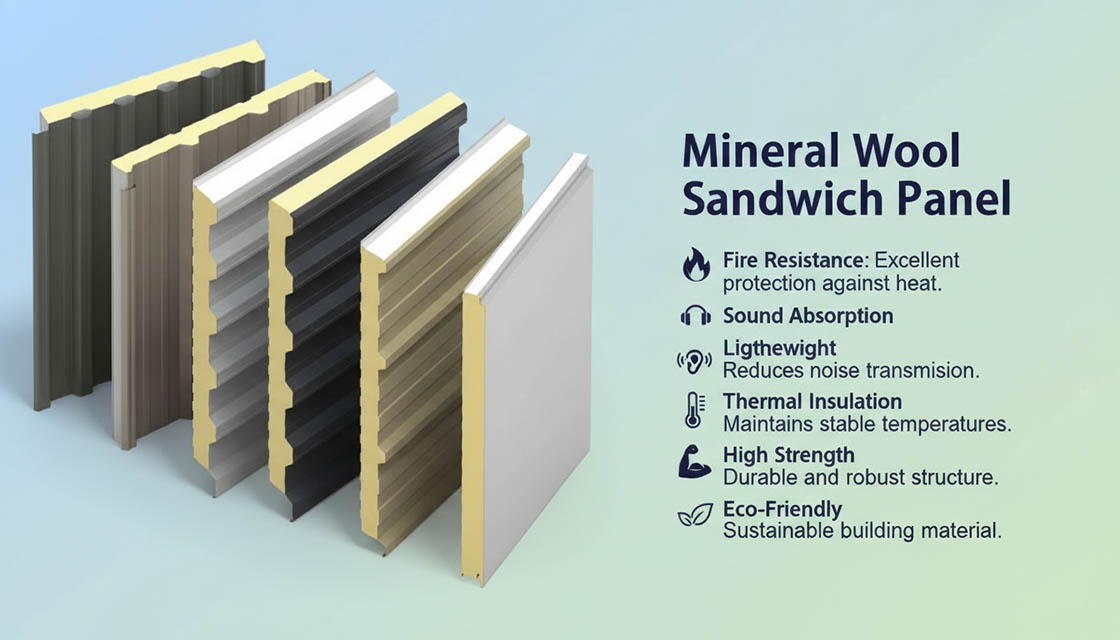
Specifications are not paperwork that follows the product. They are the product, written down early enough to change. The buildings that pass first inspection belong to owners who read all four lines before the price.
Frequently Asked Questions About Panel Specifications
What thickness of color steel sandwich panels do I need?
Follow span and insulation target: 40 to over 200 mm is the standard range, with 50, 75, 100 and 150 mm as trade-typical steps. Roof spans and temperature targets push thickness up before anything else does.
Which core should a fire-rated wall use?
Mineral wool cores sit at the top of the EN 13501-1 reaction-to-fire ladder, typically A1 or A2. Match the certificate to the class written on the drawing – a B-class foam core fails an A2 wall regardless of price.
Does steel facing thickness really matter?
Yes – the faces work as the flanges of an I-beam, so thin facings oil-can and pull through fasteners first. Trade-typical facings run 0.2 to 0.6 mm; our materials guide covers the 0.4 versus 0.6 mm decision in depth.
Are color steel sandwich panel specifications standardized?
Europe certifies panels to EN 14509:2013, and fire classes follow EN 13501-1; other markets run their own systems. Thickness steps and core figures otherwise remain trade-typical, so ask for batch test data, not brochures.