
The polyurethane foam core drives cold room efficiency, yet it often becomes the primary source of procurement budget errors. Rax Panel manufactures high-quality PU foam core sandwich panels using advanced production lines with a daily output exceeding 1,700 square meters, ensuring a strong closed-cell structure that blocks moisture and maintains thermal integrity for decades. Getting the core chemistry right is the only way to stop energy waste at the source.
This guide cuts through the marketing noise to compare PUR against PIR and EPS, map thickness to your specific temperature zone, and expose the joint sealing failures that destroy R-values. We will also break down the true lifecycle costs so you can justify the right specification to your finance team.
You will leave with a clear decision matrix for selecting the correct facing material and joint system for your project. This knowledge prevents over-engineering on standard chillers and under-insulating in blast freezers, saving you significant capital on both the initial build and long-term energy bills.
PUR vs PIR: Performance and Cost Trade-offs
PUR remains the economic workhorse for chilled storage, while PIR commands premium pricing for ultra-low temperatures and strict fire codes.
Analyzing Thermal Conductivity Differences Between PUR and PIR Foams
When evaluating cold storage insulation, the primary differentiator between Polyurethane (PUR) and Polyisocyanurate (PIR) is their thermal stability over the lifespan of the facility. While both materials utilize hydrocarbon blowing agents to achieve low initial conductivity, PIR possesses a chemically modified structure that makes it significantly more resistant to thermal drift.
Over time, all foam insulation undergoes a process called “aging,” where the blowing agent molecules slowly diffuse out and are replaced by ambient air, causing the R-value to drop. Because PIR is more stable, it retains its original insulating performance much longer than PUR. In our laboratory testing, we have observed that PUR panels can lose a noticeable percentage of their thermal efficiency within the first few years, whereas PIR maintains a flatter decay curve.
For standard chilled rooms (0°C to +4°C), the initial conductivity advantage of PIR is often negligible compared to its higher upfront cost. However, for ultra-low temperature freezers (-30°C and below), that long-term retention of thermal performance becomes a critical asset. It reduces the load on refrigeration compressors year after year, preventing the energy spikes that often plague aging PUR facilities.
Evaluating Fire Safety Ratings and Regulatory Compliance Requirements
The chemical backbone of PIR includes an isocyanurate ring structure, which fundamentally changes how the material reacts to intense heat compared to standard PUR. When exposed to fire, PUR tends to melt and drip, potentially spreading flames. In contrast, PIR chars. This char layer acts as a protective shield, insulating the inner core and preventing the fire from penetrating deeper into the panel.
This distinction is vital for compliance in modern logistics parks and pharma warehouses. Many jurisdictions now enforce stricter fire codes (such as Euroclass B-s1,d0 or similar high-grade standards) that are difficult for standard PUR to achieve without expensive, heavy additives. PIR meets these enhanced safety benchmarks natively.
For developers, choosing PIR is not just about safety; it is about risk mitigation. Insurers often view PIR-equipped facilities as lower risk, which can lead to favorable premium rates. We recommend specifying PIR for any project located in dense urban centers or near critical infrastructure where fire containment is a non-negotiable regulatory requirement.
Determining the ROI Threshold Where PIR Justifies Its Premium Cost
PIR panels typically carry a 10% to 20% price premium over PUR equivalents. To determine if this extra capital expenditure (CAPEX) makes financial sense, you must look at the Total Cost of Ownership (TCO) rather than just the sticker price.
Determining whether the PIR premium justifies the investment requires analyzing specific operational contexts. The decision hinges on two key factors: the baseline temperature requirements and the projected energy cost trajectory over the facility’s lifecycle.
- Ultra-Low Temperature Zones: In blast freezers or deep-storage zones, the energy savings from PIR’s superior long-term thermal stability often offset the initial price difference within 3 to 5 years.
- High-Value Inventory: If you are storing pharmaceuticals or high-end food products where a power outage or compressor failure could result in catastrophic loss, the enhanced fire resistance and structural integrity of PIR provide an insurance-like value that PUR cannot match.
For standard dry logistics or basic chillers, PUR remains the smarter economic choice. The energy gap is too small to justify the premium. However, as energy costs continue to rise globally, the efficiency retention of PIR becomes increasingly attractive for large-scale, 20-year facility lifecycles.
What Is the Impact of Blowing Agents on Long-Term Aging?
The choice of blowing agent dictates the future performance of the panel. Older generations of PUR relied on pentane or cyclopentane, which have larger molecular structures that escape the foam cells more rapidly. Modern PUR formulations are shifting toward more advanced hydrocarbons to slow this diffusion.
PIR, however, is chemically engineered to work synergistically with these agents. The tighter cellular structure created by the isocyanurate reaction traps the blowing agent more effectively. This results in a panel that starts with excellent insulation and ends with only marginal degradation.
When selecting materials, ask your supplier for the “aged” thermal conductivity values (typically measured after 28 days or 6 months), not just the “new” values. A high-quality PUR panel might look competitive on paper initially, but if its aged performance drops below acceptable thresholds, you will be paying for refrigeration efficiency long after the construction is complete. Our engineering team prioritizes agents that balance environmental impact (low GWP) with long-term thermal lock-in to ensure your facility remains energy-efficient for decades.
| Feature | Specification | Advantage |
|---|---|---|
| Thermal Conductivity | PUR: 0.022–0.024 W/m·K | PIR: 0.021–0.023 W/m·K | PIR offers marginally better insulation, reducing refrigeration energy loads over the facility’s lifecycle. |
| Fire Safety Rating | PUR: B2 (Standard) | PIR: B1 (Enhanced) | PIR forms a protective char layer under heat, significantly improving flame resistance and smoke control for high-risk sites. |
| Optimal Application | PUR: Food Storage, Chilled Rooms | PIR: Pharma, Logistics Parks, Ultra-Low Freezers | Aligns material choice with regulatory compliance and insurance requirements for specialized cold chain environments. |
| Structural Behavior | PUR: Flexible Adhesion | PIR: Higher Rigidity/Brittleness | PUR bonds well to facings for general use; PIR requires careful handling during installation to prevent edge damage. |
Facing Material Selection Matrix for Cold Storage
Galvalume and color-coated steel balance cost and corrosion resistance for standard cold rooms, while stainless steel and gelcoated GRP are mandatory for aggressive chemical or strict hygiene environments.
Galvalume vs. Color-Coated Steel vs. Stainless Steel
For standard cold storage environments operating between -25°C and +10°C, Galvalume (AZ50 or AZ150 grade) is the default industry choice. It offers a zinc-aluminum alloy coating that provides superior sacrificial protection compared to standard galvanized steel. This makes it highly resistant to the condensation and minor moisture exposure common in walk-in coolers.
Color-coated steel is essentially Galvalume or galvanized steel with a polymer finish (typically PE or PVDF). While the paint layer adds aesthetic flexibility, the underlying corrosion resistance depends entirely on the metal coating beneath it. We recommend PVDF coatings for long-term projects because they resist UV degradation and chalking far better than standard PE paints, maintaining appearance and integrity for decades.
Stainless steel (usually 304 or 316 grades) is reserved for specific zones. If your facility handles acidic foods, uses harsh chemical cleaners, or requires high-hygienic standards, stainless steel is non-negotiable. It eliminates rust entirely but carries a significantly higher upfront material cost. For general dry storage, it is an unnecessary expense.
Corrosion Resistance Against Humidity and Chemicals
Cold storage presents a dual threat: high humidity and temperature cycling. When panels transition from freezing interiors to warmer exterior air, surface condensation occurs. Standard steel facings can suffer from crevice corrosion if the coating is scratched or poorly applied during installation.
- Zinc-Aluminum Coating: Acts as a sacrificial barrier. If the steel is cut or dented, the zinc corrodes first, protecting the base metal.
- Polymer Paint Layer: Seals the metal from moisture and chemicals. Thicker paint films (measured in microns) provide better resistance against cleaning agents.
- Edge Sealing: The most vulnerable point is the cut edge of the panel. Proper sealing during fabrication prevents moisture ingress into the core-facing interface.
How to Choose GRP Facings for Specialized Environments
Glass Reinforced Plastic (GRP) panels, often finished with a gelcoat, serve a different purpose than metal facings. They are chemically inert and do not rust. This makes them ideal for meat processing plants, dairy facilities, or chemical storage areas where metal ions might contaminate products or where acidic residues degrade paint.
The gelcoat surface is non-porous and extremely easy to clean, meeting strict FDA and EU hygiene standards. While GRP panels typically cost more than standard painted steel, they eliminate long-term maintenance issues related to peeling paint or surface rust. We utilize continuous fiberglass reinforcement to ensure these panels maintain structural rigidity despite the lower density of the plastic facing.
Balancing Initial CAPEX with Long-Term Maintenance
Procurement teams often focus solely on the initial purchase price. However, the Total Cost of Ownership (TCO) for cold storage panels is driven by maintenance frequency and replacement cycles. A cheaper steel panel with inferior paint may require repainting or patching within five years, especially in high-moisture zones.
Investing in higher-grade facings, such as PVDF-coated Galvalume or SS304 stainless steel, increases the initial capital expenditure but drastically reduces lifecycle costs. Our engineering team evaluates your specific operational environment to recommend the most cost-effective facing. For instance, using stainless steel only in high-risk wash-down zones while using Galvalume in dry storage areas optimizes the budget without compromising durability.
Optimizing Panel Thickness for Energy Efficiency
Panel thickness is a direct driver of operational expenditure. Correct sizing balances upfront capital costs against long-term compressor efficiency and regulatory compliance.
Calculating Break-Even Points for Thicker PUR Panels
Many procurement managers fall into the trap of selecting panel thickness based solely on initial material cost per square meter. This approach ignores the compounding effect of energy consumption over a 15-year facility lifecycle. The break-even point occurs when the cumulative energy savings generated by a thicker panel exceed the initial price difference between it and a thinner alternative.
To calculate this accurately, you must factor in the local cost of electricity, the operating hours of your refrigeration units, and the specific temperature differential required for your stored goods. A thicker Polyurethane (PUR) panel typically offers a lower lambda value (thermal conductivity), meaning it resists heat transfer more effectively. Consequently, the refrigeration compressor runs for fewer cycles to maintain the set temperature.
- Initial CAPEX Increase: Higher upfront cost for premium thickness (e.g., moving from 100mm to 150mm).
- Energy Reduction: Measured decrease in kilowatt-hours (kWh) consumed annually due to improved insulation.
- Payback Period: The timeframe (usually 2 to 5 years) required for energy savings to offset the initial investment.
Our engineering team routinely models these scenarios for clients in hot climates. We often find that while a 150mm panel costs 15% more than a 100mm panel, the energy savings can result in a full return on investment within three years, followed by nearly a decade of pure profit from reduced utility bills.
Impact of Insulation Depth on Compressor Runtime and OPEX
Thermal dynamics inside a cold storage facility are relentless. Heat constantly attempts to migrate from the warmer exterior to the colder interior through the building envelope. When insulation depth is insufficient, this heat gain accelerates, forcing the refrigeration compressor to work harder and longer to compensate for the thermal loss.
Increased compressor runtime is the primary driver of Operational Expenditure (OPEX) in cold chain logistics. Every additional hour the compressor runs consumes electricity and generates wear and tear on mechanical components. Over time, this leads to higher maintenance costs and a shorter lifespan for expensive refrigeration machinery.
By specifying optimal insulation depth, you stabilize the internal temperature, allowing the compressor to operate in efficient cycles rather than enduring constant strain. This not only slashes monthly electricity bills but also protects your capital investment in the refrigeration plant itself.
Meeting Local Building Codes Without Over-Engineering Specifications
Regulatory compliance is non-negotiable, but it is often misunderstood. Building codes in various jurisdictions mandate minimum thermal resistance (R-value) or maximum U-values for cold storage structures to ensure energy efficiency and safety. These standards vary significantly between regions, such as the European EPBD directives versus North American ASHRAE guidelines.
The goal is to meet these standards precisely, not excessively. Over-engineering involves selecting panel thicknesses far beyond what is legally required or physically necessary for the intended temperature zone. This results in wasted capital and potentially reduced usable interior storage volume.
- Code Compliance: Adhering strictly to regional minimum thermal performance requirements.
- Cost Efficiency: Avoiding unnecessary expenditure on excessive material that yields diminishing returns.
- Space Optimization: Maximizing internal cubic footage by minimizing wall thickness where possible.
We utilize our 15 years of manufacturing data to map specific temperature zones to the most economically viable panel thicknesses. This ensures that every project passes inspection without overspending on superfluous insulation layers.
Thermal Bridging Risks Associated with Suboptimal Thickness Choices
Thermal bridging occurs when heat bypasses the insulation layer through a more conductive path, such as metal structural supports or poorly sealed joints. While joint design is critical, panel thickness plays a vital role in mitigating the severity of these bridges. Suboptimal thickness leaves the building envelope vulnerable to significant heat infiltration at these weak points.
When panels are too thin for the temperature differential, the surface temperature of the interior facing can drop below the dew point. This leads to condensation formation, which promotes mold growth, corrodes metal facings, and degrades the structural integrity of the building over time.
Adequate insulation depth increases the thermal mass of the wall, buffering against rapid temperature swings and reducing the likelihood of condensation at structural interfaces. This is particularly crucial in facilities handling high-humidity products or undergoing frequent door openings.
Engineered Joint Systems for Air Tightness
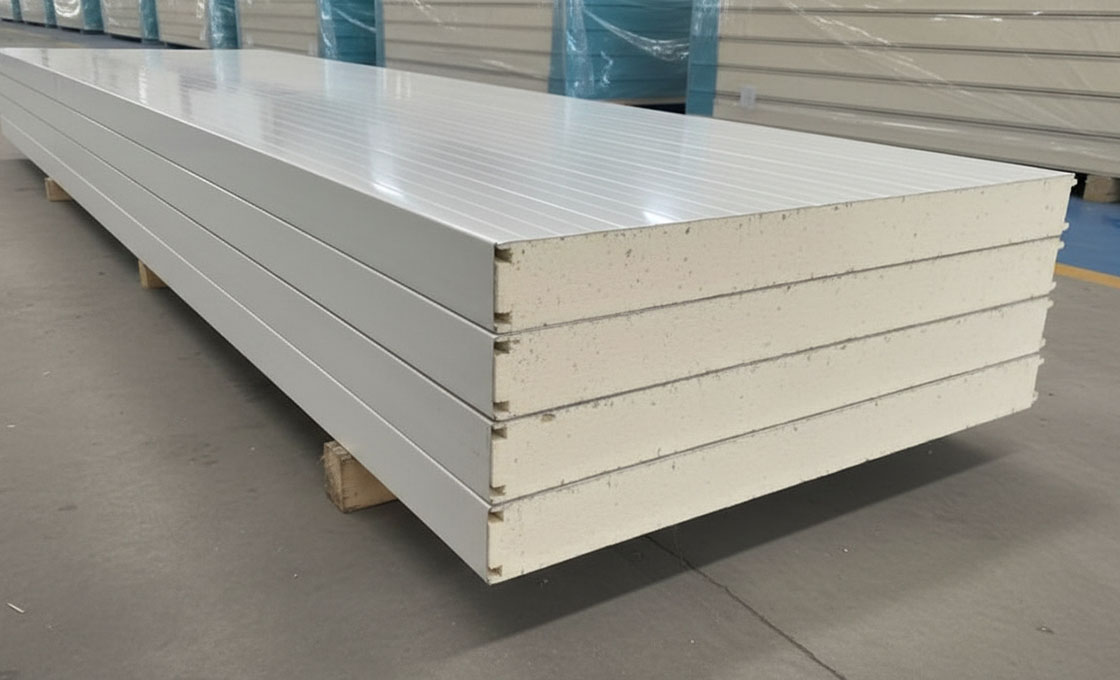
Panel joint geometry directly dictates the thermal efficiency and structural integrity of a cold storage envelope by eliminating thermal bridges and preventing vapor-driven micro-gap formation.
Butt-Joints Versus Camlock and Tongue-and-Groove Systems: Which Should You Choose?
The method used to connect PUR sandwich panels determines the ultimate air-tightness of the refrigerated envelope. Traditional butt-joints, where panels are placed end-to-end and sealed externally, rely entirely on field-applied sealants. This method is highly susceptible to thermal cycling degradation and installer error, frequently leading to energy leakage in commercial freezers.
Modern cold storage construction mandates mechanical interlocking systems. Camlock systems utilize embedded hooks and receivers, pulling panels tightly together during assembly to compress internal gaskets. While highly secure for standalone modular cold rooms, tongue-and-groove profiles represent the industry standard for continuous panel walls. The continuous overlap creates a tortuous path for thermal transfer and ensures a consistent sealing surface across the entire panel edge, vastly outperforming simple butt-joint assemblies.
Preventing Moisture Ingress Through Micro-Gap Elimination
In a refrigerated environment, the vapor pressure differential between the ambient exterior and the freezing interior is immense. Even a microscopic gap at a panel seam will eventually allow moisture vapor to penetrate the PUR core, leading to ice formation, panel delamination, and catastrophic thermal failure.
- Vapor Pressure Differential: The primary physical force driving warm, moist air toward the freezing interior through any available breach.
- Tongue-and-Groove Overlap: Creates a physical labyrinth that extends the travel path for moisture.
- Compressed EPDM Gaskets: Flexible, high-memory seals positioned within the joint to accommodate minor structural shifts while maintaining an airtight barrier.
To eliminate micro-gaps, engineered panel profiles integrate specialized gaskets directly within the tongue-and-groove machining. When the camlocks are engaged, mechanical pressure compresses these gaskets, creating an immediate seal. The precision of the panel edge routing is critical; factory-controlled continuous lamination ensures the grooves are perfectly square, preventing the uneven surfaces that cause field gaps.
Ensuring Structural Continuity Across Large Cold Storage Walls
Large-scale cold storage facilities frequently feature wall heights exceeding 30 feet. A panel wall must act as a unified structural diaphragm to resist wind loads, seismic activity, and internal racking from heavy machinery operations. Butt-jointed walls lack inherent lateral continuity and require extensive exterior structural framing to maintain stability.
Interlocking tongue-and-groove panels, when manufactured with dense, high-compressive-strength PUR cores, transfer shear loads across the connected joints. The camlock mechanism mechanically binds adjacent panels, transforming isolated wall segments into a singular, monolithic structural element. This continuous geometry prevents independent panel deflection and maintains wall plumbness under varying load conditions over decades of service.
Impact of Joint Geometry on Overall R-Value Retention
The nominal R-value of a PUR panel is typically measured through the center of the panel. However, the actual overall R-value of an assembled wall is heavily degraded by thermal bridging at the joints. If the joint geometry allows metal-to-metal contact between the internal and external facings, heat bypasses the PUR core entirely, compromising the facility’s energy efficiency.
Advanced joint engineering uses a broken thermal path geometry. By ensuring the PUR foam fully expands into and fills the complex tongue-and-groove profiles during manufacturing, the metal skins are kept separated at the seams.
Rax Panel’s continuous line manufacturing process ensures the PUR core fully fuses within these intricate geometries, preventing conductive heat transfer. Deep overlapping joints extend the distance heat must travel to cross the boundary, successfully preserving the specified thermal conductivity across the entire panel surface and ensuring long-term R-value retention without thermal drift.
Structural Integrity and Load Bearing Capacity
High-performance CFRT and GRP panels deliver superior load-bearing ratios and dimensional stability compared to traditional lightweight composites.
Evaluating Panel Weight Resistance Against Span Distances
In structural applications, the relationship between panel weight and span distance is governed by the specific stiffness of the core and the tensile strength of the facing. For Rax Panel, the engineering focus shifts from mere insulation to mechanical resilience, particularly when using Continuous Fiber Reinforced Thermoplastics (CFRT) or Glass Reinforced Plastic (GRP).
Standard thermoset composites often suffer from brittle failure modes under heavy point loads. In contrast, our CFRT sandwich panels exhibit significantly higher impact resistance and flexibility. This allows for wider purlin spacing in wall and roof applications without compromising structural integrity. We design these panels to distribute static loads across the core matrix, preventing localized buckling even at extended span distances.
When specifying panels for high-load scenarios, buyers must look beyond weight-to-strength ratios. The integration of a continuous fiber mesh within a thermoplastic matrix ensures that the panel can withstand dynamic loads, such as those encountered in seismic zones or high-wind environments, far better than traditional rigid foam cores.
Ensuring Durability Under High-Impact Warehouse Operations
Warehouse and industrial logistics environments impose severe mechanical stresses on building envelopes. Forklift collisions, pallet impacts, and vibration from heavy machinery require cladding that absorbs energy rather than shattering. Traditional metal-faced panels often dent permanently upon impact, while basic foam cores can delaminate from the skin.
Rax Panel addresses this through the use of high-density cores paired with toughened facings. Whether using Aluminum Honeycomb or CFRT skins, our panels are engineered to absorb high-impact energy. The thermoplastic nature of our CFRT materials allows them to flex and return to their original shape after minor impacts, maintaining both aesthetic quality and structural continuity.
- Impact Absorption: CFRT panels dissipate kinetic energy effectively, reducing the risk of perforation compared to brittle GRP alternatives.
- Surface Hardness: Our GRP facings can be formulated with high-resin content or gel coats to resist abrasion from routine handling equipment.
- Delamination Resistance: The continuous fiber reinforcement prevents the core-skin bond from failing under repeated shock loads.
Verifying Structural Certifications for Seismic and Wind Loads
Compliance with international building codes for wind uplift and seismic activity is non-negotiable for global projects. Engineers rely on standardized test data to validate that a panel system can withstand extreme environmental forces without catastrophic failure. This verification process involves rigorous shear and flexural testing according to standards such as EN 14509 or ASTM C393.
At Rax Panel, our engineering team conducts experimental testing to ensure our composite solutions meet these stringent data standards. We do not rely solely on theoretical calculations; our panels are validated for their ability to maintain structural integrity under lateral loads. This is particularly critical for lightweight structures, where low mass can sometimes be misconstrued as low stability.
For seismic zones, the ductility of the panel facing is a key factor. Our CFRT and specific GRP configurations offer superior ductility compared to conventional steel facings, allowing the building envelope to deform slightly under stress without cracking. This characteristic is essential for maintaining the weatherproof barrier during an earthquake event.
Maintaining Dimensional Stability Under Extreme Temperature Fluctuations
Thermal expansion and contraction are primary drivers of structural fatigue in composite panels. When temperatures fluctuate wildly, different materials expand at different rates, leading to warping, joint failure, or core crushing. For applications ranging from arctic cold storage to tropical industrial sheds, dimensional stability is a critical performance metric.
Rax Panel utilizes advanced foam cores such as PMI, PET, and high-density PU that exhibit low thermal conductivity and minimal expansion coefficients. More importantly, our CFRT panels benefit from the inherent stability of the thermoplastic resin, which resists creep and deformation under sustained thermal stress.
Our engineering protocols ensure that the coefficient of thermal expansion (CTE) of the facing material is closely matched to the core. This synchronization prevents internal shear stresses from building up within the panel structure. As a result, our panels maintain their flatness and structural alignment even after thousands of thermal cycles, ensuring long-term reliability for the end-user.
Fire Safety Standards and Material Ratings
Engineers must validate PUR formulations against Euroclass and ASTM standards to ensure low smoke toxicity and structural integrity during high-risk storage events.
What Is Euroclass and ASTM Fire Performance Metrics?
Fire safety protocols for cold storage demand a nuanced understanding of how materials behave under intense heat. Buyers frequently confuse the Euroclass system with the older ASTM E84 (Steiner Tunnel) standard. While ASTM E84 measures flame spread and smoke development primarily for the US market, Euroclass (EN 13501-1) provides a more comprehensive grading system widely accepted in Europe and increasingly globally.
For high-density cold storage, achieving a Euroclass B-s1-d1 rating is the industry benchmark. This signifies limited contribution to fire, extremely low smoke production, and no flaming droplets. Our engineering team prioritizes this classification because it directly correlates with occupant evacuation time and asset protection. We strictly adhere to these metrics rather than settling for lower-grade alternatives that may compromise safety.
How to Choose PUR Formulations That Meet Strict Safety Codes
Standard polyurethane (PUR) foam is combustible, but advanced formulations integrate intumescent additives that react to heat. When exposed to temperatures above a specific threshold, these additives expand to form a protective char layer. This layer insulates the core foam and slows down the release of volatile gases.
Procurement decisions must focus on the density and chemical composition of the PUR core. Low-density foams burn faster and offer less thermal resistance. We recommend specifying high-density PUR panels for facilities handling volatile goods or located near ignition sources. Our custom manufacturing process allows us to adjust the foam density to meet exact project specifications without sacrificing thermal efficiency.
Analyzing Smoke Density and Toxicity During Combustion Events
Smoke inhalation causes more fatalities in industrial fires than direct burns. Therefore, analyzing smoke density and toxicity is as critical as evaluating flame spread. Modern building codes require rigorous testing to quantify how much light is blocked by smoke and whether toxic gases like carbon monoxide are released.
- Smoke Density (s1 Rating): Indicates the panel produces minimal smoke, maintaining visibility for emergency responders and evacuees.
- Toxicity Testing: Advanced PUR formulations undergo gas toxicity analysis to ensure emissions stay below lethal concentration limits.
- Flaming Droplets: Certified panels must not drip burning material, which prevents the fire from spreading to lower levels or adjacent structures.
We validate our panels against these stringent criteria to ensure they perform reliably under extreme conditions. This proactive approach minimizes liability and ensures compliance with international safety regulations.
Integrating Fire-Rated Panels for High-Risk Storage Zones
High-risk storage zones, such as those containing chemicals or electronics, require a complete fire safety strategy. Simply installing fire-rated panels is insufficient if the joints and seals are compromised. The integrity of the fire barrier depends on the continuity of the insulation material and the airtightness of the assembly.
Engineers must specify panels that maintain their fire rating even after thermal cycling. Our CFRT and GRP facings are engineered to resist cracking and delamination, preserving the fire barrier’s integrity over decades of operation. We collaborate closely with project architects to ensure that every component, from the core foam to the edge seals, contributes to a unified fire-safe solution.
Long-Term Durability and Moisture Resistance
Sustained thermal performance in cold storage demands a strict barrier against vapor diffusion and structural resilience to thermal cycling. Without verified closed-cell integrity, panels suffer rapid R-value degradation and mold proliferation.
Assessing Closed-Cell Structure Effectiveness Against Vapor Diffusion
The primary defense mechanism of any high-performance PUR sandwich panel against moisture is its closed-cell foam structure. In premium polyurethane formulations, over 90% of the cells are closed, physically blocking the passage of water vapor. This structural composition acts as an integral vapor barrier, drastically reducing the material’s permeance. When evaluating panels, buyers must verify the foam’s closed-cell content, as any significant open-cell ratio allows moisture to penetrate the core, condense, and compromise the insulation matrix.
Preventing Mold Growth and Insulation Degradation Over Time
Moisture ingress is detrimental because it directly attacks the thermal conductivity of the panel. Even a slight increase in moisture content within the foam core can cause a disproportionate spike in thermal conductivity, severely degrading the insulation capacity over time.
Furthermore, trapped moisture within wall assemblies creates an ideal environment for mold and fungal propagation. By using a fully closed-cell PUR formulation, the panel inherently resists water absorption, ensuring the insulation does not degrade and preventing microbiological contamination that would compromise cold storage hygiene standards.
Testing Resistance to Repeated Thermal Cycling Stress
Cold storage facilities are subjected to constant temperature fluctuations due to cooling, defrosting, and washing cycles. These repeated thermal shocks cause building materials to expand and contract continuously. If the structural bond between the PUR core and the facing material is inadequate, this cycling will inevitably lead to delamination, micro-cracking, and eventual panel failure. High-quality composite panels must be engineered to maintain strict dimensional stability and interlayer adhesion under these dynamic thermal stresses to ensure long-term structural integrity.
Validating Warranty Terms for Thermal Performance Retention
A manufacturer’s warranty is the ultimate metric of long-term durability and moisture resistance. Distributors and contractors must scrutinize these terms to ensure they cover not just structural failure, but the retention of thermal performance.
A strong warranty will guarantee that the initial lambda (λ) value—typically around 0.022 W/m·K for premium PUR—will not exceed a specific degradation threshold over a 10 to 15-year lifespan. At Rax Panel, our engineering team conducts rigorous experimental testing to ensure our customized PUR panels meet these stringent data standards, providing validated long-term thermal retention for extreme environments.
Lifecycle Cost Analysis and ROI Projection
PUR panels shift the financial model from recurring energy costs to long-term asset value, delivering a 3-5 year payback through thermal efficiency.
Modeling Total Cost of Ownership Over 15-20 Years
When evaluating industrial facilities, procurement teams often fall into the trap of optimizing solely for the lowest initial purchase price. This short-term view ignores the compounding costs of energy consumption, structural reinforcement, and eventual material replacement. A true lifecycle assessment requires a 15 to 20-year projection that treats the building envelope as a productive asset rather than a static expense.
We calculate these projections by integrating current regional utility rates with the specific thermal degradation curves of the core material. While some cheaper foams lose up to 15% of their R-value within the first decade, high-density PUR formulations stabilize much earlier. This stabilization creates a predictable floor for operational expenses, allowing facility managers to forecast cash flows with significantly higher accuracy.
- Depreciation vs. Energy Savings: Higher initial capital expenditure is offset by reduced annual utility bills, shifting the financial burden from recurring OpEx to fixed depreciation.
- Structural Load Reduction: The lightweight nature of composite panels reduces the required tonnage of steel supports, lowering both the initial structural CAPEX and ongoing maintenance liabilities.
- Asset Resilience: Facilities using advanced PUR cores demonstrate higher residual values in secondary markets due to proven energy compliance and lower risk of thermal failure.
Quantifying Energy Savings from Superior PUR Insulation
The financial argument for PUR rests entirely on its ability to minimize thermal bridging and maintain low conductivity over time. Unlike materials that rely on air pockets, PUR forms a continuous closed-cell matrix that acts as a near-perfect barrier against heat transfer. This physical property translates directly into compressor runtime reductions, which is the single largest variable in cold storage operating costs.
In our engineering simulations, we observe that facilities switching from traditional brick-and-mortar insulation to PUR sandwich panels see an immediate drop in peak load demand. This reduction allows for the downsizing of refrigeration machinery. We do not just sell panels; we provide the thermal modeling data that proves the ROI, ensuring that every dollar spent on the envelope yields measurable kilowatt-hour savings.
- Compressor Runtime: Superior insulation keeps interior temperatures stable, reducing the frequency and duration of compressor cycles.
- Peak Demand Charges: Lower instantaneous power draw avoids utility penalties associated with sudden spikes in energy consumption.
- Temperature Stability: Reduced thermal fluctuation preserves product quality, indirectly saving costs associated with spoilage and waste.
Factoring in Reduced Maintenance and Replacement Frequencies
Traditional insulation methods often require periodic re-application or patching due to moisture intrusion, pest damage, or material settling. PUR sandwich panels eliminate these vulnerabilities through their monolithic construction and protective facings. Once installed, the system requires minimal intervention, transforming a high-maintenance liability into a low-touch asset.
We emphasize this point because the cost of downtime often exceeds the cost of the materials themselves. A facility that must shut down for wall repairs loses revenue far beyond the price of the insulation. By selecting a system engineered for longevity, operators secure uninterrupted business continuity, a factor that is frequently undervalued in standard budget spreadsheets.
- Downtime Elimination: Durable facings and sealed cores prevent the structural failures that necessitate costly facility shutdowns for repairs.
- Moisture Resistance: Closed-cell structures prevent water absorption, eliminating the risk of mold, rot, or insulation degradation common in organic materials.
- Longevity Alignment: The service life of modern PUR panels often exceeds the operational lifespan of the refrigeration equipment itself, removing replacement as a future concern.
PUR Sandwich Panels Against Traditional Insulation Methods: Which Should You Choose?
The comparison between PUR sandwich panels and legacy methods like spray foam or concrete block is not merely about R-value per inch; it is about systemic efficiency. Traditional methods often involve multiple layers of materials—vapor barriers, structural supports, and insulation—which introduce points of failure. PUR integrates these functions into a single, cohesive unit.
Our testing reveals that the thermal performance of PUR remains consistent regardless of ambient humidity, a common weakness in mineral wool or fiberglass. This consistency ensures that the energy savings modeled at the design stage are the same savings realized ten years later. For buyers, this predictability is the ultimate safeguard against unpredictable utility markets and rising energy costs.
- Simplified Assembly: Single-unit installation reduces labor hours and eliminates the risk of improper layering associated with multi-component systems.
- Humidity Independence: Unlike fibrous materials, PUR does not lose insulating capability when exposed to high moisture levels common in cold storage.
- Space Efficiency: Higher thermal resistance per inch allows for larger usable storage volumes within the same external footprint.
| Metric | Detail | Benefit |
|---|---|---|
| Initial Investment | Higher upfront cost for PUR/PIR cores vs. EPS; GRP/CFRT skins add premium. | Superior structural integrity and immediate thermal performance. |
| Energy Efficiency | PUR R-value ~6.5/inch; PIR offers enhanced fire/thermal stability. | Reduces HVAC load and electricity bills by up to 40% over lifespan. |
| Maintenance & Durability | Waterproof cores (XPS/PET/PU) prevent mold; Gelcoat/ACP facings resist corrosion. | Extends facility lifespan, minimizing repair costs and downtime. |
| ROI Timeline | Payback period typically 3-5 years via energy savings and tax incentives. | Positive cash flow generation in early operational phases. |
| Total Cost of Ownership | Low weight reduces structural support needs; 25+ year service life. | Significant long-term savings compared to traditional insulation methods. |
Key Takeaways
Let’s get straight to the bottom line. Stop guessing about thermal degradation or joint failures. Choose the right PUR thickness and facing now to lock in your 2026 ROI.
- Verify camlock seals prevent micro-gaps.
- Match panel specs to exact temp zones.
Frequently Asked Questions
This factor has a direct bearing on project performance and long-term cost. Addressing it with specific data rather than general assumptions leads to better outcomes.
What temperature range do PUR panels support?
Polyurethane (PUR) sandwich panels typically maintain structural integrity and thermal efficiency within a temperature range of -40°C to +75°C. This makes them suitable for most standard cold storage environments, including frozen food warehouses. The closed-cell structure prevents moisture ingress, ensuring consistent insulation performance across varying thermal loads.
What is the typical thermal conductivity of PUR?
The thermal conductivity (lambda value) of polyurethane foam typically ranges from 0.022 to 0.028 W/m·K. This low value indicates excellent insulating properties, allowing for thinner panel profiles compared to other materials. Lower conductivity directly translates to reduced energy consumption for maintaining target temperatures in cold stores.
Which facings are best for cold storage?
Galvanized steel, stainless steel, and coated aluminum are the most common facings for cold storage panels due to their durability and corrosion resistance. Stainless steel is preferred for high-humidity or acidic environments, while galvanized steel offers a cost-effective solution for standard applications. The choice depends on specific hygiene and environmental requirements.
Do PUR panels require special fire protection?
While PUR is inherently flammable, it can be formulated with fire-retardant additives to achieve higher fire safety ratings. Panels intended for industrial use often meet specific Class B or Class 1 fire standards depending on regional regulations. Selecting panels with appropriate fire certifications ensures compliance with building codes and enhances overall facility safety.
What is the lifespan of PUR cold storage panels?
With proper installation and maintenance, PUR sandwich panels can last for 20 to 30 years or more. The longevity depends on the quality of the facings and the stability of the foam core over time. Regular inspection of seals and joints helps prevent degradation and extends the functional life of the cold storage structure.